My parents recovered slowly from the dinner.
Not because Charles had taken their money.
Not because they had depended on the Harrington family financially.
They hadn't.
What stayed with them was the humiliation.
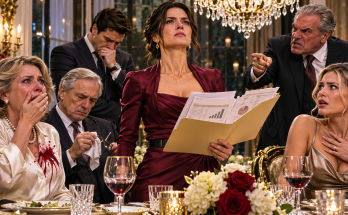
My mother had worn white silk that night.
She had chosen the blouse carefully.
I remembered how the red wine spread across the fabric.
I remembered her looking down.
And I remembered feeling as though I had failed to protect her.
She didn't talk about the dinner every day.
Neither did Dad.
They had their own lives.
They didn't want to spend every conversation discussing Charles and Madison.
But I noticed little changes.
Mom became reluctant to wear white silk to formal dinners.
She didn't make an announcement about it.
She simply chose other things.
I noticed because I remembered the blouse.
Before that night, I might not have thought twice about what she wore.
Afterward, a white blouse could bring the entire evening back to me.
The chandelier.
The tablecloth.
Madison's expression.
My father cleaning his glasses.
Daniel looking away.
I hated that one cruel evening had left my mother thinking differently about something as ordinary as getting dressed for dinner.
Dad changed too.
He stopped attending Harrington family gatherings altogether.
I didn't blame him.
I wouldn't have asked him to return.
For years, he had been willing to sit through uncomfortable evenings because I wanted our families to get along.
He had never demanded that Charles like him.
He had never tried to impress Madison.
He had simply been polite.
And the Harringtons had treated that politeness as weakness.
After the anniversary dinner, Dad was finished with them.
I understood.
I was finished too.
But understanding didn't remove the guilt I felt.
Sometimes I remembered the first time I had introduced Daniel to my parents.
I had been proud of him.
I had believed I was bringing someone wonderful into their lives.
I wanted them to love him.
I wanted Daniel to see how kind they were.
And for a while, I thought everything would work out.
Then the differences between our families became harder to ignore.
Charles expected people to respect him because of his position.
Madison expected people to make allowances for her behavior.
Daniel expected everyone to avoid confrontation.
My parents expected people to treat each other decently.
It wasn't a complicated expectation.
But in the Harrington family, it seemed almost unreasonable.
I had spent years trying to make those two worlds fit together.
I had asked my parents to be patient.
I had explained that Charles was difficult.
I had said Madison didn't always think before she spoke.
I had defended Daniel by telling them he hated conflict.
Looking back, I could hear how many excuses I'd made.
I didn't like remembering those conversations.
My parents had listened because they loved me.
They hadn't wanted to criticize my marriage.
They hadn't wanted me to feel caught between them and Daniel.
So they had tolerated more than they should have.
And I had let them.
That was the part I couldn't stop thinking about.
I knew I wasn't responsible for Madison throwing wine.
I knew I hadn't told Charles to threaten my father.
I knew I hadn't ordered Daniel to remain silent.
But I had kept inviting my parents into situations where they were not treated with respect.
I had done it because I wanted everyone to get along.
I had wanted proof that my marriage could become the family I imagined.
The anniversary dinner had shown me the cost of that hope.
One afternoon, I found Dad in his backyard.
He was sitting with a newspaper.
It was an ordinary scene.
No expensive dining room.
No company documents.
No chandelier.
Just my father sitting outside with the paper in his hands.
I remember feeling relieved to see him like that.
He looked comfortable.
He looked like himself.
He wasn't trying to impress anybody.
He wasn't being careful about what he said.
He wasn't waiting for Charles to decide whether he belonged.
I went over and sat beside him.
He looked up.
"Hi, Claire."
"Hi, Dad."
Then he returned to his newspaper.
I sat quietly.
I wasn't sure how to begin.
There had been so much happening.
The investigation.
The divorce.
Daniel's resignation.
Madison's apology.
The financial records.
The months of trying to understand how the company had been used.
But sitting beside Dad, none of those things felt like the subject I needed to discuss.
I wanted to talk about the dinner.
I wanted to talk about my mother.
I wanted to tell him I was sorry.
Not as an employee.
Not as a wife.
As his daughter.
I looked at the newspaper.
He turned a page.
I took a breath.
"Dad?"
He lowered the paper slightly.
"Yes?"
"I'm sorry."
He looked at me.
"For what?"
I felt my throat tighten.
"For bringing you into that family."
He set the newspaper down.
I looked at my hands.
I hadn't realized how badly I needed to say those words.
I had been carrying them for months.
Every time I remembered Mom's stained blouse.
Every time I remembered the way Dad cleaned his glasses.
Every time I thought about Charles threatening him.
I felt the same shame.
My parents had come to dinner because I asked them to.
They had endured the Harrington family because I wanted my marriage to work.
And that night, they had been humiliated in front of me.
I swallowed.
"I should have stopped it sooner."
Dad didn't answer immediately.
I continued.
"I knew how they treated you."
He watched me.
"I kept thinking it would get better."
My voice felt unsteady.
"I kept asking you to give them another chance."
He folded the newspaper.
Then he looked directly at me.
"Claire, you didn't make me go anywhere."
I shook my head.
"But I wanted you there."
"Of course you did."
I looked away.
He waited.
I could feel tears gathering.
"I should have protected you."
Dad reached over and placed his hand on mine.
"I went because you're my daughter."
I looked at him.
He smiled a little.
"That's all."
I tried to answer.
Nothing came out.
He continued.
"You didn't bring me into something against my will."
I looked down at our hands.
"I came because I wanted to be there for you."
That made me cry.
Not loudly.
Just enough that I had to wipe my face.
I had spent so long thinking about the dinner as something I had done wrong.
I had forgotten that my parents were adults making their own choices.
They had known Charles was difficult.
They had known Madison could be rude.
They had chosen to attend because they loved me.
That didn't make the Harringtons' behavior acceptable.
But it changed how I understood my own responsibility.
Dad waited until I looked at him again.
Then he spoke.
"You need to understand something."
I nodded.
"You can't make other people behave decently."
I stared at him.
He wasn't angry.
He wasn't lecturing me.
He was saying something simple that I had spent years refusing to accept.
I had believed that if I found the right words, Charles would listen.
If I stayed calm enough, Madison would stop being cruel.
If I explained my feelings clearly enough, Daniel would defend me.
If I worked hard enough, the company would become safe.
I had tried to solve people as though they were problems in a spreadsheet.
Find the mistake.
Correct the entry.
Balance the accounts.
But people weren't numbers.
They had choices.
And no amount of effort from me could make those choices for them.
Dad continued.
"You weren't responsible for what they decided to do to us."
I opened my mouth.
He shook his head gently.
"No, listen."
I stopped.
"You spent years trying to make that family treat people better."
I looked down.
He was right.
I had tried to control everything around me because I couldn't bear the alternative.
If I accepted that Charles might never respect me, I would have to reconsider my place in his family.
If I accepted that Madison might never treat my parents kindly, I would have to stop asking them to attend those dinners.
And if I accepted that Daniel might never stand up to his father, I would have to face what that meant for my marriage.
I hadn't wanted those answers.
So I kept trying.
Dad squeezed my hand.
"You can't decide what kind of people they are."
I nodded.
"But you can decide how close they get to you."
I looked at him.
That sentence settled into me slowly.
For years, I had believed I needed the Harrington family to change before I could feel better.
I needed Charles to respect me.
I needed Madison to apologize.
I needed Daniel to become braver.
I needed the family to understand that my parents deserved dignity.
But Dad was telling me something different.
I didn't need to wait for anyone to become kinder.
I could decide who had access to my life.
I could refuse another dinner.
I could leave a marriage.
I could protect my professional reputation.
I could tell the truth.
And I could stop asking people who had shown me contempt to decide whether I was worthy of respect.
I sat quietly beside him.
The newspaper rested in his lap.
I remembered the anniversary dinner.
Charles had threatened him.
He had told Dad that walking out with me would mean losing any support from the Harrington family.
Dad hadn't argued about money.
He hadn't explained that he didn't need anything from Charles.
He had simply said that my marriage didn't make me someone's property.
Then he had walked out.
I thought I understood his courage that night.
Sitting beside him in the backyard, I understood it better.
Dad hadn't been brave because he wasn't afraid of Charles.
He had been brave because Charles's approval didn't determine his choices.
He had known who he was before entering that dining room.
And he had left knowing exactly the same thing.
I wanted that kind of certainty.
I had spent years allowing the Harrington family to make me question myself.
I had wondered whether I was too sensitive.
Too demanding.
Too stubborn.
Too unwilling to compromise.
Whenever I defended my parents, I felt as though I was creating a problem.
Whenever I challenged financial decisions, I felt as though I was betraying the family.
Whenever I asked Daniel to speak up, I felt guilty for putting him in a difficult position.
I had become so concerned about what everyone else thought that I had stopped trusting my own judgment.
Dad hadn't.
He knew what respect looked like.
He knew when it was missing.
And he knew he didn't have to remain somewhere simply because someone powerful expected him to stay.
I looked at him.
"I wish I'd understood that sooner."
He smiled.
"You understand it now."
I wiped my face.
"I keep thinking about Mom."
He nodded.
"I know."
"That blouse."
He looked down at the newspaper.
I didn't need to explain.
He remembered.
I knew he did.
I could still see the wine spreading across the white silk.
I could still see my mother's expression.
She hadn't been angry at me.
She had looked shocked.
And embarrassed.
That had hurt more than if she'd shouted.
I wanted to go back to that moment and stand up sooner.
I wanted to stop Madison before the wine reached her.
I wanted Daniel to say something.
I wanted Charles to act like a decent host.
But none of those things had happened.
Dad looked at me.
"Your mother knows you love her."
I nodded.
He continued.
"That hasn't changed."
I felt my shoulders loosen.
I hadn't realized how badly I needed to hear that.
I had been afraid my parents might secretly blame me.
I had been afraid they would remember the dinner whenever they looked at me.
I had been afraid I had made them feel less important by trying so hard to please the Harrington family.
But Dad wasn't looking at me with disappointment.
He was looking at me the way he always had.
As his daughter.
Not Charles Harrington's daughter-in-law.
Not the woman responsible for a company guarantee.
Not the person who had opened a forensic folder at dinner.
Just Claire.
I sat beside him for a long time.
We didn't need to keep talking.
That was another difference between my parents and the Harringtons.
Silence with Charles had always felt dangerous.
Someone was angry.
Someone was withholding information.
Someone was waiting for another person to give in.
Silence with Daniel had often meant a conversation was being avoided.
But silence with Dad felt peaceful.
I didn't have to fill it.
I didn't have to explain myself.
I didn't have to prove that I deserved to be sitting there.
I could simply be his daughter.
Eventually, he picked up the newspaper again.
I smiled.
He looked over at me.
"What?"
"Nothing."
He raised his eyebrows.
I laughed softly.
For the first time in a long while, the laughter felt easy.
Not because everything was finished.
The investigation had been painful.
The divorce was still part of my life.
And I knew I would carry memories of the Harrington family for a long time.
But something inside me had changed.
I no longer believed that their behavior was mine to repair.
I no longer believed I needed their approval to make the right decision.
And I no longer believed that protecting my parents meant controlling every person who might hurt them.
Sometimes protection meant recognizing when a situation was wrong.
Then refusing to return to it.
Dad turned another page.
I looked out across the backyard.
There was no chandelier.
No expensive tablecloth.
No company name hanging over our conversation.
There was only my father beside me.
And the simple feeling of being somewhere I belonged.
I thought about Madison's apology.
She had finally admitted that my parents deserved better.
I was glad she understood that.
But I didn't need her apology to make it true.
My parents had deserved respect before she gave it.
They deserved respect when she was cruel.
They deserved respect when Charles threatened them.
And they deserved respect now.
The Harrington family hadn't given them their dignity.
So the Harrington family couldn't take it away.
I looked at Dad's hand resting on the newspaper.
I remembered him putting his glasses back on at dinner.
That image had haunted me for months.
For the first time, I could remember it differently.
Not as proof that I had failed him.
But as the moment before he stood up and walked away from people who did not deserve another minute of his time.
I reached over and touched his hand.
He glanced at me.
I smiled.
"Thanks, Dad."
He smiled back.
"For what?"
I shook my head.
"For being here."
He returned to his newspaper.
I stayed beside him.
I didn't need to say anything else.
For years, I had been afraid that leaving the Harrington family would mean losing the life I had built.
Sitting in my father's backyard, I began to understand that I hadn't lost the people who mattered.
They had been with me all along.
And for the first time, I was ready to build a life that didn't depend on anyone else's permission.