I had always believed that a mother should never have to pay for a place at her daughter's Christmas table.
Then my daughter sent me a bill.
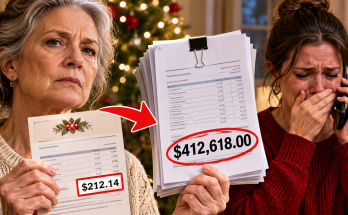
Two hundred and twelve dollars and fourteen cents.
I remember staring at that number longer than I wanted to admit.
It was not a fortune.
It would not ruin me.
I had spent far more than that on Lauren without thinking twice.
But seeing those numbers attached to Christmas dinner made something inside me go quiet.
My name is not important.
What matters is that I was Lauren's mother.
I had been her mother through thirty-nine years of scraped knees, broken plans, sleepless nights, and decisions neither of us could take back.
I had done it gladly.
Or at least I had tried to.
And until that Christmas, I had never thought of keeping a running total.
Lauren had invited me to her house for the holiday.
She and her husband, Mark, had a lovely home.
It was new enough that everything still seemed to have a proper place.
The furniture was carefully chosen.
The dining table looked as though it belonged in a furniture showroom.
Even the table linens were new.
I had noticed them when I arrived.
Lauren had seemed pleased with everything.
She wanted the day to feel special.
I understood that.
I remembered wanting the same thing when she was young.
Christmas had always been one of those days when I could make the world seem a little softer for her.
Sometimes that meant getting up early.
Sometimes it meant staying awake until midnight.
Sometimes it meant spending money I would rather have saved.
She never knew the difference.
That was the point.
When she was little, she believed Christmas simply happened.
The food appeared.
The house became warm.
The presents waited.
And somehow, everything worked out.
I had allowed her to believe that for as long as I could.
Looking back, perhaps I had allowed her to believe it for too long.
That year, I had brought food to her house.
A ham.
Pies.
And the shortbread I had been making since Lauren was small.
She knew that shortbread.
She knew how it looked when I packed it carefully.
She knew the smell before I opened the container.
I had made it because it was Christmas.
Not because anyone required me to.
Not because I expected a favor in return.
I had simply wanted to contribute something familiar to the table.
Mark's parents were there as well.
His mother had brought wine.
His father had come without bringing anything.
I did not care.
It never occurred to me to measure anybody's worth by the number of bags they carried through the front door.
A family dinner was not a competition.
At least that was what I believed.
The meal itself had been pleasant enough.
There had been food on the table.
There had been conversation.
Lauren had been busy making sure everything went according to plan.
I had watched her fuss over the little details.
The linens.
The dishes.
The way everything was arranged.
I recognized that kind of nervous attention.
I had once been exactly the same.
I wanted her to enjoy her first Christmas in that house without worrying over every small thing.
So I helped where I could.
After dinner, I helped with the cleaning.
There was nothing remarkable about it.
I had been helping clean up after family meals for most of my life.
Nobody had to ask me.
I knew where the dirty dishes belonged.
I knew what a kitchen looked like after a holiday meal.
And I knew how much easier things became when everyone did a little.
Before I left, I felt tired.
But it was an ordinary, satisfied kind of tiredness.
I had spent Christmas with my daughter.
I had seen her in a home she seemed proud of.
I had been part of her day.
That should have been enough.
A little later, I received the invoice.
It came electronically.
I opened it expecting something ordinary.
Instead, there was a breakdown of what I supposedly owed for attending Christmas dinner.
I looked at it once.
Then again.
I remember thinking I must have misunderstood.
Lauren could not possibly be billing me for a holiday meal.
Not after everything I had brought.
Not after helping her clean.
Not without saying anything beforehand.
Yet there it was.
The food.
The household items used for the occasion.
Even a portion of the cleaning expense.
The total came to $212.14.
I sat in my kitchen with the message open in front of me.
I could hear the ordinary sounds of my own house.
Nothing had changed.
The chair was the same.
The table was the same.
My coffee was sitting where I had left it.
But the feeling I had carried home from Christmas was gone.
I tried to think of a reasonable explanation.
Perhaps Lauren had misunderstood something.
Perhaps Mark had suggested splitting the costs.
Perhaps they were worried about money.
I would have understood that.
If my daughter needed help paying for Christmas dinner, she could have called me.
She could have said she had spent more than expected.
She could have asked whether I would contribute.
I would have helped.
I had helped before.
That was what made the invoice so difficult to understand.
She was not asking for help.
She was presenting a charge.
There was a difference.
An uncomfortable one.
I kept looking at the amount.
Two hundred and twelve dollars.
Fourteen cents.
The fourteen cents bothered me almost as much as the rest.
It made the whole thing feel precise.
Calculated.
As though someone had decided that my presence at the family table had an exact financial value.
I wondered whether everyone had received the same treatment.
Had Mark's parents been billed?
Had Mark calculated his own share?
Had Lauren included herself?
I did not know.
I would find out later.
At that moment, all I knew was that my daughter had sent me a bill after Christmas.
I thought about calling immediately.
I even reached for my phone.
Then I stopped.
I was hurt.
And I had learned over the years that hurt could make a person say things they could not easily take back.
I did not want to shout at Lauren.
I did not want to accuse her of being ungrateful.
I did not want an argument that ended with both of us hanging up angry.
So I sat there.
And I thought.
I remembered Lauren as a little girl.
She used to make birthday cards for me from colored paper.
Her hearts were never quite even.
The glitter usually ended up everywhere.
And she always wrote the sweetest things in the space she had left.
She used to tell me that she loved me farther than anyone could count.
I still had those cards.
I had saved them for years.
I knew exactly where they were.
They were in boxes with other things I had kept from her childhood.
School papers.
Small reminders.
Old receipts.
Things that had seemed too important to throw away.
I had never imagined that those boxes might one day become part of an argument about money.
I thought about the hospital visit when Lauren was three.
She had swallowed a button.
I could still remember how frightened I had been.
The doctor had told me she was fortunate.
Lauren had been far more interested in the sticker she received afterward.
She had gone home without understanding how terrified I had been.
That had been motherhood.
One person frightened beyond words.
The other delighted with a sticker.
I had kept the hospital receipt.
Not because I expected reimbursement someday.
I kept it because I remembered the doctor's warning.
I remembered how close an ordinary childhood accident had come to becoming something worse.
I remembered being grateful that I could take my daughter home.
There were so many memories like that.
Small ones.
Expensive ones.
Painful ones.
Some had required money.
Others had required time.
Many had required both.
And I had never thought of them as transactions.
I looked back at the invoice.
I wondered whether Lauren had any idea how strange it felt to receive a bill from the child whose entire life I had helped build.
I thought about the science fair.
She had been determined to make a volcano.
She had wanted it to work perfectly.
Of course, it hadn't.
Her first eruption had happened too quickly.
And some of the mess had reached the principal's shoes.
Lauren had been humiliated.
She had believed everybody would laugh.
So I had stayed awake and helped rebuild the project.
It had been close to midnight.
Her father had already gone to bed.
Lauren was tired.
I was tired.
But neither of us wanted her to walk into school believing she had failed.
She eventually received second place.
She was proud of that ribbon.
I was proud of her.
And I had made a little joke about the principal's expensive shoes being the reason she had not won first.
She had laughed.
For years afterward, that was what she remembered.
Not the cost.
Not the time.
Just the volcano.
The ribbon.
The joke.
That was what I had wanted her to remember.
I wondered when those simple memories had stopped being enough.
I did not believe Lauren had become cruel overnight.
That would have been easier to understand.
She had always been capable of warmth.
She had always known how to make me feel loved.
But something had changed.
I could feel it in the formality of that invoice.
There was no conversation attached to the decision.
No question about whether I agreed.
Just an amount.
A breakdown.
An expectation.
I read the document once more.
Then I made a decision.
I paid it.
Every cent.
I did not argue about the food I had brought.
I did not dispute the charge for the cleaning.
I did not subtract the value of my shortbread.
I simply paid the $212.14.
Once the payment was completed, I sat still.
I had expected to feel relieved.
Instead, I felt embarrassed.
Not because I lacked the money.
Because I had just paid my own daughter for Christmas dinner.
There was something terribly sad about that.
I thought about the card she had given me.
It was sitting on my kitchen counter.
The front showed Lauren and Mark outside their new home.
They looked happy.
Inside, she had thanked me for always being there.
I had liked that card when I first read it.
I had placed it beside a photograph of Lauren as a little girl.
Now I looked from the card to the invoice.
The words in one seemed to contradict the numbers in the other.
I knew I could not ignore that feeling.
If I did, it would stay with me.
Every future invitation would become uncomfortable.
Every holiday meal would carry the memory of that bill.
I would wonder whether I was a guest or an expense.
And I did not want to spend the remaining years of my life wondering whether my daughter could afford to love me.
I needed her to understand why this hurt.
But I also knew that simply telling her might not be enough.
Lauren was grown.
She had responsibilities.
She had a husband.
She had learned to organize her life around work, money, and practical decisions.
Perhaps numbers had become easier for her to understand than feelings.
If that was true, then maybe I needed to speak in a language she could recognize.
I turned away from the invoice.
Then I thought about the boxes.
The old ones.
The ones I had kept through the years.
Some held photographs.
Some held birthday cards.
And some held records of money spent when Lauren needed me most.
For the first time, I began wondering what those numbers would look like if I put them together.
I had never counted them.
Not properly.
I had never had a reason.
Until now.
I looked at the payment confirmation once more.
Then I closed it.
I did not feel angry enough to punish my daughter.
I felt hurt enough to want her to understand.
Those were not the same thing.
And I had to be very careful not to confuse them.
Because I was about to do something I had never imagined doing as a mother.
I was going to prepare an invoice of my own.