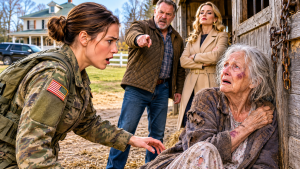
PART 1: THE VOICE BEHIND THE HOUSE
After fifteen years of serving my country, I came home expecting an awkward family reunion.
Instead, I found my seventy-six-year-old mother locked inside a horse stable.
I had been standing beside my rental car for less than thirty seconds when I heard her voice.
“Emily?”
It was so faint that at first I thought the November wind had carried the sound from somewhere else.
Then I heard it again.
“Emily… please. Is that really you?”
My suitcase slipped from my hand.
I knew that voice.
“Mom?”
I ran.
The Carter ranch sat outside Lexington, Kentucky, on land my grandfather had bought when horses still pulled plows through half the county. The farmhouse stood on a low rise surrounded by bare oak trees, white fencing, and fields browned by the first hard frost.
From the driveway, everything looked almost painfully perfect.
The farmhouse had been repainted.
The porch had been rebuilt.
A black SUV and a silver luxury pickup were parked beneath the trees.
New stonework bordered the front garden.
Someone had spent money here.
A lot of it.
But my mother’s voice wasn’t coming from the house.
It was coming from behind it.
I rounded the corner and saw the old stable.
The building hadn’t been used regularly since Dad died six years earlier. He had kept two horses there when I was a girl, and even after arthritis forced him to stop riding, he had refused to tear it down.
I remembered brushing a chestnut mare named Daisy in the second stall.
I remembered Mom bringing lemonade to Dad on summer afternoons.
I remembered Richard chasing me through the hayloft until Dad yelled at both of us to quit before we broke our necks.
Those memories disappeared the moment I saw the padlock.
There was a chain wrapped around the stable door.
“Mom!”
“Emily!”
I grabbed the chain and pulled.
The door opened only a few inches.
Through the gap, I saw a hand.
Thin.
Trembling.
Bruised.
My stomach turned.
“Move back,” I said.
I searched the wall until I found an old iron pry bar. The lock was newer than the building, but whoever installed it had attached the hasp to rotten wood.
I wedged the bar behind the metal plate and pulled.
Years of military training had taught me how to remain calm when panic would accomplish nothing.
But this wasn’t a mission.
This was my mother.
I pulled again.
The screws tore free.
The door swung open.
The smell hit me first.
Urine.
Mildew.
Old hay.
Cold earth.
And underneath it all, the unmistakable sour odor of someone who hadn’t been allowed to bathe properly.
“Mom?”
She was curled against the wall on three filthy blankets.
For one terrible second, I didn’t recognize her.
My mother had always been small, but now she looked skeletal. Her silver hair was tangled around her face. She wore a torn winter coat over a nightgown, and one slipper was missing.
Purple bruises circled both wrists.
There was another bruise along her cheek.
Beside her sat an empty plastic bowl.
No food.
No water.
I dropped to my knees.
“Mom. My God.”
Her eyes filled with tears.
“You came.”
I reached for her, then stopped myself because I didn’t know where she was hurt.
“What happened to you?”
She touched my face with freezing fingers.
“They told me you weren’t coming.”
“Who told you?”
She looked toward the doorway.
That was when I heard slow applause behind me.
“Well, well.”
I turned.
My older brother Richard stood twenty feet away.
His wife, Vanessa, was beside him.
Richard had gained weight since the last photograph I’d seen. He wore expensive boots, a quilted hunting jacket, and a watch I knew cost more than my first car.
Vanessa looked equally polished.
Perfect hair.
Designer coat.
Gold earrings.
Neither of them looked shocked to find me kneeling beside our mother in a filthy stable.
Richard smiled.
“Look who finally decided to come home.”
I stood.
“Why is Mom locked in here?”
He shrugged.
“Because that’s where she stays.”
For several seconds, I honestly couldn’t process the answer.
“What?”
“You heard me.”
I looked at Vanessa.
She smirked.
That expression told me more than any explanation could have.
I turned back to Richard.
“Our mother is seventy-six years old.”
“And?”
“And she’s bruised, dehydrated, and locked inside a stable.”
Richard gave an exaggerated sigh.
“You’ve been gone fifteen years, Emily. Don’t come marching back here pretending you know what we’ve dealt with.”
“I’ve been stationed away from home. I haven’t been dead.”
“You might as well have been.”
Behind me, Mom whispered, “Emily…”
Richard pointed toward her.
“She got impossible after Dad died. Complaining. Accusing people. Wandering around the house at night. Calling the bank. Calling lawyers. Making scenes.”
“So you locked her in a stable?”
“She needed somewhere safe.”
I stared at him.
There was a bed in the farmhouse.
There were bathrooms.
Heat.
Running water.
Food.
And he had put our mother in a stall.
“Safe?”
Richard’s mouth hardened.
“She is seventy-six. She’s useless, demanding, and nothing but trouble. This is where she belongs.”
Something inside me went very still.
I had been angry before.
I had been furious.
I had been afraid enough to taste metal in my mouth.
But there is a kind of rage so deep that it doesn’t make you shout.
It makes everything clearer.
Vanessa folded her arms.
“What are you going to do, soldier? Order us around?”
I removed my sunglasses.
“My name is Colonel Emily Carter.”
Richard’s smile faltered for half a second.
I continued.
“And you two have made a terrible mistake.”
Then he laughed.
It was forced this time.
“This is my property. You don’t scare me.”
I looked past him at the freshly painted farmhouse.
At the SUVs.
At the renovated porch.
Then I looked back at the woman shivering behind me.
I took out my phone.
Richard’s face changed.
“Who are you calling?”
I dialed.
When the call connected, I said, “I need Detective Sarah Mitchell.”
Richard stepped toward me.
“For what?”
I ignored him.
“Tell her Colonel Carter needs immediate assistance at the Carter ranch. Possible felony abuse of a vulnerable adult. I also need EMS.”
Vanessa’s smirk vanished.
Richard stared at me.
“You can’t just come here and call the police.”
“I just did.”
I began taking photographs.
The broken lock.
The chain.
The blankets.
The empty bowl.
The bruises on Mom’s wrists.
Richard reached for my phone.
I stepped back.
“Don’t.”
“Give me that.”
“No.”
“This is private property.”
“Then I’m sure you’ll enjoy explaining why there’s a padlock on the outside of the building where your mother is being kept.”
His face reddened.
“She agreed to stay there.”
Behind me, Mom whispered, “No.”
Richard froze.
I turned.
Mom had pushed herself upright against the wall.
“No,” she said again.
Richard’s eyes narrowed.
“Mom, you don’t know what you’re saying.”
She flinched.
I saw it.
Not confusion.
Fear.
That single movement told me everything I needed to know about the balance of power in this house.
I stepped between them.
“Don’t speak to her.”
“You don’t tell me what to do.”
“I just did.”
I went back to Mom.
“We’re getting you out of here.”
Richard moved into the doorway.
“She isn’t going anywhere.”
I stood slowly.
“What did you say?”
“She lives here. I take care of her. You can’t just remove her.”
I walked toward him until only a few feet separated us.
Richard was taller than me.
He had always enjoyed that fact when we were children.
But I had spent fifteen years learning that physical size and authority were two very different things.
“Move,” I said.
He didn’t.
“Now.”
Something in my voice reached him.
He stepped aside.
I took off my coat and wrapped it around Mom. When I helped her stand, her knees buckled.
I caught her.
She weighed almost nothing.
That frightened me more than the bruises.
“How long since you ate?”
She looked ashamed.
“I had some bread yesterday.”
“Yesterday morning or evening?”
“I don’t know.”
I closed my eyes for one second.
Then I lifted her.
She protested weakly.
“I can walk.”
“I know.”
But I carried her anyway.
As we crossed the yard, she pressed her face against my shoulder.
“They said you abandoned me.”
My throat tightened.
“What?”
“They said you didn’t want to talk to me anymore. Richard said you were too important now.”
I stopped.
For years, I had called home.
At first Mom answered.
Then, gradually, Richard started answering instead.
Mom was sleeping.
Mom was at an appointment.
Mom didn’t feel well.
Mom had misplaced her phone.
Mom was becoming forgetful.
Eventually, calls stopped going through altogether.
Richard told me she didn’t like talking on the phone anymore.
I had believed him.
Not because I trusted Richard.
Because I trusted that there were limits to what my brother was capable of.
That was my mistake.
I kissed Mom’s forehead.
“They lied.”
Her fingers tightened around my uniform sweater.
“I never stopped wanting you.”
“I know.”
“No, sweetheart. You need to know. I never stopped.”
My eyes burned.
“I’m here now.”
She looked over my shoulder.
Richard and Vanessa were watching us.
Then Mom pulled me closer.
“Emily.”
“What?”
“There is something else.”
Her voice dropped to a whisper.
“Richard and Vanessa have been signing your father’s name.”
I stopped breathing.
“What did you say?”
“On papers.”
“Dad’s name?”
She nodded.
Our father had been dead for six years.
I looked toward the farmhouse.
The renovations.
The vehicles.
The money.
Then back at Richard.
He was no longer angry.
He was afraid.
And that changed everything.
“What papers?” I whispered.
Mom’s eyes moved toward the house.
“They made me sign some too.”
My pulse began hammering.
“What kind?”
“I don’t know all of them.”
“Did you read them?”
“They wouldn’t let me.”
“Mom, listen to me. Did they threaten you?”
Her eyes filled.
“They said if I didn’t sign, they’d make sure nobody ever found me.”
I felt her trembling.
Then she whispered the words that turned a case of cruelty into something much darker.
“Emily, those papers aren’t just about the ranch.”
“What are they about?”
She glanced at Richard.
Then she looked back at me.
“Your father knew something was wrong before he died.”
Behind us, a siren sounded in the distance.
Richard heard it too.
His face went white.
And my mother whispered, “He left proof.”
PART 2: MY FATHER’S SIGNATURE
The ambulance arrived before Detective Sarah Mitchell.
Two paramedics examined Mom on the front porch while I stood close enough for her to reach me.
She refused to go inside the farmhouse.
That mattered.
One of the paramedics, a woman named Claire, gently asked her why.
Mom stared at the front door.
“I don’t want to be in there with them.”
Richard heard.
“This is ridiculous.”
I turned.
“Stay back.”
He pointed at me.
“You’re turning her against us.”
Vanessa stood beside him, whispering rapidly into her phone.
I noticed Richard’s attention shift toward the house.
Not toward Mom.
Not toward the ambulance.
Toward the house.
He wanted something inside.
I moved between him and the steps.
“Where are you going?”
“My house.”
“Wait for the police.”
“You don’t have authority over me.”
“No. But the officers arriving in about two minutes will.”
His jaw tightened.
“You think your rank means something here?”
“Not legally.”
That answer surprised him.
I continued.
“My rank doesn’t make me a police officer. It doesn’t give me jurisdiction over you. What it does mean is that I spent fifteen years learning how to document a situation before someone has time to rewrite it.”
I held up my phone.
His eyes went to the photographs.
“And I’ve documented this one.”
A county cruiser came up the driveway.
Then another.
Detective Sarah Mitchell arrived behind them.
Sarah and I had grown up three roads apart. We hadn’t been close friends, but we knew each other well enough that when I called from overseas about concerns regarding Mom two years earlier, Sarah had offered to check on her.
Richard had told her Mom was visiting relatives.
I hadn’t known that until Sarah mentioned it while walking toward me.
“I remember this place,” she said quietly.
“So do I.”
She looked at Mom.
Her expression changed.
“What happened?”
“I found her locked in the stable.”
Sarah glanced at the broken hasp.
“Locked from outside?”
“Yes.”
Richard interrupted.
“She wasn’t locked in. That was for the horses.”
Sarah looked toward the empty stable.
“What horses?”
Richard said nothing.
Sarah took statements separately.
Mom went to the hospital.
I went with her.
Before the ambulance doors closed, Sarah leaned toward me.
“Don’t confront them about anything else tonight.”
“I already know about forged documents.”
Her eyes sharpened.
“What documents?”
“Mom says they’re using Dad’s signature.”
“Your father died in 2020.”
“I know.”
Sarah looked toward Richard.
He was standing with Vanessa beside the farmhouse, both of them watching us.
“I’ll secure what I can,” she said. “But if you’re talking about financial documents, property transfers, bank records, trusts, we need to do this properly.”
“Do it properly.”
“I intend to.”
At the hospital, doctors found dehydration, malnutrition, untreated arthritis, bruising consistent with forceful gripping, and a healing fracture in Mom’s left wrist.
That fracture nearly broke me.
“When did this happen?” I asked.
Mom looked down.
“August.”
“August?”
She nodded.
“Richard grabbed me when I tried to leave.”
“Did you see a doctor?”
“No.”
“Why?”
“He said doctors ask questions.”
I had to turn away.
For fifteen years, I’d spent holidays in barracks, bases, temporary quarters, airports, and foreign cities.
I had missed birthdays.
Thanksgivings.
Dad’s last Christmas.
I had been home for his funeral, but only briefly before duty pulled me away again.
I had always told myself there would be time.
Time to come home.
Time to sit with Mom on the porch.
Time to repair the strange distance that had grown between us.
Now I understood that some of that distance had been manufactured.
Richard had become the gatekeeper.
He had controlled the calls.
The mail.
The explanations.
The narrative.
And I had accepted too much of it.
Mom reached for me.
“Don’t blame yourself.”
“I should have known.”
“How?”
“I should have come.”
“You were serving.”
“You were my mother.”
“And I was proud of you every day.”
That almost undid me.
I sat beside her and took her hand.
“Tell me about Dad’s papers.”
She looked toward the hospital door.
“Are they here?”
“No.”
“You’re sure?”
“Yes.”
She took a breath.
“A few months before your father died, he started checking the ranch accounts.”
Dad had never been wealthy in the way people imagined horse-country families were wealthy. The ranch was valuable, but land value and cash were different things.
He had worked.
Saved.
Invested carefully.
He hated debt.
“He said money was disappearing,” Mom continued.
“From where?”
“The ranch account at first.”
“Did he think Richard was taking it?”
“He didn’t say.”
That sounded like Dad.
He had been slow to accuse and almost impossible to fool twice.
“What happened?”
“He started keeping copies.”
“Where?”
“I don’t know. He wouldn’t tell me. He said if he was wrong, he didn’t want to destroy the family.”
“And if he wasn’t wrong?”
Mom looked at me.
“He said truth survives better when there are two copies.”
I remembered the phrase.
Dad used to say it whenever he made duplicate records.
Tax receipts.
Property maps.
Horse registrations.
Insurance documents.
Truth survives better when there are two copies.
“After he died,” Mom continued, “Richard took over everything. He said he was helping.”
“Banking?”
“Yes.”
“Taxes?”
“Yes.”
“Ranch records?”
She nodded.
“At first I was grateful. Then papers started coming for me to sign.”
“What papers?”
“Things about property. Loans. Accounts.”
“Did you sign?”
“Some.”
“Did you understand them?”
“No.”
“Did Richard explain?”
“He said I didn’t need to understand.”
My hand tightened around hers.
“And Dad’s signature?”
“I saw it on a paper last spring.”
“What paper?”
“I don’t know. Richard left it on the dining table.”
“Could it have been an old document?”
She shook her head.
“It had this year’s date.”
That was the contradiction.
A dead man’s signature on a new document.
“What happened when you asked Richard?”
Mom swallowed.
“He told me I was confused.”
“And Vanessa?”
“She said grief makes old women imagine things.”
I looked away before my expression frightened Mom.
“What happened after that?”
“I started looking.”
That was my mother.
Seventy-six years old, isolated and increasingly controlled, and still stubborn enough to investigate.
“What did you find?”
“Copies of checks. Forms. Your father’s name. My name. Sometimes signatures I knew I hadn’t made.”
“Where?”
“In Richard’s office.”
“You went through his office?”
“I still owned the house.”
The past tense caught me.
“Owned?”
She stared at me.
“I don’t know anymore.”
A cold feeling moved through my stomach.
“Why not?”
“Because one day Richard told me the ranch belonged to him.”
“Did Dad leave it to him?”
“No.”
“What did the will say?”
“Your father left the ranch to me for my lifetime. After that, you and Richard were supposed to share it.”
I knew that.
Dad had told me himself.
“Then Richard can’t just declare it his.”
“He showed me a deed.”
“What deed?”
“One saying I transferred everything.”
“Did you?”
“No.”
“Did you sign one?”
She hesitated.
“I signed papers he put in front of me.”
My heart sank.
“But I never agreed to give him the ranch.”
That distinction would matter.
“What happened when you challenged him?”
“He got angry.”
“And that’s when the stable started?”
“Not immediately.”
She looked ashamed again.
I squeezed her hand.
“You don’t have anything to be ashamed of.”
“He took my phone first.”
“When?”
“Last year.”
Richard had told me she lost it.
“He said I kept calling people and embarrassing him. Then he started opening my mail.”
I felt sick.
“Then Vanessa took my car keys. They said I shouldn’t drive.”
“Were you having accidents?”
“No.”
“Getting lost?”
“No.”
“They isolated you.”
Mom nodded.
“Then I found another paper with your father’s signature.”
“What was different about it?”
“It had a bank name.”
“Which bank?”
“I can’t remember.”
“That’s okay.”
“And there was a number.”
“What number?”
She closed her eyes.
I waited.
“Two hundred eighty-six thousand.”
I stared at her.
“Dollars?”
“I think so.”
That explained some of the visible spending.
Maybe.
But not everything.
“What happened when Richard caught you?”
“He said I’d become dangerous.”
“To whom?”
Mom looked at me.
“To him.”
The hospital door opened.
Sarah stepped inside.
Her face told me she had found something.
“What?”
She closed the door behind her.
“We got consent to secure the office while we work on warrants and records.”
“And?”
“We found a shredder.”
“That isn’t a crime.”
“No.”
She held my gaze.
“But it was still warm.”
Richard had tried to destroy something after the ambulance arrived.
Sarah continued.
“We recovered pieces from the bin.”
“Can you reconstruct them?”
“Maybe.”
“Anything readable?”
“One fragment.”
She took a photograph from her phone and enlarged it.
I saw half a printed line.
A date.
A parcel number.
And beneath it, the bottom half of a signature.
Thomas Carter.
My dead father’s name.
Mom stared at it.
“That’s the one.”
Sarah looked at her.
“You’re certain?”
“Yes.”
Then Mom pointed to the fragment.
“No. Wait.”
“What?”
Her finger trembled over a tiny line of print near the bottom.
“That name.”
I leaned closer.
There was another name.
Barely visible.
M. Holloway.
“Who is Holloway?” Sarah asked.
Mom’s face drained of color.
“Our old attorney.”
“Old?”
“He died three years ago.”
The room went silent.
Two dead men.
Both named on a document created after their deaths.
Sarah lowered the phone.
“This is bigger than a forged signature.”
I looked at Mom.
“What was Richard trying to do?”
She whispered, “Take everything before anyone realized what he’d already taken.”
Then she began to cry.
PART 3: WHAT MY MOTHER HID
Mom stayed in the hospital for three nights.
I stayed with her.
Richard called me twenty-three times.
I answered once.
“What?”
“You need to stop this.”
“Stop what?”
“This circus.”
“My mother has a fractured wrist.”
“She fell.”
“She says you grabbed her.”
“She doesn’t know what she’s saying.”
“That defense is getting old.”
“You’ve been gone fifteen years.”
“And you keep saying that like it excuses what I found.”
“You don’t understand what she became.”
I looked through the glass toward Mom’s bed.
She was eating soup and talking coherently with a nurse.
“What did she become, Richard?”
“Paranoid.”
“About forged documents?”
Silence.
I knew immediately I had hit something.
“Sarah told you that?”
“No.”
“You stay out of my office.”
“You mean Dad’s office?”
“My office.”
“Interesting priority.”
His voice dropped.
“You think you’re some kind of hero because you wear a uniform?”
“No.”
“You always did.”
That was Richard’s oldest wound.
I had left.
He had stayed.
Dad had been proud when I joined the Army.
Richard had heard that pride as rejection.
For years, he treated my career as evidence that I believed myself superior.
I never had.
But resentment doesn’t require truth.
Only repetition.
“I don’t care what you think of me,” I said. “I care what you did to Mom.”
“I took care of her while you played soldier.”
“You locked her in a stable.”
“She was trying to ruin us.”
There it was.
Not confusion.
Not safety.
Not caregiving.
She was trying to ruin us.
“How?”
Richard realized his mistake.
“She was making accusations.”
“About the money?”
He hung up.
I stared at the phone.
Mom had been watching me.
“He hates you,” she said.
“I know.”
“No. He envies you.”
I sat beside her.
“Why?”
“Because your father respected you.”
“He respected Richard too.”
“He loved Richard.”
“That isn’t the same thing?”
“Not to Richard.”
I thought about that.
Dad had loved us both.
But he trusted people according to what they had earned.
When I was seventeen, Dad gave me responsibility for the ranch payroll one summer.
When Richard was twenty-two, Dad stopped allowing him to use the ranch credit card after unexplained charges appeared.
Small history.
Small resentments.
Pressure accumulating quietly over years.
“Mom, why didn’t you tell me?”
“I tried.”
“When?”
“Many times.”
“I never got anything.”
“I wrote letters.”
I closed my eyes.
Richard had controlled the mail.
“I called the base number you gave me years ago. It didn’t work anymore. I asked Richard for your new number. He said you didn’t want me to have it.”
My chest hurt.
“He told me you were angry because I had given him power of attorney.”
“Were you supposed to?”
“For a limited purpose.”
“What purpose?”
“To handle the ranch while I recovered from hip surgery.”
“When?”
“Three years ago.”
That made sense.
A legitimate power of attorney could have become the doorway to everything else.
“When did you revoke it?”
“I tried last year.”
“And?”
“Richard told me it was too late.”
“It doesn’t work like that.”
“I know that now.”
She looked toward the window.
“Your father always handled complicated papers. After he died, I didn’t realize how much I depended on him.”
That was the kind of vulnerability predators exploited.
Not stupidity.
Trust.
Grief.
Habit.
Isolation.
The next morning Sarah returned with a financial-crimes investigator named Daniel Brooks.
He was methodical and quiet.
He asked Mom about dates.
Accounts.
Signatures.
Loans.
Property.
Then he asked the question that changed the investigation.
“Mrs. Carter, did your husband ever use a trust?”
Mom frowned.
“Yes.”
“What kind?”
“I don’t know.”
“Do you remember the name?”
She thought.
“The Carter Family Land Trust.”
Daniel looked at Sarah.
“Who was trustee after your husband’s death?”
“I was.”
“And successor trustee?”
“Emily.”
I stared at Mom.
“Me?”
She nodded.
“Your father wanted one child who wasn’t financially dependent on the ranch.”
Richard.
Dad hadn’t named him.
That gave Richard a motive.
Daniel leaned forward.
“Mrs. Carter, did you ever resign as trustee?”
“No.”
“Did you ever appoint Richard?”
“No.”
“Did you ever authorize him to mortgage trust property?”
“No.”
The room went still.
Daniel closed his notebook.
“If the documents say otherwise, we have a serious problem.”
The serious problem became visible over the next two weeks.
Richard had not simply stolen cash.
He had constructed an alternate paper reality.
Using the limited power of attorney Mom granted after her hip surgery, he gained access to records.
Then came documents bearing signatures.
Some were real.
Some were copied.
Some were forged.
Some had been obtained from Mom when she didn’t understand what she was signing.
A deed appeared to transfer a valuable section of the ranch.
Loan documents appeared to authorize borrowing against property.
Dad’s signature appeared as guarantor on paperwork dated years after his death.
Attorney Holloway’s name appeared on certifications he could not possibly have made.
Every false document supported another.
It was a structure.
A house built from paper lies.
And Richard had been living inside it.
The SUVs were only the visible part.
Renovations.
Credit lines.
Business investments.
Debt.
Vanessa had opened a small equestrian-events company using ranch assets as collateral.
Richard had borrowed heavily.
Then borrowed again.
They weren’t rich.
They were drowning.
And Mom had become dangerous because she had started pulling at the thread.
But there was still a problem.
Richard’s lawyer argued that Mom had willingly given him authority.
He claimed she was mentally declining.
He claimed she had agreed to live in a converted stable area temporarily after becoming “combative.”
He even claimed the bruises came from falls.
The stable destroyed much of that story.
But the financial case needed more.
We needed Dad’s proof.
One afternoon, Mom and I returned to the ranch under police supervision to collect her belongings.
The farmhouse felt different.
Not because anything had changed.
Because I could finally see it.
Dad’s old desk had been moved.
His file cabinets were gone.
Mom’s photographs had disappeared from several rooms.
Vanessa had redecorated the living room.
It looked less like my parents’ home and more like a magazine spread.
Mom stood in the hallway.
“They erased us.”
I put my arm around her.
“No.”
She looked at me.
“They tried.”
We went upstairs.
Her bedroom had been emptied except for old clothes.
“What happened to your jewelry?”
“Vanessa said she put it somewhere safe.”
“Of course she did.”
We documented everything.
Then Mom stopped beside Dad’s old bedroom closet.
“What?”
She stared at the floor.
“Your father replaced this.”
“The floor?”
“The boards.”
“When?”
“Before he died.”
I crouched.
The hardwood inside the closet was newer than the surrounding floor.
“Why?”
“I thought there was water damage.”
I pressed along the edges.
Nothing.
Then I remembered Dad’s saying.
Truth survives better when there are two copies.
Dad wasn’t dramatic.
He wasn’t the kind of man who buried cash in coffee cans.
But he believed in redundancy.
I examined the baseboard.
One piece had two tiny screw heads instead of nails.
I removed them.
Behind the board was a narrow cavity.
Empty.
Mom gasped.
“No.”
Someone had already found it.
There were scratches in the dust.
Recent scratches.
I sat back.
Richard.
He had found Dad’s hiding place.
Maybe that was why the shredder had been running.
Mom began shaking.
“He got it.”
“Maybe.”
“No, Emily. Your father said there were two copies.”
I looked at her.
“What exactly did he say?”
She frowned.
“He said, ‘Truth survives better when there are two copies. One stays home. One goes where fire can’t reach it.’”
“Where fire can’t reach it?”
“Yes.”
A bank.
A safe-deposit box.
“Did Dad have a safe-deposit box?”
“I don’t know.”
Daniel found one the next day.
It was at a bank in downtown Lexington.
The box had been opened jointly by Dad and Mom eleven years earlier.
No one had accessed it since Dad’s death.
Mom’s key was missing.
The bank required documentation before allowing access.
Richard’s attorney immediately objected.
That told me we were looking in exactly the right place.
It took days.
Those days were torture.
Richard was released pending further proceedings.
Vanessa posted photographs online suggesting their family was being persecuted by an “estranged military relative.”
I ignored them.
Then one evening, Mom woke from a nightmare.
I found her sitting on the edge of the guest bed in the apartment I’d rented.
“He was at the door,” she whispered.
“Richard?”
She nodded.
“He said nobody would believe me.”
I sat beside her.
“I believe you.”
“He said he’d tell everyone I was senile.”
“You’ve been evaluated.”
“He said he’d put me somewhere worse than the stable.”
I felt my hands curl.
“When did he say that?”
“The night I found the blue folder.”
I looked at her.
“What blue folder?”
She froze.
“Mom?”
She pressed both hands to her mouth.
“I forgot.”
“Where did you find it?”
“In Vanessa’s room.”
“What was inside?”
“Copies.”
“Of what?”
“Your father’s death certificate.”
That alone wasn’t strange.
Then she continued.
“And insurance papers.”
My heartbeat changed.
“What insurance papers?”
“I don’t know.”
“Were they about Dad?”
“Yes.”
“What did you do with the folder?”
“I hid it.”
“Where?”
She shook her head.
“I don’t remember.”
“Think.”
“I was scared.”
“That’s okay.”
“Richard came looking for it. He knew I’d taken it.”
“Was that before he locked you in the stable?”
She nodded.
“How long before?”
“Two days.”
Now we had a direct sequence.
Mom finds a folder.
Richard discovers it missing.
Two days later, Mom is imprisoned.
“What was on the insurance papers?”
She closed her eyes.
“I saw Richard’s name.”
“As beneficiary?”
“I don’t know.”
“What else?”
“A number.”
“What number?”
“Five hundred thousand.”
I stared at her.
Dad had died six years earlier.
If Richard had already received insurance money, why was he forging documents now?
Unless the money had started disappearing long before Dad died.
I called Sarah.
She answered immediately.
“Emily?”
“We need to find a blue folder.”
“Where?”
“I don’t know.”
“What is it?”
“Mom says it contained Dad’s death certificate and insurance documents.”
Sarah went quiet.
“Why does that matter?”
“Because Richard locked her in the stable two days after she took it.”
That was enough.
The next morning, Mom remembered where she’d hidden it.
Not in the farmhouse.
Not in the stable.
In Dad’s old truck.
The truck hadn’t run in four years and sat beneath a tarp in a machinery shed at the edge of the property.
Mom had slipped the folder behind the passenger seat.
Sarah recovered it.
At 4:17 that afternoon, she called me.
“Emily.”
Her voice was different.
“What did you find?”
“The insurance policy isn’t the important part.”
“What is?”
“There are handwritten notes in the folder.”
“Dad’s?”
“Yes.”
My knees weakened.
“What do they say?”
“He was tracking withdrawals.”
“From the ranch?”
“From multiple accounts.”
“How much?”
“Enough that we need to sit down.”
“Sarah.”
She exhaled.
“Your father suspected Richard was stealing from him before he died.”
I closed my eyes.
“And there’s something else.”
“What?”
“One of the notes says, ‘If anything happens to me, check the second copy.’”
The safe-deposit box.
Dad had known.
And whatever waited inside that box was the reason Richard had spent six years trying to control everything Dad left behind.
PART 4: THE SECOND COPY
The bank opened the box on a Thursday morning.
Mom sat beside me.
Sarah and Daniel stood across the room.
The bank manager placed the metal box on a private table and stepped away.
For a moment, nobody touched it.
I looked at Mom.
“Ready?”
“No.”
Neither was I.
I lifted the lid.
Inside were three envelopes, a small notebook, a flash drive, and a sealed letter with my name on it.
EMILY.
Dad’s handwriting.
My vision blurred.
I touched the envelope but didn’t open it.
Not yet.
Daniel photographed everything before we removed it.
The first envelope contained copies of trust documents.
The second contained bank statements.
The third contained photocopies of checks.
Dad’s notebook tied them together.
Dates.
Amounts.
Account numbers.
Short observations.
Richard asked for temporary access.
Richard claims vendor payment.
No invoice.
Transfer reversed after confrontation.
$18,400 missing.
He had been documenting my brother.
Not because he wanted to destroy him.
Because he had been hoping to prove himself wrong.
The entries became more painful as they continued.
Spoke to Richard. Denies.
Vanessa involved?
Need attorney.
Do not tell Margaret until certain.
Then the final entries.
Confirmed.
Richard used account credentials.
Holloway preparing restrictions.
Trust amendment protects Margaret.
Emily successor.
Richard must not control land.
Mom covered her mouth.
“He knew.”
“Yes.”
“He knew before he died.”
The flash drive contained scanned copies.
The second copy.
Documents Richard had apparently destroyed or altered at home existed here in untouched form.
Original trust terms.
Original deeds.
Letters from Attorney Holloway.
Bank correspondence.
Evidence of unauthorized transfers.
It did not prove every later crime.
But it established the foundation.
Richard had already been taking money before Dad died.
Dad discovered it.
Dad changed the estate structure to protect Mom and the ranch.
After Dad’s death, Richard used Mom’s grief, her surgery, and limited power of attorney to regain access.
Then he started rebuilding the authority Dad had deliberately taken away.
Piece by piece.
Signature by signature.
Lie by lie.
Daniel pointed to one document.
“This matters.”
It was a letter from Dad to the bank.
It explicitly stated that Richard Carter had no authority to pledge trust property as collateral.
The date was six months before Dad died.
Yet years later, Richard had produced documents claiming Dad authorized exactly that.
The contradiction was devastating.
Then we opened the letter addressed to me.
My hands shook.
Emily,
If you’re reading this, then something has gone wrong that I wasn’t able to fix myself.
I had to stop.
Mom squeezed my arm.
I continued.
I hope I was wrong about your brother. I hope there is an innocent explanation for what I found. But hope is not a substitute for protecting your mother.
Richard has been taking money.
I confronted him.
He denied it.
I gave him the chance to repay it quietly.
Instead, more disappeared.
I have changed the trust so your mother remains protected. If I am gone, you become successor trustee if she cannot act.
Do not let guilt make you careless.
Your brother is still your brother.
But family is not permission to do harm.
Protect your mother.
Protect the land if you can.
And remember that justice without mercy becomes vengeance, but mercy without truth becomes permission.
Dad
I couldn’t read the last line aloud.
For years, I had wondered whether Dad died disappointed that I stayed in the Army.
He had asked once if I ever planned to come home.
I had heard accusation in the question.
Maybe it had been fear.
Maybe he had already understood that someday Mom would need someone outside Richard’s control.
I folded the letter carefully.
Mom touched my hand.
“He trusted you.”
I nodded.
I couldn’t speak.
The evidence moved the case quickly.
Search warrants expanded.
Bank records came in.
Signatures were examined.
Notaries were questioned.
One notary admitted she had signed documents Richard brought to her without Mom being physically present.
Another document carried a seal belonging to a notary whose commission had expired.
A handwriting examiner found repeated signs that Dad’s signatures had been traced from older originals.
Richard’s alternate paper reality began collapsing.
But the most painful evidence came from Mom.
She had to describe the stable.
The threats.
The isolation.
The papers placed in front of her.
The night Richard grabbed her wrist.
The morning Vanessa took away her phone.
The meals that became smaller after Mom refused to sign.
The cold.
The humiliation.
The bucket they gave her instead of allowing her into the house at night.
I sat outside the interview room while she spoke.
I had faced hostile environments without feeling as helpless as I did listening to my mother’s voice through a closed door.
Sarah came out eventually.
“You okay?”
“No.”
“She did well.”
“She shouldn’t have had to.”
“No.”
I looked through the window.
“Did they really think they’d get away with it?”
Sarah sat beside me.
“They almost did.”
That was the part that haunted me.
If I had postponed my leave another month…
If Mom had become sicker…
If winter had arrived fully…
If Richard had destroyed the second copy…
If Dad hadn’t planned ahead…
How long could a person disappear inside her own family before everyone accepted the explanation given by the people responsible?
Richard wanted to talk to me.
His lawyer arranged it.
I almost refused.
Then I remembered Dad’s letter.
Family is not permission to do harm.
I agreed to meet with attorneys present.
Richard looked older when he entered.
The arrogance was gone.
Not completely.
But enough.
He sat across from me.
“You happy?”
“No.”
“You got what you wanted.”
“What do you think I wanted?”
“To destroy me.”
“You locked Mom in a stable.”
“She was ruining everything.”
“There it is again.”
“You don’t understand.”
“Then explain it.”
His lawyer shifted, but Richard continued.
“You left.”
I stared at him.
“You got medals. Promotions. Dad bragged about you to everyone.”
“This is about me?”
“It was always about you.”
“No, Richard. It was about money.”
“You weren’t here.”
“So you stole from Dad?”
“I borrowed.”
“He confronted you.”
“I was going to put it back.”
“You didn’t.”
“My business failed.”
“So you took more.”
“I had Vanessa. I had bills. I had people depending on me.”
“And Dad didn’t?”
“He had the ranch.”
“That doesn’t make his money yours.”
“You sound just like him.”
“Good.”
He flinched.
For the first time, I saw something beneath his anger.
Shame.
But shame wasn’t remorse.
Not yet.
“Dad treated me like a failure,” he said.
“Did he?”
“He took me off everything.”
“After you stole from him.”
“I borrowed.”
“Stop changing the word.”
He slammed his palm against the table.
“You weren’t there!”
I didn’t move.
“No. I wasn’t.”
That took some of the force out of him.
“I wasn’t there,” I repeated. “And I will regret that for the rest of my life. But my absence didn’t put Mom in that stable. You did.”
His face tightened.
“She found the folder.”
“Yes.”
“She was going to call the police.”
“So you imprisoned her.”
“I needed time.”
The room went silent.
His lawyer whispered, “Richard.”
Too late.
I looked at my brother.
“Time for what?”
He realized what he’d admitted.
I continued.
“Time to finish the property transfer?”
No answer.
“Time to destroy Dad’s records?”
Nothing.
“Time to convince everyone Mom was incompetent?”
His eyes moved away.
That was it.
The plan had not required Mom to vanish forever.
Only long enough.
Long enough for Richard to complete the paperwork.
Long enough to secure loans.
Long enough to establish a story that she was mentally declining.
Then, perhaps, he could move her somewhere permanent and tell the world it was for her own good.
The stable had been temporary.
That made it no less monstrous.
It made it calculated.
“Did Vanessa know?” I asked.
Richard looked at his lawyer.
“Did she?”
He didn’t answer.
But he didn’t need to.
The evidence showed Vanessa had benefited from the loans, participated in isolating Mom, and helped obtain signatures.
She later claimed Richard controlled everything.
Richard claimed Vanessa pushed him to keep borrowing.
Their united front lasted exactly as long as their comfort did.
Then they began blaming each other.
Mom watched none of it.
She didn’t want to.
She moved into a small house near Lexington while the legal issues surrounding the ranch were resolved.
The first night there, she called me from the bedroom.
I rushed in.
She was standing beside the window.
“What happened?”
“Nothing.”
She pointed outside.
There was no lock on the bedroom door.
“I know.”
“I can leave whenever I want?”
The question destroyed me.
“Yes.”
“And nobody can stop me?”
“No.”
She nodded.
Then she sat down and cried.
Freedom had become something she needed permission to believe in.
I sat beside her until she fell asleep.
Three months after I found her in the stable, prosecutors presented the core charges.
Elder abuse.
Unlawful imprisonment.
Financial exploitation.
Forgery-related offenses.
Fraud connected to the property and lending documents.
The exact legal process would take time.
Justice usually did.
But Richard no longer owned the story.
That mattered.
The ranch transfers were challenged.
Accounts were frozen.
The luxury vehicles disappeared.
Vanessa’s business collapsed when lenders examined the documents behind its financing.
And the farmhouse that had looked so beautiful on the afternoon I arrived began to reveal what it really was.
Paint over rot.
Debt behind luxury.
Fear behind control.
Lies behind signatures.
Then Sarah called me one evening.
“We found one more document.”
I was sitting with Mom on her porch.
“What kind?”
“A draft.”
“Of what?”
“A petition concerning your mother’s capacity.”
I stood.
“What?”
“It was on Richard’s computer.”
Mom looked at me.
Sarah continued.
“He was preparing to have her declared legally incompetent.”
My hand tightened around the phone.
“When?”
“The file was created four days before you arrived.”
Four days.
Richard had been almost finished.
If I had come home a week later, he might have walked into court claiming to be the devoted son of a confused elderly mother.
He might have used her isolation as proof of incapacity.
Her fear as proof of instability.
Her weakened condition as proof she couldn’t care for herself.
He had created the evidence of helplessness he intended to use against her.
I looked at Mom.
She knew from my face that something was wrong.
“What?”
I sat beside her.
“He was going to have you declared incompetent.”
She stared at me.
Then something changed in her expression.
Not fear.
Recognition.
“He told me.”
“When?”
“In the stable.”
“What did he say?”
“He said soon nobody would care what I said because a judge would decide I couldn’t be trusted.”
I closed my eyes.
That was the secret behind the stable.
Not merely punishment.
Not merely cruelty.
Control.
Richard needed Mom frightened, isolated, physically weakened, and publicly discredited because she was the only living person who could directly challenge the authority he claimed.
She was not useless.
She was dangerous to him because she remembered the truth.
And he had nearly succeeded in making everyone believe her truth didn’t matter.
PART 5: WHERE SHE BELONGED
The first time Mom returned to the ranch by choice, spring had come to Kentucky.
The fields were green again.
Dogwoods bloomed along the road.
The old stable still stood behind the farmhouse.
I had considered tearing it down.
Mom said no.
“Not yet.”
So we walked toward it together.
The police tape was gone.
The broken hasp remained where I had ripped it from the wood.
Mom stopped outside.
“You don’t have to go in,” I said.
“I know.”
She took my hand.
“That is why I can.”
We entered.
The stall had been cleaned.
The filthy blankets were gone.
So was the empty bowl.
But I could still see her there in my mind.
Curled against the wall.
Bruised.
Starving.
Calling my name.
Mom touched the wood.
“He said this was where I belonged.”
I swallowed.
“I remember.”
“For a while, I believed him.”
I turned toward her.
“Mom—”
“No. Listen.”
Her voice was calm.
“When someone tells you every day that you’re old, confused, difficult, useless… when they take away your phone and your keys… when they tell people you’re losing your mind… eventually you start checking your own memories before you trust them.”
I said nothing.
“That was the worst part,” she continued. “Not the cold. Not even the hunger.”
“What was?”
“Not trusting myself.”
She looked around the stable.
“I knew your father’s signature. I watched that man sign his name for fifty-one years. I knew it wasn’t right. But Richard kept telling me I was confused.”
“You weren’t.”
“I know that now.”
She stepped outside.
We stood in the sunlight.
The criminal cases had not magically healed everything.
Real life rarely provides justice in one dramatic afternoon.
There were hearings.
Motions.
Financial audits.
Civil claims.
Arguments over property.
Deals discussed and rejected.
Richard eventually pleaded guilty to multiple offenses rather than face every count at trial.
Vanessa entered her own agreement and admitted involvement in obtaining and using documents she knew were false.
Neither confession was noble.
Both came after the evidence left them fewer places to hide.
Richard’s statement at sentencing was the first time I heard him say the word stole.
Not borrowed.
Stole.
He admitted taking money from Dad.
He admitted using Mom’s limited power of attorney beyond its intended purpose.
He admitted participating in documents that falsely represented authority over the ranch.
And he admitted keeping Mom in the stable after she threatened to expose him.
He still tried to explain.
Debt.
Pressure.
Resentment.
Fear.
Vanessa’s expectations.
Dad’s disappointment.
My absence.
But explanations are not absolution.
When Mom was invited to speak, she walked to the front of the courtroom without assistance.
Richard couldn’t look at her.
She didn’t shout.
That made it more powerful.
“I am your mother,” she said.
Richard began crying.
Mom continued.
“I loved you before you knew what money was. I loved you when you failed. I loved you when your father was angry with you. I loved you when you lied to me because I kept hoping there was still a line you would not cross.”
Richard covered his face.
“You crossed it.”
The courtroom was silent.
“You told me I was useless because I was old. You told me nobody would believe me. You locked me away because I remembered things you needed everyone else to forget.”
She paused.
“I do not hate you.”
Richard looked up.
“But I will never protect you from the consequences of what you did.”
That was Mom’s justice.
Not revenge.
Truth.
The ranch remained protected under Dad’s original trust structure after the fraudulent transfers were unwound or challenged.
There were losses we couldn’t recover.
Money gone.
Property damaged.
Legal expenses.
Years of peace stolen.
Mom’s jewelry was partly recovered.
Some pieces had been sold.
Her wedding necklace was never found.
She mourned that more than the money.
I stayed in Kentucky longer than I had planned.
For the first time in fifteen years, my future stopped being a sequence of orders and assignments.
I had decisions to make.
Mom never asked me to leave the Army.
She never used what happened as leverage.
One evening we sat on her porch watching the sun go down over the fields.
“You don’t have to give up your life for me,” she said.
“I know.”
“You’ve earned your career.”
“I know.”
“Then why are you staring at the horses like you’re planning something?”
I smiled.
“I might be.”
The Army had taught me that service takes many forms.
For fifteen years, mine had carried me away from home.
Now, for a while, I wanted it to bring me back.
I arranged my next steps carefully.
Not out of guilt.
Dad had warned me about guilt.
Do not let guilt make you careless.
I made the decision because I wanted time with Mom while time still existed.
We renovated a small cottage on the ranch for her.
Her choice.
Her keys.
Her accounts.
Her phone.
Her decisions.
Every door opened from the inside.
That detail mattered to me.
The old stable remained untouched until the following autumn.
Then Mom came to me with an idea.
“I want to change it.”
“Into what?”
“Something useful.”
I almost laughed at the word.
Useful.
Richard’s word.
The weapon he had used against her.
“What do you have in mind?”
“A place for the rescue horses.”
Mom had started volunteering with a local equine rehabilitation program. She said abused horses understood frightened people and frightened people understood abused horses.
So we repaired the roof.
Replaced the rotten boards.
Added proper stalls.
Installed water.
Heat lamps.
Windows.
No outside padlocks.
The first horse we brought in was an old gray mare that had been neglected by its previous owner.
Mom named her Grace.
“That’s subtle,” I told her.
“I am seventy-seven years old. I have earned the right not to be subtle.”
I laughed.
It was one of the first times I’d heard myself laugh at the ranch without immediately remembering what had happened there.
Healing wasn’t forgetting.
It was being able to remember without allowing the memory to own every room.
One afternoon, while cleaning Dad’s old desk, I found a photograph.
Richard and I were children.
He was maybe eleven.
I was eight.
Dad stood behind us with one hand on each of our shoulders.
Richard was laughing.
So was I.
I sat there for a long time.
Mom found me.
“You miss him?”
“Dad?”
She looked at the photograph.
“Richard.”
I didn’t answer immediately.
“Yes.”
That was the truth.
I missed the brother he had been.
Or perhaps the brother I believed he had been.
I missed racing bicycles down the gravel road.
I missed him teaching me to skip stones.
I missed the sixteen-year-old boy who punched another teenager for making fun of my braces.
People want villains to be monsters from birth.
It makes life easier.
But Richard had not been born as the man who locked our mother in a stable.
He became him one compromise at a time.
One excuse.
One lie.
One theft renamed a loan.
One forged signature justified by desperation.
One threat justified by necessity.
Until eventually he could look at the woman who raised him and decide her humanity was less important than his secrets.
That frightened me more than believing he had always been evil.
Because it meant character was not a fixed possession.
It was something we built through choices.
And destroyed the same way.
A year after I came home, Mom and I stood outside the restored stable while Grace grazed in the paddock.
Mom’s hair had grown back thick and silver.
She had gained weight.
The bruises were gone.
Her wrist still hurt when rain approached, but she called it her weather station.
She had started driving again.
Slowly.
Aggressively.
And with a terrifying disregard for yellow lights.
I complained.
She told me colonels were not authorized to issue traffic citations.
I told her that wasn’t how rank worked.
She told me she didn’t care.
Some things returned.
Others never did.
She still woke from nightmares occasionally.
She hated locked doors.
If someone stood too close behind her unexpectedly, she flinched.
Whenever an unknown number called, she looked frightened before answering.
But fear no longer ran her life.
One afternoon she asked me to drive her to the cemetery.
We brought flowers to Dad.
She stood before his headstone for a long time.
“Thomas,” she said, “your children made a mess.”
I laughed despite myself.
She looked at me.
“What? He knows.”
We sat on the grass.
I took Dad’s letter from my coat.
I carried a copy now.
The original stayed secure.
Truth survives better when there are two copies.
I read the final lines again.
Justice without mercy becomes vengeance, but mercy without truth becomes permission.
For months, I had wondered whether we had shown Richard mercy.
Then I understood.
Mercy wasn’t pretending the stable hadn’t happened.
Mercy wasn’t destroying evidence.
Mercy wasn’t asking prosecutors to ignore crimes because the offender shared our blood.
That would have been permission.
Mercy was refusing to become consumed by hatred.
It was allowing consequences to belong to the person who earned them.
It was refusing to spend the rest of our lives inside the prison Richard had built, even after he could no longer lock the door.
Mom leaned against me.
“You know what your father would say?”
“What?”
“That you still sit on grass in good clothes.”
I smiled.
“He hated that.”
“He did.”
We stayed until the afternoon light began fading.
Then we went home.
Home.
For years, that word had meant a place I visited between assignments.
Then it became the place where I discovered the worst thing my family had ever done.
Now it meant something else.
It meant Mom’s coffee cup on the porch rail.
Grace calling from the paddock.
Dad’s old photograph on my desk.
Doors that opened.
Accounts Mom controlled herself.
A phone Richard could no longer take away.
A stable transformed from a prison into a place of recovery.
And truth.
Especially truth.
Sometimes people ask what made Richard finally stop laughing that first afternoon.
They assume it was when I told him I was a colonel.
It wasn’t.
Rank impressed him for perhaps three seconds.
The uniform wasn’t what frightened him.
Neither was the detective.
It was Mom.
He had spent months convincing her that she was powerless.
He had spent years building a financial scheme that depended on one assumption:
that nobody would listen to an old woman.
Then I came home.
I opened the stable door.
And I listened.
Once someone listened, the whole structure began to fall.
The bruises contradicted his story.
The padlock contradicted his story.
The forged signatures contradicted his story.
Dad’s records contradicted his story.
The bank box contradicted his story.
And finally Richard contradicted himself.
That is the problem with a lie large enough to become your life.
Eventually, you need everyone else to keep living inside it too.
Mom refused.
Dad had left the proof.
And I came home before Richard could finish erasing them both.
One evening, almost exactly two years after the day I found her, Mom and I sat outside the stable.
The sunset painted the Kentucky sky orange and gold.
Grace pushed her nose against Mom’s shoulder, searching for an apple.
“You’re spoiled,” Mom told her.
Grace pushed harder.
“She’s persistent,” I said.
“That’s different.”
“Is it?”
Mom gave me a look.
Then she handed Grace the apple.
For a while we listened to the horses moving through the grass.
“Emily?”
“Yeah?”
“Do you remember what Richard said that day?”
I knew exactly which words she meant.
She’s useless now. That’s where she belongs.
“Yes.”
Mom looked at the stable.
“I used to hear it every night.”
My chest tightened.
“Do you still?”
“Sometimes.”
She turned toward me.
“But now I know he was wrong.”
“You always belonged wherever you chose to be.”
“I know.”
She reached for my hand.
Her grip was stronger now.
Warm.
Steady.
Alive.
I thought about the woman I had carried out of that stable.
I thought about the empty bowl.
The bruises.
The torn coat.
The way she had whispered my name as if I were something she had dreamed into existence.
Then I looked at the woman beside me.
She wasn’t useless.
She wasn’t confused.
She wasn’t a burden.
She had been the one person standing between Richard and everything he wanted to steal.
That was why he had needed to silence her.
Not because she was powerless.
Because she wasn’t.
And maybe that was the truth Richard never understood.
Age had made my mother slower.
It had not made her worthless.
Fear had made her quiet.
It had not made her weak.
Isolation had made her doubt herself.
It had not changed what she knew.
And the stable had nearly broken her.
But it had not erased her.
Mom squeezed my hand.
“Ready to go inside?”
I looked toward the farmhouse.
The windows glowed warmly through the trees.
“Yeah.”
We started walking.
Halfway across the yard, Mom stopped.
“What?”
She looked back at the stable one last time.
Then she smiled.
“Nothing.”
She turned away from it.
And this time, she didn’t look back.
Neither did I.