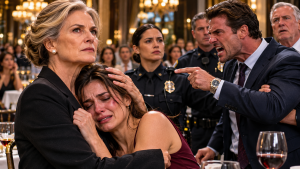
“Then buy it,” I said. “But first, take your hand off my daughter.”
Marcus laughed.
It was the laugh of a man who had never experienced a consequence he couldn’t pay someone else to remove.
His fingers remained tangled in Sarah’s hair.
“Did you hear that, Dad? The old woman thinks she’s giving orders.”
Richard raised his wineglass.
“Careful, Marcus. She might hit you with her knitting needles.”
I didn’t look at Richard.
I kept my eyes on Marcus.
“I’m going to say this once more. Release her.”
Something in my voice made the waiter standing near our table stop moving.
Marcus noticed.
His smile faltered for half a second.
Then he pulled Sarah’s head back another inch.
She cried out.
And the last fragile piece of patience I had left disappeared.
“Manager,” I said.
A tall man in a charcoal suit appeared almost immediately.
“Madam?”
“Call the police. Tell them a woman is being assaulted in your dining room. Preserve the security footage, and please ask your staff not to interfere physically unless necessary to prevent further harm.”
Marcus released Sarah so suddenly that she nearly struck the edge of the table.
“What the hell do you think you’re doing?”
I stepped around my chair and placed myself beside my daughter.
“Sarah, look at me.”
Her eyes were wet.
“Mom—”
“Are you hurt?”
She nodded.
“Can you stand?”
Marcus reached toward her again.
I turned.
“Don’t touch her.”
He stopped.
Not because he respected me.
Because the manager was watching, two servers had approached, and half the dining room had fallen silent.
Richard set down his glass.
“This is a private family matter.”
“No,” I said. “It stopped being private when your son assaulted his wife in front of witnesses.”
Richard laughed dismissively.
“Assault? He pulled her hair. Don’t be ridiculous.”
I looked at him.
“Thank you for clarifying what you witnessed.”
His smile faded.
Marcus stepped closer.
“Listen, Evelyn. You’re going to sit down, apologize, and stop embarrassing my family.”
I could smell the wine on his breath.
His expensive watch flashed beneath the chandelier.
He was thirty-eight years old, broad-shouldered, immaculate in a tailored suit, and accustomed to intimidating people with his money.
I’d seen men like him before.
Not always in expensive restaurants.
Sometimes in modest kitchens.
Sometimes in police interview rooms.
Sometimes sitting in court wearing the expression of a man genuinely astonished that anyone had dared hold him accountable.
I had spent thirty-four years on the bench before retiring.
For much of that time, I handled criminal matters, including domestic violence cases.
I knew the difference between a family disagreement and an assault.
And I knew that the most dangerous moment often came when an abuser realized his control was slipping.
So I didn’t threaten Marcus.
I didn’t announce my former title.
I didn’t tell him who I knew.
I simply helped Sarah stand.
Her knees trembled.
“Can you walk?” I whispered.
She nodded.
“Then we’re going somewhere safe.”
Marcus blocked our path.
“She’s not leaving.”
I looked at the manager.
“Please ask him to step aside.”
The manager’s expression hardened.
“Sir, I need you to let the ladies pass.”
Marcus laughed.
“Do you know who I am?”
“Yes, sir,” the manager said. “And I also know what I just saw.”
A murmur moved through the dining room.
Richard rose.
“This is outrageous. My son is one of your biggest customers.”
The manager didn’t move.
“Sir, please lower your voice.”
Marcus pointed at him.
“You’re fired.”
The manager blinked.
Then said, “You don’t employ me.”
For the first time that evening, I almost smiled.
Marcus looked around.
The room had changed.
A few minutes earlier, he’d been the center of attention because of his wealth.
Now people were watching him with open disgust.
He turned toward Sarah.
“Tell them it’s fine.”
She flinched.
“Marcus—”
“Tell them.”
I felt her fingers tighten around mine.
I knew that fear.
I’d heard it described from witness stands for decades.
The fear of saying the wrong thing.
The fear of going home afterward.
The fear that telling the truth would make everything worse.
I leaned closer.
“You don’t have to answer him.”
Marcus stared at me.
“You’re poisoning her against me.”
I shook my head.
“No. I’m listening to her.”
Two uniformed officers arrived several minutes later.
By then, the manager had escorted Sarah and me to a quiet private room.
A female employee brought water.
Sarah sat beside me, trembling so badly she could barely hold the glass.
I kept my hand near hers without forcing her to take it.
The older officer introduced herself as Officer Elena Ruiz.
“Who called?”
The manager raised his hand.
“I did.”
“Can you tell me what happened?”
He described the incident.
Calmly.
Precisely.
He explained that Marcus had grabbed Sarah’s hair and pulled her head backward while she cried out.
He identified the employees who had witnessed it.
Then he told Officer Ruiz that the restaurant had cameras covering the dining area.
She nodded.
“We’ll need to preserve any relevant footage.”
Marcus appeared in the doorway with Richard behind him.
“This is absurd,” Marcus announced. “My wife and I had a disagreement.”
Officer Ruiz turned.
“Sir, please wait outside while we speak with her.”
Marcus laughed.
“She’s my wife.”
“Yes,” Ruiz replied. “And she’s entitled to speak without you present.”
Richard stepped forward.
“Officer, I’m Richard Vale. Perhaps you’ve heard of Vale Development.”
Ruiz looked at him.
“Sir, I’m going to ask you to wait outside too.”
Richard’s face reddened.
“You’re making a serious mistake.”
She remained calm.
“Please step outside.”
For a moment, I thought Marcus might refuse.
Then his eyes moved toward the second officer standing in the hallway.
He stepped back.
Richard followed.
The door closed.
Sarah exhaled shakily.
Officer Ruiz sat across from her.
“Mrs. Vale, are you comfortable speaking with me?”
Sarah looked at me.
I squeezed her hand.
“It’s your choice, sweetheart.”
She swallowed.
Then nodded.
“Yes.”
Ruiz asked what had happened.
Sarah began with the wine.
The Cabernet.
Her migraines.
Marcus insisting she drink it.
Then the hair pulling.
Her voice cracked when she described his grip.
Ruiz listened without interrupting.
When Sarah finished, the officer asked, “Has anything like this happened before?”
My daughter went still.
I felt her hand turn cold.
For a long moment, she stared at the carpet.
Then she whispered, “Yes.”
The word was so quiet I almost didn’t hear it.
My heart seemed to stop.
Ruiz leaned forward slightly.
“Can you tell me about that?”
Sarah looked toward the closed door.
“He gets angry.”
I swallowed.
She continued.
“When I embarrass him.”
I felt something heavy settle in my chest.
“Sarah,” I whispered.
She shook her head.
“Mom, please.”
I stopped.
This wasn’t the time for my questions.
This was her statement.
Her voice.
Her decision.
Officer Ruiz spoke gently.
“What happens when he gets angry?”
Sarah stared at her hands.
“He grabs me. Sometimes he pushes me.”
I closed my eyes.
She continued.
“He broke my phone once because I called my friend without telling him.”
Ruiz nodded.
“Has he ever threatened you?”
Sarah hesitated.
Then whispered, “He says if I leave, he’ll make sure I never see our son again.”
I opened my eyes.
Our son.
My grandson.
Noah.
Four years old.
Bright-eyed, curious, obsessed with dinosaurs.
He was staying with a nanny at the Vale house that evening.
My stomach tightened.
Officer Ruiz asked, “Where is your child now?”
“At home.”
“Is he safe?”
Sarah looked uncertain.
“I think so.”
I felt her hand tighten around mine.
“Marcus doesn’t usually get angry with Noah.”
Usually.
The word frightened me more than anything else she’d said.
Ruiz asked several more questions.
Then she explained the next steps.
The officers would investigate the assault.
They would gather witness statements and available footage.
Sarah could receive information about protective measures and domestic violence resources.
And her immediate safety, including Noah’s, needed attention.
Sarah nodded.
Then she looked at me.
“Mom, I’m sorry.”
The words nearly broke me.
I leaned toward her.
“For what?”
Her eyes filled.
“For not telling you.”
I swallowed.
“Sarah, you don’t owe me an apology.”
She began crying.
I wrapped my arms around her carefully.
And for the first time in years, my daughter let herself cry against my shoulder the way she had when she was little.
I held her.
Not as a judge.
Not as a woman who knew the law.
As her mother.
And I made myself a silent promise.
I would not let my anger become another force controlling her choices.
I would help her reclaim them.
When the officers finished taking statements, Marcus was no longer laughing.
He had been separated from Richard and questioned.
The restaurant had preserved the footage.
Several employees had provided accounts.
And the incident was now part of an official investigation.
Marcus stood near the entrance as Sarah and I prepared to leave.
His expression was cold.
“Sarah.”
She stopped.
I felt her tense.
He stepped toward us.
“Come home.”
She didn’t answer.
He looked at me.
“Evelyn, you’ve made your point.”
I met his eyes.
“No.”
His jaw tightened.
“Excuse me?”
“I haven’t made a point. I’ve helped my daughter get medical attention and report an assault.”
He laughed bitterly.
“You think you can ruin my life?”
I looked at him.
“Marcus, you are responsible for your own actions.”
Richard appeared beside him.
He was furious.
“You have no idea who you’re dealing with, woman.”
I looked at him.
Then I remembered what he’d said while Sarah was being hurt.
A girl without a father.
I felt a familiar grief rise.
My husband, Thomas, had died when Sarah was nine.
He’d been a firefighter.
A gentle man with broad hands and a laugh that filled our kitchen.
He had loved Sarah fiercely.
And Richard had used his absence as permission to humiliate her.
I took a slow breath.
“Actually, Richard, I know exactly who I’m dealing with.”
He sneered.
“Do you?”
I looked at Marcus.
“Your wife is leaving with me tonight.”
Marcus stepped forward.
“She’s not going anywhere.”
Sarah flinched.
I didn’t move.
“That’s her decision.”
He turned toward her.
“Sarah, tell your mother to stop.”
My daughter stared at him.
Her lips trembled.
Then, quietly, she said, “I’m going with Mom.”
Marcus froze.
For a moment, his expression was pure disbelief.
Then rage flashed across his face.
“You’ll regret this.”
Officer Ruiz, still nearby, stepped forward.
“Sir, that’s enough.”
Marcus looked at her.
Then at the restaurant staff.
Then at the guests who were pretending not to watch.
He stepped back.
Sarah and I walked outside.
The night air was cool.
A car waited near the curb.
I helped her into the back seat.
Then climbed in beside her.
She stared out the window.
“Mom?”
“Yes, sweetheart?”
“Are you angry with me?”
My throat tightened.
“No.”
She turned.
“Not even a little?”
I took her hand.
“I’m angry that someone hurt you.”
Her eyes filled.
“But I’m not angry that you were afraid.”
She looked down.
Then whispered, “I thought if I could just be better, he’d stop.”
I closed my eyes.
I’d heard those words in courtrooms for decades.
From teachers.
Nurses.
Business owners.
Women with advanced degrees.
Women who had survived poverty.
Women who had survived wealth.
Abuse didn’t require ignorance.
It required someone willing to use fear and control.
I looked at my daughter.
“Sarah, you were never the problem.”
She began crying again.
I held her hand.
And as the car carried us away from Le Jardin, I knew that the dinner had been only the beginning.
Because Marcus Vale had built his life on the assumption that money could protect him from consequences.
And I had just watched him make the mistake of believing that my daughter had nobody powerful enough to stand beside her.
He was wrong.
But the next surprise wouldn’t come from my old judicial title.
It would come from the truth Sarah had been too frightened to tell anyone.
The truth she finally whispered as we reached my house.
“Mom, there’s something else.”
I turned toward her.
She was pale.
Her hands were shaking.
“What is it?”
She looked down.
“Marcus has been taking money from the foundation.”
I stared.
“What foundation?”
Her voice cracked.
“The one he started in Dad’s name.”
My breath caught.
Thomas Vale Memorial Foundation.
A charity Marcus had announced two years earlier, claiming he wanted to honor the father Sarah had lost.
I’d attended the opening gala.
I’d donated.
I’d even thanked him for remembering Thomas.
Sarah looked at me.
“Mom, I think he’s been stealing from it.”
I felt cold.
Then she whispered the words that changed everything.
“And I think he used my signature to do it.”
For a moment, I couldn’t speak.
The porch light illuminated Sarah’s face, making the fear in her eyes impossible to ignore.
“Your signature?” I asked quietly.
She nodded.
“Marcus made me sign papers. He said they were routine documents for the foundation.”
I looked at her trembling hands.
“What kind of papers?”
“I don’t know all of them.”
Her voice broke.
“At first, they were donation acknowledgments. Then authorization forms. Sometimes he brought them home late at night and told me to sign before he left for work.”
I felt something tighten in my chest.
“Did you read them?”
She lowered her eyes.
“I tried.”
I waited.
“He got angry when I asked questions.”
The words settled heavily between us.
I remembered Marcus gripping her hair in the restaurant.
The contempt in his voice.
The way Richard had laughed.
And now I was beginning to understand that the cruelty I’d witnessed was only one part of a much larger pattern.
I took Sarah’s hand.
“Sweetheart, listen carefully. Whatever those documents contain, we’re going to find out. But tonight, our first concern is keeping you and Noah safe.”
Her eyes filled.
“Marcus will never let me take Noah.”
I squeezed her hand.
“Marcus doesn’t get to decide everything.”
She began crying.
I pulled her into my arms.
For several minutes, we stood beneath the porch light while she trembled against me.
Then I led her inside.
The house was quiet.
I made tea.
She sat at the kitchen table, staring at her phone.
Every few minutes, the screen lit up.
Marcus.
Richard.
Marcus again.
I watched her flinch each time.
Finally, I asked, “Would you like to turn it off?”
She shook her head.
“What if something happens to Noah?”
That was the question that mattered.
Not the foundation.
Not the money.
Not even the evidence of Marcus’s violence.
My grandson was still inside the Vale house.
And Sarah was terrified that her husband would use him to force her back.
I called Officer Ruiz.
She listened carefully as I explained the situation.
Then she helped us understand the available options for checking on Noah’s safety and arranging for Sarah to retrieve him without creating another confrontation.
We also contacted a family-law attorney experienced in domestic violence cases.
Her name was Laura Bennett.
She agreed to meet us early the following morning.
Until then, Sarah remained with me.
I stayed awake beside her.
At three in the morning, she finally fell asleep on the living-room sofa.
I covered her with a blanket.
Then I sat in the armchair opposite her.
For thirty-four years, I had listened to people describe the moment they discovered someone they loved was living in fear.
I had always understood the law.
I had understood evidence.
Procedure.
Protective orders.
The importance of allowing survivors to make their own decisions.
But nothing in those years had prepared me for the sight of my own daughter sleeping with her phone clutched against her chest because she was afraid her husband might take her child.
I looked toward the framed photograph of Thomas on the mantel.
He was standing beside a fire engine.
His helmet was tucked beneath one arm.
His familiar smile filled the picture.
I whispered, “I’m going to help her.”
Then I corrected myself.
“No. We’re going to help her find her way out.”
Because Sarah wasn’t helpless.
She was frightened.
And those were not the same thing.
By morning, she had made a decision.
“I want Noah with me,” she said.
I nodded.
“Then we’ll work toward that.”
Laura Bennett met us in her office at eight-thirty.
She listened as Sarah described the restaurant assault, the previous incidents, Marcus’s threats concerning custody, and her concerns about the foundation.
Laura did not interrupt.
When Sarah finished, she placed her pen on the desk.
“Sarah, I want you to understand something. You have options. We can seek appropriate protective measures, address temporary custody, and arrange safe communication regarding your son.”
Sarah swallowed.
“Will Marcus know where I’m staying?”
“We can discuss ways to protect your address and limit unnecessary contact.”
Sarah nodded.
Laura continued.
“The foundation allegations should be handled separately with qualified counsel and financial investigators. But we will preserve any evidence that may be relevant.”
I looked at her.
“What about Noah?”
Laura explained the steps available under the circumstances.
There were no promises.
No dramatic guarantees.
Just a careful plan built around Sarah’s safety and her child’s welfare.
And that was exactly what we needed.
Later that day, with appropriate assistance and legal guidance, Sarah was able to reunite with Noah.
When he ran into her arms, she dropped to her knees.
“Mommy!”
He wrapped his small arms around her neck.
She held him so tightly that I thought she might never let go.
I stood a few feet away, trying not to cry.
Noah looked over her shoulder.
“Grandma!”
I opened my arms.
He ran toward me.
I lifted him carefully.
“Hello, my little dinosaur expert.”
He grinned.
“Did you know a triceratops has three horns?”
“I believe you mentioned that once or twice.”
He laughed.
Such a small sound.
So ordinary.
And after everything that had happened, it felt like sunlight breaking through a storm.
That evening, Noah slept in the guest bedroom.
Sarah sat beside his bed until he was asleep.
When she returned to the kitchen, she looked exhausted.
But something in her face had changed.
For the first time since the restaurant, she wasn’t watching the door.
She sat across from me.
“Mom?”
“Yes?”
“I want to tell you everything.”
I reached for her hand.
“I’m listening.”
She began with the foundation.
Marcus had established the Thomas Vale Memorial Foundation two years earlier.
He’d announced that its mission was to provide educational assistance to children of fallen firefighters and other first responders.
The idea had moved me deeply.
Thomas had died in the line of duty.
He had believed that children deserved stability, opportunity, and people willing to stand beside them.
I’d donated generously.
So had several of his former colleagues.
Local businesses contributed.
Firefighter associations helped promote the foundation.
And Marcus had proudly presented himself as a devoted husband honoring his wife’s father.
But according to Sarah, the public image concealed something very different.
She had begun noticing unusual transactions months earlier.
Large consulting fees.
Payments to companies she didn’t recognize.
Invoices for events that had never taken place.
When she questioned Marcus, he told her she didn’t understand business.
When she asked to see the accounts, he became furious.
Then she discovered a folder on his computer.
It contained financial statements bearing her electronic signature.
Some dated on days when she had been visiting me.
Others carried approvals she had no memory of giving.
“I thought maybe I’d forgotten,” she whispered.
I felt my heart break.
“He kept telling me I was confused.”
I squeezed her hand.
She continued.
“Then I found a transfer.”
“How much?”
She swallowed.
“Two hundred and seventy thousand dollars.”
I stared.
“To whom?”
“A consulting company connected to Richard.”
For several seconds, neither of us spoke.
Then Sarah whispered, “Mom, I think they used Dad’s name to raise money and moved part of it into their own businesses.”
I took a slow breath.
“We need to preserve what you have and let qualified investigators examine it.”
She nodded.
“I saved copies.”
My eyes widened.
“Where?”
She reached into her handbag.
Then removed a small USB drive.
“I made this three weeks ago.”
I looked at her.
She was trembling.
“I didn’t know what to do with it.”
I took her hand.
“You did something important. You protected information that may help establish the truth.”
Her eyes filled.
“I was so scared.”
“I know.”
She began crying.
And I held her until she could breathe again.
The next morning, I contacted an attorney who specialized in nonprofit governance and financial misconduct.
His name was Jonathan Price.
He had no connection to the Vale family.
He reviewed the materials through a secure process and arranged for a forensic accountant to examine the foundation’s records.
I did not contact Richard.
I did not confront Marcus.
I did not threaten to expose them.
I had spent too many years in courtrooms to mistake anger for evidence.
The investigation needed facts.
And facts required patience.
Over the following weeks, the picture became clearer.
The foundation had received substantial donations.
Some funds had supported legitimate scholarships and community programs.
But other payments raised serious questions.
Consulting contracts appeared to have been awarded to companies associated with Richard’s business interests.
Certain invoices lacked adequate supporting documentation.
And several authorization records bearing Sarah’s name could not be readily reconciled with her account of what she had approved.
The forensic accountant was careful.
“These findings warrant further investigation,” he told us. “They don’t establish every person’s intent or responsibility.”
I nodded.
“What do we do?”
Jonathan answered.
“We preserve the records, notify the appropriate authorities and oversight bodies, and pursue lawful steps to protect the foundation’s assets.”
Sarah sat beside me.
For the first time, she spoke before I could.
“Then that’s what I want to do.”
I looked at her.
Her voice was steady.
Not because she wasn’t frightened.
Because she had decided fear would no longer make every decision for her.
The foundation’s independent board members were informed through counsel.
An external review began.
The relevant authorities received the information.
And the financial records were examined more closely.
Marcus’s reaction was immediate.
He called repeatedly.
Sent messages.
Accused Sarah of betraying him.
Then he changed tactics.
He apologized.
Promised counseling.
Said he missed Noah.
Said he couldn’t live without his family.
Sarah read the messages with tears in her eyes.
One evening, she looked at me.
“Mom, what if he really changes?”
I considered my answer carefully.
“People can change,” I said. “But change is something they demonstrate consistently through their actions. It isn’t something you have to risk your safety to prove.”
She looked down.
“I still love him.”
“I know.”
“Does that make me foolish?”
“No.”
I reached across the table.
“Love doesn’t disappear just because someone has hurt you. But loving someone doesn’t require you to remain where you’re unsafe.”
She began crying.
I moved beside her.
For a long time, we sat together.
No lectures.
No orders.
Just a mother and daughter trying to understand how a life that once looked beautiful had become so frightening.
Meanwhile, the family-law proceedings continued.
Sarah obtained temporary protective measures and custody arrangements appropriate to the circumstances.
Marcus disputed the allegations.
His attorneys challenged portions of her account.
Richard attempted to portray the restaurant incident as a misunderstanding.
But the security footage remained.
So did the witness statements.
And Sarah’s documented reports of earlier incidents received careful consideration.
The legal process was not effortless.
There were difficult interviews.
Hearings.
Long days when Sarah returned home exhausted.
But she was no longer facing them alone.
Laura Bennett guided her through each step.
A counselor helped her work through the fear she’d carried for years.
And I learned to do something that was surprisingly difficult.
I learned to support my daughter without trying to take over her life.
Sometimes she made decisions differently than I would have.
Sometimes she needed time.
Sometimes she wanted to talk.
Sometimes she wanted silence.
I respected that.
Because the greatest gift I could give her wasn’t control.
It was the freedom to trust herself again.
Three months after the restaurant incident, Jonathan called.
“Evelyn, we’ve received an important update.”
I sat down.
“What happened?”
“The foundation’s external review has identified additional transactions involving related-party entities.”
I closed my eyes.
“How significant?”
“Significant enough that the board has taken steps to restrict further unauthorized payments and strengthen financial oversight.”
“And Marcus?”
“He and Richard are facing serious questions concerning their roles in those transactions. The appropriate investigative processes are continuing.”
I looked toward the garden.
Sarah was outside with Noah.
He was holding a plastic dinosaur.
She was laughing.
I watched them through the window.
“Will the foundation survive?” I asked.
Jonathan paused.
“That depends on several factors. But the legitimate charitable mission can still be protected.”
I nodded.
“Then that’s what matters.”
Because the foundation wasn’t supposed to be about Marcus.
Or Richard.
Or their reputations.
It was supposed to honor Thomas.
And help children whose families had suffered losses like ours.
I refused to let that purpose disappear because of the people who had misused his name.
With independent oversight, the foundation began reviewing its operations.
Conflicted arrangements were examined.
New financial controls were introduced.
And the board worked to ensure that future donations would be used for their intended charitable purposes.
I stepped away from any decisions where my personal involvement might create a conflict.
I wanted the process to be credible.
Not simply favorable to my family.
As the months passed, the investigations and legal proceedings produced consequences.
Civil claims were pursued concerning disputed payments.
Some funds were recovered through negotiated arrangements.
The foundation corrected its records and strengthened its governance.
The authorities continued reviewing whether any criminal conduct had occurred.
I did not predict the outcome.
I did not demand special treatment.
I gave truthful statements when asked.
And I let the process move forward.
Marcus’s influence over Sarah diminished as enforceable boundaries and legal arrangements took effect.
He could no longer simply appear at my home and demand that she return.
Communication concerning Noah was handled through appropriate channels.
Sarah continued building a life independent of him.
She found a small house near a park.
It had pale yellow walls.
A sunny kitchen.
And a bedroom with dinosaur wallpaper for Noah.
The first time we visited, he ran straight to his room.
“Mommy! Look!”
Sarah laughed.
“I see it, sweetheart.”
He pointed at the wall.
“That’s a stegosaurus!”
I stood in the doorway.
For a moment, I remembered Sarah at four years old.
Running through our kitchen.
Laughing while Thomas pretended to chase her.
I felt tears rise.
Sarah looked at me.
“Mom?”
I smiled.
“Your father would have loved this.”
Her eyes filled.
“I know.”
We stood together while Noah explored his new room.
Then Sarah whispered, “I never thought I’d have a home that felt safe again.”
I took her hand.
“You’ve worked very hard to get here.”
She nodded.
Then smiled.
“Yes. I have.”
A year after that terrible dinner, Sarah and I returned to Le Jardin.
Not for a confrontation.
Not to relive what had happened.
But because she wanted to reclaim a place that had once represented fear.
She chose the date.
She made the reservation.
And she invited me.
When we entered, the manager recognized us.
He approached with a warm, respectful smile.
“Mrs. Bennett. Mrs. Vale. Welcome.”
Sarah smiled.
“Thank you.”
He hesitated.
“I’m glad to see you both.”
I nodded.
“So are we.”
We were seated near the windows.
The same chandeliers glowed overhead.
Soft music drifted through the dining room.
But everything felt different.
Sarah wore a simple navy dress.
Her hair fell loosely over her shoulders.
She looked relaxed.
Confident.
Present.
The waiter brought menus.
Then asked whether we’d like wine.
Sarah glanced at me.
For one brief second, I saw the memory pass across her face.
Then she smiled.
“No, thank you. I’ll have sparkling water with lemon.”
The waiter nodded.
“Of course.”
Such an ordinary exchange.
A simple preference.
A choice respected without argument.
But I watched Sarah’s shoulders relax.
And I understood how much that moment meant.
We ordered dinner.
Talked about Noah’s preschool.
About Sarah’s new work.
About the garden she wanted to plant.
At one point, she looked across the table.
“Mom, do you remember what you said that night?”
I smiled faintly.
“I said quite a few things.”
She laughed.
“The first thing.”
I thought back.
Then I remembered.
Then buy it. But first, take your hand off my daughter.
I nodded.
“Yes.”
Sarah looked down at her hands.
“For a long time, I thought that was the moment you saved me.”
My eyes filled.
She continued.
“But I think what really changed everything was what you said afterward.”
“What was that?”
She looked at me.
“You told me it was my decision.”
I swallowed.
Sarah smiled through tears.
“Marcus had spent years making me feel like I couldn’t decide anything. What I wore. Who I called. Where I went. Whether I was allowed to disagree.”
She paused.
“Then you stood beside me and reminded me that my life still belonged to me.”
I reached across the table.
She took my hand.
“Thank you, Mom.”
My throat tightened.
“You don’t have to thank me for loving you.”
She smiled.
“I know. But I want to.”
We sat quietly for a moment.
Then the waiter returned with dessert menus.
Sarah laughed.
“Chocolate cake?”
I smiled.
“Absolutely.”
We ordered one slice and two forks.
Just as we had when she was a little girl.
After dinner, we walked outside together.
The night air was cool.
Cars moved along the street.
Somewhere nearby, someone was laughing.
Sarah stopped beside the entrance.
“Mom?”
“Yes?”
“Do you think Dad would be proud of me?”
I turned toward her.
The question broke my heart.
I thought about Thomas.
His kindness.
His courage.
The way he’d always encouraged Sarah to speak her mind.
I smiled.
“Sweetheart, your father was proud of you when you learned to tie your shoes. When you brought home your first school drawing. When you stood up for a classmate who was being bullied.”
Her eyes filled.
I continued.
“He wouldn’t need you to survive something terrible to be proud of you.”
She began crying.
I pulled her into my arms.
“But yes,” I whispered. “He would be very proud of the woman you’ve become.”
We stood together beneath the restaurant lights.
For a long moment, neither of us moved.
Then Sarah stepped back.
Wiped her eyes.
And smiled.
“Let’s go home.”
I nodded.
“Let’s.”
The following spring, Noah started kindergarten.
On his first morning, Sarah invited me to join them for breakfast.
I arrived to find him sitting at the kitchen table wearing a backpack almost as large as he was.
He looked very serious.
“Grandma.”
“Yes?”
“I have an important question.”
I sat beside him.
“I’m listening.”
He leaned closer.
“Do dinosaurs go to school?”
I pretended to consider it.
“Only the very well-behaved ones.”
He nodded solemnly.
“Then I think a triceratops could go.”
Sarah burst out laughing.
I looked at her.
She was standing by the stove.
Sunlight illuminated her face.
She was smiling without hesitation.
Without looking over her shoulder.
Without wondering whether someone would punish her for being happy.
And suddenly, I felt tears fill my eyes.
Sarah noticed.
“Mom?”
I shook my head.
“Nothing, sweetheart.”
She smiled knowingly.
Then came over and kissed my cheek.
Noah climbed down from his chair.
“Come on! We’re going to be late!”
We laughed.
Outside, the morning was bright.
Sarah held Noah’s hand as we walked toward the car.
He talked nonstop about dinosaurs, crayons, and whether his teacher would let him bring a toy fossil.
I followed a few steps behind.
Watching them.
Listening to their laughter.
And thinking about the night everything had changed.
Marcus had believed his money made him untouchable.
Richard had believed his influence gave him permission to humiliate people.
They had mistaken silence for weakness.
Fear for obedience.
And wealth for character.
But the truth had outlasted their threats.
The legal proceedings had not erased every wound.
The foundation’s recovery had required patience.
Sarah’s healing had taken time.
And our family would always carry memories of what happened.
But those memories no longer controlled our future.
Sarah had a home.
A career.
Friends.
A growing confidence in her own judgment.
Noah had a childhood filled with safety, laughter, and people who loved him.
And I had something I hadn’t dared hope for on the night of the restaurant incident.
The sight of my daughter living freely.
When Sarah reached the car, she turned toward me.
“Mom, are you coming?”
I smiled.
“Of course.”
I walked toward them.
Noah waved his small plastic dinosaur.
“Grandma, hurry!”
I laughed.
And as I climbed into the passenger seat, I realized that the greatest victory had never been proving Marcus wrong.
It wasn’t exposing the financial irregularities.
It wasn’t watching Richard discover that his wealth couldn’t control every institution.
It wasn’t even the legal accountability that followed.
The greatest victory was sitting beside my daughter on an ordinary morning, listening to my grandson laugh, knowing that neither of them had to be afraid to go home.
I looked at Sarah.
She started the car.
The radio played softly.
Noah began singing along to a song he barely knew.
Sarah glanced at me and smiled.
I smiled back.
For thirty-four years, I’d believed that justice was something delivered through careful decisions, evidence, and the rule of law.
I still believed that.
But now I understood another kind of justice.
The quiet justice of a woman reclaiming her choices.
The quiet justice of a child growing up without fear.
The quiet justice of a family rebuilding itself around respect instead of control.
And as we drove toward Noah’s school beneath the bright morning sky, I knew Thomas would have understood.
He had spent his life running toward danger to help strangers.
I had spent mine trying to make sure people were treated fairly.
And Sarah, in her own way, had shown a courage that belonged entirely to her.
She had chosen to leave.
Chosen to speak.
Chosen to rebuild.
And chosen to believe that she deserved a life where love did not hurt.
I rested my hand against the window.
The sunlight warmed my fingers.
Noah laughed in the back seat.
Sarah joined him.
And I closed my eyes for one brief, grateful moment.
Because the woman who had once whispered apologies for being hurt was now teaching her son something far more important than fear.
She was teaching him that love is gentle.
That respect is not negotiable.
And that no amount of money can buy the right to control another human being.
When I opened my eyes, Sarah was smiling at the road ahead.
And for the first time in years, there was nothing frightened about that smile.
It was hers.
Completely hers.
And that was everything.