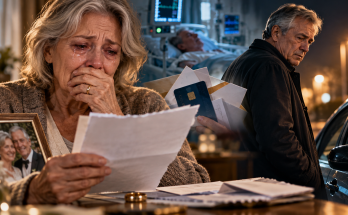
At 12:43 a.m., while I was standing beneath the hard fluorescent lights of Portland General’s emergency department, my sixteen-year-old daughter called me and said she was sitting outside our house in the rain.
I almost missed the call.
The ER had been running at full capacity for hours. Two ambulances had arrived within minutes of each other, a toddler with a split chin was crying behind one curtain, and a man with chest pain had just been transferred upstairs. I had stepped into the medication room for less than a minute, still wearing one blue nitrile glove, when my phone began vibrating against the counter.
Emma knew not to call during a night shift unless something mattered.
I answered immediately.
“Mom?”
Her voice was so small I straightened before I even understood what I was hearing.
“Emma? What happened?”
For several seconds she did not answer. There was rain behind her, the hiss of tires passing on wet pavement, and something thin and plastic crackling near the phone.
Then she took a shaky breath.
“Grandpa says I can’t sleep in my room anymore.”
I stared at the locked medication cabinet in front of me.
“What are you talking about?”
“He gave it to Olivia.”
I thought I had misunderstood her.
Olivia was my seventeen-year-old niece, Daniel’s sister’s daughter. She had been staying with us temporarily because her mother was supposed to be getting treatment. Emma had known she was coming. We had discussed it as a family. The plan was simple: Olivia would use the guest room until the situation stabilized.
Nobody had mentioned Emma giving up her bedroom.
“Where are you right now?”
“Outside.”
The word landed harder than anything else she had said.
“Outside where?”
“Our house.”
I pulled off my remaining glove and dropped it into the trash.
“Emma, are you telling me you’re sitting outside the house?”
“On the curb.”
My hand tightened around the phone.
Portland had been taking freezing rain all evening. Earlier, one of the paramedics had complained about black ice forming near the hospital entrance. I pictured Emma in the hoodie she usually wore around the house, her knees drawn up beneath her, water soaking through her jeans.
“Why are you outside?”
Another pause.
“Grandma packed some of my things.”
The plastic sound came again.
“What things?”
“My pajamas. My school stuff. My toothbrush. She put everything in grocery bags.”
I closed my eyes.
“Where is your coat?”
“I have it.”
“Shoes?”
“Yeah.”
“Are you hurt?”
“No.”
“Did anyone touch you?”
“No.”
Her answer came quickly, but the relief lasted less than a second.
“Then why are you outside?”
Emma began crying harder.
Not loudly. Emma had never been a loud crier. Even as a little girl she had tried to swallow pain before anyone noticed it. That was what frightened me now—the way she was working so hard to keep her breathing steady.
“Grandpa said Olivia needs my room more than I do.”
I walked out of the medication room, found an empty section of hallway, and pressed myself against the wall.
“What exactly did he say?”
Emma wiped her nose. I heard the scrape of her sleeve against the phone.
“He said Olivia’s been through enough and it’s time I stopped being selfish. Grandma said I can sleep downstairs.”
“In the guest room?”
“No.”
I already knew the answer before she gave it.
“The basement couch.”
That couch had been in the basement since before Emma started middle school. One arm sagged inward. A metal spring could be felt beneath the center cushion, and the basement itself smelled faintly of concrete whenever it rained.
“Where is Olivia sleeping?”
“My room.”
I forced myself to breathe slowly.
“Did you tell Dad?”
This time the silence was different.
Emma stopped crying for a moment.
“He was there.”
My eyes opened.
“Your father was there when they put you outside?”
“Yeah.”
“What did he do?”
“He told Grandpa everybody needed to calm down.”
The old familiar ache of disappointment started forming somewhere beneath my ribs.
“And after that?”
“Grandpa told him not to interfere.”
I heard Emma inhale.
“Dad said he didn’t want to get in the middle.”
For an instant, the noise of the emergency department seemed to disappear.
Daniel had said versions of that sentence throughout our marriage.
When his mother criticized the way we raised Emma, he did not want to get in the middle. When Gerald made decisions about family holidays without asking us, Daniel preferred to avoid conflict. When his parents needed somewhere to live after their condo flooded, I had agreed because Daniel assured me it would be temporary.
I had accepted his passivity because most of the consequences had fallen on adults.
Tonight, they had fallen on our daughter.
“Listen to me carefully,” I said. “You are not staying on that curb.”
“I don’t know where to go.”
“Yes, you do. Go next door to Mrs. Ellis.”
Emma sniffed.
“It’s almost one in the morning.”
“She told us years ago that you could knock on her door anytime. Tonight counts.”
“What if she’s asleep?”
“Wake her.”
Behind me, someone called my name from the nurses’ station.
I turned away.
“Take your bags. Walk directly to her front porch. Do not go back inside our house, and do not argue with anybody. I’m leaving the hospital.”
“Mom, you’re working.”
“I know.”
“You can’t just leave.”
There was something terrible about hearing my child worry about my job while she sat in the rain after being removed from her own bedroom.
“I can hand off my patients,” I said. “You are my responsibility before any shift.”
Emma was quiet.
Then she whispered, “Grandpa said you’d agree once you understood.”
That stopped me.
“Understood what?”
“I don’t know. He kept saying Olivia needs stability and I already have everything.”
“Did he explain what your bedroom has to do with stability?”
“No.”
“And Grandma?”
“She said family makes sacrifices.”
I looked through the glass doors toward the ambulance bay. Rain streaked the outside lights into silver lines.
“Your grandparents do not decide where you sleep in my house.”
Emma did not answer.
I corrected myself.
“Our house.”
That made her cry again.
I walked to the charge nurse, Linda, and told her I had a family emergency. She took one look at my face and did not ask for details. We redistributed the patients I was carrying, documented the medications I had already given, and completed the handoff as quickly as hospital policy allowed.
Nine minutes later I was changing out of my scrub jacket in the staff locker room.
My phone rang again.
Mrs. Ellis.
“Rachel?”
Her voice was fully awake.
“I have Emma.”
My knees weakened with relief.
“Thank you.”
“She’s in my kitchen. I gave her a towel and some tea.”
“Is she okay?”
“She’s soaked through.”
Anger rose so fast I had to grip the edge of the locker.
Mrs. Ellis lowered her voice.
“Rachel, Daniel came outside after she came over here.”
“What did he want?”
“He stood at the end of my driveway for a while. He didn’t knock.”
That hurt in a way Gerald’s behavior did not.
I expected cruelty from a man who treated every family disagreement like a contest he intended to win.
I had expected more from my husband.
“Where is he now?”
“Back inside.”
I pulled on my coat.
“Keep Emma there until I arrive.”
“You don’t have to ask.”
“Please don’t let anyone take her back over there.”
“I won’t.”
When I reached the employee garage, freezing rain slapped across my face. I unlocked my car and sat behind the wheel without starting it.
I wanted to drive home immediately.
Instead, I forced myself to think.
Gerald had a habit of creating chaos and then using everyone else’s anger as evidence that he was the reasonable one. If I arrived screaming, he would use it. If I threatened him before I understood what had happened, he would twist that too.
So I opened the banking app connected to my property account.
Mortgage: paid.
Taxes: current.
Insurance: current.
Owner: Rachel Moore.
Only Rachel Moore.
The house had never belonged to Daniel.
My father had purchased it years before Daniel and I married. After Dad died, the title transferred directly to me. Daniel and I had lived there together and raised Emma there, but ownership had never changed.
Gerald knew that.
Or at least I had always assumed he did.
I started the engine.
The drive that normally took twenty minutes felt twice that long. The freeway reflected every headlight in sheets of white. Wind drove rain against the windshield faster than the wipers could clear it, and twice I passed cars pulled onto the shoulder.
At every red light I saw Emma as a little girl.
Emma at five, painting cardboard stars at the kitchen table.
Emma at eleven, running down the stairs because she had finally learned to braid her own hair.
Emma at fifteen, asking whether Olivia could borrow her laptop because Olivia’s phone had been shut off.
She had not treated her cousin like an intruder.
That made what had happened tonight worse.
When Gerald and Marlene’s condo flooded, I had opened my home.
When Olivia suddenly needed somewhere safe, I had opened it wider.
Somewhere along the way, hospitality had been interpreted as surrender.
My phone buzzed at a stoplight.
Daniel.
I let it ring.
A message appeared seconds later.
Please come home before this gets worse.
I read it twice.
Not: Emma is safe.
Not: I’m sorry.
Not: My parents crossed a line.
Before this gets worse.
As though the problem had begun when Emma called me.
I put the phone facedown.
A second message arrived.
Dad is upset. Mom is crying. Olivia feels terrible. We can work this out.
I stared through the windshield until the light turned green.
There were four people inside my house concerned about how difficult the evening had become for themselves.
My daughter was next door in wet clothes.
At 1:21 a.m., I turned onto our street.
Mrs. Ellis’s kitchen light glowed warmly through the rain.
Across from it, every downstairs light in my house was blazing.
Gerald’s SUV sat in the driveway.
Marlene’s suitcase was visible through the front window near the stairs.
And in Emma’s second-floor bedroom, I saw a silhouette move behind the curtains.
Someone was already settling into my daughter’s room.
I parked at the curb.
Before I could open the door, the porch light came on.
The front door swung wide.
Gerald Hart stepped outside and folded his arms across his chest, waiting for me as if I were the guest who needed permission to enter.
That was the moment I understood this was no impulsive family argument.
They had expected me to come home.
And they believed they were ready for me.