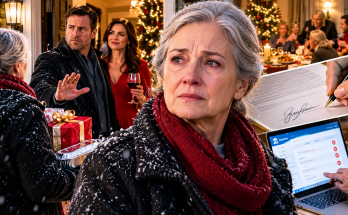
My mother did not answer my question. She stood on our front porch gripping the old banking document, staring at the name Iris Mercer as though the letters had rearranged themselves into something impossible. Behind her, Warren reached for the black suitcase and suggested that they should leave. It was the first sensible thing he had said since arriving, but Celeste barely heard him. Her fingers trembled against the page. She looked at me and asked whether Iris had ever mentioned a woman named Eleanor. The name meant nothing to me. Before I could say so, my father told her sharply that this was not the place to discuss old family matters.
Celeste turned toward him. I had watched my mother silence rooms full of people with a glance, but I had never seen anyone silence her so completely. She examined Warren's face as if discovering an unfamiliar feature. "You told me she died," she said. Her voice was quiet, almost conversational. Warren took a step closer and urged her to lower her voice. She repeated the accusation, louder this time. I heard Caleb shift his cane beside me. He was watching my father with an expression I recognized from our work together: the careful concentration he used when a client's explanation did not match the records.
I told them both that I would not continue the conversation on the porch if they intended to shout. That did not mean they were moving into our house. I wanted that distinction understood before anyone crossed the threshold. Warren looked relieved when I opened the door wider, but I stopped him before he reached for his suitcase. They could come into the sitting room to explain what was happening. Their luggage would remain outside. Celeste passed me without a word, still holding the document. Warren followed, carrying nothing. For a moment, seeing him inside our home felt more unnatural than finding a stranger there.
Our sitting room overlooked the garden, where Caleb's tomatoes were beginning to ripen. Sunlight crossed the wooden floor and reached the edge of the cream-colored rug. My mother settled into an armchair without waiting to be invited. She sat upright, knees together, the document spread across her lap. My father remained standing near the fireplace. Caleb chose the chair beside mine, extending his injured leg slightly before leaning his cane against the armrest. No one spoke while I brought water from the kitchen. I needed those few moments alone to steady my hands.
When I returned, Celeste asked how old Iris was. I told her that she was in her late seventies and had lived beside our first rented duplex when Caleb and I married. My mother closed her eyes. She asked whether Iris had a small scar near her right eyebrow. I remembered it immediately, a thin pale mark partly hidden beneath her silver hair. I nodded. Celeste pressed her fingers against her mouth. My father said that people could resemble one another and that old documents might refer to someone else. It was such a feeble objection that I almost felt embarrassed for him.
"Her name was Eleanor Mercer," my mother said at last. "I knew her as Eleanor."
Warren moved away from the fireplace. He told Celeste that she was confusing two women. She ignored him. Her gaze remained fixed on mine as she explained that Eleanor was her mother, a woman she had believed dead since she was a young adult. I stared at her, trying to reconcile that statement with the Iris who had stood beside me at my wedding, taught us to keep accurate records, and sat at our kitchen table eating lemon bars. My grandmother had not been a figure in my childhood. My mother had always said that her parents died when she was young and that there was little worth discussing about the years before she married Warren.
"You knew her?" I asked. "You knew she was my grandmother?"
Celeste shook her head so fiercely that her pearl earrings swung against her neck. She insisted that she had not known. She hadn't seen Eleanor in more than thirty years. According to my mother, her parents' marriage had ended badly when she was a young woman. Her father had died not long afterward, and Eleanor had become involved in disputes over money and family property. Warren had helped settle the resulting difficulties. Some years later, he received information that Eleanor had died while living under another name. Celeste had accepted it because, by then, contact between mother and daughter had almost entirely disappeared.
I looked toward Caleb. He said nothing, but his jaw was tight. We both knew Iris had sometimes avoided questions about her family. She had told us there were people she loved who remained beyond her reach. I had assumed estrangement or grief. Now I was beginning to understand that her silence might have been tied to something more deliberate. My mother continued speaking, describing unanswered letters, an address that stopped working, and a telephone number that eventually belonged to strangers. The story came in fragments. Each time she approached the question of who had told her Eleanor was dead, Warren interrupted.
I asked him to stop. He looked at me with familiar impatience, the expression he used when I challenged his authority as a teenager. Then his eyes moved to the documents on Celeste's lap, and the impatience disappeared. He claimed he had relied on information provided by an intermediary. When I asked for the person's name, he said he couldn't remember. My mother turned toward him. She remembered the date, the place, and the gray envelope in which he had brought her the news. She remembered sitting at the breakfast table while he explained that there was no reason to pursue the matter further. He had told her that reopening the past would only cause distress.
"Did you see a death certificate?" Caleb asked.
Warren's expression hardened. He said that he had no obligation to answer questions about private family history. Caleb remained composed. He explained that Celeste had just discovered a woman she believed dead might be alive, and asking how that belief began was hardly unreasonable. My father glanced toward the door. I recognized the movement. It was the same instinct that had driven him to look away at my engagement dinner when my mother insulted Caleb. He preferred uncomfortable truths to vanish before they required a decision. This time, however, there was nowhere for him to retreat without leaving questions behind.
My mother asked if she could see Iris. The request struck me with unexpected force. A few minutes earlier, Celeste had demanded a place in our home because she believed our wealth entitled her to comfort. Now she was asking to meet someone who had shown me more practical affection than either of my parents. I told her that Iris's health had been fragile and that I would not bring an unexpected confrontation to her door. If Iris wanted to see Celeste, the decision would be hers. My mother began to protest, then stopped. Something in my expression must have reminded her that she no longer controlled the arrangements of my life.
Warren announced that they should return to their hotel. I reminded him that they had arrived without reservations. He corrected himself, saying they would find accommodation. Celeste did not move. She asked whether Iris had attended my wedding. I told her she had arranged the flowers and sat in the front row. My mother looked down at her hands. She asked whether Iris had known my married name before meeting Caleb. I said she had known me as Megan before the wedding and that we had introduced ourselves using our first names when we became neighbors. At the ceremony, however, she had heard guests use my maiden name. I remembered how she had asked about Celeste Bennett while helping me dress.
"She knew," my mother whispered.
It wasn't clear whether she meant Iris knew our relationship or Warren knew where her mother had gone. Perhaps both possibilities frightened her equally. I found myself remembering the blue handkerchief, the careful embroidery, and Iris's fleeting expression when I mentioned my mother on our wedding morning. At the time, I had seen only kindness. Now another possibility emerged: she had recognized me as her granddaughter and had chosen to remain near without explaining. I wanted to know why. I also wanted to know what kind of fear could make someone conceal such a connection while helping us build a future.
Caleb asked Warren about his financial difficulties. The change of subject startled my mother, but my husband had seen something I hadn't. If Warren's problems involved the trust, they might explain why he had appeared at our house so suddenly. My father said several investments had failed and that creditors were seeking repayment. He had borrowed against property and other assets. The obligations had become difficult to manage. When Caleb asked whether the debts were personal or connected to business entities, Warren said both. His answer was vague enough to cover almost anything.
I asked for the amount. Warren stared at the garden. He said there was no need to discuss figures until we had agreed on a temporary arrangement. I replied that there would be no arrangement based on secrecy. My mother raised her head and told him to answer. He said they faced demands approaching two million dollars, though not all were immediately payable. I felt the room change around that number. It was not merely the sort of unexpected expense that might force a couple to reduce their lifestyle. It was the kind of obligation that could destroy a household already burdened by failed investments and expensive habits.
My mother looked genuinely shaken. She said Warren had told her the situation was temporary and that their properties could cover the debt. He insisted they could, provided they had time. Caleb asked whether any of those properties were pledged as collateral for more than one obligation. Warren refused to discuss his lending arrangements with him. I reminded my father that he was asking us to put our home and resources at risk. If he wanted assistance, the information was relevant. His face reddened. For an instant, I saw the man who had once threatened to cut me off unless I abandoned Caleb. But the old leverage was gone. He could raise his voice without changing anything.
I told my parents that we would not offer money, housing, or a financial guarantee that day. If they needed accommodation, I could provide the telephone numbers of nearby hotels. If they wanted to discuss debts honestly, they could arrange a meeting with an independent financial adviser and share verified documentation. My mother looked as though she wanted to argue, but her attention kept returning to Iris's name. Warren appeared relieved to end the encounter before more records emerged. He collected the document from Celeste, but I stopped him. The pages were our copies, and they would remain with us. He handed them back reluctantly.
As they rose, my mother asked one more question. She wanted to know whether Iris had ever spoken about a daughter. I remembered the afternoon in our old kitchen when she said she had loved people whom circumstances kept away. I told Celeste that Iris had rarely discussed her family and that I had respected her privacy. My mother's face tightened. She said that if Eleanor truly was alive, there were things she needed to ask her. Her tone had lost its earlier entitlement. I told her I would convey the request, nothing more. She nodded, and for a brief moment she looked like a frightened young woman rather than the mother who had spent decades making others afraid of disappointing her.
My father walked toward the door with his shoulders drawn tight. Before leaving, he turned to Caleb and asked what other documents Iris had given him. Caleb answered that he had preserved records entrusted to his care and that any concerns about their significance belonged with the appropriate professionals. Warren pressed him to be specific. Caleb refused. He was courteous, but there was no softness in his reply. I watched my father assess him anew. Fourteen years earlier, Warren had dismissed Caleb as a burden who would never provide the life I deserved. Now he seemed to recognize that the man before him understood something about his business affairs that he desperately wanted to keep hidden.
Once the door closed, I stood beside the window and watched my parents carry their suitcases back to the car. Celeste moved slowly, glancing at our house as though trying to understand how her mother had entered my life without her knowledge. Warren placed the luggage in the trunk with sharp, impatient movements. They argued beside the driver's door. I couldn't hear the words, but I saw Celeste point toward the house and Warren shake his head. Eventually they drove away. I remained at the window until the car disappeared beyond the trees. The silence that followed was so complete that I heard the refrigerator switch on in the kitchen.
Caleb brought me water and sat nearby. I asked whether he had known Iris was my grandmother. He answered immediately that he had not. He had suspected she knew my family after seeing her response to certain records, but he had never imagined the relationship was so close. He looked troubled that she had trusted him with documents while withholding something so personal. I understood his discomfort, yet I couldn't bring myself to resent her without hearing why. Iris had been beside us during the years when we had almost nothing. She had never asked for more than honesty and hard work. Whatever she had concealed, it existed alongside years of genuine care.
I called her home. The telephone rang several times before she answered, her voice slightly breathless. I asked if she was feeling well. She said she had been resting after breakfast and wanted to know whether anything had happened. I told her my parents had arrived unexpectedly and that Celeste had recognized her name on a banking document. There was a long silence. I could hear the faint ticking of the clock in her sitting room. Then Iris said, very softly, that she had hoped to explain everything before this day came.
"Are you my grandmother?" I asked.
She did not try to evade the question. "Yes, Megan," she answered. "I am."
For several moments, I couldn't speak. I had imagined discovering hidden family connections in books and films, where recognition arrived with embraces and immediate explanations. In my kitchen, the truth felt different. It was a rearrangement of ordinary memories. Iris carrying soup when Caleb was recovering from surgery. Iris insisting that our business agreement be reviewed by an attorney. Iris holding my hand on my wedding morning when I was grieving the absence of my parents. Every act remained real, but its meaning had deepened beyond anything I had understood.
I asked why she hadn't told me. Her breath caught. She said the answer was complicated and involved decisions she regretted, threats she had once believed, and years in which she had lost the courage to approach her daughter. When she recognized my family name, she had been afraid that revealing herself would bring old conflicts into our marriage. Then she had grown attached to Caleb and me, and each passing month made the confession more difficult. She insisted that her affection hadn't been a performance. I told her I believed that much, but I needed to understand the rest. She said she was ready to tell me.
Caleb offered to drive us to her house. Before I could agree, Iris asked whether Warren had seen the documents. I told her he had examined several pages and that his reaction had been unmistakable. She became quiet. Then she asked whether Celeste had mentioned receiving proof of her mother's death. I described the gray envelope. Iris made a small sound, almost like a gasp. She said Warren had once used exactly that kind of envelope to deliver a different set of papers, documents that had changed her own life. Her voice grew steadier as she told me to bring Caleb and the copies of the records. There was something she had kept apart from the financial investigation, and I needed to see it before speaking to my father again.
I went into our bedroom to retrieve the blue handkerchief from the box where I kept our wedding photographs. Its fabric had yellowed slightly, but the tiny flowers remained intact. As I unfolded it, I noticed something I had overlooked for fourteen years: two initials stitched beneath the embroidery, almost hidden in the corner. E.M. I sat on the edge of the bed, holding the handkerchief against my palm. The woman who had given it to me had once been Eleanor Mercer, the mother my mother believed dead. I wondered what memories she had carried in that small square of cloth, and how many years she had waited for a chance to pass it to someone who belonged to her.
When I returned to the kitchen, Caleb was preparing the document folder. He looked up and saw the handkerchief in my hand. I told him what I had found. He touched the embroidered initials with one finger, then carefully folded the fabric. We left for Iris's house shortly afterward. As we drove through familiar streets, I realized that my parents' sudden arrival had done more than reopen an old wound. It had exposed a connection between my childhood, Caleb's struggle to establish his career, and financial records that reached back decades. I still didn't know whether those events were deliberately linked. But when we turned into Iris's driveway, I understood that our next conversation might alter everything I believed about the family I came from.