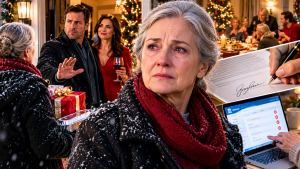
CHAPTER ONE: THE CHRISTMAS THAT CHANGED EVERYTHING
The first time my son pretended I was dead, he was standing six feet away from me, holding the door to his beautiful house.
The second time, his wife had already put my signature on the paperwork.
And by the time I discovered what they’d done, I realized that fourteen years of financial betrayal had been only the beginning.
My name is Margaret Whitmore.
I’m sixty-eight years old, a widow, a mother, and a grandmother.
Until last Christmas, I thought those last two titles meant I would always have a place in my son’s life.
I was wrong.
It began on Christmas Eve in Maplewood, New Jersey.
Snow was falling in thick, beautiful flakes when I pulled into Daniel’s driveway.
The house glowed with Christmas lights, and through the living room windows, I could see a tall tree decorated with red ribbons and golden ornaments.
I had spent the afternoon preparing Daniel’s favorite roasted turkey dish.
In the back seat were presents for my grandchildren, eleven-year-old Sophie and eight-year-old Noah.
I’d wrapped every gift myself.
For Sophie, there was a beautiful leather-bound sketchbook and a set of professional watercolor pencils.
She loved drawing, especially pictures of birds and flowers.
For Noah, I’d bought a wooden train set that reminded me of the one his grandfather had built for Daniel decades earlier.
And tucked inside one of the gift bags was something else.
Something I had been saving for the right moment.
**A handwritten letter from their late grandfather, Thomas Whitmore.**
My husband had died fifteen years earlier, and there were still mornings when I reached across the bed expecting to find him there.
But that night, I wasn’t thinking about sadness.
I was thinking about Christmas.
I carried the food and presents to the front door and rang the bell.
Daniel opened it.
His expression changed immediately.
“Mom?
What are you doing here?”
“Merry Christmas, sweetheart.”
I smiled and lifted the dish.
“I brought your favorite.
And I couldn’t wait to see the kids.”
But he didn’t smile back.
He stepped outside and pulled the door nearly closed behind him.
“Mom, you weren’t invited.”
I laughed nervously.
“Daniel, don’t be silly.”
“I’m serious.”
Behind him, I caught sight of his wife, Claire, wearing an elegant red dress and holding a glass of wine.
She looked directly at me.
Then she smiled.
Not a welcoming smile.
**The kind of smile someone gives when something unpleasant is happening exactly as planned.**
“Daniel,” I whispered, “what’s going on?”
“We decided to keep Christmas small.”
I glanced through the window.
Claire’s parents were sitting at the dining table.
Her brother and his wife were there.
Several cousins were gathered around the fireplace.
And my grandchildren were running around in matching Christmas pajamas.
“Small?”
I repeated.
Daniel sighed.
“Please don’t make this difficult.”
Then Sophie called from inside.
“Daddy, who’s at the door?”
My heart lifted.
Before I could call her name, Daniel answered.
“Nobody, sweetheart.
Just someone at the wrong house.”
I felt the words hit me harder than any slap.
“Daniel, I’m your mother.”
He looked me straight in the eyes.
“Then act like it and go home.”
The door closed.
For nearly a minute, I stood on that porch, holding presents nobody wanted and food nobody would eat.
Snow settled on my hair and shoulders.
Through the window, I watched my son return to the dining table.
Claire leaned toward him.
They laughed.
And suddenly, I understood.
**My exclusion wasn’t an accident.
It was the entertainment.**
I returned home in silence.
At 10:47 that night, Daniel called.
For one foolish moment, I thought he was apologizing.
Instead, I heard laughter.
Claire was mocking the turkey.
Daniel’s voice was slightly slurred.
“Mom, don’t start telling people we mistreated you.
You embarrassed yourself by showing up uninvited.”
Then he said something I’ll remember for the rest of my life.
“She really thinks her money can buy her a seat at our table.”
Claire laughed so loudly that I had to move the phone away from my ear.
I didn’t argue.
I simply ended the call.
Then I went upstairs, opened my laptop, and signed into my bank account.
For fourteen years, I’d helped Daniel and Claire pay their bills.
Mortgage assistance.
Private-school tuition.
Insurance.
Business expenses.
Emergency transfers.
Whenever Daniel needed something, I helped.
I never asked him to repay a dollar.
But that night, as I stared at the list of automatic payments, something inside me finally broke.
I clicked the first transfer.
Cancel.
Then the second.
Cancel.
Then the third.
By 12:16 a.m., every recurring payment had been stopped.
I went to bed without sending a message.
On Christmas morning, I woke to twenty-five missed calls.
All from Daniel.
Then I listened to his voicemail.
“Mom, you need to call me immediately!
The bank rejected the payments!
The mortgage didn’t go through!
Claire is freaking out!
What have you done?”
I made coffee.
My hands were steady.
When he called again, I answered.
“Merry Christmas, Daniel.”
“Mom!
Thank God!
You need to fix this!”
“Fix what?”
“The payments!
We could lose the house!”
I took a sip of coffee.
“Maybe you should ask the people who were welcome at your Christmas table.”
He went silent.
Then his voice changed.
“Mom, please.
There’s something you don’t understand.”
“What?”
He hesitated.
I heard Claire shouting in the background.
“Daniel, don’t you dare!”
Then he whispered the words that would turn my entire life upside down.
**”Claire already signed your name.”**
I slowly lowered my coffee cup.
“She did what?”
“Mom, listen—”
“Daniel.
My name on what?”
There was another silence.
Then he said:
**”On the papers for the house.”**
CHAPTER TWO: THE SIGNATURE I NEVER GAVE
I don’t remember sitting down.
One moment I was standing beside the kitchen counter.
The next, I was in a chair with my hand pressed against my chest.
“What papers?”
I repeated.
Daniel began speaking quickly.
“It was just supposed to be temporary.
Richard said everything would be fine.”
Richard.
Claire’s father.
Richard Hale was a wealthy businessman who owned several commercial properties throughout northern New Jersey.
He wore expensive watches, drove a black Mercedes, and spoke to everyone as though he were doing them a favor by allowing them into his presence.
I’d never trusted him.
He had a habit of smiling with his mouth while keeping his eyes perfectly cold.
“Daniel,” I said, “what does Richard have to do with my signature?”
“It was an arrangement.”
“What arrangement?”
“A short-term loan.
For the business.”
I closed my eyes.
Daniel had operated a small construction supply company for nearly eleven years.
He was always promising that the next contract would finally make everything profitable.
And somehow, the next contract always required more money.
“How much?”
I asked.
“Mom—”
“How much, Daniel?”
He exhaled.
“Seven hundred and eighty thousand dollars.”
For a moment, I couldn’t speak.
“Are you telling me Claire forged my signature on a loan for seven hundred and eighty thousand dollars?”
“It’s complicated.”
“No.
It’s not complicated.
It’s a very simple question.”
Claire’s voice suddenly came through the phone.
“Margaret, stop being dramatic!”
Apparently, Daniel had put me on speaker.
“You were going to help us anyway,” she continued.
“We just handled the paperwork.”
I stared at the wall.
“You signed my name without permission?”
“It was a family arrangement.”
“Did I authorize it?”
Silence.
“Did I authorize it, Claire?”
Her voice sharpened.
“You’ve been supporting us for years.
Don’t suddenly pretend you’re some innocent victim.”
Something cold and unfamiliar settled inside me.
“Send me the documents.”
Richard’s voice joined the conversation.
“Margaret, this isn’t something you need to concern yourself with.”
I hadn’t realized he was there.
That frightened me more than anything.
“Richard,” I said, “you are discussing a document bearing my signature.
I suggest you concern yourself with what happens next.”
He laughed.
“Don’t threaten me.”
“I’m not threatening you.”
I took a breath.
**”I’m telling you that if my signature appears on a document I never signed, I’m going to find out exactly how it got there.”**
Richard’s tone changed.
“Be careful, Margaret.
At your age, misunderstandings can become very embarrassing.”
I looked at the empty kitchen.
At the framed photograph of my husband.
At the Christmas presents still sitting beside the counter.
And for the first time, I felt something more frightening than heartbreak.
I felt threatened.
“Send the documents,” I repeated.
Then I ended the call.
Five minutes later, Daniel sent me four photographs.
They were blurry images of legal paperwork.
I enlarged the first page.
The document described a commercial loan connected to a company called Willowgate Development Partners.
The second page contained a personal guarantee.
The third referred to property security.
And on the fourth page, beneath a signature line, was my name.
Margaret E.
Whitmore.
The handwriting was remarkably similar to mine.
But I knew immediately that I hadn’t written it.
My signature had changed after the arthritis in my right hand worsened.
For the past six years, I’d formed the letter M with a distinctive curve.
This signature had the old shape.
The one I’d used when I was younger.
Someone had copied it from an earlier document.
I stared at the image.
Then another detail caught my attention.
The property address.
It wasn’t Daniel’s house.
It was mine.
**My home on Willow Street.**
The house Thomas and I had purchased thirty-eight years earlier.
The house where we’d raised our son.
The house where my husband had taken his final breath.
The only place in the world where I still felt close to him.
My stomach twisted.
They hadn’t merely borrowed money.
**They had used my house as part of their financial arrangement.**
And I had never given them permission.
I tried calling Daniel.
He didn’t answer.
I called Claire.
Straight to voicemail.
Then a text appeared from Richard.
“Let’s discuss this privately after the holidays.
There’s no reason to upset yourself.”
I read it three times.
Then I typed a reply.
“All further communication must be in writing.”
I placed the phone on the table.
And I remembered something Thomas used to tell me.
**”Margaret, generosity is beautiful until someone starts confusing it with ownership.”**
At the time, I thought he was being unnecessarily cautious.
Now I wished I had listened.
CHAPTER THREE: THE WOMAN WHO KEPT EVERYTHING
Before retirement, I’d spent thirty-one years working in financial administration for a regional hospital network.
I wasn’t a banker.
I wasn’t an attorney.
But I knew how to read financial statements, reconcile accounts, and recognize when numbers didn’t tell the whole truth.
And Thomas had taught me something even more valuable.
Keep records.
Keep receipts.
Keep copies of everything important.
He used to joke that I could find a grocery receipt from 1997 faster than most people could find their car keys.
He wasn’t wrong.
By noon on Christmas Day, I had pulled three boxes from the storage closet.
Inside were mortgage statements, insurance policies, tax records, family documents, and years of bank correspondence.
I also called Naomi Brooks.
Naomi had been my attorney and friend for more than twenty years.
She was sixty-two, sharp as a razor, and possessed the unsettling ability to make people confess things merely by allowing silence to stretch long enough.
She answered on the third ring.
“Merry Christmas, Margaret.”
“Naomi, I think my daughter-in-law forged my signature.”
There was no hesitation.
“Tell me everything.”
I did.
When I finished, she was quiet.
Then she asked one question.
“Have you signed anything involving your property in the last twelve months?”
“No.”
“Have you given anyone power of attorney?”
“Absolutely not.”
“Has anyone had access to your old financial records?”
I thought for a moment.
“Daniel borrowed our family filing cabinet last Thanksgiving.
He said he needed to find some paperwork related to his father’s insurance.”
Naomi exhaled slowly.
“Margaret, I need you to secure your documents.
Don’t confront them in person.
Preserve every message, and don’t sign anything they send.”
“What about the loan?”
“We’ll challenge it.
But first we need the complete paperwork and the lender’s identity.”
“Can they take my house?”
“Not simply because someone wrote your name on a document.
A forged signature doesn’t create valid consent.
But that doesn’t mean we should underestimate the damage.”
I felt my throat tighten.
“Naomi, why would they do this?”
Her answer was quiet.
“Because they thought you wouldn’t fight back.”
By that evening, I had organized everything.
Fourteen years of transfers.
Bank statements.
Messages from Daniel asking for assistance.
Emails from Claire thanking me for paying tuition.
Requests for insurance money.
Promises to repay loans that had never been repaid.
I wasn’t looking for revenge.
I needed to understand what had happened.
At 7:30 p.m., my phone rang again.
This time, it was Sophie.
My granddaughter.
“Grandma?”
Her voice was barely above a whisper.
“Sophie, sweetheart!
Merry Christmas.”
There was a long pause.
“Grandma, why didn’t you come yesterday?”
I swallowed.
“I did come, honey.”
Another pause.
“Daddy said you got confused and went to somebody else’s house.”
My eyes filled with tears.
“No, sweetheart.
I knew exactly where I was.”
Sophie lowered her voice further.
“I saw you.”
I sat very still.
“What?”
“Through the window.
I saw your red scarf.”
My heart broke all over again.
“Why didn’t you come outside?”
“Mommy told me to stay in the living room.”
Then she whispered something I would never forget.
**”Grandma, they were waiting for you to get angry.”**
I stopped breathing.
“What do you mean?”
“Mommy had her phone ready.
Grandpa Richard said you might make a scene.”
I stared at the wall.
The conversation from the previous night suddenly felt different.
Daniel hadn’t simply refused to let me inside.
Claire had expected a confrontation.
Richard had expected one, too.
They had been prepared to record it.
“Sophie, did anybody say why?”
“I don’t know.
But Grandpa Richard said something about proving you weren’t thinking clearly.”
A chill moved through me.
Before I could respond, I heard Claire in the background.
“Sophie!
Who are you talking to?”
The line went dead.
I sat alone for a long time.
Then I called Naomi again.
When I repeated Sophie’s words, Naomi didn’t interrupt.
Finally, she said:
“Margaret, this may be bigger than a forged loan.”
“How much bigger?”
Her voice was grave.
**”They may be trying to make you look incapable of managing your own affairs.”**
CHAPTER FOUR: THE HOUSE WITH NO MORTGAGE
The next morning, December twenty-sixth, Naomi and I met at her office.
She arrived carrying two coffees and a yellow legal pad.
I brought a folder thick enough to make her eyebrows rise.
“Good,” she said.
“You came prepared.”
I showed her the loan photographs.
She studied them closely.
Then she pointed to the company name.
“Willowgate Development Partners.
Do you recognize it?”
“No.”
“Richard Hale is listed as one of its managers.”
My stomach dropped.
“Why would Daniel’s business loan involve a development company owned by his father-in-law?”
“That’s one of several questions we need answered.”
She requested property records, contacted the lender’s fraud department, and helped me prepare a formal statement disputing the documents.
The lender was a private commercial financing company.
The loan had not been fully disbursed.
A substantial final advance was scheduled after the holidays.
Naomi instructed me to request an immediate hold while the suspected forgery was investigated.
Then we examined the transfers I’d made to Daniel.
For years, I’d sent money into the household account he shared with Claire.
He told me the funds covered the mortgage and other expenses.
I had believed him.
Why wouldn’t I?
He was my son.
But Naomi noticed something strange.
The amounts supposedly needed for their mortgage had increased repeatedly, even during years when mortgage rates had fallen.
She leaned back in her chair.
“Margaret, do you have any statements showing that these transfers actually went to their mortgage lender?”
“No.
Daniel told me he handled the payments.”
“Did you ever see the mortgage balance?”
I shook my head.
Naomi looked at me with an expression I couldn’t quite read.
“Let’s check.”
We requested the recorded mortgage history for Daniel’s property.
That afternoon, the records arrived.
Naomi read the first page.
Then the second.
Her expression changed.
“Margaret.”
“What?”
“Come here.”
I leaned over her desk.
She pointed to a document dated nine years earlier.
It was a satisfaction of mortgage.
Daniel’s original home loan had been paid in full.
Nine years ago.
I stared at the paper.
“No.”
Naomi said nothing.
“That can’t be right.”
She turned the document toward me.
The address matched Daniel’s home.
The names matched.
The mortgage had been discharged.
There was no conventional mortgage remaining on the property.
Yet I’d been sending Daniel thousands of dollars every month for mortgage assistance.
For nine years after the debt had already disappeared.
My voice came out as a whisper.
“Where did the money go?”
Naomi’s expression hardened.
“That’s what we need to find out.”
I began calculating.
Three thousand dollars a month.
Sometimes thirty-five hundred.
Sometimes four thousand when Daniel claimed the bank had raised his payment.
Even conservatively, the total was enormous.
**Hundreds of thousands of dollars I’d believed were protecting my son’s home had never been needed for that purpose.**
I sat back.
Memories came rushing through me.
Daniel telling me he couldn’t afford a family vacation.
Claire asking for extra money because their mortgage had increased.
Richard explaining that business owners often experienced temporary cash-flow problems.
And all those times I’d skipped my own plans because Daniel said his family needed help.
I’d postponed replacing my aging car.
Canceled a trip to Scotland that Thomas and I had always dreamed of taking.
Delayed renovations on my own home.
Not because I was struggling.
But because I believed my family needed the money more.
Naomi placed a hand over mine.
“Margaret, listen carefully.
We still need to establish where those funds went and who knew what.
But the story they’ve been telling you doesn’t match the records.”
I closed my eyes.
For fourteen years, I’d been afraid of failing my son.
And for years, he’d allowed me to believe his family might lose their home without my help.
I thought about Christmas Eve.
About Claire’s laughter.
About Daniel saying money couldn’t buy me a place at his table.
Then I looked at Naomi.
“Find out where the money went.”
She nodded.
“That’s exactly what we’re going to do.”
But neither of us knew that the missing mortgage payments were only one part of the deception.
And the next discovery would make the money seem almost insignificant.
CHAPTER FIVE: THE PLAN BEHIND THE FRONT DOOR
Three days after Christmas, Richard Hale came to my house.
I saw his Mercedes through the front window.
He stepped out wearing a dark wool coat, polished shoes, and the confident expression of a man who expected people to obey him.
He rang the doorbell twice.
I didn’t open it.
Instead, I spoke through the security camera.
“Richard, you can leave.”
“Margaret, we need to talk.”
“Put it in writing.”
He looked directly into the camera.
“This is ridiculous.
We’re family.”
I almost laughed.
“Funny.
I was told I wasn’t family three nights ago.”
His expression tightened.
“That Christmas misunderstanding is getting out of hand.”
“Is that what we’re calling it?”
“Daniel and Claire are under tremendous financial pressure.
You’re making everything worse.”
I remained silent.
Richard stepped closer.
“You’ve been helping them for years.
There’s no reason to stop now.”
“I don’t need a reason to stop paying another adult’s bills.”
His smile disappeared.
“Margaret, you don’t understand the consequences.”
“Explain them.”
He glanced toward the street.
Then he lowered his voice.
“That loan is tied to a development agreement.
If financing collapses, multiple people could be financially exposed.”
“Then perhaps they shouldn’t have used my signature without permission.”
He stared at the camera.
“Do you really want to destroy your own son’s future?”
For a moment, I felt that familiar pull.
The guilt.
The fear.
The instinct to fix everything.
But then I remembered something Sophie had said.
They were waiting for you to get angry.
I kept my voice calm.
“Richard, you’re on camera.
Please leave.”
He stood motionless.
Then he said:
**”You might want to reconsider before someone decides you’re no longer capable of making these decisions.”**
My blood turned cold.
“What did you say?”
He smiled again.
“Have a nice afternoon, Margaret.”
He walked away.
I saved the recording immediately.
When Naomi watched it later, she didn’t smile.
“That was careless of him.”
“Do you think he meant it?”
“I think he wanted you frightened enough to cooperate.”
She forwarded the recording to the investigator assigned to the lending complaint.
Then she told me something I hadn’t expected.
Richard had already retained an attorney to discuss an emergency guardianship petition.
The alleged basis was concern about my memory and judgment.
He claimed I’d become confused, emotionally volatile, and unable to manage complex financial decisions.
According to the preliminary paperwork Naomi had obtained, the family intended to use several examples.
Unusual spending decisions.
Suddenly canceling household payments.
Showing up at my son’s home without an invitation.
And allegedly becoming distraught when asked to leave.
I stared at Naomi.
“They’re using Christmas Eve against me.”
“That’s what it looks like.”
I remembered Claire standing behind Daniel, holding her phone.
Waiting.
Hoping I’d scream.
Hoping I’d bang on the door.
Hoping I’d make myself look unstable.
But I hadn’t.
I’d simply walked away.
Naomi gave me a small, grim smile.
“Sometimes the most powerful thing you can do is refuse to give someone the reaction they’re counting on.”
I looked at my hands.
The same hands that had cooked Christmas dinner.
Wrapped presents.
Written birthday cards.
Signed tuition checks.
The same hands Claire had imitated on a document that could have endangered my home.
“Naomi, what happens now?”
“We defend your rights.
We challenge the forgery.
And we make sure the court sees the entire picture.”
I nodded.
Then my phone buzzed.
A message from Daniel.
“Mom, Claire says you’re trying to get her arrested.
Please stop.
We can fix this as a family.”
I stared at the words.
Then I typed:
**”A family doesn’t forge documents against someone it loves.”**
I pressed send.
For the first time in my life, I didn’t feel guilty for saying no.
CHAPTER SIX: THE SECRET IN THOMAS’S DESK
On New Year’s Eve, I went into Thomas’s old study.
I hadn’t changed much since his death.
His reading lamp still stood beside the leather chair.
His favorite books lined the shelves.
And in the bottom drawer of his mahogany desk sat the small wooden box where he kept personal papers.
Thomas had been a civil engineer who worked on municipal infrastructure projects throughout northern New Jersey.
He loved maps, old photographs, and anything with a history.
He also loved our neighborhood.
He knew the names of the original families who had lived along Willow Street.
He knew which houses had been built before the war.
He knew where the old footpaths had once connected the neighborhood to the river.
And he believed that some things were worth protecting, even when people offered enormous amounts of money to change them.
I opened the desk drawer.
Inside were yellowed surveys, old property maps, and a small envelope labeled:
“Willow Street.”
I recognized Thomas’s handwriting immediately.
My throat tightened.
I opened the envelope.
Inside was a copy of a property survey dated nearly twenty years earlier.
Several neighboring parcels were outlined in blue.
Our home was marked with a red circle.
Across the back of the properties ran a narrow strip of land.
I remembered it.
The old pedestrian path.
Thomas had spent years working with neighbors to preserve access to the community gardens and a wooded area beyond.
Developers had wanted to close it.
Thomas had fought them.
He believed children should always have somewhere safe to play outdoors.
I turned over another document.
It was an agreement involving the Willow Street Neighborhood Land Trust.
I frowned.
I knew Thomas had helped establish the trust.
But I’d never paid much attention to its technical arrangements.
He’d always handled those matters.
There was another paper beneath it.
A letter.
Dated three months before his death.
My dearest Margaret,
If you’re reading this, there’s something I need you to understand.
The land behind our home is not merely valuable because of what can be built on it.
It’s valuable because of what people have been able to keep there.
I know that one day someone will offer enough money to make selling it seem reasonable.
But not everything precious can be measured in dollars.
Please remember that.
I love you more than words will ever explain.
Thomas.
I pressed the letter against my chest.
For a moment, I could almost hear his voice.
Then I noticed a final line written below his signature.
“Ask Naomi about the original trust agreement.”
I stared at it.
Naomi.
My attorney.
Thomas had known Naomi for years.
Why hadn’t he mentioned this before?
I called her immediately.
She answered on the second ring.
“Margaret?”
“Naomi, I found a letter from Thomas.”
I explained.
There was a long silence.
Then she asked:
“Are you sitting down?”
My heart began pounding.
“Naomi, what is it?”
“The Willow Street trust was one of the first matters I handled for Thomas.”
“Why?”
“He wanted to protect that land permanently.”
“I know that.”
“Margaret, there’s something else.”
I gripped the phone.
“Tell me.”
“Do you remember the development proposal Richard Hale presented to the township eighteen months ago?”
I frowned.
I remembered hearing something about a commercial project.
A modern shopping center, office space, and luxury apartments.
I hadn’t paid attention.
“What about it?”
Naomi continued carefully.
“That project needs access across the old Willow Street corridor.”
I glanced at the map.
Our property sat beside the narrow strip.
“And?”
“Without changes to the existing easement arrangements, the developer may not be able to use that corridor the way it wants.”
I stared at Thomas’s letter.
The room seemed suddenly colder.
“Richard’s company is the developer?”
“One of the companies involved.”
I looked down at the forged loan documents.
Willowgate Development Partners.
Richard Hale.
My property.
My signature.
Everything began to connect.
“They weren’t just trying to borrow against my house,” I whispered.
“No,” Naomi said.
“Then what were they trying to do?”
Her answer made my knees weaken.
**”They may have been trying to use your signature to clear the way for a multimillion-dollar development.”**
CHAPTER SEVEN: THE PRICE OF A MOTHER
The next two weeks were unlike anything I’d experienced in my sixty-eight years.
Naomi brought in a forensic accountant named Rebecca Shaw.
Rebecca was in her early forties, with short dark hair and a habit of speaking only after she’d checked something twice.
She didn’t care about family explanations.
She cared about numbers.
And the numbers told a terrible story.
Over fourteen years, I’d transferred nearly nine hundred thousand dollars to Daniel and Claire.
Some of it had legitimately supported their household during difficult periods.
But far more had passed through accounts that were connected to Claire’s parents.
The supposed mortgage payments were especially revealing.
After Daniel’s original mortgage was paid off, transfers continued leaving my account.
Within days, portions of those funds moved through the Whitmore household account to accounts associated with another property.
A luxury condominium near the Jersey Shore.
The owners?
Richard and Judith Hale.
Claire’s parents.
When Rebecca showed me the records, I felt physically sick.
“Are you telling me I helped pay for their vacation home?”
She folded her hands.
“The records strongly suggest your money contributed to that property and related expenses.”
I thought about Richard’s expensive suits.
Judith’s designer handbags.
The photographs Claire posted of weekends by the ocean.
They’d spent summers at the condominium while I stayed home, worrying that Daniel couldn’t afford his mortgage.
**I had sacrificed my own peace of mind to subsidize the lifestyle of people who treated me like an inconvenience.**
Rebecca continued.
“There were also transfers to a development investment account.
Some were labeled as consulting payments.”
“Consulting for what?”
“We haven’t established that yet.”
She pointed to another statement.
“But the money moved from Daniel and Claire’s household account into an account associated with Willowgate.”
Naomi leaned forward.
“So Margaret’s transfers may have helped fund the very project that later tried to use her property as collateral.”
Rebecca nodded.
“That’s a reasonable concern.
We need the remaining records to establish the complete path.”
I stared at the papers.
I couldn’t understand how my son had allowed this.
I remembered him at seven years old, crying because he’d accidentally broken the neighbor’s window with a baseball.
He’d insisted on using his allowance to help replace it.
I remembered him at fifteen, refusing to cheat on an exam even though half his classmates had answers.
I remembered the young man who held my hand at Thomas’s funeral and promised he’d always look after me.
Where had that boy gone?
When had helping his family become more important than telling the truth?
That evening, Daniel appeared at my door.
I opened it only after confirming Claire wasn’t with him.
He looked terrible.
His eyes were red.
His face was unshaven.
He stood in the same spot where Thomas used to sweep snow from the porch.
“Mom.”
I waited.
“Can I come in?”
I hesitated.
Then I stepped aside.
He walked into the living room and looked around as though he’d forgotten how familiar everything once was.
His father’s photographs were still on the mantel.
His childhood drawings were still tucked into an old scrapbook.
He noticed the Christmas gifts beside the fireplace.
“Those are for the kids?”
“Yes.”
His eyes filled with tears.
“Mom, I’m sorry about Christmas.”
I watched him carefully.
“Are you sorry I was hurt, Daniel?
Or are you sorry I stopped paying?”
He flinched.
“That’s not fair.”
“Neither was telling Sophie I was nobody.”
He lowered his head.
For several minutes, neither of us spoke.
Then I asked the question I’d been dreading.
“Did you know your mortgage was paid off?”
He closed his eyes.
“Yes.”
I felt the answer like a knife.
“How long?”
“Nine years.”
“All those times you told me you couldn’t make the payment?”
He began crying.
“Claire handled the finances.”
“Daniel.”
He looked up.
“You knew.”
His shoulders slumped.
“Yes.”
I turned toward the window.
I couldn’t look at him.
“Did you know some of the money went to Richard and Judith?”
He didn’t answer.
That was enough.
“Get out.”
“Mom, please.”
I faced him.
“Get out of my house.”
He began sobbing.
“I was trying to keep everyone happy.”
“No, Daniel.”
My voice shook.
**”You were trying to keep everyone comfortable.
And you decided I was the person who could pay the price.”**
He sank onto the couch.
“Mom, Richard said the development was going to make us rich.”
I stood perfectly still.
“What development?”
“He said if we helped him secure the Willow Street access, we’d have enough money to pay you back ten times over.”
I stared at him.
“So you knew about the property documents?”
His face drained of color.
“Not everything.”
“What did you know?”
He wiped his eyes.
“Claire said you’d never agree to the loan because you were too attached to the house.”
“And?”
“Richard said once the project closed, we’d replace the money.
He said nobody would get hurt.”
I felt an awful realization forming.
“Daniel, why wasn’t I allowed at Christmas dinner?”
He looked away.
“Claire said it would be better if you stayed home.”
“Why?”
He started trembling.
“Mom, please.”
“Tell me.”
Finally, he whispered:
**”Because they wanted you upset enough to make a scene.”**
I felt the blood leave my face.
“And you agreed?”
He began crying harder.
“Richard said the court would never interfere with your finances unless there was proof something was wrong.
He said if you shouted or acted confused, it might help.”
I stared at the stranger sitting on my couch.
My son.
The little boy I’d once carried in my arms.
The man whose comfort I’d spent fourteen years protecting.
He’d known they were planning to portray me as incapable.
And he’d stood on his porch, looking into my eyes, waiting for me to break.
I opened the front door.
“Leave, Daniel.”
“Mom—”
“Now.”
He stood slowly.
At the doorway, he turned.
“Do you hate me?”
I looked at him for a long time.
Then I said the hardest words of my life.
**”I love you.
But I don’t trust you.”**
And I closed the door.
CHAPTER EIGHT: THE GRANDDAUGHTER WHO REFUSED TO LIE
Three days later, I received a letter from an attorney representing Claire.
It accused me of harassing her family.
It claimed I was attempting to interfere with Daniel’s marriage.
And it suggested that my sudden cancellation of financial support demonstrated impaired judgment.
I almost laughed.
Almost.
Naomi read the letter and shook her head.
“They’re trying to turn your boundaries into evidence against you.”
“What do we do?”
“We respond with facts.”
By then, the lender’s fraud department had initiated a formal review.
The disputed advance was suspended.
An independent examiner was reviewing the signature and notarial acknowledgment.
We also discovered that Claire had submitted documents supposedly authorizing certain changes to the Willow Street property arrangements.
Those documents carried my name.
Again.
The same old-fashioned signature.
The same handwriting I’d stopped using years earlier.
And this time, the witness information pointed toward someone connected to Richard’s business.
The pattern was becoming difficult to explain away.
But Richard wasn’t finished.
On January tenth, Naomi received notice of a petition seeking temporary authority over certain of my financial decisions.
Daniel and Claire alleged that I was experiencing memory problems.
They claimed I had become suspicious and irrational.
They described Christmas Eve as an example of confusion and agitation.
Then they attached screenshots of text messages I’d sent after discovering the forgery.
One of them read:
“You are not entitled to my money.”
Another:
“I will not allow anyone to use my property without my permission.”
Naomi held the pages up.
“They think setting boundaries makes you look unstable.”
I stared at the documents.
I had never felt so insulted.
“Will a judge believe them?”
“Judges evaluate evidence, not just accusations.
And we have substantial evidence contradicting their story.”
Still, the prospect terrified me.
I had spent my life making my own decisions.
Now my family was trying to convince strangers that I could no longer be trusted to do so.
That evening, my doorbell rang.
When I checked the camera, I saw Judith Hale.
Claire’s mother.
She stood beside Sophie and Noah.
For a moment, I couldn’t move.
Then I opened the door.
“Grandma!”
Noah threw himself into my arms.
I hugged him so tightly he squealed.
Sophie wrapped her arms around my waist.
Judith looked uncomfortable.
“Claire had an appointment,” she said.
“The children wanted to bring you something.”
She held out a paper bag.
Inside were two homemade Christmas cards.
Noah had drawn a picture of me standing beside a giant Christmas tree.
Underneath, he’d written:
“I LOVE YOU GRANDMA.”
Sophie had painted a small red cardinal.
My favorite bird.
I felt tears fill my eyes.
Judith glanced at her watch.
“We can’t stay long.”
I knelt in front of Sophie.
“Thank you, sweetheart.
It’s beautiful.”
She looked at me seriously.
“Grandma, are you sick?”
I froze.
“No, honey.
Why?”
“Mommy says you’re forgetting things.”
Judith shifted uncomfortably.
I smiled gently.
“Sometimes I forget where I put my glasses.
But I’m not confused about who I am.”
Sophie nodded.
Then she glanced at Judith.
“Can I tell Grandma something?”
Judith stiffened.
“Sophie, not now.”
“Please.”
“Sophie.”
I straightened.
“Judith, what’s going on?”
The older woman looked away.
Finally, she sighed.
“Two minutes.”
Sophie took my hand and led me toward the kitchen.
Then she reached into her coat pocket.
She pulled out a folded piece of paper.
“Grandma, I found this in Mommy’s office.”
I unfolded it.
It was a printed schedule.
At the top were the words:
“Family Transition Plan.”
Below were several dated entries.
Financial review.
Capacity assessment.
Residential placement consultation.
Property management transfer.
And beside an item scheduled for January, someone had written:
“Secure Margaret’s agreement or proceed through court.”
My knees weakened.
I stared at Sophie.
“Where did you find this?”
“In Mommy’s drawer.”
“Why did you bring it to me?”
Her eyes filled with tears.
“Because Mommy said you might have to move somewhere special where people take care of old ladies.”
She swallowed.
“But I don’t want you to move.”
I pulled her into my arms.
“Oh, sweetheart.”
She clung to me.
Then she whispered:
**”Grandma, I know you weren’t lost on Christmas Eve.
I saw Daddy close the door.
And I heard Grandpa Richard say they needed you to look crazy.”**
I closed my eyes.
I wanted to cry.
I wanted to scream.
But I held my granddaughter instead.
“You don’t have to carry this, Sophie.”
She nodded against my shoulder.
“Are you going to be okay?”
I kissed her hair.
“Yes, sweetheart.”
Then I looked at the paper again.
**”And I’m going to make sure nobody uses you to hurt someone else.”**
CHAPTER NINE: THE FIRST HEARING
The hearing took place on a cold January morning.
The courthouse smelled of polished wood, wet coats, and burnt coffee.
I wore a navy suit Thomas had always liked.
My hair was neatly pinned back.
In my hands, I carried a small leather folder containing my identification, financial statements, and medical evaluation.
Naomi had arranged for an independent assessment of my cognitive abilities.
The results showed no evidence of impairment that would prevent me from managing my affairs.
But I knew this wasn’t really about my memory.
It was about control.
Daniel sat beside Claire at the opposing table.
Richard sat behind them.
Judith was absent.
Claire wore a cream-colored blouse and looked appropriately worried.
Her attorney spoke first.
He described me as a formerly generous mother whose behavior had changed abruptly.
He mentioned my refusal to continue supporting Daniel’s family.
He described Christmas Eve as an example of erratic conduct.
He claimed my accusations against Claire were rooted in confusion and resentment.
I listened without moving.
Then Naomi stood.
“Your Honor, the petitioner is asking the court to interpret financial independence as incapacity.”
She placed my medical assessment before the judge.
Then she submitted records of the canceled payments.
“My client voluntarily supported her adult son.
She subsequently learned that her name had been used without authorization on significant financial documents.”
Claire shifted in her seat.
Naomi continued.
“When Mrs.
Whitmore withdrew financial support and challenged those documents, her family attempted to portray her response as evidence that she could not manage her affairs.”
The judge leaned forward.
“Are you alleging forgery?”
“Yes, Your Honor.
The matter has been reported to the lender and relevant authorities.
An investigation is ongoing.”
Claire’s attorney objected.
The judge allowed Naomi to continue within the scope of the hearing.
Then Naomi played the recording from my front door.
Richard’s voice filled the courtroom.
“You might want to reconsider before someone decides you’re no longer capable of making these decisions.”
I watched his expression change.
For the first time since I’d met him, Richard looked genuinely uncomfortable.
Naomi stopped the recording.
“Mrs.
Whitmore was threatened with exactly the kind of proceeding we are now attending.”
The judge looked toward Richard.
He didn’t speak.
Then Naomi introduced something I hadn’t expected.
A security recording from Daniel’s home.
I turned toward her.
“Naomi?”
She gave me a reassuring glance.
“Your Honor, this recording was provided with the permission of a person authorized to access the system.”
Claire sat up abruptly.
“That recording is private!”
The judge instructed her to remain quiet.
The video began.
It showed the front porch on Christmas Eve.
Snow falling.
Me standing at the door.
Daniel opening it.
Even without perfect audio, the scene was unmistakable.
I watched myself smile and offer the turkey dish.
I watched Daniel step outside.
I watched him block the doorway.
Then the audio became clearer.
“You weren’t invited.”
My chest tightened.
The judge watched silently.
Then Sophie’s small voice came through.
“Daddy, who’s outside?”
And Daniel replied:
“Nobody.
Just someone at the wrong house.”
I stared at the floor.
Hearing it again was worse than remembering it.
Naomi allowed the video to continue.
I didn’t shout.
I didn’t threaten anyone.
I didn’t appear confused about where I was.
I simply stood there.
Then I turned and walked away.
The judge leaned back.
For several seconds, nobody spoke.
Finally, he addressed Claire’s attorney.
“Your petition describes Mrs.
Whitmore as becoming confrontational at this event.”
“Yes, Your Honor.”
The judge looked at the paused image.
“Where?”
The attorney hesitated.
The judge continued.
“She appears upset, understandably.
But I see no evidence here supporting your description.”
Naomi then introduced the recording of Richard’s visit to my home.
When it ended, the courtroom was silent.
The judge looked directly at me.
“Mrs.
Whitmore, do you understand the financial decisions you’ve made?”
“Yes, Your Honor.”
“Why did you stop supporting your son?”
I took a breath.
“Because I discovered he and his wife were accepting my money while hiding important financial information from me.”
“And you understood that stopping your payments might cause difficulties for them?”
“Yes.”
“Why proceed?”
My voice trembled.
“Because I realized I was allowed to love my son without financing his life.”
The judge studied me.
Then he nodded.
The emergency request was denied.
The petitioners had failed to establish a basis for taking control of my financial decisions.
Additional allegations concerning the documents would proceed through appropriate legal channels.
I should have felt victorious.
Instead, I felt exhausted.
As we left the courtroom, Daniel approached me.
“Mom.”
I stopped.
He glanced toward Claire.
Then he whispered:
“I’m sorry.”
I looked at him.
“Sorry doesn’t undo what happened.”
“I know.”
“Then tell the truth.”
His eyes filled with tears.
“I’m scared.”
I waited.
He lowered his voice.
“Richard has more documents.”
My pulse quickened.
“What documents?”
Daniel looked over his shoulder.
Then he said:
**”Mom, the loan wasn’t the first time they used your name.”**
CHAPTER TEN: THE FOURTEEN-YEAR DECEPTION
Daniel wouldn’t say anything else in the courthouse hallway.
Claire was watching.
Richard was watching.
And Daniel had the terrified expression of a man who had finally realized that the people he’d spent years trying to please were capable of destroying him.
Two days later, he called Naomi.
He wanted to give a formal statement.
Without Claire.
Without Richard.
Without anyone else present.
Naomi arranged the meeting through his attorney.
I didn’t attend.
I wasn’t ready to sit across from my son again.
But I waited at home while he spoke.
That evening, Naomi came to see me.
She looked tired.
“Margaret, there’s something you need to hear.”
We sat at my kitchen table.
The same table where Thomas and I had planned vacations.
Where Daniel had done his homework.
Where I’d written checks for school fees and family emergencies.
Naomi placed a folder between us.
“Daniel says Richard began discussing the Willow Street property with him more than two years ago.”
I frowned.
“Why?”
“Because the planned development is worth a great deal of money.”
“How much?”
“Potentially tens of millions, depending on approvals and financing.”
I stared at her.
“And my house?”
“Your house is located near a critical access corridor.
Richard believed controlling certain rights connected with your property could make the project substantially more valuable.”
I remembered Thomas’s map.
The red circle.
The narrow path.
The old gardens.
“Why didn’t Richard ask me?”
“He did, indirectly.”
I looked up.
“What?”
“Daniel says Richard asked whether you would ever consider changing the property arrangements.
Daniel told him you were attached to the land because of Thomas.”
I remembered a conversation from the previous spring.
Daniel had asked if I’d ever sell the house.
I’d laughed.
“Where would I go?”
He’d shrugged.
“Somewhere easier to maintain.”
I’d told him I planned to stay.
I hadn’t realized he was gathering information.
Naomi continued.
“Richard began exploring ways to secure access without your voluntary agreement.”
“By forging my signature.”
“That appears to be part of it.”
I stared at the folder.
“What else?”
Naomi hesitated.
“Daniel says Claire had access to older documents containing your signature.
Richard arranged for paperwork to be prepared.
Daniel claims he initially believed they’d only use it to support an application.”
“Do you believe him?”
“I don’t know.
His account needs corroboration.”
I appreciated her honesty.
Then she turned another page.
“Daniel also admitted he knew the mortgage payments you were making were unnecessary.”
I nodded.
“He told me that.”
“But there’s more.”
She slid a financial summary across the table.
The transfers had been used to support several properties and business ventures controlled by Richard.
Some payments went to the condominium.
Others supported expenses associated with Willowgate Development Partners.
And some had been transferred to a company called HRC Holdings.
I looked at Naomi.
“HRC?”
“Hale Residential Capital.”
Richard’s company.
I felt sick.
“How much?”
“The full accounting is ongoing.
But the records show that a substantial portion of the money you believed was supporting Daniel’s mortgage eventually benefited Richard’s interests.”
I leaned back.
For fourteen years, I’d believed I was helping my son stay afloat.
Instead, my generosity had helped build a financial network I knew nothing about.
“Did Claire know?”
Naomi folded her hands.
“Daniel says she managed most of the transfers.”
I stared at the documents.
Then another question struck me.
“Why would Daniel agree to this for so long?”
Naomi looked at me sadly.
“Because he was benefiting, too.”
There it was.
The truth I’d been avoiding.
Daniel wasn’t simply a victim of his in-laws.
He’d enjoyed the expensive house.
The private schools.
The vacations.
The financial safety net.
And whenever the money wasn’t enough, he’d asked me for more.
Richard had offered him the illusion of success.
Claire had offered him approval.
And I’d offered him unconditional financial protection.
Together, we’d created a world where Daniel never had to face the consequences of his own choices.
I covered my face.
“Thomas would be devastated.”
Naomi’s voice softened.
“Thomas would want you to protect yourself.”
I looked up.
“What happens next?”
“The financial investigation expands.
And there’s something else Daniel mentioned.”
My stomach tightened.
“What?”
Naomi opened the final page.
“Richard believed your family’s old land trust agreement could be challenged or modified.”
I remembered Thomas’s letter.
“Why?”
“Because that agreement may prevent the development from using the land as planned.”
I stared at her.
“Naomi, what exactly did Thomas put in that trust?”
She was silent for a moment.
Then she said:
**”Margaret, I think it’s time we review what your husband actually protected.”**
CHAPTER ELEVEN: THE PROMISE THOMAS MADE
Thomas and I had met when I was twenty-four.
I was working at a hospital accounting office.
He was a young engineer sent to review an aging heating system.
He arrived with rolled-up blueprints, a crooked smile, and absolutely no ability to flirt.
For three weeks, he found excuses to visit my office.
First, he needed directions.
Then he needed a copy of an invoice.
Then he wanted to know if I could recommend a good place for lunch.
Finally, I looked at him and said:
“Thomas, are you asking me on a date?”
He blushed so deeply that I thought he might faint.
“Yes,” he admitted.
We were married eleven months later.
Thomas wasn’t wealthy when we met.
Neither was I.
We saved every spare dollar to buy our home on Willow Street.
The property was ordinary.
A red-brick house with a small backyard, an old maple tree, and a narrow path running behind the neighboring gardens.
But Thomas loved it.
He said the neighborhood reminded him of the place where he’d grown up.
People knew one another.
Children rode bicycles down the street.
Neighbors exchanged vegetables from their gardens.
There was a little wooded area beyond the old footpath where families gathered for picnics.
When Daniel was small, Thomas took him there every Sunday.
They searched for birds.
Collected leaves.
Built little bridges across puddles.
And once, when Daniel was seven, they planted a young oak tree beside the path.
Thomas told him:
“One day, you’ll bring your own children here.”
Daniel had laughed.
“Will the tree be bigger than me?”
“Much bigger.”
After Thomas died, I rarely visited that path.
The memories hurt too much.
But the old oak tree remained.
And according to the documents Naomi showed me, Thomas had done something extraordinary to protect the surrounding land.
Years before his death, several neighbors had agreed to preserve the old corridor and community gardens.
They placed important property rights into a neighborhood land trust.
The arrangement restricted certain commercial uses and protected public access.
Thomas had been one of its driving forces.
He believed the neighborhood should retain a place where ordinary families could walk, garden, and gather without paying a fee.
But as Naomi explained the documents, I began to understand why Richard had become interested.
The development company wanted to build a private access road.
The most convenient route would cut directly through the preserved corridor.
Without changing the protected rights, the project faced significant obstacles.
“Thomas knew something like this might happen,” Naomi said.
I looked at the old documents.
“He was protecting the gardens.”
“Yes.”
“And Richard wanted the protections removed.”
“That appears to be the goal.”
I frowned.
“But if the trust protects the corridor, why forge my signature?”
“Because your property is involved in several related agreements, and Richard appears to have believed he could use documents bearing your name to support the changes he wanted.”
I stared at her.
“Would it have worked?”
“That’s complicated.
The original trust documents establish rights that can’t simply be erased by an unauthorized signature.
But fraudulent paperwork can create serious problems before it’s uncovered.”
I thought about Thomas.
How careful he’d been.
How patiently he’d explained things.
How often he’d told me never to sign documents I didn’t understand.
“There’s something else,” Naomi said.
She pulled out a photograph.
It showed the old path.
Children playing.
Neighbors standing beside a wooden sign.
And Thomas, smiling broadly, holding a shovel.
I recognized the day immediately.
The dedication ceremony.
Daniel had been ten.
Thomas had helped open the community garden.
I’d brought lemonade.
Several children had planted flowers.
I began smiling through my tears.
“That’s him.”
Naomi nodded.
“He was proud of that project.”
Then she turned over the photograph.
Written on the back in Thomas’s handwriting were the words:
“For the children who come after us.”
My throat tightened.
Naomi waited until I could speak.
“Margaret, there’s a reason I wanted you to see this.”
She unfolded another document.
It was an agreement dated shortly before Thomas’s death.
I recognized his signature.
Below it was the signature of the original neighborhood trust representative.
The document confirmed that the protected corridor would remain dedicated to community use under the terms of the trust.
But then I noticed a name.
A name I hadn’t heard in years.
Eleanor Price.
Naomi’s mother.
“Your mother signed this?”
Naomi nodded.
“She helped establish the trust.
After she died, I became involved in preserving its records.”
I stared at her.
“Why didn’t you tell me sooner?”
“Because until recently, nobody had challenged these rights in a way that directly threatened you.”
I looked again at Thomas’s handwriting.
“For the children who come after us.”
Then I whispered:
“He didn’t leave us a fortune.”
Naomi smiled.
“No.”
I touched the photograph.
**”He left us something he believed money shouldn’t be able to buy.”**
CHAPTER TWELVE: WHEN CLAIRE CAME ALONE
In early February, Claire appeared at my door.
Alone.
No Daniel.
No Richard.
No lawyer.
She wore jeans, a gray sweater, and no makeup.
For the first time since I’d known her, she looked frightened.
I spoke through the door camera.
“What do you want, Claire?”
“Please, Margaret.
Five minutes.”
“I think we’ve said enough.”
“No.
We haven’t.”
Her voice cracked.
“Richard’s going to blame everything on me.”
I said nothing.
“Please,” she repeated.
Against Naomi’s advice, part of me wanted to open the door.
Not because I trusted Claire.
But because I needed to understand how someone I’d welcomed into my family could do what she’d done.
I called Naomi first.
She told me not to discuss legal matters privately.
Then she arranged for Claire’s attorney to be contacted about a proper interview.
But before Claire left, she said something through the camera.
“Margaret, Richard has been lying to all of us.”
I froze.
“About what?”
“Everything.”
I watched her face.
“Then tell the investigators.”
She began crying.
“He told me I could go to prison.”
“Claire, if you forged my signature, that’s a serious matter.”
“I know!”
She covered her face.
“I know.”
For a moment, I saw the young woman Daniel had brought home years earlier.
She’d been twenty-six, ambitious, fashionable, and determined to create a beautiful life.
I’d tried so hard to make her feel welcome.
I’d helped plan the wedding.
Paid for flowers when her parents complained about the cost.
Bought furniture for their first home.
Looked after Sophie when she was a baby.
Held Noah through countless sleepless nights.
I had loved Claire because Daniel loved her.
Now I barely recognized her.
She wiped her cheeks.
“Richard said you had plenty of money.
He said you wouldn’t even notice.”
I stared through the camera.
“Wouldn’t notice what?”
“The transfers.”
“Claire, I postponed things I wanted for years because Daniel told me he needed help.”
She looked down.
“I didn’t know that.”
“Did you ever ask?”
Silence.
I continued.
“Did you ever wonder why I drove the same car for twelve years while you bought a new luxury SUV?
Did you wonder why I didn’t take vacations?
Why I kept telling you I didn’t need anything for my birthday?”
Her lips trembled.
“I thought you liked helping.”
“I did.”
My voice broke.
**”I liked helping people I loved.
I didn’t agree to be lied to.”**
She began crying again.
Then she said something unexpected.
“Richard promised us three million dollars.”
I went still.
“What?”
“For helping with the property agreement.”
I felt my stomach turn.
“He said the project would be worth enough that nobody would care where the original money came from.”
I stared at her.
“And Christmas Eve?”
Claire closed her eyes.
“I was supposed to record you.”
My hand tightened around the phone.
“Record me doing what?”
“Getting angry.
Crying.
Saying things that didn’t make sense.”
“Why?”
“Because Richard said if you challenged the documents, we’d need evidence you were having memory problems.”
I stood motionless.
Then she whispered:
“Daniel didn’t want to do it.”
I felt a sudden flash of hope.
Until Claire continued.
“But he agreed.”
There it was again.
The truth.
Daniel had chosen comfort over conscience.
I looked at Claire.
“Why are you telling me this now?”
She began shaking.
“Because Richard has another investor.
Someone who wants the project completed no matter what happens to us.”
“Who?”
“I don’t know his name.”
“Then what do you know?”
Claire hesitated.
Then she said:
**”The original development company is almost out of money.
Richard was counting on the final loan advance to keep everything from collapsing.”**
I stared at her.
“So when I canceled the payments and challenged the signature…”
“The lender froze the money,” she whispered.
“And Richard couldn’t cover his obligations.”
She nodded.
Then I finally understood why Daniel had called twenty-five times on Christmas morning.
It hadn’t simply been about a mortgage.
It hadn’t even been entirely about their household bills.
**Stopping my financial support had exposed a much larger problem they were desperately trying to hide.**
Claire looked directly into the camera.
“Richard says if the project fails, he’s taking all of us down with him.”
I took a slow breath.
“Then tell the truth before he does.”
She stared at me.
For the first time, her arrogance was gone.
“Will you forgive me?”
I looked at the woman who’d laughed while my son shut the door in my face.
The woman who’d used my signature.
The woman who’d helped plan an attempt to take control of my finances.
I wanted to tell her yes.
I wanted to end the ugliness.
But I couldn’t.
“Claire,” I said softly, “forgiveness and trust are not the same thing.”
Then I ended the conversation.
CHAPTER THIRTEEN: THE INVESTIGATION
The investigation moved faster after Claire began cooperating.
Her attorney arranged formal interviews.
She turned over messages, financial records, and documents connected to Richard’s development company.
Daniel provided additional information.
And the lender’s own review uncovered discrepancies that raised serious concerns about how the loan had been approved.
The authorities began examining possible forgery, fraudulent financial representations, and efforts to obtain control over property rights without valid authorization.
Richard denied everything.
Through his attorney, he called the allegations a family dispute.
He claimed the signatures had been authorized.
He insisted I had changed my mind after a disagreement with Daniel.
But the evidence was accumulating.
There were messages discussing my signature.
Documents prepared using outdated information.
Financial transfers that didn’t match the explanations I’d been given.
And the security recordings from Christmas Eve and my front porch.
Then Rebecca found something that changed the investigation.
A series of payments from Willowgate Development Partners to a consulting company controlled by Richard.
The payments were supposedly for project management services.
But the records indicated that a large portion of the funds had been used for personal expenses and to cover obligations unrelated to the development.
The project hadn’t merely been overleveraged.
There were signs of serious financial misconduct.
And my family wasn’t the only one affected.
Other investors had put money into Willowgate.
Some were retirees.
Some were small-business owners.
Several had been promised returns that depended on development approvals Richard hadn’t secured.
The more investigators examined the records, the clearer it became that Richard had been telling different people different stories.
To investors, he described a project nearing approval.
To lenders, he represented that required property agreements were in place.
To Daniel, he promised a multimillion-dollar payout.
To Claire, he promised security and wealth.
And to me?
He had said almost nothing.
Because he never intended to ask me honestly.
I wasn’t a business partner.
I wasn’t an investor.
I wasn’t even someone he believed deserved an explanation.
**I was an obstacle with a signature he thought he could steal.**
One morning in late February, Naomi called.
“Margaret, the authorities want another statement.”
“Why?”
“They’ve uncovered evidence suggesting this may not be the first time Richard used questionable financial documents.”
I sat down.
“How many people?”
“We don’t know yet.”
I looked at Thomas’s photograph.
My husband had spent years protecting a small stretch of land because he believed ordinary people deserved something beautiful that couldn’t be taken away by the highest bidder.
Now a wealthy businessman had tried to use my family against me to undo that work.
I felt anger rise inside me.
Not the wild, uncontrolled anger Richard had hoped to capture on video.
Something steadier.
Something stronger.
I opened the folder Naomi had given me.
Inside were copies of the documents, the recordings, and the records of my financial support.
I was no longer interested in protecting Daniel from embarrassment.
I wasn’t going to lie for him.
I wasn’t going to rescue Claire from consequences.
And I certainly wasn’t going to let Richard frighten me into silence.
I told Naomi:
**”Whatever happens, I want the truth on the record.”**
CHAPTER FOURTEEN: THE NIGHT MY SON FINALLY UNDERSTOOD
Daniel came to see me again in March.
This time, he didn’t ask for money.
He didn’t ask me to withdraw a complaint.
He didn’t tell me Claire was upset.
He simply stood on my porch holding a small cardboard box.
“Mom, I found something.”
I looked at him.
He seemed older.
There were shadows beneath his eyes.
His marriage was deteriorating.
His business had lost contracts.
And his relationship with Richard had collapsed.
Consequences had finally arrived.
“What is it?”
I asked.
He opened the box.
Inside was a wooden train.
A small, faded locomotive with carefully painted red wheels.
Thomas had made it when Daniel was six.
I recognized it immediately.
My eyes filled with tears.
“Where did you find that?”
“In the attic.”
Daniel ran his thumb over the wood.
“Dad made it for me.”
“I know.”
He looked toward the old maple tree.
“I remember him telling me that if I broke it, he’d help me fix it.”
I smiled sadly.
“Your father was good at fixing things.”
Daniel swallowed.
“I wish he were here.”
“So do I.”
He stood silently.
Then he said:
“Mom, I’ve spent weeks thinking about Christmas Eve.”
I waited.
“Not the money.
Not the loan.
Just you standing outside.”
His eyes filled with tears.
“I keep remembering your face.”
I looked away.
“Daniel, I don’t want to hear another explanation.”
“I’m not explaining.”
His voice broke.
“I’m ashamed.”
For the first time, I believed him.
Not because his words were beautiful.
But because he wasn’t trying to make me feel responsible for comforting him.
He continued.
“I knew Claire didn’t want you there.
I knew Richard had a plan.
But I told myself it was one uncomfortable evening, and after the development deal closed, everything would be fine.”
I stared at him.
“Fine for whom?”
He lowered his head.
“Us.”
I nodded.
“Exactly.”
He began crying.
“I thought if we had enough money, Claire would stop worrying.
Richard would respect me.
The business would finally succeed.”
“And me?”
His shoulders trembled.
“I thought you’d always forgive me.”
The words settled between us.
For years, he’d relied on my love as though it were a guarantee against consequences.
I had made mistakes, too.
I’d given money whenever he asked because I couldn’t bear watching him struggle.
I’d convinced myself that helping him financially meant I was protecting him.
But I had been protecting him from lessons he desperately needed to learn.
“Daniel,” I said, “when you were little, your father and I taught you to tell the truth even when it was difficult.”
He nodded.
“What happened?”
He covered his face.
“I don’t know.”
I looked at the wooden train.
“Maybe you started believing that being successful mattered more than being decent.”
He wept quietly.
Then he asked:
“Can you ever forgive me?”
I thought about it.
I thought about the snow.
The closed door.
The phone calls.
The forged documents.
The attempted guardianship.
The years of dishonesty.
“I don’t know yet.”
He nodded.
It hurt to say.
But it was true.
Then I added:
“If you want a relationship with me, you’ll have to build it honestly.
Without money.
Without excuses.
Without asking me to solve every problem.”
He wiped his eyes.
“I want to try.”
“Then start by being a father your children can trust.”
He nodded again.
Before leaving, he set the little train on the table.
“Dad would’ve hated what I became.”
I looked at it.
“Your father would’ve been disappointed in your choices.”
Daniel lowered his head.
Then I continued.
**”But he would’ve believed you could choose differently.”**
Daniel began crying again.
He didn’t hug me.
He didn’t ask to stay.
He simply thanked me for speaking to him and walked away.
And for the first time in months, I felt a tiny piece of hope.
Not that everything would return to normal.
It couldn’t.
But perhaps something honest could eventually grow in the place where our old relationship had broken.
CHAPTER FIFTEEN: THE FINAL DOCUMENT
By early summer, the criminal investigation had resulted in formal charges against Richard and two business associates.
The allegations included fraudulent financial activity and the use of false documents connected to the development.
Claire faced serious legal consequences for her own involvement.
She entered into an agreement to cooperate with investigators, while her attorney negotiated the resolution of her case.
Daniel also had to answer for what he’d known and done.
He was not permitted to erase his conduct simply by apologizing to me.
That was difficult to watch.
He was my son.
Every maternal instinct in my body wanted to rescue him.
But I remembered what Naomi had told me.
“Accountability is not cruelty, Margaret.
Sometimes it’s the only thing that makes change possible.”
Richard’s financial situation collapsed.
Investors brought claims.
The development project was suspended.
The disputed property documents were challenged.
The lender acknowledged serious problems with the documentation and worked through the necessary legal process to resolve the claims involving my property.
My home remained mine.
And the protected Willow Street corridor remained protected.
For the first time since Christmas, I could breathe without feeling as though something terrible was about to happen.
Then Naomi called.
“Margaret, I need you to come to my office.”
I could hear something unusual in her voice.
“What happened?”
“I found an old document that changes our understanding of Thomas’s trust.”
My heart skipped.
“Is something wrong?”
“No.”
She paused.
“Actually, I think Thomas would be very pleased.”
I drove to her office that afternoon.
On her desk lay a large envelope.
The paper was yellowed with age.
Across the front, in Thomas’s handwriting, were the words:
“For Margaret, when the time is right.”
I stared at it.
“Where did this come from?”
Naomi folded her hands.
“My mother kept it with the original trust records.
It was supposed to be reviewed if the land protections were seriously threatened.”
I sat down slowly.
“Why?”
“Thomas anticipated that one day someone might try to challenge the trust.”
I reached for the envelope.
My fingers trembled.
Inside was a letter.
And a copy of a document I’d never seen.
I unfolded the letter first.
My beautiful Margaret,
You once told me that the most frightening thing about growing old was the possibility of becoming a burden.
I laughed when you said it, because I’ve never known anyone stronger than you.
But I understood what you meant.
We spent our lives building a home for Daniel.
We wanted him to feel safe.
We wanted him to have every opportunity we could give him.
And sometimes I worried that in our determination to protect him, we might forget to teach him that love requires responsibility.
I hope I’m wrong.
I hope he grows into a man who knows that kindness is worth more than status, and integrity is worth more than wealth.
But if life becomes difficult, I want you to remember something.
You have spent so many years taking care of everyone else.
One day, you must allow yourself to choose what makes you happy.
The house is yours.
The life we built is yours.
And the years ahead belong to you.
I love you.
Thomas.
Tears rolled down my face.
I could barely read the final lines.
Naomi waited quietly.
Then she pushed the second document toward me.
“Margaret, look at this.”
It was an amendment to the original neighborhood land trust.
Thomas had helped negotiate an additional provision shortly before his death.
It created a framework for a future community project if the protected land ever faced an attempted commercial takeover.
A nonprofit organization could acquire certain related properties and use them for a public garden, reading center, and educational space.
The provision itself didn’t transfer ownership of anyone’s home.
But it established a charitable plan that the neighborhood trust could pursue when funding became available.
I looked up.
“Thomas wanted to build a library?”
Naomi smiled.
“A small community reading center.
Somewhere children could gather after school.”
I stared at the page.
“Why didn’t he tell me?”
“He planned to discuss it after he recovered.”
My heart tightened.
Thomas had been ill for months before his death.
There had been hospital visits.
Specialists.
Treatments.
So many hopes that slowly disappeared.
The project must have seemed like something he could complete later.
But later had never come.
I traced my finger over his signature.
“Is it still possible?”
Naomi leaned forward.
“Yes.”
“Even now?”
“Especially now.”
I looked at her.
“What would it take?”
She opened another folder.
“There are grants available.
The neighborhood trust still exists.
Several residents have expressed interest in preserving and improving the gardens.”
I stared at the map.
The path Thomas loved.
The oak tree Daniel had planted as a boy.
The place where generations of children had played.
Then I looked at Thomas’s letter again.
You must allow yourself to choose what makes you happy.
For fourteen years, I’d sent money to Daniel and Claire because I believed my son’s happiness was my responsibility.
Now I realized something.
**I’d spent so much time funding the life my son wanted that I’d almost forgotten I still had a life of my own to live.**
I looked at Naomi.
“Let’s finish what Thomas started.”
CHAPTER SIXTEEN: A DIFFERENT KIND OF LEGACY
The Willow Street Children’s Garden Project began that autumn.
At first, it was only a handful of volunteers.
A retired teacher.
Two local parents.
A landscape architect.
Naomi.
Me.
And several neighbors who remembered Thomas.
We spent Saturdays clearing debris from the old path.
We repaired the garden beds.
Planted flowers.
Installed benches.
And worked with the neighborhood trust to raise funds for a small reading pavilion.
The project wasn’t glamorous.
Nobody arrived in a Mercedes with grand promises of million-dollar returns.
Nobody talked about luxury apartments.
People brought shovels.
Paintbrushes.
Homemade sandwiches.
Old books.
And their children.
One Saturday morning, Sophie and Noah arrived with Daniel.
I hadn’t expected them.
Daniel stood near the entrance, uncertain whether he was welcome.
Sophie ran toward me.
“Grandma!”
She hugged me tightly.
Noah followed, carrying a small plastic watering can.
“Daddy says we can help!”
I looked at Daniel.
He nodded.
“I thought they should see what Grandpa worked on.”
I felt something soften inside me.
“Of course they can help.”
For the next two hours, Sophie painted small wooden signs for the garden beds.
Noah watered flowers with such enthusiasm that he soaked his own shoes.
Daniel repaired a damaged fence.
He worked quietly.
He didn’t ask for praise.
He didn’t mention money.
And when the work was finished, he helped clean up.
That afternoon, Sophie sat beside me beneath the old oak tree.
“Grandma?”
“Yes, sweetheart?”
“Are you still mad at Daddy?”
I thought carefully.
“I’m still hurt by some things he did.”
She nodded.
“But you still love him?”
“Very much.”
She leaned against me.
“That’s good.”
I kissed the top of her head.
Then she looked toward the small pavilion taking shape across the garden.
“Grandpa Thomas would’ve liked this.”
My heart tightened.
“You remember him?”
She shook her head.
“Daddy tells us stories.”
I smiled sadly.
“What kinds of stories?”
“That Grandpa could fix anything.”
I laughed softly.
“He was certainly good at trying.”
She looked up at me.
“Do you think he could’ve fixed our family?”
For a moment, I couldn’t answer.
Then I took her hand.
“Families aren’t like broken toys, Sophie.
You can’t always put them back exactly the way they were.”
She looked disappointed.
“But sometimes,” I continued, “people can learn to build something better.”
She smiled.
“Like the garden?”
“Exactly like the garden.”
Across the path, Daniel was helping Noah straighten a crooked wooden sign.
For a moment, I saw Thomas in the way my son knelt beside his child.
And I felt an ache so deep that I had to turn away.
But there was hope in it, too.
Because Daniel was finally learning something he should have understood years earlier.
**Love wasn’t a payment that arrived automatically every month.**
It was something you demonstrated.
With honesty.
With respect.
With actions.
And sometimes, with the courage to admit you’d been wrong.
CHAPTER SEVENTEEN: THE CHRISTMAS NO ONE EXPECTED
One year after the Christmas Eve that changed everything, I woke to the sound of snow tapping against my bedroom window.
It was Christmas morning.
For the first time in decades, I hadn’t prepared a huge dinner.
I hadn’t spent weeks worrying about whether Daniel and Claire would approve of my gifts.
I hadn’t transferred money to cover somebody else’s holiday expenses.
Instead, I had made plans to spend the morning at the newly completed Willow Street Reading Pavilion.
The building was modest.
Warm wooden walls.
Tall windows overlooking the garden.
Shelves filled with donated books.
A fireplace.
A small kitchen.
And a beautiful framed photograph of Thomas near the entrance.
Underneath it was a brass plaque.
THOMAS WHITMORE
FOR THE CHILDREN WHO COME AFTER US
The official opening was scheduled for noon.
I arrived early.
Snow covered the garden paths.
The oak tree stood tall against the winter sky.
Inside, volunteers arranged cookies and hot chocolate.
Naomi was already there, checking the final paperwork with a representative from the neighborhood trust.
When she saw me, she smiled.
“Merry Christmas, Margaret.”
“Merry Christmas.”
She hugged me.
Then she handed me a folder.
“Everything is complete.”
I opened it.
The final project documents.
The nonprofit’s operating agreement.
The charitable commitments.
The protections ensuring that the land would remain dedicated to community use.
I ran my hand over the pages.
“Thomas would’ve loved this.”
Naomi smiled.
“He would’ve been very proud of you.”
At noon, neighbors began arriving.
Children crowded around the bookshelves.
Parents admired the garden.
Several elderly residents who remembered Thomas came to shake my hand.
I felt overwhelmed.
Not by applause.
But by the realization that something beautiful had grown out of one of the worst years of my life.
Then I saw Daniel.
He stood in the doorway with Sophie and Noah.
He looked healthier than he had months earlier.
His business had been reorganized under a repayment plan.
He was working long hours and living much more modestly.
He and Claire were separated.
Claire was dealing with the consequences of her actions and receiving counseling as part of the process of rebuilding her life.
Nothing was simple.
Nothing had been magically repaired.
But Daniel had begun showing up for his children.
He attended their school events.
Prepared their meals.
Helped with homework.
And, most importantly, he had stopped asking me to pay his bills.
He approached slowly.
“Mom.”
I smiled.
“Merry Christmas, Daniel.”
He held out a small wrapped package.
“I brought you something.”
I looked at it.
“Daniel, you didn’t have to.”
“I know.”
He smiled faintly.
“That’s why I wanted to.”
I opened the package.
Inside was a small wooden cardinal.
Hand-carved.
Carefully painted.
Not perfect.
One wing was slightly larger than the other.
But it was beautiful.
I looked up.
“Did you make this?”
He nodded.
“Dad taught me when I was little.
I thought I’d forgotten how.”
My eyes filled with tears.
He glanced toward Thomas’s photograph.
“Turns out I remembered more than I thought.”
I held the bird carefully.
For a long moment, neither of us spoke.
Then Daniel said:
“Mom, there’s something I want to tell you.”
I looked at him.
“I know I can’t erase what I did.”
He swallowed.
“And I know you may never trust me the way you used to.”
I said nothing.
“But I want you to know that for the first time in my adult life, I’m paying my own bills.”
A small smile touched my lips.
“Good.”
He laughed nervously.
“And I’m learning how to say no when people ask me to do things I know are wrong.”
I nodded.
“Even better.”
He looked at me.
Then his voice broke.
“I’m sorry I made you feel like you didn’t belong.”
Tears slipped down my cheeks.
I took a breath.
“Daniel, I always wanted to be part of your life.”
“I know.”
“I just never wanted to have to purchase the privilege.”
He began crying.
Then he whispered:
“Mom, would you have Christmas dinner with us tonight?”
I hesitated.
Not because I wanted to punish him.
But because I understood that rebuilding trust required patience.
“Just you and the children?”
He nodded.
“Just us.”
I looked toward Sophie and Noah.
They were standing beside the fireplace, watching us with hopeful eyes.
Then I smiled.
“Yes.”
Daniel covered his face.
When he lowered his hands, he looked like the little boy I’d once known.
“Really?”
“Really.”
He stepped forward.
This time, when he hugged me, I hugged him back.
Not because everything was forgiven.
Not because the past had disappeared.
But because healing sometimes begins with one small, honest moment.
And after such a terrible year, I was finally ready to allow one.
CHAPTER EIGHTEEN: THE LAST SURPRISE
That evening, after dinner, Daniel drove me home.
Sophie and Noah had fallen asleep in the back seat.
The streets of Maplewood were quiet.
Christmas lights glowed behind frosted windows.
When we reached my house, Daniel carried the children’s presents to my porch.
Then he paused.
“Mom, there’s something else.”
I looked at him.
“What is it?”
He reached into his coat and pulled out a sealed envelope.
It was old.
The paper had yellowed.
My name was written across the front.
In handwriting I recognized immediately.
Thomas’s.
My heart stopped.
“Where did you get that?”
Daniel looked nervous.
“I found it in Dad’s old toolbox.
The one I took when I moved out years ago.”
I stared at the envelope.
“Why didn’t you give it to me before?”
“I didn’t know it was there.
Noah was looking for some of Grandpa’s old tools, and we found a hidden compartment.”
I took the envelope.
My fingers trembled.
Daniel continued.
“I was going to give it to you earlier, but…”
He swallowed.
“I thought maybe you should read it alone.”
I nodded.
“Thank you.”
After he left, I carried the envelope into Thomas’s study.
I sat in his old chair.
Turned on the reading lamp.
And carefully opened the seal.
Inside was a letter.
Dated fourteen years earlier.
Only weeks before Daniel married Claire.
My dear Margaret,
If you’ve found this letter, I hope it means Daniel has finally become the man we dreamed he would be.
I know how much you love him.
I know how much you want to protect him.
But there is something I have never told you.
Something I discovered shortly before I became ill.
I read the first lines twice.
My hands began to shake.
Thomas continued.
Years ago, when I was reviewing a financial arrangement for the Willow Street land trust, I discovered irregularities involving a man named Richard Hale.
I raised concerns and requested that his involvement be reviewed.
I believed the matter had been resolved.
But recently, I learned that Richard had begun approaching people connected with the same property interests.
He is charming, Margaret.
He knows how to make people believe they’re being offered something wonderful.
But I don’t trust him.
I stared at the page.
Richard.
Fourteen years earlier.
Before Claire had become my daughter-in-law.
Before Daniel’s years of financial dependence.
Before the forged signature.
Thomas had known.
My heart pounded as I continued reading.
I don’t know whether Richard will ever become part of our lives again.
Perhaps he won’t.
But if he does, I want you to be careful.
He once told me something I never forgot.
He said people are easiest to control when you convince them they’re protecting someone they love.
At the time, I thought he was simply cynical.
Now I believe he meant it as advice.
I lowered the letter.
Memories raced through my mind.
Richard telling Daniel that the development would make him wealthy.
Claire insisting that everything was for the children’s future.
Daniel claiming I needed to support the family.
Fourteen years of appeals to my love.
Fourteen years of financial dependence.
And then Christmas Eve.
When they tried to use my humiliation as proof that I was unfit to manage my own affairs.
I forced myself to continue.
Margaret, you have always been the strongest person I know.
But your greatest strength can also become your greatest weakness.
You love so completely that you sometimes forget you deserve love in return.
If anyone ever asks you to surrender your home, your independence, or your dignity in the name of family, remember this:
**A person who truly loves you will never require you to disappear so they can live comfortably.**
I began crying.
But there was one final page.
A small sheet of paper folded separately.
I opened it.
It was a copy of a letter Thomas had sent to Richard shortly before his death.
The subject line read:
“Willow Street Trust — Final Notice.”
And beneath it was a sentence that made my breath catch.
**”The land you want is no longer available for private development, and no agreement bearing Margaret’s name can change that without the consent of the independent trust.”**
Thomas had protected the land.
He’d anticipated the possibility of manipulation.
And he’d ensured that no single family member could secretly surrender the neighborhood’s rights.
I sat completely still.
Then I turned the page.
At the bottom was a handwritten note from Thomas.
“If Richard ever tries again, give Naomi this letter.”
I stared at it.
My husband had died fifteen years earlier.
But somehow, sitting alone in his study on Christmas night, I felt as though he’d just reached across the years and placed a protective hand over mine.
I pressed the letter to my heart.
“Oh, Thomas,” I whispered.
“You knew.”
For a long time, I sat there crying.
Not because I was frightened.
Not because I felt defeated.
But because I finally understood how deeply Thomas had tried to protect the people and places he loved.
Then my phone rang.
Naomi.
“Margaret, Merry Christmas.”
“Merry Christmas.”
She paused.
“Are you all right?”
I looked down at Thomas’s letter.
“Naomi, I found something.”
“What?”
“A letter from Thomas.
About Richard.”
There was a silence.
Then Naomi said something I wasn’t expecting.
“Margaret, there’s something I need to tell you, too.”
I straightened.
“What?”
“Richard’s case has uncovered another set of records connected with the old trust.”
My pulse quickened.
“What kind of records?”
“A financial arrangement involving the development rights he was trying to acquire.”
I gripped the phone.
“And?”
Naomi took a breath.
“The outside investor Richard kept referring to has finally been identified.”
I closed my eyes.
“Who is it?”
There was a long pause.
Then Naomi said:
**”Judith Hale.”**
I stared at the wall.
“Claire’s mother?”
“Yes.”
“But she never seemed involved.”
“That may have been deliberate.”
I thought about Judith standing quietly at Christmas dinner.
Judith bringing the children to my house.
Judith looking uncomfortable when Sophie asked why I was supposedly confused.
Judith remaining absent from the guardianship hearing.
All this time, I’d believed Richard was the mastermind.
And Claire was following her father’s instructions.
But Naomi continued.
“Investigators believe Judith controlled a substantial part of the investment money through a separate company.”
I felt my stomach twist.
“Does that mean she helped plan everything?”
“Her exact role is still being investigated.
But the records show she had far more financial involvement than anyone initially realized.”
I remembered something.
The afternoon Judith brought Sophie and Noah to my home.
She’d allowed Sophie to speak with me privately.
She’d looked uncomfortable.
But she’d stayed.
Had she known what Sophie was carrying?
Had she wanted me to discover the transition plan?
Or had she simply lost control of something she’d helped create?
I looked down at Thomas’s letter.
Then I whispered:
“Naomi, I think I know why Judith stayed away from the hearing.”
“Why?”
“Because she wasn’t just afraid the truth would come out.”
I paused.
**”She was afraid someone would realize how much she’d invested in keeping me silent.”**
Naomi didn’t answer immediately.
Then she said:
“Margaret, we should meet tomorrow.”
After we ended the call, I sat quietly.
Outside, snow began falling again.
Just as it had one year earlier.
But this time, I wasn’t standing on somebody else’s porch, holding gifts and begging to be acknowledged.
I was sitting in my own home.
Reading a letter from the man who had loved me more than anything.
And I finally understood something that had taken sixty-eight years to learn.
**The most dangerous people aren’t always the ones who openly threaten you.
Sometimes they’re the ones who stand quietly beside the person doing the threatening, pretending they know nothing.**
I folded Thomas’s letter.
Placed it carefully inside its envelope.
Then I turned off the study lamp.
Tomorrow would bring more questions.
Perhaps more revelations.
Certainly more difficult decisions.
But I wasn’t afraid of them anymore.
Because one year earlier, my son had looked me in the eyes and called me nobody.
He’d believed I would always be there to pay his bills.
Claire had believed my signature was hers to use.
Richard had believed my age made me powerless.
And Judith had apparently believed she could remain invisible behind the people carrying out the plan.
They had all underestimated me.
They thought they were dealing with a lonely widow who would do anything to keep her family.
But the woman they tried to erase had spent her entire life building something they couldn’t understand.
A home.
A legacy.
A community.
And a love that no amount of money could purchase.
I walked to the living room and placed the wooden cardinal Daniel had made beside Thomas’s photograph.
For the first time in years, the room felt peaceful.
Then I looked at the framed words beneath the photograph of the new reading pavilion.
FOR THE CHILDREN WHO COME AFTER US.
I smiled through my tears.
Because in the end, Richard hadn’t destroyed Thomas’s dream.
His greed had forced me to rediscover it.
And the family I’d nearly lost had begun learning lessons no inheritance could ever teach.
Outside, the snowfall grew heavier.
I went to the window.
Across the street, a neighbor’s Christmas tree glowed in the darkness.
I remembered that terrible night.
The turkey dish.
The presents.
The closed door.
The words that had nearly broken me.
“Nobody.
Wrong house.”
I placed my palm against the cold glass.
Then I whispered the words I wished I’d known how to say that night.
**”No, Daniel.
I was never at the wrong house.”**
I looked around the home Thomas and I had built.
At the photographs.
The books.
The Christmas cards from my grandchildren.
The little wooden cardinal.
And the letter that had crossed fifteen years to remind me of my own worth.
**”I was simply knocking on a door that should have been opened by people who loved me.”**
I turned away from the window.
And for the first time, I understood that I no longer needed anyone else’s invitation to belong.
I had my own home.
My own future.
And my own place in the world.
But the greatest surprise came the following morning.
When Naomi arrived, she brought a certified copy of the final ownership records for the Willow Street corridor.
Thomas’s old trust agreement had done more than protect the land.
It had provided a process for transferring the protected community interests to a permanent charitable organization.
And during the previous months, with the required approvals, that process had been completed.
The protected rights were now held for the community, beyond the reach of Richard’s failed development scheme.
The children’s garden and reading pavilion had a lasting legal foundation.
Naomi placed the final document in my hands.
“There’s something else you should see.”
She pointed to the dedication schedule attached to the charitable project.
One of the principal donors had insisted on remaining anonymous until the official records were finalized.
The donor’s contribution had paid for a large part of the pavilion construction.
I stared at the name.
Daniel Thomas Whitmore.
My son.
For a moment, I couldn’t speak.
“Naomi?”
She smiled gently.
“He used the proceeds from selling his interest in a separate business asset.
The contribution was properly disclosed and accepted after the necessary review.”
I stared at the paper.
“Daniel paid for the pavilion?”
“Part of it.
A substantial part.”
My hands began shaking.
“Why didn’t he tell me?”
Naomi reached into her bag and withdrew another envelope.
“He asked me to give you this once everything was completed.”
I opened it.
Inside was a handwritten note.
Mom,
When I was little, Dad told me the best things you build are the things that make life better for someone else.
I forgot that.
For a long time, I thought being successful meant having the nicest house, the newest car, and enough money that nobody could look down on me.
I let people convince me that wealth mattered more than honesty.
And I hurt the person who had loved me most.
I can’t change what I did.
I can’t buy forgiveness.
And I don’t want you to feel that you owe me anything because of this gift.
But when I saw what you were building in Dad’s memory, I realized I finally had a chance to use my money for something that wasn’t about impressing anyone.
So I helped.
Not to make you proud.
Not to erase Christmas Eve.
But because Dad was right.
Some things are worth building even when you don’t get anything back.
I love you, Mom.
And I’m going to spend the rest of my life trying to become someone whose words mean something again.
Daniel.
I pressed the letter against my heart.
For a long time, I couldn’t speak.
Then I began crying.
Not the helpless tears I’d shed outside his house.
Not the angry tears I’d cried after discovering the fraud.
These were different.
Because I finally saw a small part of the boy Thomas and I had raised returning to the man he’d become.
Naomi waited until I could breathe.
Then she smiled.
“Well?”
I looked down at the letter.
Then at the final charitable agreement.
Then toward the window, where children were already walking past on their way to the garden.
And I whispered:
**”Thomas, I think our son finally remembered who he was.”**
That afternoon, I visited the pavilion.
I stood beneath the brass plaque bearing my husband’s name.
Children were reading beside the windows.
A little boy was helping his grandmother hang paper snowflakes above the fireplace.
And near the entrance, Sophie had placed a small hand-painted wooden sign.
I knelt to read it.
In colorful letters, she’d written:
“EVERYONE IS WELCOME HERE.”
I stared at those four words.
Then I smiled.
Because that was the real ending to my Christmas story.
Not the canceled payments.
Not the forged documents.
Not the collapse of Richard’s business.
Not even Daniel’s apology.
The ending was a place where no child would have to watch someone they loved turned away.
A place where kindness didn’t depend on wealth.
Where a person’s value wasn’t measured by what they could pay.
And where an old woman’s heart, broken on a snowy porch, had somehow helped create something beautiful.
I looked up at the winter sky.
And for the first time since Thomas died, I felt completely at peace.
**My son had closed a door in my face because he thought I was nobody.**
**But that closed door had led me back to the one thing I’d almost forgotten.**
**I was Margaret Whitmore.**
**I was not a bank account.**
**I was not a burden.**
**I was not somebody else’s emergency fund.**
**I was a woman who had loved, sacrificed, survived, and finally learned to stand up for herself.**
And no one would ever take that away from me again.
THE END.