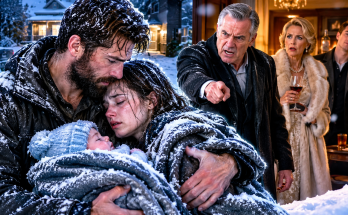
The night my husband left me unconscious on our living room floor, I was seven months pregnant, struggling to breathe, and begging him to save our baby.
His mother stood over me, crossed her arms, and said five words that would haunt me forever.
**”She’s faking.
Let her sleep.”**
Ethan hesitated.
For one brief second, I thought he would choose me.
Instead, he put his phone away.
That was the moment I understood something terrifying about my marriage: the man who had promised to protect me was capable of watching me die if his mother told him it was inconvenient to save me.
But what I didn’t know was that my medical emergency hadn’t happened by accident.
Someone had been secretly giving me a dangerous substance for weeks.
Someone had deliberately hidden information about my pregnancy.
And someone had already made plans for a baby I didn’t even know I was carrying.
**By the time I discovered the truth, three people I loved had betrayed me—and one of my unborn sons had already been promised to another family.**
But to understand how that happened, I need to tell you about the life I thought I had.
My name is Claire Morgan.
I’m thirty-two years old, and until everything fell apart, I lived with my husband, Ethan, in a sunny second-floor apartment outside Sacramento, California.
I was an architect at a respected design firm.
Ethan worked in sales for a technology company.
We’d been married for five years.
Like most couples, we had arguments.
We worried about bills, disagreed about vacations, and occasionally went to bed angry.
But I believed we loved each other.
After nearly three years of trying to have a baby, including fertility appointments, painful disappointments, and more negative pregnancy tests than I could count, I finally became pregnant.
I still remember the morning I found out.
It was raining.
Ethan was making coffee when I walked into the kitchen holding the positive test.
He stared at it for several seconds.
Then he grabbed me around the waist, lifted me off the floor, and spun me in a circle.
“We did it, Claire!”
I laughed and cried against his shoulder.
For the first time in years, I felt as though our future had finally opened its doors.
Our refrigerator soon became covered with ultrasound photographs, nursery paint samples, and baby-name lists.
We debated everything from stroller brands to whether our child would inherit my stubbornness or Ethan’s terrible singing voice.
There was only one person who seemed determined to ruin our happiness.
My mother-in-law.
Linda Morgan was sixty-one, impeccably dressed, and possessed the kind of smile that could make an insult sound like a compliment.
She had disliked me from the moment Ethan introduced us.
My career was too demanding.
My cooking wasn’t traditional enough.
I spent too much money on clothes.
I didn’t spend enough time cleaning.
Once, during Thanksgiving dinner, she announced that women who worked as much as I did usually ended up with “neglected children and wandering husbands.”
Ethan merely chuckled.
“Mom’s old-fashioned,” he said afterward.
That was his standard defense.
**”She means well, Claire.
You know how Mom is.”**
I knew exactly how Linda was.
She was controlling, manipulative, and incapable of accepting that her son had built a life outside her influence.
But pregnancy changed her.
Or at least, I thought it did.
Suddenly, she was bringing homemade meals to our apartment.
She called after my doctor’s appointments.
She knitted little blue blankets and cried whenever she touched my growing stomach.
“I’m finally going to have a grandchild,” she whispered one afternoon.
Something about her sudden affection felt unnatural.
Still, I wanted peace.
I wanted my child to have a loving grandmother.
So I allowed myself to believe Linda had changed.
And that was my first mistake.
***
By my seventh month, strange things had started happening.
I was constantly exhausted.
My ankles swelled so badly that I sometimes couldn’t get my shoes on.
I developed headaches that felt like someone was tightening a steel band around my skull.
Then came the dizzy spells.
At first, they were brief.
I would stand up from my desk and see black spots dancing across my vision.
Sometimes my heart raced while I was sitting perfectly still.
My obstetrician had warned me to monitor my symptoms carefully, especially because of my rising blood pressure.
But whenever I told Ethan I was worried, his response was dismissive.
“Pregnant women feel weird all the time, Claire.”
Or worse:
“You’re letting your anxiety get out of control.”
Meanwhile, Ethan’s behavior was changing.
He began missing prenatal appointments.
He carried his phone everywhere.
He smiled at messages he wouldn’t explain.
When I asked who he was texting, he said work.
Sometimes he disappeared for hours, claiming he had meetings with clients.
I thought he might be having an affair.
That possibility broke my heart.
But the truth was far worse.
My cousin Tessa was the one person I confided in.
Tessa and I were practically sisters.
We had grown up together, shared bedrooms during summer vacations, and comforted each other through everything from teenage heartbreak to family funerals.
When my father died five years earlier, she stayed beside me through the entire funeral.
When I struggled to conceive, she brought flowers and listened while I cried.
Tessa had suffered her own heartbreak.
She had undergone several unsuccessful fertility treatments, and I knew how deeply she wanted a child.
When I became pregnant, she hugged me and said, “At least one of us is getting our miracle.”
There had been sadness in her eyes.
But I thought it was understandable.
I never imagined what that sadness would become.
Tessa had also recommended the private prenatal clinic where I’d received most of my early pregnancy care.
She worked there as a patient-services coordinator.
“They’re the best,” she assured me.
“I’ll make sure you’re treated like family.”
I trusted her completely.
That was my second mistake.
***
The night everything changed was Tessa’s thirty-fourth birthday.
She had organized dinner at a neighborhood restaurant and practically begged me to attend.
I told her I wasn’t feeling well.
“Just come for an hour,” she pleaded.
“I can’t celebrate without you.”
Surprisingly, Ethan agreed.
“You need to get out of the apartment,” he told me.
So I put on a loose blue maternity dress, brushed my hair, and tried to ignore the throbbing pain behind my eyes.
The restaurant was warm and crowded.
Within twenty minutes, I felt terrible.
The smell of grilled onions made me nauseous.
My hands tingled.
My vision blurred.
I leaned toward Ethan.
“Something’s wrong.
I need to go home.”
He barely looked up from his phone.
“Can we at least wait until they cut the cake?”
“Ethan, I’m serious.”
He sighed loudly.
Across the table, Tessa watched us.
Her expression was difficult to read.
“Maybe some water will help,” she suggested.
She slid a glass toward me.
I took a few sips.
Twenty minutes later, I was in the bathroom gripping the sink because the room seemed to be moving.
I splashed cold water on my face.
Nothing helped.
When I returned, I could barely stand.
“Please,” I whispered.
“Take me home.”
Ethan finally agreed.
He spent the entire drive looking irritated.
When we reached our apartment building, the elevator was broken.
We had to climb the stairs.
Halfway up, my knees buckled.
I caught the railing.
“Ethan…”
He turned.
“What’s wrong now?”
My chest tightened.
I couldn’t draw a full breath.
“Call an ambulance.”
He reached for his phone.
Then it rang.
Linda.
Instead of calling 911, he answered his mother.
Less than fifteen minutes later, Linda was standing over me in our living room.
By then, I was lying beside the couch.
My hands were numb.
My heartbeat felt violent and irregular.
Every breath took enormous effort.
“Pregnancy isn’t an illness,” Linda announced.
“I worked until the day Ethan was born.”
“Mom, she says she needs an ambulance,” Ethan muttered.
Linda laughed.
“An ambulance?
For this?
Don’t be ridiculous.”
I tried to reach for him.
“Please…
Ethan…”
He crouched beside me.
For the first time, he looked frightened.
Then Linda placed a hand on his shoulder.
**”Don’t do it, son.
She’s faking.
Let her sleep.”**
I stared at him.
He looked from me to his mother.
Then he stood.
The betrayal was so complete that I barely understood it.
Linda leaned toward me while Ethan walked into the kitchen.
“You’ve used this pregnancy to control him long enough,” she whispered.
“He’s finally starting to see what you really are.”
I wanted to scream.
But the room was disappearing.
Darkness swallowed the furniture, the windows, and finally Linda’s face.
The last thing I heard was her voice.
“She’ll wake up when she realizes nobody is paying attention.”
Then nothing.
***
I woke to the sound of a heart monitor.
Bright lights glowed above me.
Something cold was taped to my hand.
I tried to sit up.
A nurse hurried to my bedside.
“Easy, Claire.
You’re in the hospital.”
My hands immediately flew toward my stomach.
“My baby?”
“The baby has a heartbeat,” she reassured me.
“But you’ve been very sick.”
She explained that I had experienced a severe pregnancy complication involving dangerously high blood pressure and reduced blood flow.
My condition had been life-threatening.
“Who brought me here?”
I whispered.
“A neighbor called emergency services.
She heard something in the hallway and found your apartment door open.”
My stomach twisted.
“Where’s my husband?”
The nurse’s face changed.
“No one came with you.”
I stared at her.
Surely there had been some misunderstanding.
I reached for my phone.
Two messages from Ethan.
The first said:
“Let me know when you wake up.”
The second read:
“Mom thinks visitors will upset you.
I’ll stay away until you’re calmer.”
I read them again.
Then again.
**My husband had abandoned me unconscious and somehow decided I was the one behaving irrationally.**
I placed the phone facedown.
A few minutes later, the nurse returned with a physician.
“Claire, I’m Dr.
Maya Grant.”
She was in her early forties, with dark hair pulled into a loose bun and eyes that suggested she rarely missed anything.
She pulled up a chair.
“I need to discuss your ultrasound.”
My heart began pounding.
“Is my baby okay?”
“We’re monitoring the pregnancy very closely,” she said.
Then she hesitated.
“There’s something your previous imaging apparently missed.”
She turned the ultrasound screen toward me.
I saw a tiny head.
Then another.
Two bodies.
Two beating hearts.
I stared.
“What am I looking at?”
Dr.
Grant took my hand.
**”Claire, you’re carrying twins.
Two boys.”**
For one glorious second, happiness overwhelmed everything.
Two babies.
After years of infertility, I was carrying two sons.
I started crying.
Then I noticed Dr.
Grant wasn’t smiling.
“One of them is significantly smaller,” she said.
“His heartbeat is weaker, and we’re concerned about his blood flow.”
My happiness turned instantly into terror.
“Is he going to die?”
“We’re going to do everything possible to protect both babies.”
I covered my stomach with trembling hands.
Two little boys.
Two lives depending on me.
And their father had left us helpless on the floor.
I thought that was the worst revelation possible.
I was wrong.
Dr.
Grant glanced toward the door.
“Claire, there’s something else.”
She showed me a laboratory report.
“Your blood contains an unexpected substance.”
I frowned.
“What substance?”
“A prescription compound that can affect circulation and blood pressure.
It wasn’t among the medications you reported taking.”
“I haven’t taken anything like that.”
“Are you certain?”
“Absolutely.”
She studied me.
“Has anyone been preparing food or drinks for you recently?”
The question made my stomach drop.
I remembered Linda’s homemade soup.
Every afternoon for three weeks, she’d brought another container.
Chicken soup.
Vegetable soup.
Beef stew.
She always insisted I finish everything.
“It’s good for the baby,” she would say.
And Ethan always made sure I ate it.
Suddenly, I felt sick for an entirely different reason.
“Doctor,” I whispered, “could someone have given me medication without my knowledge?”
Dr.
Grant didn’t answer immediately.
“That’s one possibility we need to investigate.”
Then she explained something even more disturbing.
The initial findings didn’t establish exactly how the substance had entered my body.
But follow-up testing, including an examination of earlier samples and longer-term exposure markers, might reveal whether I’d been exposed repeatedly.
An hour later, she returned with a toxicologist.
Their preliminary findings were concerning.
**This might not have been a single exposure.**
I stared at them.
“How long?”
“We can’t establish the precise timeline yet,” the toxicologist said carefully.
“But there’s reason to investigate whether this has been happening over several weeks.”
Several weeks.
Exactly when Linda began bringing homemade meals.
Exactly when my dizziness started.
Exactly when Ethan began telling me I was imagining things.
My phone vibrated.
Another message from Ethan.
“Mom says you need to stop making accusations.
We’re coming to get you tomorrow.”
I looked at Dr.
Grant.
And for the first time, I said the words out loud.
**”I think someone has been making me sick.”**
***
That evening, a hospital social worker named Angela came to my room.
She spoke gently but directly.
“Claire, do you feel safe returning home?”
I thought about Ethan turning away from me.
Linda’s mocking voice.
The soup containers in our refrigerator.
“No,” I said.
It was the hardest and most honest answer I’d given in years.
Angela helped me create a safety plan.
The hospital restricted access to my medical information.
My chart was marked so that staff would not release updates or permit visitors without my consent.
She also explained how to contact law enforcement and seek legal protection.
Dr.
Grant documented my condition and the toxicology concerns.
Nothing could undo what had happened.
But for the first time, people were listening.
The next morning, I met the woman who had saved my life.
Her name was Marisol Alvarez.
She was sixty-three, a retired emergency dispatcher, and lived in the apartment directly below ours.
I recognized her immediately.
We’d exchanged greetings in the building for years.
Sometimes she left homemade cookies outside neighbors’ doors during the holidays.
But we’d never been particularly close.
When she entered my hospital room, she carried a small vase of yellow daisies.
“Well,” she said, examining me, “you certainly know how to frighten an old woman.”
I started crying.
She set the flowers down and hugged me.
“Thank you,” I whispered.
“You saved my babies.”
She pulled back.
“Babies?”
I nodded.
“Twins.”
Her eyes widened.
Then she smiled through tears.
“Good heavens.
Two of them.”
We sat together for nearly an hour.
Finally, I asked what had happened that night.
Marisol’s expression changed.
“I heard a heavy thud above me,” she explained.
“Then I heard a woman’s voice.”
“Linda?”
“I believe so.”
“What was she saying?”
Marisol hesitated.
“She said something about you learning your lesson.”
My stomach tightened.
“Then I heard footsteps and the apartment door close.”
“Did you see Ethan?”
“No.
But I looked through my peephole when I heard people on the stairs.”
She paused.
“I saw your husband walking beside an older woman.”
My throat closed.
“They left?”
Marisol nodded.
“I waited a minute because I thought perhaps someone was coming back.
Then I heard another noise upstairs.”
She went to investigate.
Our apartment door was slightly open.
I was lying motionless near the couch.
She called 911 immediately.
“Your lips looked wrong,” she whispered.
“I was afraid I was too late.”
I gripped her hand.
“Why was the door open?”
“I don’t know, sweetheart.”
She stared toward the window.
“But there’s something else.”
I waited.
“Our building has security cameras near the entrance and stairwell.
I asked the manager to preserve the footage.”
I looked at her.
“Why?”
“Because I spent thirty-two years listening to people call for help.”
Her voice hardened.
“And I know the difference between a medical emergency and someone being abandoned.”
***
My first call after Marisol left was to Priya Desai.
Priya was my closest friend at work, a brilliant architect who could recognize a structural problem from a drawing and a personal disaster from the way someone said hello.
She arrived within an hour.
When I told her everything, she didn’t interrupt.
She simply listened.
Then she stood and picked up her phone.
“What are you doing?”
I asked.
“Finding you an attorney.”
“Priya—”
“No.
Absolutely not.”
Her voice shook with anger.
“That man abandoned you while you were pregnant.
His mother may have been secretly medicating you.
And you’re worried about making a scene?”
I lowered my eyes.
She sat beside me.
“Claire, you don’t have to protect people who refused to protect you.”
Those words broke something open inside me.
I began telling her things I’d never admitted aloud.
How Ethan controlled our joint savings.
How Linda had gradually taken over grocery shopping.
How I had stopped inviting certain friends over because Linda criticized them.
How Ethan made me feel guilty whenever I questioned his behavior.
Priya listened, then asked a question that startled me.
“When was the last time you looked closely at your bank statements?”
I blinked.
“What?”
“Your accounts.
Have you checked them?”
“Ethan handles most of the household payments.”
“Then we should look.”
I gave her permission to help me review the accounts I could access.
What we discovered was alarming.
Over the previous six months, Ethan had transferred almost $84,000 from our joint savings into accounts I didn’t recognize.
There were also substantial credit-card payments and several transfers labeled as business consulting expenses.
When I called our bank, they confirmed the transactions had been made through Ethan’s authorized access.
The money was nearly gone.
I felt as if the hospital bed had disappeared beneath me.
“Why would he do this?”
Priya stared at the screen.
“That’s what we need to find out.”
One transfer caught her attention.
It had been made to a company called Northstar Family Solutions.
The name meant nothing to me.
At the time, I assumed it was related to Ethan’s work.
I couldn’t have been more wrong.
***
Two days later, Ethan appeared at the hospital.
He arrived carrying white roses and looking like a man who hadn’t slept.
The nurses called my room to ask whether I wanted to see him.
Part of me wanted to scream no.
Another part wanted answers.
I allowed him in.
He stood in the doorway.
“Claire.”
I said nothing.
He approached slowly.
“Thank God you’re okay.”
I almost laughed.
“You didn’t seem particularly concerned when you left me unconscious.”
He flinched.
“I didn’t know it was that serious.”
“I told you I couldn’t breathe.”
“Mom said—”
“Stop.”
My voice was so sharp that he froze.
“Don’t you dare tell me what your mother said.”
He lowered the flowers.
“I panicked.”
“You didn’t panic, Ethan.
You made a decision.”
He rubbed his forehead.
“Can we please talk about this without attacking each other?”
I stared at him.
“Do you know we’re having twins?”
His face changed.
It happened so quickly that someone else might have missed it.
But I knew my husband.
His eyes widened, then immediately narrowed.
“Twins?”
“Two boys.”
He looked toward the window.
“Wow.”
I waited for excitement.
Shock.
Questions.
Anything.
Instead, he whispered:
“Are they both okay?”
I felt a flicker of hope.
“One of them is very small.
He’s struggling.”
Ethan’s jaw tightened.
“Which one?”
I frowned.
“What?”
“Which baby is having problems?”
“Why does that matter?”
He shook his head.
“It doesn’t.
I just—I’m trying to understand.”
I watched him carefully.
“Ethan, did you know there were two babies?”
He looked directly at me.
“No.”
The answer came too quickly.
Then he reached for my hand.
“Claire, please.
Let’s go home when the doctors release you.
Mom will apologize.”
I pulled away.
“Your mother may have been giving me something dangerous.”
His expression hardened instantly.
“That’s ridiculous.”
“Doctors found an unexpected medication in my blood.”
“Then maybe you took something without remembering.”
I stared at him.
“Are you seriously suggesting that?”
“I’m saying you’re stressed.”
There it was.
The same explanation.
The same attempt to make me doubt myself.
I reached for the call button.
“I want you to leave.”
“Claire—”
“Now.”
He stood there for several seconds.
Then he placed the roses on the windowsill.
As he turned toward the door, he said something that stayed with me.
“Don’t make decisions you’ll regret. **You don’t understand how complicated this is.**”
I watched him leave.
Then I called Angela and revoked his visitation permission.
***
That afternoon, Detective Lena Brooks came to my room.
She was a practical woman with short gray-streaked hair and the calm expression of someone who had heard every excuse imaginable.
She explained that the police had received the hospital’s report and were investigating.
“I need to be clear,” she said.
“An unusual toxicology result doesn’t automatically prove someone poisoned you.”
“I understand.”
“But your medical findings, your account of being abandoned, and the possibility of repeated exposure give us serious concerns.”
I described the soup.
The dinner.
The stairwell.
Linda’s words.
Ethan’s messages.
When I finished, Detective Brooks asked about the private prenatal clinic.
“Who referred you there?”
“My cousin, Tessa.”
“Does she work there?”
“Yes.”
“What kind of work?”
“Patient services.
Scheduling, records, that sort of thing.”
The detective wrote something down.
“Was anyone from the clinic aware you were carrying twins?”
“I don’t know.
According to Dr.
Grant, none of my records mention twins.”
She looked up.
“That is unusual.”
I nodded.
“Dr.
Grant said it was very unusual.”
At seven months, a second baby should not have been overlooked throughout multiple properly performed examinations.
The hospital had requested my earlier imaging and reports.
So far, the materials received from the clinic appeared incomplete.
“I’ll look into that,” Detective Brooks said.
Then she asked a question that seemed unrelated.
“Did your husband have financial problems?”
I told her about the missing money.
And Northstar Family Solutions.
For the first time, her expression shifted.
“Northstar?”
“You know it?”
“I know the name.”
She closed her notebook.
“I don’t want to jump ahead of the evidence, Mrs.
Morgan.
But please don’t contact that company yourself.”
After she left, I stared at the ceiling.
Nothing made sense.
A possible poisoning.
Missing money.
A pregnancy that had somehow concealed an entire child.
And a detective who recognized the name of a company my husband had secretly paid.
I began to feel that the life I’d been living was only the surface of something much darker.
***
Three days later, Tessa came to see me.
The moment she entered my room, she burst into tears.
“Oh my God, Claire.”
She rushed to my bed and hugged me.
I clung to her.
After Ethan’s betrayal, I desperately needed someone familiar.
Someone who remembered the girl I’d been before marriage.
Tessa stroked my hair.
“I can’t believe he left you there.”
“I know.”
“And Linda!
That horrible woman.”
I nodded against her shoulder.
Then I told her about the twins.
Her body went strangely still.
“Twins?” she repeated.
“Two boys.”
She pulled back.
For a moment, she looked more frightened than surprised.
Then she smiled.
“Claire, that’s incredible.”
“I wish I could be happier.”
“Why?”
“One of them is very small.
His heartbeat isn’t as strong as it should be.”
Her eyes flickered toward the monitor.
“Which one?”
My stomach tightened.
Ethan had asked me exactly the same question.
“What do you mean?”
“The first baby or the second?”
I stared.
“How would I know which one is first?”
Tessa blinked.
“Sorry.
I guess I’ve spent too much time around medical terminology.”
She laughed nervously.
I tried to laugh too.
But something about that moment troubled me.
Then she reached into her purse.
“I brought you something.”
It was a soft knitted blanket.
Pale blue, with tiny white stars.
“I started making it months ago,” she said.
“I thought it would be for your little boy.”
I touched the fabric.
“It’s beautiful.”
Her eyes filled with tears.
“I’ve always wanted to make one for my own baby.”
Guilt washed over me.
I knew how much she’d suffered.
I squeezed her hand.
“One day, Tess.”
She nodded.
“One day.”
Then she changed the subject.
“I spoke to someone at the clinic.
They said the hospital is overreacting about your records.”
I frowned.
“You spoke to the clinic?”
“Of course.
I wanted to help.”
“They haven’t sent all the ultrasound images.”
Tessa shrugged.
“Those private offices are terrible with paperwork.”
“Dr.
Grant says there should have been evidence of twins much earlier.”
“Maybe the scans were unclear.”
I looked at her.
She was studying the blanket rather than my face.
“Maybe,” I said quietly.
Before leaving, she made another suggestion.
“Have you considered transferring to St.
Anne’s Women’s Pavilion?
It’s smaller, more comfortable, and they have a wonderful maternity team.”
“Dr.
Grant wants me monitored here.”
“But you might feel less stressed somewhere private.”
I shook my head.
“I’m staying.”
Her smile faded for an instant.
Then she kissed my cheek.
“Whatever makes you comfortable, sweetheart.”
After she left, I looked at the blanket.
For reasons I couldn’t explain, I no longer wanted it near my bed.
***
The following morning, Marisol returned.
She carried coffee for Priya and a manila envelope for me.
“The building manager finally gave the police the camera footage,” she said.
“And he let me see part of it.”
My heart accelerated.
“What did it show?”
“Your husband and his mother leaving the building.”
“I already know they left.”
Marisol nodded.
“Yes.
But there was something strange about the timing.”
She explained that Linda and Ethan had left our apartment shortly after I lost consciousness.
They reached the building entrance together.
Then Linda stopped.
She appeared to receive a phone call.
While Ethan waited near the car, Linda went back inside.
I stared.
“She came upstairs again?”
“Apparently.”
“Why?”
Marisol’s voice grew quieter.
“That’s what the police are trying to determine.”
The camera showed Linda returning to the stairwell.
Seven minutes later, she came back down.
She was carrying a small insulated bag.
My blood turned cold.
The same kind of bag she used to bring me soup.
“Did she take something from our apartment?”
“I don’t know.”
Marisol reached across the bed and took my hand.
“But Claire, listen carefully.”
I looked at her.
“There was another person at the building that night.”
“Who?”
“The cameras don’t show a clear face.
Someone wearing a dark coat entered through the side door before Linda arrived.”
I tried to remember the evening.
There had been a noise in the hallway.
A door opening.
Maybe footsteps.
But my memories were broken into pieces.
“Did that person come upstairs?”
“Yes.”
“Did they leave?”
Marisol hesitated.
“Not until after the ambulance took you away.”
I stared at her.
Someone else had been in the building.
Someone who had stayed long enough to watch the entire disaster unfold.
***
My condition stabilized over the next several days.
The hospital continued monitoring both babies closely.
The larger twin was growing reasonably well.
The smaller one remained a serious concern.
Dr.
Grant explained that the babies had differing growth patterns and that the smaller twin was receiving less support through the placenta.
She also warned me that early delivery might become necessary.
I began talking to my sons every evening.
It was embarrassing at first.
I’d rest my palms against my stomach and whisper:
“Hi, boys.
It’s Mom.”
Then I’d tell them about the world.
About sunshine after rain.
About pancakes on Sunday mornings.
About the little park near our apartment.
About the grandmother they’d never met—my mother, who had died when I was twelve.
I told them about my father, who had taught me to draw houses on graph paper and insisted that every good home needed one thing more important than beautiful windows.
“A safe foundation,” he’d always say.
At the time, I thought he meant concrete and steel.
Now I understood he meant something else.
I started calling the larger twin Jonah.
And the smaller one Eli.
Jonah had always been one of my favorite names.
Eli was short and gentle.
I didn’t tell anyone yet.
Those names belonged to us.
Just the three of us.
One night, while I was speaking softly to my stomach, a nurse named Harper entered.
She listened for a moment.
Then she smiled.
“You’re going to be a wonderful mother.”
Tears filled my eyes.
“How can you know?”
“Because you’re fighting for them before you’ve even met them.”
I looked down at my stomach.
“Some days I’m terrified.”
“Good mothers get scared, Claire.”
She adjusted my blanket.
“They just don’t let fear make all their decisions.”
I carried those words with me.
Especially when the next piece of evidence arrived.
***
A week after my hospitalization, Detective Brooks returned.
This time, she wasn’t alone.
A forensic accountant named Daniel Price accompanied her.
They asked whether I’d ever signed papers authorizing an adoption or guardianship arrangement.
I actually laughed.
“No.”
“Not during fertility treatment?”
“No.”
“Not while discussing estate planning?”
“Absolutely not.”
Detective Brooks exchanged a glance with Daniel.
Then she placed a copy of a document on my bed.
My name was printed at the top.
**CLAIRE MORGAN — MATERNAL CONSENT AND TRANSFER AUTHORIZATION.**
I stared at it.
“What is this?”
“An unsigned draft recovered during our investigation,” she explained.
“It appears to describe a proposed arrangement concerning a newborn.”
My hands went numb.
“Whose newborn?”
She hesitated.
“Yours.”
I looked closer.
The document referred to a male infant.
It included language about a private placement, a receiving family, and consent to be obtained following delivery.
At the bottom was a signature line bearing my name.
I stared at it.
“I never agreed to this.”
“We know.”
“Why would someone prepare it?”
“That’s one of the questions we’re investigating.”
I continued reading.
Then I saw a phrase that made me stop breathing.
**INFANT A.**
Not “the baby.”
Not “the child.”
Infant A.
I looked up.
“Why does it say Infant A?”
Detective Brooks didn’t answer immediately.
“Claire, when did you first learn you were carrying twins?”
“Here.
After I woke up.”
She nodded.
“We’re examining evidence suggesting that certain people may have known earlier.”
The room spun.
“Who?”
“We’re not ready to establish that conclusively.”
I gripped the paper.
“Detective, this is my child.”
Her expression softened.
“I know.”
“No, I don’t think you understand.
Someone made plans for my son before I even knew he existed.”
My voice cracked.
“Someone was planning to take him.”
Detective Brooks leaned forward.
“Claire, I need you to hear me clearly.
This document has no legal effect simply because someone drafted it.
No one can take your child through an unsigned paper like this.”
I nodded shakily.
“But somebody wanted to.”
“Yes,” she said.
“And we intend to find out who.”
***
The forensic accountant explained what he’d discovered about Northstar Family Solutions.
The company wasn’t a legitimate adoption agency.
It was a recently established consulting business with connections to private family-placement services.
Some of its transactions were suspicious.
Ethan had made payments to it.
But the money hadn’t all flowed in one direction.
Several large deposits had been made into an account linked to Ethan.
The amounts were staggering.
One payment alone was $120,000.
I stared at the figures.
“Where did that money come from?”
Daniel pointed to another document.
“The originating account belongs to a private holding company.”
“Who owns it?”
He glanced at Detective Brooks.
She nodded.
“That information is part of our ongoing investigation.”
I was furious.
“Everyone keeps telling me what I can’t know.”
“I understand,” the detective said.
“But we’re trying to build a case that won’t collapse because we moved too quickly.”
She let me sit with that for a moment.
Then she asked about the prenatal clinic again.
“Did anyone there ever tell you your pregnancy was high-risk because of twins?”
“No.”
“Did you ever see two heartbeats on a scan?”
“No.”
“Did you ever miss an appointment?”
“Only one, when Ethan said the clinic had rescheduled.”
“What happened?”
“He told me the doctor was sick and that I should rest at home.”
She wrote it down.
“Do you remember which appointment?”
“An anatomy scan follow-up.
Around twenty-one weeks.”
“Did they schedule another?”
“Yes.
But the ultrasound screen was turned away from me.
The technician said she was checking measurements.”
The detective looked at Daniel.
Something passed between them.
Then she said:
“Claire, we’re going to request the original imaging files—not just the copies in your chart.”
“Why?”
“Because digital images can contain information that doesn’t appear on printed reports.”
I looked down at the document again.
Infant A.
There had been a plan.
Someone had known about both my sons.
And somehow, everyone involved had kept that knowledge from me.
***
Two days later, Linda called.
I hadn’t spoken to her since the night I collapsed.
I considered ignoring the call.
Instead, I answered and activated the recording function on the advice of my attorney, who had helped me understand the applicable rules and the importance of documenting communications lawfully.
“Claire,” Linda said sharply.
“We need to settle this nonsense.”
I closed my eyes.
“What nonsense?”
“Your ridiculous accusations.”
“I’m in the hospital.”
“Yes, and you’ve turned that into a family scandal.”
I almost laughed.
“Linda, I could have died.”
“You were always dramatic.”
I felt my anger rising.
“Why didn’t you call an ambulance?”
“Because you weren’t dying.”
“How would you know?”
“Because I’ve seen women pretend to be sick before.”
I squeezed the phone.
“Doctors found a medication in my blood that I never knowingly took.”
Silence.
Then she said:
“Well, perhaps you should pay more attention to what you put in your mouth.”
My skin went cold.
“Did you put something in my food?”
“Don’t be absurd.”
“Then why did you bring me soup every day?”
“Because you couldn’t be bothered to cook.”
I took a breath.
“Linda, I know about the twins.”
Another silence.
Longer this time.
“What twins?” she finally asked.
“My sons.”
She exhaled sharply.
“Of course.
Two babies.
As if one wasn’t enough trouble.”
I sat upright.
“How did you know?”
“What?”
“How did you know I was carrying two babies before I told you?”
Linda stopped speaking.
I continued quietly.
“You just said two babies.”
“Because you told me!”
“No, Linda.
You asked what twins.
Then you said two babies.”
Her voice changed.
“You’re twisting my words.”
“How long have you known?”
“You’re making a mistake, Claire.”
“Who else knows?”
Her response came in a whisper.
**”You have no idea what you’re interfering with.”**
Then the call ended.
I sat motionless.
My hands were shaking so hard I almost dropped the phone.
I sent the recording to my attorney and reported the conversation to Detective Brooks.
It was the first time Linda had openly suggested that something bigger was happening.
And she sounded afraid.
Not of me.
Of someone else.
***
That night, I couldn’t sleep.
Rain tapped against the hospital window.
Machines hummed softly.
I watched Jonah’s and Eli’s heart rates on the monitor and thought about every person who had been allowed into my life.
Ethan.
Linda.
Tessa.
The clinic.
The doctors.
The nurses.
Someone had lied about something as fundamental as the number of children growing inside my body.
Someone had prepared an arrangement involving one of them.
Someone had been willing to risk my life.
And I couldn’t stop wondering whether all those things were connected.
Around midnight, my phone buzzed.
An unfamiliar number.
The message was only one sentence.
**”Ask why your twenty-week ultrasound was replaced.”**
I sat straight up.
A second message arrived.
“Don’t trust the printed records.”
I called the number.
It went directly to voicemail.
No name.
No explanation.
The next morning, I showed the messages to Detective Brooks.
She took screenshots and asked me to preserve the originals.
“Do you recognize the number?”
“No.”
She examined it.
Then she said, “We’ll find out who sent these.”
I wanted to believe we were finally getting closer to the truth.
But the next development nearly destroyed me.
***
On the eighteenth day of my hospitalization, Dr.
Grant entered my room during morning rounds.
She wasn’t smiling.
“Claire, I need you to remain calm.”
Those words instantly terrified me.
“Which baby?”
“The smaller twin.”
My hand flew to my stomach.
“What’s wrong with Eli?”
She paused at the name.
“Eli?”
I nodded.
“That’s what I’ve been calling him.”
Her expression softened briefly.
Then she continued.
“His blood-flow measurements have become more concerning.
We need to discuss the possibility of delivery sooner than we’d hoped.”
I stared at her.
“But it’s too early.”
“I know.”
“He can’t survive yet.”
“Babies born at this stage often can survive with intensive care, but there are significant risks.
We’re going to evaluate everything carefully.”
I started crying.
“Please don’t let him die.”
Dr.
Grant took my hand.
“Claire, we’re going to give both your boys the best chance we can.”
For the next two days, specialists monitored us constantly.
I tried to stay calm.
I listened to music.
I prayed, although I hadn’t prayed regularly in years.
I talked to Jonah and Eli.
I told them I was waiting.
That they had a mother who loved them.
That they deserved to meet the world.
Then, early one morning, the monitors changed.
Nurses hurried into my room.
Dr.
Grant followed.
The smaller twin’s condition had deteriorated.
My own blood pressure was dangerously unstable again.
The medical team explained that continuing the pregnancy had become riskier than delivering.
I remember signing consent forms.
I remember Priya squeezing my hand.
I remember Marisol kissing my forehead.
And I remember looking at Dr.
Grant.
“Please save both of them.”
She nodded.
“We’re going to do everything we can.”
As they wheeled me toward the operating room, my phone began ringing.
Tessa.
Then Ethan.
Then Linda.
Three names flashing across the screen.
Three people demanding access to me at the exact moment my sons were fighting to live.
I turned the phone off.
**For the first time in my marriage, I chose my children without asking anyone’s permission.**
***
The operating room was freezing.
Bright lights shone above me.
A blue curtain separated my face from the doctors working to deliver my babies.
Someone asked if I was comfortable.
I nodded even though I was terrified.
Priya had been allowed to remain nearby briefly before the procedure began, but when the medical team prepared for delivery, I was surrounded by nurses and physicians.
I felt strangely alone.
Then I remembered something my father used to say when teaching me to design buildings.
“Strength doesn’t mean never moving, Claire.
Even the strongest structures have to bend when the storm comes.”
I closed my eyes.
“I’m bending, Dad,” I whispered.
“Please don’t let me break.”
Then I heard a doctor say:
“First baby delivered.”
A tiny cry pierced the room.
It was thin and sharp and impossibly beautiful.
I started sobbing.
“Is he okay?”
“Your first boy is here.”
Jonah.
My beautiful Jonah.
Then the room became tense.
I heard quick instructions.
Footsteps.
A pause that felt endless.
“Second baby delivered.”
Silence.
I waited.
No cry.
“Why isn’t he crying?”
No one answered immediately.
My heart began pounding.
“Please,” I whispered.
“Please, somebody tell me.”
I heard movement near the neonatal team.
Someone said, “Come on, little guy.”
I couldn’t see him.
I couldn’t touch him.
I could only wait.
Those seconds felt longer than the previous thirty-two years of my life.
Then I heard a tiny sound.
Not quite a cry.
More like a fragile squeak.
But it was there.
A nurse appeared beside my head.
“Claire, your second boy is receiving help breathing.”
“Is he alive?”
“Yes.”
I started crying again.
“His name is Eli.”
The nurse smiled.
“Then we’re going to take very good care of Eli.”
Both boys were rushed to the neonatal intensive care unit.
I didn’t get to hold them.
I barely saw their faces.
But I heard two things before exhaustion swallowed me.
Jonah was breathing with assistance.
And Eli was still fighting.
***
When I woke after surgery, Priya was sitting beside my bed.
Her eyes were red.
“Hey, Mama.”
I tried to speak.
“My boys?”
“They’re in the NICU.”
“Both?”
“Both.”
I closed my eyes.
Relief rolled through me so powerfully that I couldn’t stop crying.
Priya told me Jonah weighed a little over three pounds.
Eli weighed significantly less.
Both needed specialized care.
Eli’s condition was especially fragile.
But they were alive.
I kept repeating those words.
They were alive.
Hours later, a nurse helped me visit the NICU.
The room was filled with soft electronic sounds.
Tiny incubators stood beneath warm lights.
Doctors and nurses moved between them with careful, practiced movements.
And there, surrounded by tubes and wires, were my sons.
Jonah had dark hair flattened against his tiny head.
His fingers curled like little question marks.
Eli was so small that I could barely comprehend how a human being could fit inside such a fragile body.
I placed my hand through the incubator opening.
His fingers moved against mine.
A nurse smiled.
“He knows you’re here.”
I leaned close.
“Hi, Eli.”
Tears ran down my face.
“I’m your mom.”
His tiny hand curled around my finger.
And in that moment, everything else vanished.
Ethan.
Linda.
The lies.
The fear.
There was only a little boy fighting to stay alive.
And a promise I made to him.
**”Nobody is ever going to take you away from me.”**
I had no idea how close someone had already come.
***
Three days after the birth, Detective Brooks returned.
She looked exhausted.
But for the first time, she also looked certain.
“We found the original ultrasound files.”
My heartbeat accelerated.
“And?”
She placed several printed images in front of me.
They were dated months earlier.
I recognized the clinic’s logo.
The first image showed my pregnancy at thirteen weeks.
But it wasn’t the image I’d been given.
There were two gestational structures.
Two fetuses.
Two heartbeats.
My vision blurred.
“They knew.”
Detective Brooks nodded.
“Yes.”
I turned another page.
The twenty-week anatomy scan showed both babies clearly.
Their measurements.
Their positions.
Even the size difference that had later become dangerous.
I stared at the images.
“Why did they tell me there was only one?”
“Because someone altered the records you were shown.”
My hands shook.
“Who?”
“We traced changes in the clinic’s electronic system to a staff account.
Some records were exported, altered, and reuploaded.”
“Whose account?”
She hesitated.
Then she told me.
“Your cousin’s.”
Tessa.
I stared at her.
“No.”
“Claire—”
“No, that’s impossible.”
Detective Brooks waited.
“Tessa would never do that.”
“We’ve obtained evidence connecting her account to the changes.”
“Someone could have used her login.”
“That’s possible.
We’re investigating the extent of her involvement.”
I shook my head.
I thought of the birthdays.
The sleepovers.
The funeral where she’d held my hand.
The nights she’d listened while I cried about infertility.
“No.”
My voice broke.
“She loves me.”
Detective Brooks looked genuinely sad.
“Sometimes the people we trust most are the ones who know exactly where we’re vulnerable.”
Then she showed me something else.
A digital scheduling record.
My twenty-one-week follow-up—the appointment Ethan claimed had been canceled—had never been canceled at all.
I had been marked as a no-show.
The clinic had recorded repeated attempts to contact me.
But the phone number listed wasn’t mine.
It belonged to Ethan.
I stared at the screen.
Tessa had access to the records.
Ethan had controlled the communication.
Linda had controlled my food.
And the three of them had known about the twins.
My stomach turned.
“What were they planning?”
Detective Brooks took a breath.
“Claire, before I answer that, I need to ask whether Tessa ever discussed adoption with you.”
“No.”
“Not even indirectly?”
I thought carefully.
Then I remembered something.
A conversation six months earlier.
Tessa and I had been sitting on my balcony.
She’d just received another negative fertility result.
“I don’t think I’ll ever have a baby,” she’d said.
I’d hugged her.
“There are other paths.”
“Like adoption?”
“Of course.”
She’d stared at my stomach.
Then she’d asked:
**”If you ever had more than one baby, would you ever consider letting someone in the family raise one?”**
At the time, I’d laughed.
“Tessa, I barely managed to get pregnant with one.”
She’d smiled.
“Just a hypothetical.”
Now that memory felt like a knife sliding between my ribs.
I looked at Detective Brooks.
“Oh my God.”
***
The truth emerged over the following weeks.
It didn’t come all at once.
It came in documents, messages, bank records, witness statements, and pieces of digital evidence that gradually formed a picture so monstrous I struggled to believe it.
Tessa had known I was carrying twins since my first trimester.
She had access to the clinic’s records and had exploited that access, working with another employee who later admitted helping alter my reports.
But knowing about the twins wasn’t enough.
Tessa wanted one of them.
For years, she had struggled with infertility.
Her relationship with her husband, Mark, had deteriorated under the strain.
He still wanted a family.
She feared he would leave.
She also had access to a substantial trust left by her grandfather, though much of her available money had been tied up in investments and fertility expenses.
At some point, desperation had turned into obsession.
Tessa began speaking with Ethan.
I still don’t know exactly who first suggested the arrangement.
Both later tried to blame the other.
But the evidence showed that they had discussed it for months.
Ethan was drowning in secret debt.
He had lost money on speculative investments and used our savings to cover the losses.
His sales job wasn’t as secure as he’d claimed.
He was terrified I would discover the truth.
Tessa offered him money.
A great deal of money.
In exchange, she wanted one of the twins.
Linda became involved because Ethan told her what Tessa was proposing.
And instead of being horrified, she saw an opportunity.
Two babies would be expensive.
Two babies would demand more of Ethan’s time.
Two babies, in Linda’s mind, would make me even harder to remove from his life.
Tessa’s proposal offered them something they all wanted.
Ethan would receive money.
Linda would regain influence over her son.
Tessa would finally have a baby.
And I would be kept in the dark.
The original plan was breathtakingly cruel.
They intended to convince me that I’d delivered only one living baby.
The other child would disappear into a supposedly private medical and family-placement arrangement.
The altered prenatal records were meant to support that deception.
The unsigned documents Detective Brooks had shown me were early drafts of the fraudulent paperwork.
The scheme involved attempts to obtain my signature under circumstances where I might not fully understand what I was signing.
They had even discussed presenting forms while I was exhausted and recovering from delivery.
Tessa had been telling her husband that they were pursuing a private gestational-surrogacy arrangement.
She claimed the birth mother wanted complete anonymity until delivery.
Mark believed he was preparing to become a father through a legitimate process.
He had no idea the baby Tessa expected to bring home was one of mine.
But there was a problem.
I was healthy, alert, and actively involved in every aspect of my pregnancy.
They couldn’t simply make one child disappear while I was asking questions.
So they began trying to make me appear unreliable.
Anxious.
Confused.
Medically unstable.
Someone whose husband could claim to be making decisions in her best interest.
That was where the substance in my blood came in.
***
The investigators eventually established that Linda had repeatedly brought me food containing a non-prescribed medication.
The exact timeline required expert analysis and wasn’t reconstructed from a single blood test.
But the evidence included preserved food samples, pharmacy records, messages, and later laboratory findings consistent with repeated exposure.
Linda claimed she’d believed the medication was harmless.
She said Tessa had told her it would calm me.
Then, when her story changed, she insisted Ethan had requested it.
Ethan claimed he hadn’t understood the danger.
Tessa denied everything.
But a series of messages among them painted a different picture.
One message from Linda read:
“She complained about dizziness again.”
Tessa replied:
“Keep things normal.
We need her to trust us.”
Another message, sent by Ethan, said:
“She wants another appointment.
What do I tell her?”
Tessa answered:
“Tell her the clinic is booked.
I’ll handle it.”
The messages made me physically sick.
But one exchange was worse.
It occurred the morning of Tessa’s birthday dinner.
Ethan had written:
“She’s not feeling well enough to go.”
Tessa replied:
“Get her there.
We need tonight to happen.”
Then Linda sent:
“Don’t let her call emergency services unless you have no other choice.”
I stared at those words for a long time.
They had known.
They’d known I was sick.
They’d known I was frightened.
And they had still insisted I attend that dinner.
Detective Brooks explained that investigators believed the group had planned to direct my care toward St.
Anne’s Women’s Pavilion, where Tessa had established contacts and where they hoped the false prenatal records would receive less scrutiny.
But I had collapsed earlier than expected.
When I begged Ethan to call an ambulance, he hesitated because doing so would surrender control of the situation.
Linda intervened.
And when they left me unconscious, they apparently believed I would either recover or remain out of sight long enough for them to decide what to do next.
They had gambled with my life.
With Jonah’s life.
With Eli’s life.
And all for money and a child they had no right to claim.
***
When I heard that Tessa had been arrested, I felt almost nothing.
I had spent so many days crying that something inside me seemed empty.
Ethan was arrested as well.
Linda followed after additional evidence tied her directly to the repeated administration of the substance.
The clinic employee who helped alter my records agreed to cooperate with investigators.
Several others faced scrutiny over their roles in the attempted placement scheme.
I filed for divorce.
My attorney obtained protective orders and began the process of securing my finances and parental rights.
The criminal case would take time.
There were hearings, motions, forensic reviews, and endless discussions about evidence.
I learned that justice wasn’t a dramatic moment when a judge slammed a gavel.
It was slow.
Exhausting.
Complicated.
Sometimes infuriating.
But each morning, I woke knowing something important.
My sons were alive.
And they were with me.
Jonah grew stronger steadily.
He learned to tolerate his feedings and gradually needed less respiratory support.
Eli’s progress was slower.
Some days, he seemed stronger.
Other days, he frightened us.
Once, a nurse called me during the night because his breathing had become unstable.
I arrived at the NICU in tears.
Marisol came with me.
We stood beside his incubator while the medical team worked.
I pressed my palm against the transparent wall.
“Come on, sweetheart.”
My voice broke.
“You’ve fought too hard to stop now.”
Marisol wrapped an arm around my shoulders.
“He’s stubborn.”
I looked at her.
She smiled faintly.
“Must get that from his mother.”
I laughed through my tears.
And somehow, we survived another night.
***
Two months after their birth, Jonah was nearly ready to go home.
Eli still needed more time.
I had been discharged from the hospital weeks earlier and was staying in Priya’s guest room.
The apartment I’d shared with Ethan no longer felt safe.
I couldn’t imagine returning to a place where I’d begged for help and been abandoned.
Priya never complained about the late-night phone calls or the piles of paperwork covering her kitchen table.
Marisol visited almost every day.
Sometimes she drove me to the NICU.
Sometimes she brought dinner.
Sometimes she simply sat beside me in silence.
One afternoon, while we were folding tiny baby clothes, I asked her something I’d been wondering for weeks.
“Why did you come upstairs that night?”
She looked surprised.
“I told you.
I heard a thud.”
“I know.
But most people would have ignored it.”
Marisol folded a tiny white onesie.
Then she became very quiet.
“My daughter died twelve years ago.”
I froze.
“I didn’t know.”
“She was twenty-seven.”
Her voice was steady, but her fingers trembled.
“She called me one night because she didn’t feel well.
She said she was having trouble breathing.”
I stared at her.
“I was working.
I told her to call an ambulance.”
Marisol swallowed.
“She said she didn’t want to make a fuss.”
My throat tightened.
“By the time her roommate found her, it was too late.”
I reached for her hand.
“Marisol…”
She shook her head.
“After that, I promised myself I would never ignore someone who might need help.”
Tears filled my eyes.
“You saved three lives.”
She looked at me.
“Maybe.”
Then she smiled sadly.
“But in a strange way, you saved a little piece of mine too.”
That afternoon, I asked whether she would consider being part of the boys’ lives.
Not simply as our former neighbor.
As family.
She cried.
Then she said yes.
***
I thought the worst revelations were behind me.
The evidence against Ethan, Linda, and Tessa was substantial.
The hospital had reported the suspected poisoning.
The altered prenatal records had been recovered.
The financial arrangement was under investigation.
I had begun rebuilding my life.
Then Detective Brooks called.
“Claire, there’s something we need to discuss in person.”
My chest tightened.
“What happened?”
“It’s about the night you collapsed.”
I sat down.
“Did you find the unidentified person from the security footage?”
“Yes.”
“Who was it?”
She paused.
“I’d rather show you.”
***
The next morning, I went to the detective’s office with my attorney.
Detective Brooks placed a laptop on the table.
“We’ve enhanced portions of the building footage and compared it with additional recordings.”
She clicked play.
The screen showed the side entrance of our apartment building.
A person in a dark coat entered.
The hood concealed most of the face.
The timestamp was 8:47 p.m.
Minutes before Linda arrived.
The person climbed the stairs.
Then disappeared from view.
Detective Brooks switched to footage from another camera farther down the hallway.
The person stopped outside my apartment.
Waited.
Then used a key.
I leaned forward.
“A key?”
She nodded.
The figure entered.
A moment later, the hood slipped.
I saw blond hair.
A familiar profile.
A face I’d known since childhood.
**Tessa.**
I stopped breathing.
My cousin had been inside my apartment while I was unconscious.
Before Linda returned.
Before Marisol found me.
Before the ambulance arrived.
I stared at the screen.
“What was she doing?”
Detective Brooks opened another file.
“This is where the timeline becomes especially important.”
The footage showed Tessa leaving our apartment.
She was carrying a small bag.
She looked down the hallway, then moved toward the stairs.
A few moments later, Linda appeared.
They exchanged something.
A small object.
Then Tessa disappeared through the side entrance.
I stared.
“What did she give Linda?”
“We believe it was a storage device containing documents and medical records.”
My skin prickled.
Then Detective Brooks showed me a recovered message.
It had been sent from Tessa’s phone to Linda at 8:58 p.m.
**”The apartment is clear.
Take the food containers.
Leave nothing behind.”**
I couldn’t speak.
Linda hadn’t returned upstairs because she cared whether I was alive.
She had returned to remove evidence.
And Tessa had been there to help.
The camera continued playing.
A few minutes later, Tessa reappeared at the side entrance.
She didn’t leave.
Instead, she stood in the shadows.
Waiting.
Then the ambulance arrived.
She watched the paramedics carry me out.
Watched them load me inside.
Watched the doors close.
And only then did she walk away.
I covered my mouth.
The woman who had hugged me in the hospital.
The woman who had brought a knitted blanket.
The woman who had cried over my babies.
**She had stood in the darkness and watched strangers carry me away, knowing exactly what had happened to me.**
But Detective Brooks wasn’t finished.
“Claire, we recovered more information from Tessa’s devices.”
She opened a document.
It was titled:
“PLACEMENT PLAN — INFANT A.”
Below the heading was a set of instructions.
Names.
Dates.
A proposed private medical facility.
A receiving family.
And a contingency plan in case I became aware of the twin pregnancy before delivery.
My eyes scanned the page.
Then I saw a sentence that made the room go silent.
**”If the mother becomes aware of the second fetus, explain that Infant B is nonviable and proceed with the placement of Infant A.”**
I stared.
My lungs seemed to stop working.
They hadn’t merely planned to hide a baby.
They had planned to tell me one of my sons had died.
Not because he was dead.
But because someone else wanted to take him home.
I pressed my hands against my face.
“Oh my God.”
My attorney touched my shoulder.
I couldn’t stop shaking.
**They had prepared to make me mourn a living child.**
And the baby they had planned to take was Jonah.
My stronger son.
The little boy who had cried first in the operating room.
The boy whose tiny fingers had already learned to curl around mine.
They had intended to leave me with Eli, whose survival had been uncertain.
And if Eli had died?
I might have spent the rest of my life believing both my children were gone.
Meanwhile, Tessa would have raised Jonah as her own.
I began sobbing.
Not quietly.
Not gracefully.
I cried like something inside me had torn open.
Because it had.
***
The following week, Tessa’s husband contacted my attorney.
His name was Mark Whitcomb.
I had known him for years but never been especially close to him.
He sounded devastated.
He asked whether I would agree to meet him with counsel present.
At first, I refused.
Then my attorney explained that he might have information relevant to the case.
So I agreed.
Mark arrived carrying a brown envelope.
He looked twenty years older than the last time I’d seen him.
“Claire,” he said, “I owe you an apology.”
“You didn’t do anything.”
“That’s what I keep telling myself.”
He sat opposite me.
For several minutes, he couldn’t speak.
Then he opened the envelope.
Inside were photographs of a beautiful nursery.
Pale green walls.
A white crib.
A rocking chair beside the window.
A mobile made of wooden stars.
He slid one photograph toward me.
“Tessa told me we were expecting a baby through a private surrogacy arrangement.”
I stared at the nursery.
“She told you that?”
He nodded.
“She said the woman carrying our child wanted privacy.”
“When?”
“Four months ago.”
My mouth went dry.
Four months ago.
When I was barely halfway through my pregnancy.
“She showed me medical updates,” Mark continued.
“She said the pregnancy was going well.
She even gave me ultrasound pictures.”
I looked at him.
“Pictures?”
He reached into the envelope again.
And placed them on the table.
I recognized them instantly.
They were photographs from my original ultrasound.
Not the altered versions I’d received.
The originals.
The ones showing two babies.
Except one fetus had been cropped out.
I stared at the image.
My name had been removed.
Tessa’s name appeared in its place.
Mark’s voice broke.
“I thought I was going to be a father.”
For the first time, I understood that Tessa had betrayed him too.
Not in the same way.
Not with the same cruelty.
But she’d built an entire imaginary pregnancy around my unborn son.
He pointed to the nursery photograph.
“We even picked a name.”
I didn’t want to know.
But I asked anyway.
“What name?”
He swallowed.
“Oliver.”
I looked down at the ultrasound.
My Jonah.
Their Oliver.
Two names for the same baby.
One real mother.
And a woman who believed desperation entitled her to steal someone else’s child.
Mark began crying.
“I’m so sorry.”
I watched him for a long time.
Then I said something that surprised even me.
“Mark, you didn’t know.”
He wiped his face.
“But I should have asked questions.”
“Yes,” I said gently.
“You should have.”
He nodded.
“I’ll answer every question the investigators ask.”
And he did.
His financial records helped establish how money had moved between Tessa’s accounts, Northstar Family Solutions, and Ethan.
He also provided messages that showed Tessa had discussed a “difficult delivery” before I even went to her birthday dinner.
By then, her scheme was collapsing.
And she was no longer able to pretend she had acted alone.
***
Months passed.
The boys grew.
My scars slowly healed.
I moved into a small rented house with a bright kitchen and a backyard shaded by an enormous oak tree.
It wasn’t fancy.
There were boxes in the hallway and mismatched furniture in the living room.
But every window opened.
Every room felt peaceful.
And nobody entered without my permission.
Jonah came home first.
He was still tiny, but he was strong enough to leave the NICU.
I cried the entire drive.
When I carried him through the front door, I whispered:
“Welcome home, sweetheart.”
His eyes remained closed.
He had no idea how much those words meant.
Eli stayed in the hospital longer.
Leaving one son behind each evening was agony.
I would kiss Jonah goodnight at home, then lie awake thinking about Eli in his incubator.
Some nights, guilt crushed me.
I felt as though I were failing both of them.
But the nurses reassured me.
Eli was progressing.
Slowly.
Carefully.
On his own schedule.
Then, one beautiful morning, Dr.
Grant called.
“Claire, I think someone is ready to come home.”
I couldn’t speak.
She laughed softly.
“Bring a car seat.”
Two days later, I carried Eli through our front door.
Jonah was asleep in his bassinet.
I placed Eli beside him.
For several seconds, they lay still.
Then Jonah moved his hand.
Eli shifted.
Their fingers touched.
I sat on the floor and cried.
After everything we’d survived, my sons were finally together.
**Both alive.
Both home.
Both mine.**
***
The criminal proceedings continued.
Ethan eventually admitted that he’d knowingly helped conceal the twin pregnancy and had participated in the financial arrangement.
He insisted he’d never intended for anyone to die.
He claimed Tessa had persuaded him that a private placement could solve his debts and give a child to a desperate relative.
He said Linda had reassured him that the medication would only make me “less anxious.”
His lawyer argued that he hadn’t understood the full medical risks.
But none of those excuses changed what he’d done.
He had watched me struggle to breathe.
He had heard me beg for an ambulance.
And he had walked away.
Linda initially denied everything.
Then confronted with the food evidence, financial records, and recovered messages, she changed her story.
She blamed Tessa.
Then Ethan.
Then me.
Eventually, she admitted helping administer the substance, while continuing to dispute how much she knew about its danger.
Her claims would be tested through the legal process.
Tessa remained the most difficult to understand.
She had spent years telling everyone she wanted nothing more than to become a mother.
Yet she’d been willing to destroy another mother to get there.
Investigators uncovered messages in which she described me as selfish.
Lucky.
Undeserving.
In one message to Ethan, she wrote:
“Claire gets everything without even appreciating it.”
I stared at that sentence for a long time.
Everything?
Had she forgotten the years I spent crying over negative pregnancy tests?
The nights I couldn’t bear to walk past baby stores?
The funeral where I’d buried my father?
The loneliness of a marriage that had been slowly hollowed out by lies?
She’d mistaken my smile for an easy life.
And she’d mistaken her pain for permission to destroy mine.
***
When Ethan finally asked to speak with me through our attorneys, I almost refused.
But part of me needed to hear him explain the moment that haunted me most.
Why hadn’t he called 911?
Why had he looked into my frightened eyes and put his phone away?
We arranged a formal meeting.
My attorney was present.
Ethan sat across the table wearing a plain gray shirt.
He looked thinner.
Older.
His hands trembled.
For a moment, I remembered the man who had spun me around our kitchen after my positive pregnancy test.
It felt like remembering a stranger.
“Claire,” he whispered.
I said nothing.
He stared at his hands.
“I loved you.”
I looked at him.
“Then why did you do it?”
He swallowed.
“I was scared.”
“Of what?”
“Everything falling apart.”
I waited.
“The debt.
The lies.
Mom finding out.
Tessa backing out.
I kept thinking I could fix it.”
I stared at him.
“You were going to give away our child.”
Tears filled his eyes.
“I convinced myself it wasn’t really giving him away.
Tessa was family.”
I felt something inside me turn cold.
“Did you ever think about what that would do to me?”
He lowered his head.
“I tried not to.”
There it was.
The truth.
He hadn’t been confused.
He hadn’t been helpless.
He hadn’t been manipulated into a moment of poor judgment.
He had repeatedly chosen not to consider my suffering because doing so would interfere with what he wanted.
I leaned forward.
“Tell me about the night I collapsed.”
He began crying.
“Mom said you were exaggerating.”
“I was begging you to help me.”
“I know.”
“You knew?”
He nodded.
I felt the room tilt.
“Then why didn’t you call?”
He covered his face.
“Because if the ambulance took you to the wrong hospital, they might discover the twins.”
Silence filled the room.
For months, I’d believed Ethan’s greatest failure was choosing his mother over me.
But now I understood.
It wasn’t merely obedience.
It was calculation.
**He had let me lie unconscious because saving me might expose their plan.**
I stood slowly.
He looked up.
“Claire, please.”
I shook my head.
“You didn’t love me, Ethan.”
“That’s not true.”
“You loved the version of me who didn’t know what you were doing.”
His face crumpled.
I continued.
“You loved my trust.
My savings.
My silence.”
He started sobbing.
“And when my life became inconvenient, you decided it was worth less than your secret.”
I turned toward the door.
He called my name.
I stopped.
“Can you ever forgive me?”
I looked back.
“I don’t know.”
He seemed to cling to that tiny possibility.
Then I added:
“But forgiveness doesn’t mean you get to come back.”
And I walked out.
***
Nearly a year after that terrible night, my divorce was finalized.
The criminal cases moved toward resolution through a combination of negotiated pleas and court proceedings.
The charges and consequences differed for each person according to the evidence against them.
There were financial penalties, custodial sentences, professional consequences, and court orders designed to protect the boys and me.
Tessa’s conduct led to charges involving fraud, conspiracy, and the attempted unlawful transfer of a child.
The medical-record alterations became central evidence.
Linda faced consequences for her role in administering the substance and participating in the scheme.
Ethan’s admissions and the documentary evidence established his involvement in the conspiracy and his deliberate refusal to seek help.
I didn’t attend every hearing.
Sometimes I stayed home with my sons.
Sometimes I sat beside Marisol while Priya held my hand.
I learned that recovering from betrayal didn’t require watching every person who hurt me suffer.
Sometimes it meant choosing not to give them another hour of my life.
But there was one hearing I knew I needed to attend.
Tessa was going to speak.
***
The courtroom was quiet when I entered.
Tessa sat near her attorney.
Her hair was shorter.
She wore a plain dark jacket.
When she saw me, tears filled her eyes.
I didn’t look away.
For years, she had been the person I trusted most outside my marriage.
Now she was the person who had studied my happiness closely enough to know how to destroy it.
When given an opportunity to speak, Tessa stood.
Her voice trembled.
“I know what I did was wrong.”
I felt Priya’s hand tighten around mine.
Tessa continued.
“I was desperate.
I had lost so many pregnancies.
I thought I’d never have a child.”
She started crying.
“I convinced myself Claire wouldn’t miss something she didn’t know she had.”
A murmur passed through the room.
My chest tightened.
Tessa wiped her eyes.
“I know that sounds horrible.”
It was horrible.
But I let her continue.
“I told myself that she would still have one baby.
And I would finally have one too.”
I thought about Jonah sleeping in his crib.
Eli laughing when I kissed his stomach.
Their tiny hands reaching for each other.
My two sons.
Not interchangeable objects.
Not pieces of happiness to be divided among adults.
Tessa looked toward me.
“Claire, I never wanted you to die.”
I stood.
My attorney touched my arm, but the court had already authorized my statement.
I walked to the designated place and looked directly at her.
“You never wanted me to die?”
She shook her head.
“No.”
“Then why did you watch the ambulance carry me away without helping?”
Her face crumpled.
“I was scared.”
“Why did you let your friends give me something dangerous?”
She sobbed.
“I didn’t understand how serious it would become.”
“Why did you prepare papers to take my son?”
She said nothing.
I took a breath.
“Do you know what I remember about us, Tessa?”
She looked up.
“When we were little, you used to climb into my bed during thunderstorms because you were afraid of lightning.”
Tears ran down her face.
“I would hold your hand until you fell asleep.”
I paused.
“That’s what family meant to me.”
My voice shook.
“It meant protecting someone when they were frightened.”
I looked directly into her eyes.
“Then I was lying on my floor, frightened and unable to breathe.
And you were standing close enough to help.”
She covered her mouth.
“But you didn’t.”
The courtroom was completely silent.
“You were willing to let me suffer because you wanted something I had.”
I swallowed the lump in my throat.
“You could have been an aunt to two beautiful boys.”
Her shoulders shook.
“They would have loved you.”
I felt tears sliding down my cheeks.
“You could have been part of every birthday, every Christmas, every school play.”
Then I said the words I’d carried inside me for months.
**”You weren’t robbed of a family, Tessa.
You threw one away.”**
I sat down.
And for the first time since the nightmare began, I felt something unexpected.
Peace.
***
I thought that hearing would be the final chapter.
But life had one more surprise waiting.
It came on the boys’ first birthday.
We held the party in the backyard of our little rented house.
There were blue balloons tied to the fence and a homemade cake decorated with two tiny stars.
Priya brought enough food for twenty people.
Marisol arrived wearing a ridiculous T-shirt that said WORLD’S BEST BONUS GRANDMA.
Jonah tried to grab the cake with both hands.
Eli laughed so hard that he fell backward onto a cushion.
I watched them from across the yard.
My sons.
Healthy.
Beautiful.
Alive.
At one point, Marisol came to stand beside me.
“You look happy,” she said.
I smiled.
“I am.”
She glanced around the backyard.
“Your father would have loved this.”
I froze.
“You didn’t know my father.”
Marisol looked startled.
Then she smiled.
“Of course not.
I just meant—”
But something in her expression made me pause.
“Marisol?”
She looked down.
For the first time since I’d known her, she seemed nervous.
“There’s something I’ve wanted to tell you.”
My stomach tightened.
After everything I’d survived, those words still frightened me.
“What is it?”
She reached into her purse.
And pulled out a small, worn envelope.
My name was written across the front.
In handwriting I recognized immediately.
My father’s.
I stared.
“Where did you get that?”
Marisol’s eyes filled with tears.
“Your father gave it to me.”
I couldn’t move.
“My father died five years ago.”
“I know.”
I looked at her.
“How did you know him?”
She took a breath.
“Before I moved into your building, I worked with your father on a neighborhood emergency-preparedness project.”
I stared at her.
She continued.
“He helped redesign an old community center where I volunteered.
We became friends.”
My mind raced.
“Why didn’t you tell me?”
“Because I didn’t realize you were his daughter when we first met.
Morgan is a common name, and he always called you his little architect, not Claire.”
She smiled through tears.
“Then one afternoon I saw an old photograph of him in your apartment.”
I remembered that day.
I’d invited her inside to give her leftover birthday cake after I’d celebrated turning thirty-one.
She’d stood near the bookshelf, looking at my father’s portrait.
I hadn’t thought anything of it.
“When I recognized him,” Marisol continued, “I wanted to tell you.
But you seemed happy, and I didn’t know whether bringing up your father would hurt.”
She handed me the envelope.
“He gave me this after his final hospital stay.
He asked me to deliver it if I ever came across you again.”
My hands trembled.
I opened it.
Inside was a folded page.
The handwriting was unmistakable.
“My dearest Claire,
If you’re reading this, I hope it means someone who cared about me has finally found a way to give you this letter.
You were the best thing I ever built.
I know I wasn’t always good at saying that.
I spent too much time teaching you how to draw straight lines and not enough time telling you that life rarely follows them.
But I want you to remember something.
A beautiful house is not necessarily a safe home.
And a person who says they love you is not necessarily someone who knows how to protect you.
When I taught you about foundations, I wasn’t only talking about architecture.
I was talking about the people who stand beneath you when everything else falls apart.
Choose those people carefully.
And if you ever find yourself in a life where you have to beg someone to care whether you survive, please remember that you deserve better.
Love isn’t supposed to make you smaller.
It should give you room to grow.
I love you, little architect.
Dad.”
I couldn’t see the page anymore.
Tears blurred every word.
For a long time, I just stood there holding the letter against my chest.
Then I looked at Marisol.
“You knew him?”
She nodded.
“He was a good man.”
I laughed through my tears.
“He was.”
Marisol glanced toward the boys.
“He’d be proud of you.”
I looked at Jonah and Eli playing on their blanket.
For months, I’d wondered how I was supposed to rebuild my life after losing the people I thought were my family.
Now the answer stood right in front of me.
A retired dispatcher who had saved my life.
A best friend who had refused to let me face disaster alone.
Doctors and nurses who had fought for my sons.
And two little boys whose laughter filled a backyard with more love than my marriage ever had.
My father had been right.
Family wasn’t simply the people whose names appeared beside yours on legal documents.
**Family was the people who showed up when showing up mattered.**
***
Six months later, another surprise arrived.
This one came from my attorney.
The remaining financial investigation had uncovered an additional account connected to Northstar Family Solutions.
A significant portion of the money intended for the illegal arrangement had been recovered or preserved through the legal process.
After months of proceedings, restitution and settlements resolved some of the losses caused by Ethan and the others.
I didn’t become rich.
I didn’t inherit an enormous mansion.
And I didn’t suddenly discover that my husband had unknowingly married a billionaire.
Real life wasn’t that simple.
But I recovered enough to put down a deposit on something I’d been dreaming about for years.
A small piece of land near the edge of Sacramento.
It had oak trees.
A view of the hills.
And enough room for a modest house.
I designed it myself.
Not because I needed a grand home.
But because I wanted to create a place where every detail had meaning.
Wide windows that welcomed sunlight.
A kitchen large enough for messy pancake mornings.
A reading nook beside the stairs.
Two bedrooms for two growing boys.
And a red front door.
My father had always loved red doors.
He said they reminded people that home should be easy to find.
When construction began, I brought Jonah and Eli to the site.
They were toddlers now, unsteady on their feet and endlessly curious.
I carried Eli on one hip and held Jonah’s hand.
“See that?”
I told them, pointing toward the concrete foundation.
“That’s where our house will stand.”
Jonah pointed at a construction truck.
“Big!”
I laughed.
“Yes, sweetheart.
Very big.”
Eli clapped.
For the first time in years, I could imagine the future without fear.
Then my phone rang.
An unfamiliar number.
I almost ignored it.
But something made me answer.
“Hello?”
A woman’s voice spoke.
“Is this Claire Morgan?”
“Yes.”
“My name is Rebecca Shaw.
I’m calling about the private prenatal clinic you attended.”
My stomach tightened.
I thought all of that was behind us.
“What about it?”
She hesitated.
“I was the ultrasound technician who worked with your cousin.”
I went still.
Rebecca had been one of the people who helped alter the records.
She had cooperated with investigators and faced professional consequences.
I knew her name from the case.
“Why are you calling me?”
“Because there’s something I never told the investigators.”
My heartbeat accelerated.
“What?”
Her voice trembled.
“When Tessa first approached me, she didn’t ask me to hide a twin.”
I frowned.
“What do you mean?”
“She asked me to identify which baby was stronger.”
I gripped the phone.
The construction noise around me seemed to fade.
“Why?”
Rebecca started crying.
“Because she wanted to be certain the child she took would survive.”
I looked at Jonah and Eli.
Jonah was chasing a butterfly.
Eli was laughing beside him.
My two beautiful boys.
Rebecca continued.
“She knew one baby was smaller long before you were hospitalized.”
I closed my eyes.
“She knew Eli was in danger?”
“Yes.”
“Did she tell anyone?”
“No.”
My voice broke.
“She could have warned me.”
“I know.”
“She could have told a doctor.”
“I know.”
“She could have saved him from weeks of suffering.”
Rebecca began sobbing.
“I’m sorry.”
I stared toward the unfinished house.
For a moment, the old anger returned.
Hot and sharp.
But something else rose beneath it.
Something stronger.
I looked at my sons.
They were alive.
They had survived what other people had done to them.
And they deserved a mother who spent more time building their future than staring backward into the darkness.
“Rebecca,” I said quietly, “you need to tell the investigators everything.”
“I will.”
“And after that?”
She waited.
“Don’t contact me again.”
I ended the call.
Then I knelt beside my boys.
Jonah immediately climbed into my lap.
Eli wrapped his tiny arms around my neck.
I held them both.
And I realized something that finally freed me.
**I didn’t need to understand every terrible choice those people had made.**
I needed to make sure my sons grew up knowing they had always been wanted.
Both of them.
Equally.
Completely.
Without conditions.
***
Two years after the night I almost died, we moved into our new house.
The red front door shone in the afternoon sunlight.
Priya helped carry boxes.
Marisol arrived with a casserole and enough cleaning supplies to stock a supermarket.
The boys ran through the empty rooms, their laughter echoing against freshly painted walls.
Jonah claimed the bedroom closest to the stairs.
Eli wanted the one overlooking the backyard.
I stood in the doorway watching them.
They were growing into different people.
Jonah was adventurous and fearless.
Eli was thoughtful, observant, and surprisingly stubborn.
He loved building towers with wooden blocks.
Jonah loved knocking them down.
They argued over toy trucks.
They shared cookies.
They sometimes fell asleep holding hands.
And every time I watched them together, I remembered the document that had tried to separate them before they were born.
Infant A.
Infant B.
Two labels on a fraudulent plan.
Two lives someone had decided could be divided like property.
I had kept a copy of that document for legal reasons.
But I no longer looked at it.
Instead, I framed something else.
The first photograph of the boys together in the NICU.
Two tiny babies lying side by side.
Jonah reaching toward Eli.
Eli’s hand resting against his brother’s fingers.
I hung it in the hallway.
Underneath, I placed a small engraved plaque.
It read:
**”Together, where you always belonged.”**
That evening, after everyone left, I tucked the boys into bed.
Jonah asked for one more story.
Eli asked for water.
Then another hug.
Then another.
Finally, the house grew quiet.
I walked downstairs and stood beside the front door.
Outside, the sky was turning pink.
The oak trees moved gently in the breeze.
For a moment, I remembered the woman I’d been two years earlier.
Seven months pregnant.
Lying helpless on a floor.
Begging a man who claimed to love her to call for help.
I remembered Linda’s voice.
“She’s faking.
Let her sleep.”
I remembered Ethan putting away his phone.
I remembered waking up alone.
And I remembered the doctor’s words.
“Claire, you’re carrying twins.”
That moment had changed everything.
But it hadn’t destroyed me.
It had forced me to discover a strength I never knew I possessed.
I had lost my marriage.
My savings.
My cousin.
My trust in people I’d loved for years.
But I’d found something far more valuable.
My own voice.
My independence.
And the courage to build a life where love didn’t require surrendering my dignity.
I touched the red front door.
Then I smiled.
Because my father had been right all along.
The strongest houses aren’t the ones that never face storms.
They’re the ones with foundations strong enough to survive them.
***
On the boys’ third birthday, we held a small celebration in the backyard.
There were balloons, cupcakes, and a ridiculous dinosaur-shaped cake that Priya insisted on making herself.
Marisol sat beneath the oak tree wearing a paper birthday crown.
Jonah was running across the grass with a toy airplane.
Eli was trying to convince him to share.
I watched them for a moment.
Then Eli looked up.
“Mommy!”
“Yes, sweetheart?”
He ran toward me.
Jonah followed.
They threw their little arms around my legs.
“We love you!”
I crouched and hugged them both.
“I love you too.”
Jonah pulled back.
“More than the moon?”
“More than the moon.”
Eli tilted his head.
“More than all the stars?”
I kissed his forehead.
“More than all the stars in the sky.”
They giggled.
Then they ran back toward the cake.
I watched them go, feeling the warm afternoon sunshine against my face.
And that’s when the final truth settled into my heart.
The people who tried to destroy my family had believed they were deciding which child I deserved to keep.
They had measured my sons.
Compared their strength.
Calculated their value.
Prepared documents.
Exchanged money.
And made plans for lives that did not belong to them.
But they had forgotten one thing.
**A mother’s love isn’t a transaction.**
It cannot be divided by a contract.
It cannot be purchased by desperation.
And it cannot be stolen by people who mistake possession for love.
That night, when I tucked Jonah and Eli into bed, they fell asleep holding hands.
I stood in the doorway for a long time.
Two peaceful faces.
Two steady breaths.
Two beautiful boys who had fought their way into this world.
I whispered the same promise I’d made beside Eli’s incubator.
“Nobody is ever going to take you away from me.”
Then I quietly turned off the light.
And for the first time since the night my husband abandoned me, I no longer heard Linda’s cruel voice in my memories.
I heard something else.
Two newborn cries.
Two little heartbeats.
Two children calling me Mommy.
And the words my father had written years before I needed them.
**”If you ever find yourself in a life where you have to beg someone to care whether you survive, remember that you deserve better.”**
I had finally learned what those words meant.
My sons would never have to beg for love.
They would never have to compete for a place in my heart.
And they would never grow up believing cruelty was simply another name for family.
Because the night Ethan chose his mother over me, he thought he was taking away my power.
He thought I’d wake up frightened enough to obey.
He thought I would never discover what they had planned.
Instead, I woke up carrying two miracles.
And those miracles taught me how to save myself.
**The people who betrayed me tried to write the ending of my story before my sons were even born.**
**They never imagined that the woman they left unconscious on the floor would become the one person strong enough to protect both boys, expose every lie, and build a life they could never touch again.**
And that was the ending they never saw coming.
**They planned for me to lose everything.**
**Instead, I finally discovered what everything really meant.**
THE END.