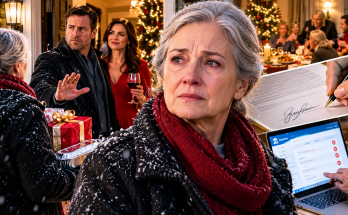
**On my thirty-sixth birthday, my mother hired a private chef to prepare a $4,800 dinner in my own house, invited thirteen people, and deliberately left me off the guest list.**
When I walked into my kitchen and found strangers drinking champagne beneath my crystal pendant lights, she didn’t even look embarrassed.
Instead, she glanced at the clock.
“Oh, Ranata.
You’re home earlier than expected.”
My older brother, Fletcher, was sitting at the head of my dining table, wearing a navy-blue suit I’d never seen before.
His wife, Simone, was showing guests photographs of the house on her phone.
My younger sister, Meredith, stood near the fireplace with a glass of wine, looking as though she desperately wanted to be somewhere else.
A beautiful three-tiered cake stood on the kitchen island.
It wasn’t for me.
The gold lettering read, “To New Beginnings.”
“Mom,” I said, struggling to keep my voice steady.
“Do you realize what today is?”
She blinked.
Then she laughed.
“Oh, goodness.
Is it your birthday?”
I nodded.
“Well, happy birthday, sweetheart.
You’re thirty-six now, aren’t you?”
“Yes.”
“Wonderful.”
She waved toward the kitchen.
“Now, don’t make a fuss.
The caterers are leaving at nine, and you’ll need to make sure everything gets cleaned up afterward.”
Fletcher raised his champagne glass.
“Come on, Ranata.
Don’t ruin a nice evening.”
I looked around my own home.
At the flowers I’d never ordered.
The champagne I’d never purchased.
The expensive strangers discussing my property as though I weren’t standing there.
Then I smiled.
“You’re right,” I said.
“I wouldn’t dream of ruining your evening.”
I walked upstairs, packed a small overnight bag, and changed into the emerald-green dress I’d purchased for my birthday.
Before leaving, I placed a thick white envelope on the kitchen counter.
Across the front, I wrote three words.
**FOR MY FAMILY.**
Inside was a letter.
But that wasn’t all.
There were photographs, legal documents, a bank statement, and one small piece of evidence that would destroy a secret my mother had protected for nearly eight years.
I left without saying goodbye.
At 9:47 p.m., my mother called, demanding to know why the kitchen hadn’t been cleaned.
I didn’t answer.
At 9:52, Fletcher called.
At 9:58, Simone sent a furious text.
Then, at 10:03, Meredith called me.
When I answered, she was crying.
“Ranata,” she whispered.
“Mom opened the envelope.”
I closed my eyes.
“And?”
There was a long silence.
Then Meredith said something I’ll never forget.
**”Fletcher just asked Mom how long she’s known.
And Simone is screaming that she’s calling a divorce lawyer.”**
But the real story began four days earlier.
***
It was a Tuesday afternoon in October, and sunlight spilled across the white quartz countertops of my kitchen in Ottawa.
Outside, the birch trees were turning gold.
Inside, a pot of chicken soup simmered on the stove.
I’d just finished editing a documentary soundtrack for a production company in Vancouver.
After fourteen hours of staring at sound waves, all I’d wanted was soup, a hot shower, and an evening with my husband and children.
Instead, my mother arrived with an announcement.
“Fletcher and his family will be moving in.”
She said it casually, as though she’d decided we were having lasagna for dinner.
I lowered my wooden spoon.
“Excuse me?”
My mother, Loretta Mercer, settled onto a barstool.
“Your brother lost his position.
Simone can’t spend another winter raising those children in that cramped apartment.
You have plenty of room.”
I stared at her.
“Mom, when exactly did I agree to this?”
She sighed.
“Oh, Ranata.
Please don’t start.”
My older brother stood near the mudroom, still wearing his expensive parka.
Fletcher was thirty-nine, handsome in the carefully maintained way of men who spent more money appearing successful than actually becoming successful.
His hair was perfect.
His watch was expensive.
And his expression told me something important.
**He hadn’t come to ask permission.
He’d come to watch our mother take care of the problem for him.**
Meanwhile, his wife, Simone, had already started examining my furniture.
“This cabinet would be perfect for my sewing supplies,” she announced, opening the glass doors of my dining room hutch.
“Your dishes could go downstairs.”
I looked at her.
“My dishes?”
She smiled.
“Just temporarily, obviously.”
My house had four bedrooms, a finished basement, an office, and a professionally insulated recording studio.
I’d purchased it outright after thirteen years of building my audio production company from a secondhand laptop and a microphone I’d bought at a garage sale.
Every room represented something.
Every mortgage payment I’d avoided meant another month of freedom.
Every wall I’d painted reminded me that I’d finally built a life nobody else controlled.
But apparently, my family had decided that my independence was their emergency savings account.
“We’ll take the east side,” Simone continued.
“You can keep your bedroom.
We’ll share the kitchen.”
“And contribute toward utilities,” Fletcher added.
“How much?”
I asked.
He shrugged.
“We’ll work something out.”
“So you’re planning to move four people into my home, take over my workspace, rearrange my belongings, and maybe pay part of the electricity?”
Fletcher rolled his eyes.
“Why do you always make everything difficult?”
That sentence transported me backward twenty-seven years.
To being nine years old and losing my bedroom because Fletcher needed somewhere to store his hockey equipment.
To being thirteen and watching my birthday savings disappear because Fletcher needed new sporting equipment.
To being nineteen and discovering that the money my father had intended to split between us had instead funded Fletcher’s first business.
When I’d protested, my mother had smiled.
“You’re resourceful, Ranata.
You’ll figure something out.”
And I had.
I’d worked.
I’d saved.
I’d struggled.
I’d built something of my own.
Yet somehow, **every achievement only gave my family another reason to demand more from me.**
“Fletcher,” I said, “you knew your job was in danger.
You told me about your performance improvement plan months ago.”
His jaw tightened.
“That’s irrelevant,” Mom interrupted.
“Your brother has a wife and children.
He has responsibilities you couldn’t possibly understand.”
Something inside my chest went very still.
I looked toward the refrigerator.
A drawing hung beneath a magnet.
It showed a yellow sun, a crooked red house, and three stick figures holding hands.
Beside the mudroom were two pairs of tiny rain boots.
My mother had walked past both.
She’d spent forty minutes discussing what she intended to take from my home.
But she’d never asked about the children’s artwork on my refrigerator.
Or the boots beside my door.
Or the small pink jacket hanging on a hook beneath my coat.
She simply didn’t notice anything that didn’t fit the version of me she’d invented.
“Mom,” I said quietly, “you need to sit down.”
She frowned.
“Why?”
“Because there’s something about my life you need to hear.”
Fletcher sighed dramatically.
“Here we go.”
I ignored him.
Then the front door opened.
A man’s voice floated down the hallway.
“Left boot first, sweetheart.
That’s it.”
Two small sets of footsteps came racing toward the kitchen.
And a little girl burst through the doorway.
“MAMA!”
My daughter Lily ran straight into my arms.
Behind her came Noah, her younger brother, holding a stuffed dinosaur.
I dropped to my knees and hugged them both.
“Hey, my babies.”
My mother made a strange choking sound.
“Mama?”
I looked up.
Her face was completely blank.
“Ranata,” she whispered, “whose children are those?”
I kissed Lily’s forehead.
“Mine.”
Fletcher actually laughed.
“Very funny.”
“I’m not joking.”
The children pressed against me.
“My daughter is seven,” I said.
“My son is five.”
Simone stared.
“You have children?”
“Yes.”
“Since when?”
“Since I became their mother.”
Daniel stepped into the kitchen behind them.
He was thirty-eight, tall, dark-haired, with the quiet steadiness of someone who didn’t feel the need to dominate every room he entered.
He was carrying Noah’s backpack.
My husband had the patience of a saint.
But when he saw my family’s expressions, his smile disappeared.
“What’s going on?”
“Apparently,” I said, “we’re having an unexpected family meeting.”
My mother stood.
“Who is this man?”
Daniel looked at her.
“I’m Daniel.
Ranata’s husband.”
Silence.
Then Fletcher said, “You’re married?”
I stared at him.
“For five years.”
Mom gripped the countertop.
“You never told me!”
“Mom, I mailed you an invitation.
You returned it because Fletcher’s family had already booked a vacation.”
She opened her mouth.
Nothing came out.
“And I sent photographs afterward,” I continued.
“You replied with a message asking whether I could lend Fletcher six thousand dollars.”
Simone shifted uncomfortably.
Fletcher looked away.
Daniel moved closer to me.
“Are you okay?”
“Not particularly.”
Then he looked directly at Fletcher.
Something changed in his expression.
“Wait,” he said slowly.
“You’re Ranata’s brother?”
Fletcher frowned.
“Do I know you?”
Daniel studied him.
“Actually, we met three months ago.”
Fletcher’s face lost its color.
Daniel set Noah’s backpack on a chair.
“At the Riverside Business Forum.”
Fletcher swallowed.
“I attend a lot of meetings.”
“Apparently.”
Daniel looked at me.
“Ranata, there’s something we need to discuss.”
He reached into his briefcase and removed a sealed envelope.
**”Your brother has been using your house to raise money.”**
***
For several seconds, nobody spoke.
I looked from Daniel to Fletcher.
“What does that mean?”
Daniel opened the envelope.
Inside were printed pages bearing the logo of a company called Birchwood Living Group.
The cover showed a photograph of my house.
My house.
Taken from the street.
Beneath it were the words:
“THE BIRCH HOUSE PRIVATE RESIDENCE PROJECT.”
I stared at the photograph.
“What’s this?”
Daniel placed another page on the counter.
It contained architectural drawings.
The east side of my home had been labeled as residential accommodations.
My recording studio was marked for conversion into an office.
The basement had been divided into additional guest suites.
And on the final page, under property resources, my address appeared beside a financial valuation.
**$1.34 million.**
I felt a cold sensation travel down my spine.
“Fletcher?”
He stared at Daniel.
“You had no right to keep those documents.”
Daniel’s voice remained steady.
“You handed them out to forty potential investors.”
My brother looked toward our mother.
She said nothing.
Three months earlier, Daniel had attended a small-business investment forum through his work as a forensic accountant.
A man introducing himself as Fletcher Vale had presented a business proposal.
Vale was my mother’s maiden name.
Daniel hadn’t recognized him.
He’d never met my brother, and Fletcher had apparently been careful not to mention me by name.
The presentation described a luxury residential retreat offering executive accommodations, private wellness suites, and short-term corporate lodging.
The problem?
**The central asset in the proposal was my house.**
And the paperwork suggested that the property owner had already agreed to contribute it to the project.
My name appeared in the supporting documents.
So did what looked like my signature.
I picked up the page.
“That’s not my signature.”
Fletcher lifted both hands.
“Those are preliminary documents.”
“That’s my name.”
“Ranata—”
“That’s my address.”
“You’re misunderstanding the arrangement.”
I looked at him.
“What arrangement?”
Mom stepped forward.
“Your brother had a wonderful business opportunity.
We were going to discuss everything with you.”
“When?”
She hesitated.
“When the time was right.”
I laughed once.
It sounded ugly.
“So the time was right to show investors my house, but not to tell me?”
Fletcher’s face reddened.
“It was a concept.
Nothing more.”
Daniel pointed toward a paragraph.
“Then why does this document identify Ranata as the contributing property owner?”
Fletcher said nothing.
“And why does it include a signed statement authorizing you to represent the property?”
My brother stared at the floor.
Mom suddenly became interested in the kettle.
I turned the page.
There, beneath a paragraph about investment security, was a statement supposedly signed by me.
It authorized my brother to discuss development and financing arrangements involving my property.
I studied the handwriting.
The signature resembled mine.
Almost.
But the first letter had a flourish I never used.
And the final stroke was too long.
I knew where Fletcher had gotten the original.
Three years earlier, I’d signed a short-term family medical authorization when my mother underwent knee surgery.
I’d handed her a copy.
She’d promised to keep it somewhere safe.
**Now my signature had apparently been copied onto paperwork involving a million-dollar house.**
I looked at Mom.
“Did you give Fletcher my documents?”
She pressed her lips together.
“Your brother needed help.”
I felt something in me break.
Not loudly.
Not dramatically.
Just a quiet fracture.
Because she hadn’t said no.
She hadn’t denied knowing.
She hadn’t even apologized.
She’d simply explained why Fletcher’s needs outweighed mine.
Again.
Daniel slid the papers back into the envelope.
“Ranata, we need a lawyer.”
Fletcher scoffed.
“Oh, for God’s sake.
You’re acting like I stole the house.”
“No,” I said.
My voice was so calm it surprised me.
**”I’m acting like you tried.”**
***
That evening, after my family finally left, I sat on the floor of Lily’s bedroom while Daniel tucked Noah into bed.
Lily was arranging stuffed animals along her pillow.
She had chestnut hair, bright blue eyes, and a serious little face that became intensely expressive whenever she thought someone was being unfair.
“Mama?”
“Yes, sweetheart?”
“Why was that lady angry?”
I hesitated.
“Which lady?”
“The older one.”
“That’s my mother.”
Lily considered this.
“Your mommy?”
“Yes.”
She frowned.
“She didn’t hug you.”
The observation struck me harder than anything Fletcher had said.
“No,” I whispered.
“She didn’t.”
Lily reached for my hand.
“Did you do something bad?”
I pulled her close.
“No, baby.
I didn’t.”
“Then why was she being mean?”
I looked at the little girl I’d fought so hard to protect.
“Sometimes people forget that loving someone means respecting them.”
Lily leaned against my shoulder.
“Well, I respect you.”
I kissed her hair.
“I respect you too.”
She smiled.
Then she said, “Daddy says families are supposed to make you feel safe.”
My throat tightened.
“Daddy’s right.”
She hugged me.
And suddenly, I remembered a hospital room from three years earlier.
The smell of antiseptic.
A woman lying beneath white sheets.
Two frightened children waiting outside with a social worker.
A promise I’d made.
A promise that had changed my entire life.
But I pushed the memory away.
Not yet.
I wasn’t ready to open that door.
When I returned downstairs, Daniel was sitting at the kitchen table with his laptop.
“I called Sarah.”
Sarah Whitcomb had been our lawyer for years.
She’d helped me establish my company, negotiate major licensing agreements, and purchase the house.
She was also the kind of woman who could communicate devastating information without ever raising her voice.
“Can she see us?”
I asked.
“Tomorrow morning.”
I nodded.
Daniel closed his computer.
“There’s something else.”
I sank into a chair.
“Of course there is.”
“Fletcher didn’t just present the property to investors.
He circulated an audio recording.”
I stared.
“What recording?”
“A voice authorization.”
My skin prickled.
Daniel opened his laptop and pressed play.
A woman’s voice filled the kitchen.
My voice.
Or something frighteningly close to it.
“I, Ranata Mercer, authorize preliminary discussions regarding the use of my Ottawa property in connection with the Birchwood Living Group proposal.”
I stopped breathing.
The voice was familiar.
The rhythm sounded familiar.
Even the soft breath before the word “authorize” resembled something I might have done.
But it wasn’t me.
I grabbed the laptop and replayed the recording.
Then again.
Then a third time.
I spent my professional life working with sound.
I knew voices better than most people knew faces.
And I immediately recognized something wrong.
The pauses were unnatural.
The sibilants carried tiny inconsistencies.
The breath sounds repeated in places where a real person’s breathing wouldn’t.
Most importantly, I recognized one phrase.
“Regarding the use of my Ottawa property.”
It contained a vocal pattern from an interview I’d recorded two years earlier.
A private production session.
**Someone had used recordings of my voice to manufacture an authorization I had never given.**
I turned toward Daniel.
“Where did Fletcher get this?”
Daniel’s expression darkened.
“That’s what we need to find out.”
I opened my company’s archive on my laptop.
Only a handful of people had access to the raw recording used in that particular session.
My production assistant.
My editor.
Me.
And one other person who had borrowed my workstation during a family visit.
My younger sister.
Meredith.
***
I called Meredith the next morning.
She answered on the fourth ring.
“Ranata?”
“We need to talk.”
She sighed.
“If this is about Fletcher—”
“Did you give him access to my recordings?”
Silence.
Then she whispered, “What?”
“Answer me.”
“I don’t know what you’re talking about.”
I closed my eyes.
“Meredith, someone used my voice to create a fake property authorization.”
Another silence.
Then I heard a chair scrape across the floor.
“Oh, God.”
My heart sank.
“What did you do?”
“I didn’t know what he was going to use it for.”
I gripped the phone.
“Explain.”
Three months earlier, Fletcher had asked Meredith for help preparing a presentation.
He said he was launching a new company.
He wanted professional audio for a promotional video.
Because Meredith had occasionally helped me organize production materials, she knew where certain files were stored.
She’d visited my house while Daniel and I were away for a weekend.
I had trusted her to water the plants.
Instead, she’d copied several files onto an external drive.
“Fletcher said he wanted samples,” she whispered.
“He said you wouldn’t mind.”
I stared at the wall.
“Did he ask me?”
“No.”
“Did you ask me?”
She began crying.
“No.”
I wanted to scream.
But I was too tired.
“Meredith, do you understand what he did?”
“I didn’t know.”
“That’s not what I asked.”
She sobbed.
“I know.
I know.”
My little sister had always been different from Fletcher.
She wasn’t demanding.
She wasn’t cruel.
But she’d inherited our mother’s greatest weakness.
**She believed avoiding conflict was the same thing as doing the right thing.**
Whenever Fletcher behaved badly, Meredith stayed quiet.
Whenever Mom pressured me, Meredith looked away.
Whenever someone needed to take a stand, she found a reason to disappear.
And now her silence had become participation.
“I need everything,” I told her.
“What?”
“Every message Fletcher sent you.
Every email.
Every file.
Every instruction.”
“Ranata, Mom will be furious.”
Something hot flashed through my chest.
“Meredith, someone used my voice to pretend I agreed to give away my house, and you’re worried Mom might get angry?”
She started crying harder.
“You’re right.”
“Then help me.”
A long pause followed.
Finally, she whispered, “Okay.”
And then she said something unexpected.
“There’s another thing you should know.”
I waited.
“Fletcher didn’t lose his job last week.”
“What?”
“He was let go almost two months ago.”
My eyes narrowed.
“Then why did Mom say it just happened?”
“Because she wanted you to feel like it was an emergency.”
I sat down.
Meredith continued.
“He’s been trying to raise money for Birchwood Living Group since spring.
He has debts.
Big ones.”
“How big?”
“I don’t know exactly.”
“Guess.”
She hesitated.
“More than six hundred thousand.”
I felt physically sick.
Six hundred thousand dollars.
Against a business that didn’t appear to own anything.
Except, according to its promotional materials, my house.
I thanked Meredith and hung up.
Then I called Sarah.
And for the first time in my life, I didn’t ask how to keep the peace.
**I asked how to protect myself from my family.**
***
Sarah’s office overlooked the Rideau Canal.
She was in her early fifties, with silver-framed glasses and the focused expression of someone who could detect dishonesty before most people finished speaking.
She spent nearly an hour reviewing the documents.
Then she removed her glasses.
“Ranata, I want you to listen carefully.”
Daniel squeezed my hand.
“Your property hasn’t been legally transferred,” Sarah said.
“I checked the current title information.
You’re still the registered owner.”
I released a breath.
“But that doesn’t make these documents harmless.”
She tapped the forged authorization.
“This appears to be an attempt to induce investors to rely on a property interest your brother does not possess.”
“What happens now?”
“We document everything.
We notify the appropriate institutions.
We address the impersonation.
And we make sure nobody can continue presenting your property as an available business asset.”
I nodded.
Sarah looked directly at me.
“Most importantly, you stop treating this like a family disagreement.”
I swallowed.
“Because it isn’t?”
“No.”
She leaned forward.
**”It’s a financial scheme involving your identity, your business assets, and potentially your home.”**
The words landed heavily.
My home.
The place Lily slept.
The place Noah built dinosaur cities across the living room floor.
The place Daniel made pancakes every Sunday.
The one place I’d promised myself my children would never have to feel afraid.
I looked at the documents.
“What if I hadn’t discovered this?”
Sarah was quiet for a moment.
“Then your brother might have continued obtaining money from people who believed he controlled property that belonged to you.”
Daniel spoke.
“There were already preliminary investor commitments.”
Sarah nodded.
“And someone could eventually have tried to enforce promises made under those false representations.
You’d have strong grounds to dispute them, but litigation is expensive, stressful, and disruptive.”
I thought of Fletcher standing in my kitchen.
“You can work somewhere else.”
As though my livelihood were a minor inconvenience.
As though my life could be rearranged to accommodate his mistakes.
My phone buzzed.
Mom.
I declined the call.
It buzzed again.
And again.
Finally, a text appeared.
**LORETTA: Stop embarrassing your brother.
Families solve problems privately.**
I showed Sarah.
She read it without comment.
Then she handed me a pen.
“We’re going to make sure your brother understands that private family pressure doesn’t override your ownership rights.”
For the next two hours, we began building a record.
Copies of the forged documents.
The synthetic audio.
Messages from Meredith.
Screenshots of Fletcher’s business materials.
Information about where the proposal had been circulated.
Sarah also asked me to document every prior occasion when Fletcher had requested access to my home or business.
I thought about the previous Thanksgiving.
The birthday dinner he’d cancelled because he needed me to cover a payment.
The time Mom had asked for photographs of my studio because she wanted to “show an old friend.”
The call in June when Fletcher casually asked whether my house was worth more than a million dollars.
At the time, I’d thought he was making conversation.
Now every memory looked different.
Not because I suddenly knew everything.
But because **I was finally willing to question people I’d spent my entire life trusting.**
When we finished, Sarah looked at me.
“One more question.”
“Okay.”
“Does your mother have a key?”
I nodded.
“She has an emergency key.”
Sarah’s expression hardened.
“Then I suggest you change your locks.”
I looked at Daniel.
He was already reaching for his phone.
***
That afternoon, we changed every exterior lock.
We reset the garage code.
We updated our home security system.
I also changed the passwords to my recording archives and commissioned a professional review of who had accessed the production files.
Daniel took the children to his aunt Helen’s house for the evening.
Helen was seventy-one, a retired elementary school principal with a sharp sense of humor and the extraordinary ability to make children feel as though they were the most important people in the world.
She wasn’t related to me by blood.
But she’d attended our wedding.
She’d sat beside us during the children’s adoption proceedings.
She knew their favorite foods.
She remembered their birthdays.
And when Lily had pneumonia the previous winter, Helen had spent three nights sleeping on our couch so Daniel and I could take turns at the hospital.
**She had never once asked whether our family was worth the inconvenience.**
When I told her what was happening, she said only, “Bring the children whenever you need.
My door is open.”
Then she added, “And Ranata?”
“Yes?”
“Don’t confuse the people who raised you with the people who deserve access to your life.”
I cried after hanging up.
Not because she’d said anything cruel.
Because she’d said something true.
That evening, as Daniel and I finished dinner, my phone rang.
Mom again.
I answered.
“Ranata, what have you done?”
I looked at Daniel.
“Changed the locks.”
“Without telling me?”
“It’s my house.”
“Your brother drove there to measure the bedrooms, and his key wouldn’t work!”
I almost dropped my fork.
“He tried to enter my house?”
“He needed to plan the move!”
“Mom, I told you nobody was moving in.”
She made an impatient sound.
“We’ve been through this.”
“Yes.
And I said no.”
“You’re behaving like a stranger.”
I stared out the window.
“Maybe that’s because you don’t know me.”
She ignored that.
“Your birthday is Saturday.”
I nearly laughed.
It was the first time she’d mentioned it.
“I know.”
“Well, I was thinking we should get everyone together.”
I leaned against the kitchen counter.
“For what?”
“A family dinner.
Something elegant.”
I frowned.
She continued.
“Fletcher has several important contacts he wants to introduce to us.
It could be good for everyone.”
There it was.
Not a birthday celebration.
Not an apology.
Not an opportunity to meet her grandchildren.
Another chance for Fletcher to advance his interests.
“Where?”
I asked.
“Your house, obviously.
It’s the only place with enough room.”
I closed my eyes.
Daniel was watching me.
I knew what he expected.
And under ordinary circumstances, I would have said no immediately.
But Sarah had asked me to report any new communications about the proposed business venture.
And I suddenly realized what Mom was offering.
An opportunity to find out exactly what Fletcher was telling people.
“Mom,” I said slowly, “I’ll discuss it with Daniel.”
She brightened.
“Wonderful!
I knew you’d come around.”
“I haven’t agreed to anything.”
But she’d already stopped listening.
Before hanging up, she said, “And Ranata?
Don’t make a scene in front of Fletcher’s guests.
He needs this to go well.”
I looked at my reflection in the kitchen window.
Then I answered quietly.
**”So do I.”**
***
On Thursday morning, Meredith came to my house.
She looked exhausted.
There were dark circles beneath her eyes, and her hands trembled as she placed her laptop on my dining table.
“I brought everything.”
We sat together for nearly three hours.
She showed me messages from Fletcher describing the supposed business.
He’d told potential investors he was converting a family-owned estate into a luxury accommodation business.
He’d presented my recording studio as a future executive media suite.
He’d even included images of Lily’s bedroom after digitally removing the toys.
I stared at the altered photograph.
“How did he get these?”
Meredith swallowed.
“Mom took pictures when she visited you last spring.”
I remembered that visit.
Mom had stayed for twenty minutes.
She’d barely spoken to me.
I’d thought she was unusually interested in the architecture.
Now I knew why.
My stomach turned.
Meredith opened another folder.
“There are emails between Mom and Fletcher.”
I read them slowly.
One message from August made my hands shake.
LORETTA: Ranata will resist initially.
She always does.
Don’t mention ownership until she’s accustomed to the idea of you living there.
Another followed.
FLETCHER: We need something in writing before the November investor meeting.
LORETTA: Leave your sister to me.
I read those words three times.
Leave your sister to me.
My mother had spoken about me like a problem to be managed.
A lock to be picked.
A stubborn obstacle between her favorite son and whatever he wanted.
Meredith watched my face.
“Ranata, I’m sorry.”
I shut the laptop.
“Did you know?”
“Not all of it.”
“How much?”
She looked down.
“I knew Mom wanted Fletcher to move in.
I thought it was because he needed help.”
“And the business?”
“I thought he already had a location.”
I felt anger rise.
“You never asked whose house it was?”
Tears appeared in her eyes.
“I should have.”
“Yes,” I said.
“You should have.”
For once, I didn’t comfort her.
I didn’t tell her it was okay.
It wasn’t okay.
And pretending otherwise would only preserve the same pattern that had hurt me for decades.
Meredith wiped her cheeks.
Then she whispered, “There’s one more folder.”
I looked up.
She hesitated.
“It’s from years ago.”
“What is it?”
“Mom’s old correspondence.”
A chill moved through me.
“What correspondence?”
Meredith swallowed.
“With someone named Mara Collins.”
The name struck me like a blow.
I stared at her.
“Where did you find that?”
“Mom asked me to organize her email archive last month.
I copied some older files because there were documents she didn’t want Fletcher to see.”
My heart began pounding.
“Meredith.
Give me that folder.”
She looked frightened.
“Do you know her?”
I couldn’t answer immediately.
Mara Collins.
A name I hadn’t spoken aloud in months.
A woman whose photograph stood in a silver frame inside a locked drawer in my office.
A woman who had trusted me with something more precious than money.
More precious than property.
**Two small lives.**
I opened the folder.
There were twenty-three emails.
Some dated almost eight years earlier.
I clicked the first.
MARA: Loretta, I’ve tried to reach Fletcher.
He needs to know about the baby.
I stopped breathing.
Meredith stared at me.
“Ranata?”
I clicked another.
MARA: I’m not asking him to leave his family.
I’m asking him to help support his daughter.
Then another, two years later.
MARA: Noah is sick.
I can’t keep doing this alone.
Please tell Fletcher to call me.
I felt tears slide down my cheeks.
I already knew much of Mara’s story.
But I’d never seen these messages.
Never seen proof that she had begged my family for help.
Never known that my mother had been personally involved.
Then I found the reply.
LORETTA: You made your choices, Mara.
My son has a respectable family.
Stop trying to destroy it.
My vision blurred.
Another message followed.
LORETTA: I have arranged the payment we discussed.
There will be no further contact.
My chest tightened.
I kept reading.
A final message from Mara appeared nearly five years earlier.
MARA: I don’t want your money anymore.
I want my children to have people who love them.
I hope one day your family understands what you’ve done.
I pressed a hand over my mouth.
Meredith moved closer.
“What is it?”
I couldn’t speak.
My mother hadn’t merely ignored Mara.
She had actively helped keep her and her children out of Fletcher’s life.
And she’d done it while telling me that Fletcher was the one who understood responsibility.
I opened the final attachment.
It was a scanned document.
A payment confirmation.
From an account associated with my mother’s financial affairs.
I stared at the amount.
**$45,000.**
The date was only weeks after Noah’s birth.
And in the reference line were two words.
“Confidential settlement.”
Meredith whispered, “Ranata, who was Mara?”
I looked toward the hallway.
Toward the little boots.
The drawings.
The photographs of my children.
Then I closed the laptop.
“Someone Mom should have helped.”
***
I met Mara Collins when I was twenty-seven.
She was a freelance photographer, stubborn and funny, with honey-colored hair and the sort of laugh that made other people smile.
We worked together on a small documentary project in Toronto.
She became my friend.
At least, I thought she did.
Then our schedules pulled us apart.
I moved to Ottawa.
She stopped returning messages.
For years, I assumed she’d simply moved on.
Then, three years earlier, I received a call from a hospital social worker.
Mara had been seriously injured in a highway collision.
Her condition was critical.
She’d listed me as an emergency contact.
When I arrived, she was barely conscious.
She recognized me immediately.
“Ranata,” she whispered.
I sat beside her.
“I’m here.”
She gripped my hand.
“The kids.”
I looked at the nurse.
“What kids?”
Mara began crying.
“My babies.”
That was how I learned about Lily and Noah.
Lily was four.
Noah was two.
Their mother had been raising them alone.
There was no reliable father in their lives.
No stable extended family willing to take responsibility.
No one they trusted.
When I asked Mara why she’d never told me, she whispered, “I was ashamed.”
I squeezed her hand.
“Of what?”
She turned her face toward the window.
“Of believing someone would come back.”
Her breathing became uneven.
I waited until she was calmer.
Then she said, “Promise me something.”
“What?”
“If I don’t make it, don’t let them grow up believing nobody wanted them.”
I started crying.
“Mara—”
“Promise.”
I looked into her eyes.
And I promised.
Mara died two days later.
The following months were complicated, frightening, and exhausting.
Daniel and I became temporary caregivers while social workers assessed the children’s needs and legal arrangements.
We attended meetings.
Completed evaluations.
Spent sleepless nights comforting a little girl who cried for her mother.
Learned how to calm a toddler who refused to sleep unless someone sat beside his bed.
We worked with professionals who understood grief and adoption far better than we did.
And slowly, something extraordinary happened.
Lily began calling me Mama.
Noah started reaching for Daniel whenever he felt afraid.
Our house filled with toy cars, storybooks, and tiny socks.
Eventually, after the necessary legal proceedings, we adopted them.
**They became our children not because we had planned it, but because loving them became the most natural thing we’d ever done.**
The identity of their biological father was known in the adoption records.
He had been legally notified during the proceedings.
He had chosen not to pursue parenting responsibilities and had signed the necessary consent documents with independent legal advice.
I knew who he was.
Daniel knew.
Sarah knew.
But our extended family did not.
At the time, we’d made a difficult decision.
We wouldn’t expose the children to people who’d already rejected them.
We would preserve their history, tell them the truth in age-appropriate ways, and allow them to grow up surrounded by adults who genuinely wanted them.
What I hadn’t known was the extent of my mother’s involvement.
The emails Meredith brought me changed that.
They proved something far uglier than indifference.
**My mother had helped create the silence that left Mara raising two children alone.**
And now she was standing in my home demanding bedrooms for Fletcher’s family.
As though the only children who mattered were the ones he’d chosen to acknowledge.
***
On Friday afternoon, Sarah called.
“We’ve made progress.”
I was sitting in my studio, staring at a waveform on my monitor.
The strange thing about sound was that every voice carried a fingerprint of sorts.
Not an infallible identity marker.
But a collection of habits.
Breathing.
Cadence.
Vowel shapes.
The tiny hesitation before someone said a word they didn’t believe.
I’d spent years learning to hear what other people overlooked.
Yet it had taken me thirty-six years to hear my own family’s cruelty clearly.
“Tell me,” I said.
Sarah explained that the fraudulent proposal had been circulated more widely than we’d expected.
Several prospective investors had received supporting documents.
Some had already transferred deposits to Fletcher’s company.
The documents did not establish any valid ownership interest in my property, but they could form part of a much larger misrepresentation.
Sarah had arranged for appropriate notices to be sent and recommended that we make a formal police report.
“We’ve also traced the promotional recording,” she said.
My stomach tightened.
“To Meredith?”
“Partly.
She supplied files.
But the synthetic authorization was generated through an external production contractor.”
“Who hired them?”
“Birchwood Living Group.”
“Fletcher?”
“Through the company, yes.”
I closed my eyes.
“Does he know we’ve discovered everything?”
“He knows you’ve contacted counsel.
He may not realize how much evidence we have.”
I looked at my calendar.
Saturday.
My birthday.
My mother’s proposed dinner.
“Sarah, I need your advice about something.”
I explained the invitation.
The business contacts.
The possible investor presentation.
The expectation that I would host everything.
Sarah listened carefully.
Then she said, “You are under no obligation to allow this event.”
“I know.”
“Especially given the circumstances.”
“I understand.”
I hesitated.
“But if he’s planning to present my house to potential investors, those people deserve to know the truth.”
Sarah was quiet.
“That’s reasonable.
But you shouldn’t expose yourself or your children to additional risk.”
We discussed alternatives.
Eventually, we agreed on a limited, carefully planned approach.
The dinner would proceed only with Daniel present and the children safely elsewhere.
Any guests would be told the truth directly.
We would not permit Fletcher to sign documents, collect payments, or continue representing my property as his business asset.
Sarah would remain available.
And I would have a written notice ready.
Not a theatrical trap.
Not an elaborate revenge fantasy.
A clear statement that the house belonged to me, that no permission had been granted, and that further misrepresentations would be addressed through proper channels.
When I finished the call, Daniel entered the studio.
“How are you holding up?”
I looked at him.
“Like someone who just discovered the people she trusted have been plotting against her for months.”
He sat beside me.
“That’s fair.”
I leaned against his shoulder.
“Do you think I’m making a mistake letting them have dinner here?”
He considered the question.
“I think you need to decide whether you’re doing it because it serves a purpose or because you’re still hoping your mother will finally love you properly.”
I looked up.
He wasn’t accusing me.
He knew me too well.
“I don’t think she knows how,” I whispered.
Daniel took my hand.
“Then don’t build your life around waiting for her to learn.”
I began crying.
He held me until I stopped.
Then he said something that made me smile.
“Besides, I already booked something for your birthday.”
I pulled back.
“What?”
“A surprise.”
“Daniel.”
“Don’t ask.”
I laughed through my tears.
“You’re impossible.”
“Occasionally.”
For the first time that week, I felt something besides anger.
I felt hope.
Not because my family was going to change.
But because I was finally beginning to understand that **my happiness didn’t depend on their permission.**
***
Saturday morning arrived with cold sunshine and the smell of cinnamon pancakes.
Lily woke me by dropping a handmade birthday card onto my pillow.
It showed a woman with enormous brown hair standing beside two children and a man holding a balloon.
The woman had a giant smile.
“That’s you!”
Lily announced.
I hugged her.
“It’s beautiful.”
Noah climbed onto the bed carrying a paper crown.
“Birthday queen!”
Daniel appeared in the doorway with coffee.
“Your Majesty.”
I laughed.
My family of four ate breakfast in our pajamas.
We sang.
We opened presents.
Lily gave me a bracelet she’d made with pink and green beads.
Noah presented a rock he’d painted gold.
Daniel gave me a beautiful leather-bound journal.
Inside the front cover he’d written:
**For all the stories you haven’t told yet.
I hope the next chapters belong entirely to you.**
I cried again.
But this time, they were happy tears.
Around noon, we took the children to Helen’s house.
She’d arranged a sleepover complete with homemade pizza, movies, and a blanket fort.
Lily hugged me tightly.
“Are you coming tomorrow?”
“Of course.”
“Promise?”
I kissed her forehead.
“Always.”
As we left, Helen squeezed my hand.
“Go enjoy your birthday.”
I smiled.
“I intend to.”
At 2:15, my mother called.
“Ranata, where are you?”
“Out.”
“Well, the flowers are arriving in half an hour.”
I frowned.
“What flowers?”
“For tonight.”
I closed my eyes.
“Mom, we agreed you could host a dinner.
We didn’t discuss flowers.”
“Oh, don’t be petty.
Everything needs to look beautiful.”
“How many people are coming?”
“Thirteen.”
I stared ahead.
“Thirteen?”
“Fletcher invited some business associates.
Simone arranged the chef.”
I took a slow breath.
“And who’s paying?”
Mom sounded annoyed.
“Fletcher has already handled the arrangements.”
I doubted that.
But I let her continue.
“The guests will arrive at six.
You should be out of the way while everything is prepared.”
I looked at Daniel.
He was watching me from the driver’s seat.
“Out of the way?”
“Yes, sweetheart.
You can come back later.”
“Mom, it’s my birthday.”
There was a pause.
Then she said, “Oh, that’s right.
Well, we’ll have cake another time.”
I stared at the phone.
Thirty-six years.
And still, somehow, her words could hurt.
I ended the call.
Daniel reached across the console and took my hand.
“Change of plans?”
I looked toward the trees lining the road.
Then I smiled.
“No.”
I had spent my entire childhood rearranging myself around Fletcher’s needs.
I’d missed parties.
Given up opportunities.
Surrendered money.
Apologized for things I hadn’t done.
But not today.
**On my thirty-sixth birthday, I would finally choose myself.**
***
By five-thirty, the house looked like a luxury hotel.
When Daniel and I returned briefly, two florists were arranging white roses across my dining table.
A caterer was setting down silver trays.
Someone had moved my grandmother’s antique chair into the hallway.
And Fletcher stood near the fireplace speaking to a silver-haired man in an expensive suit.
“…a wonderful investment opportunity,” he was saying.
I stopped in the doorway.
The man glanced toward me.
Fletcher followed his gaze.
His smile faltered.
“Oh.
Ranata.”
I walked toward him.
“Hello, Fletcher.”
He lowered his voice.
“Can we not do this right now?”
“Do what?”
“Make things awkward.”
I looked around.
“My house is full of strangers.”
“Potential business partners.”
“Business partners for a company that doesn’t own this property?”
His face hardened.
“Keep your voice down.”
I smiled.
“No.”
The silver-haired man stepped closer.
“Excuse me,” he said politely.
“I’m Graham Ellison.”
I shook his hand.
“Ranata Mercer.
The homeowner.”
He blinked.
“Homeowner?”
“Yes.”
He looked toward Fletcher.
“I thought the property was held by the family development company.”
I met his eyes.
“It isn’t.”
Fletcher interrupted.
“This is exactly the kind of misunderstanding I warned you about.”
Graham looked uncomfortable.
I continued calmly.
“My lawyer has sent formal notices regarding the use of my property in Birchwood Living Group’s promotional materials.
If you’re considering an investment, I strongly recommend reviewing those notices.”
Graham’s expression changed.
“Are you saying the company doesn’t control the property?”
“That’s correct.”
He turned toward Fletcher.
“We need to discuss this.”
Fletcher looked as though he might explode.
Before he could speak, my mother appeared.
“Ranata!”
Her eyes flashed.
“Why are you upsetting our guests?”
I looked at her.
“I’m telling them who owns my home.”
She grabbed my arm.
“Not now.”
I gently removed her hand.
“Especially now.”
She lowered her voice.
“Your brother needs tonight to go well.”
I watched her.
“Do you remember what day it is?”
She blinked.
Then laughed.
“Oh, goodness.
Is it your birthday?”
I nodded.
She waved dismissively.
“Well, happy birthday, sweetheart.
We’ll celebrate another time.”
Simone approached carrying a tray of champagne glasses.
“Honestly, Ranata, you’re making everyone uncomfortable.”
I looked toward the dining room.
Thirteen place settings.
Not fourteen.
No chair for me.
Not even at my own table.
I turned toward Simone.
“Where am I sitting?”
She hesitated.
“Well, the seating arrangement is already finalized.”
Fletcher exhaled impatiently.
“Can’t you just eat upstairs?”
Something inside me became remarkably calm.
I looked at my mother.
At the woman who had told me I was selfish for needing privacy.
At the brother who had tried to use my house as collateral.
At the sister-in-law who had already claimed my cabinets.
And at Meredith, standing near the staircase, watching everything with horror.
Then I smiled.
“You’re right.”
Fletcher looked relieved.
“What?”
“I shouldn’t disrupt your evening.”
Mom nodded.
“Exactly.”
“I’ll go change.”
She smiled.
“That’s better.”
I walked upstairs.
And instead of putting on something suitable for their dinner, I changed into my emerald-green birthday dress.
I brushed my hair.
Applied lipstick.
Fastened the bracelet Lily had made for me.
Then I opened the drawer in my office.
Inside was a photograph of Mara Collins.
She was standing beside a lake, laughing, her hair blowing across her face.
I looked at it for a long time.
“Tonight,” I whispered, “they’re finally going to know.”
I placed the photograph inside a white envelope.
Then I added the documents Sarah had prepared.
And one final piece of evidence.
Something I’d kept for three years.
Something I had never intended to share with my family.
Until now.
***
At 6:18, I walked downstairs.
My mother was laughing beside the fireplace.
Simone was introducing Fletcher to another potential investor.
A waiter carried a tray of champagne glasses toward the dining room.
Nobody noticed me until I reached the kitchen island.
I placed the envelope beneath the fruit bowl.
Then I quietly picked up my bag.
Daniel was waiting beside the front door.
He looked at me.
“Ready?”
I nodded.
“More than ready.”
We walked outside together.
The evening air was crisp.
The sky above Ottawa glowed violet.
For the first time all week, I could breathe.
Daniel opened the passenger door of our car.
“Where are we going?”
I asked.
He smiled.
“You’ll see.”
Twenty minutes later, we arrived at a beautiful riverside restaurant.
The kind of place I’d always admired but rarely visited because I’d spent so many years convincing myself that expensive celebrations were unnecessary.
Inside, candles flickered across white linen tables.
Soft jazz played near the windows.
A hostess smiled.
“Mrs.
Mercer?
Happy birthday.”
I looked at Daniel.
He grinned.
“Surprise.”
Our table overlooked the river.
There were flowers waiting for me.
Not white roses chosen to impress investors.
Wildflowers.
The kind I loved.
Beside them sat an envelope decorated with glittering stickers.
I recognized Lily’s handwriting.
MAMA, WE LOVE YOU MORE THAN ALL THE STARS.
I pressed it against my heart.
Daniel reached for my hand.
“Thirty-six looks good on you.”
I laughed.
“Thirty-six feels complicated.”
He smiled.
“Then let’s make thirty-seven easier.”
We ordered dinner.
For two glorious hours, we talked about everything except Fletcher.
We remembered our wedding.
Our first apartment.
The night Lily lost her first tooth.
The time Noah poured orange juice into Daniel’s shoes because he was “making breakfast.”
We laughed until my stomach hurt.
At dessert, the waiter brought a small chocolate cake with one candle.
Daniel watched me.
“Make a wish.”
I closed my eyes.
For most of my life, I’d wished for my mother to notice me.
To be proud of me.
To say she’d been wrong.
To love me without asking for anything in return.
But this time, my wish was different.
**I wished for the courage to protect the beautiful life I already had.**
I blew out the candle.
And just as Daniel raised his glass, my phone began vibrating.
Mom.
I ignored it.
Then Fletcher.
Then Simone.
Then Mom again.
Daniel looked at the screen.
“Do you want to answer?”
I shook my head.
“Not yet.”
At 9:47, a text appeared.
LORETTA: Where are you?
The caterers are leaving.
Someone needs to clean the kitchen.
At 9:52:
FLETCHER: This is ridiculous.
Stop sulking and come home.
At 9:58:
SIMONE: You agreed to host.
You can’t abandon everyone because you want attention.
I read the messages.
Then I turned the phone face down.
Daniel lifted his glass.
“To the birthday girl.”
I smiled.
“To new beginnings.”
Neither of us knew that those words were already causing chaos back at my house.
***
At 10:03, Meredith called.
I answered because I could hear immediately that she was crying.
“Ranata?”
“What happened?”
“Mom found your letter.”
I looked at Daniel.
“And?”
Meredith took a ragged breath.
“Fletcher just asked her how long she’s known.”
My pulse quickened.
“Known what?”
“The truth about Mara.”
I closed my eyes.
Meredith continued.
“Simone is screaming.
She’s saying she’s going to call a divorce lawyer.”
I stared out at the river.
For several seconds, I couldn’t speak.
Then I asked, “Where are the guests?”
“Most of them left.”
“What happened?”
Meredith lowered her voice.
“Mom sent me into the kitchen to find you.
She wanted you to clear the dishes.”
Of course she did.
“I found the envelope,” Meredith continued.
“I brought it into the dining room.”
I imagined the scene.
My mother at the head of my table.
Fletcher beside her.
Simone drinking champagne.
People discussing investments they didn’t understand.
Meredith carrying the truth in a plain white envelope.
“Mom opened it,” she whispered.
“The first page was your letter.”
I could almost hear my mother’s voice reading the words.
And I remembered exactly what I’d written.
***
Dear Mom, Fletcher, Simone, and Meredith,
Tonight, you are celebrating a future you believe belongs to you.
You are sitting inside a house you did not buy, did not maintain, and have no legal right to control.
For thirty-six years, I have been told that family means giving Fletcher whatever he needs.
When he wanted my bedroom, I gave it up.
When he wanted my savings, I surrendered them.
When he needed business funding, I was expected to understand.
And when he decided he needed my house, you treated my refusal as betrayal.
**But a family that only values someone for what they can provide is not behaving like a family.**
My attorney has prepared formal notices regarding the unauthorized use of my name, my property, my business materials, and my recorded voice.
The documents attached to this letter explain those matters.
I have also provided information to the appropriate authorities.
No one has permission to move into my home.
No one has permission to use it as a business asset.
And no one has permission to make decisions on my behalf.
As of tonight, any future contact about these matters must go through my attorney.
But there is something else.
Something much more important than the house.
Mom, you said Fletcher understands responsibilities that I could never comprehend because he has a wife and children.
You looked at Lily and Noah as though their existence were some shocking inconvenience.
You called my life selfish.
Small.
Empty.
Yet you never asked how they came into my family.
You never asked who their mother was before me.
You never asked why I adopted them.
And most importantly, you never asked who their biological father was.
**Perhaps you should have.**
Turn to the final documents.
Then look carefully at the photograph.
And ask yourselves which children this family has chosen to forget.
Ranata.
***
When Meredith finished describing the letter, I heard someone shouting in the background.
Simone.
“You knew?”
Then Fletcher.
“Mom, answer her!”
Meredith whispered, “They’re looking at the photograph now.”
I didn’t speak.
The photograph showed Mara sitting on a hospital bed.
Lily, then four, stood beside her.
Noah, barely two, was asleep in her lap.
And beside the photograph was a certified copy of a document from the children’s adoption records.
A document that had been disclosed to us through the proper legal process.
The biological father’s identity had been established.
He had signed the relevant consent paperwork.
And his name appeared clearly.
**Fletcher James Mercer.**
***
I could hear Simone screaming through the phone.
“Those are YOUR CHILDREN?”
My brother said nothing.
“Fletcher!”
Meredith was breathing hard.
Then I heard Mom.
“Simone, please calm down.”
“Calm down?”
Her voice rose sharply.
“You knew about this?”
My mother’s silence told everyone the answer.
“HOW LONG?”
Finally, Loretta whispered, “It was complicated.”
Simone gave a bitter laugh.
“Complicated?”
There was a crash.
Glass breaking.
Then Fletcher’s voice.
“That was years ago!”
“Years ago?”
Simone shrieked.
“You have a seven-year-old daughter and a five-year-old son!”
Daniel closed his eyes beside me.
I looked at the dark water.
The truth was finally out.
Fletcher had been married to Simone for more than a decade.
They had two children together.
An eleven-year-old daughter and a nine-year-old son.
But eight years earlier, during a business trip, Fletcher had begun an affair with Mara Collins.
At first, he’d promised her a future.
Then she’d become pregnant.
He’d panicked.
His mother had stepped in.
And the woman who constantly lectured me about responsibility had helped her favorite son abandon his.
Mara gave birth to Lily.
Two years later, after Fletcher briefly returned to Mara and promised to help, Noah was born.
Then Fletcher disappeared again.
My mother arranged a payment intended to keep Mara quiet.
The emails Meredith discovered showed that Loretta had known about both children.
She had discouraged contact.
She had protected Fletcher’s marriage.
She had helped conceal the truth from Simone.
And when Mara died, Fletcher had signed the legal documents confirming he wouldn’t take responsibility for the children.
He had never asked where they went.
Never requested photographs.
Never checked whether they were safe.
He had simply signed away the responsibility and returned to his comfortable life.
Meanwhile, Daniel and I had welcomed Lily and Noah into ours.
I had known the truth since the adoption proceedings.
And I had kept it private.
Not to protect Fletcher.
Not to protect Mom.
**To protect the two children who had already been rejected by the people who should have loved them.**
They deserved stability.
They deserved safety.
They deserved time to grieve their mother.
And they deserved to grow up without becoming weapons in Fletcher’s marriage.
But when my family tried to take our home, they crossed a line.
The children were no longer merely people Fletcher had forgotten.
They were people his actions threatened.
And I would not allow it.
***
Meredith was still on the phone.
“Ranata?”
“I’m here.”
“There’s something else.”
My stomach tightened.
“What?”
“Mom says she didn’t know the children were living with you.”
I closed my eyes.
“I believe that.”
“You do?”
“Yes.”
Because my mother had spent years refusing to see anything about me that didn’t serve her purposes.
She knew Mara had children.
She knew Fletcher had surrendered his parental responsibilities.
She knew money had changed hands.
But she hadn’t cared enough to discover where those children ended up.
And when she finally stood in my kitchen and saw Lily and Noah, she hadn’t asked their names.
She’d asked whose children they were.
As though that was the only thing that mattered.
Meredith began crying again.
“I should have said something years ago.”
I took a breath.
“Maybe.”
“I didn’t know everything.”
“I know.”
“But I knew Mom had helped Fletcher hide something.”
I stared at the birthday candle on my dessert plate.
“Meredith, you can’t change what happened before.”
She sniffled.
“What can I do now?”
“Stop being afraid of telling the truth.”
Another pause.
Then she said, “Okay.”
I looked at Daniel.
He nodded.
I returned to the phone.
“Is Simone still there?”
“Yes.”
“Put her on.”
A moment later, Simone’s voice came through.
It sounded nothing like the confident woman who’d been claiming my cabinets four days earlier.
“Ranata?”
“Hello, Simone.”
She began crying.
“I didn’t know.”
I closed my eyes.
“I believe you.”
“Those babies…”
Her voice broke.
“I’ve been married to him for twelve years.”
I said nothing.
“He told me Mara was someone he’d dated briefly before we got serious.”
I stared at the table.
“Simone, your marriage is something you need to discuss with Fletcher.
But Lily and Noah are my children.”
“I know.”
“They are not responsible for any of this.”
“I know.”
“And I won’t allow anyone to approach them without discussing it with Daniel and me.”
She swallowed.
“Of course.”
I hesitated.
“Your children aren’t responsible either.”
She started crying harder.
For a moment, I felt sorry for her.
Not because she’d been kind to me.
She hadn’t.
But because she’d just discovered that the man she’d trusted had built part of their marriage on a lie.
Finally, she whispered, “I’m sorry about your birthday.”
The words were so unexpected that I nearly cried.
“Thank you.”
She took a breath.
“And I’m sorry about your house.”
I looked at Daniel.
“That’s something you’ll need to help make right.”
“I will.”
For the first time since I’d known her, Simone sounded sincere.
***
When Daniel and I returned home shortly after eleven, my house was almost empty.
The champagne glasses had been cleared.
The catering equipment was gone.
The flowers still stood across the table.
Meredith was waiting in the kitchen.
Her eyes were red.
She stood when she saw me.
“Where’s Mom?”
“Gone.”
“Fletcher?”
“Left with her.”
“Simone?”
“She took a taxi to a hotel.”
I nodded.
Meredith looked around.
“I cleaned everything.”
I stared at her.
“What?”
“The kitchen.
The dining room.
The dishes.”
I didn’t know what to say.
She gave a sad little smile.
“Mom told me to leave it for you.”
Something tightened in my chest.
Meredith looked down.
“I told her no.”
For a moment, neither of us spoke.
Then I walked forward and hugged my sister.
She began crying.
“I’m sorry, Ranata.”
I held her.
“I know.”
“I should have stood up for you a long time ago.”
“Yes.”
She nodded against my shoulder.
Then she pulled back.
“I’m going to tell Sarah everything I know.”
“Thank you.”
“And I’m going to stop letting Mom tell me what kind of person I am.”
I smiled through my tears.
“That would be a good start.”
Meredith left shortly after midnight.
Daniel and I stood in the silent kitchen.
The expensive flowers looked strangely out of place.
He put his arms around me.
“Happy birthday,” he whispered.
I rested my head against his chest.
“It was certainly memorable.”
He kissed my forehead.
“Any regrets?”
I considered the question.
For most of my life, I’d been afraid of disappointing my family.
Now I’d disappointed them in the most dramatic way imaginable.
And yet, standing in my kitchen with my husband, knowing my children were safe, I felt lighter than I had in years.
“No,” I said.
Then I looked toward the photograph of Mara sitting on the counter.
“Not one.”
***
The weeks that followed were difficult.
There were meetings with lawyers.
Requests for documents.
Formal reports.
Questions about the forged authorization and the investment presentations.
Fletcher’s business relationships began collapsing once potential investors learned the truth.
Several demanded the return of their deposits.
The disputed recordings were preserved for examination.
The circumstances surrounding the unauthorized use of my property became the subject of legal proceedings.
And for once, I didn’t attempt to rescue my brother.
When Mom called crying about how Fletcher’s reputation was being destroyed, I asked one question.
“Who destroyed it, Mom?”
She went silent.
Then she said, “You could still help him.”
I looked out at my garden.
“By giving him my house?”
“By showing compassion.”
I felt an old ache.
Then I remembered Mara.
Her hospital bed.
Her desperate eyes.
Her two frightened children.
“Mom,” I said, “where was your compassion when Mara asked for help?”
She didn’t answer.
“Where was it when Lily was born?”
Silence.
“When Noah was sick?”
Nothing.
“When Fletcher signed those adoption documents?”
Finally, she whispered, “I was protecting my son.”
I closed my eyes.
**”You protected him from consequences.
You didn’t protect him from becoming the kind of man who creates them.”**
She began crying.
“I did what I thought was best.”
“For Fletcher,” I said.
“Always for Fletcher.”
Then I hung up.
For the first time, I didn’t feel guilty.
***
Simone filed for separation.
She eventually moved into a smaller apartment with her children.
Through her attorney, she apologized for her involvement in the pressure to move into my house and provided information relevant to Fletcher’s business arrangements.
I didn’t suddenly become her best friend.
Some wounds don’t disappear because someone finally says the right thing.
But we established respectful boundaries.
And when she asked whether her children might someday meet Lily and Noah, I didn’t slam the door.
I explained that anything involving the children’s biological connections would happen carefully, with professional guidance, and only when it was right for them.
Simone understood.
Meredith changed, too.
Not overnight.
But gradually.
She moved out of the apartment Mom had helped her rent.
Found a new job.
Started seeing a therapist.
And began learning a skill that had been almost forbidden in our family.
Saying no.
One afternoon, she visited and helped Lily bake cookies.
When Noah spilled flour across the floor, Meredith laughed.
Then she looked at me.
“You know what’s strange?”
“What?”
“Mom always said you were the selfish one.”
I raised an eyebrow.
“And?”
She looked toward the children.
“You’re the only one who built a family without needing somebody else to sacrifice for it.”
I smiled.
“Daniel and I sacrifice plenty.”
She nodded.
“Yes.
But you choose to do it for people you love.
You don’t demand that they prove their love by sacrificing themselves.”
I considered that.
Then I said, “That’s the difference, isn’t it?”
Meredith smiled.
“I think so.”
***
Three months after my birthday, I received a handwritten letter from my mother.
It was six pages long.
She apologized for some things.
Justified others.
Blamed Fletcher for decisions she’d helped make.
Blamed Simone for demanding too much.
Blamed me for not being more understanding.
And near the end, she wrote:
“I hope one day you understand that I loved all my children equally.”
I stared at that sentence for a long time.
Then I folded the letter.
Put it in a drawer.
And didn’t respond.
Because I finally understood something.
**Love isn’t proven by insisting it exists.
Love is proven by what someone does when loving you becomes inconvenient.**
My mother had been willing to sacrifice my childhood, my money, my peace, my home, and even my children’s security to preserve Fletcher’s comfort.
Whatever she called that, it wasn’t equal love.
It had never been.
***
Spring arrived slowly in Ottawa.
The birch trees outside my kitchen turned green.
Lily lost another tooth.
Noah learned to ride a bicycle.
Daniel and I celebrated our sixth wedding anniversary.
My audio production company landed its largest documentary contract yet.
And life began to feel ordinary again.
Beautifully, wonderfully ordinary.
Then, one Saturday afternoon, something happened that I hadn’t expected.
I was cleaning out a cabinet in my recording studio when I found an old hard drive.
A small black one.
I recognized it immediately.
Mara’s.
The hospital had returned it with her personal belongings after her death.
I’d backed up the photographs and documents years earlier.
But I hadn’t examined every recording.
The drive contained hundreds of files.
Pictures.
Voice notes.
Short videos.
And one folder labeled:
“For the children.”
My heart tightened.
I clicked it.
Inside were dozens of audio recordings.
Mara reading bedtime stories.
Singing lullabies.
Wishing Lily a happy birthday.
Laughing as Noah babbled in the background.
I sat motionless, listening.
Then I noticed a final file.
Its creation date was only weeks before Mara’s accident.
The title was simple.
“When They’re Old Enough.”
I stared at it.
Then pressed play.
Mara’s voice filled the studio.
“Hi, my babies.”
I began crying immediately.
“If you’re hearing this, it means I couldn’t be there to tell you something myself.”
She paused.
I could hear her breathing.
“I want you to know that you were wanted.
Not by everyone who should have wanted you.
But by me.”
A sob escaped my throat.
“I loved you before I knew your faces.
Before I felt your little hands.
Before I heard your first words.”
Another pause.
Then her voice grew stronger.
“And if Ranata ever becomes part of your lives, I want you to know something about her.”
I froze.
Mara continued.
“She probably doesn’t remember this, but years ago, when we worked together, she told me that nobody should have to earn a place in their own family.”
Tears streamed down my face.
“I remember thinking how strange it was that someone who’d been hurt so much could still believe in kindness.”
Her voice trembled.
“Ranata, if somehow you’re listening too, thank you for being the kind of person I could trust with the truth.”
I covered my mouth.
Then came the final words.
**”And children, if she ever calls herself your mother, believe her.
Because the woman who chooses to love you when she doesn’t have to is giving you something no one can ever take away.”**
The recording ended.
I sat there for a long time.
Then I called Daniel.
He came downstairs and found me crying.
Without asking questions, he sat beside me.
I played the recording.
We listened together.
When it ended, he held me.
And I realized that Mara had left us something extraordinary.
Not money.
Not property.
Not an inheritance that could be fought over.
**She had left her children the sound of unconditional love.**
***
That night, after Lily and Noah were asleep, Daniel and I discussed how to preserve Mara’s recordings for them.
We weren’t going to force a painful revelation before they were ready.
They already knew, in ways appropriate to their ages, that they had another mother who had loved them.
We wanted to help them understand their story without shame.
With time.
With patience.
With honesty.
We made copies of the recordings.
Stored them securely.
And began creating a beautiful collection of Mara’s photographs, letters, and voice messages.
Something the children could explore gradually.
Something that would remind them their beginnings weren’t a secret to hide.
They were part of who they were.
A few weeks later, Lily asked a question while we were planting flowers in the garden.
“Mama, did my first mommy like roses?”
I smiled.
“She liked wildflowers.”
Lily considered that.
“Like you?”
“Yes.”
She dug another little hole.
“Then can we plant some for her?”
I felt my throat tighten.
“Of course.”
Noah came running across the grass.
“Can I help?”
Lily nodded solemnly.
“We’re making a flower garden for our first mommy.”
Noah looked at me.
“And for you too?”
I laughed through my tears.
“There’s room for everyone.”
So we planted wildflowers.
Blue.
Yellow.
Purple.
White.
And beside the garden, Daniel placed a small wooden bench.
No plaque.
No grand inscription.
Just a place to sit.
A place to remember.
A place where love didn’t have to compete.
***
On the first anniversary of that disastrous birthday dinner, we hosted a party.
A real one.
There were balloons in the backyard.
A chocolate cake covered in strawberries.
Music from the studio speakers.
And a long table beneath the birch trees.
Helen came.
Meredith came.
Friends from my company came.
Lily and Noah invited their classmates.
Daniel’s family arrived carrying enough food to feed an army.
There were twenty-six people in total.
Nobody argued about who deserved the best seat.
Nobody counted how much I’d spent.
Nobody discussed my property value.
Nobody asked me to prove my loyalty.
We ate.
We laughed.
We sang.
And when it was time to blow out the candles, Lily climbed into my lap.
“Mama, do you have a birthday wish?”
I looked around.
At Daniel.
At Noah.
At Meredith laughing with Helen.
At the friends who had celebrated my successes and supported me through my hardest days.
Then I looked toward the kitchen windows.
A year earlier, my mother had stood in that very room telling me I was selfish for wanting to keep my home.
She’d insisted Fletcher’s children deserved more than I did.
She’d ignored the little boots.
The drawings.
The pink jacket.
She’d failed to notice the two children sleeping just down the hallway.
And eventually, she’d discovered that those children were also her own grandchildren.
**The two grandchildren she’d helped her son abandon.**
There had been no magical reconciliation.
No sudden transformation.
No tearful apology that erased years of cruelty.
My mother still hadn’t earned a place in Lily and Noah’s lives.
Fletcher still had consequences to face.
And the past remained the past.
But the future?
That belonged to us.
I looked at my daughter.
“I already have everything I wished for.”
She smiled.
“Then wish for something silly.”
I laughed.
“Like what?”
“A pet dragon!”
Noah immediately shouted, “TWO DRAGONS!”
Everyone burst out laughing.
Daniel leaned over.
“One dragon.
We have a budget.”
I laughed so hard tears ran down my cheeks.
Then I closed my eyes.
Made a wish.
And blew out the candles.
***
Later that evening, when the guests had gone and the children were asleep, I found one final envelope on the kitchen counter.
For a moment, my heart stopped.
White paper.
My name written across the front.
An envelope waiting exactly where I’d left the one that had changed everything a year earlier.
I recognized the handwriting.
Meredith’s.
Inside was a small card.
It read:
“One year ago, you taught me that keeping the peace isn’t the same as doing what’s right.
You also taught me that family isn’t something we can demand from people.
It’s something we have to deserve.
Thank you for giving me the chance to become a better sister.
Happy birthday.
Love, Meredith.”
Behind the card was a photograph.
It showed our backyard that afternoon.
Daniel standing beside the cake.
Lily sitting on my lap.
Noah leaning against my shoulder.
Helen laughing.
Meredith smiling.
And me.
For once, I wasn’t standing behind everyone else.
I wasn’t serving food.
I wasn’t cleaning up.
I wasn’t taking the photograph while everyone else enjoyed the celebration.
**I was right there in the center, surrounded by people who were genuinely happy I existed.**
I placed the photograph on the refrigerator.
Right beside Lily’s drawing of our family.
Then Daniel walked into the kitchen.
“Everything okay?”
I turned toward him.
“Better than okay.”
He looked at the photographs.
Then smiled.
“Come on.
Birthday girl gets out of dish duty.”
I laughed.
“Are you sure?”
“Absolutely.”
He wrapped his arms around me.
And as I rested my head against his chest, something occurred to me.
For thirty-six years, I had been waiting for my mother to tell me I mattered.
But the truth had been sitting in front of me all along.
In the tiny shoes beside my door.
In the drawings on my refrigerator.
In the husband who never asked me to make myself smaller.
In the children who ran toward me because they knew I would catch them.
In the friends who remembered my birthday without needing to be reminded.
And in the woman who, with her final strength, had trusted me to give her children a home.
**My family had tried to take my house because they thought I was alone.**
**They never understood that I’d already built the one thing they couldn’t steal.**
A real family.
Not one created by obligation.
Not one held together by guilt.
Not one that measured love in dollars, bedrooms, or favors.
A family built on trust.
Choice.
Protection.
And the simple promise that no one would ever have to earn the right to belong.
I turned off the kitchen lights.
Outside, the wildflowers moved softly in the evening breeze.
And for the first time in my life, I didn’t wonder whether my mother would ever call to wish me a happy birthday.
I didn’t need her to.
Because the people who loved me had already spent the entire day showing me.
**And that was the greatest birthday gift I’d ever received.**
THE END.