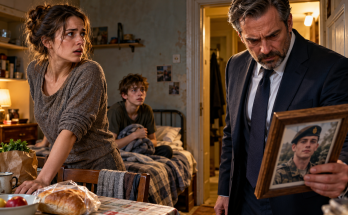
We sat in the garage because it was the only place in the house where I could remember being comfortable with Russ without my mother nearby. The workbench was cleared, and the wooden box lay open between us. Outside, rain tapped against the driveway, turning the gravel dark. I had brought my notebook, but I left it closed at first. Thomas sat on the old stool beside the cabinet and rested his hands on his knees. He looked toward the tools hanging above the bench, then at the photographs spread across the surface. I asked him to begin before the explosion, when he was still Thomas Voss and nobody had told me he was dead. He nodded slowly. “I was good at finding things that didn't belong where people said they belonged,” he began. “That was useful until I found something somebody wanted hidden.”
He explained that his work in maritime ordnance had involved careful documentation of restricted materials, disposal procedures, and the movement of equipment between military and civilian facilities. The system depended on accurate records because explosives could not simply disappear into ordinary commerce without creating enormous risks. In early 1993, he noticed discrepancies between materials listed as destroyed and supporting records from the facilities that supposedly handled them. At first, he assumed clerical errors. Those were common enough, and most could be resolved by checking dates, quantities, and signatures. But the same irregularities appeared repeatedly. Certain shipments had been recorded as completed even though supporting evidence was incomplete. Some documents bore signatures that did not align with personnel schedules.
Thomas described the first time he realized the discrepancies might be deliberate. He had requested clarification from a civilian contractor and received an answer that was technically plausible but inconsistent with another record. When he asked for the underlying documentation, the contractor became defensive. A few days later, a different official suggested that he stop making unnecessary trouble over minor accounting issues. Thomas had been irritated more than frightened. He believed the matter could be handled through normal channels. He documented what he found and brought it to a superior he trusted. The response was cautious. There were concerns that the irregularities might involve more than negligence, and the information was passed to investigators.
I asked whether he had understood that he was exposing a criminal network. He shook his head. Not at first. He thought someone might be falsifying records to cover waste, incompetence, or financial fraud. The possibility that restricted explosive materials were being diverted for illicit purposes became clearer only after investigators compared his findings with information from other sources. Some of the materials had been associated with disposal programs involving civilian companies. The system created opportunities for people with the right access to manipulate documentation. Thomas said he began noticing unusual behavior among individuals who had previously been cooperative. Meetings were canceled. Records became harder to obtain. People who once answered questions freely started referring him elsewhere.
Alan Mercer appeared during that period. Thomas remembered him as a civilian specialist who worked closely with procurement and transport personnel. Mercer was knowledgeable, personable, and apparently helpful. He understood the paperwork and knew which offices handled different approvals. At first, Thomas considered him a useful contact. The photograph we had found in the album had been taken during a routine visit, when Mercer accompanied him outside a facility near the waterfront. Thomas had not known then that investigators would later examine Mercer's access to sensitive information. I asked whether he believed Mercer had betrayed him. Thomas paused. “I suspected he knew more than he admitted,” he said. “But suspicion isn't proof.” I appreciated that he did not use thirty-three years of fear to turn uncertainty into a definitive accusation.
As the investigation developed, Thomas began receiving warnings. Some were indirect, such as unfamiliar vehicles appearing near places he visited regularly. Others were more explicit. A man approached him outside a store and suggested that people with families should be careful about making enemies. Thomas reported the encounter. Investigators increased their precautions, but the situation remained difficult because the suspected network included people with legitimate access to facilities and information. He was told to avoid discussing the investigation outside authorized channels. At home, he tried to behave normally. I was five, interested in toy boats, pancakes, and whatever insects I could find in the yard. He didn't want me to sense that something had changed.
I asked whether Margaret knew about the threats. He said she knew enough to be frightened. He had told her there were concerns involving his work and that investigators were taking precautions. He had not given her every detail because some information was restricted and he wanted to avoid increasing her anxiety. But she noticed his changed routines and the way he checked doors and windows. She began asking whether we should move. Thomas said he considered it, but the investigation was expected to progress quickly. He believed the responsible people would be identified and the danger contained. “I kept thinking the worst part was nearly over,” he said. He looked down at his hands. “That's something people tell themselves when they can't afford to imagine the alternative.”
The explosion occurred on May 19, 1993, during a movement connected to his work near a maritime terminal. Thomas remembered the morning in fragments. He had left home early, kissed me while I was still half asleep, and promised to bring back a small souvenir from the waterfront. I remembered none of that farewell, but the detail struck me because I had spent years imagining our last conversation. He described arriving at the facility, reviewing documents, and boarding a support vessel. There had been another man nearby, later identified as Michael Danner. Thomas did not know exactly what Danner was doing there. The vessel was preparing for routine movement when an explosion tore through part of the structure.
He stopped speaking. His hands had begun trembling, and he pressed them together. I waited. After a long silence, he said he remembered a flash, a violent force, and the sensation of being thrown against metal. He did not remember entering the water. His next clear memory was a confused image of sky and smoke, followed by pain so intense that it seemed to fill his entire body. He believed someone pulled him from the water, but his memory of the rescue was incomplete. Medical records later helped reconstruct what happened. He had suffered burns, fractures, and severe airway injuries. He was barely conscious when emergency personnel reached him. I watched his face as he spoke and understood why the scars had become part of my childhood without explanation.
I asked whether he knew someone had tried to kill him. He said he suspected it almost immediately after regaining consciousness, but the confirmation came later. Investigators found evidence of deliberate sabotage, and the timing suggested the attacker had expected him to be aboard. The death of Michael Danner complicated the initial casualty identification. Thomas's injuries were severe enough that communication was difficult, and the first reports were prepared amid confusion. By the time his survival was confirmed within restricted channels, officials were concerned that revealing it publicly might alert the people responsible. They decided to maintain the appearance that Thomas Voss had died while investigators worked to identify the network.
I asked whether he had consented. Thomas looked at me for a long moment. He said that in the earliest days, he had been too injured to understand the full consequences. He was sedated, undergoing treatment, and struggling to breathe. When he became capable of making decisions, officials explained that his survival could place Margaret and me at risk if the attackers believed he might testify. The protective arrangement was presented as temporary, though nobody could give him a reliable end date. He agreed because he feared the same people who had targeted him might hurt us. He said he imagined being separated for months, perhaps a year. He never imagined the secret would become the defining fact of our family.
During rehabilitation, he asked constantly about me. He wanted photographs, school updates, and ordinary details. Some requests were granted. Others were delayed or limited because communication with the family was tightly controlled. He learned I was having nightmares and that Margaret was struggling to explain his death. He asked whether there was any way to tell me he was alive without exposing us. The answer was always complicated. He had difficulty speaking and could not travel freely. His appearance had changed. He sometimes feared that even if he returned, I would be frightened of him. He began recording messages because he believed he might die before seeing me again. I thought of the cassette on which he struggled to say my name.
I asked whether he had ever heard my voice during those years. His expression softened. He said he had listened to a short recording Margaret sent through an authorized contact. I was singing a song from kindergarten, badly out of tune, and laughing when someone interrupted me. He had played it repeatedly. He remembered the exact place where I forgot the words and made up my own ending. I covered my mouth. I had no memory of the recording, but I could imagine him lying in a hospital bed listening to a child who believed he was dead. The image was so painful that I looked away. He reached toward me, then stopped before touching my arm.
As his recovery progressed, he became increasingly desperate to return. The protective program could provide housing and a new identity, but it could not replace his family. Officials discussed several possibilities. One involved maintaining complete separation until the investigation concluded. Another considered a carefully managed return under a protected identity, with strict limits on disclosure. Thomas argued for the second option. He believed he could live as Russ Wickham, avoid his former professional contacts, and help raise me without exposing our connection to the old case. Margaret initially resisted. She feared bringing a new man into the house would confuse me. Eventually, she agreed, partly because she wanted her husband back and partly because she believed the arrangement offered stability.
I asked whether he understood that I would think my father was still dead. He nodded. That had been the most difficult part of the plan. He had hoped the deception would be brief. He imagined that once the principal suspects were arrested, he could reveal himself and explain why the disguise had been necessary. He did not anticipate how quickly the new identity would become embedded in daily life. He entered our home as Russ, married Margaret legally under the protected identity, and adopted me through arrangements he now recognized had created serious emotional confusion. He helped with homework, repaired bicycles, attended school events, and watched me grow. Each year, he told himself the truth would come soon. Each year, the consequences of telling it seemed larger.
I asked why he had allowed Margaret to control the decision. He said she had been the one who kept the household functioning while he recovered. He trusted her judgment about my emotional state. He also felt guilty for the danger his work had brought to our family. When she said disclosure would harm me, he wanted to believe she knew best. I reminded him that he had seen me grieve. He nodded. “I saw it,” he said. “And I told myself being there mattered more than being recognized.” His voice tightened. “I was wrong.” I did not answer. The admission was important, but the image of a little girl being comforted by her own father while believing him dead remained almost impossible to forgive.
We sat in silence for several minutes. Rain continued tapping against the garage roof. I looked at the tools on the wall and remembered countless afternoons spent beside Russ, learning how to repair things. He had taught me to examine a problem carefully, identify what was broken, and avoid making changes until I understood the mechanism. I had carried that habit into my career. Now I was applying it to him. I asked whether he had ever wanted to return to the Navy after rehabilitation. He said the injuries and protective restrictions made that impossible. He had lost the profession that once defined much of his life. Becoming Russ allowed him to work in civilian maintenance and later technical consulting, but he missed the sense of service. When I joined the Navy, he felt pride mixed with terror.
I asked whether he had recognized the Afghanistan rescue in any reports. He said he had heard vague references to operations involving my specialty, but I had never discussed that particular incident in detail. The protective system had complicated access to records bearing the Voss name, and he had avoided investigating my assignments for fear of violating restrictions or attracting attention. He had been proud of my career without knowing the full extent of my work. When Greg recognized me, Thomas realized how much of my life he had failed to understand because he had accepted silence as normal. I told him that ignorance went both ways. I had known him as a gentle man who fixed household problems. I had never known the officer who discovered a criminal network and survived an attempt on his life.
The conversation shifted when I asked about Michael Danner. Thomas said investigators believed Danner had been connected to the diversion scheme, though the exact circumstances of his death remained uncertain. Some evidence suggested he might have been involved in arranging access to the vessel. Other findings indicated he could have been present for reasons unrelated to the final sabotage plan. Thomas had never been comfortable treating him as a simple villain. Danner had died, and the surviving evidence did not establish every decision he made. I respected that caution. It reminded me that even in cases involving terrible wrongdoing, the record should distinguish what was proven from what people wanted to believe.
I asked whether Alan Mercer had ever contacted him after the explosion. Thomas said not directly. He had heard that Mercer was questioned and later released without charges. Some investigators continued examining his connections to procurement records, but no prosecution followed. Thomas had been told not to pursue the matter independently. He obeyed. His priority was keeping the family safe, not satisfying every unanswered question. I thought of the photograph we had found and Daniel's interest in the vehicle visible behind the men. It was possible the image would help clarify something. It was also possible it would prove nothing. I told Thomas I would let the official review determine its significance. He looked relieved.
Near the end of our conversation, Thomas opened a drawer beneath the workbench and removed a small metal object wrapped in cloth. It was a damaged brass compass, its glass cracked and its needle frozen slightly off center. He said he had carried it during his early naval service and kept it after the explosion. It had been recovered among his belongings, though he no longer trusted it for navigation. He placed it in my hand. The metal was cool and heavier than I expected. I remembered seeing a similar compass in photographs from my childhood, but I had never known it still existed. He said he wanted me to have it, not as proof of anything, but because it belonged to the life we had shared before everything changed.
I looked at the compass for a long time. It was damaged but recognizable, a small object that had survived when so much else had been altered or hidden. I told him I would keep it, but I did not want gifts to become substitutes for answers. He nodded. I asked whether there were any other secrets he had not told me. He considered the question seriously. Then he said there were details of the protective program he still did not fully understand and portions of the investigation that remained restricted. But as far as his own choices were concerned, he intended to tell me everything. I studied his face, looking for hesitation. He seemed frightened, but he did not look away.
Before I left the garage, he asked whether I remembered the first time he taught me to ride a bicycle without training wheels. I did. I had fallen twice, scraped my knee, and accused him of letting go too soon. He had helped me stand, checked the injury, and encouraged me to try again. I remembered him running behind me, one hand steadying the seat until I found my balance. He told me that day had been one of the happiest of his life because he had been allowed to teach his daughter something again. I had thought Russ was simply being kind to a child who wasn't his. Now I understood why he had looked so proud when I rode away without his help.
I walked toward the garage door with the compass in my pocket. Thomas called after me. I turned. He said he knew he had no right to ask for forgiveness, but he hoped that someday I might be able to remember the good years without feeling they were entirely false. I looked at him for a long moment. “They weren't false,” I said. “That's what makes this so difficult.” His eyes filled. I continued toward the driveway, leaving him beside the workbench. For the first time since the revelation, I felt that I had learned something about the man rather than merely the secret. He had been brave in danger, weak in the face of family conflict, deeply loving, and terribly afraid. None of those qualities canceled the others.
That evening, Daniel called with news from the administrative review. Investigators had identified a sequence of changes made to personnel records associated with the Afghanistan rescue. Some appeared to have been routine corrections. Others had been entered through an office responsible for protecting sensitive identity information, using references connected to Thomas's old case. The review had not established deliberate misconduct, but the pattern warranted further examination. Daniel said a formal meeting would address the findings the following week. I thanked him and looked at the cracked compass resting on my hotel desk. My father had spent decades hiding from a danger that began before I understood his profession. Now the consequences of that secrecy had reached into my own career. I decided I would not allow another official explanation to remain incomplete merely because the people involved found the full truth uncomfortable.