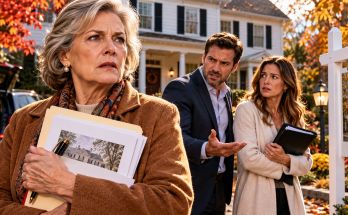
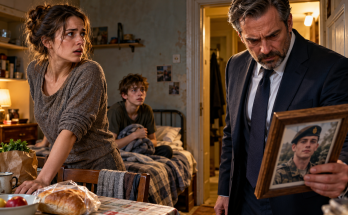
Russ stood beneath the kitchen doorway with both hands hanging at his sides. For several seconds, I couldn't decide whether he was frightened of what he had already said or of what he was about to say next. His face had lost its usual warmth. The familiar lines around his mouth seemed deeper, and he kept looking toward the photograph of Thomas Voss lying on the dining room table. I asked him what he meant by saying my father was closer than I realized. He looked at Captain Sandival, but the captain remained silent. My mother stepped out of the kitchen and caught Russ by the arm. He didn't turn toward her. Instead, he stared directly at me and said, “Claire, the man you've been looking for has been living in this house since you were seven years old.”
I heard the sentence clearly. Every word made sense, yet together they seemed impossible. I looked from Russ to my father's photograph and back again. The men did not resemble each other in any obvious way. Thomas had been lean, dark-haired, and sharp-featured. Russ was broader, his face marked by scars I had always assumed came from an industrial accident. Thomas had spoken with an easy, resonant voice. Russ's voice carried a permanent rasp, particularly when he was tired. I had known both men, or believed I had, and no part of my memory suggested they were the same person. “What are you saying?” I asked. Russ swallowed. “My name was Thomas Edward Voss before it became Russell Wickham.” My mother made a small sound, almost a gasp. I gripped the edge of the table because the floor seemed to shift beneath me.
I wanted him to stop. For thirty-three years, I had mourned Thomas, and for thirty-one I had loved Russ. Those relationships occupied separate places inside me. I understood the affection I felt for my stepfather, even when his silence disappointed me. I understood the grief I carried for the father I believed I had lost. Now Russ was asking me to put those histories together, as though the distance between them could be closed with a sentence. I shook my head. “No.” He didn't argue. I repeated it, louder. “You don't get to say something like that without proof.” His face tightened, but he nodded. “You're right.” The agreement made me angrier. I had spent much of my childhood hearing adults tell me what was true. I was not prepared to accept another extraordinary claim simply because one of them sounded sincere.
Captain Sandival drew a document from the envelope. It was a summary of identity records associated with the protective arrangement. Several sections were still redacted, but enough remained visible to connect Thomas Edward Voss with the identity Russell Andrew Wickham. The document included dates, authorization references, and a sequence of administrative changes. I read the names again and again. Russ stood without moving while I examined it. Daniel explained that Thomas had received extensive medical treatment after the explosion and later entered a formal witness-protection arrangement connected to the criminal investigation. His appearance and voice had changed significantly because of his injuries and reconstructive procedures. The new identity had allowed him to return to an ordinary-looking life while keeping his survival hidden from people who had tried to kill him.
I looked at Russ's face as though seeing it for the first time. A faint pale line crossed his jaw near his left ear. Another scar disappeared beneath his collar. I remembered asking about them when I was small. He had told me that machinery sometimes hurt people who didn't treat it carefully. I had accepted that explanation because he was the adult and I was a child. Now I wondered how many small lies had been needed to sustain the larger one. Russ touched his throat and explained that the explosion had damaged his airway. There had been surgeries, grafts, and months when speaking had been painful. His voice had never fully recovered. “I didn't choose to look different,” he said. “I was fortunate to look like anything at all.” I believed his suffering. It did not make the deception easier to bear.
The captain spoke carefully, making clear that a new identity had not magically erased the danger. Thomas had been a central witness in a case involving diverted military explosives, fraudulent disposal records, and people prepared to murder him. Investigators worried that anyone associated with his former life might become a target. The protective plan initially called for his separation from Margaret and me. During rehabilitation, however, he learned that Margaret was struggling with the consequences of his reported death. She was raising a frightened child, living under uncertainty, and receiving occasional warnings that convinced her somebody might still be watching. Thomas wanted to return. After prolonged discussions, a carefully managed arrangement had permitted him to reenter our lives under another identity. I stared at Daniel. It sounded like an extraordinary decision, and I wanted to know who had approved it.
Daniel didn't pretend the arrangement had been ordinary. He said it involved multiple agencies and exceptional circumstances, and that some aspects had later been questioned. Documentation supported the creation of the Russell Wickham identity and the protective conditions surrounding it, but the decision to become my mother's husband while concealing his relationship to me had been intensely personal. The authorities had not ordered Thomas to let me believe he was a stranger. That distinction mattered. It separated danger from choice. Russ lowered his head when Daniel said it. My mother moved toward the table and insisted that the deception had been necessary. “She was only seven,” she said. “She couldn't have kept a secret.” I turned toward her. “Then why did you bring him home at all?” She opened her mouth, but no answer came.
Russ said he had asked himself that question more times than he could count. During rehabilitation, he had imagined remaining distant until the investigation ended. At first, he received photographs and occasional information about my health and schooling. He learned I was having nightmares. He learned I had stopped speaking about him in front of my mother. He knew the house had become a place where his name caused pain. The information tormented him. Eventually, he convinced himself that returning as Russ would allow him to protect me without exposing us to the risks associated with Thomas Voss. “I told myself I could be your father in everything but name,” he said. His voice cracked. “I thought being there would be enough.” I remembered him sitting outside my bedroom when I woke frightened. I had believed a kind stranger was keeping watch. The truth was both tender and unbearable.
I asked whether he had recognized me immediately when we first met. Russ nodded. He remembered the day clearly. I had worn a green shirt with a crooked button near the collar and carried a small plastic horse with one broken leg. He said I had stared at him suspiciously because my mother had introduced him as a friend. I remembered that visit, though not every detail. He had brought a toolbox and repaired the back step. He had asked whether I wanted to help. I had held a handful of screws while he worked. For years, that memory had represented the beginning of my relationship with Russ. Now he told me it had been one of the most difficult afternoons of his life. He had watched his own daughter look at him without recognition and had been forbidden, by an agreement he accepted, from correcting her.
The word forbidden caught my attention. I asked whether someone had threatened him with prosecution if he told me. Daniel answered that there had been strict security requirements and serious concerns about disclosure, but secrecy inside the family had evolved beyond the original protective plan. Some restrictions were reviewed periodically. Other choices became habits that Margaret and Russ continued making themselves. I understood the distinction immediately. A dangerous investigation could explain why information remained concealed for a time. It could not automatically justify every birthday, every school form, every Christmas, and every moment when my parents had watched me grieve someone standing beside me. Russ accepted that criticism. He said he had kept waiting for a safer moment. Every year that passed made the confession harder, until the life they had constructed seemed impossible to dismantle.
My mother objected to his description. She said they had not constructed a false life; they had built a family. She reminded him that he had survived, that I had grown up with two parents, and that Lauren had been born into a stable home. “We did what we had to do,” she said. Her tone was so familiar that I almost answered as I would have when I was sixteen. Then I looked at the photograph on the table and realized that my mother's certainty had controlled my understanding of the past for most of my life. “You did what you chose to do,” I replied. “Some of those choices may have kept us safe. Others kept me ignorant long after there was any reason.” She flinched. Russ looked at the floor.
Lauren had been silent since the revelation. I turned toward her and saw tears running down her face. She looked between our parents, struggling to understand what the confession meant for her. “Then Thomas is my father too?” she asked. Russ moved toward her, but she stepped back. It was a small movement, almost involuntary, and I saw how deeply it hurt him. He told her that he had been her father from the moment she was born and that nothing in their daily life had been false in the way he loved her. Lauren shook her head. “That isn't what I asked.” He stopped. After a long pause, he explained that she was his biological daughter and that her legal records under the Wickham name reflected the identity he had been using at the time. She covered her face. I realized that the secret had reached into her life as well.
Greg placed an arm around Lauren's shoulders. He seemed torn between comforting his wife and trying to understand the role his own father's search had played in exposing the truth. Captain Sandival remained seated, allowing the family to speak. I appreciated his restraint. Whatever he knew about the official investigation, he could not explain away the emotional consequences of what Margaret and Russ had done. I asked whether Lauren's birth had changed their decision to tell me. Russ said it had made the lie more difficult. He had watched the two of us grow up together, one daughter knowing him as her biological father and the other being told he was a stepfather. The arrangement had become grotesque to him over time, but he had feared that confessing would destroy our trust. “It has,” I said. The words came out before I could soften them.
Russ nodded, accepting the judgment. I wished he would become defensive. I wished he would offer some easy excuse that I could reject. Instead, he stood before me with the exhausted patience of a man who had spent decades anticipating this moment and still had no idea how to survive it. I remembered the night before my first deployment, when he had repaired a loose buckle on my equipment bag. He had worked carefully, asking questions about my responsibilities without pretending to understand everything. He had hugged me at the airport and told me to come home. At the time, I thought his emotion came from the love of a stepfather who had chosen to raise a child. Now I understood why he had held me so tightly. He had already experienced the loss of his family once.
I asked him whether he had followed my career. His expression changed. He said he had followed everything he was permitted to know. He had kept copies of public announcements, saved photographs from graduations, and read articles about my assignments whenever they appeared. He remembered my first promotion, the day I qualified for a demanding specialty, and the time I called home after a difficult deployment. I asked whether he had ever considered telling me that I was following his profession in more ways than I knew. He said he had wanted to do so every time I mentioned ordnance disposal. He had worried that I would encounter people connected with the old investigation or discover a record bearing his former name. He admitted that my decision to reclaim Voss had frightened him because he knew the name might attract attention.
I remembered the argument on my eighteenth birthday and the look on his face when I presented the name-change documents. I had interpreted his silence as a conflict between loyalty to my mother and affection for me. Now I understood that he had been watching his daughter reclaim the identity he had surrendered. I asked why he hadn't stopped me if the danger was real. He said the most immediate threats had diminished by then, though some people associated with the original network remained unaccounted for. More importantly, he knew how much the name meant to me. He couldn't bear to deny me that connection again. “It was the one thing I could give you without telling you the truth,” he said. I looked away. I didn't want his confession to become a gesture of generosity. He had already taken enough.
Captain Sandival explained that the military records connected to my career were a separate but related concern. When I entered the Navy under the Voss name, certain automated reviews and background processes created references to the older protected identity. Those references had been handled inconsistently. Some officials sought to prevent exposure of the classified witness arrangement, while others apparently removed or altered identifying details without appropriate authorization. The result was a trail of incomplete records that later made it difficult to identify me as the specialist involved in the Afghanistan rescue. Daniel emphasized that he had not yet established who had made every change. I told him I wanted the matter investigated properly. I would not accept another hidden administrative arrangement simply because it was described as protective.
The captain said he had already begun pursuing the appropriate review channels, but he needed my consent before involving certain personal records. I appreciated that he was asking rather than assuming. It was a small courtesy after an afternoon filled with discoveries made without my participation. I told him I would consider signing the necessary authorization once I had read the available documents. My professional identity was not an inconvenience to be managed behind my back. It represented years of work, risk, and responsibility. If someone had altered the record of my service, I wanted a precise accounting of what happened and why. Daniel agreed. Greg looked relieved that the conversation had reached something concrete, a problem with procedures and evidence rather than wounds nobody knew how to address.
My mother sat down heavily. She said I was treating the situation like an investigation rather than a family matter. I looked at her in disbelief. “It is an investigation,” I answered. “It involves an attempted murder, a false death notification, altered records, and a daughter who wasn't told her father was alive.” Margaret pressed her lips together. I could see the familiar impulse to regain control. She wanted to decide the tone, the timing, and the acceptable limits of every question. But there were too many witnesses now, and the captain's documents lay between us. She could no longer end the conversation by telling me I was being difficult. For the first time, I saw something beneath her anger that resembled panic.
I asked her directly whether she had ever wanted me to know the truth. She didn't answer immediately. Russ looked at her, clearly hoping she would speak honestly. Finally, she said she had planned to tell me after I left the Navy. The answer was so inadequate that I almost laughed. I had made a career in the service. Leaving might be years away. She had spent my childhood trying to discourage me from joining, and now she was using my continued service as a reason for silence. I asked whether she understood how convenient that sounded. She insisted that she had been trying to protect us from scrutiny. I asked why the color of my uniform mattered if protection was her concern. She looked away.
Aunt Phyllis, who had been sitting quietly near the staircase, spoke for the first time. She said she remembered the funeral service for Thomas. She had held me while my mother received condolences. She had watched relatives bring casseroles and flowers, believing they were helping a widow and her daughter survive an unbearable loss. Now she learned that the man everyone mourned had returned to the family under another name. Her voice trembled as she asked Margaret whether the extended family had been deliberately deceived as well. My mother said the fewer people who knew, the safer everyone had been. Aunt Phyllis looked at Russ and said she understood danger, but she did not understand making a child grieve when the person she loved was sitting across the dinner table.
Russ tried to speak, but his voice failed him. He touched his throat and took a drink of water. I had seen him do that countless times, especially after long conversations. Now the gesture carried a history I had never recognized. The injuries were real. The danger had been real. His desire to return to me had been real. So had the cruelty of remaining silent. I found myself holding all those truths at once, unable to choose which one should matter most. I did not want to forgive him simply because his suffering moved me. I also did not want to reduce thirty-one years of care to a deception. Both reactions seemed dishonest.
I asked one final question before leaving the table. “When you adopted me as Russ Wickham, did you know I was signing away the name of my own father while he sat beside me?” Russ closed his eyes. He said yes. I remembered the yellow dress, the papers on the dining room table, and my mother explaining that we were becoming a complete family. I remembered asking whether Thomas would still be my father. Russ had told me I didn't have to stop loving anyone. The memory struck with a force greater than the official documents. He had known exactly what I was asking. He had given me a comforting answer while withholding the one fact that could have changed everything.
I stood. My mother began to rise, but I told her to remain seated. I needed space, and I would decide when the conversation continued. Lauren offered to come with me. I thanked her but said I wanted to be alone. Greg moved aside so I could reach the hallway. As I passed Russ, he spoke my childhood nickname, the one Thomas had used when I was little. I stopped so abruptly that my shoulder brushed the doorframe. Russ had used that nickname only once before, years earlier, when I was ill with a fever. I had thought I imagined it. Now I heard it clearly in his damaged voice. The sound reached a place in my memory that no document could touch.
I turned back. He looked terrified of what I might say. I asked him whether he remembered the little ships my father made from pancakes. His face changed. He nodded and described how I used to rearrange the blueberry windows before eating them. Then he mentioned the broken plastic horse I carried everywhere, including the day he first came home as Russ. I remembered my father repairing that toy once, long before the explosion, using a small piece of wire from his toolbox. The two memories joined without effort. For a moment, I saw the same hands moving carefully over the broken leg of a toy and the loose buckle of my military bag. My throat tightened. I couldn't speak.
The recognition hurt more than disbelief had. I was standing before a man I had loved twice without knowing it. He had been present for most of my life, yet a part of our relationship had been withheld so completely that I now felt like a stranger to my own childhood. Russ took a cautious step toward me. I stepped back. He stopped immediately. I wanted to embrace him and accuse him at the same time. Neither impulse felt safe. Finally, I said, “I need to know who decided that being near me was more important than letting me know who you were.” He looked toward Margaret, then back at me. “I agreed to it,” he said. “And I have regretted it every day.”
I walked out to my truck with the photograph of Thomas Voss in my hand. I placed it on the passenger seat beside the folded documents Daniel had allowed me to take. The late-afternoon light caught the glossy surface, revealing the face of the man I had thought was dead and the man I had called Russ for three decades. I sat behind the wheel without starting the engine. My mother had spent years telling me that the past was finished and that reopening it would accomplish nothing. Now I knew the past had been living under the same roof, helping with homework, attending my promotions, and watching me build a career in the profession that had nearly killed him. I took out my phone and opened a new note. At the top, I wrote the first question I intended to ask when I returned: Who had kept the truth from me after the danger was gone?