I Bought 8,700 Acres of Petrified Forest—Then Caught the HOA Selling My Ancient Trees, and Their Auction Records Exposed a Million-Dollar Lie
“My attorney explained the easement.”
“This is bigger than an easement.”
“Then I’m interested in seeing the documents.”
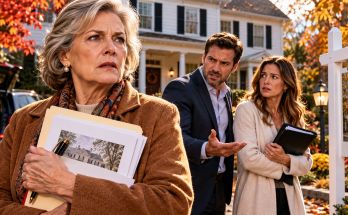
She reached into a leather portfolio and handed me a printed notice.
The heading read:
NOTICE OF LANDSCAPE VIOLATION AND RESTORATION ASSESSMENT
Amount due: $31,400.
Reason: Unauthorized disturbance of geological landscaping.
I read it twice.
Then I looked up.
“What landscaping?”
Vivian pointed west.
“Several protected decorative stone features have been disturbed on the common-use tract.”
I followed her finger toward a ridge that was unquestionably inside my surveyed property.
“That’s my land.”
“According to your interpretation.”
“According to the county recorder.”
Her smile became thin.
“Miss Hart, we’ve maintained these grounds for years. The community has invested hundreds of thousands of dollars in protecting the area’s historical appearance.”
“By doing what?”
“Preservation work.”
“And you’re charging me for it?”
“You’re responsible for restoration.”
I glanced at the security guard.
He was carefully avoiding eye contact.
That was interesting.
People who believed they were enforcing legitimate rules usually didn’t look embarrassed to be there.
I handed the notice back.
“I’ll have my attorney review this.”
Vivian refused to take it.
“You have ten business days.”
“To do what?”
“Pay the assessment and recognize the HOA’s authority.”
I set the paper on the hood of her SUV.
“No.”
She stepped forward.
“Excuse me?”
“I’m not paying a fine issued by an association that has no governing authority over my property.”
For several seconds, nobody spoke.
Then Vivian laughed.
It wasn’t a happy laugh.
It was the kind people use when they want witnesses to believe they’re still in control.
“You have absolutely no idea who you’re dealing with.”
I opened my truck door.
“Neither do you.”
And I drove through the service entrance after the guard quietly moved the SUV.
At the time, I thought the encounter was about land boundaries.
I was wrong.
It was about something buried beneath those boundaries.
And someone had already made a fortune digging it up.
The First Empty Pit
The original ranch caretaker was a seventy-three-year-old man named Hank Dobbs.
Hank had worked for Ellis Calder for twenty-eight years.
He was tall, wiry, and permanently sunburned, with a gray mustache and hands rough enough to sand furniture.
When I pulled up beside the old ranch house, he was repairing a fence.
“Meet the queen of Juniper Crest?” he asked before I even got out.
“Apparently.”
“She give you a bill?”
“Thirty-one thousand four hundred dollars.”
He let out a low whistle.
“Prices have gone up.”
I laughed.
He didn’t.
That was when I noticed something was bothering him.
“Hank?”
He set down his pliers.
“There’s something I need to show you.”
We took his battered pickup along a dry wash toward the southern fossil beds.
The land changed as we drove.
Yellow grass disappeared into bands of orange clay and dark sediment.
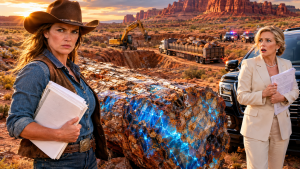
Pieces of ancient petrified wood lay scattered across the slopes, some no larger than a fist, others as large as truck tires.
Hank stopped beside a low ridge.
And I saw the hole.
It was almost thirty feet long.
Six feet deep in places.
Fresh tire tracks surrounded it.
Broken fragments of petrified wood lay mixed with sandy dirt.
Something enormous had been removed.
“What was here?” I asked.
Hank stared at the empty excavation.
“Ellis called it the Thunderheart Log.”
I looked at him.
“Thunderheart?”
“Thirty-one feet of petrified trunk. About four feet across at the thick end. Had this blue quartz vein running through it. Looked like lightning trapped inside stone.”
“Where is it?”
“That’s what I’d like to know.”
I crouched and touched a broken fragment beside the hole.
It was heavy, polished naturally on one edge, and streaked with blue-gray mineral.
“Did Ellis ever authorize excavation?”
“Never.”
“Was anyone permitted to remove specimens?”
“Not without him standing right there.”
“Did you see who did this?”
Hank hesitated.
“I saw trucks.”
“What kind?”
“Flatbeds. Excavators. A big loader. Mostly at night.”
“And you didn’t report them?”
He looked away.
“Ellis got sick three years ago. The estate kept me on, but I wasn’t authorized to confront anyone. I called the sheriff twice. The drivers had a paper from Juniper Crest saying it was approved restoration work.”
He rubbed his jaw.
“After that, things got ugly.”
“What do you mean?”
“Someone cut my fence wire. Somebody poisoned the water in an empty cattle trough with diesel. Then a note appeared on my porch.”
“What did it say?”
He looked straight at me.
“Old men who don’t mind their own business don’t stay old for long.”
For a moment, all I heard was the desert wind.
I didn’t immediately ask another question.
Hank had lived alone on this ranch for years.
He wasn’t the sort of man who frightened easily.
And he was frightened now.
“Do you still have the note?”
He nodded.
“In a coffee tin. With pictures.”
“Pictures of what?”
“The trucks.”
I stood.
“Good.”
Hank studied my face.
“You don’t seem surprised.”
“I am.”
“You don’t look angry.”
“I am that, too.”
“Then why are you smiling?”
I looked at the fresh excavation tracks.
“Because whoever did this made two mistakes.”
“What mistakes?”
“They assumed Ellis’s death meant nobody would ever check the property again.”
“And the second?”
I held up the blue-streaked fragment.
“They left evidence.”
Part Two: The $186,000 Tree
That evening, I returned to the ranch house with Hank’s photographs, the property survey, and the estate’s original geological inventory.
Ellis had been meticulous.
Every significant exposed petrified log had a number.
Every major deposit had GPS coordinates.
He had also photographed some specimens every few years to document erosion and natural changes.
The Thunderheart Log was specimen RM-014.
In a photograph dated June 2019, it rested halfway out of a red clay hillside, surrounded by small fragments of yellow and brown petrified wood.
Its most distinctive feature was exactly what Hank had described.
A jagged blue vein running diagonally across its exposed face.
I enlarged the image on my laptop.
Then I searched for recent petrified wood auctions.
I wasn’t expecting to find anything immediately.
Stolen geological specimens often moved through private sales, collectors, and middlemen.
But the second search result made my stomach tighten.
A company called High Mesa Heritage Auctions had advertised a major collection of Arizona petrified wood.
Its promotional page displayed a photograph of an enormous polished log section.
Blue quartz cut across the face like frozen lightning.
The listing called it:
THE THUNDER KING — MUSEUM-GRADE ARIZONA PETRIFIED WOOD
Sold price: $186,000.
Sale date: Three days earlier.
Seller: High Mesa Mineral Arts LLC.
I sat completely still.
Then I opened the larger photograph.
The colors matched.
The grain matched.
Even a small triangular fracture along the blue vein matched the 2019 inventory image.
I laid the two photographs side by side.
There was no reasonable doubt.
Someone had cut a massive section from RM-014, polished it, renamed it, and sold it.
I searched the seller’s business registration.
High Mesa Mineral Arts LLC had been organized fourteen months earlier.
Its statutory agent was a commercial registration service.
The listed business address was an office suite in Scottsdale.
Nothing obviously suspicious.
Then I searched its public exhibition photographs.
In one picture, a man in an expensive gray suit stood beside a display of polished petrified wood.
A woman in an emerald-green dress stood next to him.
Vivian Rusk.
The caption identified her as a special consultant to the company’s “community geological preservation initiative.”
I leaned back.
And there it was.
The HOA president who had just fined me for disturbing geological landscaping was publicly posing beside petrified wood sold by a commercial dealer.
I called my attorney, Daniel Mercer.
It was nearly nine.
He answered on the fourth ring.
“Abigail, please tell me you’re calling because you found a good steakhouse.”
“I found a stolen tree.”
Silence.
“How large?”
“Originally thirty-one feet.”
“That’s a very large tree.”
“Someone sold a section for $186,000.”
Another silence.
Then Daniel said, “Start from the beginning.”
For the next forty minutes, I told him everything.
The easement.
Vivian.
The assessment.
Hank’s photographs.
The auction.
When I finished, he asked a question I had already been thinking about.
“Do you know how many specimens are missing?”
“Not yet.”
“Then don’t confront her again until you do.”
“Agreed.”
“Preserve the online listings and original files. We need the legal chain of ownership, the excavation dates, the people involved, and the money.”
“I know.”
“And Abigail?”
“Yes?”
“Don’t let anyone convince you this is just an HOA dispute.”
I looked at the enlarged photograph on my laptop.
“I don’t think it ever was.”
Forty-Seven Empty Places
Over the next four days, Hank and I checked the major fossil sites listed in Ellis Calder’s original inventory.
We didn’t touch disturbed areas.
We photographed them, recorded coordinates, and brought in a licensed survey crew and a consulting geologist to document what remained.
By Wednesday afternoon, we had identified forty-seven specimens that had been removed or seriously damaged.
Some had been small.
Some were enormous.
At least eleven had required heavy equipment.
The estimated commercial value of the missing material could be well over a million dollars, depending on how much had survived intact.
But the money was only part of what bothered me.
These specimens had lain undisturbed for geological ages.
Someone had ripped them out, cut them into decorative pieces, and sold them for furniture, countertops, and luxury landscaping.
My father had loved ancient things.
Not because they were valuable.
Because they reminded him that the world existed before us and would continue long after we were gone.
Looking at the empty pits, I could almost hear him asking the question he always asked when we visited archaeological sites or geological formations.
Who gave us the right to destroy something just because we can sell it?
By the end of the week, I had a preliminary report.
Forty-seven disturbed locations.
Nineteen sets of identifiable heavy-equipment tracks.
Seven separate access routes.
One commercial auction company.
And one HOA president who had suddenly become extremely interested in preventing me from entering my own land.
Then I received the letter.
It arrived by certified mail.
The sender was a law firm in Phoenix.
According to the letter, Juniper Crest Estates had enjoyed “continuous and exclusive community stewardship” over parts of Red Mesa Ranch for years.
The HOA claimed that the prior owner had executed a geological management agreement giving the association broad rights to collect, process, and sell “surplus mineralized decorative material.”
The letter demanded that I immediately cease interference with all HOA-authorized operations.
Attached was a copy of the alleged agreement.
Seven pages.
An official-looking title.
A notary acknowledgment.
A signature that appeared to belong to Ellis Calder.
And a date.
September 14, 2025.
I stared at it.
Then I pulled open the estate folder.
Ellis Calder’s death certificate was inside.
He had died on February 6, 2024.
I read the document again.
The HOA was claiming that a dead man had signed away the commercial extraction rights to his property nineteen months after his funeral.
I picked up my phone.
Daniel answered.
“What now?”
“Vivian made another mistake.”
“How bad?”
I looked at the forged signature.
“She has a ghost signing contracts.”
Part Three: The Agreement With a Dead Man
Daniel arrived at Red Mesa Ranch the following morning.
He was fifty-three, broad-shouldered, and almost painfully methodical.
I had known him for thirteen years.
In that time, I had never once seen him get excited about a legal document.
Until that morning.
He placed the alleged geological management agreement on my kitchen table.
“September 14, 2025,” he said.
“Correct.”
“Ellis Calder died February 6, 2024.”
“Correct.”
“And this document supposedly gives the HOA the right to excavate, transport, process, and sell geological specimens from approximately 2,400 acres of your property.”
“That’s what it says.”
He removed his glasses.
“Abigail, whoever created this expected you to be intimidated by the letterhead and never read the date.”
“That’s what I thought.”
He tapped the signature.
“There’s something else.”
“What?”
“This isn’t a recorded easement. It’s an alleged private contract. Even if it were authentic, we would have to determine whether its terms could bind a later purchaser. But it clearly isn’t authentic.”
He slid the final page closer.
“The notary seal looks wrong.”
I leaned over.
The impression was faint, but the commission expiration date was visible.
December 2023.
A notary whose commission had expired almost two years before the alleged signing.
Daniel shook his head.
“They couldn’t even forge the document properly.”
“Or they were counting on the people receiving it being too frightened to check.”
“Exactly.”
We began making calls.
The attorney whose letterhead appeared on the demand confirmed that his office had sent the letter based on documents supplied by Juniper Crest.
He had not independently verified the supposed signature.
Once Daniel provided the death certificate, the attorney’s tone changed considerably.
He promised to preserve every original file and communication.
He also said something that made me pay attention.
“Ms. Rusk personally instructed us to send that letter yesterday,” he admitted. “She said the landowner was interfering with an urgent commercial delivery.”
“Commercial delivery?” Daniel repeated.
“That’s what she called it.”
After the call, Daniel looked at me.
“Whatever she’s selling, she’s in a hurry.”
We filed for emergency injunctive relief to stop unauthorized entry and excavation while the ownership and access claims were investigated.
We notified the sheriff’s office of the suspected forgery and theft.
And we began reviewing every public record associated with Juniper Crest Estates.
That last step revealed a second set of questions.
Juniper Crest had spent $682,000 over three years on what its financial summaries described as “geological landscape preservation and heavy-equipment maintenance.”
The work had supposedly been performed by a company called Canyon Forge Restoration.
Its invoices described excavation, stone processing, transportation, and environmental grading.
There was nothing inherently suspicious about an HOA paying contractors for legitimate landscaping.
Except Canyon Forge’s business address matched the Scottsdale office used by High Mesa Mineral Arts.
Two businesses.
The same office.
One paid by the HOA to excavate stone.
The other selling petrified stone to collectors.
And Vivian Rusk appeared in publicity for the second business.
I called Hank into the kitchen.
“Ever heard of Canyon Forge Restoration?”
He frowned.
“White trucks?”
“Maybe.”
“Big red lettering on the doors?”
“Could be.”
He scratched his chin.
“That’s who drove the lowboy trailer out here last spring.”
“Did it have a piece of equipment on it?”
“Two. Excavator and a loader.”
“Do you remember the date?”
Hank looked at me as if I’d insulted him.
“April seventeenth. Thursday. Day after my birthday.”
I smiled.
“Of course you do.”
He pointed toward the west window.
“They were out here three nights straight. Hauled something big down the Juniper Crest service road.”
“Did you get photographs?”
“Some.”
“Good.”
Then he added, “But you might want to talk to a woman named Laura Bennett.”
“Who’s Laura?”
“She’s the treasurer of the HOA.”
I raised an eyebrow.
“Vivian’s treasurer?”
Hank shook his head.
“Not exactly.”
The Woman Who Had Paid Twice
Laura Bennett lived in Juniper Crest, in a pale stucco house with a neatly trimmed lawn and an American flag hanging beside the garage.
She was fifty-eight, a retired accountant, and had the exhausted expression of someone who had spent too many evenings arguing with unreasonable people.
She invited Daniel and me inside after we introduced ourselves.
“I wondered when someone would finally investigate the rock business,” she said.
That was an interesting greeting.
“What rock business?” I asked.
Laura gave me a tired smile.
“That’s the problem. Nobody is supposed to call it a business.”
She led us to her dining room.
A stack of HOA financial reports sat beside a yellow legal pad.
“I became treasurer eight months ago,” she explained. “The former treasurer resigned unexpectedly. Vivian said she had moved to Colorado for family reasons.”
“Did she?”
“No. She moved twelve miles away.”
Laura opened a folder.
“When I started reviewing the books, I found hundreds of thousands of dollars in payments for geological preservation.”
“We found those in the financial summaries,” Daniel said.
“Then you saw the easy part.”
She turned a page.
A schedule of special assessments appeared.
Every Juniper Crest homeowner had been charged for a project called the Desert Heritage Improvement Initiative.
The assessments ranged from $2,100 to more than $6,000, depending on lot size.
Residents had been told the money would fund erosion-control work, entrance landscaping, and the preservation of nearby geological formations.
“What happened to the money?” I asked.
“Some went to actual landscaping. Some paid contractors. But almost all the major excavation payments went through Canyon Forge.”
“Do you know who owns it?”
Laura nodded.
“I didn’t until three weeks ago.”
She handed me a printout from the state corporation database.
Canyon Forge Restoration was managed by a man named Trevor Rusk.
Vivian’s younger brother.
I looked up.
“Has Vivian disclosed that relationship to the board?”
“No.”
“Has anyone asked?”
“I did.”
“What happened?”
Laura’s voice became quieter.
“She told me my duties were limited to keeping the accounts balanced. She said if I continued questioning the vendors, the board would find a more cooperative treasurer.”
Daniel leaned forward.
“Do you have access to the underlying invoices in your official capacity?”
“Yes.”
“Have you altered or deleted anything?”
“Absolutely not.”
“Good. We need those records preserved through the proper process. And we need to distinguish what the HOA lawfully authorized from what these people may have done outside that authorization.”
Laura looked at him for a long moment.
“Mr. Mercer, are you telling me the rocks weren’t theirs to remove?”
I took out a photograph of the Thunderheart excavation.
She stared at it.
Then I placed the auction photograph beside it.
Her hand went to her mouth.
“Oh, my God.”
“That specimen was removed from my property,” I said. “A large section sold for $186,000.”
Laura looked from one picture to the other.
“We paid for that?”
“Your HOA paid Canyon Forge to perform excavation work. We’re investigating whether those payments included this site.”
She sat back.
For nearly a minute, she didn’t speak.
Then she whispered, “My husband and I paid $4,800 toward that improvement project.”
“I’m sorry.”
Her expression hardened.
“No. Don’t apologize.”
She pulled another binder from the stack.
“I want you to see something.”
Inside was a proposed contract titled the Juniper Crest Desert Discovery Project.
It outlined a visitor center, geological walking trails, and a private museum featuring petrified wood displays.
The projected development budget was $3.6 million.
A highlighted paragraph described the project’s land as “HOA-controlled adjacent heritage acreage.”
I read it again.
“Adjacent heritage acreage?”
Laura pointed to an attached map.
A red outline surrounded approximately 1,900 acres.
All of it was inside Red Mesa Ranch.
My ranch.
Not the HOA’s property.
Not a common area.
Not an easement.
My land.
And according to the proposal, Vivian planned to announce the project at the HOA’s annual founders’ celebration the following Saturday.
Eight days away.
I looked at Daniel.
He was already reading the last page.
It contained a proposed revenue-sharing arrangement with High Mesa Mineral Arts.
And there, under projected annual income, was a line item that stopped me cold.
Specimen acquisition and sales: $1,250,000.
Vivian wasn’t just stealing petrified wood.
She was building an entire business model around stealing it.
And she was using the homeowners’ own money to finance the operation.
The Secret Behind the Stone Walls
When we left Laura’s house, I took the longer road through Juniper Crest.
I wanted to see its main entrance.
Two enormous decorative walls curved beside the gate.
Each was faced with beautifully polished pieces of petrified wood.
The panels displayed vivid orange, smoky black, purple, and gold.
One section contained a familiar streak of pale blue.
I stopped the truck.
Daniel looked at me.
“What?”
I pointed.
“That wall.”
He studied it.
“What about it?”
“Some of those pieces may have come from my ranch.”
He went quiet.
For years, residents had driven past that entrance and admired what they believed was a luxury architectural feature.
Now, looking at the carefully arranged fossil panels, I saw something else.
An inventory of missing specimens.
I took photographs from the public-facing entrance area without disturbing anything.
A woman walking a golden retriever stopped beside us.
“Beautiful, isn’t it?” she said.
I looked at the wall.
“Very impressive.”
“Cost a fortune. That’s what they told us, anyway.”
“How much?”
She laughed.
“More than my daughter’s wedding.”
“Do you know where the stone came from?”
“Vivian said it was salvaged from a local abandoned quarry. She called it ethical preservation.”
My stomach tightened.
“Did she?”
“Oh, yes. She gave a whole presentation about rescuing ancient material before erosion destroyed it.”
The woman smiled and continued walking.
I watched her disappear down the sidewalk.
Then I said to Daniel, “She didn’t just hide the theft.”
“No.”
“She made the theft the reason people trusted her.”
He looked toward the gate.
“And that’s how she got them to pay for it.”
That night, I added the entrance-wall photographs to our evidence file.
I matched six visible fragments to distinctive patterns in Ellis’s historical inventory.
Two matches were strong enough for the geologist to recommend further examination.
One was particularly striking.
The blue streak in the wall appeared to connect with the unusual quartz vein found in the Thunderheart Log.
Part of Ellis Calder’s most famous fossil had apparently been turned into a decorative panel greeting people who lived in a subdivision that had no right to take it.
I didn’t sleep much that night.
Not because I was afraid.
Because the whole operation was beginning to make sense.
Vivian had created a perfect story for her neighbors.
The HOA was protecting ancient fossils.
The HOA was improving property values.
The HOA was developing a heritage attraction.
The HOA was investing in community beauty.
And the people paying the bills had never been shown the boundary map.
They had no idea they were funding the destruction of someone else’s land.
The following morning, my phone rang.
Unknown number.
I answered.
“Abigail Hart.”
Vivian’s voice came through immediately.
“I hear you’ve been visiting my homeowners.”
“Your homeowners?”
“You know what I mean.”
“I spoke with someone who wanted to talk.”
“Laura Bennett is a disgruntled employee.”
“She’s the elected treasurer of your association.”
There was a pause.
Then Vivian changed tactics.
“I’m prepared to resolve this privately.”
“I’m listening.”
“We’ll withdraw your violation assessment. We’ll also agree not to challenge your ownership of the northern grazing parcels.”
I almost laughed.
“That’s very generous, considering you have no right to challenge them.”
“Abigail, don’t be difficult.”
“What do you want in exchange?”
“Recognition of the existing heritage-management boundaries.”
“How many acres?”
“Roughly two thousand.”
“And you want to continue removing geological specimens?”
“Only where appropriate.”
“To sell them?”
“To support community programming.”
I looked at the excavation photographs spread across my desk.
“Vivian, you have a remarkable talent for making theft sound like charity.”
Her voice hardened.
“You bought that property sixteen days ago. We’ve been operating here for years.”
“That doesn’t make it yours.”
“You think a piece of paper gives you the right to destroy everything we’ve built?”
“No. I think the deed gives me the right to decide who enters my land.”
She went silent.
Then she said something I would remember for a long time.
“You have no idea how much money is already committed.”
“Then you should be very careful with the next dollar.”
The call ended.
Twenty minutes later, Hank walked into the ranch house carrying his phone.
“You’re not going to like this.”
He held out the screen.
Vivian had posted a public announcement to the Juniper Crest resident group.
It accused me of attempting to shut down community preservation projects, threatening property values, and interfering with access to a beloved local geological landmark.
There was even a photograph of me beside my truck.
Below it, someone had written:
Greedy outsider buys desert ranch and immediately tries to destroy our heritage.
The comments were already piling up.
Some people were furious.
Others demanded that the HOA sue me.
One man suggested parking trucks across the ranch road until I agreed to negotiate.
And one comment, written by an account with no profile photograph, made my blood run cold.
Maybe she needs to learn why the previous owner stopped causing trouble.
I read it twice.
Then I saved it.
Because Vivian had just turned a financial dispute into something much more dangerous.
And when powerful people start encouraging a crowd to hate someone, the next mistake can happen very quickly.
Part Four: The Night They Came Back
The first trespasser arrived at 11:43 p.m. on Thursday.
My new security camera captured the headlights coming over the eastern ridge.
Then another truck appeared.
And another.
Three heavy vehicles moving without ordinary work lights toward the southern fossil beds.
The first was a flatbed.
The second carried an excavator.
The third was a utility truck.
I was awake when the motion alert appeared on my phone.
Hank had gone home to his trailer near the ranch headquarters.
Daniel had returned to Flagstaff.
I was alone in the house.
I watched the live camera feed.
The trucks turned off the utility road and crossed a dry wash, heading directly for the excavation area where several large petrified logs remained exposed.
I called Hank.
He answered immediately.
“Something wrong?”
“The trucks are back.”
His voice changed.
“How many?”
“Three.”
“Where?”
“South fossil bed.”
A chair scraped on his end.
“I’ll get my shotgun.”
“No, Hank.”
“Abigail—”
“Stay inside. Lock your door. I’m calling the sheriff.”
He protested.
I interrupted him.
“They’ve already threatened you once. Nobody is confronting armed or heavy-equipment operators in the desert at midnight. We have cameras. Let law enforcement handle this.”
He exhaled.
“All right.”
I called the county sheriff’s dispatch center and reported the unauthorized excavation in progress.
Then I called Detective Samuel Ortega, who had been assigned to review our complaint.
He was a compact, serious man in his late forties, with a reputation for taking property crimes personally.
I had met him two days earlier.
At first, he had treated the situation as a complicated civil dispute.
Then I showed him the forged agreement.
And the auction photograph.
And Hank’s threat note.
His attitude changed.
Now, when I told him heavy equipment had returned, he didn’t waste time.
“Stay at the house,” he said. “Are you watching them live?”
“Yes.”
“Save everything. Units are on the way.”
The next thirty minutes felt much longer.
On the camera, I watched the excavator lower its bucket.
A worker in an orange vest attached a heavy lifting strap to an exposed section of petrified wood.
The operator began moving dirt.
They weren’t simply collecting loose rocks.
They were removing another enormous fossil.
The excavator lifted slowly.
Even through the grainy nighttime image, I could see the scale of it.
An ancient tree.
Dragged from the earth like discarded construction material.
Then a white pickup appeared near the edge of the camera’s view.
Its headlights flashed twice.
The excavator stopped.
The workers looked toward the road.
A moment later, two sheriff’s vehicles came into view.
Red and blue lights washed across the desert.
I watched three workers step away from the equipment.
One tried to walk quickly toward the pickup.
A deputy stopped him.
The camera didn’t record the conversation.
But it recorded enough.
The trucks.
The excavation.
The fossil suspended in lifting straps.
The operators.
And the arrival of law enforcement while the extraction was still in progress.
That footage would become one of the most important pieces of evidence in the entire case.
Detective Ortega called me at 1:12 a.m.
“We have three men detained while we investigate. The equipment and load are being secured pending further legal process. Do you know a Trevor Rusk?”
“Vivian’s brother.”
“He’s one of the men here.”
I closed my eyes.
Of course he was.
“Did he say anything?”
“He says he has a contract.”
“With a dead man?”
There was a pause.
“Interesting you should say that.”
“Why?”
“Because he showed us a copy of the same agreement.”
I stared at the kitchen wall.
“Anything else?”
“Yes.”
“What?”
“He claims the owner authorized the work this week.”
My fingers tightened around the phone.
“I’m the owner.”
“That’s what I explained to him.”
“What did he say?”
“He told me you don’t understand the arrangement and that I should call his sister.”
I almost smiled.
It was becoming a theme.
Everyone was supposed to call Vivian.
No one was supposed to read the records.
The Hidden Shipment
The arrests didn’t happen that night.
The three men were identified and questioned, and detectives continued collecting evidence before the prosecutor decided which charges were appropriate.
But the attempted extraction changed the investigation.
The sheriff’s office now had fresh evidence of unauthorized activity after explicit notice that permission had been denied.
And the heavy equipment had been caught in the act.
The following morning, Daniel received a call from a lawyer representing High Mesa Mineral Arts.
The company wanted to discuss a “commercial misunderstanding.”
They claimed to be a legitimate dealer that had purchased geological specimens in good faith.
Daniel responded that his client intended to pursue the return of any identifiable property and appropriate compensation, and that the company should preserve all transaction records.
By afternoon, the dealer’s attorney had agreed to suspend pending sales associated with the disputed ranch specimens while the ownership issues were examined.
That was when we learned about the shipment.
A major order was scheduled to leave the following Monday.
The buyer was Heritage Canyon Resort, a luxury development outside Sedona.
The order included twenty-six polished petrified wood sections, several large landscape specimens, and four museum-grade display pieces.
Contract value: $742,000.
The listed supplier was High Mesa Mineral Arts.
The material was being held at a warehouse near Winslow.
And the shipping documentation identified its source using a phrase I was starting to hate.
Juniper Crest Heritage Conservation Site.
My property had been given a new name on paper.
A name that made it sound like a community resource.
A name that erased the actual owner.
A name that made the theft easier to sell.
Daniel put the shipping documents down.
“Abigail, we may be able to prevent these pieces from disappearing into a resort.”
“How?”
“The dealer’s counsel has agreed to preserve them. We’ll also seek a court order covering the identifiable disputed specimens.”
I thought about the original Thunderheart Log.
“Can we get them back?”
“Some, probably. Others may already have gone to buyers in different states. Some were cut and polished. Recovering everything may be impossible.”
I looked at the list.
Twenty-six polished sections.
Four museum-grade pieces.
Several large specimens.
Millions of years of history.
Reduced to a shipping manifest.
“Then we’ll recover what we can.”
Daniel nodded.
“And we’ll hold the responsible people accountable for the rest.”
Vivian’s Offer
At 4:35 that afternoon, Vivian arrived at the ranch.
Not in her black SUV.
In a silver Mercedes.
She was alone.
I watched her approach through the front window.
Her emerald-green outfit had been replaced by a cream-colored designer jacket and tailored black pants.
She looked different.
Not frightened exactly.
But strained.
She knocked three times.
I opened the door.
“Vivian.”
“Can we talk?”
“Through my attorney.”
“This is personal.”
“Then it can be a personal conversation in his presence.”
She looked over her shoulder at the empty ranch yard.
“Please.”
I let her remain on the porch while I called Daniel and put him on speakerphone.
Vivian waited until he confirmed he was listening.
Then she took a folded document from her handbag.
“I want to settle this.”
Daniel asked, “On what terms?”
Vivian unfolded the paper.
“Juniper Crest will arrange a payment of one million six hundred thousand dollars.”
I said nothing.
“In return,” she continued, “Abigail will acknowledge the historical management agreement, grant the association a permanent geological access right over the designated parcels, release all civil claims, and agree not to make further public accusations against HOA leadership.”
Daniel’s voice came sharply through the phone.
“Does that include a request that my client withdraw her cooperation with law enforcement?”
Vivian looked annoyed.
“I’m talking about a comprehensive business resolution.”
“That’s not an answer.”
She ignored him.
“One million six hundred thousand dollars, Abigail. For rocks you didn’t even know existed a month ago.”
I stared at her.
For the first time, her desperation was visible.
Not in her voice.
In her eyes.
She needed me to sign.
She needed the land rights.
She needed the criminal investigation to become a commercial disagreement.
And she needed it before the residents started asking questions.
I folded my arms.
“Where is the money coming from?”
Vivian blinked.
“What?”
“The $1.6 million. Is that from you personally, from High Mesa Mineral Arts, or from the Juniper Crest homeowners?”
“That isn’t your concern.”
“It absolutely is.”
Her cheeks reddened.
“You’re being unreasonable.”
“You’re offering to pay me to give you legal rights you don’t have.”
“I’m offering you an opportunity.”
“No. You’re offering me someone else’s money in exchange for my silence.”
She took a step closer.
“Do you have any idea what this will do to our community?”
“I know what you’ve already done to it.”
She glanced toward the ranch yard again.
Her voice dropped.
“People invested their retirement savings in Juniper Crest. Families bought homes there because I promised the area would become a destination. If this project collapses, home values could suffer.”
“Then tell them the truth.”
“You think it’s that simple?”
“No.”
I stepped closer to the screen door.
“I think telling the truth is the part you should have done before the first excavator entered my land.”
Her face hardened.
“You could walk away from this wealthy.”
“I already own 8,700 acres, Vivian. I didn’t buy them because I needed you to make me wealthy.”
For the first time, she lost her composure.
“You sanctimonious little—”
She stopped herself.
Daniel’s voice came through the speaker.
“Ms. Rusk, this conversation is over. Any genuine settlement proposal should be sent to my office.”
Vivian folded the paper so sharply that it nearly tore.
Then she looked at me.
“You’re going to regret embarrassing me.”
I held her gaze.
“I haven’t embarrassed you yet.”
She spun around, hurried to her Mercedes, and drove away.
I watched the dust trail disappear toward Juniper Crest.
Then Daniel spoke.
“Abigail?”
“Yes?”
“That offer was extraordinary.”
“I know.”
“Why would someone offer $1.6 million when she keeps insisting she did nothing wrong?”
I looked at the photographs covering my dining room table.
“Because we’ve only discovered what she stole.”
“And?”
“We haven’t discovered everything she owes.”
Part Five: The Meeting Vivian Couldn’t Control
Juniper Crest’s founders’ celebration was scheduled for Saturday evening.
Vivian had spent months preparing it.
There would be catered food, live music, a presentation on the Desert Discovery Project, and a ceremonial unveiling of a new petrified wood monument.
The event was supposed to establish her legacy.
Instead, it became the night her neighbors learned what had been happening behind their gates.
The turning point came that morning.
Laura Bennett called me at 9:17.
“Abigail, I have something important.”
“What happened?”
“Vivian called an emergency board meeting yesterday. She wanted approval to transfer $900,000 from the HOA’s capital reserve into a new heritage-development account.”
“Did the board approve it?”
“No.”
“Why not?”
“Because I refused to certify the transfer without supporting documents.”
I sat up.
“What did she say?”
“She said I was sabotaging the association.”
“Are you safe?”
Laura hesitated.
“My husband is here. We’re fine.”
“Good.”
“There’s something else.”
“What?”
“Two board members have asked for a special membership meeting to review the project and the financial records. More homeowners have signed the petition than the bylaws require.”
I smiled.
“How many?”
“One hundred and thirty-eight.”
That number mattered.
Juniper Crest had 312 homes.
One hundred and thirty-eight signatures meant Vivian could no longer dismiss the opposition as one angry treasurer and a ranch owner.
A substantial part of her own community wanted answers.
The association’s attorney confirmed that the required procedure had been followed.
The special membership meeting would take place Saturday evening before any vote on the Desert Discovery Project.
Vivian would have to face the people who had financed her operation.
And she would have to do it in public.
The Clubhouse
I arrived at the Juniper Crest clubhouse at 6:45 p.m.
The building was enormous.
Cream-colored columns framed a wide entrance.
The lobby floor was polished travertine.
A crystal chandelier hung above a circular reception desk.
Behind the desk stood a decorative sculpture made from petrified wood.
I recognized it from an auction photograph.
Of course I did.
A banner on the far wall celebrated Juniper Crest’s commitment to preserving the natural heritage of Arizona.
I nearly laughed.
Then I saw the people.
There must have been more than two hundred residents inside.
Some wore evening clothes.
Others had come in jeans and work shirts.
Several held folders.
A few carried printed copies of the geological photographs that had begun circulating after Laura’s request for an independent review.
Vivian stood near the stage in a royal-blue dress, smiling at people as they entered.
Her smile froze when she saw me.
Then she marched across the room.
“You are not welcome here.”
I kept my voice calm.
“I’m here at the invitation of several members.”
“This is a private HOA event.”
“Then you should speak with the members who invited me.”
Her eyes narrowed.
“You think you can steal my community from me?”
I looked around the room.
“Your community?”
“Don’t play games.”
“These people own their homes, Vivian. You don’t own them.”
Before she could respond, Laura appeared beside us.
“Abigail is my invited guest,” she said.
Vivian turned on her.
“You are no longer authorized to act as treasurer.”
Laura didn’t move.
“Only the board can remove me in accordance with the governing documents. You don’t have the authority to do it yourself.”
Several nearby residents turned to listen.
Vivian looked from one face to another.
For a split second, her expression changed.
She realized people were watching.
And she smiled again.
“Of course. Let’s all be civil.”
She walked away.
Laura waited until Vivian was out of earshot.
“That woman has spent ten years making people afraid of disagreeing with her.”
I looked toward the stage.
“Then tonight should be educational.”
The First Question
The meeting began at seven.
Vivian stood behind the podium with a wireless microphone.
She welcomed everyone.
She praised the development.
She talked about property values, community pride, responsible land stewardship, and the future of Arizona heritage tourism.
For fifteen minutes, she was polished and confident.
Then she introduced the Desert Discovery Project.
A large screen displayed architectural renderings of walking trails, museum exhibits, gift shops, and outdoor gathering spaces.
The centerpiece was a proposed geological pavilion built around giant petrified wood specimens.
Vivian spoke enthusiastically.
“Our association has the extraordinary privilege of caring for one of the most significant privately managed geological landscapes in the region.”
A few people applauded.
I didn’t.
Then a gray-haired man in the front row raised his hand.
His name was Martin Fletcher.
A retired high school principal.
“Vivian, before we discuss this investment, I’d like to know who actually owns the land shown in your presentation.”
The room became quiet.
Vivian smiled.
“The land is subject to longstanding community stewardship arrangements.”
“That’s not what I asked.”
Her smile tightened.
“Martin, we have extensive legal documentation.”
“Then who owns it?”
She looked toward the board table.
“The situation is complicated.”
Martin stood.
“Is it owned by Juniper Crest Estates?”
“Not technically.”
A murmur moved through the audience.
“Then is it owned by this woman?”
He pointed toward me.
Vivian glanced in my direction.
“The property recently changed hands, but that does not extinguish our historical rights.”
I heard someone whisper, “What historical rights?”
Another resident spoke up.
“Are you saying we’re building a multimillion-dollar project on somebody else’s ranch?”
Vivian raised both hands.
“Please. Everyone calm down.”
Then Laura stepped toward the microphone.
“I have a question about the financial records.”
Vivian’s voice sharpened.
“Laura, this is not the appropriate time.”
“The meeting was called specifically to review the project and its finances.”
“You’re creating confusion.”
Laura placed a folder on the podium.
“Over the last three years, the HOA paid $682,000 to Canyon Forge Restoration.”
“Those payments were approved.”
“Canyon Forge is managed by your brother, Trevor Rusk.”
The room went silent.
Vivian stopped smiling.
A man near the back said, “Her brother?”
Laura continued.
“That relationship was not disclosed in the vendor records I reviewed.”
Vivian leaned toward the microphone.
“Trevor is an experienced contractor. There’s nothing illegal about hiring a family member.”
“Then why wasn’t it disclosed?”
“I won’t dignify personal attacks.”
Laura opened the folder.
“Did Canyon Forge perform excavation work on Red Mesa Ranch?”
Vivian didn’t answer.
“Did Canyon Forge transport petrified wood specimens from that property?”
Vivian looked toward the association’s attorney.
He remained seated.
“Laura,” she said softly, “you need to stop.”
That was the wrong thing to say.
Because everyone heard it.
The Photograph
Martin Fletcher stood again.
“I’d like to hear from the landowner.”
Vivian immediately objected.
“Absolutely not.”
Several residents began calling out.
“Let her speak.”
“We paid for this.”
“Let us hear both sides.”
The meeting moderator, a board member named Robert Ellis, looked deeply uncomfortable.
Then he nodded to me.
“Ms. Hart, you may speak. Please keep your remarks factual.”
I walked to the microphone with a folder in my hand.
I didn’t bring a lawyer to frighten anyone.
I didn’t bring accusations I couldn’t support.
I brought photographs, surveys, public records, and questions.
“My name is Abigail Hart,” I began. “Sixteen days before I first met your HOA president, I purchased Red Mesa Ranch. The property contains 8,700 acres, including the land shown in the proposed museum presentation.”
A resident called out, “Are you sure it’s yours?”
I looked toward him.
“Yes. The county’s recorded documents and a recent independent survey establish the boundaries.”
I held up the relevant survey sheet.
“The association has a narrow utility-access easement across one corner of the ranch. That easement doesn’t grant commercial fossil extraction rights.”
I paused.
“During my first week on the property, I discovered that numerous petrified wood specimens had been removed.”
I showed the first photograph.
An enormous fossil log lying in the desert.
Then the second.
An empty excavation pit.
The audience grew quiet.
“This is specimen RM-014. The former owner called it the Thunderheart Log.”
I showed the auction photograph.
“A large section of this specimen was recently advertised and sold for $186,000.”
A collective murmur moved across the room.
Someone whispered, “A hundred and eighty-six thousand?”
I continued.
“The dealer was High Mesa Mineral Arts. Excavation contractors working at my ranch have also been connected to Canyon Forge Restoration.”
Vivian stepped forward.
“That proves absolutely nothing.”
I turned toward her.
“Then perhaps you can explain the agreement you sent to my attorney.”
Her face went pale.
I placed a copy of the document beneath the projector.
“According to this agreement, Ellis Calder authorized the HOA to extract and sell geological material.”
Vivian lifted her chin.
“That’s correct.”
“The document is dated September 14, 2025.”
“Yes.”
I removed another sheet from the folder.
“And Ellis Calder died on February 6, 2024.”
Silence.
Not an ordinary silence.
A deep, stunned silence.
The kind that fills a room when everyone has heard something so obvious that their minds need a moment to catch up.
Martin Fletcher was the first to speak.
“Wait.”
He looked at the screen.
“You’re saying he signed it after he died?”
“That’s the date on the document the HOA supplied,” I said. “Its authenticity is being investigated.”
Someone near the back said, “How is that possible?”
Another voice answered.
“It isn’t.”
Vivian rushed toward the podium.
“This is a deliberate distortion!”
I stepped aside.
She grabbed the microphone.
“The agreement is legitimate! There was an administrative error involving the execution date!”
Daniel, who had quietly entered the back of the room before the meeting, stood.
“Then the association should preserve the original document, identify the witnesses, and cooperate with the investigation.”
Vivian looked toward him.
“Who are you?”
“Daniel Mercer. Attorney for the owner of Red Mesa Ranch.”
She gripped the microphone.
“You people are attempting to destroy a decade of community investment.”
Martin Fletcher stood again.
“No, Vivian. We’re trying to find out what happened to our money.”
A woman in the second row lifted her assessment statement.
“We paid five thousand dollars for this project!”
A man near the aisle held up his phone.
“My brother bought a polished petrified wood table from that auction company. Are you telling me it might have been stolen?”
The room erupted.
Voices overlapped.
Questions flew toward the stage.
What had the HOA actually purchased?
Who approved the excavation?
Why were private companies selling the specimens?
Who owned the land?
Where were the proceeds going?
Why had the association paid Vivian’s brother?
Vivian kept demanding order.
But something fundamental had changed.
For the first time in years, people were no longer asking her permission to question her decisions.
They were demanding answers.
And she had none that could survive the evidence.
The Second Signature
The meeting might have ended there.
But Laura had one final document.
She walked to the front carrying a single sheet of paper.
“There’s something else the members should see.”
Vivian stepped between her and the projector.
“No.”
Laura stopped.
“Vivian, move.”
“This is confidential board material.”
“It’s a proposed agreement sent to multiple board members for approval. Our attorney has confirmed that we may discuss its existence and financial implications in this meeting.”
Vivian looked toward the attorney.
He nodded reluctantly.
Laura placed the document under the projector.
It was a proposed land-use and revenue-sharing agreement between Juniper Crest and High Mesa Mineral Arts.
The document contained a clause authorizing the company to retain seventy percent of proceeds from specimen sales.
Thirty percent would supposedly go toward HOA programming.
Then Laura displayed the signature page.
One signature belonged to Vivian Rusk as HOA president.
Another belonged to Trevor Rusk as manager of Canyon Forge Restoration.
The third was the authorized signatory for High Mesa Mineral Arts.
A company manager named Raymond Vale.
Laura looked out at the audience.
“Raymond Vale is Vivian’s husband. He uses his mother’s maiden name in his business registrations.”
Vivian made a small sound.
Almost a gasp.
I had suspected a family connection.
But I hadn’t confirmed that one.
Laura continued.
“The proposed arrangement would allow the same family to control the excavation contractor, the specimen-selling company, and the HOA’s side of the approval process.”
Someone shouted, “That’s a conflict of interest!”
Another resident stood.
“Did any money from the specimen sales go into our association account?”
Laura looked down at the paper.
“I have not found records showing that the association received the sale proceeds it was supposedly entitled to. A full independent audit is needed.”
Vivian suddenly turned toward the exit.
Not dramatically.
Not with a speech.
She simply stepped away from the podium and began walking.
Martin Fletcher called after her.
“Vivian, we’re not finished!”
She didn’t stop.
A few seconds later, the clubhouse doors slammed behind her.
Two hundred people sat in shocked silence.
Then Robert Ellis, the moderator, cleared his throat.
“We’ll proceed with the agenda.”
He looked at the board members.
“I move that all pending Desert Discovery Project expenditures be suspended, subject to the governing documents and legal obligations, until an independent investigation is completed.”
The motion passed.
Then the members demanded a formal recall process for Vivian and the board members involved.
The petitions were already circulating before the meeting adjourned.
I watched people gather around Laura.
Some were angry.
Some looked humiliated.
A few were crying.
They weren’t wealthy villains.
They were retirees, working parents, and ordinary homeowners who had trusted someone to manage their community.
Vivian had used that trust as a business asset.
Now the people who had financed her scheme were discovering they might be its second set of victims.
I left the clubhouse shortly after nine.
Daniel walked beside me into the cool desert night.
“That went better than I expected,” he said.
“I don’t know.”
He looked at me.
“Why not?”
“Vivian wasn’t surprised by the missing wood. She wasn’t surprised by the invoices. She wasn’t even surprised when we connected Canyon Forge to her brother.”
“But?”
“The only thing that truly frightened her was the proposed revenue-sharing agreement.”
Daniel frowned.
“Because it exposed the family businesses?”
“Maybe.”
I stopped beside my truck.
“Or because there are payments we haven’t found yet.”
As if on cue, my phone buzzed.
An email.
The sender was an address I didn’t recognize.
There was no message.
Only a photograph of a handwritten ledger.
At the top of the page were two words.
PRIVATE DISTRIBUTIONS
Below them were names, dates, and dollar amounts.
Vivian Rusk.
Trevor Rusk.
Raymond Vale.
And one more name.
A name I recognized immediately.
A county planning consultant who had helped prepare the disputed heritage-development maps.
I looked at Daniel.
“The money went somewhere.”
He studied the photograph.
“Yes.”
“And now we know where to start looking.”
Part Six: Following the Money
I didn’t sleep that night.
Not because I was frightened of Vivian.
Because the ledger suggested something even uglier than the theft itself.
The names on the page matched people we had already connected to the operation.
The amounts were substantial.
Some entries were labeled “consulting.”
Others were labeled “facilitation.”
Several had no descriptions at all.
One name appeared repeatedly.
Grant Hollis.
A planning consultant who had previously worked on county development projects.
The same man whose name appeared on the preliminary maps for the Juniper Crest Desert Discovery Project.
According to the photograph, he had received distributions totaling $218,000.
For what?
The more I studied the map, the more suspicious it became.
The original county survey showed the eastern boundary of Red Mesa Ranch clearly.
The later development map didn’t directly falsify that boundary.
It simply covered it.
A broad green area labeled “Community Heritage Management Zone” stretched across my property.
Anyone examining the colorful presentation without comparing it to the recorded survey could easily assume the land belonged to Juniper Crest.
It was a clever deception.
Instead of changing the actual legal boundary, someone had created a map that encouraged people to misunderstand it.
And Vivian had used that map to raise money.
The following morning, Daniel forwarded the anonymous email and its original attachment to Detective Ortega, documenting how we had received it.
We did not treat the handwritten numbers as proof.
A photograph of a ledger could be fabricated.
The names could be misleading.
The payments might never have occurred.
But it was enough to justify asking more questions.
And the investigators were already asking plenty.
Over the following weeks, detectives obtained records through warrants and other lawful processes.
A court-appointed forensic accountant began examining the HOA’s disputed transactions in connection with the civil proceedings.
The separate investigations uncovered a pattern that was difficult to explain away.
Canyon Forge had billed Juniper Crest for excavation and transportation work.
High Mesa Mineral Arts had received revenue from sales of petrified wood.
Money had moved through company accounts associated with Vivian’s family.
And significant sums had been spent on development consulting, luxury purchases, and transfers to individuals who were supposedly unrelated to the HOA’s operations.
The anonymous ledger wasn’t a complete account.
But several entries eventually matched real financial transactions.
That was the breakthrough.
The scheme had never been simply about selling rocks.
It had three distinct sources of profit.
First, the Rusk family companies were paid for extracting and processing material they did not own.
Second, they collected revenue from selling that material.
Third, Vivian used the promise of a geological tourist attraction to justify additional assessments and proposed development contracts.
They were charging people to take the fossils.
Charging buyers to purchase them.
And preparing to charge homeowners again for the privilege of seeing the same fossils displayed as community heritage.
It was extraordinary.
It was also beginning to collapse.
The $218,000 Explanation
Grant Hollis contacted investigators through his attorney.
His position was that he had provided legitimate planning services.
He insisted the payments reflected consulting fees, not improper compensation.
The problem was that some of his work products contained boundaries that could not be reconciled with the recorded land descriptions.
Emails later produced during the investigations showed repeated requests from Vivian’s office to remove references to Red Mesa Ranch’s private ownership from presentation materials.
One message instructed Hollis to replace the phrase “privately owned neighboring ranch property” with “managed heritage acreage.”
Another requested that the original property boundary line be made less visually prominent.
And one message from Raymond Vale asked whether the acquisition maps could be presented to investors as showing “land under community control.”
Hollis had replied:
Use that language in marketing materials only. It does not establish ownership.
That single sentence was devastating.
It showed that at least one person involved understood the distinction between a marketing claim and a property right.
They had not necessarily believed the HOA owned the land.
They had simply wanted other people to believe it.
When Daniel explained the significance of those emails, I thought about my father.
He used to say that the most dangerous lie wasn’t the one someone told you directly.
It was the lie they arranged for you to tell yourself.
That was exactly what Vivian had done.
She never needed to show residents a fraudulent deed.
She only needed to show them a beautiful map.
The Court Order
Ten days after the clubhouse meeting, we returned to court for an evidentiary hearing on the request for temporary injunctive relief.
Vivian arrived with two attorneys.
She wore a dark navy suit.
No emerald green.
No dramatic jewelry.
No oversized sunglasses.
She looked smaller than she had on the ranch road.
But when she noticed me sitting beside Daniel, her expression turned cold.
Her attorneys argued that Juniper Crest had invested substantial resources in the geological heritage initiative and that interrupting its activities would cause financial harm.
Daniel responded with the recorded deed, the original easement, the independent survey, the history of unauthorized excavation, and the disputed agreement.
The judge studied the dates.
Then he looked toward the HOA’s counsel.
“Am I understanding correctly that the agreement relied upon by your client bears a purported signature dated after the signatory’s death?”
The attorney stood.
“Your Honor, we acknowledge serious questions concerning the document’s authenticity.”
“Questions?”
“We are not asking the court to make a finding of authenticity today.”
The judge looked down at the death certificate.
“That is probably wise.”
No one laughed.
The judge continued.
“Financial investment in a project does not create property rights where none have been established.”
He granted an injunction prohibiting unauthorized entry, excavation, removal, and sale of identifiable disputed specimens pending further proceedings, with the necessary protections and exceptions defined in the order.
He also required preservation of relevant records and equipment evidence and scheduled further hearings.
He emphasized that the civil ruling did not decide criminal guilt.
It did, however, recognize the serious harm being done to the property and the need to prevent it from continuing.
Outside the courthouse, reporters had gathered.
A local television station had picked up the story.
The headline was impossible to ignore.
HOA Accused of Selling Ancient Petrified Wood From Neighboring Private Ranch
Vivian walked through the crowd without answering questions.
Then she stopped beside me.
For a moment, I thought she was going to threaten me again.
Instead, she spoke quietly.
“You could have accepted the settlement.”
I looked at her.
“You could have stopped the excavation.”
“You think you’re some kind of hero?”
“No.”
“Then what exactly do you think you’ve accomplished?”
I considered the question.
Then I answered.
“I’ve made sure the next person who buys land beside your subdivision won’t have to wonder whether you plan to sell pieces of it.”
Her face tightened.
“You’ve destroyed everything I built.”
I shook my head.
“No, Vivian. You built something on a lie. I just showed people the foundation.”
She turned and walked away.
I never spoke to her privately again.
Part Seven: What the Desert Gave Back
The criminal investigation lasted months.
The civil litigation lasted longer.
There were subpoenas, depositions, forensic examinations, financial audits, and more conversations with attorneys than I care to remember.
The sheriff’s investigators traced more than $2 million in completed and documented specimen sales connected to the disputed operation.
They also found that the family-controlled companies had received substantial payments from the HOA and had sought additional development money.
Not every dollar was proven to be illegal.
Not every specimen was identifiable.
And not every person who handled the petrified wood knew its source was disputed.
Some buyers had purchased beautiful stone in good faith.
Some contractors had simply followed orders.
But the evidence against the people directing the operation became overwhelming.
Investigators connected the forged management agreement to records maintained by Vivian’s office.
A document-preparation contractor testified that Vivian had supplied the language and insisted on using a signature image from an earlier, legitimate ranch correspondence.
The notary named on the false agreement denied witnessing Ellis Calder sign anything.
And records from High Mesa Mineral Arts showed that Vivian and Raymond had exercised direct control over important specimen sales and the handling of the proceeds.
Trevor Rusk’s company records tied his crews to specific extraction sites on my property.
Truck GPS records, equipment rental invoices, fuel receipts, and Hank’s photographs helped establish the timeline.
The attempted nighttime excavation became particularly important.
The operators had entered the ranch after the new owner expressly denied permission.
They had arrived with heavy equipment.
They had begun removing another fossil.
And the sheriff’s deputies had found them there.
For once, nobody could convincingly call it a misunderstanding about decorative landscaping.
The Recall
While the cases moved through the legal system, Juniper Crest changed.
The homeowners completed the recall process under their governing documents.
Vivian was removed from her position.
Two other board members resigned.
An independent accounting firm was hired.
Laura Bennett became interim board president after the new board organized itself.
Her first public statement was only three sentences long.
“We are homeowners, not a geological mining company. Our association exists to maintain our common property, not to enrich private vendors. We will cooperate fully with the investigations and restore the trust our residents deserve.”
I read it twice.
Then I smiled.
That was the first statement from Juniper Crest leadership that sounded like something an HOA should actually say.
The new board canceled the proposed Desert Discovery Project and suspended its disputed contracts.
It reviewed vendor relationships, required clearer conflict-of-interest disclosures, and provided residents with detailed financial reports.
The association also reached a civil resolution with me regarding its involvement in the unauthorized activities, while claims against the responsible individuals and companies continued.
Residents eventually received partial assessment credits and other financial relief funded through recoveries, settlements, and the association’s restructuring of project funds.
Not everyone was made completely whole.
Some financial damage couldn’t be undone.
But the homeowners stopped paying for a project that was never theirs to begin with.
And for the first time in years, the board’s financial statements were understandable.
The Return of Thunderheart
The greatest surprise came almost seven months after the original excavation report.
Daniel called me on a Tuesday afternoon.
“Abigail, are you near your computer?”
“I’m at the ranch.”
“Open your email.”
I did.
There was a photograph attached.
A polished section of petrified wood rested on a reinforced steel display stand.
A jagged blue vein crossed the face.
Thunderheart.
I stared at it.
“Where is that?”
“An auction buyer in Colorado.”
I didn’t speak.
“The buyer learned about the investigation. His attorney contacted the dealer. After ownership and restitution discussions, he’s agreed to a resolution under which the disputed section can be returned.”
I swallowed.
“Really?”
“Yes.”
“What about the other pieces?”
“We’ve identified additional sections. Some have been recovered from the dealer’s inventory. Others are still being traced.”
I looked at the photograph.
The massive ancient trunk would never be whole again.
People had cut it apart.
Polished it.
Shipped sections across state lines.
Turned pieces of it into decorative products.
But part of it was coming home.
“Daniel?”
“Yes?”
“Thank you.”
He was quiet for a moment.
Then he said, “You know, Abigail, I used to think your obsession with old surveys was the least interesting thing about you.”
I laughed.
“And now?”
“Now I’m grateful you don’t throw away paperwork.”
Hank’s Last Promise
When the first recovered Thunderheart section arrived, I asked Hank to come to the ranch headquarters.
The transport company had unloaded it inside a secure storage building.
The piece was beautiful.
Nearly six feet long, with rich brown mineral patterns and an astonishing blue quartz vein across one polished face.
Hank walked toward it slowly.
He removed his hat.
For a long moment, he simply stared.
Then he reached out and gently touched the edge.
“Ellis would have loved to see this.”
I stood beside him.
“He’d probably be angry about what happened.”
“Oh, he’d be furious.”
Hank smiled faintly.
“But he’d be glad somebody brought it back.”
We stood in silence.
Then Hank said something I wasn’t expecting.
“I almost quit.”
I turned.
“When?”
“Two years before Ellis died. After the trucks started coming. After the threats.”
“Why didn’t you?”
He rubbed the brim of his hat.
“Because Ellis asked me to keep an eye on the place.”
I felt something tighten in my chest.
“He knew?”
“He suspected somebody was taking material. He was too sick to handle it himself. Kept saying he’d deal with it when he got better.”
Hank’s voice grew rough.
“Then one evening he told me, ‘If I don’t make it, Hank, just make sure somebody remembers this wasn’t theirs to take.’”
I looked down at the recovered fossil.
“And you did.”
He shook his head.
“No. I kept notes. You did the rest.”
I put a hand on his shoulder.
“We did it together.”
For the first time since I’d met him, the old cowboy’s eyes filled with tears.
He put his hat back on.
“Well,” he said, clearing his throat, “guess we’d better figure out where to put the darn thing.”
I laughed.
And for a few minutes, the legal battles, threats, and financial reports felt very far away.
Part Eight: The Price of Stealing History
Fourteen months after I first met Vivian Rusk at the ranch gate, she stood before a judge in a criminal courtroom.
The woman who had once threatened to have me arrested for trespassing on my own land now faced charges arising from the fraudulent documents, unlawful extraction operation, and financial transactions.
The evidence had been reviewed.
Her attorneys had negotiated.
And eventually, she entered a guilty plea to multiple felony offenses, including charges related to theft and fraudulent schemes.
Trevor Rusk and Raymond Vale also entered pleas in connection with their respective roles.
Other participants faced separate proceedings or civil claims, depending on the evidence against them.
Grant Hollis’s planning work became the subject of professional disciplinary proceedings and financial claims. His involvement was evaluated separately rather than treated as proof of criminal guilt merely because his name appeared in the ledger.
Vivian received a prison sentence and a restitution order.
Trevor and Raymond also faced criminal penalties and financial judgments.
Assets tied to the scheme were pursued to satisfy restitution and settlement obligations.
Properties were sold.
Business accounts were frozen or placed under court supervision where authorized.
Commercial contracts were unwound where possible.
The recovered money would never restore every damaged fossil or erase what had happened.
But the legal system finally treated the operation as more than a neighborhood disagreement.
At sentencing, Vivian was offered the opportunity to speak.
She stood slowly.
Her hair was still immaculate.
Her suit was expensive.
But the certainty had disappeared from her voice.
“I spent more than a decade trying to make Juniper Crest an extraordinary community,” she said. “I made mistakes in the process.”
The judge looked down at the record.
“Ms. Rusk, a mistake is an error made without the intention to deceive. The conduct established here involved deliberate deception, repeated unauthorized removal of property, and significant financial harm.”
Vivian lowered her eyes.
The judge continued.
“Your position as an association leader gave you access to money and authority entrusted to you by others. You used that position for improper personal benefit.”
I sat quietly beside Hank.
No celebration.
No applause.
No satisfaction in seeing someone sentenced to prison.
Only relief that the truth had finally caught up with her.
Vivian had spent years acting as though other people’s property, savings, and trust were simply resources she could control.
The court had finally told her they weren’t.
The Last Wall
The entrance walls at Juniper Crest became another issue in the civil settlement.
Specialists examined the petrified wood panels and compared them with photographs, geological characteristics, and recovered records.
Several sections were identified as disputed material from Red Mesa Ranch.
The new HOA board didn’t fight to keep them.
Instead, it arranged for the identified pieces to be carefully removed by qualified contractors and returned as part of the negotiated resolution.
I visited the entrance the morning the work began.
The enormous walls looked different with sections of polished fossil missing.
Less expensive.
Less impressive.
But somehow more honest.
Laura Bennett stood beside me.
“I wish we’d known,” she said.
I looked at the workers lifting a blue-streaked panel into a padded crate.
“I believe you.”
She sighed.
“Some of our neighbors are angry with you.”
“I know.”
“They think you should have just taken the money.”
I smiled slightly.
“That’s their right.”
Laura watched a contractor secure the crate.
“Most of us understand why you didn’t.”
I turned toward her.
“Vivian told me you would all lose your property values if I stopped the project.”
Laura laughed bitterly.
“Well, she was wrong about that, too.”
“How so?”
“The biggest problem wasn’t that the houses were near a privately owned ranch.”
“What was it?”
“That the woman running our HOA was stealing from the ranch and lying to us.”
She looked at the entrance walls.
“We don’t need stolen fossils to be a good community.”
I nodded.
“No. You don’t.”
By the end of the week, the identified panels had been removed.
The new board replaced them with locally sourced, properly purchased building stone.
It was simpler.
Less dramatic.
And nobody had to forge a dead man’s signature to put it there.
What Became of Red Mesa Ranch
I didn’t turn the ranch into a commercial quarry.
I didn’t build a luxury resort.
And I didn’t sell the remaining petrified logs to collectors.
Instead, I worked with geologists and land-management specialists to establish the Red Mesa Heritage Preserve on a portion of the property.
We mapped the remaining major deposits.
We improved security.
We stabilized damaged excavation sites where that could be done without causing further harm.
And we created a small educational program for invited school groups, university researchers, and supervised visitors.
Access remained controlled.
Some fossil locations were deliberately kept confidential to discourage further theft.
The recovered Thunderheart section became the centerpiece of a modest interpretive room built beside the original ranch headquarters.
It wasn’t a grand museum.
There were no marble floors or crystal chandeliers.
Just wooden beams, natural light, geological maps, old ranch photographs, and the remarkable blue-veined stone.
Beside it was a photograph of Ellis Calder standing next to the original thirty-one-foot petrified trunk.
Hank insisted we include it.
“He deserves to be remembered,” he said.
And he was right.
I also placed a small framed copy of the original survey on the wall.
Not as a threat.
Not as a legal warning.
But as a reminder of how close we had come to losing something irreplaceable because people had been persuaded to ignore a boundary.
The first school group arrived on a warm April morning.
Twenty-three seventh graders from a nearby district climbed out of a yellow bus.
They were noisy, curious, and much more interested in the enormous fossil than in my explanation of property records.
One boy stood in front of Thunderheart for almost five minutes.
Then he raised his hand.
“Miss Hart?”
“Yes?”
“Is that really a tree?”
“It was.”
“How old?”
“The wood came from a tree that lived roughly two hundred million years ago.”
His eyes widened.
“Before dinosaurs?”
“During the age of dinosaurs.”
He stared at the blue quartz.
“And somebody tried to steal it?”
I glanced toward Hank, who was leaning against the doorway with his arms folded.
“Yes.”
“Why?”
I thought about the answer.
Money.
Greed.
Status.
The belief that anything valuable was available for whoever had enough power to take it.
All of those things were true.
But the boy was twelve.
He deserved an answer he could carry with him.
“Because they saw what they could get from it,” I said, “instead of understanding what they were supposed to protect.”
He considered that.
Then he nodded seriously.
“That’s pretty stupid.”
Hank laughed so hard he had to remove his hat.
I smiled.
“Yes,” I said. “It was.”
Epilogue: The $31,400 Fine
Two years after the first confrontation, I found the original HOA violation notice while sorting through old documents.
Thirty-one thousand four hundred dollars.
Unauthorized disturbance of geological landscaping.
I stared at it for a while.
It was almost funny now.
Vivian had stolen petrified wood from my land, paid her brother’s company to remove it using community funds, helped arrange its commercial sale, and then sent me a bill for the damage her operation had caused.
The audacity was almost impressive.
I slipped the notice into a frame.
Then I hung it in my office beside the recorded deed.
Hank walked in a few minutes later carrying two cups of coffee.
He saw the framed paper and grinned.
“You’re keeping that?”
“Absolutely.”
“Why?”
“Because people forget.”
He handed me a cup.
“Forget what?”
I looked through the window.
Beyond the ranch house, the desert stretched toward the horizon.
Red ridges.
Ancient washes.
Juniper trees bending in the wind.
Somewhere out there, buried beneath layers of earth, were the remains of forests that had lived before any human being existed.
For centuries, long after we were both gone, those stones would still be there if we cared for them properly.
“I want to remember how this started,” I said.
Hank took a sip.
“With that ridiculous fine?”
“With someone telling me I didn’t own what I owned.”
He chuckled.
“Well, you sure straightened that out.”
I shook my head.
“No, Hank. A lot of people helped straighten it out.”
The surveyors who documented the boundaries.
The geologists who identified the specimens.
Laura, who questioned the money.
The homeowners who demanded accountability.
Detective Ortega and the investigators who followed the evidence.
Daniel, who refused to let intimidation replace the law.
And Hank himself, who kept photographing trucks when everyone else told him to mind his own business.
He looked out the window.
“Ellis would be proud.”
I didn’t answer immediately.
Then I smiled.
“I hope so.”
A moment later, my phone buzzed.
It was a photograph from Laura.
The new Juniper Crest board had just completed its annual meeting.
Behind the members was a simple landscape of native plants and ordinary stone.
No stolen fossils.
No grand promises.
No fraudulent heritage maps.
Just a group of neighbors trying to run their community properly.
Her message read:
For the first time in years, everyone left the meeting without threatening to sue anyone.
I laughed.
Hank looked at me.
“What?”
“Nothing. Just some good news from the neighbors.”
He raised an eyebrow.
“Those neighbors?”
“Those neighbors.”
He shook his head in disbelief.
“Never thought I’d hear you say that.”
I put my phone down.
People sometimes asked me whether buying Red Mesa Ranch had been worth the trouble.
They asked whether I regretted the lawsuits, the threats, the money spent on security, or the months consumed by court proceedings.
They asked why I hadn’t accepted Vivian’s $1.6 million offer and walked away.
The answer had never changed.
I hadn’t bought 8,700 acres because I wanted to get rich selling ancient trees.
I bought them because I wanted to protect a place that had survived for millions of years.
Vivian looked at that same land and saw inventory.
I looked at it and saw history.
She saw money buried in the ground.
I saw something that couldn’t be replaced.
She believed being HOA president made her powerful enough to decide what belonged to everyone around her.
But there was one thing she never understood.
Authority doesn’t create ownership.
A community vote doesn’t erase a property line.
A beautiful development plan doesn’t make a forged signature real.
And the fact that something has been buried for two hundred million years doesn’t mean the first person with an excavator gets to sell it.
I kept my land.
We recovered meaningful pieces of its lost history.
The people responsible faced consequences.
The homeowners reclaimed their association.
And the desert finally became quiet again.
As for Vivian’s original $31,400 fine?
I never paid a penny.
But I kept it on my wall.
Because sometimes the most valuable thing you can take away from a battle isn’t money, land, or even victory.
Sometimes it’s the reminder that when someone demands you surrender what is rightfully yours, the most powerful response is not anger.
It’s evidence.
And when you have the truth, the records, and the patience to follow both wherever they lead, even the most arrogant people eventually discover that they cannot sell what was never theirs.
THE END.