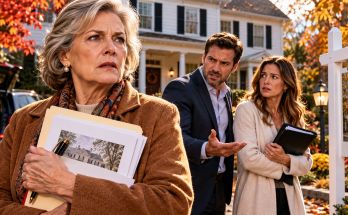
For several moments, nobody spoke. I remember the photographer's equipment case near the door, a white ribbon hanging loose from the banister, and the faint sound of someone walking on the sidewalk outside. Those details stayed with me because I couldn't immediately absorb the sentence Russ had just spoken. My father had survived. The fact stood apart from everything else in the room, impossibly large and simple. I asked Russ to say it again. He looked miserable but did as I requested. Thomas Voss had survived the explosion on May 19, 1993. He had not died on the support vessel. The folded flag, the memorial, and the years of mourning had all existed alongside a truth I had never been allowed to know.
I felt Lauren's hand tighten around my arm. She asked whether I needed to sit. I shook my head, although my knees were unsteady. The questions arrived faster than I could arrange them. Had my father been conscious after the blast? Where had he been taken? Who had identified him? Why had his family received a death notification if he was alive? Russ answered some questions and avoided others. He explained that Thomas had suffered severe injuries and required immediate medical treatment. The explosion had caused extensive burns, fractures, and damage to his airway. His condition had been critical. He survived the initial event, but the months that followed were uncertain. I tried to picture him lying in a hospital while I waited for him to return home. The thought made my chest hurt.
Daniel Sandival explained that the first casualty reports had been confused by the severity of the blast and the discovery of human remains near the vessel. Investigators later determined that one of the people initially associated with Thomas's death was another man. The mistake had been corrected within restricted channels, but the public account was allowed to remain unchanged after concerns arose about the security of surviving witnesses. I stared at him. I knew how bureaucratic errors could persist, but this was more than an error. An entire family had been made to live inside a false account of a man's death. I asked whether the government had formally authorized such an arrangement. Daniel said certain protective measures had been approved during the investigation, though the documentation required careful review before it could be understood in full.
My mother said that I was imagining the situation as safer and simpler than it had been. She reminded me that the people behind the explosives diversion had not yet been identified, and some still possessed access to information that could expose our location. She had been frightened for both of us, she said. I watched her hands as she spoke. She kept rubbing the side of one thumb against the other, a gesture I remembered from childhood. I asked whether the danger was the reason she had removed every picture of Thomas. She said it had been one reason. When I asked what the others were, her eyes moved toward Russ. I noticed the hesitation but didn't know what it meant.
Russ explained that Thomas had been transferred from emergency treatment to specialized medical care. There had been multiple procedures over a long period. His injuries made recovery difficult, and he could not simply return to his former life. The people overseeing the investigation believed his survival should remain restricted until the threat could be contained. I knew enough about protective measures to understand why a witness might need a new identity. I also understood that such measures carried enormous human costs. What I couldn't accept was why a child had been allowed to believe her father was dead without any prospect of learning otherwise. I asked who had made that decision. Russ said several people had been involved. My mother said she had agreed because she was afraid.
I turned toward her. She had once told me that grief required accepting what could not be changed. She had scolded me for keeping photographs and punished me with silence whenever I asked about Thomas. Now she stood in front of me explaining that she had known the truth was different. The memory of my childhood felt suddenly unstable. Had she been frightened whenever I spoke his name because she feared someone might recognize it? Had she removed his belongings to protect us, or because they reminded her of a life she wanted to abandon? Both explanations seemed possible. I realized with a sickening clarity that I no longer knew which memories could be trusted.
The question that hurt most came without warning. Had Thomas ever asked about me? I had imagined him in a grave for so long that the possibility of his thoughts had never existed outside childhood fantasy. Now I wondered whether he had remembered my birthday, whether he had wanted news of school, whether he knew I had chosen the Navy. Russ closed his eyes before answering. He said Thomas had asked about his daughter throughout his recovery. I pressed him for details. How often? Did anyone tell him I was safe? Did he know I missed him? Russ said he had wanted updates constantly and had been told as much as those responsible for his protection believed could safely be shared. The uncertainty in those answers made me feel worse rather than better.
I stepped away from everyone and walked toward the front door. Greg moved as if to follow, then stopped when I raised my hand. I needed air. The afternoon was bright, with a faint breeze moving through the trees beyond the driveway. Somewhere nearby, a lawn mower was running. The sound struck me with such force that I remembered the leaf blower on the day of the death notification. Ordinary life had continued then, too. I had once believed that the rest of the world should have stopped when my father disappeared. Now I stood in the same kind of sunlight, wondering how the world could remain unchanged when the explanation for my entire childhood had collapsed.
I reached my truck and leaned against the driver's door. My boots scraped the gravel. I could feel the embroidered letters of my surname beneath my fingertips when I touched my uniform. I had carried that name back into adulthood because I believed it honored a dead man. I had fought my mother for it. I had made peace with the fact that I would never hear Thomas say whether he approved. Now I knew that he had survived at least the earliest years after the explosion, somewhere beyond my reach. I didn't know whether he was still alive. The question frightened me enough that I didn't immediately return to ask it. There were answers that could change a life, and I was beginning to understand how much I feared receiving another one.
Greg came outside a few minutes later. He stopped several feet away and asked whether I wanted company. I nodded. We stood without speaking while a breeze moved dry leaves across the driveway. Finally, he said he had not expected any of this when he recognized my name. I believed him. His face still carried the bewilderment I felt. He said he had wanted to thank me for saving him, not expose some buried family history. I told him he had done nothing wrong. The truth had existed before he came downstairs. His recognition had merely opened a door that other people had kept locked. He looked toward the house and admitted that he wasn't sure his father had known how much of the story would emerge that afternoon.
I asked how Daniel had become involved in the older investigation. Greg said his father had worked in naval assignments that occasionally brought him into contact with complicated cases, though he had never discussed this one in detail. Daniel had started searching for the unidentified rescuer after Greg returned from Afghanistan. At first, he concentrated on operational reports and personnel records. He encountered conflicting descriptions that made identification difficult. The name Voss appeared more than once, but no consistent profile emerged. Some accounts described a male specialist. Others omitted the rescuer's identity altogether. Greg believed the inconsistencies were simply the result of administrative confusion until his father began suspecting that information had been deliberately altered.
I asked whether my name had been removed from the report. Greg said Daniel believed so, but he didn't know who had made the changes or why. That distinction mattered to me. If someone had manipulated my service record, there should have been an identifiable chain of responsibility. I had worked too long within the military system to accept a vague explanation involving hidden forces and anonymous interference. I wanted documents, dates, signatures, and a reason that could withstand scrutiny. Greg agreed. He said Daniel had brought the envelope because he believed recent developments allowed some of those questions to be examined properly. The captain was not asking me to rely solely on his word.
We stood beside the truck until my breathing steadied. Then I asked Greg something more personal. Did he remember being rescued clearly, or had the memory changed over time? He thought for a moment. He said he remembered fragments with extraordinary sharpness, while other portions had become confused. He recalled the sound of my instructions and the certainty that the ground around him could kill him. He remembered following my boots, carrying a wounded man, and feeling almost ashamed when he stumbled. But he could not reconstruct the entire sequence without consulting reports. I appreciated the admission. Memories of danger can be powerful without being complete. I wished my parents had approached the past with the same willingness to acknowledge uncertainty.
Greg told me that he and Lauren had talked about the rescue throughout their marriage. At their wedding, when he thanked the people who brought others home, he had meant the unknown specialist as well as the many people who supported him during his recovery. His daughter was now old enough to ask questions about the injury in his shoulder. Sometimes, he said, he had explained that somebody had helped him when he couldn't get home by himself. I imagined his little girl listening to that story without knowing that the person he meant was her aunt. The coincidence was remarkable, but it did not feel like a miracle. It felt like the strange result of many ordinary lives crossing without anyone noticing how deeply they were connected.
I thought about the annual gathering Greg had mentioned at Thanksgiving. He confirmed that his former unit continued leaving a chair unoccupied to honor the person they had never identified. Some of the men believed the rescuer had been reassigned and simply preferred anonymity. Others thought the incomplete records indicated that the individual had died. Greg had refused to accept either explanation without evidence. He said his father carried the laminated index card because the surname was the one detail that had survived every conflicting account. I pictured the captain reaching into his jacket and removing the worn card. A name that my mother had spent decades trying to silence had been carefully preserved by a stranger.
That contrast stayed with me as we returned toward the house. Inside, my relatives had gradually moved into smaller groups, but no one seemed ready to leave. The photographer had finished packing. Aunt Phyllis was making tea in the kitchen, an activity she apparently considered the only reasonable response to a family crisis. Uncle Walt stood near the window, pretending to study the garden. Lauren approached as soon as she saw me and asked whether I was all right. I told her I was not, but I would manage. She hugged me without demanding reassurance. I noticed that her eyes were red. Whatever our mother had concealed from me, Lauren was discovering it alongside me. I didn't want my anger to swallow that distinction.
Daniel was seated at the dining room table with the sealed envelope before him. Russ stood near the kitchen entrance, shoulders bowed. My mother had disappeared from the room. I sat opposite the captain and asked him to begin with the documents rather than another verbal account. He agreed. He explained that the case involving my father's explosion had undergone additional review and that certain restrictions connected with it had recently changed. Not every record was available, and some portions still required formal procedures to obtain, but he could show me enough to establish that the death notification had not reflected the final known facts. He placed the envelope within reach without pushing it toward me.
I hesitated before touching it. I had spent years believing that knowledge about Thomas was permanently unavailable. Now it lay in a small packet on my mother's dining room table. I wondered what he had looked like after the explosion, whether the injuries had changed his voice, and whether he had suffered through a recovery I should have known about. I also wondered why Russ seemed so profoundly shaken by the prospect of my reading these records. He had already admitted knowing my father survived. What additional fact could frighten him more than that confession? I looked toward him. He met my eyes briefly and then looked away.
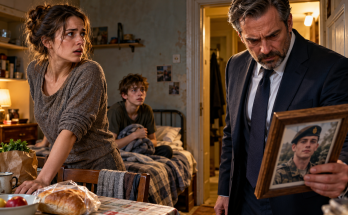
Daniel removed a photograph from the envelope and laid it on the table. It showed my father in uniform before the explosion. The image was sharper than most of the pictures I had kept as a child. His face was younger than I remembered, his expression serious but not severe. There was a slight asymmetry in his smile that made him instantly recognizable. I touched the edge of the photograph, careful not to cover his face. For a few seconds, I could imagine myself at five years old again, waiting for him to come through the kitchen door. I asked where the photograph had come from. The captain said it belonged to the original investigation file.
He placed another sheet beside it. The document recorded the explosion date, the initial casualty findings, and later amendments made within restricted channels. Daniel explained that a second man had been near the blast. His remains had initially been associated with Thomas's identity. Investigators eventually determined that the deceased man was Michael Danner, a civilian contractor linked to the diverted materials. The name meant nothing to me, but the implications were enormous. My father's apparent death had been shaped by an identification error, a criminal investigation, and a subsequent decision to conceal his survival. I asked whether that decision had ever been reconsidered. Daniel said it had, more than once, as the threat picture changed.
He told me Thomas had spent nearly two years in medical treatment and rehabilitation. The injuries included significant burns, reconstructive procedures, and damage to his airway. Some records were difficult to interpret without medical specialists, and Daniel cautioned against drawing conclusions from isolated pages. What he could establish was that Thomas had survived long enough to recover a measure of independence. I felt myself gripping the edge of the table. Two years after the explosion was approximately when Russ had entered our home. The timing occurred to me, then slipped away under the weight of everything else I was trying to understand. I had too many questions to recognize which ones mattered most.
I asked whether the people who threatened Thomas had ever been captured. Daniel explained that principal defendants had eventually been convicted and that later investigations dismantled much of the remaining network. The process had been slow because some participants operated across multiple jurisdictions and others vanished for years. Protective restrictions connected to Thomas's case had remained in place far longer than anyone originally anticipated. I could hear the strain in Daniel's voice when he discussed the delay. He had spent much of his career believing procedures existed to protect people. Now he was describing procedures that, however necessary they may once have seemed, had inflicted lasting damage on a family.
The captain paused and studied me before continuing. He said the final protective restrictions associated with the old investigation had been lifted recently. I asked when. He answered that the change had occurred six weeks earlier. The number seemed small after thirty-three years, but it immediately became the most important detail in the room. Six weeks meant there had been time to arrange a meeting, explain the history, and give me some choice in how I learned the truth. I asked whether anyone in my family had been notified. Daniel looked toward Russ. My stepfather lowered his head. The captain confirmed that Margaret and Russ had received the relevant notification.
I stared at the two men. Six weeks earlier, my mother had known that the restrictions used to justify the silence were no longer in force. During those weeks, she had telephoned me about the portrait, criticized my schedule, and reminded me repeatedly to wear pale colors. She had not mentioned Thomas. She had not asked whether I wanted to discuss the past. She had not given me the slightest indication that the story of my father's death was about to change. Yesterday, she had sent another message insisting that I leave my Navy identity outside her carefully arranged family picture. I felt the familiar anger returning, but this time it rested on something more solid than hurt feelings.
Russ took a step toward me. He said there were reasons he hadn't spoken immediately. I looked at him and asked whether those reasons involved actual danger or simply the difficulty of telling the truth. He had no quick answer. I told him that a delay of thirty-three years could not be made harmless by describing it as protection, and that another six weeks of silence required an explanation of its own. His face tightened. For a moment, I thought he might finally tell me everything. Instead, he glanced toward the kitchen where Margaret stood just beyond the doorway. She had been listening.
I looked down again at the photograph of Thomas Voss. My father was young, alive, and unaware of what waited for him. Behind that picture lay another history, one that included a damaged body, a hidden identity, and people who had continued making decisions about his daughter long after the original danger had changed. I placed my hand flat on the table and told Daniel I wanted access to every record I was legally entitled to see. I also wanted to know where Thomas had gone after leaving medical care and whether he was alive now. The captain nodded, but before he could answer, Russ spoke from the doorway. His voice was barely audible. He said that the answer was much closer than I realized.