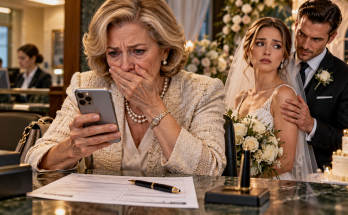
Paula removed her glasses and placed them beside the keyboard. Through the glass wall of her office, I could see two employees adjusting strings of lights beneath the barn's heavy beams. One stood on a ladder while the other passed up the cable. The ordinary scene unsettled me. My daughter's wedding was supposed to take place in this beautiful building, and I had imagined watching her enter it in a white dress. Instead, I was sitting in an office trying to discover why her fiancé had asked for my forty-thousand-dollar deposit to be transferred somewhere unfamiliar.
“The account was registered to Miller Coastal Holdings, LLC,” Paula said. She rotated the computer toward me. On the screen was Derek's email, sent the previous Thursday afternoon. It contained a polite explanation about altered wedding plans, followed by banking details and instructions to arrange the refund. Nothing in the message suggested that I, the person who had paid the deposit and signed the contract, had authorized the request. I read the company name twice. Joselyn had never mentioned it, and neither had Derek.
“Did you process the refund?” I asked. Paula shook her head. She explained that the contract permitted payments to be returned only under its terms and to the authorized party. Derek had pressed her to make an exception. When she refused, he suggested that my age was beginning to affect my judgment and that younger family members were taking responsibility for my financial affairs. He asked whether the principal signatory could be changed without the inconvenience of involving me.
I felt heat rise beneath my collar. I was sixty-one, not incapacitated. Only months earlier, I had led a technical review of a major medical building designed for a region with serious earthquake risks. My staff trusted me with complex engineering decisions, and I continued to oversee a company employing forty professionals. Yet Derek had attempted to portray me as an aging woman incapable of understanding her own finances. It was more than an insult. He had made that claim to someone responsible for administering a contract worth tens of thousands of dollars.
Paula admitted that the request had disturbed her. She had managed weddings for nearly two decades and was accustomed to financial disagreements between relatives. What concerned her was Derek's insistence on changing both the payee and the authorized signatory. She had preserved the email and documented the call rather than allowing the conversation to disappear into an ordinary customer-service record. When I asked for copies, she printed them, signed a statement identifying the records, and provided the date and time of the conversation.
I asked whether the forty-thousand-dollar deposit was truly lost if I canceled the event. Paula reopened the agreement and showed me a provision I had overlooked. Because we were still more than ninety days from the scheduled ceremony, the non-refundable deposit could be converted into a venue credit. I would not receive cash, but I would have two years to use the amount toward another qualifying event. Since the agreement was in my name, the credit would remain under my control.
I considered the possibilities. I could leave the booking intact and hope Joselyn changed her mind. I could allow Derek to continue planning a wedding financed by someone he had deliberately excluded. Or I could acknowledge that the arrangement no longer existed as I had understood it. I asked Paula to cancel the Weber-Miller ceremony, convert the deposit to a credit in my name, and document that no other person was authorized to modify the account. Paula completed the forms while I watched. By the time I signed them, I understood that this was no longer merely a disagreement over a guest list.
Outside, I paused near the barn entrance. The mountain view was as beautiful as Joselyn had promised, and sunlight was beginning to burn away the mist. I remembered the day she first showed me photographs of the venue. She had sat beside me on the couch, pointing out the timber ceiling and the windows that overlooked the valley. I had been delighted by her enthusiasm. Now, looking toward the same building, I wondered whether Derek had ever intended the celebration to happen there at all.
I called Sandra from the parking lot. I described Paula's records, the unfamiliar company, and the comments Derek had made about my mental competence. Sandra asked me to photograph the documents and send them through her secure client portal. She told me not to confront Derek or accuse him publicly while she reviewed the evidence. She also advised me to preserve every message and record connected to the business loan and wedding expenses. Her calm voice did little to lessen my anxiety, but it gave the next hours a structure.
I drove home, ate half a sandwich without tasting it, and tried to work. The drawings on my desk required attention, yet my mind kept returning to the company name. Miller Coastal Holdings. Derek's proposed business was a restaurant supply operation. Why would he direct a wedding refund to an entity with an entirely different name? If there were an innocent explanation, why had he concealed it from me? More troubling still was his effort to establish that I could no longer manage my own affairs.
Sandra called back earlier than I expected. She had checked public corporate registrations and relevant court records. Miller Coastal Holdings had been formed four months earlier, with Derek listed as its sole managing member. Its registered address was a rented mailbox in a commercial strip along Route 9. The company had no obvious connection to restaurant equipment, warehouse services, or event planning. Sandra had also identified two previous companies associated with Derek, both dissolved after troubled periods of operation.
The first had sold nutritional supplements. The second had dealt in small property transactions. Several vendors had obtained unpaid judgments arising from those businesses, with amounts ranging into the tens of thousands of dollars. A failed business did not automatically prove dishonesty, Sandra cautioned, but the recurrence of unpaid obligations made his presentation as a successful entrepreneur difficult to accept. I thought back to our dinner conversation, his expensive watch and smooth explanations. I wondered how much of his confidence had been borrowed.
Then Sandra turned to the commercial loan. The bank had begun reviewing the facility following her formal request, and because I was the guarantor, information relevant to my liability was being examined through authorized channels. Of the one hundred and fifty thousand dollars originally approved, seventy-five thousand had been released. The remaining seventy-five thousand had not yet been disbursed. The application described a business requiring kitchen equipment, storage space, and commercial inventory. The financial records examined so far did not support those planned expenditures.
According to Sandra, no matching warehouse lease or major equipment purchase had been identified. Approximately forty thousand dollars from the first disbursement had gone toward previous obligations, including debts associated with Derek's earlier ventures and personal credit liabilities. Another thirty-five thousand had been transferred into Miller Coastal Holdings. Sandra stressed that the lender would need to establish the full transaction history before drawing final conclusions. Still, the discrepancy between the loan application and the apparent use of the funds was serious.
I walked to the stove and switched off a pot of soup that had been simmering too long. The kitchen smelled of onions, thyme, and overcooked chicken. I had forgotten I was preparing dinner. Sandra continued speaking while I set the pan aside. She explained that the bank had placed a hold on the remaining disbursement pending its review. My guarantee on the first amount remained a potential liability, but she believed there were grounds to challenge it if Derek had obtained my signature using materially false representations.
I sat at Robert's table and opened the folder containing the original business proposal. Derek had presented precise revenue forecasts and estimated equipment costs. I remembered asking whether he had already identified a suitable warehouse. He had assured me that negotiations were advanced. Joselyn had nodded beside him. Had she known those claims were false? The possibility hurt so much that I forced myself not to answer the question without evidence. I knew my daughter could be stubborn, but I had never considered her deliberately dishonest.
Sandra raised another concern. The attempted venue refund, the hidden company, and Derek's comments about my competence might be related. If Joselyn remained the beneficiary of my estate and successor under the existing trust arrangement, marriage could give Derek indirect influence over significant future assets. If he could persuade my daughter that I was mentally unreliable, he might also try to involve himself in present financial decisions. Sandra did not claim she knew his ultimate intentions. She said the pattern justified immediate legal precautions.
I looked around my kitchen. Every chair, picture, and piece of furniture contained some memory of Robert or Joselyn. My house was not simply real estate, however valuable it had become. It was where we had celebrated birthdays and mourned a death. The idea of Derek treating it as an asset waiting to be acquired made my hands go cold. I asked Sandra whether my estate changes could be completed promptly. She confirmed that the revised documents were being prepared for execution with the required formalities.
The scholarship arrangement was also moving forward. Sandra had contacted the county community college regarding a restricted endowment focused on students pursuing practical engineering, drafting, construction, and technical programs. I wanted the funds administered properly rather than dispersed as a gesture made in anger. She assured me that a formal agreement would define eligibility and permitted uses. I found unexpected relief in discussing those details. The money would still support a future, just not the future Derek had described.
Late that afternoon, I checked my phone again. Joselyn had not responded to my acknowledgment, nor had she asked why the honeymoon transfer had not arrived. I drafted several messages and deleted them. One asked whether she knew about Miller Coastal Holdings. Another simply asked whether she was safe. I wanted to reach her without driving her further toward Derek, but I no longer trusted my understanding of their relationship. I decided to wait until Sandra had assembled the relevant documents.
At eight forty-seven that evening, Joselyn called. I recognized the strained sound of her breathing before she spoke. She demanded to know why I had canceled her wedding venue. In the background, Derek's voice rose and fell, followed by a sharp bang. I moved into my study and closed the door. She accused me of humiliating them, interfering with Derek's business, and retaliating because they had decided to exclude me from the ceremony.
I allowed her to finish. Then I said I had respected the boundary she communicated. She had told me I would not be welcome at the wedding, and I had decided not to finance an event from which I was barred. The loan, I explained, was a separate matter involving significant obligations and discrepancies that needed proper investigation. Joselyn answered that Derek had warned her I would use money to control them. I heard him prompting her again, supplying accusations that emerged from her mouth a moment later.
I wanted to list everything I had done for her. I wanted to remind her of tuition payments, emergency repairs, midnight drives, and twelve years of raising her without Robert. Instead, I asked her whether she knew Derek had sought a refund of the venue deposit before she sent the message excluding me. Joselyn sounded confused. I explained that he had supplied an account belonging to Miller Coastal Holdings, not an account in my name or hers. I asked her to question him directly about that company and the purpose of the transfer.
Derek stopped speaking in the background. The sudden silence was more revealing than his earlier interruptions. Joselyn asked me how I knew about the account. I told her Paula had preserved the written request. Then I said that whatever happened between us, she would always be my daughter, and she could come to my home whenever she genuinely needed me. I would listen. I would help her find safety. But I would no longer surrender financial control or sign documents to win her approval.
I ended the call before the argument could begin again. For a long time I remained at my desk, staring at an unfinished engineering drawing. The house made small settling noises as the temperature dropped. Eventually I unclasped the silver chain and held Robert's ring in my palm. The tears I had managed to suppress since the bank finally came. I cried for the wedding I might never witness, for the daughter who no longer trusted me, and for my own willingness to ignore warning signs whenever she asked for help.
By morning, I had made another decision. If Derek had used my daughter to obtain financial support, I needed to protect myself without turning Joselyn into an enemy. I gave Sandra permission to proceed with the lawful safeguards, requested copies of all completed documents, and returned to my work. I could not force Joselyn to recognize what was happening. I could only make sure that if she eventually did, there would still be something solid for her to return to.
Two days passed without a word from her. On the third evening, while I was returning from the garden, a car pulled into my driveway. Derek stepped out alone. He carried a bouquet wrapped in clear plastic and wore the same polished smile I remembered from our first dinner. He climbed the porch steps as though he had come to resolve a harmless misunderstanding. I stopped at the foot of the stairs, keeping the iron railing between us, and waited to hear what he wanted.