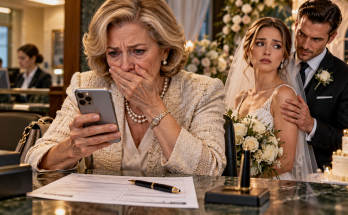
The pen was already touching the paper when my phone vibrated against the polished desk. I had written the date, confirmed the account number, and checked the amount twice. Twenty-five thousand dollars. The final installment for my daughter’s honeymoon on Italy’s Amalfi Coast. Across from me, the bank employee waited patiently while I glanced at the message. I expected a question about the travel arrangements, perhaps a photograph of another wedding decoration Joselyn wanted me to admire. Instead, I found a sentence that made the room seem strangely far away.
My daughter had informed me that I would not be attending her wedding. Her fiancé, Derek, had decided he did not want me there. There was no apology, no suggestion that we discuss it, not even an acknowledgment of what the decision might mean to me. She had delivered the news as though she were changing the address for a package. I read the message again, then looked at the form beneath my hand. The transfer authorization was still incomplete. One movement of my pen would send the money.
For several seconds, I considered finishing the signature. That is the part of this story I am least proud to admit. My first reaction was not anger. It was an almost physical urge to prevent another separation from occurring in my family. If I paid, perhaps Joselyn would soften. Perhaps Derek would reconsider. Perhaps there would be a chair for me somewhere at the ceremony after all. A mother can recognize an insult and still feel compelled to protect the person delivering it.
“Mrs. Weber?” the teller asked. Her name was Hannah, according to the little brass plate above her blouse. She had noticed the change in my expression. “Is there a problem with the information?”
I put my phone on the desk with the screen facing downward. My husband's wedding ring, hanging from a silver chain around my neck, touched the edge of my collar as I leaned forward. Robert had been dead for twelve years, but I still reached for that ring whenever I needed to make a decision without him. I pressed my thumb against the familiar gold and told Hannah that I would not be authorizing the wire transfer.
She reached for the paperwork. “Certainly. I can void this for you.”
“There are other arrangements I need reviewed,” I said. “The automatic transfers connected to my daughter, the supplementary credit facilities, and the joint shopping account. I want the payments stopped wherever I have the authority to stop them. Anything involving a binding obligation needs to be identified before another dollar goes out.”
Hannah regarded me carefully. I could almost see her deciding whether this was a temporary family disagreement or the beginning of something more serious. She did not ask. Instead, she opened my account records and explained which instructions could be changed immediately, which required another department, and which involved contracts that could not simply be canceled. Her professionalism helped me remain composed. I had spent thirty-five years designing buildings that had to withstand pressure. I could sit through a banking procedure without collapsing.
When she asked whether I wanted to reconsider the honeymoon payment, I answered no. My voice surprised me. It sounded like the voice I used during engineering meetings when someone proposed an unsafe shortcut. Hannah printed the cancellation acknowledgment and placed it in front of me. I signed that document instead. Then I opened Joselyn's message one final time and wrote a single reply: “Understood.”
I left First National Bank carrying a thin folder of paperwork. Outside, the afternoon sun flashed against windshields in the parking lot. My Subaru stood between an expensive minivan and a contractor's truck with a ladder strapped to its roof. I got behind the wheel but did not start the engine. A woman crossed the parking lot holding a little boy's hand. He was explaining something urgently, and she bent toward him to listen. I looked away before they disappeared through the bank doors.
Joselyn was twenty-nine. When she was seven, she followed me around the house with a yellow measuring tape and demanded that I teach her how bridges stayed standing. She insisted on measuring furniture, window frames, and the distance from our kitchen table to the refrigerator. Robert had made her a wooden stool so she could stand beside my drafting board. Every evening she would climb onto it and announce that she was reporting for work. Back then, she believed I understood everything.
Robert had been a carpenter, a gifted one who could look at a piece of rough timber and see the table hidden inside it. He built the oak dining table that still occupied my kitchen. He built bookcases, repaired neighbors' porches, and burned the first pancake nearly every Sunday morning because he always turned the heat too high. When his heart stopped without warning twelve years earlier, our daughter was seventeen. The house became so quiet that for months I left the radio playing while I worked.
After his death, I devoted myself to keeping Joselyn's life steady. I worked longer hours at the engineering consultancy I had founded and took on larger contracts. By then, the business had grown beyond the small rented office where I had started. Eventually, forty full-time engineers worked there. I paid for Joselyn's university education, replaced her aging car when it became unreliable, and made sure she entered adult life without student debt. I thought security was the greatest gift I could provide after she had experienced such a devastating loss.
It had not always been about money. We used to speak every Sunday, sometimes for an hour. She called while making breakfast, folding laundry, or driving to buy groceries. She asked about my work. I asked about hers. Occasionally we argued, usually because I offered an opinion when she wanted only to be heard. Then one of us would apologize, and our conversations would resume their familiar rhythm. I knew we were different women, but I never imagined becoming a stranger to her.
Eighteen months before the message at the bank, she introduced me to Derek Miller. He arrived for dinner in a carefully fitted navy jacket and wore a watch large enough to catch the light whenever he moved his wrist. His handshake was firm, his compliments numerous. He praised the house, the garden, and Robert's furniture. Yet he seemed more interested in the size of the property than the craftsmanship of anything inside it. When he discovered I owned an engineering consultancy, he spoke of it as though it were a pleasant hobby.
At dinner, he asked whether I had considered selling the company. I told him I had no intention of doing so. He smiled and suggested that managing such a business must be exhausting for a woman approaching retirement. Joselyn laughed awkwardly and changed the subject. I could have challenged him, but I noticed how eagerly she watched his face. She was in love, and she wanted us to get along. I told myself that one patronizing comment did not reveal a person's entire character.
Six months later, Joselyn asked me to guarantee a business loan for him. Derek planned to establish a restaurant supply company, she explained. He needed funding for equipment and a warehouse, and the bank wanted additional security. He had convinced her the venture would give them a stable future. The loan facility was worth one hundred and fifty thousand dollars. My corporate credit history and personal guarantee would support it. I requested the documents, read the proposed business plan, and asked several questions that Derek answered with considerable confidence.
I should have insisted on independent verification. I knew that even then. But Joselyn sat beside him during our meeting, holding his hand beneath the table. She looked at me with an expression I remembered from childhood, when she wanted reassurance that an uncertain thing would work out. I signed. At the time, I believed I was helping two adults create a business. I did not recognize how often Derek's requests would soon arrive through my daughter rather than from him directly.
The wedding expenses followed. Joselyn loved Ridgeline Barn, an expensive timber-framed venue outside town, with views across the valley and rows of suspended lights. The reservation required a forty-thousand-dollar deposit. I agreed to pay it and signed the venue's principal contract myself. I wanted her to have a beautiful wedding, and I had the resources to provide one. Then there was a supplementary grocery account I maintained for her, automatically replenished with two hundred dollars each month. She liked a particular dark-roast coffee and a Greek yogurt sold in small containers with blue foil lids. I continued paying because those little preferences reminded me of the girl I had raised.
The honeymoon had been another request that somehow became an obligation. Joselyn mentioned an Italian resort with a private terrace and views of the Mediterranean. Derek talked about how rarely young couples had the opportunity to begin married life somewhere extraordinary. I offered to cover the last installment. By the time I sat down opposite Hannah at the bank, I had stopped asking whether the expense was appropriate. I simply wanted Joselyn to be happy. The distinction between generosity and appeasement had become difficult to see.
I drove home by the familiar road through town. At a red light, my phone rang, and for an instant I hoped it was Joselyn calling to explain. It was an employee from my office asking about a foundation calculation. I answered the question, confirmed the schedule for our next meeting, and ended the call. Work still made sense. Measurements could be checked. Defects could be documented. If two people disagreed about a steel beam, there were equations capable of establishing which one was correct.
At home, I carried my handbag into the kitchen and made tea. Without thinking, I set two mugs on the table. I had developed that habit during Robert's lifetime, and it persisted even after twelve years of living alone. I returned one mug to the cupboard. Then I sat in the chair across from the place where he used to unfold his newspaper. I thought about something he had said years earlier when a difficult developer kept demanding revisions without paying the firm's invoices.
Robert had been helping me finish a drawing late one evening. He examined the changes and observed that I was spending more effort protecting the developer from his own decisions than completing the project. He told me I could not build a sound structure on ground that someone else refused to maintain. At the time, I considered it ordinary practical advice. Now, sitting at his table, I understood why the memory had surfaced. I had taken responsibility for supporting an adult daughter who was increasingly unwilling to offer me even basic consideration.
At six that evening, I called Sandra Okafor, my attorney of many years. Sandra handled both my estate planning and significant corporate matters. She knew my family, understood my business, and possessed the rare ability to ask a difficult question without making the person answering it feel foolish. She picked up after two rings and asked whether something urgent had happened. I told her I needed a review of my financial arrangements, including my estate plan, Joselyn's supplementary accounts, Derek's loan, and the wedding contracts.
Sandra listened without interruption. Then she asked what had prompted such an extensive review. I told her about the message. There was a silence long enough for me to hear a door closing at her end of the call. When she spoke again, her tone had changed. She said we could amend my estate documents and stop discretionary support, but my existing obligations as guarantor and venue signatory needed careful legal handling. I appreciated that she did not promise an effortless escape from commitments I had voluntarily undertaken.
I asked her to prepare a codicil removing Joselyn as sole beneficiary and successor under the existing arrangements, subject to properly executed revisions. I also wanted the unused portion of Derek's loan facility frozen while the bank reviewed the guarantee. Sandra said she would contact the lender immediately, though any release of my obligations would require its agreement or another valid legal basis. Finally, I instructed her to arrange a twenty-five-thousand-dollar scholarship endowment for the county community college. The money originally intended for an Italian honeymoon would help students learn skills that could support them for years.
Sandra asked whether I understood that these decisions might provoke an ugly confrontation. I did. I could already imagine Derek explaining my actions to Joselyn as punishment, and Joselyn believing him. But I could no longer justify financing a wedding from which I had been excluded, particularly when so much of my financial security was connected to people who treated it as theirs to command. Sandra arranged an appointment for the following morning. Before we ended the call, she recommended I contact the wedding venue personally, since the forty-thousand-dollar deposit involved a contract in my name.
I spent that night reviewing documents at my drafting desk. The house seemed particularly empty. Occasionally I picked up my phone and looked at Joselyn's message. No new explanation arrived. I wondered whether she had been expecting an argument, and whether my single-word reply had confused her. At midnight, I returned Robert's old yellow measuring tape to its drawer. It still bore a faint pencil mark Joselyn had made as a child while calculating the width of a pretend bridge.
The next morning, I drove toward Ridgeline Barn through patches of valley mist. The restored building stood above a gravel parking area, its long roofline visible between mature trees. Paula, the venue director, greeted me in her office. She appeared to recognize my name immediately, but her expression changed when I said I wanted to discuss terminating the wedding reservation. She closed the office door, retrieved our contract, and examined something on her computer before looking back at me.
“Mrs. Weber,” she said carefully, “there is something you should know before we discuss what happens to your deposit.” She turned her screen slightly away, as though deciding how much she was permitted to reveal. Then she explained that Derek had called her five days before Joselyn excluded me from the wedding. He had asked whether the deposit could be returned if the ceremony were moved elsewhere. More importantly, he had supplied instructions for where the money should be sent.
I looked at the woman across the desk and felt the first stirrings of a concern much greater than hurt feelings. “Was he asking for the money to be returned to my account?” I asked. Paula shook her head. When I requested the name of the account holder, she looked once more at the screen. I waited, suddenly aware that whatever she said next could change my understanding of Derek, my daughter, and everything I had signed.