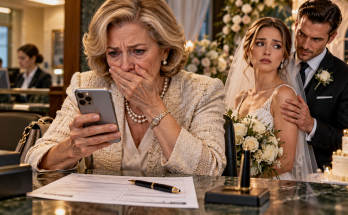
The court's decision arrived on a clear morning in early spring. Sandra called shortly after nine while I was reviewing drawings in my office. I recognized the seriousness in her voice before she explained the result. The court had found Derek responsible for the financial offenses established through the evidence presented, including the submission of false documentation connected to the business loan. The ruling addressed the specific charges and records examined during the proceedings. It did not attempt to resolve every private wrong he had committed, but it confirmed that the central financial deception had been substantiated.
I put down my pen and listened carefully as Sandra explained what the decision meant. The court's findings concerned Derek's use of inaccurate certifications and financial representations to obtain loan funds. The record supported the conclusion that the disputed signature had been reused without Joselyn's authorization. The movement of money through Miller Coastal Holdings and the discrepancies in supplier documentation had also been examined. Derek would face sentencing and related financial consequences through the legal process, with further details to be determined under the applicable procedures.
Sandra reminded me that my personal guarantee had already been released by the bank. The ruling did not require me to pay the outstanding loan balance. The lender retained its rights to pursue appropriate recovery from those legally responsible. My finances and the engineering company were no longer exposed through the guarantee that had once seemed capable of dragging us into Derek's business failures.
For several seconds, I stared through my office window. A delivery truck was backing toward the loading area across the street. Two engineers were discussing a drawing near the conference room. The ordinary sounds of the workplace continued around me, indifferent to the fact that a chapter of my life had finally reached its legal conclusion.
I thanked Sandra. She had guided me through months of decisions that required patience, restraint, and evidence. She told me the outcome reflected careful documentation and the willingness of witnesses to provide truthful accounts. Then she asked how I felt.
I looked at Robert's photograph on my desk.
“Relieved,” I said. “But not happy about what it took to get here.”
Sandra understood.
After the call, I closed the project file and drove home. Joselyn was at work, so I did not contact her immediately. Michael would explain the ruling directly, and I wanted her to hear the details from her own attorney. I made coffee, opened the kitchen window, and sat at the dining table where Derek had once presented his business plan. The same oak surface had held his glossy financial projections, the canceled wedding documents, and the evidence that later exposed him.
I ran my hand across a faint scratch near the table's edge. Robert had made it accidentally while repairing a chair years earlier. He had promised to sand it smooth but never did. I had kept the mark because it reminded me of him. Now I found myself studying it as though it were a small lesson. A sound piece of furniture could bear scratches without losing its strength. The damage became part of its history, not the whole of what it was.
Joselyn came home shortly after six. She had already spoken with Michael. She stood in the kitchen doorway holding her bag, her expression difficult to read. I rose from the table, uncertain whether she wanted an embrace or time alone.
She set down her bag.
“He was found responsible,” she said.
“Yes.”
She nodded slowly. Then she crossed the room and hugged me.
I held her without speaking. Her shoulders trembled, but she did not sob. The emotion seemed too complicated for a single reaction. She had once intended to marry Derek. She had imagined a future with him, defended him against concerns, and believed his promises. Now a court had examined evidence showing that he had used false financial documents and concealed transactions while building that future.
When she finally stepped back, she wiped her eyes.
“I thought I would feel triumphant,” she admitted.
“And?”
“I feel sad. And angry. And relieved. All at once.”
I told her there was no correct emotional response. The ruling established legal responsibility for particular acts. It could not restore the time she had lost or make the relationship she remembered real again. Those consequences would take longer to understand.
We ate dinner quietly. Joselyn asked several questions about the bank's remaining recovery process, and I answered what Sandra had explained. We agreed not to speculate about Derek's final sentence or future actions. The legal system would address those matters. Our responsibility was to continue building lives that no longer depended on his decisions.
Over the following weeks, the remaining proceedings moved forward. Derek received a sentence and financial obligations reflecting the offenses established in court. The precise consequences were handled through the formal legal process, including provisions relating to restitution and other remedies. I did not attend every proceeding. When my presence was necessary, I participated. Otherwise, I allowed Sandra to keep me informed.
The result brought accountability, but it did not erase the experience. I still remembered the message that arrived while my pen hovered over the wire transfer form. I still remembered Derek standing on my porch, offering flowers before asking for control over my finances. I remembered Joselyn arriving through the storm, soaked and frightened, carrying a suitcase with a broken wheel.
Those memories remained. What changed was their power over my decisions.
The first time I returned to First National Bank after the ruling, Hannah was working at the same desk where I had nearly authorized the honeymoon payment. She recognized me immediately. I was there to complete an ordinary account review, not because of an emergency.
She asked how I had been.
I told her things were considerably better.
As we worked through the paperwork, I noticed the same polished surface, the same arrangement of pens, and the same small brass nameplate. The room looked almost identical to the afternoon when Joselyn's message changed everything. Yet I felt entirely different sitting there.
Hannah asked whether I needed any additional changes to my accounts.
“No,” I said. “Everything is where it belongs.”
She smiled and returned the documents.
When I left the bank, I did not sit in my car trying to stop myself from crying. I drove directly to the community college, where preparations for the scholarship event were underway.
Ridgeline Barn had agreed to host the gathering under the venue credit remaining in my name. Paula worked with Rosa Delgado to develop an event that would focus on technical education rather than elaborate entertainment. Students would present projects, local employers would discuss career opportunities, and the first scholarship recipients would be recognized. The budget included food, transportation assistance for students, and equipment needed for demonstrations.
Joselyn helped Rosa establish clear accounting procedures for the event. She prepared expense categories, reviewed vendor invoices, and documented how the venue credit would be applied. No one asked her to surrender her judgment in the name of loyalty. When she questioned a cost, Rosa thanked her for noticing it. When she suggested a better reporting method, the staff considered the idea on its merits.
I watched my daughter work and understood how much had changed.
The scholarship endowment had originated from the twenty-five thousand dollars I refused to send for the Amalfi Coast honeymoon. Now it was supporting two students pursuing technical qualifications. One, a young woman named Elena, was studying civil engineering technology while caring for her younger brother. The other, Marcus, had worked in construction for several years before deciding to pursue formal training in project management.
Both students had practical reasons for needing assistance. Neither had asked for luxury. They wanted tuition support, materials, and enough financial breathing room to complete their programs without abandoning work or family responsibilities.
When I met them, I did not tell them the personal history of the endowment. Their achievements deserved attention without becoming symbols in someone else's family dispute.
Elena showed me a structural model she had designed for a class project. She explained how she modified the supports after an initial test revealed uneven loading. Her excitement reminded me of the girl who once followed me around the house with a yellow measuring tape.
Marcus described his years working on construction sites and his desire to understand the engineering decisions behind the plans he followed. I told him about Robert, who had been a carpenter with remarkable practical knowledge of materials. Marcus smiled and said the best tradespeople he knew could often identify a problem before anyone opened the drawings.
I agreed.
On the morning of the event, I arrived early at Ridgeline Barn. Sunlight streamed through the tall windows, illuminating the timber beams and the rows of chairs arranged beneath them. The building looked almost exactly as it had when Joselyn first showed me photographs. For a moment, the memory of her canceled wedding returned with unexpected force.
I stood near the entrance and imagined her walking down the aisle in the dress she had chosen. I imagined Robert beside her, if he had lived long enough to see the day. The grief was real, and I allowed myself to feel it. Then I looked toward the students setting up their displays and recognized that the building had acquired a different purpose.
Paula approached with a clipboard.
“Everything is ready,” she said.
I thanked her for protecting the original deposit when Derek tried to redirect it. She looked uncomfortable with the praise and said she had simply followed the contract.
“That was enough,” I told her.
She smiled and returned to her work.
The event began shortly after noon. Students demonstrated projects involving structural design, drafting, construction materials, and technical systems. Engineers from my company spoke with young people interested in internships. Community college instructors explained their programs, and local employers discussed the skills they needed.
Daniel stood near a display of bridge models, asking questions with the enthusiasm of someone who had spent decades solving similar problems. I watched him encourage a nervous student to explain why she had changed the shape of a support. When she answered, her confidence visibly grew.
The gathering felt different from the wedding reception I had once imagined. There were no elaborate floral arrangements, no carefully staged photographs, and no luxury menu intended to impress strangers. People were there because they shared an interest in helping students build useful futures.
When Rosa invited me to speak, I kept my remarks brief. I talked about Robert's craftsmanship, the importance of technical education, and the value of combining practical experience with careful thinking. I told the students that every successful project involved revisions, failures, and people willing to ask difficult questions before mistakes became dangerous.
I did not mention Derek.
I did not need to.
After the scholarship recipients were recognized, Joselyn approached me near the windows. She wore a simple blue dress and held a folder containing the event's financial records. She told me the expenses were within budget and the remaining venue credit had been applied correctly.
I laughed.
“You couldn't wait until tomorrow to tell me?”
She smiled.
“I thought you'd appreciate knowing.”
“I do.”
Then she looked around the barn.
“This is better than what I planned here.”
I shook my head.
“It's different.”
She considered that.
“Different,” she repeated. “And good.”
We stood together watching students speak with employers beneath the timber beams. The place no longer belonged to the wedding that never happened. It belonged to the people using it that afternoon.
A month later, Joselyn moved into her own apartment. It was small, with pale walls, a narrow balcony, and a kitchen that required careful planning if two people wanted to cook at the same time. She paid the deposit herself and arranged her utilities without asking me to handle the paperwork.
I helped her carry boxes upstairs. Daniel lent us a small truck, and Claire arrived with sandwiches. We spent the afternoon assembling shelves, arranging dishes, and arguing mildly about where the blue ceramic bowl belonged.
Joselyn placed it on the kitchen counter.
“It stays here,” she said. “It's my first masterpiece.”
I examined the uneven rim.
“Then the apartment is officially decorated.”
She laughed and handed me another box.
When the work was finished, we sat on the floor eating sandwiches because the dining table had not yet arrived. Sunlight fell across the empty wall where she planned to hang photographs. She looked around the room with an expression I recognized from childhood: the quiet satisfaction of having completed something difficult.
“It's not much,” she said.
“It's yours.”
She nodded.
That evening, before I left, she gave me a spare key.
“For emergencies,” she said.
I accepted it but told her I would never use it without permission unless there was a genuine emergency. She smiled and said that was exactly why she trusted me with it.
The exchange was small, but it represented a new understanding between us. I would remain her mother, someone she could call for advice or comfort. I would not manage her life, and she would not expect me to finance every decision. We were learning that closeness did not require dependence.
At home, the house felt quiet again. I noticed the empty space near the stairs where her broken suitcase had stood. Her room was clean, and the books remained on their shelves. I missed hearing her footsteps in the morning, but the sadness was different from the fear I had felt when Derek isolated her. She had left because she was ready, not because someone had persuaded her to abandon me.
I made tea and sat at Robert's dining table.
The revised estate documents remained in place while Sandra and I completed a longer-term plan. I decided that any future inheritance should be structured responsibly, taking into account Joselyn's independence, the company's obligations, and my wish to support technical education. I did not restore the old arrangement simply because our relationship had improved. Nor did I use the estate to punish her.
The company would remain protected by clear governance procedures. Senior managers would have defined responsibilities, and any eventual ownership transition would be handled through proper planning. Joselyn would be treated with love and fairness, but not promised control over a business she had not chosen to manage.
When I explained this to her, she accepted it.
“I don't need to inherit your work to know you love me,” she said.
I looked at her for a moment.
It was a sentence I had waited years to hear, though I had never known how to ask for it.
Our Sunday conversations returned, but they were different from before. Sometimes Joselyn called while cooking dinner. Sometimes I called to ask about her week. We spoke about work, friends, books, and the small irritations of ordinary life. We also spoke honestly about the past when it mattered.
There were still moments when she apologized for the wedding message. I no longer needed her to repeat the apology. I told her that forgiveness did not require pretending I had never been hurt. It meant we could acknowledge what happened without allowing it to govern every future conversation.
She understood.
We never became a family without disagreements. I still offered advice too quickly sometimes. She still became defensive when she felt questioned. But we learned to recognize those patterns and correct them. The difference was that neither of us treated an argument as proof that love had disappeared.
One Sunday afternoon, Joselyn visited with a bag of groceries. She had bought the dark-roast coffee and the Greek yogurt she loved, the same small items I once financed through an automatically replenished account. She placed them on the counter and grinned.
“I thought I'd contribute to the household.”
I looked inside the bag.
“You remembered my coffee too.”
“Of course.”
We prepared lunch together. She chopped vegetables while I warmed bread in the oven. The kitchen filled with the sound of knives against the cutting board and the smell of rosemary. It was an ordinary afternoon, the kind I once feared we would never share again.
After lunch, she helped me prune Robert's roses. The bushes had grown unevenly during the months when legal matters consumed my attention. We cut away dead stems and tied the heavier branches to supports. Joselyn worked carefully, occasionally asking whether a particular branch should remain.
I showed her how to identify healthy growth.
“Don't cut everything just because one section is damaged,” I said.
She gave me a sideways look.
“Are we talking about roses?”
“For once,” I answered, “yes.”
She laughed so hard that she nearly dropped the pruning shears.
When she left that evening, I stood on the porch and watched her drive away. The garden smelled of damp soil, and the last light touched the roof of her car before it disappeared around the corner.
I thought about the afternoon at the bank, when a message from my only child had made me feel as though I was losing the last person who connected me to Robert. I had nearly signed the transfer anyway, hoping money might purchase another chance to belong.
Instead, I had put down the pen.
That decision had not solved everything. It had provoked anger, exposed financial danger, and forced both of us to face truths we had avoided. But it had also created the first clear boundary in a relationship that had become tangled with obligation and fear.
I went inside and placed the gardening gloves beside Robert's old measuring tape.
The house was quiet, but it no longer felt abandoned.
My daughter had her own life. My company was secure. The scholarship was helping students build futures they had chosen. Derek's conduct had been examined through the legal process, and the financial arrangements he tried to exploit no longer gave him control over us.
I took Robert's wedding ring from beneath my collar and held it between my fingers. For years, I had carried it as a reminder of what I lost. That evening, I thought instead about what he had taught me while he was alive: build carefully, examine the foundation, and never mistake a structure's appearance for its strength.
Then I returned the ring to its place against my heart.
The next morning, Joselyn sent me a photograph of the blue ceramic bowl filled with strawberries. Beneath it, she had written that she was making breakfast before work.
I smiled and typed a reply.
“Looks beautiful.”
A moment later, another message appeared.
“Dinner Sunday?”
I answered without hesitation.
“Of course.”
I put down the phone and returned to my drawings.
For the first time in a long while, there was nothing I needed to purchase, surrender, or prove in order to see my daughter again.
The End
Read more original stories on Feel Every Story.