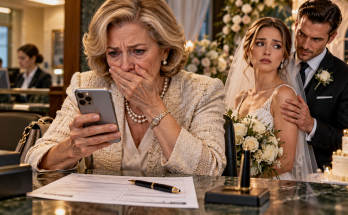
The morning Joselyn testified, she wore a charcoal suit and carried a slim folder containing the documents Michael had told her to review. We left the house before sunrise. The sky was still pale above the roofs, and dew covered the grass beside the driveway. She had eaten only half a piece of toast. I offered to make something else, but she shook her head. Her stomach was too unsettled. I understood. My own breakfast remained untouched beside the sink.
The proceeding followed months of investigation, disclosure, and legal argument. Derek had denied wrongdoing, and the case had advanced to a contested hearing at which witnesses and records would be examined. Sandra explained that the court would distinguish allegations from facts established through admissible evidence. Some issues involved the bank's loan and the financial certification. Others concerned Derek's conduct and the movement of funds through his companies. Not every painful thing he had done to our family was a crime, and the court was not there to judge our entire relationship.
That distinction mattered to me. Derek had insulted me, manipulated Joselyn, and tried to redirect my wedding deposit. Those acts formed part of our personal history, but they did not all carry the same legal significance. The case required specific proof concerning financial representations, documents, and transactions. I wanted accountability grounded in facts rather than the satisfaction of hearing every grievance repeated before a judge.
At the courthouse, Michael took Joselyn aside for a final conversation. I waited with Sandra near a window overlooking the parking lot. She reminded me that I might be called to explain the loan guarantee and the representations that influenced my decision. I had prepared carefully. My account was simple: Derek presented a business plan, assured me that funds would support equipment and a warehouse, and relied on Joselyn's supposed accounting oversight to strengthen my confidence. I signed because I believed those statements were accurate.
When proceedings began, Derek sat beside Peter Lang with a stack of papers in front of him. He looked toward the courtroom entrance as Joselyn entered. Their eyes met briefly. She lowered her gaze to the folder in her hands, then took her seat beside Michael. I watched her shoulders rise as she inhaled. She had spent months rebuilding independence, but the presence of the man who had once controlled so many of her decisions still affected her.
The prosecution began by presenting the structure of the loan application. A financial investigator explained the approved facility, the first disbursement of seventy-five thousand dollars, and the later suspension of the remaining funds. Bank records showed payments to earlier creditors and transfers to Miller Coastal Holdings. The investigator described the discrepancies between the submitted business plan and the transactions that followed. He did not claim every payment was unlawful simply because it differed from a forecast. Instead, he identified the specific representations the bank alleged were false.
The next witness addressed the equipment invoices. Several documents submitted as evidence of proposed purchases did not correspond to verified supplier orders. In one instance, the listed company had not issued the quotation attributed to it. In another, the equipment model and pricing did not match the supplier's records. The defense questioned whether administrative errors or changes in business plans could explain the discrepancies. The witness acknowledged those possibilities in general but maintained that the documents under examination contained inconsistencies requiring explanation.
I listened closely. Years earlier, I had reviewed the same proposal at my dining table. I remembered Derek's confidence as he pointed to photographs of commercial equipment. He had turned pages quickly, explaining future revenue and expansion opportunities. I had asked several questions but allowed his answers to substitute for independent verification. Hearing the details examined in court made my mistake feel both ordinary and serious. I had trusted a persuasive presentation because I wanted my daughter to be happy.
When I was called, Sandra accompanied me to the appropriate place before I took the oath. I answered questions about my relationship with Derek, the loan discussions, and the guarantee. I described the specific assurances he gave concerning equipment, suppliers, and Joselyn's role in reviewing the figures. I acknowledged that I had signed voluntarily and had possessed the means to seek additional verification. I did not attempt to portray myself as helpless or unaware of the financial risk.
Peter Lang questioned me carefully. He suggested that I had withdrawn support because I was angry about being excluded from the wedding. I agreed that the exclusion had prompted me to reassess my financial arrangements. He asked whether I would have questioned the loan if my daughter had invited me to the ceremony. I considered the question before answering. I said I could not know exactly when I would have discovered the discrepancies, but the bank's records and disputed documents existed independently of my feelings about the wedding.
He asked whether I disliked Derek from the beginning. I said I had reservations about some of his comments and financial assumptions, but I had nevertheless supported the loan. I had invited him into my home and contributed substantially to the wedding. My actions demonstrated that I had been willing to accept him, even when I had questions. The lawyer moved on.
After my testimony, I returned to my seat feeling exhausted. Sandra gave me a small nod. I had not delivered a dramatic accusation or made Derek appear monstrous. I had simply described what happened and accepted my own role in the decisions. That was enough.
The forensic evidence followed. Priya Nair explained how the disputed certification had been assembled. She showed the earlier spreadsheet, the later signature page, and the image that matched Joselyn's scanned signature from an unrelated lease document. She described the metadata, the account identifiers, and the limits of what could be concluded from copied files. Her testimony was precise. She did not claim to have watched Derek insert the image. She explained why the available records supported the conclusion that the signature had been reused rather than created naturally for the certification.
The defense questioned the reliability of timestamps and the possibility that another person could have accessed the computer account. Priya acknowledged that timestamps can be altered and accounts can be shared. Then she described the additional submission records, the sequence of file versions, and the surrounding communications. The court was left to weigh those details. I admired her restraint. She was more persuasive because she refused to claim certainty beyond the evidence.
Joselyn was called after lunch.
She stood slowly, smoothed the front of her jacket, and walked toward the witness stand. I wanted to reach for her hand, but there was no opportunity. She took the oath and sat with her folder closed before her. When the first question came, she answered clearly.
She explained her professional background and the bookkeeping work she had performed for Derek's proposed company. She described preparing preliminary projections from figures he supplied and sending him an email warning that the estimates were unverified. The email was presented, including his acknowledgment. She identified the version of the spreadsheet she had prepared and explained how it differed from the later submission.
Then the disputed certification appeared on the screen.
Joselyn looked at it steadily.
She said she had not signed that document. She had not approved the final figures, authorized the removal of the preliminary designation, or certified that supplier quotations had been verified. She acknowledged that she had previously provided Derek with a scanned signature for an unrelated lease matter. She also admitted that she should have maintained better records and questioned his requests more carefully.
The prosecutor asked why she had not challenged Derek sooner.
Joselyn paused.
She explained that their relationship had changed gradually. Derek initially welcomed her financial expertise, then became angry whenever she identified inconsistencies. He portrayed questions as disloyalty and repeatedly suggested that she was undermining their future. Over time, she stopped insisting on explanations because arguments became exhausting. She did not describe herself as incapable of making decisions. She described how her decisions had been influenced by fear of conflict and loss.
The courtroom was quiet.
She then explained the discovery of the Timeline document and the files concerning my property. She described leaving Derek's home, preserving the records, and seeking legal advice. Her account was factual, with dates and documents wherever possible. When she could not remember the exact wording of a conversation, she said so.
Peter Lang's cross-examination was difficult. He asked whether Joselyn had benefited from my financial support and whether she had wanted the luxury honeymoon. She acknowledged both. He asked whether she had participated in preparing the business projections. She said she had prepared preliminary figures, but she had not certified the altered submission. He suggested that she was blaming Derek because their relationship had collapsed.
She looked toward the lawyer, then answered quietly.
“Our relationship ended after I discovered the documents. It didn't create them.”
I felt tears gather but kept my face still.
Lang continued questioning her about inconsistencies in her recollections. She acknowledged several dates she had initially remembered incorrectly and explained how later records clarified the chronology. She did not become defensive. When asked whether she had ever signed documents without reading them carefully, she admitted that she had. Then she distinguished those documents from the certification she denied signing.
The cross-examination lasted more than an hour. By the end, Joselyn looked drained, but she had not apologized for telling the truth. She had not allowed the questions to draw her into an argument about whether she had loved Derek enough. She had answered what she knew and admitted what she did not.
When she returned to her seat, Michael leaned toward her and spoke briefly. She nodded. I wanted to embrace her, but proceedings continued. I watched her take a bottle of water from her bag and drink slowly, her hands steadier than they had been that morning.
Anthony Bell testified later. He described his previous business relationship with Derek and produced correspondence concerning unpaid obligations and disputed financial representations. The court admitted relevant portions of the records while limiting material that did not directly concern the charges. Anthony acknowledged that his former partnership with Derek had ended badly and that he had his own grievances. The defense emphasized that history. The prosecution relied on the documents and their connection to the transactions under examination.
The court also heard evidence concerning Miller Coastal Holdings. Bank records demonstrated how funds moved from the loan proceeds into the company and then toward various obligations. The defense argued that some transfers represented legitimate business restructuring and that financial difficulties did not establish criminal intent. The prosecution maintained that the problem was not business failure alone, but the use of inaccurate documents and representations to obtain funds.
The proceedings continued over several days. I attended when my presence was required or when Joselyn wanted support. At other times, I returned to work. Daniel managed the project schedule with characteristic efficiency, and the company continued operating. I was grateful that my life had not become entirely dependent on the court's calendar.
During a recess, Joselyn and I sat on a bench outside the courthouse. The weather had turned cool, and leaves gathered against the steps. She asked whether I believed the judge would understand what Derek had done.
“I believe the court will examine the evidence,” I answered. “Understanding everything that happened to us is a different matter.”
She nodded.
“I wanted him to hear me,” she admitted. “For a long time, I thought that if I found the right words, he would finally understand.”
“Did you still want that today?”
She considered the question.
“No. I wanted the record to be accurate.”
The distinction stayed with me.
Eventually, the evidentiary phase ended. The parties presented their arguments, and the court reserved its decision. Sandra explained that we would be notified when the ruling was ready. The wait could be difficult, but we had already provided the evidence available to us. There was nothing useful to gain by rehearsing every possible outcome.
On the drive home, Joselyn asked to stop at the community college. Rosa had invited us to inspect preliminary arrangements for the scholarship event, and the campus was nearby. I hesitated, wondering whether she was too exhausted. She insisted she wanted to go.
We walked through a technical laboratory where students were building scale models of structural systems. One young man explained how he had designed a small bridge to distribute weight more efficiently. His enthusiasm reminded me of Joselyn as a child with her yellow measuring tape. I asked him questions about his materials and calculations. He answered eagerly, then showed us a revised design after an earlier version failed testing.
Joselyn watched us with a small smile.
Later, as we crossed the courtyard, she said she had forgotten how satisfying it felt to work on a problem that could be understood and improved.
I told her people were more complicated than bridges.
She laughed.
“Especially the ones who insist they're never wrong.”
The following week, the scholarship committee confirmed its first two recipients. Both were pursuing technical qualifications while working part time. One hoped to become a civil engineering technician. The other was studying construction management after several years in manual trades. Their applications described practical ambitions, family responsibilities, and the difficulties of paying tuition while supporting themselves.
I read their profiles carefully. I thought about the twenty-five thousand dollars I had nearly transferred for a honeymoon. At the time, the payment seemed like the price of remaining close to my daughter. Now it would help two students move toward work they had chosen for themselves.
The contrast no longer made me angry. It made me grateful that I had stopped the transfer before signing.
Meanwhile, Joselyn continued her work at the nonprofit. Her supervisor praised a revised reporting system she developed, and she began discussing the possibility of pursuing an additional professional certification. She had also found a small apartment near her office. She had not yet decided whether to move, but the fact that she was considering it felt significant.
One evening, she brought the apartment listing to the kitchen table. It was modest, with a narrow balcony and a kitchen barely large enough for two people. She asked what I thought.
I examined the photographs and the estimated monthly expenses.
“It looks manageable,” I said. “What do you think?”
She smiled.
“I think I'd like a place that's mine.”
I felt a brief ache at the thought of her leaving again. The house had become lively with her presence. But I understood that keeping her safe did not mean keeping her beside me forever.
“Then you should look at it,” I said.
A few days later, the court notified the parties that its decision would be delivered the following month. The news brought a fresh wave of anxiety, but neither of us allowed it to halt our plans. Joselyn scheduled an apartment viewing. I continued preparing the scholarship event. Daniel finalized staffing recommendations for the engineering company.
Life was moving forward without waiting for Derek's case to end.
One night, while closing the kitchen windows, I heard Joselyn speaking to Claire on the phone. She was discussing furniture, moving costs, and whether a blue sofa would fit in the apartment. Her laughter drifted through the hallway.
I thought about the girl who had arrived during a storm with a broken suitcase, terrified that Derek might find her. She was not entirely free of that fear, but she was no longer organizing her life around it.
The court's decision still mattered. Financial wrongdoing deserved proper examination, and the people harmed by it deserved lawful remedies. Yet the deeper victory was becoming visible in ordinary choices: a job accepted, a question asked without fear, an apartment considered, a friendship renewed.
I went upstairs and opened the drawer containing Robert's yellow measuring tape.
Its metal casing was scratched, and the spring no longer retracted smoothly. I held it for a moment, remembering Joselyn's childhood certainty that every difficult problem could be solved by measuring carefully enough.
Then I returned it to the drawer.
Some things could not be measured. But they could still be rebuilt.