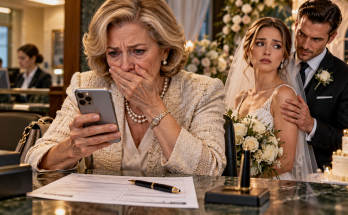
Marcus was still speaking when Grace began crying from the living room. I held the telephone against my ear and looked toward the sound, suddenly aware of the distance between the child I needed to protect and the people gathering at my husband's company. Vanessa had chosen her moment carefully. I was recovering from childbirth, my daughter was barely a week old, and the company had been operating without Daniel for seven months. She had brought strangers into the building where he had spent so many years, hoping to turn private accusations into public pressure before I could defend myself.
“Don't let them upstairs,” I told Marcus. “And make sure nobody speaks to the reporter until Patricia has reviewed the situation.” He assured me that security had already restricted access to the executive offices. Vanessa and Trevor were refusing to leave the reception area, but neither had authority to enter the company's private floors. The reporter had begun asking employees whether Daniel's estate was under investigation. Marcus sounded furious, though he was working hard to keep his voice controlled.
After ending the call, I stood beside the kitchen table with the certified genetic report in my hand. The paper was warm where my fingers had pressed against it. I had imagined receiving these results would bring some measure of peace. Instead, my sister had already created another confrontation. I slipped the report back into its envelope and returned to the living room, where Evelyn was lifting Grace from her bassinet.
“She sounds hungry,” Evelyn said. Her expression changed when she saw my face. I explained what Marcus had told me, and she listened while supporting Grace against her shoulder. The baby gave a small, impatient cry, entirely unaware that adults she had never met were arguing over her identity. Evelyn handed her to me, then drew the curtains halfway against the bright afternoon light.
“Feed your daughter,” she said. “The lawyers can handle Vanessa for an hour.” I wanted to protest that the situation was too serious to ignore, but Grace had begun rooting against my blouse. I settled into the armchair, adjusted the nursing pillow, and concentrated on helping her latch. The ordinary task demanded my attention. It was both frustrating and strangely comforting that my daughter's needs remained immediate regardless of what was happening outside our home.
While Grace fed, Evelyn telephoned Patricia. I could hear fragments of their conversation from the hallway. She asked about the reporter, whether the company could require the visitors to leave, and what precautions were necessary to prevent the genetic report from being mishandled. Evelyn had spent decades teaching difficult students and negotiating with school administrators. She knew how to ask direct questions without allowing another person to evade them.
Patricia returned the call shortly afterward and spoke with me directly. She confirmed that the courthouse had received the amended filings and that her office was preparing the certified genetic evidence for submission. She also reminded me that the laboratory's result, while extremely strong evidence of paternity, did not automatically resolve every legal issue raised in Vanessa's petition. We still needed to address the inheritance provisions, the requested restrictions, and the allegations concerning my management of Daniel's assets.
“What exactly are they saying about me?” I asked. Patricia hesitated before answering. The latest submission alleged that I had concealed information about the circumstances of Grace's conception and had used my position as Daniel's surviving spouse to redirect funds away from people who had previously benefited from his estate planning. It also suggested that I was restricting access to records because I feared scrutiny. The accusation was not supported by the documents Patricia had reviewed, but it had been written in language designed to sound serious.
I looked down at Grace. Her fingers had curled around the fabric of my blouse. “They're calling me dishonest because I stopped paying for their lives,” I said. Patricia did not disagree. She explained that the distinction between Daniel's personal generosity and legally enforceable obligations would become central to the hearing. Certain agreements had to be honored according to their terms. Others had always been discretionary. Vanessa's attorneys were attempting to blur those categories.
The reporter's presence introduced a different problem. Even if the court rejected the claims, a misleading article could damage the company's reputation. Aegis Cyber Defense handled sensitive technology contracts, and clients expected stability. Marcus had already received a call from a procurement officer asking whether the inheritance dispute affected contractual authority. Patricia advised a brief statement confirming that business operations continued normally and that the company would not discuss private family litigation.
“Do not release Grace's medical information publicly,” she added. “We can present the evidence where it belongs. Your daughter deserves privacy.” I had been considering whether to send the genetic report to the reporter, hoping it would end the rumors immediately. Patricia's warning stopped me. Vanessa had made Grace's parentage a public question, but I did not have to accept her terms for answering it.
After the call, I asked Evelyn to bring me my laptop. Daniel had purchased it shortly before his final trip, replacing an older machine whose battery failed unpredictably. The home screen still displayed a photograph of the two of us beside Lake Michigan, our coats pulled tightly against the wind. I had avoided opening several company folders since the funeral because their familiar names reminded me of conversations we would never finish.
I signed into the secure portal Marcus had arranged for me and reviewed the latest financial reports. I was not unfamiliar with Aegis. Before Grace's conception, I had worked as a senior operations director for a healthcare technology company, managing budgets, contracts, and compliance teams. Daniel and I had often discussed his business over dinner. Still, understanding a company from the outside was different from being the person ultimately responsible for major ownership decisions.
The reports showed a profitable business with substantial commitments. Hundreds of employees depended upon regular payroll, and several contracts required assurances about governance and continuity. Marcus and the board had managed the transition after Daniel's death competently. Their work deserved better than a public spectacle staged by someone who had never shown interest in the company's actual operations.
I opened the records associated with my family's financial arrangements. The figures were larger than I remembered. Daniel had approved assistance over several years, sometimes after consulting me and sometimes through his personal investment advisers. Arthur's landscaping business had received financing for equipment, vehicles, and operating expenses. Vanessa's boutique had obtained support for inventory and expansion. Linda's household expenses had been covered in part by income from an investment structure Daniel established to help the family.
None of those arrangements automatically entitled my relatives to ownership of Aegis. Yet I could see how they had gradually come to treat the payments as permanent. When Daniel was alive, he had occasionally declined additional requests. After his death, my parents began describing those limits as temporary obstacles I should remove. I remembered Arthur telling me that a responsible daughter would preserve her father's livelihood. At the time, I had accepted the statement as an appeal for compassion. Now I recognized the expectation beneath it.
A message arrived from Marcus containing a summary of the confrontation. Vanessa had told the reporter that she feared her niece was being used to justify a massive inheritance transfer. Trevor had introduced himself as Daniel's close relative and claimed the family deserved transparency. Neither had disclosed his years of estrangement from Daniel or Vanessa's own reliance on the financial arrangements she was challenging.
The security staff had eventually escorted them outside after they refused repeated requests to leave. The reporter departed with them. Marcus had preserved the lobby footage and arranged for counsel to review whether any further response was necessary. He asked me not to visit the office until we knew whether the group intended to return.
I read his message twice. Vanessa had referred to Grace as her niece. Eight days earlier, she had mocked me at dinner and suggested another man was the father. Now she had acknowledged the relationship in front of a reporter while using it to question my integrity. The contradiction was revealing. Her words shifted according to what would serve her immediate purpose.
I called Marcus. “Did she actually say 'my niece'?” He confirmed it. He sounded surprised that this detail mattered to me amid everything else. I explained that Vanessa had consistently denied Daniel's paternity in private. Her public recognition of Grace suggested she was less interested in establishing the truth than creating whichever version of events might advance her claim.
Marcus was silent for a moment. Then he said, “Patricia needs that exact recording.” He promised to preserve the original security files and provide them through the company's legal team. We discussed the importance of maintaining a clear chain of custody so that the footage could be authenticated if necessary. It was a small development, but for the first time I saw an opportunity to challenge the pattern rather than merely answer each new accusation.
As we spoke, Marcus mentioned something else that troubled him. The reporter had arrived with copies of documents that were not public. They appeared to include portions of the family financing schedules and references to internal company discussions concerning Daniel's estate. Marcus had not yet seen the complete material, but he believed some of the information could only have come from someone with access to confidential records.
I sat straighter. “Could Trevor have obtained them?” I asked. Marcus doubted it. Trevor had no recognized role at Aegis and had not participated in company affairs. Vanessa might have retained copies of documents connected to her own financial assistance, but the reported references went beyond those agreements. Marcus had already instructed the information-security team to begin a limited access review.
The possibility of an internal disclosure frightened me more than Vanessa's performance in the lobby. Daniel had built Aegis around the belief that trust required verification. He often said that security failures began when people assumed familiarity was the same as authorization. Someone might have handed private documents to my sister because they sympathized with her, feared losing a financial benefit, or believed her claims. Whatever the motive, the consequences could extend beyond our family dispute.
I asked Marcus to keep the investigation discreet. He agreed and reminded me that accusations against employees required evidence. We could examine access logs, permissions, and document histories without speculating publicly about who was responsible. I appreciated his caution. After months of being accused without proof, I had no desire to inflict the same experience on someone else.
The afternoon passed in fragments. Grace slept, woke, fed, and slept again. Evelyn prepared soup and insisted I eat at the table rather than balancing a bowl on the armchair. I tried to rest while my phone remained within reach. Each time it vibrated, my stomach tightened. Most messages were routine notes from Patricia's office, but I found myself expecting another threat.
Near five o'clock, Patricia forwarded a copy of the latest court filing. I read it slowly, making notes in the margins. The petition relied heavily on uncertainty rather than established facts. It described Daniel's travel schedule, implied that the fertility treatment records were incomplete, and questioned my refusal to provide private information directly to Vanessa. It also included a declaration from Trevor asserting that Daniel had discussed protecting extended family interests.
I remembered the few times Daniel had spoken about Trevor. He had been disappointed by the unpaid loan, but the deeper injury was the realization that Trevor contacted him primarily when he needed money. Daniel had told me he was finished financing his cousin's projects. I had never heard him suggest that Trevor should inherit anything from the company or our daughter's future assets.
The declaration contained a paragraph claiming that Daniel had promised Trevor an opportunity to participate in family business interests if certain conditions arose. Its wording was vague enough to avoid a direct statement about ownership, but it was clearly intended to suggest an expectation. I asked Patricia whether such a claim could have legal significance. She answered that expectations and enforceable rights were not the same. Trevor would need credible evidence supporting any actual entitlement.
“Could he have something signed?” I asked. Patricia said no such document had been produced. If one existed, her office would examine its authenticity and legal effect. She warned me not to assume the absence of evidence meant the opposing side had nothing left to present. That caution was reasonable, but it left me uneasy.
After dinner, Evelyn encouraged me to sleep while she watched Grace. I went upstairs and lay on the bed Daniel and I had shared for nearly nine years. The room still contained his books, his watch on the bedside table, and the faint scent of cedar from the wardrobe. I had intended to reorganize his belongings before the baby arrived. Every attempt had ended with me sitting on the floor among clothes I could not bear to move.
I closed my eyes but remained awake. Eventually I remembered a conversation from the summer before Daniel died. We had been discussing my family's increasing requests for assistance. Daniel had sounded unusually weary. He said Arthur was using short-term loans to conceal deeper problems in the landscaping business and that Vanessa's boutique had not produced the results she claimed. He was considering requiring independent financial reviews before providing further support.
At the time, I had defended my family. I told Daniel they were trying to rebuild their lives and that we were fortunate enough to help. He agreed, but reminded me that helping someone did not mean accepting every explanation. I had grown irritated, accusing him of judging people who lacked his advantages. He apologized for sounding harsh, though he maintained that proper records mattered. We had never fully resolved the disagreement.
Now I wondered whether Daniel's concerns had been more serious than he let on. I opened my eyes and reached for the notebook on the bedside table. On a blank page, I wrote the names of the people involved in the current dispute: Arthur, Linda, Vanessa, Trevor, and the unidentified source of the confidential documents. Beneath them I wrote a single question: What did Daniel discover before he died?
I did not believe his accident was connected to the financial arrangements. There was no evidence for that, and I refused to let fear turn coincidence into accusation. But he had been examining family finances, and those same arrangements were now at the center of the litigation. Perhaps the records he gathered could explain why my sister was so determined to gain access.
I telephoned Marcus again. He answered from his office, sounding tired. I asked whether Daniel had kept a separate file concerning the family financing arrangements. Marcus remembered a folder in the secure archive, restricted to Daniel and the company's outside financial advisers. Its existence did not surprise him; Daniel maintained detailed records of major personal investments. Marcus promised to ask Patricia about proper access because some contents might be subject to estate confidentiality.
Before we ended the call, Marcus added that the security review had produced an initial concern. A user account belonging to the finance department had accessed several archived documents shortly before Vanessa's attorneys filed their expanded petition. Access alone did not establish misconduct, but the timing warranted examination. The account belonged to Martin Ellis, the company's senior financial controller.
I knew Martin. He had worked with Daniel for years and had attended our wedding. He sent flowers after the funeral and wrote a thoughtful letter about the early days of Aegis. I found it difficult to imagine him betraying Daniel's trust. Marcus shared my reluctance to draw conclusions. He said Martin's responsibilities could legitimately require access to financial archives, and the review would continue.
After the call, I sat beside the bedroom window. The streetlights illuminated wet pavement, and a neighbor's dog barked twice before the neighborhood became quiet again. Downstairs, I could hear Evelyn speaking softly to Grace. Her voice moved through the house like something steady and ordinary.
My phone displayed another message. This one came from an unfamiliar number, but the opening words made its source unmistakable.
Claire, you need to understand that the company isn't as secure as Marcus wants you to believe. Daniel knew there were problems before he died. Ask him about the accounts he reviewed last spring.
There was no signature. I read the message several times, then took a screenshot and forwarded it to Patricia without responding. The reference to Daniel's spring review was too specific to ignore. Someone knew about records I had only just remembered discussing with my husband.
A second message appeared before I could set down the phone.
Your sister has someone helping her from the inside. If you want to protect Grace's inheritance, find out what happened to the documents before Friday.
I stared at the screen, feeling the familiar temptation to call the number and demand an explanation. Instead, I followed Patricia's earlier advice and preserved the messages. Whoever had sent them wanted me frightened enough to act quickly. I would not allow an anonymous warning to dictate my decisions, but I could not dismiss the details.
I went downstairs and found Evelyn sitting in the armchair with Grace asleep against her chest. I told her about the messages and the questions concerning Aegis's financial archives. She listened carefully, then asked whether Daniel had ever expressed distrust of Martin Ellis. I said he had not, at least not in any conversation I remembered. Evelyn nodded, reminding me that uncertainty was not proof.
I sat beside them and looked at my daughter. The confrontation had begun with my family's denial of her place in Daniel's life. It was now exposing financial questions that had remained hidden while he was alive. I felt afraid of what we might discover, but I also understood that avoiding the records would leave Grace vulnerable to whatever story Vanessa chose to tell next.
Before going back upstairs, I wrote Patricia one more message. I asked her to request immediate preservation of relevant financial records, electronic access logs, communications, and archived files connected to the family financing arrangements. I also asked whether the court could be informed of the potential confidentiality concerns without making unsupported accusations.
Patricia replied that the appropriate preservation steps were already being coordinated with company counsel and that we would discuss the archive the following morning. I placed the phone on the table, finally allowing myself to breathe more slowly. The next stage would not be decided by shouting in a lobby or exchanging accusations on a porch. It would depend on documents, dates, signatures, and the people who had handled them.
Upstairs, I prepared for bed while the house settled around me. The anonymous messages remained unanswered, and Martin Ellis's access to the files had not been explained. I could not yet know whether someone inside Aegis was helping Vanessa or whether the records concealed a different problem. But I knew Daniel had been asking difficult questions before his death, and I intended to finish the work he had started.