The October wind entered the hallway as soon as I opened the front door. My mother stood on the porch holding the pink gift bag against her coat, one hand gripping the handles so tightly that the tissue paper trembled. She looked at me with a bright, practiced expression, as though we were meeting for lunch rather than facing each other eight days after she had watched me leave her house in labor.
“Claire, darling,” she began. “I hope I'm not interrupting anything. I thought I should come by and meet the baby.” She glanced past my shoulder toward the staircase. Her eyes were searching the house before she had finished speaking. I stayed in the doorway, keeping one hand against the frame. My body was still sore from delivery, and standing for long periods was uncomfortable, but I had no intention of inviting her inside.
For several seconds I studied her face. Linda had always placed considerable importance on presentation. She believed people could overcome difficult situations by choosing the correct words, dressing appropriately, and behaving as though nothing unpleasant had happened. I had learned that habit from her. As a child, I knew when to smile for visitors even after an argument. As an adult, I had spent months minimizing my grief whenever she suggested that my unhappiness made family occasions uncomfortable.
She lifted the gift bag slightly. “I brought something for my granddaughter.” The word seemed to hang between us. Granddaughter. My mother pronounced it easily, without hesitation, as if it had always belonged to her. I remembered the sound of her laughter at dinner, the cold accusation that followed, and the way she had stared at the stained rug when my water broke.
I looked directly at her. “Which granddaughter are you talking about?” Linda blinked, apparently uncertain whether she had heard correctly. Her smile tightened. “Claire, please. You know perfectly well who I mean.” I did not move aside. “I'm asking because eight days ago you made it clear that the baby I was carrying wasn't part of your family.”
My mother's eyes shifted toward the neighboring houses. She disliked conversations that might be overheard. “We don't have to discuss all that on the porch,” she said. “I've come to see you and the little one. Surely we can put a difficult evening behind us.” The phrase made me feel unexpectedly tired. She was already treating the incident as an unfortunate disagreement rather than a deliberate refusal to help her daughter during childbirth.
“A difficult evening,” I repeated. I kept my voice low because Grace was sleeping inside. “I told you I was in labor. You laughed. Dad told me to manage on my own. Vanessa accused me of cheating on Daniel. And when my water broke, you asked me to clean the floor.” Linda opened her mouth, but I continued. “I drove myself to the hospital while having contractions. I gave birth without any of you there.”
Her face lost some of its color. She adjusted the bag in her hands and looked down at the steps. “We didn't understand how serious it was,” she said. I felt anger rise, but beneath it was something harder to explain. I had spent my entire pregnancy waiting for her to care. Hearing her offer such a small excuse confirmed how little thought she had given the night.
“I told you exactly what was happening,” I answered. “You understood enough to worry about your rug. You simply didn't want to help me.” She shook her head. “That's unfair.” The old instinct to defend my judgment stirred, but I let it pass. I no longer needed her agreement to believe what I had experienced.
Linda drew a breath and lowered her voice. “Vanessa showed us information. Daniel was away so much, and the dates were difficult to follow. We were worried you weren't telling us everything.” I watched her search for a version of events in which everyone had acted reasonably. It was a familiar process. Whenever Vanessa caused trouble, my mother found circumstances that made her behavior understandable.
“The treatment records explained the dates,” I said. “You refused to read them.” Linda frowned. “Medical records can be confusing.” I looked at her without responding. She tried another explanation. “We didn't know whom to believe.” I reminded her that I had been married to Daniel, that we had spent years trying to conceive, and that he had known about the pregnancy before he died. Nothing about those facts was complicated.
She looked past me again. “Perhaps we can settle this after I've seen her.” Her request carried an assumption that I would eventually move aside. I had always done so before. I had surrendered arguments, forgiven insults, and accommodated last-minute demands because refusing my mother felt like refusing the family itself. That habit had been built over a lifetime, and even now a small part of me wanted to avoid the confrontation.
Then I heard Grace make a faint sound from the living room. My attention shifted instinctively toward her. She was a week old, and everything in her world depended upon the people responsible for her care. She could not distinguish between a relative and a stranger. She could not know why an adult wanted to hold her or whether that adult would protect her. Those decisions belonged to me.
I turned back to Linda. “Why did you come today?” She stared at me. “I've already told you. I wanted to meet my granddaughter.” I waited. The silence lasted long enough for her to become uncomfortable. She adjusted her coat collar, then looked down at the gift bag again. Finally she admitted that Arthur had received some troubling news from the bank.
I felt a strange stillness settle over me. “His credit request was declined,” I said. My mother looked up sharply. “You know about that?” I nodded. “Patricia informed me this morning.” Linda's expression changed from concern to suspicion. “Then you were involved.” It was not a question, although she seemed to want me to deny it.
“Daniel's financial arrangements aren't an unlimited account you can use whenever you need something,” I said. “The access privileges have been changed.” She stared at me as though I had announced a decision entirely outside my authority. “Your father has obligations. People depend on his business.” I thought about the employees at Aegis and the obligations Vanessa's legal action was threatening. My mother had not mentioned them.
“Arthur needs to speak with his own financial advisers,” I answered. “He can't assume Daniel will keep supporting the business after Daniel's death.” Linda tightened her grip on the bag. “Daniel would never have abandoned us.” The accusation was so familiar that I almost responded automatically. Instead, I considered what my husband would have wanted. He had helped my family because he believed they deserved an opportunity to recover, not because he intended to finance their lives forever.
“Daniel isn't here to make those decisions anymore,” I said. “He left responsibilities with me, and I intend to fulfill them.” My mother shook her head. “You've changed.” Perhaps she meant it as an insult. I looked at her and realized she was right. I had changed. Daniel's death had forced me to make decisions I once expected we would make together, and Grace's birth had made the consequences of those decisions immediate.
Behind me, a floorboard creaked. Evelyn appeared near the living room doorway, holding Grace wrapped in a pale blanket. My mother saw them and stopped speaking. I watched recognition spread across her face as she took in the baby's dark hair and the small cheek resting against Evelyn's arm.
Evelyn remained a few steps behind me. She had heard enough of our conversation to understand what was happening, but she did not interrupt. My mother looked from Grace to Evelyn, then back at me. “Is that her?” she asked softly. Her voice sounded entirely different from the one she had used a moment earlier. The sharpness had gone. For an instant, she looked simply like an older woman seeing a newborn for the first time.
“This is Grace,” Evelyn said. She shifted the blanket slightly, allowing my mother to see the baby's face. Linda stepped forward before stopping herself. Her eyes filled. I could not tell whether she was grieving what she had lost, recognizing Daniel in the child, or reacting to the possibility that she would not be allowed to hold her.
Evelyn looked at her steadily. “Daniel wanted this child very much,” she said. “He was already making plans for her before the accident.” Her voice remained composed. “I know exactly how happy he was when Claire became pregnant. I also know what happened at your house the night Grace was born.” Linda's gaze dropped. She offered no answer.
“I buried my son,” Evelyn continued after a pause. “There are things I would give anything to change, but I cannot. What I can do is make sure his daughter grows up knowing she was wanted. Nobody who tries to make her feel otherwise will have my cooperation.” She spoke without raising her voice. That restraint seemed to affect Linda more than an argument would have.
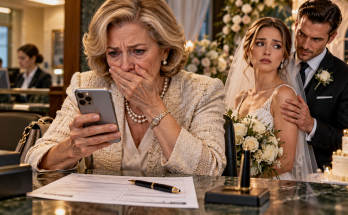
My mother began crying. At first she tried to conceal it, turning slightly and pressing her fingers beneath her eyes. Then her composure failed. She lowered the gift bag onto the porch and covered her face. I had seen her cry before, but usually in situations where she expected someone to comfort her. This time I remained where I stood.
“Claire, I'm sorry,” she said. Her words came unevenly. “I was wrong. We were wrong.” I listened, searching for some indication that she understood the full extent of what had happened. She said she had been upset, that Vanessa had confused everyone, and that the family had been under pressure since Daniel's death. Some of those circumstances were true. None explained why she had left me to drive alone to the hospital.
“Mom,” I said, “you weren't forced to believe Vanessa. You chose not to believe me.” She lowered her hands and looked at me. For a moment she seemed prepared to argue, but the words did not come. I continued. “You had months to ask questions. You had access to the clinic records. You knew how much Daniel and I wanted this baby. What you did at dinner wasn't confusion. It was cruelty.”
Linda looked toward Grace, who had begun moving in Evelyn's arms. “Could I hold her?” she asked. The question was barely more than a whisper. I felt a complicated pull of emotions. I wanted to protect my daughter. I also remembered being a little girl who loved her mother without questioning whether that love would be returned.
I took a moment before answering. “Not today.” Linda's face tightened. She opened her mouth, then closed it. I explained that she could not arrive with a present and expect the events of the previous week to disappear. If she wanted a relationship with Grace, she needed to acknowledge what she had done without blaming Vanessa or circumstances beyond her control.
“I don't know what else you want me to say,” she whispered. I looked at her carefully. “I want the truth. Why was it so easy for you to turn against me? Why did you believe something you knew would hurt me? Why did you watch me leave your house when I needed help?” She stared down at the porch boards. I waited, but she gave no answer.
I told her she could contact me when she was prepared to discuss those questions honestly. Until then, I needed space to recover and care for Grace. Linda looked at the baby once more. Her expression was filled with a longing I could recognize, but I could not allow that longing to replace accountability. She had been offered chances to protect her granddaughter before Grace was born and had rejected them.
“I love you, Claire,” she said. The words were familiar. For years I had used them as reassurance that whatever happened between us could eventually be repaired. Now I understood that love declared after harm did not erase the harm itself. “Then show me something different,” I replied. “Words aren't enough anymore.”
I closed the door gently. On the other side I heard my mother moving, then the faint creak of the porch swing. She did not leave immediately. Evelyn carried Grace back into the living room while I remained in the hallway. I felt neither victorious nor relieved. Setting a boundary had required less noise than I expected, but it had left me shaking.
After several minutes I retrieved the gift bag from where Linda had abandoned it. Inside lay a small silver rattle and a folded greeting card. The card was blank. I examined it for a moment, then placed it on the hall table. Perhaps my mother had not known what to write. Perhaps she had intended to add a message before giving it to me. The absence of words seemed appropriate after everything she had avoided saying.
Evelyn asked whether I was all right. I told her I did not know. She accepted that answer without asking for reassurance. We sat together while Grace slept, listening to a gust of wind scatter leaves across the driveway. I thought about my mother alone on the porch and wondered whether she was beginning to understand what she had done or merely grieving the privileges she had lost.
A courier had delivered an envelope earlier that morning, and Evelyn brought it from the table where we had left it. Patricia had arranged for an expedited, properly documented genetic comparison using Grace's sample and Daniel's stored material from the fertility clinic. The certified report was intended to support our response to the probate challenge.
I opened the envelope and read the identifying information carefully. Grace's name appeared beside Daniel's. Beneath the technical findings was the conclusion we had known from the beginning: the testing supported Daniel's biological paternity with a probability exceeding 99.99 percent. I read the result twice. The numbers did not change anything about my daughter, but they could change the course of the legal dispute.
I thought of Daniel at the ultrasound appointment, leaning toward the monitor to hear the heartbeat more clearly. He had not required a laboratory to tell him that the child was his. He had known because he had been there through the treatment, waiting with me for every result. I wished he could have seen the paper, not because he needed proof, but because he would have understood the bitter irony of our family demanding evidence he had never doubted.
I called Patricia and confirmed that the report had arrived. She asked me to preserve the original and let her office handle formal submission to the court. We discussed the Friday hearing and the arguments Vanessa's attorneys might still attempt. Patricia believed the evidence significantly strengthened our position. She also warned that the people pursuing the claim might respond unpredictably once they realized their central accusation could not survive scrutiny.
After ending the call, I decided that Marcus needed to know the results immediately. I wanted the company's legal team prepared, and I wanted to understand whether any clients or employees had already been affected by the litigation. I told Evelyn I was considering a brief visit to the Aegis offices once Patricia approved the next steps. Evelyn suggested I rest first, pointing out that I was still recovering from childbirth.
I had barely set the report aside when my phone rang again. Marcus's name appeared on the screen. I answered, expecting questions about the genetic findings. Instead, I heard hurried voices behind him and the sharp electronic chime of the executive-floor elevator.
“Claire, whatever you're planning, don't come to the office yet,” he said. His composure had disappeared. He explained that Vanessa had arrived at the Aegis headquarters with Trevor Brooks. They were demanding access to company representatives and claiming that Daniel's estate was being improperly controlled.
I stood, holding the edge of the table. “Have they contacted Patricia?” I asked. Marcus said the legal department was already responding, but there was another complication. Vanessa had brought a reporter and a cameraman from a local business publication. They were in the lobby, preparing to turn the dispute into a public accusation against me and the company.
Grace began crying in the next room. I looked toward her, then at Daniel's name on the genetic report. My sister had chosen the place where he had built his life's work to challenge the legitimacy of his daughter. She had also chosen an audience, hoping that public embarrassment would accomplish what her legal petition might not. I asked Marcus to keep the visitors away from restricted areas and to preserve any relevant security recordings.
He urged me to remain at home until Patricia could assess the situation. I agreed not to act impulsively, but I also knew that silence had allowed Vanessa's accusations to grow for months. I picked up the certified report and placed it in its envelope. The next decision would require care, because it concerned more than my family's reputation. It concerned the company, its employees, and the truth Daniel had left us to protect.