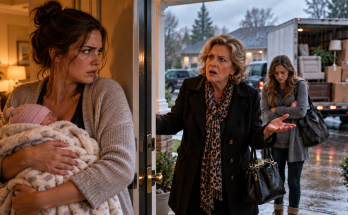
The first thing I did after ending the call was check the back door. I moved through the hallway slowly, listening to Clara's soft breathing from the nursery while my mother's final words repeated in my head. We can manage the house. She hadn't said she wanted to help me manage it. She had spoken as though I were an obstacle to an arrangement already underway. The rear entrance opened onto a small concrete patio bordered by overgrown shrubs. I switched on the exterior light, looked through the glass, and checked the deadbolt. It was locked. Then I slid the interior security bar into place, something I had never expected to use while standing in my own kitchen.
The old brass lock felt loose beneath my fingers. The real estate inspector had mentioned that several exterior locks were worn and should eventually be replaced. I had intended to handle them after the birth, once life became more manageable. There had seemed no urgency. I was the only person living there, and the one spare key I had distributed was in Krista's possession. She had promised to keep it strictly for emergencies. At the time, handing it to her felt like a small gesture of trust between sisters who had spent years working around our mother's interference. Now I wondered whether Nancy had convinced her that an emergency meant whatever the family needed most.
I opened my messages and found Krista's number. My fingers hovered over the screen. Calling her again might give her an opportunity to explain what I didn't understand, but it might also draw her into another round of pressure from Nancy. My sister had sounded frightened during our earlier conversation, and I couldn't dismiss that. She was responsible for three children and had a husband whose income had disappeared at the worst possible time. The prospect of losing stable housing must have made every offer sound tempting. Yet I couldn't ignore the fact that she had known something about the relocation and had allowed me to discover it through a commercial postcard.
I wrote instead of calling. "Mom has told me you're all moving into my house tomorrow. I have not agreed to that, and I won't agree. Please don't bring your things here. I love you and the kids, but we need to find another solution." I read the message before sending it. There was no accusation about the key, no demand that she choose between me and our mother. I wanted to give her one opportunity to make a decision without feeling cornered. When the message was delivered, I placed the phone beside the sink and waited. Five minutes passed. Then ten. The screen remained dark.
I returned to the living room and glanced at the boxes I still hadn't unpacked. One contained my professional reference books, another the framed photographs I'd taken from my previous apartment. The smallest held family pictures, including several of my father. I opened that one carefully and found a photograph from a summer afternoon when Krista and I were children. She was standing beside me in the backyard, holding a plastic watering can, her hair escaping from two uneven braids. I looked serious, as I often did in childhood photographs, while Krista smiled toward someone beyond the frame. My father had taken the picture. I could remember his laughter when the watering can tipped and soaked both of our shoes.
There had been a time when Krista and I protected each other without thinking about it. When our mother searched my drawers, Krista sometimes warned me by knocking twice on the bedroom wall. When Nancy criticized Krista for bringing home a disappointing grade, I distracted her with a question about something she liked to discuss. Our strategies were imperfect, but we understood that we were on the same side. As adults, the arrangement had become more complicated. Krista wanted to preserve the idea of a functioning family, even when doing so required sacrifices. I wanted a family too, but not one that treated sacrifice as an obligation imposed by whoever shouted the loudest.
My father had once told me that Nancy confused love with responsibility. It happened during a drive home from the grocery store, when I was old enough to ask why she became so angry whenever I wanted to do something independently. He kept his eyes on the road for a long moment before answering. "She thinks if she isn't directing things, she's failing people," he said. I asked whether that meant I had to obey her. He shook his head. "It means you'll have to learn how to disappoint her without deciding you've done something wrong." I hadn't appreciated the difficulty of that lesson until he was no longer there to remind me.
I set the photograph on the mantel, near the lamp. For a moment, I considered calling Victor. He had been my father's closest friend for decades and remained the one adult whose presence reliably made my mother reconsider her behavior. Victor wasn't loud or threatening. He asked uncomfortable questions and waited for honest answers. Nancy couldn't distract him with complaints about her intentions. But asking him to become involved felt like crossing another threshold. It meant admitting this was no longer an ordinary family disagreement. It was a conflict serious enough that I might need witnesses and outside protection.
My phone vibrated. Krista had answered. "I told Mom you weren't ready. She said you would understand when everyone got there." I stared at the words. There was no apology, but there was information. Krista had objected, at least in some form. I asked whether Pete knew I hadn't agreed to the move. Her answer came slowly. "He knows you're upset." I typed a response and erased it. Upset was another one of those words that made a concrete boundary sound like an emotional disturbance. I wasn't upset because people wanted to visit. I was refusing unauthorized occupation of my property.
"Please tell Pete directly that nobody has permission to move into my house," I wrote. "I don't want him driving here tomorrow believing I've agreed." Krista responded with a short message: "Mom says she has everything arranged." I felt my throat tighten. The sentence explained why Nancy had sounded so confident. Krista was still measuring reality against what our mother declared. I started to type that Nancy didn't have the authority to arrange anything. Instead, I answered, "I understand what Mom says. I'm telling you what I have decided." After that, no more messages arrived.
Clara woke shortly afterward. I went to her, grateful for a task that required nothing more complicated than my full attention. Her diaper needed changing, and she protested the cold air with a surprisingly determined cry. I warmed a clean cloth between my hands and spoke softly while I worked. "There you go. I've got you." Her expression eased when I wrapped her again. I held her against my shoulder, listening to the irregular little sounds of her breathing. The thought of seven additional people moving through the house while I tried to care for her was almost unbearable. There would be children's voices, television noise, footsteps outside the nursery, and arguments over rooms. My recovery would become an inconvenience to be worked around.
I had helped hundreds of children learn to tolerate changes in routine, but I knew the difference between a manageable challenge and an environment that overwhelmed someone's ability to function. Clara needed feeding, sleep, clean clothes, warmth, and parents or caregivers who responded to her signals. I needed rest and enough quiet to recognize those signals. My medical team had made that clear. Even under ordinary circumstances, asking a recovering mother to host an extended household would have been unreasonable. In my circumstances, with elevated blood pressure and an exhausting delivery behind me, it carried risks I wasn't prepared to accept.
The phone rang again just as Clara settled. This time the caller was Gil, my mother's husband. I watched his name appear on the screen and considered letting it ring. Gil was not a cruel man. In family gatherings, he usually occupied the margins, carrying chairs, collecting plates, or making small jokes when Nancy's temper began to rise. He had an extraordinary ability to remain present without taking a position. Sometimes I wondered whether he approved of my mother's behavior or had simply learned that resistance was more trouble than compliance. Either way, his passivity often made her demands easier to carry out.
I answered because I wanted to know whether he understood what was happening. "I hear there's been some disagreement," he began. I told him there wasn't a disagreement about an arrangement, because no arrangement existed. My mother had decided to move people into my house without asking me. Gil sighed. "Your sister's in a rough spot. Nancy's just trying to help." I asked whether he believed helping Krista required forcing me out of my home. He didn't answer immediately. Then he said, "Nobody wants to force you anywhere. Your mother says you might prefer somewhere quieter while the family gets settled."
I felt anger rise, not suddenly but with the slow pressure of something being pushed too far. "Gil, this is already the quiet place I chose. I bought it so Clara and I could recover and live here. I am not leaving." He cleared his throat. "I'm not trying to upset you." I asked whether he could tell Nancy that the moving arrangements had to be canceled. He replied that she had spent a considerable amount of time organizing everything and would be disappointed. I said her disappointment didn't give her the right to continue. He ended by suggesting we all sleep on it and talk in the morning.
After the call, I sat at the table and wrote down what Gil had said. It struck me that both he and Krista had described the situation as though Nancy's determination made the move inevitable. Neither had asked whether I could afford to support another household or how the arrangement would affect my daughter. My mother had created a problem, declared herself the person solving it, and arranged the conversation so that refusing her solution would appear cruel. I knew the pattern. It had governed birthdays, holidays, family finances, and private decisions for years. The difference was that I could not accommodate it this time without losing the very thing I had worked to secure.
I considered contacting the police immediately, but I wanted accurate advice rather than a confrontation driven by fear. There had been no physical entry, no property damage, and no direct threat of violence. I was still trying to understand which steps would protect us and which might escalate the situation unnecessarily. I checked that my doors were locked and turned on the security system installed when I bought the house. The cameras covered the front walkway, driveway, and rear patio. I had purchased them for ordinary peace of mind, not because I expected my relatives to become the people I needed to watch.
The security application showed the front yard shining under the porch light. Rain had stopped, leaving the pavement black and reflective. The street was almost empty. A vehicle passed slowly, its headlights sweeping across the opposite houses, then disappeared around the bend. I tested the camera notifications to confirm that they were enabled. The system registered movement near the mailbox when a gust of wind lifted a small branch. I checked the rear view next. The concrete patio was empty, and the shrubs along the fence moved gently in the breeze. Beyond them lay the narrow strip of grass I planned to turn into a garden when Clara was older.
I returned to the nursery and settled into the chair with my daughter. My body was beginning to feel the cost of the evening. Every movement required more care, and my eyes burned from fatigue. I checked my blood pressure again and followed the discharge instructions, reminding myself that no family argument was worth ignoring a serious symptom. The readings and my condition needed to remain within the limits my medical team had discussed with me. I had a plan for seeking care if they didn't. I placed water and my medication within reach, then sent a short message to the friend who had helped with my hospital transportation, letting her know I might need practical assistance if the next day became difficult.
Clara fed slowly. I watched the changing expressions on her face and tried to imagine what she would remember of these early days. Nothing, of course. Not consciously. But the patterns we created now would become the background of her life. She would learn whether people respected her discomfort, whether the adults around her listened when she said no, and whether love could exist without constant access to her body and time. I didn't expect to raise her without making mistakes. I only wanted the mistakes to be mine to recognize and repair, rather than rules imposed by somebody who believed age and motherhood entitled her to control everything.
Around eleven, I finally lowered Clara into her bassinet and went to the kitchen for another glass of water. My phone lay on the counter beside the relocation postcard. I glanced at the clock and decided to try sleeping. There would be enough to manage in the morning. I had just switched off the kitchen light when the security application sent a notification. Motion detected: rear patio. I paused, assuming another branch had moved across the camera's field of vision. Then a second alert appeared, followed by a third. I opened the live feed.
At first, I saw only the edge of a dark coat near the patio steps. Whoever was outside stood close enough to the door that the camera captured only part of their body. A hand entered the frame, reaching toward the lock. I enlarged the image. The person shifted backward, and the overhead light revealed a familiar face. Krista. My older sister stood beneath the porch fixture, her hair damp from the evening rain, holding a small ring of keys. She looked toward the kitchen window, then down at the lock. The camera showed her choosing one key and slipping it into the deadbolt.
For several seconds, I couldn't move. Krista was supposed to be at home with her husband and children, preparing for whatever difficult morning my mother had planned. Instead, she was standing behind my house late at night, attempting to unlock a door I had expressly told her not to enter. I watched the key turn. The old lock gave slightly, but the interior security bar held the door in place. She withdrew the key, checked it, and tried again. Her movements weren't aggressive. They were tentative, almost embarrassed. That made the sight harder to bear. She knew enough to feel uncomfortable, but not enough to stop herself.
My first impulse was to open the door and demand an explanation. The second was to call her phone and ask what she thought she was doing. Then I remembered Clara asleep down the hall, the medical instructions on my bedside table, and the conversation in which my sister had failed to assure me that she would respect my refusal. I stepped away from the glass instead. I took screenshots of the security footage, saved the recording, and made sure the interior bar remained secure. I had given Krista that key because I trusted her to use it if I needed help. She was trying to use it when I had explicitly told her not to come.
On the screen, Krista lowered her hand and stood motionless beneath the light. She looked exhausted. After a moment, she lifted her phone, read something, and glanced toward the street as though expecting someone to arrive. Then she returned the key to her pocket and walked out of the camera's view. I waited for another notification, listening for footsteps or a knock. None came. I didn't know whether she had left or was still somewhere near the house. What I did know was that my mother's plan had already progressed beyond telephone pressure. Someone had come to test access to my home before the announced arrival.
I opened the contact information for Rebecca Haines, a property attorney whose name a colleague at the clinic had recommended during an earlier conversation about protecting my ownership interests. I had saved it because Rebecca was known for being precise, direct, and difficult to intimidate. I had never expected to call her after eleven at night. I hesitated over the emergency number, then looked once more at the security recording of Krista's hand turning the key. The situation was no longer hypothetical. An unauthorized entry had been attempted, and a group of people planned to arrive within hours. I called. When the answering service asked what kind of emergency required immediate legal assistance, I told the operator that my family was preparing to move into my home against my wishes. Then I added the fact that changed everything: "One of them has already tried to get inside."