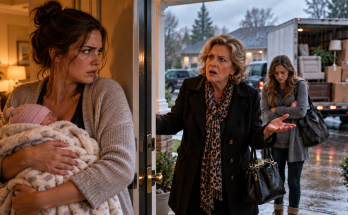
The key slipped from my fingers before I managed to turn it in the lock. I stood on the front porch of the little brick house on Clover Ridge Drive, my eight-day-old daughter pressed against my chest, and stared at the silver key lying between my shoes. My hands were trembling badly enough that I didn't trust myself to bend down. Clara stirred beneath her blanket, making the small, questioning sound she always made just before waking. I tightened my arm around her and leaned against the doorframe. After thirty hours of labor, eight days of interrupted sleep, and a blood pressure reading that had frightened two nurses into speaking very quietly, I had finally reached the one place where I believed nobody could tell me what to do.
The October air carried the smell of damp leaves and somebody's wood-burning stove. Across the street, a man was dragging a recycling bin toward his garage. He lifted one hand in greeting, then noticed the baby and gave me the sort of apologetic smile people offer when they realize someone is too exhausted for conversation. I appreciated him immediately. With a slow, careful movement, I crouched far enough to retrieve the key, ignoring the sharp protest from my lower abdomen. The lock turned. Inside, sunlight stretched across the bare hardwood floor, illuminating a scattering of dust left behind by the painters. Nothing moved. Nobody called my name from another room. For several seconds I remained motionless, listening to a silence that belonged entirely to me.
I had bought the house eleven days before Clara was born. The closing papers were still stacked in a blue folder on the kitchen counter, beside a roll of masking tape and a small collection of paint samples. It was a three-bedroom ranch built in 1953, with a low roof, narrow hallways, and windows that needed replacing eventually. The kitchen cupboards were old but solid. The bathroom tiles were pale yellow, and a corner of the living room floor creaked whenever someone stepped on it. There was nothing grand about the place. I loved it so fiercely that, when I finally shut the front door behind us, I began to cry.
Clara was too young to understand why her mother stood weeping in an almost empty hallway. She simply turned her face toward my sweater, searching for the warmth she associated with being fed. I kissed the top of her head. Her hair was dark and impossibly soft, still carrying that faint, sweet smell that seemed to belong only to newborns. "We're home," I whispered. My voice sounded unfamiliar in the quiet room. I said it again, more firmly. "This is our home, sweetheart." I hadn't realized until that moment how important the word our had become. It meant the two of us, not an invitation for anyone else to decide how we should live.
I was thirty-two years old, a pediatric occupational therapist, and a woman who could guide a frightened child through an unfamiliar environment without raising my voice. At the clinic, I helped children tolerate uncomfortable sensations, develop coordination, and gradually learn to trust their own abilities. I knew how to recognize distress before it became a crisis. I knew when silence meant concentration and when it meant fear. Yet for much of my life I had been unable to perform a far simpler task: tell my mother no without immediately calculating what punishment would follow. Nancy had a talent for making refusal feel like an offense against the entire family. She could turn a locked bedroom door, an unanswered telephone call, or an ordinary private decision into evidence that someone didn't love her enough.
When I was nine, she removed the lock from my bedroom because she said secrecy encouraged dishonesty. At twelve, she went through my schoolbag and read a note a friend had written about her parents' divorce. By fifteen, I had learned to recognize the sound of her footsteps and close whatever I was reading before she reached the doorway. She never described these things as intrusions. She called them involvement. She would say that mothers worried because they cared, that a decent child had nothing to conceal, and that privacy was a ridiculous American obsession. By the time I turned eighteen, I had decided that the only kind of privacy she might respect was the sort created by distance.
I left home shortly after my birthday with two suitcases, a scholarship letter, and an envelope of money I had saved from weekend jobs. My mother stood beside the car and asked why I was determined to embarrass her by moving so far away. When I explained that the university offered the program I wanted, she looked at me as though I had deliberately misunderstood her. "There are schools closer to family," she said. My father was standing behind her, holding the smaller suitcase. He didn't argue. He simply put it into the trunk, squeezed my shoulder, and told me to drive carefully. For years afterward, I remembered the pressure of his hand more clearly than anything else about that morning.
My father was gone now. His death had left behind a complicated emptiness, not least because he had been the only person in our household who sometimes interrupted my mother's certainty. He rarely challenged her directly. More often, he made quiet spaces around her demands, taking me out for coffee or suggesting that a disagreement could wait until morning. I used to resent how much he avoided confrontation. After he died, I understood how much effort those small interventions had required. One of his closest friends, Victor Ames, remained in occasional contact with me. Victor was a reserved man with a dry sense of humor and an unusually steady gaze. My mother had never liked being questioned by him, perhaps because he was almost impossible to intimidate.
I carried Clara into the living room and lowered myself onto the deep velvet couch that had been delivered two days before her birth. It was my one extravagance, a purchase made after months of comparing prices and convincing myself I should choose something more practical. The upholstery was wonderfully soft, and I had imagined holding my baby there on winter afternoons while rain tapped against the windows. For now, the couch stood beside two unopened boxes of books and a floor lamp without a shade. I eased Clara onto a nursing pillow, arranged a folded blanket behind my back, and took several careful breaths until the dizziness passed.
My doctor had been unusually direct about the recovery period. The delivery had lasted nearly thirty hours and ended with me shaking from exhaustion beneath harsh hospital lights. My blood pressure remained elevated afterward, enough for the medical team to insist on rest, medication, monitoring, and prompt evaluation if certain symptoms appeared. A nurse had looked me in the eye before discharge and said, "You don't get extra credit for trying to do everything yourself." I had promised to follow the instructions. Unfortunately, resting was more complicated than sitting still. I could manage an empty house, delivered meals, and a few quiet hours with my daughter. What I could not manage was an audience.
That was why, several weeks before Clara's birth, I had told my mother I wanted no visitors for the first two weeks after we came home. I chose my words carefully, knowing she would search for an interpretation that suited her. No family gatherings. No surprise visits. No relatives stopping by to hold the baby while I recovered. I would call when we were ready. It wasn't a punishment or a competition between grandparents. It was a medical and personal decision, made after I had discussed my recovery with my healthcare team. My mother listened without interrupting, which should have warned me. Nancy could argue for an hour about something minor. When she became very quiet, she was usually deciding which part of a boundary she intended to ignore.
At the time, she had merely said, "We'll see how you feel when the baby arrives." I answered that I already knew how I felt. She changed the subject to whether I had bought enough receiving blankets, then asked about the dimensions of the house. I remember that shift because it seemed so typical of her. If she couldn't win an argument immediately, she behaved as if the argument had never occurred. I thought perhaps she had accepted my decision reluctantly. I wanted to believe that having a granddaughter might soften her habit of controlling people. Sitting on my new couch, with Clara resting against me, I could almost persuade myself that we had reached some kind of understanding.
My phone vibrated on the cushion. I glanced at the screen and saw three messages from Nancy, all sent within the previous hour. The first asked whether I had left the medical facility. The second wanted to know why I hadn't answered the first. The third read, "I need to know when you are settled. There are things we should discuss." No question about my blood pressure. Nothing about whether Clara was feeding properly or whether I had someone bringing groceries. The words there are things we should discuss made my shoulders tighten. My mother rarely wanted to discuss something unless she had already decided what the outcome should be.
I placed the phone facedown. Then I felt guilty, which irritated me more than the messages themselves. The feeling arrived with familiar speed, as though some old mechanism inside me still responded to her smallest expression of displeasure. I looked around at the walls I had paid for and tried to understand why a woman standing in another part of town could still make me feel like a child caught doing something forbidden. Clara made a soft snuffling noise. I watched her tiny fingers uncurl against the blanket and reminded myself that I was responsible for a different child now. Whatever habits I carried from my own upbringing did not have to become hers.
When Clara finished feeding, I carried her into the nursery. The room was painted a muted sage green, a color I had chosen from several samples taped beside the window. My mother preferred pink. She had sent photographs of elaborate nursery furniture and suggested a wallpaper covered in flowers, then sounded offended when I thanked her but declined. I had painted the walls with help from a contractor while I was still pregnant, sitting on a folding chair to supervise the final coat because my doctor had already warned me to avoid unnecessary exertion. The room smelled faintly of clean cotton and new wood. A simple white crib stood against the far wall, with a small dresser beside it and a comfortable chair near the window.
I placed Clara in her bassinet and stood there until her breathing settled into an even rhythm. The afternoon light was fading through the curtains. In the glass, I caught a glimpse of myself: unwashed hair gathered into a loose knot, loose clothing, dark circles beneath my eyes, and a body that still felt unfamiliar. I had spent years learning to inhabit my adult life with confidence. Pregnancy and childbirth had shaken that confidence in ways I hadn't anticipated. I was proud of what my body had done, but I was also sore, frightened by my own fatigue, and sometimes overwhelmed by the knowledge that this small person depended so completely on me.
Before Clara, I had been accustomed to handling difficulties in a particular way. I worked, saved, made lists, and solved problems by turning them into manageable tasks. My colleagues sometimes teased me about how thoroughly I prepared for everything. At the clinic, I kept spare clothing, sensory toys, and a notebook full of observations that helped me understand each child as an individual. When something went wrong, I made a plan. But there was no checklist that could erase the memory of my daughter's birth, the frightening medical conversations, or the strange vulnerability of holding a newborn while knowing that the world would continue making demands.
The hardest demand had already come months earlier, when David told me he was leaving. We had been together long enough that I had imagined him standing beside me through the ordinary chaos of parenthood. During my fourth month of pregnancy, he sat at our small kitchen table and said that he wasn't ready for the life we had planned. He spoke carefully, almost professionally, as though the right arrangement of words could prevent them from hurting. I remember looking at the cup in his hands and noticing that he hadn't taken a single drink. I asked whether he wanted time to think. He said he had been thinking for weeks. That was when I understood the conversation was not a beginning but the final announcement of a decision made without me.
For a while, I allowed myself to feel humiliated. I had spent so much of my youth insisting that I would build a different life from my parents' marriage, one where love did not require obedience. When David left, part of me wondered whether I had mistaken independence for emotional distance. My mother encouraged that doubt. She said David might have stayed if I had been more accommodating, then suggested I move in with her and Gil until the baby was older. Her tone made the arrangement sound generous. I knew exactly what it would cost. Under her roof, I would have a bedroom but no authority, assistance but no freedom to refuse it, and a child whose routines would quickly become a matter for family debate.
So I stayed where I was, kept working as long as my pregnancy allowed, and used the savings I had been building for years to buy a home. It was not an impulsive gesture or an attempt to prove something to David. I had wanted a place of my own long before I met him. His departure only made the need more urgent. The house on Clover Ridge Drive was affordable because it needed updates, and the inspection revealed nothing I couldn't eventually address. I read every document twice, asked questions until the real estate agent began anticipating them, and signed the final papers with a hand that trembled for reasons entirely different from those troubling me now.
The memory of that signing returned as I walked back through the hallway. I had been heavily pregnant, my ankles swollen, and the chair at the closing office had pressed uncomfortably against my back. The attorney handling the transaction slid the documents toward me and pointed out where to sign. My name appeared alone as the purchaser. No partner. No parent. No family arrangement. Just me. I remember touching the top sheet before picking up the pen. It wasn't wealth or status that moved me. It was the astonishing fact that I could choose what happened inside those walls and that the law recognized the choice as mine.
The telephone rang again, interrupting my thoughts. Nancy's name appeared across the screen. I let it ring until the call ended. A few seconds later, another message arrived. "I know you're busy with the baby, but ignoring family isn't acceptable." I almost answered with an explanation about feeding schedules and recovery. I could picture myself composing a long, apologetic paragraph, trying to make a perfectly reasonable decision sound gentle enough that she wouldn't be offended. Instead, I wrote a single sentence: "Clara and I are home safely, and we're resting. I'll contact you when I'm ready for visitors." I read it once, sent it, and put the phone down.
The reply appeared immediately. "You have always been very stubborn." It was almost comforting in its predictability. She had said variations of those words throughout my childhood, usually when I wanted something ordinary that didn't fit her expectations. I was stubborn when I requested a bedroom lock. Stubborn when I chose my degree. Stubborn when I refused to let her arrange my weekends. At thirty-two, I was beginning to suspect that what she called stubbornness was often nothing more than the ability to notice where another person's wishes ended and mine began.
I made tea and carried it into the living room, walking slowly because my doctor had warned me to watch for symptoms that might require urgent medical attention. The house was quiet except for the refrigerator and a faint tapping from a branch near the rear window. I looked at the two empty bedrooms down the hallway. One would eventually become a small office, with a desk for my patient notes and shelves for professional books. The other could remain empty until I found a use for it. It was an oddly satisfying thought. I didn't need to justify unused space. I didn't have to fill every corner just because somebody believed an empty room was an opportunity.
As the light disappeared, I switched on the floor lamp and watched the windows darken into mirrors. There were still boxes to unpack, laundry to wash, medication reminders to manage, and a newborn who would wake whenever she needed me. None of it frightened me as much as I had expected. I had prepared for this life with the understanding that difficult days would come. What I hadn't prepared for was how deeply my mother's voice remained lodged inside my thoughts, warning that independence was selfish and that someone would eventually make me pay for it. I told myself those fears belonged to the past. The walls around me were solid. The deed was in my name.
Just before seven, my phone lit up again. I expected another complaint about unanswered calls. Instead, Nancy had written, "I hope you haven't put anything permanent in the two extra bedrooms. We need to talk about their use before you get too settled." I read the message twice. She had seen the floor plan weeks earlier, during one of the conversations I now regretted. At the time, she had asked practical questions about the layout, and I had answered without thinking. Now I noticed the possessive certainty of her wording. Not what I intended to do with those rooms. What we needed to discuss. I was about to type that the bedrooms were not available when Clara began to cry.
I went to my daughter and left the message unanswered. As I lifted her, I heard the house settle around us: a small creak in the hallway, the heater beginning to run, rain starting against the windows. Clara quieted almost immediately against my shoulder. I rested my cheek on her hair and looked toward the closed nursery door. For the first time since entering our home, I felt an uneasiness I couldn't explain away as exhaustion. My mother wasn't asking whether she could visit. She was speaking as though she had a say in what happened to rooms she had never paid for. I had spent fourteen years building enough distance to keep her from arranging my life. I did not yet understand that, while I was recovering from childbirth, she had begun making arrangements of her own.