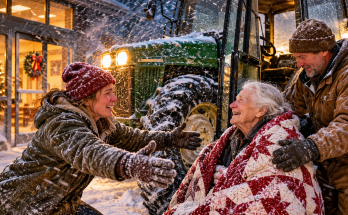
I was carrying firewood when Emily arrived.
It was Saturday morning.
Tom had asked me to help organize the wood beside his shed, and I had been working there for a while.
I heard tires moving across the driveway.
When I turned, a silver minivan had just passed the white fence.
I recognized the vehicle.
My stomach tightened.
Before Michael had completely settled the van in its parking space, Emily was getting out.
“Dad!”
I lowered the piece of wood I was holding.
She crossed the yard so quickly that I barely had time to straighten myself.
Then her arms were around me.
I held her.
For a little while, neither of us managed to speak.
I had imagined seeing her again under better circumstances.
I had wanted to arrive at her house wearing clean clothes, carrying something for the children, and looking like a man who had successfully managed his problems.
Instead, she had come looking for me at the home of people she had never met.
I hadn't expected to feel so grateful that she was there.
Eventually, she pulled away.
She studied my face.
“You're thinner.”
“I've been doing quite a bit of physical work.”
She shook her head.
“Dad.”
I stopped trying to explain.
“Yes. I've lost some weight.”
She touched my cheek.
Her eyes were wet.
Michael came toward us.
I offered him my hand.
He shook it and pulled me into an embrace.
“Good to see you, Frank.”
There was no judgment in his voice.
I had worried about that, too.
A man didn't particularly enjoy admitting to his son-in-law that he had lost the ability to support himself.
But Michael didn't seem interested in making the encounter uncomfortable.
Then the children came running toward us.
Noah was nine.
Sophie was six.
I hadn't seen them in far too long.
Sophie wrapped both arms around one of my legs.
I bent down and picked her up.
She immediately started telling me something about school.
Noah looked toward the tractor shed.
“Grandpa, do you live on this farm now?”
“I'm helping the people who live here.”
“What are you helping them with?”
“Repairs, mostly.”
He seemed pleased by that answer.
“Like fixing things at your old work?”
“That's right.”
To him, I was still the grandfather who knew how to make broken things work.
He hadn't seen me searching for somewhere to sleep.
He didn't know how many days I had gone without a proper meal.
And he didn't need to know everything.
I carried Sophie toward the house while Noah walked beside Michael.
Margaret came outside to greet them.
Emily put her handbag down almost immediately and embraced her.
“Thank you for looking after my dad.”
Margaret appeared slightly embarrassed.
“He's been a great help to us.”
Emily looked toward Tom.
“Both of you. I don't know how to thank you enough.”
Tom waved toward the house.
“Let's get everybody inside before we freeze.”
There were sandwiches at the kitchen table that afternoon.
Noah asked several questions about the outbuildings.
Sophie wanted to know whether she could walk around the yard later.
For the first time in months, I was sitting in a room where my family was talking about ordinary things.
I had missed the interruptions.
The questions asked before somebody finished answering the previous one.
The way Emily reminded Sophie to finish chewing before speaking.
When Ruth joined us, Emily stood.
Ruth was moving more easily than she had during the previous weeks.
She still depended on a cane, but she no longer needed quite as much assistance getting from one room to another.
She looked at Emily.
“So this is the daughter I've heard about.”
Emily stepped forward.
“I'm Emily.”
Then she hugged her gently.
“My dad told me what happened. I'm so thankful you're recovering.”
Ruth smiled.
“I had some rather unexpected help.”
She looked toward me.
“If your father hadn't come along, I wouldn't be standing here.”
Emily turned.
Her expression caught me by surprise.
She looked proud.
I had spent so much time worrying that she would be disappointed in me.
I had forgotten that I could still do something she might admire.
I lowered my eyes toward my plate.
It wasn't easy accepting praise for what had happened.
I hadn't entered Ruth's farmhouse intending to rescue anybody.
I had entered because I was cold and desperate.
The discovery had been an accident.
Helping her had seemed like the only reasonable thing to do afterward.
But Emily's expression mattered to me.
More than I wanted anybody around that table to realize.
Later, Michael took the children outside with Tom.
Noah wanted to see some of the farm equipment.
Sophie followed them because she didn't want to miss anything her brother might discover.
Emily asked whether I would walk with her.
We put on our jackets and followed a fence bordering the Harpers' property.
The fields beyond it had already been harvested.
The wind was cold, but it wasn't particularly unpleasant.
For a while, we discussed ordinary things.
Michael's work.
The children's school.
Plans for the coming holidays.
Then Emily became quiet.
I knew the conversation we had avoided around the kitchen table was about to begin.
“How long were you actually homeless?”
I answered as honestly as I could.
She listened.
I told her about the shelters and the times I hadn't been able to find accommodation.
I described some of the difficulties I had experienced trying to get work without a stable place to live.
It wasn't simply a matter of filling out applications.
Keeping yourself clean became difficult.
Receiving telephone calls became difficult.
Getting proper rest before an interview became difficult.
Even protecting the few possessions you still owned required attention.
Every ordinary task seemed to require something you no longer had.
Emily stopped walking.
“Why didn't you just come to our house?”
I looked toward the fence.
“I thought I'd get back on my feet first.”
“And if you hadn't?”
I didn't answer.
She wiped her eyes.
“Mom would have been so angry with you.”
That brought an unexpected smile to my face.
Helen had never had much patience for my stubbornness.
She used to tell me when I was turning a simple repair into a difficult project because I refused to ask somebody to hold the other end.
Emily had inherited some of that straightforwardness.
“Your mother probably would've had a few things to say.”
Emily nodded.
“She wouldn't have cared that you lost the apartment.”
I looked at her.
“She would've cared that you chose to sleep outside instead of telling your own family.”
I swallowed.
There was no defending that decision anymore.
“I wanted you to remember me the way I used to be.”
Emily looked genuinely confused.
“What does that mean?”
“Before everything happened.”
“Before Mom died?”
I nodded.
She took a long breath.
“Dad, things changed for me when she died, too.”
I looked at her.
She began telling me what the months after Helen's death had been like from her side.
She had tried calling.
She had offered to visit.
Whenever she asked how I was managing, I told her I was fine.
Whenever she suggested spending time together, I found an excuse.
There were repairs I supposedly needed to complete.
Appointments.
Job interviews.
Things I claimed had to be dealt with first.
Some were real.
Others weren't.
Emily had eventually stopped knowing which questions she could ask without making me withdraw farther.
“I wanted to talk about Mom.”
Her voice became quieter.
“But you never seemed willing to.”
I stared across the harvested field.
Helen had been my wife.
She had also been Emily's mother.
I knew that, of course.
But I had spent so much time thinking about my own grief that I hadn't properly considered how lonely Emily might have felt.
She couldn't call Helen anymore.
And whenever she called me, I tried to end the conversation before anything painful came up.
“I thought I was keeping my problems away from you.”
“You were keeping yourself away from me.”
That hurt.
Because it was true.
Emily wiped her face again.
“I didn't need you to pretend everything was normal.”
I reached for her hand.
“I should've been there for you.”
She shook her head.
“We should've been there for each other.”
I nodded.
For months, I had believed being a good father required me to protect Emily from the details of my life.
But I had taken that belief so far that she no longer knew whether she could reach me.
I had confused silence with strength.
There was nothing strong about leaving my daughter to wonder what had happened to me.
“I'm sorry, sweetheart.”
She leaned against my shoulder.
We stood beside the fence without speaking.
The wind moved through the dry grass.
Eventually, I told her something I hadn't been able to say during our telephone call.
“I don't know whether I'll always be able to manage on my own.”
Emily looked up.
“Nobody expects you to.”
“But I'm going to try.”
“I know.”
“And if things become difficult again, I'll tell you.”
She squeezed my hand.
“That's enough.”
When we returned to the house, Noah was still asking Tom questions.
Michael was listening with the patience of a man accustomed to his son's curiosity.
Sophie was talking to Margaret.
Ruth sat near the window, watching everyone.
The room felt full.
Not crowded.
Full.
There was a difference I hadn't appreciated until I spent months surrounded by strangers without feeling that I belonged anywhere.
Emily and her family remained until Sunday.
Before leaving, she handed me a small envelope.
“Something for you to keep.”
I opened it after they finished packing the van.
There were photographs of Noah and Sophie.
Beneath them was a note written in purple by Sophie.
She had asked me to come and visit soon.
She had also told me she loved me.
The letters varied in size.
Some leaned toward each other.
I read it twice.
Then I placed it in my wallet, behind my driver's license.
The wallet still contained identification bearing the address of the apartment I had lost.
But now it also contained something reminding me that my life extended beyond that apartment.
I hugged everyone before they left.
Emily checked that I had her telephone number saved correctly.
I assured her I did.
She smiled.
“Call me when you have something to tell me.”
“I will.”
“And when you don't.”
I laughed.
“All right.”
The following week, Tom mentioned that he had been speaking to someone about my maintenance experience.
The man's name was Bill Foster.
He managed rental properties and several commercial buildings in the county.
Apparently, he needed somebody capable of dealing with a variety of repair requests.
Tom had told him about my previous work.
“He'd like to meet you.”
I felt excitement followed almost immediately by nervousness.
“What did you tell him about me?”
“That you know your way around a toolbox.”
I smiled.
Tom continued.
“And that you show up when you say you will.”
That was a recommendation I could live with.
Bill and I arranged to meet at a local diner.
I wore one of my cleaner shirts.
Before leaving, I checked that my boots were reasonably presentable.
It had been a long time since I felt prepared to discuss employment without pretending my circumstances were better than they were.
Bill was waiting when I arrived.
We ordered coffee.
He asked what kinds of buildings I had worked in.
I explained that I had spent twenty-six years maintaining apartments.
I described the ordinary jobs involved.
Plumbing problems.
Doors and locks.
Heating complaints.
Repairs that could be handled directly and problems requiring a specialist.
He listened closely.
“Why'd you leave your last position?”
“New management. My job was eliminated.”
“And since then?”
I looked at the coffee cup between my hands.
This was the part of the conversation I used to dread.
There had been a substantial gap.
No clever explanation could change that.
“My wife passed away. After I lost the job, I had trouble keeping up financially.”
Bill waited.
I continued.
“I lost my apartment. I've only recently found stable accommodation again.”
He stirred his coffee.
“Any trouble with alcohol?”
“No.”
“Something that would prevent you from turning up for a scheduled job?”
“No.”
He nodded.
Then he asked whether I could diagnose problems with older boilers.
I smiled slightly.
“I'd need to know what kind of boiler you're talking about.”
He laughed.
“That's probably the right answer.”
We discussed the work he needed done.
It wasn't an immediate full-time position.
He wanted to begin with part-time hours and see how things went.
The pay was lower than what I had earned before losing my old job.
But it was regular work.
It was a chance to establish myself again.
I accepted.
When I returned to the Harpers' house, Tom was outside.
“How'd it go?”
“He hired me.”
Tom nodded.
“Good.”
He didn't make a tremendous celebration of it.
He simply looked pleased.
I appreciated that.
Later, I called Emily.
“I've got some news.”
She immediately asked what had happened.
I told her about Bill and the job.
She sounded delighted.
Then she asked whether I had eaten lunch.
I laughed.
“Yes, Em.”
“Just checking.”
We talked for a few more minutes.
When the conversation ended, I took Sophie's note out of my wallet.
I looked at it before putting it back.
A few weeks earlier, I hadn't believed I had anything good to tell my daughter.
Now I had employment.
And even if the employment hadn't worked out, I knew I could still have called her.
That was perhaps the more important change.
During that same week, the sheriff's office contacted Ruth and Linda.
Daniel had been taken into custody.
The case involved allegations concerning Ruth's confinement and mistreatment, along with financial and document-related misconduct.
The exact legal outcome would depend on the evidence and the proceedings that followed.
I was in the house when Ruth received the news.
She sat beside the fireplace.
Margaret waited until she ended the call.
“What did they say?”
Ruth lowered the telephone into her lap.
“They've arrested him.”
Nobody celebrated.
I watched Ruth close her eyes.
Margaret sat beside her.
“Are you all right?”
Ruth pressed her fingers against her forehead.
“I don't know.”
She looked toward the small photograph of Daniel she had shown me several nights earlier.
“When he was young, I used to ask God to keep him out of trouble.”
Her voice broke.
“I never imagined this.”
Linda explained the next steps when she spoke with Ruth.
Daniel would have an opportunity to answer the allegations.
There would be legal proceedings.
The disputed property transaction and financial losses could also require separate action.
His arrest didn't automatically resolve every question.
Ruth understood.
She wasn't looking for somebody to promise that everything would be corrected immediately.
She wanted to sleep without worrying that Daniel might enter the house.
She wanted to receive her own correspondence.
She wanted to decide for herself whether the land would ever be sold.
After a while, she asked Linda about making arrangements to return to the farmhouse.
I looked at her.
She had struggled even to look at the basement entrance during our previous visit.
But she was determined.
“I've been away from my home long enough.”
Linda discussed the safeguards that needed to be established first.
Ruth agreed to cooperate with those arrangements.
Then she turned toward me.
“Frank, would you be willing to look at some repairs?”
I nodded.
“Of course.”
She mentioned the entrance, the porch, the utilities, and several things that had been neglected.
I told her I would inspect everything and prepare an estimate.
She smiled.
“You're going to charge me like an ordinary customer?”
“If you want me to do a proper job.”
“That's exactly what I want.”
I thought about the night I had entered her kitchen without permission.
I had been afraid somebody would discover me sleeping on the sofa and throw me out.
Now the owner of that house was asking me to return.
This time, I would enter through the front door.
With tools.
With her permission.
And with work that needed doing.