I had traveled the road into town so many times that I rarely thought about where I was going.
That afternoon, I had trouble recognizing it.
The snow had covered the edges of the road completely.
The ditches were no longer visible.
Even places I knew particularly well looked different beneath the drifting snow.
I kept my attention on the fence posts.
They appeared and disappeared through the whiteness, giving me some indication of where the road ought to be.
Stig watched the surroundings beside me.
The tractor moved steadily, but there was nothing quick about our progress.
Twelve miles an hour.
That was approximately what we were managing.
Ordinarily, I would have been impatient traveling at that speed.
That afternoon, I was grateful whenever we moved another few feet without difficulty.
The wind struck the side of the cab.
I could hear the engine working beneath us.
Every so often, the blowing snow became so thick that the world outside seemed to disappear.
I kept thinking about the time.
Mom had been ready since noon.
By the time we reached her, she would have spent most of Christmas Eve sitting beside an entrance.
I wondered whether Paloma had persuaded her to remove her coat.
Knowing my mother, probably not.
Once she prepared herself to go somewhere, she liked to remain prepared.
She had always been that way.
When we were children, she would put on her church clothes long before anyone else was ready.
She would sit waiting with her handbag on her knees.
Dad used to tease her about it.
She would tell him that somebody in the family needed to understand the importance of arriving on time.
Now I pictured her sitting in much the same position, except that Dad wasn't coming through the doorway to make her laugh.
I was.
Or at least I was trying.
Stig shifted beside me.
"You doing all right?"
"Yes."
I kept watching the road.
I didn't want to discuss Kurtis while I was driving.
I was still upset enough that I knew I would say things I might regret.
Stig had heard enough of our family conversations over the years to understand my brother.
He also knew when I needed silence.
We continued toward town.
The journey took nearly fifty minutes.
It felt considerably longer.
I recognized the buildings as we reached the town streets, although the snow had softened their familiar outlines.
When the nursing home's illuminated entrance finally came into view, I felt my shoulders relax for the first time since leaving the farm.
There it was.
Warm light shining through the glass.
I had seen those doors dozens of times since August.
Usually, they represented the place where I had to say goodbye to Mom.
That evening, they meant I had reached her.
I brought the tractor close to the entrance.
Paloma was waiting outside.
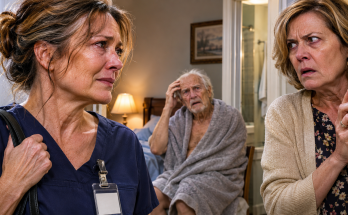
She had pulled a heavy winter coat over her blue scrubs.
Her hair and clothes were being blown about by the wind.
She was trying to control an empty wheelchair that seemed determined to move away from her.
Then I saw Mom.
She had a red-and-white quilt wrapped around her.
The sight of that familiar bundle of blankets and winter clothing did something to me.
I was relieved.
And suddenly, I felt like crying.
I opened the tractor door.
Cold air rushed into the cab.
Mom raised her head when she saw me.
I leaned toward her.
"Hello, Mama."
Her eyes traveled from my red hat to the enormous green machine beside the entrance.
Then she smiled.
"Would you look at what my girl has come to fetch me in?"
There was delight in her voice.
Not embarrassment.
Not disappointment because I hadn't arrived in a comfortable automobile.
Delight.
For a moment, she looked younger than she had during any of my recent visits.
Paloma smiled at me.
Getting Mom into the tractor was the next challenge.
Stig climbed down.
He positioned himself where he could support her as she moved toward the steps.
I remained above them and extended both hands.
Mom looked at the tractor.
Then she looked at me.
I could tell she was concentrating.
She had worked for months to regain strength and confidence after her accident.
Even ordinary movements required thought and preparation.
I didn't want her to feel rushed.
I took hold of her hands.
Stig supported her from below.
She lifted herself onto the first step.
We waited until she was steady.
Then we helped her onto the next one.
It was slow.
It was awkward.
But she kept going.
Through the glass doors, I could see people gathered in the nursing home hallway.
They were watching us.
Under other circumstances, I might have felt self-conscious.
I was wearing farm clothes, standing inside a tractor cab, collecting my elderly mother from a medical facility.
Nothing about it resembled the Christmas photographs people liked to take.
But I couldn't have cared less.
Mom reached the cab.
We helped her turn and settle onto the little folding seat.
She adjusted herself carefully.
Then she reached for the metal grab bar.
Her fingers closed around it.
I looked at Stig.
He finished helping her get comfortable.
Paloma remained beside the entrance until everything was settled.
I was grateful that she had waited with Mom.
I was grateful she hadn't treated my mother's Christmas visit as something unimportant.
Mom had spent months living according to schedules determined by other people.
Being able to attend supper with her family meant something to her that was difficult to put into words.
I thanked Paloma.
Then I closed the tractor door.
The wind became quieter.
Mom looked around the cab.
Her attention settled on the controls and the windows.
As I turned toward Main Street, she started laughing.
I glanced at her.
"What is it?"
She shook her head.
"Do you know when I last rode in one of these?"
"No."
"Nineteen sixty-six."
I looked back at the road.
"Really?"
"Your father and I had just gotten married that year."
She laughed again.
The old tractor suddenly seemed to have carried her somewhere other than town.
I could almost see the young woman she was remembering.
Before the children.
Before the grandchildren.
Before the responsibilities that had gradually filled her life.
Before the fall on the cellar stairs.
I wished Dad could have seen her.
He would probably have laughed at the sight of us bringing his wife home in a tractor.
Perhaps he would have admired my stubbornness.
Perhaps he would have told me I had too much of my mother in me.
Both possibilities sounded like him.
We began the nine-mile journey back toward the farm.
Mom held the grab bar firmly.
She didn't complain about the seat.
She didn't ask how much longer the trip would take.
She watched the snow moving across the fields.
From time to time, I checked her expression.
She seemed comfortable enough, considering the circumstances.
Stig remained attentive beside us.
I had spent the previous months watching Mom adjust to needing help.
She didn't particularly enjoy it.
She had always been independent.
Even accepting assistance with something as ordinary as putting on her shoes could leave her frustrated.
That afternoon, however, she seemed to have made peace with letting us take care of her.
She was going somewhere she wanted to go.
Perhaps that made all the difference.
Partway home, I heard a faint sound beneath the rumble of the engine.
Mom was humming.
I recognized the melody immediately.
Silent Night.
I glanced toward her.
She was looking through the window, still holding the bar.
I didn't say anything.
I didn't want her to stop.
A little farther along, she hummed the same melody again.
Outside, the wind was still blowing.
The road remained difficult to distinguish from the fields.
But inside that old cab, my mother was remembering a Christmas song.
I thought about Kurtis.
I thought about the thirty dollars he didn't want to spend.
For the first time, I wasn't thinking primarily about what his refusal had cost Mom.
I was thinking about what he was missing.
He could have been beside her.
He could have heard her talking about 1966.
He could have seen how happy she was simply to be going somewhere familiar.
Instead, he was somewhere else.
And he had no idea what he had chosen not to experience.
The farmhouse gradually emerged through the snow.
I recognized the lights before I could clearly distinguish the building itself.
We turned toward the yard.
Almost immediately, the back door opened.
Children began appearing.
All eight of them.
Some were moving too quickly for the snowy conditions, and I watched them with the familiar concern of a mother who had spent years telling children to slow down.
They were excited.
Not because of the tractor.
Because their grandmother was inside it.
Before I had finished shutting down the engine, they were gathered near us.
Mom smiled through the cab window.
I saw little Elin among them.
The children were calling to their grandmother, their voices nearly disappearing beneath the wind.
Three of those children belonged to Kurtis and Britt.
Looking at them, I felt another small twist of anger toward my brother.
His children had made it.
His wife had made it.
His mother had made it.
And he wasn't there.
Britt stood at the farmhouse entrance.
She held the door open as Stig and I helped Mom down from the tractor.
She didn't ask whether Kurtis had called.
She didn't offer an explanation for him.
She concentrated on making sure Mom could get inside comfortably.
I appreciated that more than I could tell her.
Once we reached the kitchen, the warmth surrounded us.
Mom looked around.
The children crowded close.
Everyone seemed to want her attention at once.
We helped her remove her winter things and made sure she had somewhere comfortable to sit.
She smoothed her clothes.
Then she looked toward the grandchildren.
"Well, aren't you a sight."
They laughed.
For a few minutes, the whole farmhouse seemed to revolve around her.
I stood back and watched.
This was what I had wanted.
Not anything expensive.
Not a perfect holiday.
Just my mother in a warm room with the people she loved.
Stig returned from putting things in order outside.
I went back to the kitchen.
The potatoes still needed attention, and there were dishes to arrange.
My hands were cold, but I hardly noticed.
Every time I glanced toward Mom, I saw another grandchild sitting beside her.
By six, we were ready to eat.
The dining table was crowded with food.
The children settled into their places.
Britt helped make sure everyone had what they needed.
Mom sat among us.
The chair I had been looking at all afternoon was finally occupied.
Before anybody began serving themselves, she bowed her head.
We became quiet.
Mom had always said grace at important family meals.
Her voice sounded a little softer than it used to, but the words came easily.
She expressed gratitude for the meal, the warmth surrounding us, and the opportunity to spend Christmas together.
Then she thanked God for her daughter.
I lowered my eyes.
I hadn't expected her to mention me.
After a brief pause, she spoke about her son.
"And please help my boy find the road he's meant to be on."
I looked toward Britt.
She was studying her plate.
There was no accusation in Mom's prayer.
That made it more painful.
She hadn't forgotten Kurtis.
She hadn't decided that his absence meant he no longer belonged.
She was still hoping he would find his way back to us.
Even after four months of waiting.
Even after that afternoon.
When she finished, we began passing the food around.
I tried to concentrate on supper.
The children were hungry.
The room was warm.
My mother was smiling.
For the next couple of hours, I allowed myself to enjoy what we had managed to accomplish.
I listened to the conversations.
I watched Mom laughing with her grandchildren.
I made sure she had enough to eat.
At around eight, I brought out the pies.
I was standing at the counter, working the knife carefully through the crust, when our dog began barking.
Not the ordinary impatient bark he made when the children were playing.
He was facing the yard.
I stopped cutting.
Mom heard him too.
She rested her fork on the plate.
I looked toward the back entrance.
A moment later, the door opened.
Cold air entered the kitchen.
And there stood my brother.
Kurtis had snow on his shoulders.
His face was red from the cold.
He remained on the doormat, looking past everyone else.
Straight at Mom.
I expected him to apologize.
Instead, he reached inside his coat.