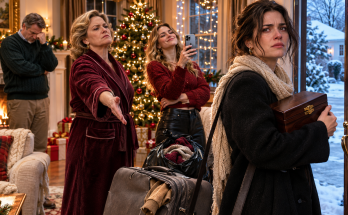
Mr. Alden arrived wearing a heavy overcoat over clothes that looked suspiciously like pajamas.
I would have smiled under different circumstances.
He climbed out of his car, looked across the parking lot, and recognized mine.
I stepped outside with the walnut box held against my chest.
“Lila?”
“Yes.”
“Come inside. It's freezing out here.”
He unlocked a side entrance instead of using the main doors.
The building felt strange without customers or employees.
There were dark computer screens behind the teller stations, empty chairs in the waiting area, and no ordinary background conversations.
He took me directly to his private office.
I placed the walnut box on his desk.
Then I sat down, suddenly conscious of my messy hair and wet sneakers.
“I'm sorry about the way I look.”
He shook his head.
“You don't need to apologize for anything.”
He looked at the box.
Something changed in his expression.
He leaned forward, studying my name on the lid.
“Arthur told me you would have this.”
“You've seen it before?”
“No. But he explained what it meant.”
I glanced down at the old note attached to the seam.
“Do you know what's inside?”
“I know why he wanted you to bring it here.”
He opened a leather folder.
From inside, he removed a thick blue file.
Printed across the front was my grandfather's full name, followed by the words Revocable Living Trust.
Arthur Raymond Vance.
Seeing his name made everything feel strangely personal.
I had grown accustomed to people referring to Grandpa in the past tense.
But there was something different about seeing his name on paperwork that appeared to have been waiting for me.
Mr. Alden asked for my identification.
I gave him my driver's license.
He checked it carefully against information in the folder.
Then he turned through several pages.
I waited.
I was expecting a small account.
Maybe Grandpa had put aside enough money to cover a security deposit somewhere.
Perhaps there would be enough to pay for a hotel and a few weeks of groceries.
Even that would have made an enormous difference.
I had been living with my parents since Grandpa's death.
Over the previous three years, most of my plans for saving money had been interrupted by some expense they needed help covering.
Every time I started getting ahead, something happened at the house.
And my mother always made it sound as though I was the only person capable of solving the problem.
Mr. Alden stopped reading.
He looked at me.
Then he looked back at the file.
He stood, walked around his desk, and closed the office door.
I felt my stomach tighten.
“Is something wrong?”
“No. But I think we should have some privacy.”
He returned to his chair.
“How long have you had your grandfather's box?”
“Since he passed away.”
“And you've kept it all this time?”
“Yes.”
“Have you examined everything inside?”
I shook my head.
“I wasn't ready to go through it. My mother said he had probably left me some old photographs or something sentimental.”
Mr. Alden rested one hand on the blue folder.
“Arthur understood you quite well.”
I looked at him.
“What is this file?”
“Your grandfather created a trust before he died. The assets held in that trust were intended for your benefit.”
“My benefit?”
“You're the only beneficiary, Lila.”
I stared at him.
I understood what a beneficiary was.
But I didn't understand why the paperwork was so thick.
“How much did he leave?”
Instead of answering immediately, Mr. Alden turned to another section.
He began explaining that Grandpa had gradually transferred different assets into the trust.
There were investment accounts.
Commercial real estate.
Municipal bonds.
Interests in privately owned businesses.
I interrupted him.
“Businesses?”
“Yes.”
“He owned businesses?”
“Ownership interests in two of them.”
I shook my head.
“That doesn't sound like my grandfather.”
Mr. Alden gave me a small smile.
“What do you remember about the way he lived?”
“He never changed houses. He drove an old Buick. He had a winter coat that was practically falling apart, but he wouldn't replace it.”
I could picture that coat.
I remembered the worn fabric at the elbows and the way he always insisted it still had plenty of life left in it.
We used to tease him about it.
My mother sometimes complained that he could afford to buy something more respectable.
He never seemed particularly bothered.
“Arthur wasn't interested in showing people how much money he had,” Mr. Alden said.
He turned a statement around and pushed it toward me.
I looked down.
There were different figures printed on the page, but my eyes eventually settled near the bottom.
I read the total once.
Then again.
$8,740,000.
For a moment, I thought I had miscounted the digits.
I brought the page closer.
The number didn't change.
“Is that the right statement?”
“Yes.”
“Are you sure?”
“I'm quite sure.”
I looked at the figure again.
“That's more than eight million dollars.”
“It is.”
I sat back.
My fingers felt cold, although the office was warm.
Mr. Alden explained that the figure represented the most recent valuation.
Some property prices and investments might have changed since then.
The exact value would need to be confirmed as part of the administration.
I heard what he was saying.
I just couldn't make the number fit into anything I knew about my life.
That morning, I had been worried about affording a hotel.
A few weeks earlier, I had been thinking about how much longer I could keep driving my eleven-year-old car.
I had turned down the possibility of moving into a better apartment because my mother insisted she needed me at home.
I had postponed holidays.
Bought things on sale.
Checked my bank balance before agreeing to dinner with friends.
And my grandfather had quietly arranged for me to inherit almost nine million dollars.
“Why didn't anybody tell me?”
“Your grandfather wanted you to develop a life of your own. He didn't want a large inheritance to become the thing that defined you.”
I looked back at the blue folder.
“Did my family know?”
Mr. Alden didn't answer that immediately.
Instead, he opened a different section.
“There's something Arthur wanted you to read.”
He took out an envelope.
My name was written across the front.
I recognized the handwriting before I touched it.
Grandpa's capital letters always had a slight lean, and he left unusually neat spaces between his words.
I used to recognize his Christmas cards before looking at the signature.
I picked up the envelope carefully.
He had indicated that the letter was intended for me when I needed to understand what had really happened.
“May I open it?”
“It's yours.”
I slid my finger beneath the flap.
There were several lines in Grandpa's familiar handwriting.
I began reading.
My darling Lila,
I hope you have never needed to open this letter. I hope the people raising you have learned to appreciate the daughter they were fortunate enough to have, and that your sister has discovered there is room in a family for more than one person to succeed.
I hope you have never mistaken the work you do for others as something you must provide in exchange for their affection.
I stopped reading.
My throat had tightened.
Mr. Alden remained quiet.
I wiped my eyes and continued.
If someone has sent you away or made you believe you are a burden, I want you to understand that their decision tells you nothing about your value.
I expect you will be examining everything you said and did, wondering how you could have avoided upsetting them.
Please don't spend another minute doing that on my account.
You have always been generous with the people you love. Unfortunately, there are people who see generosity as something they are entitled to receive. They may take whatever you offer without ever thinking about what it costs you.
You don't have to keep giving.
I lowered the page.
I had heard my grandfather say things like that before.
Usually, it happened when I mentioned some difficulty at home and tried to dismiss it.
He would look at me carefully.
He never insulted my parents.
But sometimes I felt as though he understood the situation better than I did.
I continued reading.
Grandpa explained that he had made arrangements for me to have a place of my own, dependable financial resources, and the ability to make decisions without relying on my family's approval.
Then I reached a sentence about Maple Grove.
He wrote that he had never intended for my parents to acquire permanent ownership of the family house.
I stopped.
Read it again.
Then looked at Mr. Alden.
“What does he mean about the house?”
“That's another matter we need to discuss.”
“My parents' house?”
“The property on Maple Grove.”
I frowned.
“Is there something wrong with the ownership?”
He opened a separate envelope and placed a certified deed on his desk.
Grandpa's full name appeared near the top.
I recognized the address.
There was no possibility that we were discussing a different property.
It was the house I had left less than a few hours earlier.
The house where my mother had arranged my belongings beside the door.
The house where I had spent years helping pay the expenses.
The house my father had watched me walk out of.
“What am I looking at?”
“Your grandfather transferred the property to the trust while he was alive.”
I waited.
“And he arranged for ownership to pass to you.”
I felt as though I had missed part of the conversation.
“To me?”
“Yes.”
“Not my father?”
“Not your father.”
I looked down at the deed.
“But my parents live there.”
“They were permitted to remain there under a written occupancy arrangement.”
I had never heard of such a thing in connection with our house.
I asked him to explain.
Mr. Alden removed another set of pages.
There were signatures, dates, and sections describing the responsibilities of the people occupying the property.
Grandpa had allowed my parents to stay after his death.
They were expected to maintain the house, cover the usual household costs, and honor certain conditions.
One of those conditions concerned me.
Mr. Alden pointed to the relevant paragraph.
I read it slowly.
The agreement protected my ability to live in the house.
My parents weren't supposed to interfere with that right.
I looked up.
“Even if my mother didn't want me there?”
“That is what the agreement appears to provide.”
“So she couldn't just decide I was no longer allowed to live there?”
“We should have an attorney review the exact provisions before I give you a definitive interpretation.”
He looked down at the document.
“But I certainly don't see anything here allowing her to exclude you permanently.”
I pressed my lips together.
My mother had stood in front of me that morning and announced that I was no longer welcome.
She had spoken with complete confidence.
She had behaved as though she possessed the unquestionable authority to decide whether I had a roof over my head.
And the property wasn't hers.
I didn't feel victorious.
I felt bewildered.
Then I remembered my father's reaction when I carried the walnut box into the living room.
The color leaving his face.
The sudden request for me to put it back.
I looked at Mr. Alden.
“Who else knew about this agreement?”
He folded his hands.
“Arthur discussed the arrangement with your father.”
I waited for him to continue.
“Your grandfather wanted your father to understand the conditions under which he was allowed to remain in the property.”
“Did he understand that I would eventually receive the house?”
Mr. Alden nodded.
“As far as I'm aware, your grandfather explained that to him.”
I looked away.
That was harder to hear than anything else he had told me.
My father hadn't merely failed to defend me during an argument.
He had understood that I had rights concerning the house.
And he had still let my mother remove me.
He had watched my clothes being gathered into plastic.
He had watched Chloe hold up her phone.
He had watched me leave without anywhere arranged to sleep.
He could have stopped it with a sentence.
At the very least, he could have told me the truth.
“Why didn't he tell me?”
Mr. Alden's expression softened.
“I'm afraid only your father can explain that.”
I nodded.
I didn't trust myself to say anything else.
He gave me a few minutes.
I looked at the envelope in my hands, then at the certified deed and the blue folder.
My grandfather had left me more than enough money to begin again.
He had left me property.
He had arranged legal protection.
But there was a part of me that would have gladly traded the entire conversation for the knowledge that my father had been willing to defend me.
I could no longer pretend he simply hadn't understood what was happening.
He had known something I hadn't.
And he had chosen to keep quiet.