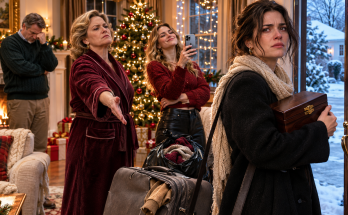
I couldn't stop looking at Clara's hands.
She kept pressing her fingers together.
It was something she did when she was worried and didn't want anyone to notice.
On the recording, she glanced toward the kitchen window before continuing.
She explained that what had begun as a financial inquiry had become much more serious.
Certain property transactions didn't make sense.
Information used to justify acquisitions appeared to have been deliberately distorted.
Buildings were being purchased after their owners and occupants had been placed under enormous pressure.
Clara believed the misleading information was being used to benefit businesses connected to my family.
She had preserved copies of records she was permitted to retain.
But she hadn't relied entirely on paperwork.
She had gone looking for people affected by the acquisitions.
People who had been pushed out of their homes.
People who had lost businesses.
She mentioned a woman who had lived in the same apartment for thirty-one years.
Then she described a man whose family grocery store had been lost.
Her voice became unsteady.
"They're not just entries in a financial report, Silas. These are people who have had their lives taken apart."
I looked down.
I had spent years working with numbers.
Property values.
Projected returns.
Probability calculations.
A building could appear on my screen as a series of figures, and I could work on those figures without ever thinking about the people living inside it.
Clara had gone to their doors.
She had sat with them.
She had listened.
On the screen, she continued explaining what she understood about Julian's involvement.
She believed he knew how the software was being manipulated.
She couldn't establish exactly how much Harrison knew about every transaction, but she had found documents bearing his signature.
Those signatures mattered.
Then she described another discovery.
Someone had been submitting financial and corporate records using her identity.
I felt Rebecca shift beside me.
Clara had recognized forged signatures on company documents.
She had questioned Harrison about them.
He dismissed her concerns.
She approached Julian.
He treated the matter as though it were ridiculous.
Then she received a disturbing telephone call.
The number was unfamiliar.
A woman's voice told her, in a carefully worded remark, that not every mother was equally capable of keeping her child safe.
Clara stopped speaking for a moment.
Then she said she knew whose voice she had heard.
I leaned closer.
I wanted her to say the person's name.
She didn't.
Instead, she explained that she had shared additional information with someone outside the company.
She wasn't depending entirely on the records inside the bank box.
Other people knew enough to help locate relevant evidence if she couldn't continue the investigation.
She also had concerns about the actual ownership of the companies involved.
She hadn't completed her examination.
But she believed the people publicly associated with the businesses might not be the people who ultimately controlled them.
If she was right, the implications extended beyond the individual fraudulent transactions.
They involved the structure of the family's wealth itself.
I looked at Rebecca.
She was watching the screen closely.
Then Clara began talking about me.
She knew how much I wanted my father's approval.
She understood that confronting him would be difficult.
She knew I had spent most of my life trying to become someone my family would respect.
But she asked me not to let those old feelings determine what happened to Finn.
I bent forward.
I couldn't hold back my tears anymore.
It wasn't only what she was saying.
It was hearing the familiar sound of her voice.
Seeing the sweater.
Recognizing the expression she wore whenever she was trying to tell me something difficult without making me feel worse.
I had missed all those little things.
Rebecca paused the recording.
"We can stop for a while."
I wiped my face.
"No. Please finish it."
She started the video again.
Clara looked directly at the camera.
She asked me to tell Finn how completely she loved him.
Then she said something that made me think of the previous evening.
She wanted our son to understand that courage didn't require him to have a steady voice or an easy time finding his words.
What mattered was his willingness to speak truthfully, even when speaking was difficult.
Then the recording ended.
Clara disappeared.
I stared at the screen.
I wanted to play it again immediately.
Not because I had missed any particular detail.
I simply couldn't bear the thought of losing the sound of her voice a second time.
Rebecca waited.
After a while, I straightened in my chair.
"We need to identify that woman who called her."
"Yes."
"And establish who's behind the forged signatures."
"Yes."
"I want to know who knew about her movements on November 26."
Rebecca closed the laptop.
"We'll have to work with the appropriate investigators now. There's too much here for us to treat this as a dispute between you and your relatives."
I understood.
I was still looking at the storage device when my phone began ringing.
Mom.
I didn't answer.
She called a second time.
I silenced the phone.
Then a message appeared.
My father expected me at the estate that afternoon.
There would be a discussion about my conduct during Julian's dinner.
I was instructed to bring Finn.
I showed Rebecca.
Another message followed.
My mother reminded me that she and Harrison had substantial concerns about their grandson's well-being.
Rebecca shook her head.
"Don't engage with her."
I put the phone down.
It vibrated again.
This time, my mother had sent a photograph.
I opened it.
For a second, I couldn't understand why she would have that picture.
Finn was standing outside Daniel's house.
He was helping Hannah carry groceries.
He looked happy.
He appeared completely unaware that someone was photographing him.
My mother had included a short message indicating that she knew where he was.
I stood so quickly that my chair moved backward.
Rebecca looked up.
I showed her the photograph.
Then I called Daniel.
He answered.
"Hey. Everything going okay?"
"Bring Finn inside."
"What's wrong?"
"Daniel, please get him inside the house."
I heard him move.
He called to Hannah.
There was a brief exchange of voices.
Then he returned to the phone.
"He's inside. Tell me what's happening."
"My mother has a photograph of him standing outside your house. It was taken today."
Daniel became quiet.
"Someone's been here?"
"I don't know who. She just sent it to me."
He swore under his breath.
"Do you want me to contact the police?"
"Yes. Tell them exactly what's happened."
Rebecca was already gathering the documents.
She contacted Melissa Grant, the attorney who was assisting with the developing family-law situation.
I left the bank and drove directly to Daniel's neighborhood.
There were moments during that drive when I wanted to call my mother and demand an explanation.
I wanted to know whether she had sent someone to follow my child.
I wanted to know what she intended to accomplish by making sure I knew he had been photographed.
But I already understood the purpose of the message.
She wanted me frightened.
And she had succeeded.
A police officer was talking with Daniel on the front porch when I arrived.
Daniel pointed toward the house.
"He's in the living room."
I went inside.
Finn was sitting near Hannah.
The moment he saw me, he stood.
"Dad!"
I opened my arms.
He ran toward me.
I held him more tightly than I intended.
He pulled back.
"Are you okay?"
"Yeah, buddy."
He studied my expression.
I tried to smile.
"Everything's fine."
He didn't believe me.
I could see that immediately.
Clara's death had made him unusually attentive to adults' expressions.
He knew what people looked like when they were hiding bad news from him.
I knelt so we were at the same height.
"There are some adults making choices they shouldn't be making. I'm dealing with it."
"Grandma?"
I hesitated.
Then I nodded.
Finn looked down at his hands.
"She said you wouldn't listen if I told you."
I felt something tighten in my chest.
"What did she say I wouldn't listen to?"
He looked toward Hannah.
His fingers twisted together.
"After Mommy died, Grandma talked to me in my room."
I waited.
"She said I shouldn't tell anybody about when Mommy went away."
I struggled to keep my expression steady.
"Was there something you remember from that night?"
His breathing changed.
"I-I-I…"
He began shaking his head.
I stopped asking.
"It's okay. You don't need to explain it now."
He moved closer.
I put my arms around him.
"She said you'd leave too."
I closed my eyes.
"What, buddy?"
"If I talked about it. She said you might have to go away."
He began crying.
I had to concentrate on keeping my voice calm.
"Listen to me, Finn. You haven't done anything wrong."
He looked up.
"Nobody is allowed to frighten you into keeping a secret. Not your grandmother. Not your uncle."
"What if it's someone in our family?"
"That doesn't make it acceptable."
He leaned against me.
I held him until his breathing slowed.
I wanted desperately to know what he remembered.
There was a part of me that wanted to ask a hundred questions.
Had he seen something?
Had he overheard a conversation?
Had Clara told him something shortly before the accident?
But he was visibly distressed.
And I wasn't going to turn my son into an investigator.
When Daniel came inside, I told him what Finn had said.
He looked furious.
Then he gave me advice that I was grateful to receive.
"Don't keep questioning him about it yourself."
I nodded.
"Someone trained to interview children should handle this. You don't want him feeling that it's his job to figure out what happened."
Daniel was right.
Finn had already spent nineteen months grieving his mother.
He shouldn't have to believe that his safety or mine depended on remembering something perfectly.
I passed the information to our attorneys.
Later that afternoon, Melissa called.
My parents had formally filed a guardianship petition.
I stood in Daniel's living room, holding the phone against my ear.
"What are they claiming?"
She began explaining.
My emotional health had supposedly deteriorated to the point where I couldn't properly care for Finn.
There were accusations concerning my financial conduct.
They alleged that I wasn't supervising my child adequately.
I looked through the doorway.
Finn was sitting at the table with Daniel's children, playing a board game.
They had provided him with company and a safe place to spend the day while I handled something difficult.
Apparently, my parents believed that amounted to inadequate supervision.
Melissa continued.
They were claiming that Finn's speech difficulties had become worse because I hadn't obtained appropriate assistance for him.
"That's completely false."
"I know."
"I've been taking him to appointments for over a year."
"We'll provide the documentation."
I rubbed my forehead.
They had taken something my son was already struggling with and turned it into an accusation against me.
They had humiliated him because of his speech.
Now they intended to argue that his speech difficulties made me an inadequate father.
"When is the hearing?"
"They've requested an expedited proceeding."
"How quickly?"
"Next week."
I looked at Finn again.
He was laughing at something one of Daniel's children had done.
I thought of the October 14 document.
Julian's name.
The guardianship strategy.
Clara's warning about what it would mean if my family tried to take our child.
What had once been hidden inside a stuffed lion was no longer simply evidence of something that had happened in the past.
It was connected to a threat we were facing in the present.
"Melissa, I want us to answer every allegation properly."
"We will."
"I don't want Finn pressured by any of them."
"We'll request safeguards."
I ended the call.
Then I contacted Rebecca.
"I need to meet the detective."
"I've already arranged it."
"When?"
"Tomorrow."
She told me his name was Thomas Mercer.
He had retired from police work, but he hadn't forgotten Clara's case.
Apparently, something about the original crash investigation had continued troubling him.
The next day, Rebecca and I traveled to his house near the Connecticut shoreline.
It was a modest place.
Nothing about it resembled the properties my family considered suitable for important people.
Mercer was sixty-eight.
He had silver hair, broad shoulders, and a tired expression that softened when I introduced myself.
"I'm very sorry about Clara."
"Thank you."
He invited us inside.
There were photographs of his grandchildren, several fishing trophies, and books piled around the living room.
He offered us coffee.
I accepted, although I barely touched it.
Mercer brought out a worn folder.
"I was responsible for investigating the collision involving your wife's vehicle."
I nodded.
"You concluded that the weather caused it."
"That was the accepted explanation."
"Was it your explanation?"
He looked at me carefully.
"I had reservations."
He opened the folder.
The first photograph showed Clara's silver sedan beside the concrete barrier.
I looked away instinctively.
The damaged front of the car was difficult to see.
Mercer waited.
I forced myself to turn back.
He pointed toward the rear passenger-side panel.
There was a long mark across the metal.
He explained that the damage didn't appear consistent with the vehicle's impact against the barrier.
There had also been paint transfer suggesting contact with another automobile.
Possibly a dark-colored SUV.
I stared at the photograph.
"That wasn't mentioned in the report I received."
"No."
"Did you investigate it?"
"We tried."
He explained that a representative connected to Pierce Development Group had contacted the department two days after Clara's death.
The representative claimed there was a possible insurance-related concern and requested access to certain records.
Rebecca asked who the representative had been.
Mercer looked at his notes.
"Martin Voss."
I recognized the name immediately.
The same attorney who had attended Julian's promotion dinner.
The man who had sat among our relatives and their guests while my son struggled through his speech.
Mercer explained that a digital attachment later became unavailable in the working investigation file.
It contained footage from a commercial truck that had traveled through the area around the time Clara's car crashed.
He had seen part of the recording.
It showed a dark SUV following her sedan.
The footage available to him didn't establish whether the vehicles made contact.
But he had reason to believe a longer recording had originally been received.
He produced an intake receipt supporting that concern.
Rebecca examined it closely.
Mercer had reported the discrepancy.
He was told that the differences were technical and that the available evidence remained consistent with a single-vehicle collision.
By the time he attempted to obtain the original footage from the trucking company, its retention period had expired.
He retired seven months after Clara died.
But the matter stayed with him.
Eventually, seeing publicity surrounding Julian's analytics platform and learning about disputes involving the company encouraged him to revisit his old concerns.
He began making inquiries.
And he found the truck driver.
His name was Aaron Whitcomb.
He lived in Vermont and had agreed to speak formally with investigators.
"Does he remember the accident?" I asked.
Mercer nodded.
"He stopped to help."
I swallowed.
"What did he see?"
Mercer explained that the driver remembered a woman near a dark SUV before emergency responders arrived.
She had been wearing a light-colored coat.
He hadn't seen her face clearly enough to identify her.
I put my coffee cup down.
"Was she trying to help Clara?"
Mercer looked genuinely uncomfortable.
Then he told me that the driver's impression was different.
The woman appeared to have been looking for something inside Clara's damaged vehicle.
I sat back.
For nineteen months, I had imagined my wife alone beside that highway.
I had hoped somebody had reached her.
I had hoped that, even if they couldn't save her, a stranger had at least tried.
Now I was hearing that someone might have reached her before the emergency services.
And that person might have been more interested in retrieving something from the car than in helping my wife.
Rebecca placed the intake receipt beside the photograph.
I looked at the damaged sedan.
Then I remembered the papers tied with Clara's blue ribbon.
Her frightened expression in the recording.
Her insistence that Finn should never be taken from me.
I didn't know who the woman in the pale coat was.
I didn't know what she had been searching for.
But I knew that Clara had spent her final weeks trying to protect evidence that someone else desperately wanted.
And for the first time, I understood that finding out what had happened to my wife and keeping my son safe were no longer two separate matters.