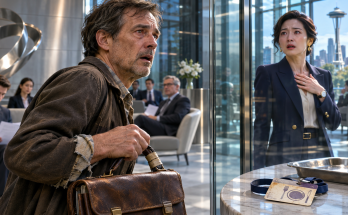
The following morning, Leah contacted me.
I was thinking about the arbitration documents when my telephone rang.
Her voice was calm.
"There's been a development at NexusRoute."
I waited.
"The board has removed Roland as chief executive."
For a moment, I didn't know what to say.
Leah continued.
His employment had also been terminated for cause.
The board was no longer prepared to retain him in his leadership position following the evidence that had emerged.
I sat down.
Six years earlier, Roland had persuaded that same company to regard me as a danger to its interests.
He had presented himself as the man responsible for protecting the business.
I had been the person escorted out of its future.
Now the board had examined evidence of his conduct.
And this time, he was the person whose employment had ended.
"Julian?"
"I'm here."
"Did you hear what I said?"
"Yes."
I looked at the telephone.
I had imagined that news might make me enormously happy.
It didn't.
There was satisfaction in knowing that his conduct had finally produced a consequence.
But I couldn't recover the six years simply by hearing that Roland had lost his position.
Dad's medical difficulties hadn't disappeared.
The opportunities I had missed weren't suddenly available again.
The damage had been real.
The consequence was real, too.
I needed to allow both things to remain true.
Leah explained that the company representatives were participating in the settlement discussions.
The removal of Roland changed the circumstances surrounding the negotiations.
NexusRoute now had its own reasons for addressing the evidence directly.
I understood.
The company had relied on records that were subsequently shown to have been fabricated.
It needed to resolve more than a disagreement about money.
Its previous statements about me had been false.
Those statements had traveled beyond the original boardroom.
They had followed me into conversations with other employers.
They had shaped the way people interpreted my professional history.
If we accepted another confidential financial agreement without correcting that history, much of the damage would remain.
Leah knew that was important to me.
We discussed the proposed resolution.
There were two matters that needed to be addressed.
The value associated with the ownership interest I had surrendered and the related financial claims.
And an unambiguous correction of the allegations.
I wasn't interested in receiving another payment in exchange for remaining professionally untouchable.
I had already lived through one arrangement like that.
I wouldn't voluntarily enter another.
The following day, the negotiations produced a binding resolution.
NexusRoute agreed to pay eight million seven hundred thousand dollars into escrow for my benefit.
The amount addressed the value of the equity I had transferred and the associated interest claims.
I listened while Leah explained the arrangement.
Then she repeated the figure.
Eight million seven hundred thousand.
I wrote it down.
I don't know why.
Perhaps I needed to see the numbers in front of me before I could accept that they belonged to a conversation about my life.
8,700,000.
Six years earlier, the offer had contained considerably fewer digits.
I remembered how relieved I had been to know that I could continue paying for Dad's treatment.
I also remembered how quickly that relief had been replaced by uncertainty about finding work.
Now there was an entirely different financial future available.
But my attention moved to the second part of the resolution.
"What about the statement?"
Leah understood immediately.
"The company has agreed to issue a public retraction."
"Unconditional?"
"Yes."
I rested my pen on the table.
I didn't want a carefully worded announcement that suggested the dispute had been resolved for commercial convenience.
I didn't want an explanation that blamed the passage of time for uncertainty surrounding the original records.
I didn't want a statement saying that both parties had chosen to move forward without admitting responsibility.
Those descriptions might have satisfied people who wanted the matter to disappear quietly.
They wouldn't satisfy me.
The allegation had been specific.
The correction needed to be specific.
I asked to examine the final wording before publication.
Leah arranged for me to review it.
When the document was placed in front of me, I began reading slowly.
I had spent years being careful about what I could say concerning NexusRoute.
Now NexusRoute was preparing to say something about me.
Something that would be available to the people who had heard the original accusation.
I wanted every important sentence to be clear.
The statement acknowledged the independent forensic findings.
It established that the evidence previously used against me had been deliberately fabricated.
It corrected the accusations of source-code theft and unauthorized disclosure.
I read those portions several times.
The company wasn't merely stating that it no longer intended to pursue the matter.
It was stating that the misconduct attributed to me hadn't occurred.
I hadn't stolen its code.
I hadn't sent its proprietary information to a competitor.
The distinction was enormous.
One version might have allowed people to continue believing I had done something wrong but escaped punishment.
The other version told them that the original accusation was false.
I looked at Leah.
"This is what I wanted."
She nodded.
"We made sure the language addressed the findings directly."
I returned to the document.
There was no reference to an unfortunate misunderstanding.
No attempt to place equal responsibility on everyone involved.
No suggestion that the truth had simply become impossible to establish.
The statement said what had happened.
For years, I had wondered what it would feel like to see my former company acknowledge that I hadn't betrayed it.
Now I was looking at that acknowledgment on a sheet of paper.
I felt my eyes begin to sting.
I put the document down.
Then I picked it up again.
I wanted to make certain I hadn't misunderstood anything.
Leah gave me time.
The settlement amount was extraordinary.
I understood that.
But the document in my hands addressed something that money couldn't accomplish by itself.
People could speculate about why a company had paid me.
They could invent explanations about the size of the settlement.
They could suggest that the business had simply decided the dispute was too expensive to continue.
The retraction left considerably less room for those interpretations.
It addressed the evidence.
It addressed my conduct.
And it corrected the false record that had damaged my reputation.
I approved the wording.
Later, when the notice was made public, I read it again.
I thought about all the times I had sat in recruitment offices and watched people discover NexusRoute on my résumé.
Sometimes the change in their expressions had been immediate.
Sometimes they continued the conversation politely.
But I had learned to recognize the moment when my professional experience became less important than the allegation.
I remembered Nadine looking at me across her desk.
I remembered Conrad's reaction to my education.
I remembered Neil attempting to undermine my work during the technical examination.
Then there had been the Blue Peak incident review.
He had stood in front of my colleagues and suggested I might have deliberately damaged an important customer relationship.
He had relied on the assumption that the old accusation would remain powerful enough to make people doubt anything I said.
That assumption was finished.
The truth was now available in a form I could point to without violating the old restrictions.
I didn't need to ask people to believe my version of what had happened.
The company that had accused me had corrected its own statements.
Messages began arriving.
Some came from engineers I had worked with years earlier.
Others came from people I recognized through professional relationships that had gradually disappeared after my departure from NexusRoute.
There were names I hadn't seen on my telephone in a long time.
A few messages began with straightforward apologies.
People acknowledged that they had heard the allegations and assumed the company wouldn't have made them without sufficient evidence.
Some expressed regret for failing to contact me.
Others admitted they had stopped involving me in professional discussions because they believed doing so might create problems for themselves.
I appreciated the honesty of those messages.
It couldn't have been comfortable for them to write.
There were other communications that avoided the subject entirely.
People asked how I was doing.
They mentioned professional opportunities.
They referred to our previous work together as though we had simply lost contact over the ordinary course of time.
I knew that wasn't what had happened.
But I didn't feel obligated to correct every person's description of the past.
I answered some of the people who contacted me.
I left others unanswered.
Six years earlier, I would have been grateful for almost any indication that somebody remained willing to work with me.
Now I had colleagues who knew what I could do.
I had assignments that required my experience.
I didn't need to reconstruct every professional relationship that had disappeared.
Some belonged in the past.
I was beginning to understand that recovering my reputation didn't mean returning to the exact life I had previously occupied.
NexusRoute had once been the center of my professional ambitions.
I had helped establish it.
My engineering work had contributed to its success.
Losing my interest had felt like losing a part of myself.
But I no longer wanted my future to revolve around that company.
I had something valuable at StrataCore.
The opportunity to work alongside people who had examined my contributions directly.
That opportunity had existed before the settlement was resolved.
It would continue afterward.
I looked at the printed retraction again.
For the first time in years, I didn't feel the need to prepare an explanation of what had happened.
There was nothing left for me to justify.
I thought about Dad.
The air filtration machine beside his chair.
The prescription bottles.
The careful calculations we had made whenever another medical bill arrived.
I thought about his voice during our telephone conversation after Simon's findings were discovered.
He had told me that he hadn't needed documents to believe me.
I wanted him to see this document anyway.
Not because it would change what he believed.
Because it might finally change what he believed about himself.
He had carried an unfair amount of guilt over my decision to accept Roland's original offer.
He understood the value of what I had surrendered.
He knew why I had needed the money.
And because he was my father, he had quietly decided that his illness was responsible for the destruction of my career.
I wanted him to understand that the responsibility had always belonged elsewhere.
The people who manufactured the allegations had created that situation.
Dad had simply needed help.
There was no wrongdoing in that.
I contacted him.
I told him that the legal matter had been resolved.
He listened while I explained the financial arrangement.
When I mentioned the amount, he asked me to repeat it.
I did.
There was a long pause.
"That's a lot of money, son."
"It is."
"What does that mean for you?"
I looked at the printed statement.
"It means they finally acknowledged what happened."
I explained that NexusRoute had issued a correction of its allegations.
Dad became quiet.
I could hear his breathing.
"So they've admitted you didn't do it?"
"Yes."
Another pause.
"Good."
It was such a small word.
But the way he said it told me how long he had been waiting.
I promised to bring him a printed copy.
He said he would like that.
After we finished speaking, I returned to the practical decisions the settlement had made possible.
I didn't want to spend money simply because it was available.
There were things I had wanted for years.
There were also things Dad genuinely needed.
His medical care belonged at the beginning of those decisions.
I wanted him living somewhere comfortable.
Somewhere suitable for the ongoing treatment his condition required.
I wanted equipment that worked reliably.
I wanted him to stop wondering whether a prescription could be postponed.
Money couldn't reverse the damage to his lungs.
It couldn't return the years he had spent being ill.
But it could remove financial uncertainty from many of the decisions surrounding his care.
That was worth more to me than any display of wealth.
I thought about Claudia's offer during my original interview.
Three hundred and twenty thousand dollars in base compensation.
At the time, the number had seemed capable of resolving practically every immediate difficulty in my life.
Now I had the proceeds of an agreement worth millions.
Yet I still felt pleased that I had refused the appointment.
The job I held belonged to me independently of the meal card.
The settlement belonged to me independently of Claudia's generosity.
And the choices I could now make didn't require me to feel indebted to either person.
I folded the printed retraction carefully.
Then I placed it inside my briefcase.
The black thread around the handle was becoming loose again.
I noticed it.
For years, I had regarded that worn briefcase as something I needed to repair because replacing it wasn't financially sensible.
Now I could replace it without thinking.
But I didn't do so immediately.
I had one more place I wanted to carry it.
There was a man south of Seattle who had spent years believing his illness had ruined his son's career.
I wanted to sit beside him while he read the truth.