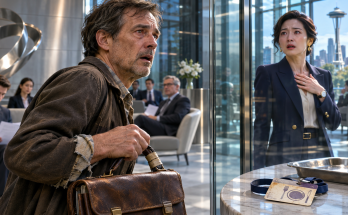
Roland's attorney was still speaking when I noticed that Evelyn Caldwell had stopped taking notes.
She was looking directly at him.
He continued explaining the importance of honoring agreements made between parties who had received independent legal advice.
I understood his argument.
I had spent six years understanding it.
Every time I considered challenging what happened, somebody reminded me that I had accepted the settlement.
Every time I wanted to defend my reputation publicly, somebody reminded me about the confidentiality provisions.
The agreement had become the answer to everything.
But nobody had properly examined how Roland obtained my signature.
Evelyn interrupted.
"Counsel, we need to distinguish between entering an agreement voluntarily and entering one based on deliberately false information."
The attorney nodded.
He began explaining that the existence of troubling communications didn't necessarily establish every element of fraud.
Leah listened.
I looked toward Roland.
His hands were folded on the table.
Six years earlier, those same hands had rested beside a folder containing the offer that would remove me from NexusRoute.
I remembered the patience with which he had waited for me to accept it.
Four hundred thousand dollars.
That figure had appeared generous when compared with the amount of money I had available at the time.
Compared with what he was taking from me, it was something else entirely.
Leah addressed the arbitrator.
She explained that we weren't relying on a single questionable message or one person's recollection.
There were several independent categories of evidence.
The contractor's correspondence.
The altered administrative history.
The absence of the alleged network connection.
Neil's sworn account of his participation.
Each piece supported aspects of the others.
Roland's attorney questioned whether the archived material could establish the original context of every conversation.
Leah directed him toward the verification records.
Simon Pratt's work had been carefully preserved and documented.
The additional material obtained through the dispute process provided further support.
The relevant findings didn't depend on anyone accepting my personal interpretation.
I watched the documents change on the presentation screen.
There was a strange comfort in seeing everything laid out so plainly.
For years, the accusation had seemed enormous.
It had occupied nearly every corner of my working life.
Now we were examining its individual components.
And those components didn't hold together.
Evelyn asked a question about the order in which the relevant administrative entries had been created.
Leah referred her to the independent analysis.
The dates mattered.
The records used to accuse me hadn't simply contained an innocent discrepancy.
They had been manipulated to support a particular conclusion.
That conclusion had benefited Roland financially.
I looked down at my hands.
I had spent years designing systems in which important decisions could be traced.
Yet the most damaging decision of my own professional life had been made using records that nobody had adequately challenged.
I wished I had been able to finance a proper investigation back then.
I wished I hadn't needed to choose between continuing the dispute and paying for Dad's treatment.
But wishing didn't change what had happened.
I was here now.
That was what mattered.
Roland's attorney returned to the circumstances surrounding my departure.
He argued that the settlement had provided me with considerable compensation at a time when the company faced uncertainty.
Considerable compensation.
I nearly laughed.
Not because four hundred thousand dollars was an insignificant amount of money.
It wasn't.
But the description left out the twenty-two percent ownership interest I had transferred in return.
It also left out the fact that Roland had helped manufacture the uncertainty he claimed to be resolving.
Leah made that distinction clear.
She wasn't asking Evelyn to reconsider an ordinary commercial disagreement simply because the shares had subsequently increased in value.
The underlying allegation had been fabricated.
It had been used to pressure a founder into surrendering his interest.
The financial consequences had followed directly from that conduct.
Evelyn examined another document.
The room became quiet enough that I could hear the paper moving beneath her fingers.
I watched Roland reach for his water.
He drank a little and returned the glass to the table.
Nobody was discussing my educational background.
Nobody was asking whether I had been sufficiently cooperative during the original investigation.
Nobody was suggesting that accepting a settlement proved I had done something wrong.
We were discussing what Roland had actually done.
There was a considerable difference.
The arguments continued until Evelyn had heard the positions of both sides.
She asked several final questions.
Then she explained her interim determination.
The evidence provided a substantial basis for challenging the validity of the original settlement.
There was sufficient support for the argument that the agreement had been obtained through fraud.
My underlying claims could no longer be dismissed simply by referring to the release I had signed.
I sat completely still.
Leah made a note.
Roland leaned toward one of his attorneys.
I waited until Evelyn finished speaking.
I knew better than to mistake an interim determination for a final award.
The money hadn't been recovered.
The ownership dispute hadn't been resolved.
Nobody had issued a public correction of the allegations against me.
But the agreement that had prevented me from properly defending myself was finally open to challenge.
That was something I hadn't possessed when I entered the room.
The parties had previously agreed to an accelerated process.
Evelyn directed them to participate in a forty-eight-hour settlement conference before the proceeding advanced to its next stage.
Leah made our position clear.
We were prepared to continue.
We were also prepared to pursue the matter publicly and provide the relevant evidence to the appropriate authorities if necessary.
I watched Roland's attorneys gather their documents.
Their conversation was quieter than it had been at the beginning of the hearing.
One of them leaned close to Roland.
Another was already organizing the exhibits they needed to review.
I collected my own papers.
My old briefcase was resting against my chair.
I lifted it carefully.
The repaired handle had survived another important day.
Outside the conference room, Leah and I stopped briefly.
She explained that we were in a stronger position than we had been before the hearing.
But we still needed to approach the remaining negotiations carefully.
"I don't want you thinking the outcome is guaranteed."
"I understand."
"There are details they'll have to agree to."
"I know."
She looked at me.
"How are you feeling?"
I considered the question.
"Tired."
She smiled a little.
"That's reasonable."
I was more than tired.
I felt as though I had been carrying something heavy for years and had finally been allowed to set it down temporarily.
I wasn't sure what to do with my hands.
I wasn't sure whether I should feel happy yet.
Leah had work to attend to.
I began walking toward the elevators.
The corridor was quiet.
I pressed the call button and watched the illuminated numbers above the doors.
Then I heard footsteps approaching behind me.
"Julian."
I recognized the voice.
Roland stopped several feet away.
His attorneys weren't beside him.
I turned.
For a moment, we stood looking at each other without speaking.
He appeared irritated rather than embarrassed.
"You didn't need to bring all of this back."
I looked at him.
"Back?"
"The agreement was finished. You had an opportunity to put it behind you."
I felt my fingers tighten around the briefcase handle.
There was something remarkable about hearing him describe those six years as an opportunity.
He had continued running the company.
His professional standing had remained intact.
He hadn't been required to explain the same accusation every time he applied for work.
He hadn't been looking at medical expenses and wondering whether another month of treatment would be affordable.
He had received the benefit of the agreement.
I had received its consequences.
"You could have built another life with the money," he said.
"I used it to keep my father alive."
Roland looked away briefly.
"You made your own decision."
"Based on the situation you created."
He turned back toward me.
There was no apology.
No acknowledgment that my father had been critically ill when the offer was made.
No suggestion that he understood what the accusations had cost me.
Instead, he began talking about the pressure the company had been under.
The obligations to investors.
The position of the board.
The uncertainty surrounding the business.
I listened for a few seconds.
Then I stopped him.
"You gave the board false information."
His mouth tightened.
"You weren't dealing with everything I was dealing with."
"No. I was dealing with a father in intensive care."
He didn't answer.
I thought about the old diner.
Dad standing behind the grill for years.
Dad encouraging me to continue my education even when the working days became exhausting.
Dad apologizing because he believed his medical needs had cost me my future.
Roland had known what was happening.
He had known that I couldn't indefinitely finance a legal dispute while trying to pay for treatment.
And he had chosen that particular moment to make his offer.
"You knew why I needed the money," I told him.
He looked toward the elevator doors.
"We all had difficult decisions to make."
I shook my head.
"Not the same decisions."
The elevator arrived.
The doors opened.
There was a time when I would have remained in that corridor arguing with him.
I would have tried to make him acknowledge what he'd done.
I would have explained myself again.
I would have hoped that if I found exactly the right words, he might finally admit that my father and I hadn't deserved what happened.
But I didn't need his acknowledgment in that moment.
The evidence had already been presented.
Other people had examined it.
I stepped into the elevator.
Roland stayed where he was.
I pressed the button for the ground floor.
As the doors moved toward each other, I saw him open his mouth.
Whatever he intended to say remained outside.
For once, I hadn't waited for Roland Briggs to decide when our conversation was over.
I stood alone inside the elevator.
The numbers descended.
My reflection looked tired.
The shirt cuff was still worn.
The briefcase was still old.
Nothing about my appearance suggested that something important had just happened.
Yet I felt different.
I had spent years thinking that defending myself meant finding a way to make Roland listen.
That afternoon, I understood that he had always known the truth.
He wasn't somebody I needed to convince.
He was somebody who needed to be held responsible.
When I reached the building's entrance, I stopped and looked out toward the street.
People were walking past carrying bags and umbrellas.
The ordinary movement of the city continued.
Nobody knew that my former business partner was upstairs discussing the consequences of evidence he had spent six years keeping hidden.
Nobody knew what the next forty-eight hours might mean for me.
I took out my telephone.
I thought about calling Dad.
Then I decided I would explain everything when there was something definite to tell him.
He had spent enough time worrying about unfinished legal matters.
I didn't want to give him another uncertain promise.
Instead, I put the telephone away and walked toward my car.
I still had my position at StrataCore.
I still had engineering responsibilities waiting for me.
Whatever happened during the settlement conference, those things belonged to me.
I had earned them separately from the dispute.
That distinction brought me considerable comfort.
I wasn't depending on Roland to provide me with a future anymore.
I was asking him to answer for what he had taken from my past.
And finally, somebody with the authority to examine that question was willing to hear it.