Part 1
The morning Jasmine Mercer discovered that her husband had stolen everything they owned, she was standing behind the counter of her bakery, brushing flour from her hands.
It was a cold Thursday in late October, the kind of morning when the windows fogged from the warmth of the ovens and customers came in wearing heavy coats, asking for coffee before they even looked at the pastries.
For seven years, Jasmine had opened the bakery before sunrise.
She knew which customers wanted cinnamon rolls, which ones preferred their coffee black, and which elderly regulars needed someone to ask how they were doing before they would admit that anything was wrong.
The bakery was not simply her business.
It was the life she had built.
Her grandfather used to tell her that a person could lose money, property, and even the people they trusted, but nobody could take away the knowledge in their hands.
Jasmine had never understood how important those words were until the envelope arrived.
It was pale yellow, with a return address belonging to a collection agency.
At first, she assumed it was a mistake.
The letter demanded payment on a commercial mortgage she had never authorized.
The outstanding balance was more than $400,000.
Her hands began to tremble as she turned to the second page.
There, beneath the loan agreement, was her signature.
Or something that looked remarkably like it.
Jasmine stared at the handwriting.
She knew immediately.
Kevin had signed her name.
Her husband of nine years had taken out a second mortgage against the commercial building she owned, using her bakery as collateral.
By noon, Jasmine had discovered that their joint savings were empty.
By two o’clock, she learned that their house was also in foreclosure.
And by four, she knew about the woman in Seattle.
Her name was Vanessa.
Kevin had been living an entirely different life with her for nearly a year.
He had rented a luxury apartment, leased an expensive car, and convinced Vanessa that he was a successful investor preparing to launch a commercial real estate company.
Every dollar supporting that illusion had come from Jasmine.
When she confronted him that evening, Kevin was standing in their beautiful kitchen, pouring himself a glass of water.
“Tell me this isn’t real,” Jasmine said.
She placed the documents on the counter.
Kevin looked at the papers.
For a moment, something resembling fear passed across his face.
Then he sighed.
“Jasmine, I can explain.”
“You signed my name.”
“I needed the financing.”
“You stole from my business.”
“I was going to replace the money.”
She stared at him.
“Four hundred thousand dollars, Kevin.”
He rubbed his forehead.
“The investment was supposed to pay out in six months.”
“And the woman in Seattle?”
He said nothing.
Jasmine felt something inside her grow painfully still.
“How long?”
“Jasmine—”
“How long have you been with her?”
Kevin looked away.
“Almost a year.”
The kitchen clock ticked loudly.
Nine years of marriage seemed to contract into that single sound.
She remembered working sixteen-hour days while Kevin told her he was traveling for business.
She remembered postponing vacations because he said they needed to save money.
She remembered the winter she had worked through pneumonia because the bakery’s payroll was due.
And she remembered Kevin telling her how proud he was of her.
“Did you ever love me?” she asked quietly.
His expression changed.
“Of course I did.”
“Then why?”
Kevin leaned against the counter.
“I don’t know how to explain it. I felt trapped. Every day was the same. The bakery, the bills, this town. I wanted something different.”
Jasmine looked around the kitchen.
The polished countertops.
The expensive refrigerator.
The photographs from their wedding.
The home she had paid for with years of early mornings and aching feet.
“You wanted something different,” she repeated.
Kevin nodded.
“And you decided to buy it with my life.”
He looked offended.
“That’s not fair.”
Jasmine almost laughed.
Instead, she picked up the documents and walked away.
The following weeks were worse than she could have imagined.
Her attorney confirmed that Kevin’s forged signatures might eventually give her grounds to challenge the loans, but proving the fraud would take time.
The lenders were already pursuing foreclosure.
The savings accounts were empty.
The commercial mortgage had been delinquent for months.
Even winning a lawsuit would not immediately give Jasmine somewhere to sleep.
Kevin left for Seattle three days after their confrontation.
He took two suitcases and the remaining money in his personal account.
At the front door, he turned around.
“I’m sorry things happened this way.”
Jasmine stood at the bottom of the staircase.
“You made them happen this way.”
He opened his mouth as though he wanted to argue.
Then he left.
She never heard the sound of his car returning.
In November, the bakery closed.
Jasmine stood outside its front doors while workers changed the locks.
Mabel Henderson, a sixty-eight-year-old widow who had worked with her for nearly five years, stood beside her.
Mabel held a small cardboard box containing Jasmine’s recipe notebook, an old photograph of her grandfather, and a ceramic coffee mug with a chipped blue handle.
“Come stay with me,” Mabel said.
Jasmine shook her head.
“You’ve already helped enough.”
“That’s nonsense. I’ve got two empty bedrooms.”
Jasmine watched a man carry the bakery’s front display sign toward a storage truck.
“I can’t, Mabel.”
“Why not?”
“Because if I walk into somebody else’s house right now, I don’t know if I’ll ever find the courage to stand on my own again.”
Mabel looked at her for a long time.
Then she took Jasmine’s hand.
“That man stole your money,” she said. “Don’t let him steal your pride, too.”
Jasmine wanted to say that pride was all she had left.
But that wasn’t entirely true.
There was something else.
Sixty acres of abandoned limestone quarry in southeastern Ohio.
Her grandfather had left it to her when he died six years earlier.
Kevin had always hated the property.
He called it a worthless hole in the ground.
He complained about taxes, insurance, and the possibility of someone getting injured there.
Eventually, he stopped including it whenever they discussed family investments.
For the first time, Jasmine was grateful for his contempt.
The quarry was inherited property, held solely in her name.
No lender had taken a mortgage against it.
It was the last place she owned.
Three days later, Jasmine packed her remaining belongings into her ten-year-old station wagon.
She had a duffel bag of clothes, three wool blankets, a box of kitchen supplies, and less than $300 in cash.
Mabel came to say goodbye.
She handed Jasmine a brown paper bag.
Inside were homemade biscuits, canned soup, two jars of jam, and a little envelope.
Jasmine opened the envelope.
There were five twenty-dollar bills.
“Mabel, I can’t take this.”
“You can.”
“I don’t want charity.”
“Then call it an advance on the next loaf of bread you bake me.”
Jasmine’s eyes filled with tears.
Mabel hugged her.
“Your grandfather was a good man,” she whispered. “If he left you that land, maybe he had a reason.”
Jasmine drove away before she began crying.
The quarry was fifteen miles beyond a struggling little town called Bell’s Crossing.
The road narrowed into a gravel track, winding through bare oak trees and low hills.
When she finally reached the property, the entrance gate hung crookedly between two rusting steel posts.
Beyond it, a steep dirt road descended into a massive limestone crater.
Jasmine stopped the car.
For several minutes, she simply stared.
Gray stone walls rose around the abandoned pit.
Old machinery lay half-buried beneath fallen leaves.
An enormous rusted pulley hung from the remains of a wooden derrick.
At the bottom stood a small building.
It had once been a way station for quarry workers.
Now it looked as though the earth was slowly swallowing it.
Jasmine drove down carefully.
The building was scarcely twelve feet wide and sixteen feet long.
Its roof sagged.
The porch was rotten.
Two windows were broken.
Inside, dead leaves covered the floor, and damp stains spread across the ceiling.
Something had been nesting in a corner.
The smell was terrible.
She set her bag down.
The silence was unlike anything she had ever experienced.
No traffic.
No voices.
No ovens humming in the background.
Only wind moving through the empty quarry.
Jasmine walked to the doorway and looked up at the narrow strip of sky.
Nine years earlier, she had walked down a church aisle wearing a white dress and believing her future was safe.
Now she stood inside a collapsing shack, wondering how much colder it would become after sunset.
She sat on an overturned wooden crate.
For the first time since discovering the forged mortgage, she cried.
She cried for the bakery.
For the customers she would never serve again.
For the woman she had been before she learned her marriage was a lie.
And for the grandfather who had once promised that she would always have a place in the world.
“I’m here, Grandpa,” she whispered.
Her voice echoed faintly against the stone.
That night, the temperature dropped below freezing.
Jasmine spread her blankets across the driest section of floor.
Wind pushed through the broken windows.
She could hear small animals moving beneath the building.
She ate a cold biscuit and drank the last of her bottled water.
At two in the morning, she became convinced that she had made a terrible mistake.
She could return to town.
She could call Mabel.
She could surrender the last of her independence and accept that Kevin had destroyed everything.
But shortly before sunrise, a pale band of light appeared above the limestone walls.
Jasmine sat up.
Her fingers were numb.
Her back hurt.
Her face was stiff from the cold.
She looked around the ruined building.
Then she remembered something her grandfather had said when teaching her to repair a fence.
“When the whole thing looks impossible, sweetheart, don’t look at the whole thing. Find the first loose board.”
Jasmine stood.
She found an old broom in the corner.
And she began to sweep.

Part 2
The first two weeks nearly broke her.
Jasmine had spent years working hard, but nothing in the bakery had prepared her for the demands of living in an abandoned quarry.
At the bakery, she had electricity, running water, warm floors, and equipment that worked when she pressed a button.
Here, every ordinary comfort demanded labor.
The old water pump behind the cabin was rusted solid.
The electrical wires had been disconnected decades earlier.
The chimney opening in the roof was blocked with debris.
The windows let in so much wind that she could see dust moving across the floor at night.
She spent her remaining money on plastic sheeting, duct tape, cleaning supplies, a small camping stove, and rice.
Every morning, she walked to a creek beyond the quarry’s eastern wall.
She carried water uphill in plastic containers, then carefully brought it back down the steep road.
She boiled what she could and rationed the rest.
When she needed to wash, she used a metal basin.
When she needed heat, she gathered fallen branches and built a fire outside.
She was careful with the flames, keeping them away from the dry building and using the old stone fire ring near the porch.
Her hands became blistered.
Her shoulders ached.
At night, her fingers throbbed so badly she sometimes could not close them.
On the tenth morning, she dropped a water container while crossing a slippery patch of rock.
The container split.
Nearly five gallons of water disappeared into the gravel.
Jasmine stood looking at it.
Then she sank onto her knees.
“Why?” she shouted.
Her voice bounced off the quarry walls.
“Why did you have to take everything?”
The echo returned to her.
Everything.
Everything.
She covered her face.
For several minutes, she stayed there in the mud.
Then she noticed the cracked container beside her.
She picked it up.
She could still use the bottom half for washing.
It was a small thought.
But it was the first one that mattered.
That afternoon, she cut the broken container into a basin and returned to the creek with another bucket.
She learned to measure progress differently.
A dry floor was progress.
A repaired door latch was progress.
Enough firewood for three nights was progress.
An ordinary person might not have noticed the changes.
To Jasmine, each one meant another day of freedom.
One afternoon, while she was gathering fallen branches along the entrance road, an old pickup truck appeared near the gate.
A tall, thin man climbed out.
He wore faded overalls and a brown canvas coat.
His white beard moved in the wind.
“You Jasmine Bell’s granddaughter?” he called.
Jasmine tightened her grip on the branch she was carrying.
“Who’s asking?”
“Walter Pike. Worked this quarry when I was young. Your grandfather and I used to drink coffee together.”
Jasmine remembered the name.
Her grandfather had mentioned Walter many times.
“Grandpa Arthur?”
Walter smiled.
“That’s the one.”
His gaze moved past her toward the old way station.
“Heard somebody was staying down here. Didn’t figure it was you.”
“Well, it is.”
Walter studied the plastic-covered windows.
“You planning on making it through winter in that?”
“I’m working on it.”
He nodded slowly.
“That roof needs attention.”
“I know.”
“And the floor needs insulation.”
“I know.”
“And you need a proper stove before the real cold gets here.”
Jasmine’s expression hardened.
“I know, Mr. Pike.”
Walter raised both hands.
“Didn’t mean to offend you.”
He looked toward the old water pump.
“Your grandfather fixed that thing twice. Third time, it beat him.”
Jasmine almost smiled.
“Sounds like Grandpa.”
Walter reached into his truck and pulled out an old metal toolbox.
“Got some hinges, nails, and a few pieces of hardware left over from a job. They’re no good to me.”
“I can’t pay you.”
“Didn’t ask.”
“Then why are you giving them to me?”
Walter’s expression became serious.
“Because your grandfather helped me repair my barn after the flood of ’98. Never charged me a dime.”
Jasmine looked at the toolbox.
Walter continued.
“He told me something that day. Said kindness isn’t a debt somebody has to carry. It’s a thing you pass along.”
She took the box.
“Thank you.”
Walter nodded.
“That’s enough.”
He started toward his truck.
Then he stopped.
“One more thing. Don’t park close to the western wall after heavy rain. That limestone sheds rock when the ground gets wet.”
Jasmine glanced toward the towering cliff.
“Good to know.”
“And don’t trust that old well until somebody tests it. Been sitting too long.”
Walter climbed into his pickup and drove away.
Jasmine stood holding the toolbox.
It was the first time since losing her bakery that she had received help without feeling smaller afterward.
Three days later, she drove to a jewelry dealer two towns away.
She carried her wedding ring in a little velvet pouch.
Kevin had told her the diamond was worth nearly $8,000.
The dealer examined it beneath a bright lamp.
“I can give you two thousand.”
Jasmine stared at him.
“That’s all?”
“The stone isn’t the quality your paperwork claims.”
She looked down.
One final lie.
She closed her eyes.
Then she nodded.
“I’ll take it.”
The money changed everything.
Not because it made her rich.
It didn’t.
But it allowed her to buy what she needed to survive.
Walter helped her locate a used cast-iron woodstove.
Together, they hauled it down the quarry road on the back of his pickup.
The stove was heavy enough that Jasmine feared they would never get it through the doorway.
Walter taught her how to use planks and a hand winch instead of trying to lift the weight directly.
“Brains before back,” he told her.
They reinforced the floor beneath it, installed proper heat shielding, and fitted a chimney through the roof with a weatherproof collar.
Walter checked the draft twice before allowing her to light it.
When the first flames caught, Jasmine stood in front of the stove without speaking.
Heat spread slowly through the cabin.
Real heat.
Not the temporary warmth of a campfire.
Not the weak protection of three blankets.
The little building finally felt as though it might shelter a human being.
That evening, she cooked rice and beans.
She sat on the floor beside the stove, holding the warm bowl in both hands.
For the first time in weeks, she slept through the night.
November brought colder weather.
Jasmine sold some remaining household items and purchased used insulation, a chainsaw, and a small solar panel with a secondhand battery.
She repaired the roof.
She replaced damaged floorboards.
She built shelves from old timber.
Walter showed her how to split wood properly, letting the weight of the maul do the work instead of exhausting her arms.
He also taught her to recognize the difference between sound limestone and unstable rock.
The quarry had been silent for decades, but it still carried dangers.
Once, while Jasmine was crossing a narrow stretch below the western wall, a fist-sized stone struck the ground several feet ahead of her.
She stopped instantly.
More pebbles followed.
Remembering Walter’s warning, she moved quickly away from the cliff.
Seconds later, a section of loose rock crashed down.
The sound echoed like thunder.
Jasmine stood shaking beside her truck.
For the rest of the afternoon, she worked near the cabin, trying not to think about how easily the falling rocks could have killed her.
That night, she wrote a sentence in her notebook.
Being alone doesn’t mean being careless.
It became one of her rules.
Another rule was never to ignore hunger.
She had lost twelve pounds since arriving at the quarry.
Her clothes hung loosely from her shoulders.
Some days, she became so absorbed in repairs that she forgot to eat until dizziness forced her to sit down.
Mabel called whenever Jasmine managed to reach the weak cell signal at the top of the quarry road.
“Are you eating enough?”
“Yes.”
“What did you have today?”
Jasmine hesitated.
“Rice.”
“And?”
“Beans.”
Mabel sighed.
“Honey, that’s not a menu. That’s a punishment.”
A few days later, Walter arrived with a sack of potatoes, a carton of eggs, and a frozen chicken.
“Mabel Henderson called me,” he explained.
Jasmine folded her arms.
“Of course she did.”
“That woman can be mighty persuasive.”
“I noticed.”
Walter grinned.
“She told me if you refused the food, I was supposed to leave it on the porch and drive away.”
Jasmine shook her head.
Then she laughed.
It surprised her.
She hadn’t heard herself laugh in nearly two months.
She invited Walter inside for coffee.
He sat beside the stove, looking around the improved cabin.
“You’ve done good work.”
Jasmine glanced at the walls.
“It still looks terrible.”
“Compared to what?”
“My old house.”
Walter took a sip.
“That’s your trouble.”
She raised an eyebrow.
“What’s that supposed to mean?”
“You’re measuring this place against something you lost instead of measuring it against what it was when you arrived.”
Jasmine looked around again.
The dry floor.
The patched windows.
The shelves.
The stove.
The firewood stacked beside the door.
For a moment, she saw the cabin differently.
Not as proof of her failure.
But as something she had made with her own hands.
Early December brought the first serious snowfall.
The quarry became a white bowl surrounded by gray stone.
Ice formed along the creek.
Jasmine carried wood inside before each storm and kept extra water stored in covered containers.
She learned that weather forecasts could not always predict what happened at the bottom of a quarry, where cold air settled and remained long after the hills above had warmed.
During one bitter morning, she crawled beneath the cabin to install the last panels of floor insulation.
The crawl space was narrow and smelled of damp earth.
Her headlamp illuminated old concrete footings and thick wooden beams.
As she pushed an insulation panel toward the rear corner, something caught the light.
It was not stone.
It was metal.
Jasmine moved closer.
Behind a support beam, the ground dropped away into a squared opening.
Its edges were lined with heavy steel plates.
The opening had been concealed beneath decades of dirt, roots, and debris.
She brushed away a layer of dust.
A thick iron latch appeared.
Jasmine stared.
The steel was badly rusted, but the construction was far too deliberate to be an ordinary drainage opening.
She touched the metal.
Cold passed through her glove.
“What in the world?”
She backed out from beneath the cabin.
Then she returned with a flashlight, a steel brush, and a crowbar.
For nearly an hour, she worked on the old latch.
It resisted every attempt.
She scraped away rust.
She applied penetrating oil.
She used the crowbar to loosen the packed dirt around the plate.
At last, the mechanism shifted.
A deep metallic groan came from beneath the building.
Jasmine froze.
The hatch opened a few inches.
A current of stale air escaped from the darkness below.
She shone her flashlight through the gap.
There was a wooden ladder.
And beyond it, something that looked like a room.
Jasmine’s heartbeat quickened.
For sixty years, the quarry had been described as worthless.
Yet somebody had spent serious money hiding a reinforced underground chamber beneath the old way station.
She stared into the darkness.
Then she whispered the name of the man who had left her this land.
“Grandpa Arthur… what did you know?”
Part 3
Jasmine did not climb into the chamber immediately.
Walter’s warnings about old structures had taught her that curiosity could be dangerous.
She examined the opening carefully, checking the surrounding concrete and looking for signs that water had entered.
Then she called Walter.
He arrived the following morning carrying a stronger flashlight, a rope, and equipment he had kept from his years working around confined spaces.
When Jasmine showed him the hatch, he crouched beside it.
His expression changed.
“Well, I’ll be.”
“You’ve seen this before?”
“Not this room. But I remember hearing stories.”
“What kind of stories?”
Walter brushed dirt from the edge of the steel plate.
“Your great-uncle Silas was a strange old fellow. Ran the quarry during the Depression. Didn’t trust banks after the crash.”
Jasmine looked down.
“Silas Bell?”
Walter nodded.
“Your grandfather’s uncle. Mean as a hornet when somebody crossed him, but sharp with numbers.”
“Did he build this?”
“Could be.”
They inspected the chamber from above, taking care not to enter until they were satisfied there was no obvious collapse or atmospheric hazard. Walter insisted that old underground spaces should be treated seriously, and they arranged for a local contractor experienced with confined spaces to check it before anyone went down.
Two days later, Jasmine finally descended.
The ladder had been replaced with a safe temporary access ladder.
Her boots touched a concrete floor.
The chamber was no larger than a walk-in closet.
It was dry.
Shelves lined one wall.
Against another stood a massive black safe.
And beneath the shelves rested four wooden crates.
Jasmine moved toward the nearest crate.
The wood was dark with age.
Faded lettering had been stenciled across the side.
She lifted the lid.
Inside were rectangular objects wrapped in oilcloth.
She picked one up.
It was astonishingly heavy.
Jasmine carefully unwrapped it.
A dull silver surface caught the flashlight beam.
She turned it in her hands.
A weight had been stamped into one edge.
Walter leaned closer.
Neither spoke for several seconds.
Finally, Walter whispered, “Jasmine, I think you’d better set that down.”
“Why?”
“Because I believe you’re holding a silver bar.”
Jasmine stared at him.
“Silver?”
He nodded slowly.
“Real silver.”
She looked toward the other crates.
There were dozens of similarly wrapped bars.
Her mouth went dry.
They opened the second crate.
More bars.
Then the third.
Still more.
The fourth held heavy canvas bags.
Jasmine untied one.
Silver coins spilled into her palm.
Some bore the profile of Lady Liberty.
Others showed an eagle with folded wings.
Dates from the nineteenth and early twentieth centuries glimmered beneath the tarnish.
Walter picked one up.
“Morgan dollar,” he murmured.
He turned another over.
“Peace dollar.”
Jasmine sat down on the concrete floor.
She couldn’t seem to breathe normally.
For months, she had counted individual dollars.
She had worried about the cost of flour, batteries, gasoline, and medicine.
She had sold her wedding ring to buy a stove.
Now she was sitting beside wooden crates filled with precious metal.
Walter lowered himself onto a crate.
“Well,” he said after a long silence, “I reckon your grandfather left you a little more than an empty hole.”
Jasmine laughed.
Then she began crying.
Walter said nothing.
He simply sat beside her until she could speak again.
“Do you think he knew?”
“Arthur knew plenty of things he didn’t talk about.”
“But why wouldn’t he tell me?”
Walter looked at the silver.
“Maybe he didn’t know exactly what was here. Maybe he knew only that Silas kept something hidden. Or maybe he wanted you to find your own way to it.”
Jasmine thought about her grandfather.
He had never been wealthy.
He drove an old pickup until the engine failed.
He repaired appliances instead of replacing them.
He kept coffee cans full of screws and nails because he hated wasting anything useful.
She could not imagine him sitting on a fortune without telling someone.
Yet she also remembered how carefully he had preserved the quarry deed.
When Kevin called the land worthless, Grandpa Arthur had merely smiled.
“Land doesn’t become worthless just because somebody quits looking at it,” he had said.
Jasmine spent the next several days examining the discovery.
She photographed the bars and coins, recorded their markings, and made an inventory.
She did not polish the old coins.
After reading about collectible silver dollars, she learned that cleaning them could destroy much of their numismatic value.
She contacted a reputable precious-metals appraiser in Columbus and arranged a confidential inspection.
The appraiser, a careful man named Thomas Reed, arrived in a plain pickup carrying scales and testing equipment.
For nearly four hours, he examined representative bars and coins.
Finally, he sat at Jasmine’s small table.
“Where did you say you found these?”
“On property I inherited from my grandfather.”
“In an underground storage room?”
“Yes.”
Thomas looked toward the window.
“Well, Ms. Mercer, assuming the ownership and provenance check out, this is a very significant collection.”
“How significant?”
He opened his notebook.
“I don’t want to give you a final figure until the full inventory and purity testing are complete. But you’re looking at substantial wealth. Potentially enough to change your life.”
Jasmine glanced at the stove.
“My life has already changed.”
Thomas smiled slightly.
“Then perhaps enough to change what happens next.”
She hired an attorney to verify the collection’s ownership and advise her on documenting and selling it properly.
She learned about taxes, appraisals, insurance, and the importance of establishing a clear record of where the assets came from.
She did not want another financial secret in her life.
She had lived through the damage secrets could cause.
The first sale was modest.
She sold a small number of common silver dollars through the dealer.
The payment covered professional water testing, a new filtration system, and overdue repairs to the cabin.
A later sale allowed her to purchase a reliable used four-wheel-drive truck and expand her solar equipment.
She bought better insulation.
She installed a proper sink and water storage system.
She replaced the worst sections of the roof.
Every improvement made the cabin warmer and safer.
But she refused to replace it with a mansion.
The little building had become important to her.
Its walls had witnessed the worst nights of her life.
Its floor had supported her when she thought she could not stand.
And its stove had given her warmth when the rest of the world seemed cold.
By February, the cabin had changed beyond recognition.
There were solid windows.
A reinforced front door.
A small kitchen counter.
A proper bed.
Two comfortable chairs beside the woodstove.
And a wooden shelf holding her grandfather’s photograph.
One evening, Walter sat near the fire while Jasmine made cornbread.
He looked around.
“Your grandfather would like this.”
Jasmine poured batter into a cast-iron pan.
“You think so?”
“Arthur never cared much for fancy things. He liked anything built to last.”
She smiled.
Then her expression became thoughtful.
“Walter, do you remember anything about the safe?”
He looked up.
“The one down below?”
“Yes.”
“Still locked?”
“Still locked.”
Walter scratched his beard.
“Silas kept records on everything. Land, equipment, debts, payroll. If I had to guess, that’s where he kept the important papers.”
Jasmine stopped stirring.
“Why would he hide papers behind all that silver?”
Walter shrugged.
“Silver was valuable. But Silas always said land was the only thing God wasn’t making any more of.”
The words stayed with her.
She began researching the quarry’s history.
Old newspapers described Silas Bell as a wealthy limestone operator during the 1920s.
His company supplied stone for roads, factories, and public buildings throughout the region.
During the Great Depression, he quietly purchased struggling properties from owners who could no longer pay their taxes.
Some articles praised him for keeping the quarry operating when other businesses closed.
Others described him as stubborn, secretive, and obsessed with land.
One photograph showed him standing beside the original quarry office.
In the background was the little way station.
Jasmine enlarged the picture on her laptop.
The building looked almost exactly as it did when she arrived, except for the roof and windows.
Somewhere beneath the feet of those long-dead workers lay the chamber she had discovered.
She wondered how many people had walked across its hidden ceiling without knowing what was below.
As winter continued, Jasmine returned to the safe again and again.
Its black paint was peeling.
The combination dial had turned green with age.
The manufacturer was Mosler, a company once known for building heavy commercial safes.
Jasmine had considered trying to force the door.
But after consulting specialists, she realized the risk of damaging the contents was greater than any satisfaction she might gain from opening it herself.
She hired an experienced safe technician.
He inspected the old mechanism and explained that opening it might require specialized equipment and several visits.
Jasmine agreed.
She had learned patience from the quarry.
Some problems could not be solved by striking them harder.
After two weeks of careful work, the technician called her down to the bunker.
“Ms. Mercer?”
Jasmine descended the ladder.
The man was standing beside the safe.
“I think we’re ready.”
He turned the dial and worked the mechanism.
For a moment, nothing happened.
Then a heavy internal bolt shifted.
The door opened with a low groan.
Jasmine held her breath.
Inside were no gold bars.
No additional silver.
No jewels.
Only shelves packed with old documents.
Ledgers.
Canvas-bound books.
Thick envelopes tied with string.
And several rolled maps.
At first, disappointment passed through her.
Then she remembered Walter’s words.
Land was the only thing God wasn’t making any more of.
She opened the largest envelope.
Inside were property deeds.
Dozens of them.
She spread the papers across the cabin table and began reading.
The names were unfamiliar.
Old farms.
Timber parcels.
Creek-bottom properties.
Hillside lots.
Tax certificates.
Mineral-right agreements.
Some documents dated back nearly a century.
Near the bottom of the stack was a folded geological survey.
Jasmine opened it carefully.
The map showed the quarry and the surrounding hills.
Blue lines indicated underground water-bearing formations.
Thick red markings traced extensive limestone deposits beneath neighboring ridges.
In the margin, someone had written:
Hold the land. The surface is only the beginning.
Jasmine sat very still.
She looked at the map.
Then at the deeds.
Then at the window, beyond which the stone walls rose into the winter sky.
The silver had given her a way to survive.
But these papers suggested that the quarry might be only one small piece of a much larger inheritance.
The next morning, she called her attorney.
“I need somebody to examine some old property records.”
“How many records?”
Jasmine looked at the envelopes covering her table.
“Enough that I think you should come here.”
Three weeks later, the results began arriving.
Many of the old tax certificates had expired or had been superseded by later transactions.
Some deeds referred to properties that had passed through generations of owners.
But several parcels remained traceable through recorded conveyances to Silas Bell’s estate and, eventually, to Jasmine’s grandfather.
A substantial portion of the surrounding timberland appeared to have been omitted from the simplified family inventory used when the quarry had passed to Jasmine.
The attorney would need a formal title examination and probate review before claiming ownership.
Even so, the preliminary findings were extraordinary.
Jasmine may have inherited far more land than anyone understood.
There were also mineral interests and water-related geological features worth investigating, though their actual commercial value remained uncertain.
When the attorney explained the possibilities, Jasmine sat silently beside the stove.
A little over four months earlier, she had nearly frozen to death in that same room.
Now people were discussing surveyors, mineral appraisals, and property values that could reach into the millions.
She looked toward her grandfather’s photograph.
For the first time, she understood that the old man might have left her something greater than money.
He had left her a chance to become independent.
And that was when Kevin called.
Part 4
The number appeared on Jasmine’s phone on a cold March afternoon.
It carried a Seattle area code.
She stared at it.
Kevin had not called her directly since leaving Ohio.
Their attorneys had exchanged documents, but he had made no serious attempt to explain what he had done.
Now, suddenly, he wanted to speak.
She let the call go to voicemail.
A minute later, a message appeared.
Jasmine pressed play.
“Jas… it’s Kevin.”
His voice sounded different.
The confident, polished tone she remembered was gone.
“Look, I know you’re angry. I understand that. But things haven’t worked out the way I expected.”
There was a long pause.
“I’ve been thinking about us. About everything that happened.”
Jasmine looked toward the shelves she had built with her own hands.
“I made mistakes,” Kevin continued. “Big ones. I know that. But I don’t think nine years should just disappear.”
His voice cracked slightly.
“I heard from somebody back home that you vanished. I was hoping we could talk. Maybe there’s a way to work something out.”
Another pause.
“I miss you, Jasmine.”
The message ended.
She sat quietly.
There had been a time when those words would have brought her running.
A time when she would have apologized for making him feel trapped.
A time when she would have worked overtime, borrowed money, or sold something precious just to solve another one of his problems.
That woman no longer existed.
Jasmine deleted the voicemail.
Then she called her attorney.
“Has he responded to the divorce proposal?”
“Not meaningfully,” the attorney replied. “His lawyer says he wants more time.”
“Does he know where I am?”
“Not from us.”
Jasmine stared out the window.
Something about Kevin’s message troubled her.
He had not asked whether she was safe.
He had not asked whether she had somewhere to live.
He had not mentioned the bakery.
He had only spoken about working something out.
Two days later, her forensic accountant called.
His name was Graham Ellis, a meticulous financial investigator based in Seattle.
Jasmine had retained him after her first substantial silver sale.
She wanted to understand exactly where Kevin had taken her money.
And she wanted evidence strong enough to survive a courtroom.
Graham had spent weeks tracing bank transfers, LLC records, commercial loans, and credit agreements.
Now he finally had a clear picture.
“Jasmine,” he said, “your husband’s business is collapsing.”
She sat down.
“How badly?”
“Very badly. The real estate project he financed with the money from your bakery has defaulted. His partners pulled out, and several contractors are suing for unpaid invoices.”
“What about the woman he left me for?”
“Apparently, that relationship ended. I can’t tell you exactly why, but the apartment is in arrears, and he’s selling assets.”
Jasmine stared at the fire.
“How much does he owe?”
“His largest commercial loan has an outstanding balance of approximately six hundred thousand dollars. He personally guaranteed a significant portion of it.”
“Six hundred thousand?”
“Yes. That’s separate from the money he diverted from your business.”
Jasmine closed her eyes.
Kevin had stolen $400,000 trying to become wealthy.
Now he owed even more.
Graham continued.
“There’s something else. Two days ago, his attorney requested information about property you own in Ohio.”
Jasmine opened her eyes.
“The quarry?”
“That’s the one.”
“Why?”
“I suspect he’s searching for assets he can use in negotiations with creditors. The divorce isn’t finalized, and he may believe he can claim an interest in the land.”
Jasmine’s jaw tightened.
“He always said it was worthless.”
“People change their opinions when they become desperate.”
She looked at the old geological map spread across her table.
“Can he take it?”
“That depends on the property records, your state’s marital-property laws, and the circumstances surrounding the inheritance. Your attorney needs to handle that question.”
Jasmine thanked him and ended the call.
For a long time, she stared at the phone.
Then she went outside.
The snow was melting.
Water trickled down the quarry walls.
The sky had begun to clear, revealing a pale stretch of blue above the cliffs.
Jasmine walked slowly toward the creek.
She remembered the night Kevin had left.
He had stood in their kitchen and told her he wanted a different life.
Now that his new life was collapsing, he wanted access to the only thing she had left.
She crouched beside the water.
Her reflection trembled between the stones.
“Not this time,” she whispered.
The following weeks were filled with meetings.
Jasmine’s attorney reviewed the inheritance documents, property taxes, recorded deeds, and the history of the quarry.
The results supported what Jasmine had believed all along.
The original sixty acres had been inherited before Kevin’s financial collapse.
It had never been used as collateral for his business.
It had remained separately titled.
Her lawyer explained that this did not eliminate every possible dispute, but it gave Jasmine a strong position.
Additional land claims would require more work.
Surveyors began examining the old boundary markers.
A title company searched county records.
A geologist studied the limestone formations and the possible aquifer.
Jasmine refused to announce the discovery publicly.
She had seen how quickly wealth could attract people who believed they deserved part of it.
At Graham’s suggestion, she also met with a financial attorney experienced in commercial debt.
Graham had learned that the lender holding Kevin’s largest troubled commercial note was willing to sell it at a substantial discount.
The bank wanted to recover part of its money rather than spend years trying to collect from a failing borrower.
Jasmine listened carefully as the lawyer explained how distressed-debt acquisitions worked.
A holding company could purchase the lender’s rights under the loan.
The note would not disappear.
The borrower would still owe the money.
Only the creditor would change.
Jasmine looked at the figures.
“How much would the lender accept?”
“About forty cents on the dollar.”
She did the arithmetic.
Two hundred forty thousand dollars.
There had been a time when that amount would have seemed impossible.
Now, after the silver sales, she could afford it.
She studied the documents for several minutes.
Then she asked, “If I buy this loan, does Kevin find out who owns it?”
“The acquiring company will appear in the records. Your own ownership can be structured privately within the law, but we cannot conceal anything we’re legally required to disclose.”
Jasmine nodded.
“And if I do it?”
“You would control the rights the lender currently has. You would not control the criminal investigation into his forged signatures, and you couldn’t guarantee what a court would do. But you would have a powerful financial position.”
Jasmine looked through the office window.
Outside, people were walking along the sidewalk carrying shopping bags and coffee cups.
Ordinary people living ordinary lives.
For a moment, she remembered standing in her bakery, serving customers while unknowingly facing financial ruin.
Then she turned back.
“Buy it.”
The attorney raised an eyebrow.
“You’re certain?”
“Yes.”
“Why?”
Jasmine thought carefully before answering.
“Because I spent nine years cleaning up the consequences of his decisions. I want him to understand what it feels like when somebody else finally controls the terms.”
The attorney studied her.
“Just make sure you’re doing this to protect yourself, not because revenge has become your new purpose.”
Jasmine nodded.
She understood the warning.
She had no desire to spend the rest of her life thinking about Kevin.
That was precisely why she wanted the matter settled.
The acquisition proceeded through a Delaware holding company called Blackwood Holdings.
Graham coordinated the financial review.
The attorneys examined the loan documents, guarantees, assignments, and outstanding balances.
When everything was completed, Blackwood Holdings legally owned the commercial note.
Kevin still owed approximately $600,000.
But he no longer owed it to the original bank.
He owed it to a company Jasmine controlled.
Meanwhile, the property lawyers helped her establish an estate plan and appropriate safeguards for her inherited assets.
She insisted that every transfer, agreement, and trust arrangement be reviewed for compliance with creditor and divorce laws.
She had seen too much damage caused by fraudulent paperwork.
She would not rebuild her life on another lie.
By early April, Jasmine had spent almost six months in the quarry.
Her cabin had become a comfortable home.
The windows were clean.
The shelves were lined with books.
A sturdy table occupied the center of the room.
There was a garden bed outside, waiting for spring planting.
She had installed a proper water system, reliable solar power, and a satellite connection.
Her old station wagon had been replaced by a truck capable of climbing the quarry road even in mud.
Walter visited twice a week.
Mabel sometimes came on Sundays, bringing ingredients so they could bake together.
The first time Mabel entered the renovated cabin, she stood near the doorway with tears in her eyes.
“Oh, sweetheart.”
Jasmine smiled.
“What?”
“Look what you’ve done.”
Mabel walked slowly through the room.
She touched the wooden shelves.
She admired the kitchen.
She paused beside the stove.
Then she turned toward Jasmine.
“You made yourself a home.”
Jasmine felt tears gathering.
“Yes,” she said.
“I suppose I did.”
They spent that afternoon baking bread.
The smell filled the cabin and drifted through the open window.
Walter arrived just as the first loaf came out of the oven.
“Smells like heaven in here,” he announced.
Mabel handed him a plate.
“Then wash your hands before you touch anything.”
For several hours, Jasmine forgot about lawyers, bank accounts, and Kevin.
She was simply a woman baking bread with people who cared about her.
That evening, after her friends left, she sat on the porch watching the sunset.
The quarry walls glowed softly in the fading light.
She thought about how much her life had changed.
Then she heard an engine.
At first, she assumed Walter had forgotten something.
But the sound was different.
Louder.
Less steady.
A powerful vehicle was struggling down the steep entrance road.
Jasmine stood.
A black Range Rover appeared near the upper bend.
Its tires slipped on the wet gravel.
The driver braked hard, causing the vehicle to slide sideways before correcting.
Jasmine watched it descend.
She recognized the car.
Her stomach tightened.
Kevin.
He had found her.
The Range Rover stopped fifty yards from the cabin.
The driver’s door opened.
A man in a charcoal suit stepped into the mud.
His expensive shoes sank almost immediately.
He looked down in disgust.
Then he raised his head.
And saw Jasmine standing on the porch.
For several seconds, neither moved.
Finally, Kevin forced a smile.
“Jasmine.”
She crossed her arms.
“What do you want?”
He looked around the quarry.
His eyes moved from the solar panels to the reinforced cabin, then to the truck parked beside the woodshed.
He seemed confused.
“I didn’t expect all this.”
Jasmine said nothing.
Kevin climbed toward the porch.
Rain began to fall.
“I think we need to talk,” he said.
Jasmine looked at him calmly.
“Then start talking.”
Part 5
Kevin stopped at the bottom of the porch steps.
Up close, Jasmine could see how badly the past few months had treated him.
His face was thinner.
Dark circles surrounded his eyes.
His expensive suit was wrinkled.
And the confidence he once carried so effortlessly had been replaced by a nervousness he could not conceal.
He looked at Jasmine as though searching for something familiar.
But the woman standing before him was not the woman he remembered.
She wore heavy canvas work pants, muddy boots, and a thick wool sweater.
Her hands were calloused.
Her face had been weathered by months of sun and cold.
Her shoulders were stronger.
And there was something in her eyes that made Kevin uncomfortable.
She no longer looked at him with the desperate hope that he might explain himself.
She looked at him as though he were a stranger who had arrived without an invitation.
“You look different,” he said.
“So do you.”
Kevin attempted a laugh.
It failed.
“Can we go inside?”
“No.”
He glanced toward the rain.
“Jasmine, it’s freezing out here.”
“You should have brought a warmer coat.”
Kevin stared at her.
Then he sighed.
“All right. I deserve that.”
He took a breath.
“Look, I’ve been doing a lot of thinking.”
Jasmine waited.
“I know I hurt you.”
“You forged my signature.”
“I know.”
“You took our savings.”
“Yes.”
“You let the bank foreclose on the bakery.”
Kevin lowered his eyes.
“I know.”
Jasmine stepped closer to the porch railing.
“Then don’t call it hurting me, Kevin. You destroyed the life I spent years building.”
He rubbed his face.
“I made terrible decisions.”
“Yes, you did.”
“But I want to make things right.”
Jasmine watched him carefully.
“How?”
Kevin hesitated.
Then he looked around the quarry.
“Well, that’s actually part of why I’m here.”
There it was.
The real reason.
Jasmine felt no surprise.
Only a familiar, weary disappointment.
Kevin gestured toward the surrounding cliffs.
“I had somebody look into the property records. There’s more acreage here than I realized.”
“Is there?”
“Apparently. And a developer I know is interested in the land.”
Jasmine kept her expression neutral.
Kevin continued.
“The location isn’t ideal, but the limestone could be worth something. There might be industrial uses. Maybe storage. Maybe some type of water project.”
He grew more animated as he spoke.
“I think we could get a substantial amount for it.”
Jasmine tilted her head.
“We?”
Kevin blinked.
“Well, we’re still married.”
“Only because you’ve been delaying the divorce.”
“That’s not entirely fair.”
“Then explain it.”
He looked away.
For the first time, Jasmine saw genuine desperation break through his carefully rehearsed words.
“I’m in trouble.”
She remained silent.
“Serious trouble, Jasmine.”
“I know.”
Kevin looked up.
“You know?”
“I know your business failed.”
His face tightened.
“I wouldn’t say failed.”
“Your commercial property investment defaulted. Your partners withdrew their funding. Two contractors are suing you.”
Kevin stared.
“How do you know all that?”
“I hired somebody to find out what happened to my money.”
He swallowed.
Jasmine continued.
“You also owe a great deal to your lenders.”
Kevin’s shoulders sagged.
For a moment, he looked as though he might finally stop pretending.
Then he stepped closer.
“That’s why we need to work together.”
Jasmine almost smiled.
He was still doing it.
Still speaking as though the disaster belonged to both of them.
Still offering partnership when what he wanted was rescue.
“I have a buyer,” Kevin said. “Somebody willing to make an offer on this property.”
“How much?”
“Enough to help with the debt.”
“Your debt.”
Kevin’s expression hardened.
“Jasmine, we’re still legally married. If my creditors come after me, this could affect you, too.”
“Then my attorney will deal with it.”
“You don’t understand how serious this is.”
“I understand perfectly.”
His voice rose.
“The bank could take everything!”
Jasmine looked at him.
“The bank already took everything from me, Kevin. You made sure of that.”
He opened his mouth.
Then closed it.
Rain struck the porch roof.
Somewhere high above them, water dripped from the limestone ledges.
Kevin looked toward the cabin.
“You’ve obviously spent money fixing this place. Where did that come from?”
Jasmine said nothing.
“Did somebody help you?”
“People helped me, yes.”
“Who?”
“People who didn’t need to be married to me to care whether I was alive.”
Kevin flinched.
He looked down at his muddy shoes.
“I’m sorry.”
For a moment, his voice sounded genuine.
Jasmine studied him.
She wanted to believe the apology came from shame rather than fear.
But she remembered the eviction notice.
The empty bank accounts.
The freezing nights.
The day he left with two suitcases while she was trying to figure out how to pay the bakery employees.
“Sorry doesn’t put things back the way they were,” she said.
“I know.”
“Then what exactly do you want?”
Kevin took a long breath.
“I need you to agree to sell the quarry.”
Jasmine looked toward the tall gray walls.
The land her grandfather had left her.
The land Kevin had mocked.
The place where she had nearly frozen, nearly given up, and eventually learned how to live again.
“No.”
Kevin blinked.
“What?”
“I’m not selling it.”
“Jasmine, please don’t be stubborn.”
Her expression changed.
“Stubborn?”
“You know what I mean.”
“No, Kevin. I don’t think I do.”
He gestured helplessly.
“This place is a hole in the ground!”
Jasmine slowly turned her head.
A small smile appeared.
“That’s what you always said.”
“Because it is!”
She nodded.
“Then it shouldn’t matter to you.”
Kevin’s face flushed.
“You’re being unreasonable.”
Jasmine walked to the wooden table beside the porch door.
A large manila envelope rested there.
She picked it up.
“Do you remember when Grandpa Arthur died?”
Kevin frowned.
“What does that have to do with anything?”
“You came to the attorney’s office with me. Remember?”
“Yes.”
“When he told us about this land, you laughed.”
Kevin looked away.
“You said I’d inherited a liability.”
“I didn’t mean—”
“You told me to sell it to anybody foolish enough to buy it.”
“Jasmine—”
“You said the property was worth less than the taxes.”
Kevin said nothing.
She looked at the envelope.
“Grandpa left me this land because he believed someday I might need somewhere to stand.”
Her voice became quiet.
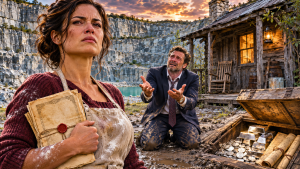
“And when you took everything else, Kevin, this was the only place I had.”
Something shifted in his expression.
For the first time, he appeared to understand that she was not simply refusing a business proposal.
She was defending her home.
“Jasmine, I didn’t know you’d end up here.”
“You didn’t ask.”
He lowered his eyes.
“I know.”
She placed the envelope on the table.
“There’s something you need to see.”
Kevin looked suspicious.
“What is it?”
“Documents.”
“About the land?”
“Some of them.”
She handed him the envelope.
He removed the papers and began reading.
The first section contained the deed and supporting records for the inherited quarry.
The second contained correspondence from Jasmine’s attorney concerning the divorce and her separate-property claim.
Kevin skimmed the pages.
“All right,” he said. “So you think the land belongs only to you.”
“It was inherited by me, and my attorney has documented the ownership.”
“That doesn’t mean a judge couldn’t—”
“Keep reading.”
Kevin turned another page.
His expression changed.
He read the heading twice.
Then he looked at Jasmine.
“What is Blackwood Holdings?”
She did not answer immediately.
Kevin looked down at the document.
It was an assignment of a commercial loan.
The original lender had transferred its rights to Blackwood Holdings, a Delaware company.
The account number matched the one on his failed real estate venture.
The outstanding balance was approximately $600,000.
Kevin stared.
“Why are you showing me this?”
Jasmine folded her hands.
“Because Blackwood Holdings purchased the loan your business defaulted on.”
Kevin blinked.
“That can’t be right.”
“It is.”
He examined the papers more closely.
“How would you even know about this?”
“I had help.”
His voice sharpened.
“Jasmine, what is Blackwood Holdings?”
She looked directly into his eyes.
“It’s my company.”
The rain seemed suddenly louder.
Kevin stood motionless.
He looked down at the documents.
Then back at her.
“What?”
“I own Blackwood Holdings.”
He shook his head.
“No.”
“Yes.”
“No, that’s impossible.”
Jasmine remained still.
“You had nothing!” he blurted.
The words hung between them.
Kevin seemed to realize what he had said.
He opened his mouth.
But Jasmine spoke first.
“You’re right.”
Her voice was calm.
“When I came here, I had almost nothing.”
She glanced toward the cabin.
“I had a few blankets. Some clothes. Less than three hundred dollars. I didn’t even have a working stove.”
Kevin stared.
“I spent my first night on that floor, wondering whether I would wake up in the morning.”
She pointed toward the old entrance road.
“I carried water from the creek. I cut wood until my hands bled. I patched broken windows with plastic because I couldn’t afford glass.”
Kevin’s face had gone pale.
“Jasmine—”
“When the first snow came, I thought I might freeze. When I ran out of money, I sold my wedding ring.”
He flinched.
She continued.
“You told me that ring was worth eight thousand dollars.”
Kevin lowered his head.
“The dealer gave me two thousand.”
He said nothing.
Jasmine looked toward the cliffs.
“Do you know what kept me here?”
Kevin shook his head.
“Every morning, I told myself that if I could survive one more day, I’d have one more chance to rebuild.”
She paused.
“And then I found something.”
Kevin slowly raised his eyes.
“What?”
Jasmine glanced toward the cabin floor.
“A hidden room beneath the building.”
His expression changed.
“A what?”
“An old storage chamber. It had been sealed for decades.”
Kevin stared at her.
“What was inside?”
Jasmine said nothing.
“Jasmine, what was inside?”
She looked at him.
“Silver.”
He blinked.
“What?”
“Silver bars. Thousands of old coins. Records dating back to the Depression.”
Kevin’s mouth opened.
Then closed.
He stared at the cabin as though the walls themselves had transformed.
“How much silver?”
“Enough.”
“Enough for what?”
“Enough to repair my home, hire good attorneys, and buy your defaulted loan.”
Kevin stumbled backward.
He caught the railing with one hand.
“No.”
Jasmine watched him.
“You spent years laughing at this place.”
He shook his head.
“No, no, no.”
“You called it worthless.”
He looked down at the documents again.
“How much is it worth?”
Jasmine did not answer.
“Jasmine, I’m asking you—”
“And I’m telling you that it doesn’t matter.”
Kevin looked at her with disbelief.
She continued.
“What matters is that I own the loan your company owes.”
His hands began to shake.
He turned back to the paperwork.
“Six hundred thousand dollars.”
“Approximately.”
“How much did you pay for it?”
“That’s not relevant to what you owe.”
He looked up.
“You’re doing this to punish me.”
Jasmine considered the accusation.
Then she shook her head.
“No. I bought the debt because it gave me a way to protect myself and resolve what you’ve spent months refusing to face.”
Kevin’s breathing quickened.
“You can’t just demand six hundred thousand dollars from me.”
“I won’t demand anything beyond the rights the loan documents give the lender. My attorneys will handle it.”
He stared at her.
“You’d really do that?”
“Kevin, you forged my signature on a mortgage.”
His face tightened.
“You could have destroyed my entire future.”
“I was going to pay it back.”
“But you didn’t.”
He lowered the papers.
For several seconds, neither spoke.
Finally, Kevin whispered, “I don’t have the money.”
“I know.”
He looked exhausted.
“Then what do you want?”
Jasmine took another document from the envelope.
“A settlement.”
He looked at the pages.
She explained the terms.
Kevin would cooperate fully in the divorce, withdraw any claim he intended to make against the inherited quarry, and provide complete financial records concerning the money he had diverted from the bakery.
He would acknowledge the outstanding debt and work with Blackwood Holdings on a structured repayment agreement, subject to the loan documents and his financial circumstances.
Jasmine would not promise to erase his fraud.
She would not promise that prosecutors would ignore the forged mortgage.
And she would not secretly forgive financial wrongdoing simply because they had once been married.
Those matters would be handled through attorneys, lenders, and the courts.
But she was prepared to give Kevin a legitimate path toward financial repayment rather than pursuing every available collection remedy immediately.
Kevin stared at the proposal.
“You’d give me ten years?”
“If you comply with the agreement.”
“At a reasonable interest rate?”
“That’s what my attorney has proposed.”
He looked at her.
“Why?”
Jasmine was silent for a moment.
Then she spoke.
“Because I know what it’s like to have everything taken away.”
Kevin’s eyes filled with tears.
For the first time since arriving, he seemed to have no prepared answer.
He looked down at the mud covering his shoes.
“I don’t deserve that.”
“No,” Jasmine said softly. “You probably don’t.”
Kevin began to cry.
It was not a graceful thing.
His shoulders shook.
His face reddened.
He pressed a hand over his eyes.
“I ruined everything.”
Jasmine watched him.
She had imagined this moment during countless cold nights.
She had pictured him begging.
She had imagined how satisfying it might feel to see him frightened and powerless.
But now that he stood before her, broken by the consequences of his own decisions, she felt something unexpected.
Not triumph.
Not hatred.
Only sadness.
She had once loved this man.
She had shared her dreams with him.
She had trusted him with her money, her home, and her future.
And he had treated that trust like an asset he was free to spend.
Kevin finally looked up.
“Do you think you could ever forgive me?”
Jasmine took a slow breath.
“Maybe someday.”
Hope flickered across his face.
“But forgiveness doesn’t mean we get our marriage back.”
His expression fell.
She continued.
“And it doesn’t mean you get to avoid what you did.”
Kevin nodded.
“I understand.”
Jasmine handed him a pen.
“Then take these documents to your attorney. If you’re willing to resolve this properly, have him call mine.”
Kevin looked at the pen.
Then at Jasmine.
“You’re not asking me to sign right now?”
“No.”
He seemed confused.
“I want you to understand what you’re agreeing to,” she said. “I know what happens when somebody signs papers they haven’t been given a fair chance to examine.”
Kevin lowered his head.
The words struck harder than any accusation.
He carefully gathered the documents.
Then he looked around the quarry one last time.
“Your grandfather really left all this to you?”
Jasmine nodded.
“Yes.”
Kevin looked toward the cabin.
“And you found that silver under the floor?”
“Yes.”
He gave a small, bitter laugh.
“All those years, I thought I was the one who understood money.”
Jasmine said nothing.
Kevin looked at her.
“I thought you were just a baker.”
For the first time, Jasmine smiled.
“I was a baker.”
She looked at the cabin, the garden beds, and the wooded ridge beyond.
“And I still am.”
Kevin stood in silence.
Then he folded the documents and placed them inside his coat.
“I’ll have my attorney call.”
Jasmine nodded.
He turned and walked toward his Range Rover.
The mud pulled at his shoes.
The rain soaked his jacket.
He climbed inside without looking back.
A few moments later, the vehicle began its slow climb toward the quarry entrance.
Jasmine watched until it disappeared beyond the ridge.
Then she went inside.
She took off her wet boots.
She added another log to the stove.
And she poured herself a cup of coffee.
The cabin was warm.
The rain tapped softly against the windows.
On the table lay her grandfather’s photograph.
Jasmine picked it up.
“You were right, Grandpa,” she whispered.
For a moment, she imagined him standing beside the old stove, smiling with the quiet satisfaction he always wore when something broken had been repaired.
Three weeks later, Kevin signed the negotiated settlement after consulting his attorney.
The agreement was incorporated into the divorce proceedings, and the financial obligations were documented separately.
His cooperation did not erase the forged mortgage or prevent authorities from investigating it.
Jasmine’s attorney continued pursuing the fraud claims, and the disputed loan records were reviewed by the appropriate institutions.
The process was not quick.
Legal matters rarely were.
But Kevin could no longer persuade Jasmine to surrender her property simply by calling his mistakes their shared responsibility.
Months later, the divorce became final.
Jasmine received the official paperwork on a sunny morning in early summer.
She read it once.
Then she placed it inside a folder and went outside to work in her garden.
She did not throw a party.
She did not celebrate Kevin’s downfall.
She planted tomatoes.
It was the first garden she had ever grown entirely for herself.
Summer transformed the quarry.
Wildflowers spread across the upper slopes.
The woods turned deep green.
The creek ran clear beneath the trees.
Surveyors completed their examinations of the surrounding parcels.
The title work confirmed that several additional tracts had passed legally through the Bell family estate.
Other historical claims were less certain and required further research.
Jasmine did not rush.
She had learned that valuable things were worth understanding before they were sold.
The geological investigation identified substantial limestone reserves and promising groundwater formations, although the commercial and environmental questions would require years of additional work.
Investors began making inquiries.
Some offered impressive sums.
Jasmine listened politely.
Then she declined.
She was not interested in allowing strangers to tear the land apart merely because it might make her wealthier.
She already had more money than she had ever expected to possess.
What she wanted now was something different.
One afternoon, Walter found her standing above the quarry, looking across the wooded hills.
“You thinking about selling?”
Jasmine shook her head.
“No.”
“Good.”
She smiled.
“You don’t even know what I was offered.”
Walter shrugged.
“Don’t need to.”
“Why not?”
He looked at the land.
“Because a man with enough money can buy a lot of things. But he can’t buy back a place after he’s ruined it.”
Jasmine stood beside him.
She thought about her grandfather.
About Silas Bell.
About all the workers who had once come through the quarry gates carrying lunch pails and hoping for another day’s wages.
The land held more than limestone.
It held memories.
She decided to preserve much of it.
Working with conservation specialists and local officials, she began exploring ways to protect the woods, improve the creek, and preserve the old quarry structures.
She also used part of the silver proceeds to purchase the former bakery property after the financial disputes surrounding it were resolved.
The building had stood empty for months.
The windows were dusty.
The old display cases were gone.
But the ovens were still there.
The first time Jasmine unlocked the front door, she stood in the quiet room and remembered the day the bank had forced her out.
Mabel stood behind her.
“Are you all right?”
Jasmine nodded.
“I think so.”
She walked slowly toward the counter.
Her fingers touched the worn wood.
For a moment, she remembered every terrible detail of losing the place.
Then she looked toward the kitchen.
“Well,” she said, “we’ve got work to do.”
Mabel laughed.
“That’s the Jasmine I know.”
They reopened the bakery in September.
This time, Jasmine did not work sixteen-hour days.
She hired a manager.
She gave employees predictable schedules and good wages.
She made sure nobody depended entirely on her being there every morning.
And she created a small community program that provided fresh bread and meals to elderly residents who lived alone.
The idea came from remembering the food Mabel and Walter had brought her when she had nothing.
One evening, after the reopening, Mabel found Jasmine sitting near the bakery window.
“Something on your mind?”
Jasmine smiled.
“Just thinking.”
“About Kevin?”
“No.”
Mabel looked surprised.
“Then what?”
Jasmine watched an elderly customer leaving with a loaf of bread.
“I keep thinking about that first winter.”
Mabel pulled out a chair.
“What about it?”
“I was so ashamed.”
“Ashamed of what?”
“Living in that shack. Needing help. Not knowing how I was going to survive.”
Mabel reached across the table.
“Sweetheart, there’s no shame in surviving.”
Jasmine nodded slowly.
“I know that now.”
Outside, the sun was setting behind the buildings.
The bakery smelled of fresh bread and cinnamon.
People passed the windows.
Cars moved along the street.
Everything looked ordinary.
And that was what made it beautiful.
Later that autumn, Jasmine invited Mabel and Walter to the quarry for supper.
The little cabin glowed warmly beneath the cliffs.
She had added a covered porch, a small greenhouse, and a proper stone path leading to the entrance.
The old rusted machinery had been cleared from the dangerous areas, and part of the quarry road had been repaired.
Inside, she cooked chicken, potatoes, green beans, and homemade biscuits.
Walter brought apple cider.
Mabel arrived with a pie.
They ate together beside the woodstove.
Afterward, Walter leaned back in his chair.
“You know, when I first came down here and found you splitting wood, I didn’t think you’d last until Christmas.”
Jasmine laughed.
“Neither did I.”
Mabel shook her head.
“Don’t say that.”
“It’s true.”
Walter nodded.
“But you did.”
Jasmine looked around the room.
At the shelves.
The table.
The stove.
The photograph above the mantel.
“Yes,” she said quietly.
“I did.”
When her friends finally left, Jasmine walked onto the porch.
The sky was clear.
Stars shone above the dark limestone walls.
A cool breeze moved through the trees.
She sat in the old wooden chair Walter had repaired for her the previous winter.
For a long time, she listened to the silence.
Six months earlier, that silence had terrified her.
It had seemed like proof that she had been forgotten.
Now it felt different.
Peaceful.
Safe.
Entirely her own.
Jasmine thought about the silver beneath the cabin.
The old deeds.
The wealth she had uncovered.
For a while, she had believed those things were the reason her life had changed.
But she knew better now.
The silver had made her financially secure.
The documents had revealed an inheritance.
The land had given her opportunities she never expected.
Yet none of those treasures explained how she had survived the first freezing night.
Or the second.
Or the weeks before she discovered the hidden chamber.
She had survived those days with empty pockets.
With blistered hands.
With stubborn determination.
And with a few kind people who refused to let her disappear.
The greatest thing she had found in the quarry had not been buried underground.
It had been waiting inside her.
A strength she had never needed to use until the world gave her no other choice.
Jasmine stood and looked across the quiet stone basin.
Somewhere beneath her feet lay the wealth of a man who had lived through the Great Depression and trusted the land more than the banks.
Above it stood a cabin that had once been considered unfit for anyone to inhabit.
And inside that cabin lived a woman who had been abandoned, betrayed, and stripped of everything familiar.
A woman who had discovered that losing her old life did not mean losing her future.
She took one last breath of the cool night air.
Then she went inside and closed the door.
The woodstove crackled.
The kettle warmed.
And for the first time in many years, Jasmine Mercer did not have to wonder whether the person she loved was hiding something from her.
She did not have to fear another surprise bill, another lie, or another betrayal.
She had her land.
She had her home.
She had people who loved her.
And she had something far more valuable than the fortune buried beneath the limestone.
She had her life back.
The end.