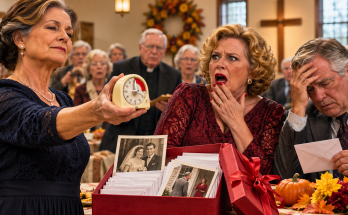
“Kaylee needs a family right now. You just want a diploma.”
My mom said that at Sunday dinner after church, in front of seven people, holding the gravy boat over the pot roast like she was blessing it.
I had my acceptance letter folded in my back pocket.
I’m Wyatt. I was 17.
10 years later, on Tuesday, March 10th, at 7:20 in the morning, with the thermometer on the dock door reading 19°, I was on a scissor lift in the new fabrication shop at Plains Mechanical in Sous City, pulling wire for a row of high bay lights.
My company had the electrical on their whole edition.
I had two guys on the floor below me and a coffee going cold on the guardrail.
Beth Ostrander came out of the office in her parka.
Beth runs HR at Plains Mechanical, has for 14 years, and she’s the reason half my apprentices found their first jobs.
She waved me down with a look on her face I didn’t recognize.
“Your mother’s in my lobby,” she said. “With your sister. Kaye has a 7:30 interview for the project coordinator job.”
I’d known my sister was applying places.
I hadn’t known she was applying here.
In the lobby, Mom was standing by the trophy case in her good wool coat, holding a manila folder against her chest.
Kaye sat in one of the vinyl chairs, checking her lip gloss in the glass of the case.
Kaye was 30.
Her license was suspended again, which is why Mom had driven her 4 and 1/2 hours from Ottoa before sunup.
Mom smiled at me like we’d seen each other last week.
We hadn’t.
She opened the folder and handed me a reference form that already had my name typed on the line marked supervisor.
Wyatt Hogland, Second Shift Electric.
“Just sign under your name, honey,” she said. “Tell Beth Kaye worked for you. It’s one line. She’s family.”
Beth had a cup of coffee in her hand.
She set it down on the reception counter and didn’t pick it back up.
What she didn’t know was that Beth had already called me about Kaye 3 weeks earlier.
Mom never asks who’s already called me.
She just shows up with the paperwork.
I’ll set the wire cutters down right here for half a minute before we back up.
It still surprises me that anybody wants to hear an electrician from Woodbury County, Iowa, talk about his family.
So, thank you, truly.
Leave me the name of the nearest little town to you down in the comments.
And while you’re at it, whether your house has one outlet nobody’s allowed to touch.
If you’d like more of these, go ahead and subscribe.
There’s always another one on the workbench.
To understand why that one line mattered, you have to understand the house I grew up in.
Ottoa sits on the De Moine River down in Wapello County.
About 25,000 people, a meat packing plant, a railroad yard, and a main street that’s been trying to come back since I was born.
We lived on the north side in a split level with a carport and a basketball hoop with no net.
My sister Kaye is 3 years older than me, and in my parents’ eyes, the sun came up and went down on her.
If she got a C, the teacher had it out for her.
If she put the Buick in a ditch, the roads were icy.
If she lied, she was under a lot of pressure.
If I brought home a 94, Dad asked what happened to the other six points.
In fourth grade, I got a perfect score on a long division test.
I carried it home flat in my hands so it wouldn’t wrinkle and showed it to Mom at the sink.
She glanced at it and said, “You’re good at math, Wyatt. Kayle’s the one who needs the encouragement.”
That was the script in our house.
Kaye needed the attention, the help, the bigger piece of cake, the first pick, the last word.
My job was to be steady and quiet and easy.
Easy was Mom’s favorite word for me.
“Wyatt, you’ve always been so easy. Thank you for not giving us any trouble.”
It took me until about 23 to figure out that easy meant I could disappear and nobody would check the room.
By high school, I’d learned to work around it.
I kept my head down, got good grades, joined the robotics club, and took a part-time job washing dishes at a supper club out on Highway 34 for $8.25 an hour.
I wasn’t trying to be special.
I just wanted a door I could open myself.
Kaylee, meanwhile, went through two high schools, failed classes at both, and fought with my parents on a schedule you could set a clock by.
They still treated her like a glass ornament on the top branch of the tree.
I was the duct tape holding the house together, and she was the crystal they kept polishing even after the crack ran all the way through it.
The one adult who saw me was my shop teacher, Mr. Fensky.
He’d been an electrician for 20 years before his niece made him a teacher, and he let me stay after school rewiring old lamps people brought in from garage sales.
One afternoon, he watched me trace a short in a 1950s floor lamp and said, “You’ve got the hands and the head both. That’s rarer than you’d think.”
Then he went back to grading.
Senior year, I applied to four electrical programs without telling my parents.
I paid every application fee out of my dishwashing money, $160 in all, and asked Mr. Fensky for a recommendation letter.
When I explained why my parents didn’t know, he was quiet for a while.
“Wyatt,” he said, “don’t let anybody talk you into staying small so they can feel tall.”
I’ve never forgotten that.
I got into three of the four.
My first choice was a 2-year electrical technology program at Northstar Technical College in St. Paul, Minnesota, and they offered me a $4,200 scholarship.
I opened the letter in my bedroom with the door locked, and I read it standing up and then sitting down and then standing up again.
It felt like somebody had finally cracked a window in a room I’d been breathing in my whole life.
I waited 3 weeks to tell my parents.
Kaye had just moved home from her second failed semester at the community college in Fairfield, and the house was wound tight.
I thought good news might loosen it a little.
That was my mistake, and it was mine.
It was Sunday, April 10th.
We’d come home from church, and Mom had a pot roast going with carrots and potatoes.
Aunt Lorna and Uncle Jean came over like they did most Sundays, and Kayle’s boyfriend Colton was there because he’d driven her to church.
Seven of us around the dining room table with the leaf in it.
I waited until the plates were passed, and then I took the letter out of my back pocket and unfolded it next to my plate.
“I got in,” I said. “Northstar, my first choice. They’re giving me a scholarship.”
Nobody said anything.
Not the good kind of quiet either.
The kind where everybody’s too proud to speak.
This was cold and heavy, like a basement in February.
Mom set her fork down and wiped her hands on her napkin.
“Watty,” she said, “we really wish you’d talked to us before doing something like this.”
My stomach dropped.
“I got in. I thought you’d be happy.”
Dad cleared his throat and moved his water glass an inch to the left like he was stepping around something on the floor.
“It’s not that we aren’t proud,” he said. “We’re still dealing with everything that happened with your sister. You know how hard it was when she had to come home. College just wasn’t the right fit for her, and right now this family’s job is getting her steady again.”
Kaye kept quiet and kept scrolling the phone in her lap under the tablecloth.
“I’m not Kaye,” I said. “I worked hard for this.”
“That’s not the point,” Mom said.
Then she picked up the gravy boat and held it over the roast, and she said it.
“Kaylee needs a family right now. You just want a diploma.”
Uncle Jean looked at his plate.
Aunt Lorna opened her mouth and then closed it again.
Mom kept going.
Calm, reasonable, like she was doing me a favor.
Kayle’s nerves had been bad since she dropped out.
She needed a stable home.
If I went off to Minnesota, it might push her somewhere they couldn’t pull her back from.
It would be cruel, she said.
Cruel, Wyatt.
Apparently, it was my job to keep my sister floating.
“You’re so talented,” Mom said. “You’ll find something practical closer to home.”
Nobody yelled.
That was the worst part.
They explained it to me the way you’d explain to a kid why the dog had to go live on a farm.
I folded the letter back along the same creases once and then again until it was the size of a playing card.
“I’m not Kaye,” I said.
Then I ate my pot roast.
I don’t remember what it tasted like.
That night, I sat at my desk under the lamp and looked at that letter for hours.
I couldn’t tell what hurt more, the fact that they’d done it, or the fact that part of me had seen it coming.
But I’d also been doing something they hadn’t counted on.
I’d been planning.
I didn’t slam a door.
I didn’t beg.
I nodded at breakfast for 2 weeks, said I understood, and packed.
I left at 6:00 on a Thursday morning in May with a duffel bag, $1,850 from the supper club, a Greyhound ticket to Sous City, and a buddy from robotics club whose older brother had a couch I could sleep on.
I left a note on the kitchen table under the salt shaker.
It said, “I’m not Kaye and I’m done pretending I have to be.”
I put the acceptance letter in my wallet behind my learner’s permit.
I didn’t hear from them for 7 months.
No call in June, no card at Thanksgiving, nothing at Christmas.
After that, things didn’t get easier.
But for the first time, they were mine.
I slept on couches for a couple of months, friends and friends of friends.
And one night in the Sous City Public Library, where a security guard named Earl pretended not to see me until 6:00 a.m., I got a job washing dishes and busing tables on the graveyard shift at a 24-hour truck stop off Interstate 29.
Ate the employee meal at 2:00 in the morning, mostly biscuits and gravy, and studied electrical theory on my phone between rushes.
In the fall, I enrolled in the electrical program at the community college across town.
It wasn’t St. Paul, but I was learning, and nobody was taking it back.
The silence hurt more than the work did.
Not one, “Where are you staying?”
Not even a mean voicemail.
They’d wiped me off the family chalkboard like I’d never been written on it.
Some nights that gutted me.
Not from missing them exactly, but from finding out how little it took to make me disposable.
Kaye, meanwhile, was all over Facebook.
Old classmates would message me.
“Did you see your sister’s new car?”
“Your mom posted Kayle’s birthday dinner. Looks fancy.”
I’d say I hadn’t seen it, but I had.
The birthday dinner was at a steakhouse in Ottawa I’d begged to go to on my 15th.
That year, we’d had spaghetti at home, and Kaye took the last piece of garlic bread before it got to me.
My second semester, on a January morning, I walked into a shop in Sous City looking for an apprenticeship and met Walt Brandt.
Walt was 68, a master electrician with four guys, a 1994 Ford with 300,000 miles on it, and a laugh you could hear over a jackhammer.
He looked at my transcript, then at my hands, then at me.
“You eat?” he asked.
I said I worked at a truck stop.
“That’s not what I asked,” he said, and took me across the street for a pork tenderloin the size of a hubcap.
I started Monday.
I want to be honest here because Walt would want me to be.
I wasn’t an easy apprentice.
I was angry and I was proud, and I thought being quiet was the same thing as being right.
The first month, I wired a basement bathroom and forgot the GFCI, and the inspector caught it.
And Walt had to eat a reinspection fee.
He didn’t yell.
He handed me the bill, $75, and said, “Now you’ll never forget one.”
I haven’t.
I got my two-year degree at 20 on a Saturday in May.
It wasn’t a big ceremony, a gown made of something like a trash bag, and my name read out in a half-empty gym, but Walt was in the third row with his cap in his lap.
I posted one picture on Facebook, me in the gown holding the diploma, and wrote, “Some folks said, ‘Don’t bother.’ Bothered anyway.”
I didn’t mean it as a poke.
Within 3 hours, Mom called.
I let it ring.
Then the text came.
“Wyatt, that picture hurt your sister. She cried for an hour. You know she’s still working on her own degree. Was that really necessary? We let go of how you left a long time ago. We expected you to have grown up some by now.”
Grown up.
That was the phrase they always reached for when I wouldn’t bend.
I didn’t answer.
I logged my hours with Walt for 4 years and passed my journeyman exam on the first try.
At 23, I passed my masters on a Friday in October.
A year later, Walt retired to a lake in Minnesota and sold me his customer list for $1 and a promise that I’d keep the Old Widow on Jackson Street on the schedule for free.
I named the company Second Shift Electric because the graveyard shift is where I learned the theory and because I figured a lot of people get their real start on the second try.
By the next spring, I had six trucks and a contract wiring two new elementary schools for the Sous City District.
The Sous City Journal ran a piece about it with a picture of me in a hard hat, and that’s when the phone started again.
First, it was little things.
Mom liked a Facebook post of mine and commented, “So proud of you.”
Kaye sent a message that said, “Look at you.”
That was the whole message.
Then Dad called on a Thursday and actually left a voicemail.
“Hey, bud. We saw the article about your company. Big congrats. Listen, maybe we could catch up sometime.”
No mention of the note on the kitchen table.
No mention of 7 months of silence or the gravy boat or the word cruel.
Now that I was worth bragging about, they wanted to catch up.
I figured something was coming.
I wasn’t wrong.
That August, Kaye texted me a complete sentence, which was rare.
“Hey, do you think you could help me get a job?”
I looked at that for a long time.
Kaye had dropped out of a third program by then.
The last one had asked her to leave for attendance.
She’d worked retail, six jobs in 4 years, none longer than a season.
And now it seemed she’d decided that the little brother who’d been forbidden to go to school because she’d failed was her best shot.
I didn’t answer.
3 days later, on a Saturday morning while I was loading my truck, Mom called, and this time I picked up.
“Wyatt,” she said, all sugar and pancake syrup. “I’m so glad to finally hear your voice.”
I didn’t say anything.
I waited.
She went through the usual.
How proud they were, how amazing it was to see me doing so well.
How they’d always known I’d land on my feet.
Like all those years of silence and guilt had been a mixup at the post office.
Then she got to it.
“Kayle’s been in a rough patch,” she said. “She just needs a chance. I thought maybe you could bring her on at your company. She’s great with people. You know how she is. She just needs somebody to believe in her.”
I bit down on the laugh.
Believe in her.
Nobody had believed in me with a 3.9 and a scholarship.
Now I was supposed to believe in Kaye after three dropped programs and six retail jobs, after being told I was selfish for wanting a future at all.
“She doesn’t have a resume,” I said. “Not even a basic one.”
“Well, that’s where you come in,” Mom said. “You could help her with all that.”
I took a long breath.
“That’s not something I’m going to do.”
Her voice changed in about half a second.
“Wyatt, don’t be like this. Kayle’s been through so much. You’ve always had it easier.”
“Easier?” I said. “You kept me home from school to spare her feelings. You called my wanting it cruel. Now I’m supposed to put her on my payroll?”
“She’s your sister.”
“I was your son the whole time, Mom. It didn’t count for much the day I packed that duffel.”
For a few seconds, there was just her breathing on the line.
Then her voice went hard.
“You turn everything around, Wyatt. We did what we could. Kaye was fragile. She needed us.”
“And I didn’t,” I said low. “You know what it’s like to leave home at 17 and sleep on a floor? To watch your parents post steak dinners while you’re eating biscuits and gravy at 2:00 in the morning? To get a diploma with nobody in the gym but your boss?”
Nothing.
Then, almost a whisper.
“Kayle’s not like you. She isn’t strong.”
That’s when I understood it.
If they ever admitted I was strong, they’d have to admit they’d left me to be.
If they said I’d built something from nothing, they’d have to say they gave me nothing.
So, they’d made me the cold one, the selfish one, the one who left, and now they wanted back in.
Not for me, for her.
They wanted my story to cover the holes in hers.
I hung up first.
I hadn’t done that before.
I didn’t answer anything after that.
Not Kayle’s follow-ups, not Dad’s small talk, not Aunt Lorna’s text asking if I was really cutting off my family over a job.
I wasn’t angry.
I was tired.
Part of me had always believed that if I built something big enough, they’d finally look at me straight.
Now I could see they didn’t want me.
They wanted access to my name, to my company, to whatever I could give Kaye that they couldn’t.
It didn’t hit all at once.
It came in slow, like fog off the river.
I started missing things.
A bid deadline, a walkthrough with a general contractor.
I let my foreman Hector run both school jobs and told myself I needed a week, then two, then three.
It wasn’t burnout.
Not exactly.
It was grief.
For a childhood I hadn’t known I’d lost.
For a family I kept waiting on.
For the kid who still thought a big enough paycheck could buy him a seat at that dining room table.
One Wednesday night in November, I was alone in my apartment on the floor with a plate of cold chili I’d forgotten to eat.
My laptop was open to bids I hadn’t finished and a schedule I hadn’t looked at in days.
I shut it.
All of it.
And then I cried.
The ugly kind that comes up from somewhere under your ribs.
All those years of holding a panel door shut, finally blowing it open.
I thought about selling.
A bigger outfit out of Omaha had already asked twice.
It would have been easy, but something in me dug its heels in, and it wasn’t pride.
It was plain stubbornness.
This thing wasn’t about proving them wrong anymore.
It was about proving me right.
So, I took a real break instead.
I put Hector in charge with a raise, told the office to say I was out until after New Year’s, and drove 7 hours north to Grand Marray, Minnesota, on the shore of Lake Superior, where an old friend from the community college named Dana ran a used bookstore with a bait cooler in the back.
I didn’t tell anybody else where I was going.
Dana lived in a creaky little house that smelled like cedar and wood smoke and whatever tea she was steeping that day out of dried flowers she’d picked herself.
When I showed up on her porch with a duffel bag, she hugged me like no time had passed.
“You look like somebody who forgot what quiet sounds like,” she said. “Come in. I’ll remind you.”
We walked the rocky shore in the mornings and read by the wood stove at night.
She never asked about my family unless I brought it up.
One night, I told her all of it.
The gravy boat, the note, the graduation post, the phone call.
When I was done, I waited for what people always say.
“They’re still your family. Maybe it’s time to forgive.”
Instead, she said, “I’m proud of you for leaving.”
I came apart again.
It was different that time.
It felt like a wound getting cleaned instead of opened.
After a month, I drove home the week after New Year’s with snow blowing sideways across Highway 61.
Not to Ottoa, to my life.
The first thing I did was clean the apartment like it owed me money.
The second thing I did was walk into the shop office and pin that folded acceptance letter to the corkboard over my desk, creases and all.
Then, I rebuilt.
Not the company, the way I ran it.
I’d been running Second Shift like a guy trying to impress somebody who wasn’t watching.
I slowed down.
I wrote a short speech for the first night of something I’d wanted to start for 2 years, a free pre-apprenticeship class on Tuesday nights for kids who’d aged out of foster care and anybody else who’d been told to stay small.
I called it Late Start.
The speech ended like this.
“Build something they can’t take from you. Not just the work, the name on it.”
I put the speech on an unlisted page on our website, and the only person I ever sent the link to was my mother in an email she never answered.
A foundation out of De Moine read about Late Start and offered to pay for the tools.
Over the next 5 months, I hired three people to help run it.
One had dropped out of nursing school over medical bills.
One had been laid off from the packing plant in the pandemic and taught herself residential wiring off YouTube before she ever walked into a classroom.
The third was a guy from my community college who used to draw panel layouts on napkins at lunch.
None of us were flashy.
All of us showed up.
Late Start filled up by word of mouth.
14 kids the first session, 22 the second.
Meanwhile, my parents kept trying.
Emails, voicemails, and then a handwritten letter from Dad that floored me because Dad doesn’t write letters.
It was two pages about how I used to wire the porch Christmas lights when I was nine and how Kaylee and I used to play store with Mom’s old adding machine and how proud they were of everything I’d built.
It never said sorry.
Not once.
Then, on a Monday in April, Kaye posted on LinkedIn.
It was a whole essay with a professional headshot.
“New chapter. After a long road, I’m stepping into the trades as project coordinator at Second Shift Electric. So thankful to my little brother Wyatt who never stopped believing in me. Like he always says, ‘Build something they can’t take from you.’ #F family # second chances # blessed.”
I sat in my truck in the Menard’s parking lot and read it four times.
Kaye didn’t work for Second Shift.
I hadn’t spoken to her in almost a year.
And there it was in public with likes from old classmates, a heart from Mom, and comments from two general contractors I bid against every month.
“So inspiring.”
“Love a family story like this.”
That post had taken my name, my company, and my own words and put them on like a borrowed coat.
The next morning, I pulled my office manager and Hector into the shop office and showed them.
Nobody had talked to Kaye.
Nobody had sent her anything.
And that line at the end was the last line of my Late Start speech, the one on an unlisted page, the one I’d sent to exactly one person.
I didn’t go loud.
A move like that only works one time, and I wanted mine to land like a framing hammer, not a tantrum.
First, I took screenshots of everything.
The post, the likes, the comments, the dates.
One comment was from my old high school counselor.
“So proud of you, Kaye. Family strength shines through.”
I saved it all in a folder on my desktop and named it panel schedule because nobody ever opens a folder called that.
Then I called Nate Lingren, a guy I’d gone to community college with who does IT for Woodbury County now.
I told him somebody was using my company’s name to get hired.
“Send me what you’ve got,” he said. “And Wyatt, if it’s family, keep copies of your copies. Family doesn’t fight fair.”
Inside of a day, Nate found that Kaye had set up an email address on a fake domain, Second Shift Electric Team.
Net looked close enough to ours to pass a quick glance.
She’d used it to write to three staffing agencies, and she’d built a PDF resume with our logo on it and a little org chart that put her under operations with me as her direct supervisor.
“She’s ambitious,” Nate said. “Dumb as a box of wire nuts, but ambitious.”
I had two choices.
Call her out in public and set the whole family on fire, or quietly pull the right wire and let the circuit go dead on its own.
I picked the second.
The first wire was Renee Kowalsski at Prairie Trade Staffing.
I’d sat on a panel with Renee at a workforce breakfast the year before, and she had a reputation for spotting a padded resume from across the room.
I sent her a short email.
“Renee, heads up. Someone is presenting herself as a project coordinator at Second Shift Electric. She isn’t and never has been. If she contacts you, feel free to forward anything to me. Wyatt.”
6 hours later, she wrote back.
“Oh, wow. She emailed me last week and dropped your name three times. Something felt off. Thanks for the heads up.”
Then I wrote a letter on company letterhead stating that we had no employee or contractor named Kaylee Hogland and never had, and that anybody claiming otherwise should be reported to our office.
I posted it on our website, and I mailed a copy to every general contractor, staffing agency, and mechanical shop we’d ever worked with in Suland.
41 letters.
Beth Ostrander at Plains Mechanical got one of them.
Then I checked the website traffic on that unlisted speech page.
One visitor the night before Kayle’s post spent 40 minutes on it.
The location came back, Iowa.
I texted, “Mom, did you send Kaye the link to my Late Start speech?”
She didn’t answer that one.
After that, a trades podcast out of De Moines called Loadside asked me back for a second episode, and I offered them a topic.
“What happens when somebody borrows your name to get hired?”
The host jumped at it.
We called the episode “Wearing Somebody Else’s Name.”
I never said Kayle’s name or mine.
I just talked about how hard it is for a small shop to protect its reputation and how fast a nice story spreads when nobody checks it.
The episode passed 48,000 downloads in 2 weeks.
People wrote in with their own versions.
A brother who took credit for a sister’s welding certification.
A cousin who listed a family business on a loan application.
A dad who put his own name on his son’s patent.
Renee forwarded me an email a few days later.
It was from Kaye.
“Hi Renee. I just heard that podcast you shared. Really disappointed Wyatt’s spinning things this way. I thought family was supposed to support each other. I’ll be pursuing other opportunities.”
It confirmed she was paying attention.
Good.
I sent Kaye exactly one message on LinkedIn where she’d posted the lie.
“Saw your post. You remembered my speech almost word for word. Just so you know, we’ve put out a written statement and notified every contractor in Suland. This is your chance to take it down quietly. Your call.”
The post was gone within 11 hours.
No comment, no goodbye.
That could have been the end of it, but I’d started something with that podcast.
We set up a page on the Late Start site called Side Door where people could tell anonymously how they got into the trades after somebody at home told them not to.
A woman who paid her own way through nursing school while her brother got a free ride and flunked out.
A guy who was told he couldn’t be a machinist because his dad wasn’t a math person.
A girl who turned down a welding scholarship so her cousin wouldn’t feel left behind.
Different towns, same story.
We read them on Tuesday nights before class.
Mom finally wrote back, but not about the link.
“Wyatt, I don’t know what you’ve been telling people, but Kaye is having a very hard time. She feels attacked. I thought you were better than this.”
Still no apology, just guilt, which was the only money they’d ever paid me in, and I’d quit accepting it.
On a Tuesday in February, nearly a year later, Beth Ostrander called me.
“Wyatt,” she said, “I’ve got an application on my desk for project coordinator. Says she’s been with Second Shift 2 years. Reports to you. Name’s Kaye. Your letter’s sitting right next to it. You want to tell me which one I believe?”
“The letter,” I said.
“That’s what I figured,” Beth said. “She’s still on my interview list. I’m curious who shows up.”
Which brings me back to that lobby.
19° outside, Beth’s coffee going cold on the counter, and my mother holding out a pen.
I didn’t take it.
I looked at the form with my name typed on it.
And then I looked at Beth.
“Wyatt,” Beth said. “For the record, did Kaye Hogland ever work for Second Shift Electric in any capacity?”
“No, ma’am,” I said. “Not one day.”
Beth turned her laptop around on the counter.
There was Kayle’s application, the fake email address, the PDF resume with our logo, and the little org chart with my name over hers.
Next to it on the counter was my letter folded in thirds the way I’d mailed it.
Mom looked at the screen, then at me.
“It’s one line, Wyatt,” she said, quieter now. “You could have just signed one line.”
“You told me Kaye needed a family,” I said. “She’s got one. What she doesn’t have is a job history.”
Kaye stood up out of the vinyl chair.
“Oh, don’t act like this is all me,” she said. “Mom’s the one who sent me his speech. She said, ‘Use it. It’ll sound like him.’”
Mom turned around so fast her purse swung.
“I sent it to you because you were sad. You paid for the website. It was $12, Kaye, so you could have an email address.”
Beth picked her coffee back up finally and took a long sip.
“Well,” she said, “I’ve had worse interviews. Not many.”
She closed the laptop.
“Kaye, we won’t be moving forward. I’ll walk you both out.”
Mom didn’t look at me on the way out.
Kaye did once from the door, and I couldn’t tell you what was in it.
Then I went back out to the shop and climbed back up on the lift because those H highays weren’t going to wire themselves.
Later that day, I sent Beth a formal letter for her file.
Kaye had never been affiliated with Second Shift Electric in any capacity.
Any claim otherwise was false, and we’d be glad to verify any future candidate who listed us.
Beth wrote back one line.
“Framing this.”
A week after that, on a Tuesday in March, a reporter at the Suland Business Journal named Monica Reyes called.
She’d heard the podcast.
She’d read the Side Door page, and she was writing about resume fraud in the trades.
She asked if I’d go on the record about what happened.
That was the fork in the road.
I could play it safe, keep it vague, protect the family name, or I could tell it straight.
I thought about every night I ate peanut butter crackers out of a vending machine while Kaye got birthday steaks.
Every shift I worked to cover application fees.
Every time I’d been told my wanting was the problem.
Then I thought about her trying to build a ladder out of all that.
I said yes.
The piece ran 15 days later on a Sunday in early April under the headline “Borrowed Name.”
No full names, just initials, and a sibling.
But anybody who’d seen that LinkedIn post knew.
It covered the speech, the fake domain, the org chart, the reference form in the lobby.
It got shared all over the trade groups on Facebook, then picked up by a couple of papers in Nebraska and South Dakota.
People tagged their own stories.
Siblings who got the farm while they got the lectures.
Cousins who patted their way into union cards.
Parents who carried one kid so long the other one learned to walk alone.
Then Dad left a voicemail.
“Wyatt, it’s Dad. We read the paper. Okay, we weren’t the perfect parents. I’ll give you that. But you made us sound like villains to half of Iowa. Your mom’s been up three nights running, and Kaye won’t come out of her room. We’re your family. Let’s just sit down at a table and talk it out. This has gotten way too big.”
Way too big for people like my parents.
My hurt was never the problem.
Me talking about it was.
I didn’t call back.
There was still the fake domain.
Nate traced the registration to a cheap hosting company and reported it under their terms of service, and it went dark inside a week.
He also pulled the access logs, which showed the same general location as my parents’ house in Ottawa, which I already knew because I’d heard my mother yell $12 in a lobby.
My lawyer sent Kaye a cease and desist.
I didn’t sue.
I didn’t need to.
5 days later, on a Friday night, Kaye emailed me.
“Wyatt, okay, you’re angry. I understand. Is this really how you want it to stay forever? You’re my brother. We shared a bathroom and a Nintendo and that fort in the backyard. I made a mistake. Okay. I was desperate. You think it’s easy being the one who didn’t make it? They never stopped comparing me to you after you left. I just wanted something that was mine. Please don’t do this.”
It might have moved me if I hadn’t watched her try to climb up my back to get there.
I forwarded it to my lawyer, added it to the panel schedule folder, and went to work.
Mom started calling relatives, my aunt, my grandmother, old family friends.
She told them I’d attacked the family in the newspaper and was using my company to shame Kaye.
Aunt Lorna called me herself, not to scold me, to thank me.
Turned out Kaye had done it before, just smaller, taking credit for a group project at the community college, listing an internship she never had.
Once trying to use a friend’s cleaning business name to land a contract that never happened.
“She’s always been charming,” Aunt Lorna said, “and we were all scared to say anything. Your folks wouldn’t hear a word against her.”
She was quiet a second.
“I was at that table, Wyatt, with the gravy. I should have said something then. I’m sorry I didn’t.”
That one stayed with me.
My parents had been protecting a Kaye who didn’t exist because if they admitted who she was, they’d have to admit they helped make her.
And if they admitted I’d been right, they’d have to admit they lost me for nothing.
So they kept telling the old story.
This time, the people who mattered weren’t buying it.
Second Shift grew faster that year than any year before.
Late Start got a state workforce grant.
We went from six trucks to 11.
The community college asked me to teach a night section of residential wiring, and I said yes.
And the first night, I stood in the same room where I’d taken my first class and didn’t know what to do with my hands.
I never once used my family’s names in public.
I didn’t have to.
That September, I got one more letter in the mail, a real one in shaky cursive from Grandma Opal in Ottawa.
“Dear Wyatt, I read the article. I know it was about our family. I am sorry. Nobody told me the half of it. Your folks always said you ran off to be rebellious, and I should have asked you myself. I see you now, and I am proud of you. Love, Grandma.”
I framed that one.
It hangs on the wall over my desk now, right next to the acceptance letter from Northstar, which I finally had pressed and framed, too.
Creases and all.
I never went to St. Paul.
I don’t need to.
That letter was the first time somebody outside my house said yes.
My parents still send an email at Christmas and one on my birthday.
Kaye hasn’t surfaced.
Last I heard from Aunt Lorna, she’s working the front counter at a car wash in Ottawa and doing all right at it, which I mean.
And me, I’m 27.
I wire schools and hospitals and old farmhouses.
And on Tuesday nights, I teach kids who were told to stay small how to strip a wire without nicking the copper.
Mom said Kaye needed a family, and I just wanted a diploma.
She had it about half right.
I got the diploma.
Then I went out and found the family.