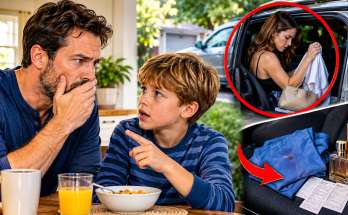
Woody looked uncomfortable.
That was unusual for him.
He could talk for twenty minutes about a Lego project without stopping to breathe.
He could ask the same question five different ways when he wanted an answer.
But now he kept looking down.
I put my coffee on the counter.
"What else did you see?"
He rubbed one thumb against the side of his glass.
"Sometimes Mom cries."
I stared at him.
"What?"
"She cries in the car."
The kitchen seemed to go quiet.
I could hear the refrigerator.
I could hear a faint sound from outside.
But I couldn't seem to hear anything else.
"How do you know she's crying?"
Woody looked up.
"Because I can see her."
He spoke slowly, like he was explaining something simple.
"She puts her head down on the steering wheel."
I didn't move.
"And her shoulders shake."
He demonstrated a little movement with his own shoulders.
I wanted him to stop.
Not because he had done anything wrong.
Because I could suddenly picture Jennifer doing exactly what he described.
Alone.
In the driveway.
A few steps from the home where her husband and son were waiting.
"Does she cry every time?" I asked.
Woody shook his head.
"Not every time."
"Just sometimes?"
"Yeah."
I swallowed.
"Then what happens?"
"She wipes her face."
He paused.
"Then she changes her shirt."
I felt the room tilt in a way I had never experienced before.
"After she cries?"
"Yeah."
"And then?"
"She comes inside."
I already knew that part.
But I made him say it anyway.
"What does she do when she comes inside?"
Woody thought for a moment.
"She smiles."
One word.
That was all.
She smiles.
I had seen that smile.
I had welcomed it.
I had believed it.
Now I was being told that before Jennifer walked through our front door with that familiar expression, she sometimes sat alone and cried so hard that our son could see her shoulders moving from an upstairs window.
I looked at my coffee mug.
My hand was still close to it.
I couldn't remember reaching for it.
"Does Mom ever see you watching?"
Woody shook his head.
"No."
"Have you ever asked her about it?"
"No."
"Why not?"
He looked confused.
"I don't know."
I nodded.
He was a child.
Of course he hadn't known what to do.
He had probably seen something strange, wondered about it, and gone back to his toys.
Maybe he had waited for someone to explain it.
Maybe he had assumed I already knew.
That thought hurt.
Because I was his father.
I was the adult in the house.
I was supposed to be the one who noticed when something wasn't right.
Instead, my nine-year-old son had been watching his mother break down in our driveway for months.
And he was the one explaining it to me.
I tried to breathe normally.
I couldn't.
The kitchen counter suddenly seemed too far away.
I remember looking at Woody's face and realizing I needed to control mine.
He wasn't asking me to investigate Jennifer.
He wasn't accusing her of anything.
He wanted an explanation.
A safe explanation.
Something that would make his mother seem understandable again.
"Is Mom sad?" he asked.
I wanted to tell him no.
I wanted to say she was only tired.
But he had seen her crying.
There was no point denying that.
"She has a hard job, buddy."
Woody watched me.
"At the hospital?"
"Yeah."
I tried to make my voice sound ordinary.
"Some days are really difficult for her."
That much was true.
Jennifer worked in intensive care.
She spent long hours with people who were badly injured or seriously ill.
I knew how demanding the job was.
I knew there were days when she came home drained.
I knew there were things she couldn't talk about easily.
So I took those truths and used them to cover something I didn't understand.
"Maybe she needs a few minutes before coming inside," I said.
Woody considered that.
"Because she's sad?"
"Maybe."
He looked toward the counter.
I could see him thinking.
Then he asked the question I had been trying not to ask myself.
"Why doesn't she just come inside?"
I had no answer.
Not one I trusted.
I could have told him she didn't want him to see her upset.
That was possible.
I could have told him she was trying to keep her work separate from home.
That was possible too.
But neither explanation covered the change of clothes.
Neither explained why she kept a clean shirt in a grocery bag.
And neither made me feel better about the fact that this had been happening for months.
"Sometimes grown-ups need to be alone for a little while," I said.
Woody nodded slowly.
He wanted to believe me.
I could see it.
Children look for certainty in their parents.
They assume adults know more than they do.
And most of the time, I had been happy to give him that certainty.
But that morning I was standing in front of my son with nothing more than guesses.
I hated that.
"Did I do something wrong?" he asked.
My stomach tightened.
"No."
I answered too quickly.
Then I lowered myself so we were looking directly at each other.
"No, buddy. You didn't do anything wrong."
He searched my face.
"Okay."
"I'm glad you told me."
He nodded.
I tried to smile.
It felt terrible.
Because I was already frightened, and I knew he was close enough to notice.
I couldn't let that fear become his.
Not over something I didn't understand.
Not over a question that might still have an innocent answer.
"Mom works long hours," I told him.
"Yeah."
"She's probably just worn out when she gets home."
Woody seemed willing to accept that.
I wasn't.
I thought about the way he had described her.
Her forehead lowered toward the wheel.
Her shoulders moving.
Her hands wiping her face.
Then the change of clothes.
Then the smile.
The order mattered.
She wasn't changing clothes and then sitting quietly.
She was crying first.
Then cleaning herself up.
Then coming inside looking normal.
That was what I couldn't stop thinking about.
I imagined her pulling into the driveway and turning off the engine.
I imagined her sitting there with the house in front of her.
The lights.
The windows.
The life we had built.
Whatever was happening inside that car, she apparently couldn't bring it through the front door.
I felt ashamed for thinking the worst.
Then I felt foolish for trying not to think about it.
My mind kept searching for patterns.
That was what I did for a living.
I designed systems.
I found problems.
I looked at pieces that didn't fit and tried to understand why.
At work, that habit had made me successful.
At home, it was beginning to make me afraid.
I wanted evidence.
I wanted an explanation that covered everything.
Not just the tears.
Not just the shirt.
Everything.
I stood up.
My coffee mug was still on the counter.
I reached for it without looking.
My fingers caught the handle awkwardly.
The mug slipped.
It struck the sink with a hard sound.
Coffee splashed across the counter.
Some of it ran into the stack of unopened mail.
The rest spread toward the edge.
I stared.
The liquid moved in a thin brown stream.
Then it began dripping onto the floor.
I didn't reach for a towel.
I didn't pick up the mug.
I just watched the coffee fall.
One drop.
Then another.
I could hear Woody moving nearby.
He said something.
I answered automatically.
I don't remember what I said.
What I remember was the ridiculous fact that I was standing in my own kitchen, unable to deal with spilled coffee.
I had handled emergencies before.
I had dealt with difficult work problems.
I had cared for Woody when he was sick.
I could keep calm when things needed to be done.
But a few sentences from my son had left me frozen.
I looked at the mail getting wet.
I should have moved it.
Instead, I thought about Jennifer.
We had been together for thirteen years.
Eleven of those years as husband and wife.
I had watched her work through exhaustion.
I had seen her come home after long hospital shifts.
I had held her when life was difficult.
And now I was learning that she had been crying alone outside our house without telling me.
I couldn't decide which part hurt more.
That she was suffering.
Or that she was hiding it.
Woody slid off his seat.
He noticed one of the dog's toys beneath the kitchen table.
Our retriever had left it there.
My son bent down to reach for it.
Just like that, his attention moved somewhere else.
He had asked his question.
I had given him an answer.
For him, breakfast was almost over.
For me, it felt as though the morning had only just begun.
I watched him retrieve the toy.
He didn't know what had happened to me.
He didn't know I was already wondering whether Jennifer had been lying about her evenings.
He didn't know I was trying to remember every time she had walked into our house smiling.
I wanted to call him back.
I wanted to ask more questions.
How many times had he seen her cry?
What did the shirts look like?
Had she ever looked toward the house?
Had she ever been on the phone?
But I stopped myself.
He had told me what he knew.
And I wasn't going to turn my son into someone who watched his mother for me.
That would have been wrong.
Whatever was happening, it belonged between Jennifer and me.
I finally knelt beside Woody.
"Thanks for telling me about Mom."
He looked at me.
"Okay, Dad."
I placed a hand against his shoulder.
"You did the right thing."
He gave me a small smile.
Then he went back to what he was doing.
I stayed there a moment longer.
The smell of spilled coffee hung in the kitchen.
A drop landed on the floor.
Then another.
I could have cleaned it up immediately.
Instead, I kept looking toward the driveway.
Because I finally understood that my son hadn't told me about an ordinary habit.
He had told me about a secret routine.
One that Jennifer had repeated for months.
And I had no idea why.