Mrs. Pappas told me Vera Monahan lived in an Airstream on the north shore and walked past her sister’s cottage every Thursday, no matter the weather. She had kept up the habit for seven years, ever since Rosalyn died in November 2019. “Don’t stand on those patio stones alone in the rain,” Mrs. Pappas said, so firmly that I promised I wouldn’t.
I went upstairs and unfolded the note again. R.C. could have been Rosalyn Clay, but that still left J.R., and the words “wrong hands” sounded different now that Delphine Osgood had been in our parlor. For the first time since the boat accident, I wasn’t thinking about where to run next; I was thinking about what I was responsible for.
Mrs. Pappas packed me cornbread when I said I was going back to Loon Point. The cottage stood quiet under the pines, its flagstone path damp with morning frost. Inside, the lavender was still fresh, and I finally used the lighter beside the hearth to start the fire someone had laid for a stranger.
I sat on the pine floor and ate the cornbread while the birch caught. My cousin used to say a person could learn a lot by keeping his mouth shut and looking properly, so when the fire settled I began going through the rooms with that in mind. Nothing had the hurried look of a house abandoned in a panic; the kitchen plates were chipped and neatly stacked, and the wooden spoons were worn smooth on one side.
Above the stove I found a card in the same careful handwriting as the envelope. It listed Rosalyn’s rules for a nurse: write down repeated lies, record what an adult patient’s son says during a visit, and end the visit if the son brings a lawyer. Those weren’t ordinary reminders about taking blood pressure, and I read them twice before walking back to the hearth.
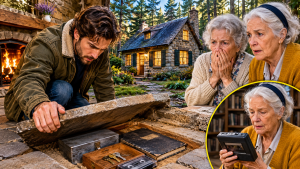
Six flat stones made up the floor in front of it. When I pressed down and turned the center slab the way Nolan once taught me to loosen a stubborn hatch, the stone shifted, exposing a shallow hollow in the sand beneath. Inside were a steel box, a small wooden box, and a cassette tape in a plastic case.
The wooden box held three keys: an old brass one, a newer silver one, and a tiny flat key. The steel box held a thick composition notebook with Rosalyn’s name and nursing credentials on the cover, followed by a request that it be delivered unopened to V. Monahan. I put it back, because after seven years someone deserved to have that request honored.
The cassette was labeled with a message to whoever came next, asking them to listen twice. I took the tape, replaced the boxes, and fitted the hearthstone back into its seam. My hands were steady while I worked, but on the walk back they wouldn’t stay still in my pockets.
At Mrs. Pappas’s kitchen table, I laid the cassette and the twine-wrapped envelope beside her bowl of peas. She looked at both, then fetched a black cassette player that had belonged to her daughter, who died at nineteen. She plugged it in, pressed play, and we listened to a woman’s breath and the rustle of old magnetic tape.
“My name is Rosalyn Clay,” the woman said, giving the date as November 4, 2019, and the time as 9:30 that night. She explained that she’d asked for help three times and been dismissed three times. Now she was hiding a record in the hope that someone would eventually listen.
Rosalyn had been a community nurse for forty-one years, and she began listing eleven patients whose cases worried her. One was Marguerite DeLante, Isaiah’s wife, whom Dr. Prior Hallett at the Rangeley Memory Clinic had diagnosed with moderate cognitive impairment. Rosalyn said she’d visited Marguerite repeatedly and seen none of the symptoms described in his letter.
The same pattern appeared in the other cases: a questionable diagnosis, a visit from Delphine Osgood or an associate, a power of attorney, money transferred into a commission-paying annuity, and eventually a lakefront property sold. Rosalyn suspected elderly people were being maneuvered out of control over their savings and homes. She had documented the cases in a notebook and given a summary to Father Benicio Marchetti in Oquossoc.
Her voice weakened when she spoke to Vera directly. She apologized for keeping her sister outside the danger, then asked whoever found the tape to verify her notes and protect the patients who were still alive. Her last warning was simple: don’t go to Delphine Osgood alone, not at the cottage and not anywhere else.
When the tape clicked off, Mrs. Pappas sat with both hands over her mouth. I asked whether Reba Hallett was related to the doctor, since they shared a surname, and she told me they weren’t; Reba had lived here for decades, while Dr. Hallett had arrived from Massachusetts in 2012. There was no reason to suspect the woman who’d given me work.
“Tomorrow, I’ll take you to Vera,” Mrs. Pappas said. I told her about the notebook still under the hearth, and she agreed it belonged with Rosalyn’s sister. That night I put the tape inside my jacket beside the envelope and left Nolan’s dollar on the bedside table, where I could see it when I woke.
Part 3 Mrs. Pappas drove me up North Shore Road in her old Buick. Vera’s polished Airstream stood beside white pines and a neat stack of firewood, with an elderly blue heeler watching us from a rug near the steps. Vera came out wearing a mustard cardigan, her short white hair held back by a navy headband, and studied my face before inviting me inside for tea.
She had spent thirty-six years as a reference librarian and hadn’t lost the habit of noticing every detail. Books lined the trailer walls, and the kettle smelled faintly of orange peel. She told me she had kept the cottage ready herself: the lavender, the oiled hinges, the clean table, and the kindling had all been her doing.
She could bear to tend the rooms, but never to linger on the patio where Rosalyn had died, and she had made sure a new owner could open the door without forcing it. Rosalyn had told her she was leaving a trail, beginning with Isaiah, and warned her not to go searching for it herself. Vera had almost broken that promise when Isaiah grew frail, but she had waited, even after he died.
I told her about the sealed envelope, the tape, and the notebook. At the mention of the steel box, she closed her eyes and whispered thanks. Then she reached across the table and touched the back of my hand, asking softly who I’d lost to make me hold a single dollar so tightly.
I told her Nolan’s name and enough about Alaska for her to understand. She didn’t offer any speeches about grief; she only said she was sorry and passed me another shortbread cookie. It was the first time I’d told the story to someone without wanting to leave the room afterward.
When I mentioned Delphine’s eighteen-thousand-dollar offer, Vera’s jaw tightened. She’d researched the advisor years earlier and knew she’d been born Darla Pelletier in New Hampshire before changing her name. That wasn’t proof of a crime, Vera said, but it was proof she had spent a long time deciding who she wanted other people to think she was.
Vera asked me to bring back the notebook so we could read it together, and she insisted I take Carnegie, her thirteen-year-old blue heeler. “He knows when someone shouldn’t be there,” she told me. I took the leash, and the old dog walked beside me as though he knew the road better than I did.
At the edge of the clearing, Carnegie stopped and growled. The cottage door stood open a few inches, though I’d shut it when I left, so I crouched behind the pines and held his collar. After a long silence a broad-shouldered blond man in a quilted vest came out carrying a brown paper bag.
He went around the back of the cottage without seeing us. A pickup started somewhere beyond the trees and drove off along a service road I hadn’t known existed. Only when the sound faded did Carnegie stop growling and allow me to approach the front door.
Someone had knocked over the lavender and scattered the three books from the top shelf. Upstairs, the cedar chest stood open, its folded wool blanket thrown aside, but the little painted icon above the bed was untouched. I went straight to the hearth and lifted the center stone.
Both hidden boxes were still there. Whoever searched the rooms hadn’t found the hollow, which meant Rosalyn’s notebook had survived another visit from someone who wanted something in that house. I picked up the steel box and the wooden box, stood the mason jar upright, and placed the crushed lavender back inside before leaving with Carnegie.
Vera was waiting at her Airstream when we returned. I told her what I’d seen, including the man’s clean boots and the pickup on the hidden road, and she reached for her phone. She called Deputy Holly Pappas, Mrs. Pappas’s twenty-nine-year-old niece, who Reba had already described as a good deputy.
Part 4 While we waited, Vera asked me to open the notebook in front of her. The first page said, “For whoever comes next. Be braver than I was. Be kinder than they will be.” Each of the eleven cases that followed had Rosalyn’s observations, a copy of Dr. Hallett’s diagnostic letter, and a trail of financial documents.
Some pages contained powers of attorney, account transfers, property listings, and commission records supplied by a clerk at the Burlington firm whose name Rosalyn had deliberately left out. Her notes didn’t ask a stranger to believe her on faith. They offered dates and papers that other people could check.
The longest file concerned Isaiah and Marguerite. Near its end I found a handwritten note dated September 2019, addressed to Rosalyn in Marguerite’s own hand. She wrote that she knew her diagnosis was false and intended to pretend it was true, keeping every bank statement and requested form in a biscuit tin under the kitchen sink.
The tin had a Scottish terrier on its lid. Marguerite asked Rosalyn to send someone young for it if it was ever needed, someone the people behind the scheme wouldn’t recognize. The note ended by telling her friend she loved her.
I looked up at Vera. “Marguerite’s still alive?” She nodded and said she was home, and had spent years allowing people to underestimate her while she saved what they put in front of her.
Holly arrived in uniform, read the notebook without interrupting us, and listened as I described the intruder. She could document the break-in, check for fingerprints, and examine tire tracks on the logging easement behind the cottage. But she was candid about how little a deputy could do alone against a well-connected doctor and a financial firm across state lines.
The sheriff who had handled Rosalyn’s death had retired, and Holly worried that the current department’s connections to Dr. Hallett would compromise an investigation. Rather than make promises, she told us she knew a lawyer in Portland named Celestine Barriga. Celestine worked with an elder-justice project at Pine Tree Legal Assistance and could bring the records to the attention of state authorities and federal investigators.
Holly wanted the tape, notebook, and a sworn statement from Marguerite before contacting her. Vera looked at me across the booth table, and I said the answer Rosalyn would have given was yes. Holly called Celestine from her cruiser, then set out for the DeLante place to see whether Marguerite wanted to speak.
Late that night, Holly sat at Marguerite’s kitchen table and listened as the older woman gave dates and names without once losing her place. Marguerite handed over the biscuit tin, which by then held 219 documents. Isaiah had learned the truth during the last months of his life and had told his wife there was nothing to forgive.
Holly drove the evidence to Portland and delivered it to Celestine. When she called us, she said Celestine would work to get the allegations and records reviewed by investigators who weren’t entangled in local loyalties. I understood that a folder of documents wasn’t a conviction; it was the beginning of the work Rosalyn hadn’t lived to finish.
That night Mrs. Pappas insisted I sleep on the pullout in her back parlor rather than upstairs near the street. Carnegie lay on the rug by my feet, and I tried to convince her I wasn’t worth upsetting her house over. She answered that she’d already buried a husband and a daughter and wouldn’t be told where she was allowed to stand in her own home.
Sometime before dawn, Carnegie raised his head toward the alley. An engine idled outside, stopped, then started again, and I heard Mrs. Pappas move quietly into the kitchen. She kept an old shotgun that had belonged to her husband, but she didn’t go outside or confront anyone; we stayed inside until the vehicle finally left.
We sat awake until the sky began to lighten. Watching Mrs. Pappas put water on for coffee, I remembered my mother in the hours after Nolan disappeared, standing at the kitchen counter because morning had come whether any of us were ready or not. I didn’t say the comparison aloud, but I think Mrs. Pappas understood when I helped her set out the cups.
Holly telephoned at 7:15. Celestine had the cassette, the notebook, and Marguerite’s statement, and had been speaking with federal authorities and Maine securities officials. She warned me not to visit the cottage or Vera alone while the matter was being assessed and told me to stay close to Mrs. Pappas.
Part 5 By late morning, news was moving from the post office to the coffee shop and along every street in Rangeley. Federal agents had searched Osgood and Sparrow’s offices in Burlington, and Delphine had been taken into custody along with several men. State investigators had gone into the Rangeley Memory Clinic and removed Dr. Prior Hallett from the office.
Calder Osgood, the man in the quilted vest, had been arrested at a gas station on Dallas Hill Road by officers from outside the county. I recognized his description immediately, down to the pickup and his clothes. Mrs. Pappas saw my face and put one hand between my shoulder blades, saying nothing while I finally let myself laugh from sheer disbelief.
Vera came to the boardinghouse in the same coat she’d worn on her weekly walks. Her eyes filled when Mrs. Pappas told her what was being reported, but for a moment she couldn’t seem to speak. Then she said she wanted to go to her sister’s house with us, before another day passed.
We drove to Loon Point in the Buick with Carnegie in back. At the clearing Vera stopped, because for seven years she had hurried past the stones where Rosalyn had died without allowing herself to stand and remember. She took my arm, and together we crossed the patio and opened the arched door.
The mason jar still held the lavender I’d gathered from the floor. Vera stood beside it, closed her eyes, and breathed out slowly, while Mrs. Pappas stayed near the doorway. I laid a new fire, and Vera sat beside it with Carnegie between us, looking at the room her sister had kept for a stranger.
After a while she took a folded obituary from her coat. It was for Jeremiah Royce, a former receptionist at the Rangeley Memory Clinic who had died in October 2019, shortly before Rosalyn. Vera said he’d noticed irregular diagnostic letters, had made copies of early files, and had met with Rosalyn to tell her what he knew.
“J.R.,” I said, remembering the initials on the twine envelope. Vera nodded: Rosalyn had added his initials because she wanted somebody to remember the man who’d helped her. His death had been recorded as a heart attack, though Vera believed there was still more to learn.
Looking into the fire, I told Vera I didn’t want the cottage to become another sealed-up place nobody dared enter. She recalled something Rosalyn used to say about an older woman sitting alone at her kitchen table with a frightening letter she couldn’t understand. What such a woman needed, Vera said, was someone patient enough to read the paper with her.
We began talking about a reading room with good light, chairs, reference books, and a kettle. Retired teachers could help visitors understand their mail, and Celestine might arrange for a lawyer to come up from Portland on Saturdays. It wouldn’t replace professional legal advice, but it could help people recognize when to seek it and where to go.
We went to see Marguerite at the DeLante farmhouse that afternoon. She met us in a pressed blue dress with her white hair pinned up and made tea at a table where she’d set an extra cup for Isaiah. For the first time, I saw her not as a name on a case file but as a woman who missed hearing her husband argue over ordinary things.
She told us that in 2019 Dr. Hallett had given her a cognitive diagnosis after a routine screening, despite her answering his questions clearly. Rosalyn had listened, checked what she could, and helped her understand why the diagnosis and later financial paperwork were so troubling. Marguerite decided to keep the forms rather than discard them.
She’d hidden them in the biscuit tin for years while allowing the people pressuring her to think she was confused. When she finally told Isaiah what she’d been doing, he didn’t scold her for the silence. He called her the most dangerous woman in Franklin County, and she repeated his words with a small, sad smile.
I asked if she would consider helping with the reading room. Marguerite straightened in her chair and told me she’d taught junior-high English for forty-one years. If we needed somebody on Tuesdays to explain a letter, she said, she could bring oatmeal cookies along with her red pen.
Part 6 A town doesn’t change its mind all at once. In the weeks after the searches, some neighbors wanted to believe the doctor had done nothing wrong, while others were ashamed that they’d trusted diagnoses or financial advice that had harmed people they loved. I saw the strain in the grocery store and at the hardware counter, where conversations stopped whenever the clinic was mentioned.
Reports emerged of money channeled into Dr. Hallett’s own accounts and of serious debts that had given him reasons to cooperate with investigators. His cooperation became important later, but no one was handed justice in a single afternoon. There were records to verify, witnesses to interview, and families left to make sense of losses that couldn’t simply be repaid.
I spent the winter at Loon Point, keeping the cottage heated and learning stonework from Ignace Fournier, a seventy-six-year-old mason who had known Isaiah. He showed me how to clean a joint, score a mortar bed, and choose the right face of a river stone. By spring I’d rebuilt sections of the patio and repaired the eastern wall, and he ran his palm over the work and said Isaiah would have nodded.
Vera filled the built-in bookcase with practical reference books about benefits, debts, powers of attorney, and ways to spot fraud. She added children’s books to the bottom shelf, saying a reading room without them wasn’t much of a reading room. We set four plain pine chairs around the same table that had held her lavender, and Mrs. Pappas volunteered to keep us supplied with cornbread.
Father Benicio came to see us before the opening. He admitted that Rosalyn had given him a sealed summary in 2019, and he’d hidden it in a Bible in the church sacristy, too afraid of endangering her patients to act. His silence had weighed on him for years; Vera listened and said carrying those names had still made him one hand in Rosalyn’s bucket brigade, though it had not been enough.
That was how Rosalyn had explained the good she saw in people: a bucket brigade, with one person passing water to the next until it finally reached a fire. I hadn’t known her while she lived, but by then I knew the phrase well enough to hear it when Vera was quiet. Our reading room would be another set of hands, not a monument nobody could use.
We opened on the first Saturday in April, Rosalyn’s birthday weekend. On the door Vera hung a handwritten notice inviting people to bring papers they wanted help understanding, with Saturday hours from nine until one. Underneath, in smaller writing, were Rosalyn’s and Jeremiah’s names and the words “The Bucket Brigade Continues.”
Forty-one people came. Celestine drove from Portland, and Marguerite joined two other retired teachers, Honora Finch and Perpetua LaVoice, at the table. Reba arrived with coffee cups, Holly stopped in, and Mrs. Pappas carried four loaves of cornbread while Vera greeted neighbors one by one.
Before the first visitors settled, Celestine asked to see the hearth. She knelt and rested one hand on the center stone, then stood without asking for any more explanation. I remembered doing almost the same thing when the stone first moved under my palm, except then I had been trying to find out what a dead woman had hidden.
Near eleven, an older man named Mr. Boucher placed a brown envelope on the table. His wife had died in January, and a company he’d never heard of was demanding twelve thousand dollars for her care. Celestine read the letter, explained why she believed the claim wasn’t owed, and helped him understand his options rather than sending him home alone with the fear.
When he finally stood, his shoulders looked different. He said he’d been sleeping with that envelope on his kitchen table, afraid of forgetting what it demanded. He promised to come back with his cousin, and the line of people waiting behind him moved one chair forward.
By one o’clock the kettle had been filled four times and the cornbread was gone. Vera closed the room with a little bell and reminded everyone they were welcome back the following Saturday. I stood outside afterward with Nolan’s dollar in my fingers, watching the lake while voices and laughter drifted through the open door.
Part 7 Vera joined me on the stone patio. She said Rosalyn would have been inside fussing over crooked chairs and telling everybody to put on a sweater. Then she handed me the smallest of the three keys we’d found under the hearth and said it opened a safe-deposit box at North Star Credit Union in Farmington.
The box had belonged to Rosalyn, and Vera had arranged for me to access it through the proper trust paperwork. “It’s a letter,” she told me, “not evidence.” She had never read it herself, because it was addressed to whoever came after her sister and she believed I was the person who should decide what to do with it.
That evening I stood by the terracotta pots outside the arched door. I’d planted a young lavender there in late winter, and now its green leaves were pushing up through the spring soil. I unfolded Nolan’s dollar, looked at it for a long while, and spoke his name without trying to keep my voice from breaking.
Then I folded the bill smaller than before and tucked it into the soil beside the plant. I wasn’t giving him away. I was putting something I’d carried for more than a year in a place where I would still see it whenever I opened the door.
The next morning I borrowed Reba’s pickup and drove to Farmington with the key, my identification, and the trust paperwork. A clerk led me to a private table and brought out Rosalyn’s box. Inside was a single envelope, with three handwritten words on the front: “To the one.”
The letter thanked me for coming and said the house, lavender, and hearth were mine. Rosalyn didn’t try to tell me exactly how to live or whom to trust; she wrote that each person in a bucket brigade chooses where to pass the water. She asked me to be quiet when a day got loud, kind when people were afraid, and to put on a sweater when Vera asked.
She admitted she had often been frightened herself. She said the dangerous part of her story was not mine to repeat, and that mine was to open the door on Saturdays, listen carefully, and set down gently whatever I’d carried into her home. At the bottom she welcomed me as a neighbor, then added a note about the cornbread waiting in Mrs. Pappas’s kitchen.
I sat with my hand over the letter for a while, remembering the first night I’d stared at the lake from the room with the sloped ceiling. I had arrived wanting to be anonymous because it seemed easier than mourning Nolan in a place where anyone knew his name. Now someone who had died years before I came to Maine had made space for me to belong.
I took the envelope back to the cottage and found Vera at the table, Mrs. Pappas pouring tea, and Marguerite scratching Carnegie behind the ears beside the hearth. When they looked up, I couldn’t explain what the letter had done to me. Mrs. Pappas just set another cup out and told me to sit, and that was enough.
Final The criminal proceedings continued long after our first Saturday. Dr. Hallett eventually received a six-year sentence after cooperating, and the case against Delphine Osgood took nearly two years to work through the courts. Marguerite’s carefully preserved records, including a document she’d copied in 2021, became part of the evidence presented at trial in 2028.
Delphine was convicted and sentenced to eleven years in federal prison. Calder Osgood received a twenty-four-year sentence for Rosalyn’s manslaughter after investigators examined a wildlife trail-camera memory card from a birdhouse at the edge of the Loon Point clearing. It showed his pickup arriving on the night Rosalyn died and a man in a quilted vest approaching the cottage before leaving minutes later.
Investigators also reopened Jeremiah Royce’s death and eventually reclassified it as a homicide, though that finding couldn’t give back the years his family had lived with unanswered questions. His name joined Rosalyn’s on a small memorial stone beside the reading room, framed by lavender. I kept thinking about those two sets of initials on Isaiah’s envelope and how close I had come to treating them as just another piece of paper.
The town never became a place without arguments or mistakes, and nobody got every dollar or every lost year restored. But the reading room kept its Saturday hours, the retired teachers kept reading letters, and Celestine kept helping people understand when they needed a lawyer. Some brought bank statements; others brought envelopes they had been too frightened to open alone.
There were evenings when I still dreamed of the boat and the empty deck, and I still missed Nolan every day. Grief didn’t disappear because I had repaired a stone wall or learned how to make a proper fire. But I no longer woke with my boots by the bed expecting to catch the next bus out of town.
One evening, after the visitors were gone, the four of us sat around the cottage’s old table with tea while Carnegie slept near the hearth. Vera called me a neighbor, Mrs. Pappas told me to eat another piece of cornbread, and Marguerite corrected the grammar on a notice she’d brought for next Saturday. I looked through the open door at the lavender by the patio and remembered a folded dollar in the soil beneath it.
The house I’d bought for sixty-two dollars was never really empty. It had been held ready by a sister, guarded by the hope of a nurse, and left for someone willing to listen twice. For the first time since losing Nolan, I could answer when somebody said, “Welcome home,” and mean it when I said, “I’m here.”
The END