I drove home with Bradley's letter inside my purse.
It was beside Tom's photograph.
I thought about that as I waited at a traffic light.
Two men who had shaped my life.
My husband, who had loved me through decades of marriage.
And my son, who had hurt me deeply before finally beginning to understand what he had done.
For years, I had carried Tom's letter because it reminded me of the life we shared.
Now Bradley's letter reminded me of something different.
A relationship could change.
But only when the people involved were willing to face what had gone wrong.
I hadn't known whether that would ever happen with my son.
After Cabo, I was afraid the distance between us might become permanent.
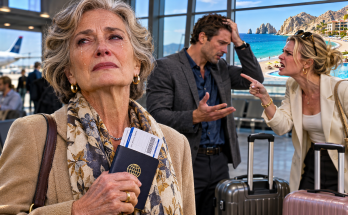
I remembered standing at the resort with Amber demanding that I restore the reservation.
I remembered Bradley looking at me as though I were responsible for their embarrassment.
I remembered how alone I felt.
Then I thought about the evening I had just spent in his apartment.
The roast chicken.
The potatoes.
The green beans.
The old baseball shirt.
Nothing expensive.
Nothing planned to impress strangers.
Yet I felt more loved at that small table than I had during the entire trip I paid twelve thousand dollars to arrange.
That was difficult to admit.
But it was true.
I had once believed beautiful memories required beautiful surroundings.
A luxury resort.
An oceanfront suite.
A carefully planned vacation.
I had thought those things would bring Bradley and me closer.
Instead, the expensive arrangements had made it easier for everyone to ignore what was wrong.
When the money stopped, the truth became impossible to avoid.
I didn't enjoy learning it.
I wished there had been an easier way.
But I couldn't deny what had happened afterward.
Bradley had begun taking responsibility.
He had made changes without asking me to finance them.
He had stopped treating my savings as part of his own future.
And he had written a letter acknowledging the things I needed him to understand.
I wasn't going to dismiss that effort.
But I wasn't going to let gratitude make me careless again.
That mattered too.
When I reached home, I carried my purse into the living room.
The house was quiet.
Tom's chair stood by the window.
The family photographs remained on the bookshelf.
I took out Bradley's envelope.
Then I sat down.
I read the letter again.
Slowly.
This time, I didn't cry as much.
I noticed the details.
The way Bradley had described accepting my help.
The way he admitted that he made excuses for Amber.
The way he acknowledged staying silent at the airport.
There were no demands in the letter.
No request for money.
No suggestion that I should restore the old arrangements because he had apologized.
That was what made it meaningful.
I thought about the financial authorization he had brought me three months before Cabo.
I still remembered my signature at the bottom.
I remembered Margaret Lewis turning the document toward me.
I remembered how frightened I felt when she explained the provisions.
Those memories hadn't disappeared.
The legal arrangements had been reviewed.
The necessary protections were being handled.
My estate documents had been updated.
I wasn't leaving those matters to trust alone again.
I could forgive Bradley without giving him authority over my finances.
I could accept his apology without pretending the paperwork had been harmless.
I could love him without reopening an arrangement that had put me at risk.
For a long time, I hadn't understood that.
I thought forgiveness required returning everything to the way it had been.
If someone apologized, I was supposed to stop talking about the problem.
If they seemed upset, I was supposed to comfort them.
If they promised to do better, I was supposed to trust them immediately.
That was how I had handled disagreements for years.
It hadn't worked.
Now I was learning that forgiveness and trust were different things.
Forgiveness could begin with an apology.
Trust needed time.
It needed consistency.
It needed choices that showed a person had changed.
Bradley had begun making those choices.
I was willing to recognize them.
But I was also willing to protect myself while our relationship continued healing.
I placed the letter on the table.
Then I looked at Tom's photograph.
I wondered what he would think of the dinner.
I could imagine him smiling at the thought of Bradley preparing a meal.
Tom had always wanted our son to learn ordinary responsibilities.
He believed a person should know how to work, manage money, and take care of a home.
He didn't consider those things signs of hardship.
He considered them part of adulthood.
I had forgotten that while trying to protect Bradley from every difficult situation.
I thought about the years after Tom died.
I had been so afraid of losing another person I loved.
I never said that aloud.
Not to Bradley.
Not to Amber.
Not even to myself.
But it had shaped my decisions.
Whenever Bradley called, I answered.
Whenever he needed money, I tried to help.
Whenever he disappointed me, I found an excuse.
I believed that if I remained useful enough, he would always have a reason to stay close.
Looking back, I was ashamed of how small that made my world.
I had reduced my own life to something other people could use.
Not because anyone forced me to do it.
Because I was afraid that without being needed, I would be forgotten.
The trip to Cabo exposed that fear.
Amber's words hurt because they made me feel invisible.
Bradley's silence hurt because it confirmed what I had been worrying about for years.
I was welcome when I paid.
But I wasn't sure I was welcome simply because I was his mother.
That was the belief I had carried home from the airport.
And it was the belief Bradley had finally begun challenging through his actions.
He had invited me to dinner.
He had cooked.
He had listened.
He had written honestly.
He hadn't asked me for anything.
I thought about the small apartment again.
It wasn't the house Bradley and Amber had wanted.
There was no expensive furniture.
No luxury vehicle outside.
No appearance of wealth.
But he seemed more responsible there.
More aware of the life he could afford.
And more willing to admit when he had been wrong.
I hoped he would continue growing.
I knew it wouldn't happen perfectly.
There would be difficult days.
There might be mistakes.
He could become frustrated.
He might sometimes wish things were easier.
But I no longer believed that every difficult feeling needed to be solved by his mother.
That had been an important lesson for both of us.
The next morning, I woke early.
I made coffee.
Then I sat near the kitchen window.
The house was peaceful.
I thought about my plans for the week.
Gardening.
Watercolor.
Lunch with Margaret and Elaine.
A conversation with Susan.
Ordinary things.
But each one belonged to the life I was building.
I wasn't waiting for Bradley to call before deciding what to do with my day.
I wasn't keeping my schedule empty in case someone needed me.
I had plans.
And I intended to keep them.
Later that week, I met Margaret and Elaine for lunch.
I told them I had enjoyed dinner with Bradley.
I didn't share every word of his letter.
That felt private.
Something between my son and me.
But I told them he had apologized in a way that meant a great deal.
My friend Margaret smiled.
She understood how difficult family relationships could become after a loss.
Elaine asked whether I felt relieved.
I thought for a moment.
"Yes. But I'm still being careful."
She nodded.
That was enough.
I appreciated that my friends didn't tell me what I should do.
They didn't insist that I forgive Bradley immediately.
They didn't tell me to remain angry.
They simply listened.
I had learned how valuable that was.
For years, I had surrounded myself with obligations.
Now I was spending time with people who respected my choices.
I could disagree with them without losing their affection.
I could decline an invitation without feeling punished.
I could speak honestly without worrying that someone would demand money afterward.
Those relationships were helping me understand what healthy closeness felt like.
I didn't need to earn it.
I simply needed to participate.
We talked about other things.
A gardening meeting.
A watercolor class.
Places we might enjoy visiting.
I listened as Susan's name came up in conversation about our outings.
I smiled.
She had been an important part of the changes in my life.
When she first called about Amber's posts, I had been frightened by what she told me.
But she had also reminded me that someone in the family cared enough to speak honestly.
I hadn't forgotten that.
I was grateful for her.
After lunch, I returned home feeling content.
I didn't rush inside.
I stood for a moment looking at the house.
Tom and I had spent thirty years paying for it.
There had been years when every payment mattered.
Years when we discussed repairs carefully.
Years when we wondered whether retirement would ever feel secure.
Now the house was paid for.
I could live there comfortably.
I could invite friends.
I could enjoy the garden.
I could sit in Tom's chair and remember him.
And I could eventually leave whatever remained according to my wishes.
That was enough.
I didn't need to prove my love for Bradley by promising him the house.
I didn't need to reassure him that every dollar would eventually belong to him.
I had already made my estate plans.
He was still included.
But my life came first while I was living it.
I opened the front door.
Inside, the house felt welcoming.
I went to the bookshelf and looked at Bradley's childhood photograph.
The little boy with the baseball trophy was still smiling.
For years, that picture had made me feel guilty whenever I considered refusing my son something.
I would look at it and remember how much I loved him.
Then I would tell myself that a good mother always helped.
Now I understood something different.
A good mother could love her child and still expect him to behave responsibly.
She could be generous without becoming an endless source of money.
She could forgive without forgetting the lessons that came from being hurt.
And she could say no without turning that no into a rejection.
I smiled at the photograph.
Then I looked toward Tom's chair.
I wished he could have seen how much I was changing.
But perhaps he had understood the problem long before I did.
His letter had been waiting for me for nine years.
The words hadn't changed.
I had.
That evening, Bradley called.
He wanted to know whether I had enjoyed the week.
I told him about lunch with my friends.
He listened.
Then he told me a little about work.
We spoke for several minutes.
There was no mention of money.
No request.
No argument.
Before hanging up, he told me he loved me.
I smiled.
"I love you too, sweetheart."
When the call ended, I didn't feel the old fear that he might not contact me again.
I trusted that we could speak another day.
And if he was busy, I had my own life to enjoy.
That was what had changed.
I was no longer measuring the strength of our relationship by how often he needed something.
I was beginning to measure it by how we treated each other when nothing was being asked.
I returned to the living room.
Bradley's letter was in a safe place with my personal things.
Tom's photograph remained nearby.
I thought about the two years that lay ahead.
I didn't know then that I would return to Cabo with Susan and my friends.
I didn't know how much joy I would eventually find there.
But I knew one thing.
If I traveled again, it would be because I wanted to go.
I would choose where to stay.
I would decide what to spend.
And I would never again believe that paying for someone else's happiness was the price of being included.
That evening, I sat in Tom's chair and watched the light fade beyond the window.
I wasn't lonely.
I wasn't waiting to be useful.
I was simply home.
And for the first time in years, that felt like enough.