The first word in Bradley's letter was simple.
Mom.
I had seen him write it hundreds of times.
On birthday cards.
On school drawings.
On notes he left in the kitchen when he was young.
But sitting at his small dining table, that one word made my throat tighten.
I looked across at him.
He was watching his hands.
He didn't ask me to hurry.
He didn't try to explain the letter before I read it.
He simply waited.
I looked back at the paper.
Bradley had written about the years after Tom died.
He said he had become accustomed to thinking of me as someone who could handle anything.
I was strong.
I was financially secure.
I rarely complained.
And because of that, he had convinced himself that accepting my help didn't cost me anything.
I stopped reading for a moment.
That was painfully close to the truth.
I had worked hard to appear strong.
After Tom died, people often told me how well I was managing.
They praised me for staying organized.
For keeping the house.
For continuing to handle my responsibilities.
I had accepted those compliments.
But there were nights when I cried alone.
There were mornings when I had to force myself out of bed.
There were birthdays when I prepared Bradley's favorite meal and hoped he would come.
I hadn't told him how lonely I felt.
I thought a good mother shouldn't make her grown son responsible for her sadness.
That part was reasonable.
But somewhere along the way, I had stopped asking him to consider my feelings at all.
Bradley had grown comfortable with that.
His letter acknowledged it.
He wrote that he had accepted my generosity without thinking carefully about what I was giving up.
Money.
Time.
Peace.
He had treated my willingness to help as though it meant I never minded.
I read those lines slowly.
I thought about the bank records.
Almost thirty-one thousand dollars in eighteen months.
The two mortgage payments.
The car insurance.
The furniture.
The medical expense.
The transfers to Amber.
Then the twelve-thousand-dollar vacation.
I had never asked Bradley to repay every dollar.
But I had wanted him to understand that the money represented real choices.
Tom and I had saved for years.
We had postponed things we wanted.
We had worked toward a retirement we hoped to enjoy together.
Bradley had been spending money from that future without considering what it meant to me.
Now he was finally acknowledging it.
I continued reading.
He wrote about Amber.
He admitted that he had excused her behavior for too long.
When she spoke harshly, he told himself she was simply direct.
When I seemed hurt, he convinced himself I was taking things too personally.
When he should have intervened, he stayed quiet.
I looked up from the page.
Bradley still hadn't moved.
His eyes were lowered.
I wanted to say something.
But I wasn't finished.
The next part of the letter made my hands tremble.
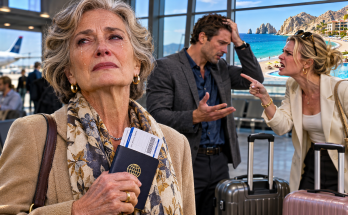
He wrote about the airport.
He remembered the boarding area in Denver.
He remembered Amber speaking to me as though I hadn't contributed anything to the vacation.
He remembered that other people could hear.
And he remembered walking away instead of correcting her.
I put my hand over my mouth.
For months, I had carried that memory.
The embarrassment.
The confusion.
The terrible moment when I looked at my son and realized he wasn't going to defend me.
I had replayed it countless times.
Sometimes I wondered whether I had expected too much.
Perhaps I should have ignored Amber.
Perhaps I should have stayed quiet and enjoyed the vacation.
Perhaps canceling the resort had been too dramatic.
Those thoughts still visited me occasionally.
But Bradley's letter didn't suggest that I had imagined the disrespect.
He knew what happened.
He knew I had been hurt.
And he was no longer trying to make it sound smaller than it was.
He wrote that he had wanted to avoid an argument with Amber.
So he had allowed me to bear the humiliation instead.
I felt tears sliding down my cheeks.
I wiped them away.
Bradley looked up briefly.
"Mom, are you okay?"
I nodded.
"Let me finish."
He lowered his eyes again.
I continued.
He admitted that he had accepted credit for things I paid for.
He had allowed friends to believe the Cabo vacation was something he and Amber purchased for themselves.
He hadn't corrected the impression.
At the time, I had been shocked when he admitted that over the phone.
Now he was putting it in writing.
Without being questioned.
Without waiting for me to demand an answer.
That mattered.
He wrote about how ashamed he was of becoming comfortable with my help while failing to acknowledge it.
He said he had been more concerned about avoiding conflict than treating me fairly.
I thought about Tom.
My husband had always believed that admitting a mistake was only useful if a person understood what they needed to change.
He used to tell Bradley that an apology wasn't a way to escape consequences.
It was the beginning of taking responsibility.
I remembered that as I read.
Bradley wasn't asking me to restore the old financial arrangements.
He wasn't asking for another chance to use the house.
He wasn't trying to persuade me that the documents had been harmless.
He was writing about his own behavior.
That was new.
His letter continued.
He said he couldn't undo the airport.
He couldn't give me back the time I had spent feeling unwanted.
He couldn't change the years when he treated my generosity as something automatic.
But he wanted me to know that he understood those things now.
I paused.
My eyes were blurred with tears.
I folded back the edge of the paper and read the final lines.
He promised that he would no longer treat my love as a financial obligation.
He acknowledged that I had deserved more consideration from him.
Then he apologized.
Not for the lost resort.
Not for the embarrassment Amber experienced.
Not because he wanted me to pay another bill.
He apologized for failing to be the son I needed him to be.
The letter ended with his name.
Bradley.
I sat holding the paper.
For a long time, I couldn't speak.
I had spent nearly a year wanting to believe my son was changing.
I had watched him sell the SUV.
Take additional work.
Move into a smaller apartment.
Pay his own expenses.
Call without asking for money.
Bring groceries.
Cook dinner.
Those things had mattered.
But this letter brought them together.
It showed me he had been thinking about what happened.
Not simply trying to make me stop being angry.
He was beginning to understand why I had been hurt.
I folded the letter carefully.
Then I placed it on the table.
Bradley looked at me.
"I don't expect you to forget any of it."
I nodded.
I knew he meant the airport.
The paperwork.
The money.
The years of taking me for granted.
I looked at his face.
He seemed older than he had a year earlier.
Not just physically.
There was something different in the way he carried himself.
He wasn't waiting for me to solve the discomfort.
He was allowing it to exist.
I appreciated that.
I thought about the first apology he offered after Cabo.
He had brought pastries.
He had said he was sorry.
But when I asked what he regretted, he struggled to answer.
He wanted the problem to be finished.
He wanted us to return to the way things had been.
Now he understood that returning to the old arrangement wasn't what I needed.
We had to build something different.
I looked down at the letter again.
"Thank you for writing this."
My voice was unsteady.
Bradley reached across the table.
I took his hand.
He held mine gently.
Then he asked something I hadn't expected.
"Do you think we can have a better relationship?"
I looked at him.
I saw the grown man sitting in his modest apartment.
Then I remembered the little boy running through the house in muddy shoes.
The eight-year-old holding his baseball trophy.
The teenager staying up late in the garage with Tom.
The young man who had married Amber.
The son who stood silently at the airport.
The man who brought me a financial document without fully explaining it.
All of those memories belonged to the same person.
I couldn't erase the painful ones.
But I didn't want them to become the only things I remembered.
I thought about Tom's grave.
The white roses.
The promises I had made to myself.
I had decided to live my life.
To protect my retirement.
To enjoy my friends.
To stop confusing being needed with being loved.
I wasn't going to give those things up.
Not even for Bradley.
But I didn't have to give up my son either.
I looked at him.
"Yes, I think we can."
His eyes filled.
I continued.
"But it can't be the way it was before."
He nodded.
"I understand."
I wanted to be clear.
I would still love him.
I would still enjoy spending time together.
I would listen when he needed to talk.
But I wouldn't return to paying his bills.
I wouldn't allow anyone to make plans around my house.
And I wouldn't accept disrespect simply to avoid an argument.
Bradley listened.
He didn't object.
He didn't ask for an exception.
He simply nodded.
"That sounds fair."
I felt something inside me ease.
For so long, I had believed boundaries would destroy our relationship.
Now I was beginning to see that they might be the only way to save it.
I looked around the apartment.
The small dining table.
The comfortable sofa.
Tom's photograph on the bookshelf.
This wasn't the life Bradley had imagined when he and Amber were chasing a bigger house and expensive vacations.
But it was a life he was learning to manage.
And for the first time in years, I felt that my son wanted me there because he loved me.
Not because I could pay for something.
I smiled.
Then I decided to say something lighter.
"There's one condition about any future vacations."
Bradley looked puzzled.
"What condition?"
I laughed softly.
"Next time, you pay for your own travel."
He stared at me for a moment.
Then he laughed.
A real laugh.
The kind I remembered from his childhood.
I laughed too.
There was no bitterness in it.
No hidden accusation.
Just an understanding that things would be different.
We sat together for a while longer.
I didn't feel the need to fill every silence.
I didn't worry that he might become uncomfortable.
I didn't wonder whether I should offer money before leaving.
I simply enjoyed being with him.
When it was time to go, I picked up the letter.
I folded it carefully and returned it to the envelope.
Bradley watched me.
"You're keeping it?"
I looked at him.
"Of course."
He smiled.
I placed the envelope inside my purse.
Beside Tom's photograph.
For years, I had carried one letter reminding me to live my life.
Now I had another reminding me that my son was beginning to understand why that mattered.
I didn't know what the future would bring.
I didn't know whether Bradley would always make good decisions.
Nobody could promise that.
But I knew something had changed.
He had stopped asking me to prove my love through money.
And I had stopped believing that saying no meant I loved him less.
When I left his apartment, I felt grateful.
Not because everything had been forgotten.
Because we were finally learning how to love each other without repeating the same mistakes.