PART 2 — THE SECRET HER FATHER LEFT BEHIND
Ingrid Vestergaard stared at the stones beneath the snow, her heart pounding so hard she could barely hear the wind.
She knew those stones.
She knew the careful way they had been fitted together,
the narrow seams between them,
and the little triangular mark carved into the corner of the largest one.
Her father had always left that mark on his finest work.
When Ingrid was a girl, she had once asked him why.
“So the stones will remember who placed them,” he had answered. Now,
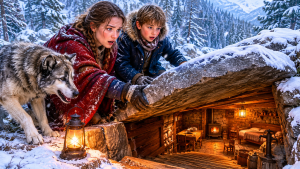
standing in the middle of a Dakota blizzard with her exhausted eight-year-old son beside her,
Ingrid realized that her father had left his mark here for a reason.
And whatever that reason was, he had carried it to his grave.
Odin barked again.
The great gray dog was digging furiously at the edge of the largest stone,
sending frozen dirt and snow flying between his paws. “Mother?”
Bjorn whispered. Ingrid turned.
Her little boy was shivering so violently that his teeth clicked together.
Snow clung to his eyelashes.
His lips had begun turning a frightening shade of blue.
“Is that Grandfather’s stone?” “Yes, sweetheart.” “Why is it here?”
“I don’t know.” The words frightened her more than she wanted to admit.
She had followed a mysterious map into the wilderness.
She had dragged her child away from the only home he had ever known.
And now the storm was closing around them like a great white fist.
If her father’s letter had led them to nothing more than buried rocks,
she had made a terrible mistake. Then Odin stopped digging.
He pressed his nose against a narrow opening between two stones and whined.
Ingrid dropped to her knees.
She brushed away the snow, ignoring the pain in her frozen fingers.
There, almost hidden beneath a crust of ice, was a small iron ring.
She pulled. Nothing happened. She tried again, using both hands.
The ring moved barely an inch. “Come on,” she whispered.
The wind howled through the cedar branches.
Ingrid wrapped the end of her shawl around the ring and
planted her boots against the frozen earth.
She pulled with every ounce of strength remaining in her body.
For one dreadful moment, nothing moved. Then came a deep grinding sound.
The largest stone shifted. A black opening appeared beneath it.
And from that opening rose something Ingrid had not felt in hours.
Warm air. Not the warmth of a stove or a roaring fire,
but the unmistakable breath of a place protected from the murderous wind.
Ingrid stared in disbelief. Her father hadn’t buried a treasure.
He had buried a doorway.
### CHAPTER 1 — THE HOUSE UNDER THE HILL “Bjorn, come here!”
The boy stumbled toward her.
Beneath the stone was a narrow stairway descending into darkness.
The steps had been cut into the earth and reinforced with timber.
Someone had taken extraordinary care to hide them.
Ingrid lifted the lantern she had carried beneath her coat.
The flame had nearly died during their journey,
but a faint orange spark still glowed behind the glass.
She sheltered it with her hands and turned the wick.
Light spilled down the stairs. Odin bounded ahead. “Wait!”
Ingrid called. But the dog had already disappeared.
A moment later, he barked from somewhere below.
Ingrid took Bjorn’s hand. “Stay close to me.” “What about Freya?”
Ingrid looked back at their little goat, trembling beneath the cedars.
“We aren’t leaving her.”
She loosened the rope and coaxed the frightened animal toward the opening.
Getting Freya down the steep steps was difficult.
Twice the goat resisted,
and twice Ingrid feared she would have to abandon the attempt.
But at last, all four of them reached the bottom.
What Ingrid saw there brought tears to her eyes.
The stairs opened into a surprisingly spacious underground chamber.
Thick wooden beams supported a low ceiling. Stone walls lined the room.
A small iron stove stood against one side,
its stovepipe disappearing into a carefully constructed passage overhead.
There were two narrow beds, a table, shelves, storage barrels,
neatly stacked firewood, and a water pump beside the wall.
Everything was covered with a thin film of dust. But everything was dry.
Everything was waiting. Bjorn stood perfectly still.
“Mother,” he whispered, “is this a house?” Ingrid could hardly answer.
“Yes.” “Whose house?” She looked at the stone walls.
“Your grandfather’s.” Her voice broke. For months,
she had believed her father had left her nothing but debts,
memories, and a farm that a powerful man could steal. Yet here,
hidden beneath the western ridge,
he had built a refuge with his own hands.
She found a box of matches beside the stove.
Her father had wrapped them carefully in waxed cloth. Ingrid struck one.
The tiny flame illuminated her face. She opened the stove,
arranged several pieces of kindling, and touched the match to them.
For a few seconds, the wood only smoked.
Then a little yellow flame appeared. It caught another piece.
Then another. Soon, fire was crackling inside the iron stove.
Bjorn held his hands toward it. And began to cry. Not loudly.
Not dramatically. He simply sank onto the nearest bed and wept with the
exhausted sorrow of a child who had tried too hard to be
brave. Ingrid knelt before him. “Oh, my darling.”
“I thought we were going to die,” he whispered.
She pulled him into her arms. For a long moment, she could not speak.
Because she had thought exactly the same thing.
Odin settled beside them, his thick fur still wet with melting snow.
Freya found a patch of dry straw near the wall and
immediately began chewing it.
That small, ordinary sound finally made Ingrid laugh through her tears.
Then she noticed something hanging above the table. A wooden plaque.
Her father had carved three Norwegian words into it. Håpet lever videre.
Hope lives on. Ingrid covered her mouth. “Oh, Papa.”
She had not spoken those words aloud since his funeral.
Now she whispered them into the little room he had built.
And for the first time since Cornelius Blaine had come to her door,
she felt something stronger than fear. She felt protected.
But she did not yet understand that her father had built
much more than a shelter.
And she had no idea how many lives it would eventually save.
### CHAPTER 2 — THE LETTER INSIDE THE WALL By morning,
the storm had grown worse.
Snow had buried the entrance so completely that no one
passing along the ridge would have guessed a family was
living beneath it. Inside, however, the little refuge was warm.
Ingrid discovered a narrow ventilation shaft concealed among the cedar roots,
and another passage that carried smoke away from the stove before releasing it through a hollow stump farther up the hillside.
Her father had thought of everything. The shelves held dried beans,
oats, flour, salt, preserved apples, and several jars of honey.
There were wool blankets wrapped in oilcloth, spare boots,
needles, thread, candles,
and enough firewood to last many weeks if used carefully.
Ingrid counted the food. They could survive. Not forever.
But long enough to outlast the storm. That afternoon,
while Bjorn slept beneath two heavy blankets,
Ingrid explored the shelter.
She found a second chamber behind a wooden door.
It was smaller than the first, but even more astonishing.
Along one wall stood a narrow workbench covered with tools.
Beside it were shelves of books, bundles of papers, and several wooden boxes.
A leather-bound Bible rested on the table.
Ingrid recognized it immediately. It had belonged to her mother.
Her father had never allowed anyone to touch it after her death.
With trembling hands, Ingrid opened the cover.
A folded letter slipped out. On the outside were four words.
For my daughter, Ingrid. She sat down.
The paper smelled faintly of old leather and cedar.
She recognized her father’s handwriting before she read a single sentence.
My dearest girl, If you have found this place, then the day I feared has come.
I prayed it never would.
Cornelius Blaine is not the man he pretends to be.
He has been trying to take our land for years, and I have discovered why.
There is something beneath the western ridge that makes
this property more valuable than the town knows.
He believes I discovered it accidentally. He is wrong.
I knew about it before I ever built our cabin. Ingrid stopped reading.
Something beneath the ridge? She looked around the hidden chamber.
Was her father talking about this shelter? She continued.
When I first came to Dakota,
I spent three winters working alongside a surveyor named Samuel Whitcomb.
He taught me more about this country than any school ever could.
He showed me where the land held water beneath the frost,
where stone could bear weight,
and where old natural channels ran through the hills.
This ridge contains a deep underground spring.
Even in the hardest winters, its water continues to flow.
I built this shelter near that spring because I
remembered what happened to our people during the blizzard of 1873.
Families died because they could not reach one another.
Livestock froze in their stalls.
Children perished only a short distance from safety.
I made myself a promise that day.
If I could build a place strong enough to withstand such a storm, I would.
Ingrid’s eyes filled with tears. She remembered that winter.
She had been a little girl, barely older than Bjorn.
She remembered the funeral bells.
She remembered her father coming home carrying a little
boy whose parents had frozen to death.
For three nights, he had sat beside the child until the fever broke.
Ingrid continued reading.
There is another reason Blaine wants this property.
The spring and the old survey records establish
boundaries he has been attempting to conceal.
If those records become public,
several farms he claims to own may be shown to belong to the families who settled them.
I copied the records and hid them where only someone who
knows my work will think to look. Find the stone with three stars.
And remember, daughter, a man may steal a house,
but he cannot make a lie into truth merely by writing it on paper.
Your loving father, Anders Vestergaard. Ingrid read the letter twice.
Then she looked up. On the far wall stood a row of stones.
One bore the familiar triangular mark. Another carried a small circle.
And near the floor, half concealed behind a stack of wooden crates,
was a flat stone marked with three tiny stars. Ingrid moved the crates.
She knelt and pressed against the stone. It shifted.
Behind it lay a narrow compartment containing a metal box.
She drew it out. Inside were survey maps, letters, signed statements,
and a collection of official papers.
One document carried the seal of the territorial land office.
Another contained names Ingrid recognized. The Jensen family.
The Halvorsens. The Millers.
Farmers who had lost land to Blaine over the previous five years.
Farmers who had been told their claims were defective.
Farmers who had left Dakota believing they had no legal right to remain.
And there, among the papers, was the original deed to the Vestergaard farm.
Signed by Anders Vestergaard. Witnessed by Samuel Whitcomb.
Recorded years before Cornelius Blaine arrived in the district.
Ingrid held it to the light.
The Norwegian letter ø bore the familiar slash. The correct one.
She pressed the document against her chest.
Her father had left her proof.
But proof was only useful if it reached someone willing to listen.
And Cornelius Blaine controlled nearly everyone in town.
### CHAPTER 3 — THE MAN WHO BET FIVE DOLLARS Three days later,
the storm weakened enough for Ingrid to venture outside.
She made sure Bjorn remained warm, left Odin to guard him,
and climbed through the hidden entrance.
The prairie looked like a different world.
Snow had covered the fence lines. Drifts rose taller than a horse.
The creek had disappeared beneath a white crust.
Ingrid climbed the ridge and looked east.
A thin trail of smoke rose from the direction of town.
Beyond it, she could barely make out the roof of her old cabin.
She felt a sharp pain in her chest. Someone had entered her home.
Then she saw two men riding slowly along the road.
Even at that distance, she recognized one of them. Cornelius Blaine.
The other was Deputy Marshal Ezra Pike. They stopped near the cabin.
Blaine pointed toward the western ridge.
Ingrid crouched behind the cedars.
The wind carried fragments of their conversation. “…
couldn’t have gone far.” Pike shook his head. “With the boy?
In that storm? They’re dead, Cornelius.”
Blaine adjusted his expensive fur collar.
“Then we’ll need to find the bodies.” “Why?”
“Because until we do, some sentimental fool may start asking questions.”
Pike looked uncomfortable. “You told me that deed was genuine.”
Blaine said nothing. “Cornelius?” “Don’t become troublesome, Ezra.”
The marshal stared at him. Blaine leaned closer.
“You have a wife and three children. Your oldest girl needs medicine.
I believe that medicine costs money.” Pike looked away. Blaine smiled.
“That’s what I thought.” They rode on.
Ingrid stayed hidden until they disappeared.
Then she returned underground. She had learned two things.
Blaine still believed she was dead.
And Deputy Pike was beginning to doubt him.
Both facts might prove useful.
But before she could decide what to do, another problem arose.
Bjorn developed a fever. At first, Ingrid hoped it was only exhaustion.
Then he began coughing.
By evening, his forehead burned beneath her hand.
He slept fitfully, sometimes calling for his father.
Ingrid sat beside him through the night.
She gave him warm water and honey, kept the stove steady,
and watched his breathing. At dawn, his fever had risen.
“Mother?” “Yes, sweetheart.” “Do you think Papa knows where we are?”
Ingrid swallowed. “I think he would be very proud of you.”
Bjorn smiled weakly. “Grandfather too?” “Especially Grandfather.”
The little boy closed his eyes. “Then tell them I wasn’t scared.”
Ingrid’s heart nearly broke.
“You were brave even when you were scared,” she whispered.
“That’s what courage means.” She knew she needed medicine.
But the nearest doctor lived in town.
And if she went there, Blaine would discover she was alive.
For the first time, Ingrid understood the terrible choice before her.
She could remain hidden and protect the evidence.
Or she could risk everything to save her son. There was no real choice.
At sunrise,
she wrapped the original deed and her father’s letters in oilcloth,
tucked them beneath her clothing, and prepared to leave.
But Odin refused to let her go alone.
The dog stood at the staircase, blocking her path.
“Odin, stay with Bjorn.” He did not move. She tried pushing him aside.
He planted his great paws more firmly. Finally, Ingrid sighed.
“Very well. Come.” Odin immediately turned and climbed the stairs.
And together they set off toward town.
### CHAPTER 4 — A DOCTOR’S SILENCE The general store was
crowded when Ingrid opened the door. Conversation stopped.
A tin cup fell from someone’s hand. At the back of the room,
a man rose so quickly that his chair crashed behind him.
It was Silas Mercer. The same man who had offered five dollars to anyone
willing to bet that Ingrid would freeze before Christmas.
He stared at her as though a ghost had entered the building.
“Ingrid?”
She stood in the doorway, snow clinging to her coat, Odin beside her.
“Good morning, Mr. Mercer.” Mercer blinked. “You’re alive.”
“Disappointed?” Several men looked down. Someone coughed.
Mercer’s face reddened.
“I didn’t mean—” “I heard what you said about me.”
Silence settled over the room. Ingrid stepped forward.
“I also heard what you said about my son.”
Mercer’s eyes flickered toward Odin. The dog gave a low growl.
“I need Doctor Harlan,” Ingrid said. “Where is he?” No one answered.
Then an elderly woman near the counter spoke. “He’s at Mrs.
Keene’s house. Her youngest has the fever.” Ingrid nodded.
“Thank you.”
The storekeeper, Amos Bell, came out from behind the counter.
“Ingrid, wait.” She turned. His expression was uneasy.
“I heard what happened to your farm.” “Yes.”
“Blaine told me you were leaving the territory.” “Did he?”
“He said you owed money.” “I owe him nothing.”
Bell rubbed his hands together.
“Well, perhaps there has been a misunderstanding.”
Ingrid looked directly at him.
“Three days ago, you refused to sell me flour on credit.
You knew my son was hungry.” Bell’s face turned pale.
“I had my business to consider.” “And I had my child.”
She walked past him. Nobody stopped her.
Outside, the wind was rising again.
Doctor Harlan was an older man with a tired face and a
black leather medical bag. When Ingrid found him,
he listened carefully as she described Bjorn’s symptoms.
“How long has he had the fever?” “Since yesterday.” “Breathing?”
“Fast, but not terribly difficult.” “Any pain in his chest?”
“He hasn’t complained.” The doctor frowned.
“There have been several cases of influenza. Some are recovering.
Others have developed dangerous complications.”
Ingrid’s stomach tightened. “Will you come?”
He looked toward the window. “Where are you staying?” She hesitated.
“I have shelter west of town.” “Where?” “I can’t tell you.”
Doctor Harlan studied her.
“Ingrid, I cannot treat a child properly if you won’t tell me where he is.”
She looked at his worn coat. His lined face.
The medical bag that had traveled to nearly every farm in the district.
Then she made a decision.
“If I tell you, you must promise not to speak of it to Cornelius Blaine.”
The doctor’s expression changed. “Blaine?”
“He is trying to steal my father’s land.” “I know he claims it.”
“The claim is false.” Harlan was silent. Then he closed his bag.
“I have known you since you were fifteen years old, Ingrid.
I delivered your son. I buried your husband.” His voice softened.
“If you say you need my discretion, you have it.”
An hour later, Doctor Harlan was following Ingrid and Odin through the cedars.
When she opened the hidden entrance, he stopped in astonishment.
“Good heavens.” “Please,” Ingrid said. “My boy.”
The doctor descended without another word.
Bjorn was awake when they reached him.
He smiled faintly at the sight of the doctor.
“Did you come through Grandfather’s secret door?”
Harlan set down his bag. “I certainly did, young man.”
He examined Bjorn carefully.
The fever was high, but his lungs were still reasonably clear.
Harlan prepared medicine from his supplies,
explained how to administer it,
and told Ingrid what danger signs to watch for.
Then he looked around the chamber. “Anders built this?” “Yes.”
“Alone?” “Most of it, I think.”
The doctor ran his hand along the stone wall.
“This place is remarkable.” Ingrid showed him the spring chamber.
Water flowed steadily through a stone-lined channel beneath the floor,
emerging into a small covered basin before disappearing into the rock.
It was cold, clear, and unfrozen. Harlan stared at it for a long time.
“Do you understand what you have here?” “A place to survive.”
“More than that.” He looked toward the ceiling. “Every winter,
families risk their lives trying to reach town when the storms close the roads.
If they knew this existed…” He fell silent. Ingrid understood.
Her father had built a refuge because he remembered the people who had died.
And now his daughter was hiding inside it while others faced the same danger.
But before she could answer, Doctor Harlan spoke again.
“Ingrid, there’s something else.” She turned.
“The territorial weather reports are troubling.
The barometer has been falling for two days.
The telegraph office received word of a violent storm
moving east before the lines went down.” “How bad?”
Harlan looked at Bjorn. “Possibly worse than the last one.”
Ingrid felt a chill despite the fire. “When?” “Within a few days.”
Outside, snow drifted silently across the hidden entrance.
And back in town,
Cornelius Blaine was about to discover that the widow he had condemned to death was very much alive.
### CHAPTER 5 — A THREAT AT THE CHURCH DOOR By the following morning,
Bjorn’s fever had begun to fall.
Doctor Harlan stayed until he was satisfied the boy was improving.
Before leaving, he promised to return if the weather allowed.
He also promised to speak quietly with Reverend Matthew Ellison,
the town minister. Ingrid was grateful. But she remained afraid.
The shelter was their only protection.
If Blaine found it before she could deliver the papers to the territorial authorities,
he might destroy the documents and leave them homeless again.
That evening, while Ingrid was preparing supper,
Odin suddenly raised his head. A low growl rumbled in his chest.
He stared toward the stairs. Ingrid froze. Footsteps sounded above.
Then a voice called from the hidden entrance. “Ingrid Vestergaard!”
Cornelius Blaine. Bjorn dropped his spoon.
Ingrid put a finger to her lips. Blaine called again.
“I know you’re down there!” A second voice followed. Deputy Pike.
“Mrs. Vestergaard, come out. We only want to talk.”
Odin’s growl deepened. Ingrid moved quietly to the bottom of the stairs.
“How did you find me?” Blaine laughed.
“You should have been more careful in town.” Her heart sank.
Someone had followed her. “Come up,” he ordered. “No.”
The laughter stopped. “I have a legal right to inspect this property.”
“You have no right to enter my home.” “This isn’t your home.”
“Then why are you standing outside asking permission?”
For a moment, there was silence. Then Blaine’s voice hardened.
“I know what your father hid here.”
Ingrid felt the blood drain from her face. “Do you?”
“I know about the spring. I know about his ridiculous little tunnels.
And I know he kept papers that don’t belong to him.”
Ingrid glanced toward the hidden compartment. Blaine continued.
“Bring me those papers,
and I’ll allow you and the boy to leave the territory unharmed.”
“And if I refuse?” “Then I cannot promise what happens next.”
Bjorn began trembling. Ingrid forced her voice to remain steady.
“You already tried to kill us.” “Don’t be dramatic.”
“You drove us into a blizzard.” “You chose to leave.”
“You threatened my son.”
“That boy would be better off if his mother learned to cooperate.”
Odin lunged toward the stairs. Ingrid caught his collar.
Above them, Deputy Pike spoke. “Cornelius, that’s enough.”
“Be quiet, Ezra.” “No. You said we were coming to speak with her.
That’s what we’ve done.” Blaine snapped, “I gave you an order.”
“And I am telling you there’s a child down there.”
Ingrid heard the scrape of boots. Then Pike called down.
“Mrs. Vestergaard, I won’t force my way inside tonight.”
Finally, the footsteps retreated
Finally, the footsteps retreated.
Ingrid remained motionless until the sound faded.
Then she slid down against the wall. Bjorn came running.
“Mother, will he come back?” She held him tightly. “Yes.”
“Will he hurt us?”
Ingrid looked at Odin, standing guard beside the stairs.
Then she thought of the papers, the spring,
and the people her father had tried to protect. “Not if I can help it.”
That night, she understood something important.
Hiding would no longer be enough.
If she wanted freedom, she would have to confront Blaine.
But she would not fight him with violence.
She would fight him with the one thing he feared. The truth.
### CHAPTER 6 — THE WIDOW WHO REFUSED TO DISAPPEAR The following Sunday,
Ingrid walked into church carrying her father’s Bible.
Bjorn walked beside her. Odin waited outside the doors.
The congregation fell silent as she entered.
Some people looked relieved. Others looked ashamed.
A few avoided her eyes entirely. Ingrid took a seat near the front.
She could feel Cornelius Blaine watching from the opposite aisle.
He wore a fine black coat and sat beside the most prominent families in town.
His expression did not change. But his fingers tightened around his hat.
After the service, Reverend Ellison asked the congregation to remain seated.
“There is a matter of importance we must address.” Blaine stood.
“Reverend, I have business elsewhere.” “Then I suggest you make time.”
A murmur passed through the church. Ingrid rose slowly.
Her hands trembled. But her voice did not.
“My father, Anders Vestergaard, settled his farm lawfully.
He built our cabin. He cleared our fields.
He buried my mother beneath the cottonwood tree beside the creek.”
She looked around. “Many of you knew him.” Several heads nodded.
“He was not a wealthy man. He was not a powerful man.
But he was honest.” Blaine made an impatient sound.
“Are we supposed to listen to a family history?”
Ingrid turned toward him. “No, Mr. Blaine.
You’re going to listen to evidence.” She opened her Bible.
From between its pages, she removed a copy of the original deed.
She held it up. “This is my father’s lawful deed.” Blaine smiled coldly.
“Anyone can produce a piece of paper.” “Yes,” Ingrid replied.
“You proved that yourself.” A few people gasped. She continued.
“The deed you presented contains a forged signature.
My father wrote the letter ø in a particular way.
Whoever copied his signature did not know that.”
Reverend Ellison examined both documents.
Then he passed them to Doctor Harlan.
The doctor looked from one to the other. “The difference is clear.”
Blaine crossed his arms.
“An eccentricity of handwriting proves nothing.”
“Perhaps not by itself,” Ingrid said. She removed another paper.
“But this might.”
She held up a land survey bearing Samuel Whitcomb’s signature.
“The original boundary records show that several properties claimed by Mr.
Blaine were never legally transferred to him.”
A man in the third row rose. “Which properties?”
Ingrid looked at the list. “The Jensen farm. The Halvorsen claim.
The northern Miller tract.” A woman near the back made a small sound.
Mrs. Jensen.
Her husband had died the previous spring after losing his farm.
“Are you saying our land wasn’t his?” she asked.
“I am saying the documents deserve an independent examination.”
Blaine stepped into the aisle. “This is outrageous!”
Ingrid met his gaze. “Then you should welcome an investigation.”
He stared at her. She continued.
“I intend to send these records to the territorial land
office and request a formal hearing.” Blaine laughed. “With what money?
With what witnesses?” A quiet voice came from the back of the church.
“You may have one witness already.” Everyone turned.
Deputy Marshal Ezra Pike stood beside the door. His face was pale.
He walked slowly down the aisle. “I was present when Mr.
Blaine ordered Mrs. Vestergaard to leave her property.”
Blaine’s expression darkened. “Ezra.” Pike ignored him.
“I was also present when he threatened her child.”
The church fell completely silent. Blaine took a step toward him.
“Think carefully about what you’re saying.” “I have,” Pike replied.
Then the deputy looked toward Ingrid. “I should have spoken sooner.
I’m sorry.” Those words were small. But to Ingrid, they mattered.
Because for the first time,
someone who had helped Blaine was willing to stand against him.
Reverend Ellison rose.
“I propose that these records be examined by an independent authority.
Until then, no action should be taken against Mrs. Vestergaard.”
Several people murmured agreement. Blaine looked around the church.
He seemed to be calculating how many friends he had left.
Then he smiled. A slow, unpleasant smile. “Of course,” he said.
Ingrid knew immediately that something was wrong. “I welcome the truth.”
He put on his hat. “And I hope Mrs.
Vestergaard survives long enough to see it.” He walked out.
That evening, a rider left Blaine’s house heading south.
By morning, two strangers had arrived in town.
And a terrible storm was gathering beyond the western hills.
### CHAPTER 7 — THE NIGHT THE SKY TURNED WHITE The first
warning came from the animals. Horses refused their feed.
Cattle crowded against fences. Birds disappeared from the fields.
Even Odin became restless.
He paced the shelter, stopping frequently at the stairs to listen.
Ingrid remembered how her father used to study the sky before a storm.
He had taught her that winter sometimes arrived quietly. A sudden calm.
A strange softness in the air. A sky too pale to be trusted.
By noon, all three signs were present.
Doctor Harlan arrived just after midday. His face was grim.
“The telegraph line is down again.
A rider came in from the western settlements before the weather closed.
He says the storm has already killed livestock and trapped several families.”
“How far away?” “Less than twenty miles.”
Ingrid looked toward the stove. Bjorn was sitting beside it,
carving a small piece of wood with his grandfather’s old pocketknife.
“Does the town know?” “I’ve warned everyone I can.” “Will they listen?”
Harlan hesitated. “Some will.” “And the others?” He looked away.
Ingrid thought of the elderly families living on isolated farms.
The children walking home from school.
The men who traveled between settlements carrying mail and supplies.
If the storm arrived as violently as Harlan feared,
many would never reach town.
She walked to the back chamber and studied her father’s maps.
The shelter had more space than she had first realized.
Behind a narrow passage were two additional rooms.
One contained raised wooden platforms.
The other held a row of storage bins.
There was enough room to shelter perhaps twenty people comfortably.
More if everyone crowded together. The spring could provide water.
The stove could provide heat.
And the food, though limited, could be divided.
Ingrid ran her finger along the map.
Her father had marked a route from the main road to the western ridge.
A series of cedar trees. A shallow ravine. An old stone marker.
She understood.
He had not designed the shelter merely as a private hiding place.
He had planned a way for travelers to find it.
That evening, Ingrid made her decision. “We need to tell the town.”
Doctor Harlan stared at her.
“Ingrid, Blaine will know exactly where you are.” “He already knows.”
“He may try to take it.” “Then he can try.” She looked at Bjorn.
Her son raised his head. “Mother?” “Yes?” “Will those people be cold?”
“Very.” He thought for a moment. Then he put down his carving.
“Grandfather wouldn’t want them to be cold.” Ingrid smiled sadly.
“No, darling. He wouldn’t.” She turned back to the doctor.
“Tell Reverend Ellison where to send people.
Tell them to follow the cedar ridge and look for the stone marker.”
Harlan nodded. “And Ingrid?” “Yes?”
“Some of the people who may need your help are the same
people who refused to help you.” She looked at the fire.
“I know.” “Can you forgive them?” Ingrid was silent for a long time.
Then she answered. “I don’t know yet.”
She looked toward the shelter door.
“But I won’t let their children die while I decide.”
Outside, the first wall of snow appeared on the horizon.
It moved across the prairie like a mountain.
And within an hour, the world disappeared.
### CHAPTER 8 — THE FIRST KNOCK The storm struck just before sunset.
It came with a roar unlike anything Ingrid had ever heard.
The wind slammed against the ridge so violently that the
cedar branches bent nearly to the ground.
Snow blasted through every open space. The temperature plunged.
Inside the shelter, Ingrid kept the stove burning and laid out blankets.
Bjorn helped fill cups with water. Odin stood guard near the entrance.
For the first two hours, no one came. Then there was a faint sound.
Three knocks. A pause. Two more.
Ingrid seized the lantern and hurried toward the stairs.
She lifted the stone hatch. A man collapsed through the opening.
His beard was white with ice. His coat had frozen stiff.
He was carrying a small girl. “Please,” he gasped.
Ingrid recognized him. Peter Halvorsen.
His family had been among those whose land Blaine had claimed.
“Bring her down!” Together, they carried the girl into the warm chamber.
She was seven years old, with blond braids frozen against her shoulders.
Her father could barely speak. “Our wagon broke.
My wife stayed with the other children. I tried to get help.”
“Where are they?” “Near the old creek crossing.”
Ingrid looked toward the storm. It was already dark.
Peter grabbed her sleeve. “Please. They’re still out there.”
She felt a rush of fear. The creek crossing was nearly two miles away.
Anyone who lost the trail could wander until morning.
And by morning, it would be too late. Ingrid turned to Odin.
The dog was already standing. As though he understood.
She wrapped a wool scarf around her face and took her father’s lantern.
“Bjorn, stay here with Mr. Halvorsen. Keep the fire burning.”
Her son nodded solemnly. “Take Odin.” “I will.” She opened the hatch.
The wind hit her like a wall. Odin bounded into the storm.
Ingrid followed.
They moved slowly, guided by the dark shapes of the cedar trees.
Twice Ingrid fell into snowdrifts.
Once she lost her footing near the ravine and slid
several feet before catching a root.
Odin returned each time, pressing his body against her until she stood.
After what seemed like hours, the dog stopped. He raised his head.
Then barked. Ingrid heard nothing. Odin barked again.
She followed him down the slope.
And there, half buried in snow, was a wagon.
A woman lay curled beneath its broken canvas.
Two children huddled beside her. The smallest was barely moving.
Ingrid dropped to her knees. “Mrs. Halvorsen!”
The woman opened her eyes. “Peter?” “He’s safe. Your daughter is safe.
I’ve come for you.” The woman began sobbing. Ingrid helped her stand.
One child could walk. The other could not.
Ingrid lifted the little boy into her arms. He was terribly cold.
She tucked him beneath her coat as best she could.
Then they began the long journey back. Odin led them.
His gray shape appeared and vanished through the blowing snow.
Every few minutes, he stopped and waited.
When they finally reached the hidden entrance,
Ingrid was shaking so badly she could barely open it.
Peter Halvorsen climbed the stairs to help. He saw his wife.
Then his children. And he dropped to his knees.
For several minutes, the little chamber was filled with nothing but crying.
That night, Ingrid gave the family warm broth and blankets.
The smallest boy gradually began to respond. His mother held him close.
At last, Peter approached Ingrid. “Mrs. Vestergaard.” She looked up.
He removed his hat. “I have no money.” “I didn’t ask for any.”
“I have nothing to give you.” “You have your family.” He stared at her.
Then his face crumpled. “That’s more than I thought I’d have tonight.”
Ingrid placed another log on the fire. The storm continued.
And before midnight, there came another knock. Then another.
And another.
### CHAPTER 9 — THE PEOPLE WHO HAD TURNED AWAY By the second day,
the shelter held fifteen people. A young mother with twin boys.
An elderly farmer whose horse had died on the road.
Two brothers who had been caught while searching for stray cattle.
A schoolteacher. Three children.
And a traveling salesman who had stumbled toward the
ridge after seeing a faint lantern through the storm.
Ingrid organized them carefully.
The sick and youngest slept closest to the stove.
The adults took turns carrying water, preparing food,
and keeping the ventilation passages clear.
No one ate more than their share. No one was allowed to waste firewood.
Bjorn became responsible for counting the blankets.
He took the duty seriously. Every evening, he walked from bed to bed,
checking that each person had enough covering.
Odin became the shelter’s unofficial guardian.
He greeted every new arrival with a cautious sniff.
Then settled beside the entrance.
But on the third afternoon, a new voice called from above. “Help!”
Ingrid climbed the stairs.
The man standing outside was almost unrecognizable beneath the snow.
His eyebrows were frozen white. His lips trembled.
One hand was wrapped in a bloodstained scarf. “Please,” he said.
Then Ingrid recognized his voice. Silas Mercer.
The man who had wagered five dollars on her death.
For a moment, neither spoke. Mercer stared at her in disbelief.
“You?” Ingrid stood beneath the open hatch. “Yes, Mr. Mercer.”
He looked past her toward the light. “I heard there was shelter here.”
“There is.” His eyes filled with tears. “My wife is sick.
She’s at home.
I went looking for Doctor Harlan, but the road disappeared.
I couldn’t find my way back.” He swayed.
Ingrid caught his arm before he fell. “Come inside.”
Mercer stared at her. “You’ll let me in?” She looked at his frozen hand.
“Of course.” “But after what I said…” “I remember what you said.”
He lowered his head. Ingrid continued.
“I also know what cold can do to a man.” She helped him down the stairs.
For a long time, Mercer sat beside the stove without speaking.
When Ingrid gave him a bowl of soup, his hands shook so badly he spilled some.
He tried to apologize. She handed him a cloth. “Eat first.”
Later that evening, he approached her. His face was lined with shame.
“I was a cruel fool.” Ingrid said nothing.
“I thought if I laughed with the others,
I wouldn’t have to think about what Blaine was doing.” He swallowed.
“It was easier to make a joke than to admit I was afraid of him.”
Ingrid looked at him. “And my son heard every word.”
Mercer’s eyes filled. “I know.”
“He asked me that night whether we would die before Christmas.”
The man covered his face. “I never thought—” “No,” Ingrid said quietly.
“You didn’t.” Mercer lowered his hands. “Is there anything I can do?”
Ingrid glanced toward the door. “Your wife is still out there.”
He nodded desperately. “Yes.”
“Then when the wind weakens, you can show me where she is.”
Mercer stared at her. “You’d help her?” “She’s done nothing to me.”
He began to cry. And Ingrid turned away,
not because she wanted to hurt him,
but because she did not yet know what to do with his remorse.
Forgiveness, she was learning, was not a door that opened all at once.
Sometimes it opened only far enough to let someone live.
### CHAPTER 10 — THE MAN AT THE DOOR On the fourth night,
the shelter was nearly full.
Twenty-three people had crowded into the chambers.
The stove worked constantly. The spring supplied water.
The food stores were shrinking.
Ingrid had begun mixing oats with flour to stretch the bread.
But everyone was alive. And that mattered more than anything.
Outside, the storm showed no sign of ending.
Near midnight, Odin suddenly rose from his place beside Bjorn.
His ears lifted. A low growl rolled through his chest.
Ingrid looked toward the staircase. Then came a violent pounding.
Not the desperate knocking of a lost traveler. A hard, commanding blow.
“Open this door!” Everyone fell silent. Ingrid knew the voice.
Cornelius Blaine. He pounded again. “Open it, woman!”
Ingrid slowly climbed the stairs.
She lifted the hatch just enough to see outside.
Blaine stood in the snow with two men behind him.
All three were in terrible condition.
One of the strangers was leaning against a tree.
The other had blood frozen along his forehead.
Blaine’s expensive fur coat was torn. His face had turned gray.
“Let us in,” he demanded. Ingrid stared at him.
The man who had threatened her child.
The man who had forged her father’s signature.
The man who had driven them into a blizzard. Now stood at her door.
Begging for the shelter he had tried to steal.
For one long moment, Ingrid said nothing.
Then Blaine saw the warmth behind her. His eyes widened.
“So it’s true.” Ingrid held the hatch. “What do you want, Mr.
Blaine?” “Are you blind? We’re freezing!” “You told me I would freeze.”
His face twisted. “This is no time for your little speeches!”
Behind him, one of the men collapsed to his knees.
The other tried to lift him. “Please,” the injured man whispered.
Ingrid looked at him. He could not have been more than twenty.
His face was frightened and exhausted.
She realized he might die within minutes. “Bring him here,” she ordered.
Blaine tried to push forward. Odin appeared beside Ingrid, teeth bared.
Blaine stopped. “Call off that beast!” “Then stop pushing.”
The younger man dragged his companion toward the opening.
Ingrid stepped aside. “Get them downstairs.” Blaine followed.
But as he crossed the threshold, Ingrid caught his sleeve.
He turned angrily. “What now?” She looked directly into his eyes.
“You may enter because no one deserves to freeze to death.”
His expression hardened. “But understand something, Mr. Blaine.”
She leaned closer. “You are entering my father’s house.”
Blaine stared at her. “And here, you do not give the orders.”
### CHAPTER 11 — THE PRICE OF A LIE Blaine hated the
shelter from the moment he entered it. Not because it was dark.
Not because it was crowded.
But because every stone reminded him that Anders
Vestergaard had outwitted him. For years,
Blaine had believed the old Norwegian farmer possessed something valuable.
He had heard rumors of a spring.
He had seen the unusual rock formations.
He had suspected Anders knew more about the land than he admitted.
But he had never imagined a hidden refuge of this size. And now,
surrounded by people who owed their lives to Ingrid,
Blaine discovered that his authority meant nothing.
No one rose when he entered. No one offered him the best bed.
No one hurried to serve him.
Instead, Ingrid handed him a cup of warm water. “Drink slowly.”
He stared at it. “Where’s the coffee?” “We don’t have enough to waste.”
His jaw tightened. “I could pay.” “The water is free.” She turned away.
Several people exchanged glances. For the first time in years,
Cornelius Blaine had met someone who was not impressed by his money.
But the danger was far from over.
His two companions were strangers from the south.
One called himself Thomas Reed.
The other, the younger injured man, was named Daniel Price.
When Doctor Harlan examined Daniel’s head wound,
he discovered a deep cut and signs of severe exhaustion.
The doctor cleaned and dressed the injury, then settled him near the stove.
Thomas Reed watched nervously.
Later, Ingrid found him standing alone near the spring chamber.
“You shouldn’t be wandering,” she said. He turned sharply.
“I was looking for water.” “There is drinking water by the stove.”
He nodded. But his eyes moved toward the workbench.
And toward the wall containing the hidden compartment.
Ingrid felt a sudden uneasiness. “Mr. Reed, why did you come to Dakota?”
He hesitated. “Business.” “What sort?” “Land business.”
Her stomach tightened. “Working for Mr. Blaine?” Reed looked away.
Ingrid stepped closer. “What did he promise you?”
Before the man could answer, Blaine appeared. “Thomas, come with me.”
Reed immediately moved toward him. Ingrid watched them go.
That night,
she quietly removed the original documents from the hidden compartment and placed them inside her father’s Bible.
She wrapped the Bible in oilcloth and hid it beneath Bjorn’s mattress.
Then she told Odin to sleep beside the boy. The dog obeyed.
But Ingrid did not sleep.
Because she had finally understood why Blaine had brought those men to Dakota.
They had not come to negotiate. They had come to destroy the evidence.
### CHAPTER 12 — THE BOY WHO HEARD EVERYTHING Shortly before dawn,
Bjorn woke to a strange sound. At first, he thought it was the wind.
Then he realized someone was whispering. He opened his eyes.
Odin lay beside him, awake.
Across the chamber, most of the adults were asleep.
The stove glowed faintly. Bjorn heard the whispers again.
They came from the passage near the spring. He sat up.
Odin lifted his head. “Quiet,” Bjorn whispered.
He slipped out of bed and moved toward the doorway.
Through a narrow opening, he saw Cornelius Blaine speaking to Thomas Reed.
“You said the papers were here,” Reed whispered. “They are.”
“Then why haven’t you found them?” “Because the woman moved them.”
Reed shook his head. “This isn’t what you promised.
You said we’d collect the documents and leave before the storm.”
Blaine’s face darkened.
“And I would have, if you hadn’t lost your nerve.” “Daniel nearly died.”
“Daniel was careless.” Reed stared at him. “He’s your own nephew.”
Bjorn felt a shiver. Daniel Price was related to Blaine?
The wealthy land agent continued.
“Once the storm passes, we’ll search every inch of this place.
Then we’ll burn the records.” Reed looked toward the shelter rooms.
“There are people here.” “Not after we get them out.” “How?”
Blaine leaned closer. “Accidents happen in storms.”
Bjorn’s stomach turned. Then Blaine said something even worse.
“If that Norwegian woman refuses to cooperate,
we’ll make sure she never reaches the land office.”
The boy stepped backward. His heel struck a loose stone.
A sharp click echoed through the passage. Blaine turned.
“Who’s there?” Bjorn ran. Odin sprang to his feet.
The dog raced down the passage, barking furiously.
Bjorn reached his mother just as Blaine emerged. “Mother!”
Ingrid sat up. “What is it?” Bjorn threw himself into her arms.
“Mr. Blaine is going to burn Grandfather’s papers!”
The entire room fell silent. Blaine stopped. For a moment, no one moved.
Then he laughed. “The boy’s dreaming.” Bjorn shook his head.
“No! I heard you!” Ingrid stood.
“Bjorn, tell me exactly what you heard.”
The boy repeated the conversation. Every word he could remember.
Reed stood frozen in the doorway
Reed stood frozen in the doorway. Ingrid turned to him. “Is it true?”
Reed said nothing. Blaine snapped, “Answer carefully.”
Reed looked at the frightened child.
Then at the people sleeping beneath Anders Vestergaard’s roof.
His shoulders sagged. “Yes,” he whispered.
A murmur swept through the room. Blaine lunged toward him.
“You miserable coward!” Deputy Pike,
who had arrived at the shelter earlier with another group of stranded travelers,
stepped between them. “That’s enough.” Blaine stared at him.
“You have no authority over me.”
Pike reached beneath his coat and removed his deputy’s badge.
“I have enough authority to stop a man from threatening a child.”
Blaine laughed. “On whose word? A boy’s?”
“On the word of two witnesses,” Pike replied. He turned toward Reed.
“You heard the threat?” Reed nodded. “Yes.”
“And you were hired to destroy those papers?” “Yes.”
Blaine’s face turned pale with fury. “You’ll regret this.”
Reed looked down. “I already do.”
For the first time, Cornelius Blaine seemed genuinely afraid.
Not of the storm. Not of the cold.
But of the truth emerging in front of everyone.
And desperate men often became dangerous when their lies began to collapse.
### CHAPTER 13 — FIRE BENEATH THE EARTH The next afternoon, disaster struck.
Ingrid was helping Mrs.
Halvorsen prepare the last of the preserved apples when
Odin began barking near the storage chamber.
At first, she thought he had heard someone approaching outside.
Then she smelled smoke. Not the familiar clean scent from the stove.
Something sharper. Oil. Burning cloth. She dropped the knife.
“Odin?” The dog barked again. Ingrid hurried through the passage.
A faint orange glow flickered beneath the storage-room door.
She opened it. Flames were climbing a stack of wooden crates.
Someone had poured lamp oil along the floor.
For one terrible second, Ingrid could only stare. Then she screamed.
“FIRE!” The shelter erupted into movement. People grabbed blankets.
Children began crying. Doctor Harlan rushed forward. “Water!
Bring water!” Peter Halvorsen ran toward the spring.
Ingrid seized a bucket and threw water onto the flames.
Steam exploded upward. But the fire continued climbing.
The wooden supports above the crates were beginning to blacken.
If the flames reached the ceiling beams, the entire chamber might collapse.
And if the smoke filled the shelter,
everyone inside could suffocate long before the fire reached them.
Ingrid turned. “Get the children toward the stairs!”
Reverend Ellison began guiding people through the main room.
Deputy Pike searched frantically for Cornelius Blaine.
He was nowhere to be seen. Neither was Thomas Reed.
Ingrid’s heart hammered. Had Blaine set the fire?
Then she heard a shout. From behind the burning crates. “Help!”
Daniel Price. The injured young man had apparently entered the storage
room searching for supplies. Now a fallen beam blocked his way.
Flames surrounded him. Ingrid rushed toward the opening.
Doctor Harlan grabbed her arm. “You can’t go in there!” “He’s trapped!”
“You’ll die!” She looked at the young man.
He was barely older than her husband’s youngest brother had been.
His face was streaked with soot. He was coughing violently.
And he was calling for help. Ingrid pulled her arm free.
“Bring water!”
She wrapped a wet blanket around her shoulders and ducked beneath the smoke.
The heat struck her face. She could barely see. “Daniel!”
“Here!” She found him pinned beneath a fallen shelf.
One leg was trapped. She tried lifting the wood. It would not move.
The flames crept closer.
Ingrid braced her shoulder beneath the shelf and pushed.
Pain shot through her back. Nothing happened.
Then a huge gray shape appeared beside her. Odin.
The dog seized Daniel’s coat and pulled. Ingrid pushed again.
The shelf shifted. Daniel cried out. “Now!” she shouted.
He dragged his leg free. Together, they crawled toward the doorway.
Behind them, a burning beam cracked overhead.
Ingrid felt a searing pain across her shoulder as a
shower of sparks struck her coat. Then strong hands grabbed her.
Peter Halvorsen and Deputy Pike pulled them into the passage.
A moment later, the beam collapsed. The doorway filled with flame.
Ingrid coughed so hard she could barely breathe.
Odin staggered beside her, his fur singed along one flank.
Bjorn ran toward them. “Mother!” She caught him. “I’m here.”
He clung to her. “Don’t leave me!” “I won’t.”
But even as she spoke, the flames were spreading. And outside,
the blizzard had become so fierce that opening the main entrance was nearly impossible.
They were trapped between fire and snow.
### CHAPTER 14 — THE LAST SECRET OF ANDERS VESTERGAARD
Ingrid forced herself to think.
The fire was spreading through the storage chamber.
Smoke was moving toward the sleeping rooms.
The main staircase was already crowded with people struggling to escape.
But the blizzard outside could kill them just as surely as the flames.
There had to be another way.
Her father had built this shelter with extraordinary care.
He had planned for severe cold. He had planned for hunger.
He had planned for travelers.
Would he have built an underground refuge without planning a second escape?
She remembered something. A small marking on his map.
Near the spring chamber. A circle with a line through it.
At the time, she had assumed it represented a water channel.
Now she wasn’t so sure. “Ingrid!” Doctor Harlan shouted.
“We have to move!” She grabbed the lantern. “Follow me!”
She hurried into the spring chamber.
The water flowed steadily beneath the stone floor.
Along the far wall stood a row of heavy rocks.
She examined them desperately. Nothing. Then she saw it.
A familiar triangular mark. Her father’s signature.
Beside it was a narrow iron handle. Ingrid pulled. The handle resisted.
She tried again. Behind her, people were coughing.
Smoke had begun seeping through the passage. “Help me!” she shouted.
Peter Halvorsen hurried forward. Together, they pulled.
The stone shifted. A hidden door swung inward.
Cold air rushed through the opening. Beyond it lay a narrow tunnel.
Ingrid nearly sobbed with relief. “Papa,” she whispered.
The tunnel sloped upward.
At the far end, she could see a faint patch of gray light.
An emergency exit. Her father had built one. “Everyone through here!”
she cried. Deputy Pike began organizing the people. Children first.
Then the elderly. Then the injured.
The tunnel was narrow, forcing everyone to move in single file.
But it led toward safety. At least, Ingrid hoped it did.
She had no idea where it emerged.
And outside, the storm was still raging.
As the last of the children entered the tunnel,
Thomas Reed stumbled into the spring chamber.
His face was black with soot. “Ingrid!” She turned. “Where’s Blaine?”
Reed coughed. “He went into the storage room.” Her stomach tightened.
“Why?” Reed looked ashamed. “He wanted the papers.
When he couldn’t find them, he took the oil.” “So he started the fire?”
Reed nodded. “I tried to stop him.” “Where is he now?” Reed hesitated.
“Part of the roof fell. I think he’s trapped.”
Ingrid looked toward the burning passage.
A terrible silence settled between them.
Cornelius Blaine had tried to destroy her life.
He had threatened her son. He had stolen from families.
And now his own cruelty had trapped him in a burning chamber.
Reed stared at her. “We have to leave.” Ingrid looked toward the tunnel.
Bjorn was already being led toward the exit by Mrs. Halvorsen.
Odin stood beside her, breathing heavily.
There was still time for Ingrid to escape. Perhaps only minutes.
She thought of her father. Of the words he had carved above the table.
Hope lives on.
Then she remembered something else he had told her as a child.
The worth of a man isn’t measured by how he treats his friends, Ingrid.
Watch how he treats someone who cannot repay him. She closed her eyes.
Then opened them. “Get everyone out,” she told Reed.
“What are you doing?” She picked up a wet blanket.
Reed stared at her in horror. “You can’t mean to go back.”
Ingrid looked toward the flames. “I won’t leave him to burn.”
### CHAPTER 15 — THE MAN SHE COULD HAVE LEFT BEHIND
Cornelius Blaine was lying beneath a fallen support beam
when Ingrid found him. The air was thick with smoke.
Flames crawled along the wall. The heat was almost unbearable.
Blaine was coughing weakly. When he saw Ingrid, his eyes widened.
“You?” She dropped beside him. “Can you move?” “My leg.”
She looked down. The beam had pinned his right leg against the floor.
Blood soaked his trousers. He was trapped. Blaine gripped her sleeve.
“Get it off!” “I’ll try.” “Don’t stand there! Do something!”
Ingrid braced herself and pushed against the beam. It did not move.
She tried again. Her shoulder burned with pain. Blaine began struggling.
“Help me!” “Stop moving!” The beam shifted slightly.
Ingrid wedged a loose stone beneath it. Then she pushed again.
Her arms trembled.
The wood rose just enough for Blaine to drag his leg free. He cried out.
Ingrid caught him as he collapsed. “Can you stand?” He shook his head.
“Then lean on me.” She pulled his arm across her shoulders.
He was much heavier than she was.
Together, they staggered toward the passage.
A burning timber crashed behind them. Blaine screamed. Ingrid stumbled.
For one dreadful moment, both fell to their knees.
Then Odin appeared through the smoke. The great dog barked furiously.
He seized Blaine’s coat and pulled. Ingrid dragged from the other side.
Step by step, they moved. At last, they reached the spring chamber.
Deputy Pike was waiting near the tunnel.
When he saw them, he rushed forward. “Good Lord!” “Help him!”
Pike took Blaine’s weight.
Together, they carried him through the hidden passage.
Behind them, flames consumed the storage chamber. The stone walls held.
But part of the roof collapsed with a thunderous crash.
The sound followed them through the tunnel like the roar of a giant.
Finally,
they emerged through a concealed opening on the sheltered side of the ridge.
Snow battered their faces. But the wind was weaker here.
A shallow ravine protected them from the worst of the storm.
And beyond the cedars,
Reverend Ellison had already led the others toward a small stone outbuilding Ingrid had never noticed before.
It was another part of her father’s refuge. A secondary shelter.
Smaller. Colder. But strong enough to survive the night.
When Ingrid reached it, Bjorn ran into her arms. “Mother!”
She fell to her knees and held him. Odin collapsed beside them.
For several minutes, Ingrid could only cry.
The underground shelter had been damaged.
Their food stores were nearly gone. The storm was still raging.
But everyone had escaped. Everyone. Even Cornelius Blaine.
And for the first time since she had met him,
the wealthy land agent had nothing to say.
### CHAPTER 16 — FIVE DOLLARS ON THE TABLE By dawn,
the wind had begun to weaken. The storm had lasted nearly five days.
Across Dakota, it had buried roads, destroyed barns,
scattered livestock, and claimed lives.
But in the small stone refuge on the western ridge,
twenty-six people had survived. Several were injured.
Many were exhausted. All were hungry. Yet they were alive.
When the weather finally cleared enough for rescue parties to reach the ridge,
the sight astonished them. Families emerged from beneath the cedars.
Children wrapped in blankets. Farmers supporting one another.
An elderly woman carrying a little Bible.
And in the middle stood Ingrid Vestergaard, her coat scorched,
her shoulder bandaged,
with Bjorn holding one hand and Odin standing beside her.
News spread quickly.
The Norwegian widow whom people had expected to freeze
had sheltered half the district.
The woman the store had refused to feed had shared her
own provisions with strangers.
The mother who had been threatened and humiliated had
saved the life of the man responsible.
By the time Ingrid returned to town, everyone knew.
Silas Mercer was waiting outside the general store.
When he saw her, he removed his hat. Then he reached into his coat.
He took out a five-dollar gold piece.
The same amount he had wagered on her death.
He placed it on the wooden counter. Ingrid looked at it.
“What is this?” Mercer’s voice shook.
“The money I was willing to bet you wouldn’t live until Christmas.”
He swallowed. “I want you to have it.” Ingrid stared at the coin.
For a moment,
she remembered standing outside that very store with Bjorn,
hearing the laughter. She remembered the humiliation. The fear.
The knowledge that people could be so cruel when they
believed someone had no power to answer them. Then she looked at Mercer.
“I don’t want money won from my suffering.” His face fell.
She pushed the coin back toward him.
“But I know what you can do with it.” “Anything.”
“Buy food for the families who lost their homes.” Mercer stared at her.
Then he nodded. “Yes, ma’am.”
Ingrid turned toward Amos Bell, the storekeeper.
“And if a hungry child comes through your door this winter,
don’t ask whether his parents can pay before you give him bread.”
Bell lowered his head. “You have my word.” She held his gaze.
“I intend to remember it.” Then she walked out. Bjorn looked up at her.
“Mother, why didn’t you keep the five dollars?” She smiled faintly.
“Because sometimes, sweetheart,
the best way to win a wager is to change what the money is worth.”
The boy thought about that. Then he grinned.
“Grandfather would have liked that.” “Yes,” Ingrid whispered.
“He would.” ### CHAPTER 17 — THE TRUTH COMES TO DAKOTA The
territorial investigation began three weeks later. By then,
the worst of the winter storms had passed,
though deep snow still covered the farms.
The proceedings took place in the town hall because the
courthouse in the larger settlement was too far for many
witnesses to reach. A territorial land examiner named Charles Whitmore
arrived with an assistant and two officials.
They brought ledgers, survey records, and copies of land filings.
Ingrid arrived carrying her father’s Bible.
Bjorn sat beside Doctor Harlan. Odin waited outside.
Cornelius Blaine entered on crutches.
His injured leg had been saved, but he walked with difficulty.
His expression was bitter. He refused to look at Ingrid.
The examiner began by reviewing the disputed deed.
Then Ingrid presented the original documents. One by one,
Whitmore compared the signatures, dates, boundary descriptions,
and recorded claims.
The handwriting discrepancy alone did not settle the matter.
But the other evidence was far more damaging.
The forged deed referred to a survey number that had not
existed when Anders Vestergaard supposedly signed it.
The witness named on the document had been dead for
nearly two years before the alleged transaction.
And one of the official seals had been copied from an
obsolete territorial form. The examiner looked up. “Mr.
Blaine, can you explain these discrepancies?” Blaine’s lawyer rose.
“My client purchased this property in good faith.”
Whitmore looked toward Blaine. “From whom?” “An intermediary.”
“Name?” Blaine hesitated. “I don’t recall.”
A murmur passed through the room. Whitmore turned another page.
“Perhaps you recall who prepared the deed?” “My clerk.”
“And where is this clerk?” Blaine said nothing.
Then Deputy Pike was called.
He testified about the threats against Ingrid and Bjorn.
He described Blaine’s attempts to intimidate him.
He also admitted his own failure to question the deed more carefully.
The examiner listened without interruption.
Then Thomas Reed took the stand. His testimony changed everything.
He described the agreement Blaine had offered him.
He explained that he had been hired to locate and
destroy Anders Vestergaard’s records.
He admitted that he had entered the hidden shelter under false pretenses.
And he identified Blaine as the man who poured oil inside the storage chamber.
Blaine leapt to his feet. “Liar!” His injured leg gave way.
He fell back into his chair. Reed did not look at him.
“I was wrong to help him,” he said quietly.
“I thought it was only papers.
I didn’t understand how many families he had hurt.”
Then came the testimony no one expected. Daniel Price.
Blaine’s own nephew. His head wound had healed enough for him to travel.
He entered the hall slowly.
When asked why he had accompanied his uncle, Daniel stared at the floor.
“He told me the widow had stolen documents belonging to him.”
“And did you believe him?” “Yes.”
“When did you begin to doubt his account?” Daniel looked toward Ingrid.
“When the fire started.” The room fell silent.
“He knew I was in the storage room,” Daniel continued. “He saw me.
But he was more concerned about the papers.” His voice broke.
“Mrs. Vestergaard came back for me.” He looked at Blaine.
“And after that, she went back for him.” Blaine lowered his eyes.
Daniel turned toward the examiner.
“I don’t know much about land law, sir.
But I know who tried to save my life.” The examiner closed his notebook.
For several moments, no one spoke. Then he addressed the room.
“The documents presented here establish substantial evidence of fraud,
forged transfers, and deliberate interference with lawful land claims.”
Blaine’s lawyer began to object. Whitmore raised his hand.
“The Vestergaard claim is to be restored in the territorial records,
subject to the required final administrative confirmation.
The disputed transfers affecting the other families will
be referred for formal review.” He looked toward Blaine.
“And the evidence concerning forgery, threats,
and the fire will be forwarded to the appropriate criminal authorities.”
Blaine’s face turned gray. Outside, the church bell began to ring.
Someone had been waiting for news. And the news was spreading.
The widow had won. Not through wealth. Not through influence.
But because a dead father’s careful work, a daughter’s courage,
and a handful of witnesses had finally brought the truth into the light.
### CHAPTER 18 — THE CONFESSION Cornelius Blaine was
arrested before the week ended.
The criminal proceedings that followed were complicated.
His lawyers challenged the testimony. They questioned the documents.
They tried to portray Ingrid as a bitter widow seeking revenge.
But the evidence continued to mount.
Investigators discovered additional forged transfers.
A former clerk testified about altered records.
Several displaced families came forward.
And an examination of Blaine’s accounts revealed
payments to men hired to pressure settlers into abandoning their claims.
Eventually, the case became impossible to dismiss.
Blaine was convicted of fraud-related offenses and arson
and received a prison sentence.
Some of his property was seized to satisfy judgments and claims.
Not every family recovered everything it had lost.
Some homes had been sold. Some fields had passed through multiple hands.
Some people had already left the territory forever.
But the pattern of intimidation was broken.
And for the first time in years,
the people of the district could imagine a future without Cornelius Blaine controlling their lives.
Several weeks before his transfer to prison,
Blaine asked to speak with Ingrid. She refused.
Then he sent another request. This time, he asked for Bjorn.
Ingrid’s anger returned immediately.
She would not allow the man who had threatened her child to come near him.
But Doctor Harlan brought a message. Blaine was ill.
He wished to explain something about her father.
Ingrid considered it for two days. Then she went alone.
The meeting took place in a small room at the county jail.
Blaine sat behind a wooden table. His once-expensive coat was gone.
He looked older. Smaller. When Ingrid entered, he tried to stand.
She stopped him. “Sit.” He obeyed. For a long moment, neither spoke.
Then Blaine said, “Your father knew.” “Knew what?”
“That I was trying to take his land.” Ingrid waited.
Blaine rubbed his hands together. “He came to my office three years ago.
He had those survey papers. He told me to stop pressuring the settlers.”
“What did you say?” “I offered him money.” “How much?”
“More than the farm was worth.” “And?” “He refused.”
Ingrid’s chest tightened. Blaine looked down.
“He said the land wasn’t his to sell at any price.” She frowned.
“What does that mean?” Blaine gave a bitter laugh.
“I asked him the same question.” He looked toward the window.
“He said the ground might belong to him on paper,
but the water beneath it was a gift no honest man had the right to keep from thirsty people.”
Ingrid felt tears rise. That sounded exactly like her father.
Blaine continued. “I thought he was a fool.” “And now?” He was silent.
Then he looked at her.
“When you came back into the fire for me, I thought you had lost your mind.”
Ingrid said nothing. “I knew what I had done to you.
I knew what I had tried to do to your boy.” His voice grew hoarse.
“I kept thinking you would leave me there.” “I considered it.”
He nodded. “I wouldn’t have blamed you.” Ingrid leaned forward.
“I did not save you because you deserved it.” Blaine looked up.
“I saved you because I refused to become the kind of
person who could watch another human being burn and do nothing.”
His eyes filled. “I understand.” “No,” Ingrid said gently but firmly.
“I don’t think you do.” She stood. “You took people’s homes.
You frightened their children.
You used hunger and winter as weapons because you
believed money made you untouchable.” Blaine lowered his head.
“I’m sorry.” Ingrid studied him.
For years, he had been accustomed to apologies that cost him nothing.
Now, finally, he had lost everything his influence once protected.
“I hope you mean that,” she said. Then she walked to the door.
“Ingrid?” She paused. “Will you ever forgive me?” She looked back.
“I don’t know.” He closed his eyes.
“But I will not spend the rest of my life hating you,” she continued.
“My son deserves a mother who can look toward the future.”
Then she left. Outside, the winter sun shone across the snow.
And Ingrid realized that justice did not always require
an enemy to suffer forever.
Sometimes it meant making sure he could never again
destroy the lives of innocent people.
### CHAPTER 19 — WHAT THE STONES REMEMBERED Spring came
slowly to Dakota that year. The snow retreated from the fields.
Water filled the ditches.
The first green shoots appeared near the creek.
And the Vestergaard farm came back to life.
With the territorial records corrected and the final title process completed,
Ingrid was once again recognized as the rightful owner of her father’s property.
The people who had once turned away now came carry…
The people who had once turned away now came carrying tools.
Peter Halvorsen brought lumber. Mrs. Jensen brought seedlings.
Amos Bell delivered sacks of flour, refusing payment.
Silas Mercer arrived with a wagon full of nails, hinges,
and roofing materials. Reverend Ellison organized a group of volunteers.
Even Deputy Pike came on his days off.
Together, they repaired the cabin. They replaced broken windows.
Rebuilt the porch. Restored the fences.
And planted a new vegetable garden beside the house.
At first, Ingrid felt uncomfortable accepting their help.
She remembered too clearly how lonely she had been when she needed them most.
But one afternoon,
Peter Halvorsen spoke to her while they worked beside the barn.
“You saved my wife and children.” Ingrid looked up. “Peter—” “Please.
Let me finish.” He set down his hammer.
“When Blaine took our farm, I stopped believing anyone would help us.
I was angry. I was ashamed. And when he came for you, I stayed silent.”
Ingrid said nothing. “I knew what he was doing was wrong.”
Peter looked toward the ridge. “But I was afraid.” He swallowed.
“You weren’t.” Ingrid shook her head. “I was terrified.”
Peter smiled sadly.
“Then perhaps courage is what people do while they’re terrified.”
She thought of Bjorn saying something similar during the storm.
Then she picked up a board. “Will you help me with this?”
Peter nodded. “Gladly.” That afternoon, they worked side by side.
And something between them began to heal. Not all wounds disappeared.
Not every cruel word was forgotten. But trust,
like a wall of carefully laid stones,
could be rebuilt one piece at a time.
Meanwhile, the hidden shelter became the subject of a remarkable discussion.
People wanted it preserved.
Some suggested turning it into a public refuge.
Others proposed building a larger storm shelter near town.
Doctor Harlan argued that both should be done.
“The ridge has protected us once,” he told a community meeting.
“It may protect us again.” Ingrid listened quietly. Then she stood.
“My father built that shelter because he remembered the
people who died during an earlier blizzard.” She looked around the room.
“He wanted to make sure another winter wouldn’t take so many lives.”
She paused. “I believe he intended the refuge to be used.”
Several people nodded. “But there is one condition.”
The room fell silent.
Ingrid looked toward the back, where Silas Mercer stood beside Amos Bell.
“No one will ever be turned away because they are poor.”
Mercer lowered his head.
“No one will be asked where they come from before they are offered warmth.”
She glanced toward the families who had lost land.
“And no child will be left outside because his parents cannot pay.”
Reverend Ellison rose. “I believe we can all agree to that.”
One by one, the others stood. Soon, the entire room was on its feet.
Ingrid felt tears gather in her eyes.
For the first time, she understood the full meaning of her father’s work.
He had not merely built a shelter to protect his family.
He had built an opportunity for a community to become better than it had been.
### CHAPTER 20 — THE SECOND WINTER By autumn,
the underground refuge had been repaired.
The burned storage chamber was rebuilt with stronger stone supports.
Additional ventilation openings were installed.
The spring was protected by new channels.
Two emergency exits were marked on updated maps.
The community stocked the shelves with food, blankets, lanterns,
firewood, and medical supplies.
A large sign was placed beside the road leading toward the ridge.
It read:
VESTERGAARD WINTER REFUGE SHELTER FOR ALL TRAVELERS NO PAYMENT REQUIRED Anders Vestergaard’s name was carved beneath it.
Bjorn insisted on helping with the letters.
His handwriting was still uneven,
but he worked patiently with a small chisel while Peter Halvorsen guided his hands.
Odin watched from the grass. Freya wandered nearby,
occasionally attempting to eat the corners of the workers’ coats.
For the first time in nearly a year, laughter returned to the ridge.
But the most important change was not the sign. It was the people.
Silas Mercer began volunteering at the refuge every Saturday.
He hauled wood, repaired shelves, and helped prepare emergency supplies.
Amos Bell established a small account at the general
store to provide food during severe weather.
Doctor Harlan trained volunteers to recognize dangerous
cold exposure and care for injured travelers until
medical help could arrive.
Reverend Ellison organized an emergency warning system.
And Deputy Pike arranged for riders to check the most
isolated farms whenever a major storm was expected.
No single person controlled the refuge. It belonged to the community.
But everyone knew whose courage had made it possible. One evening,
as the first snowflakes of the new winter drifted across the windows,
Bjorn sat beside Ingrid in their restored cabin.
He was carving another little wooden dog.
His first attempt had looked more like a sheep.
His second had resembled a bear.
This one, he insisted, would look exactly like Odin. “Mother?”
“Yes, sweetheart?”
“Do you think Grandfather knew we would find the shelter?”
Ingrid set down her sewing. “I think he hoped we would.”
“Did he know Odin would help?” She smiled.
“Your grandfather knew Odin was clever.”
Bjorn glanced toward the sleeping dog.
“Do you think he built it for us?” Ingrid considered the question.
Then she looked toward the western ridge.
“I think he built it for anyone who needed it.” Bjorn nodded.
After a moment, he asked another question. “Even Mr. Blaine?”
Ingrid was silent. The fire crackled softly. Finally, she answered.
“Yes.” Bjorn looked surprised. “Even after everything he did?”
“Even then.” “Why?” Ingrid pulled him onto her lap.
“Because a shelter stops being a shelter the moment we
decide some people deserve to freeze outside.”
The boy thought about that for a long time. Then he leaned against her.
“Grandfather was a good man.” Ingrid kissed his hair. “Yes.”
She looked toward Odin.
“And I think he would be very proud of the good man you’re becoming.”
### CHAPTER 21 — CHRISTMAS EVE Christmas Eve arrived beneath a clear,
bitterly cold sky.
The town had prepared a gathering unlike any it had held before.
Families came from miles around. Some traveled in wagons.
Others arrived on horseback.
Many walked through the snow carrying baskets of food.
The celebration took place at the Vestergaard Winter Refuge.
Lanterns illuminated the cedar trees.
A large fire burned in a sheltered outdoor hearth. Inside,
the underground rooms smelled of fresh bread, stew, pine branches,
and warm apple cider. Children laughed. Neighbors exchanged gifts.
Someone played a fiddle. And for once,
nobody seemed concerned about who had the finest coat or the most expensive wagon.
Ingrid stood near the entrance, watching.
A year earlier, she had been a widow struggling to keep her family alive.
Now she was surrounded by people who had helped rebuild her home.
People whose lives had become intertwined with hers.
People who had learned, often painfully,
that kindness was worth more than pride.
Doctor Harlan approached carrying a small wrapped package.
“This is for Bjorn.” Ingrid smiled. “He’ll be delighted.”
The doctor hesitated. “And this is for you.”
He handed her a second parcel. Inside was a new leather-bound notebook.
On its first page, written in careful handwriting, were the words:
For the Keeper of the Ridge. Ingrid looked up. “Doctor…”
He smiled. “Your father kept records of every stone he laid.
Perhaps you should keep records of every life this place shelters.”
She ran her fingers across the page. “I will.”
Then the doctor stepped aside. And Ingrid saw Silas Mercer approaching.
He carried a small wooden box. His face was nervous. “Mrs.
Vestergaard?” “Ingrid,” she corrected gently. He nodded.
“Ingrid.” He held out the box.
“I’ve been wanting to give you something.” She opened it.
Inside lay a silver coin mounted in a simple wooden frame.
Beneath it was a small engraved plaque.
FIVE DOLLARS THE WAGER I LOST THE LESSON I WILL NEVER
FORGET Ingrid stared at it. Mercer swallowed.
“I kept thinking about that day outside the store.” She looked up.
“I remember.” “I know you do.” He took a breath.
“I spent five dollars trying to prove that you were too weak to survive.”
His voice cracked. “Then you saved my life.”
Ingrid closed the box gently. “Silas…” “Please. I need to say this.”
His eyes shone.
“I used to think a strong man was someone who never needed help.”
He looked around the crowded room.
“But the strongest person I’ve ever known is a woman who
helped people who didn’t deserve her kindness.” Ingrid felt tears rise.
Mercer removed his hat. “I can’t undo what I said.” “No.”
“But I can make sure my children know what happened.” She nodded.
“That would mean a great deal.” He smiled through his tears.
Then a little voice called from across the room. “Mother!”
Bjorn was standing beside the Christmas tree.
In his hands was a small carved wooden object. He ran toward her.
“I made you something!” Ingrid knelt. The boy placed it in her palm.
It was a tiny stone house. Not perfectly shaped. Not polished.
But unmistakable. A little doorway had been carved into the front.
Beside it stood a small gray dog.
And above the door, in uneven letters, Bjorn had written: HOPE LIVES ON.
Ingrid looked at the gift. Then at her son. “Oh, Bjorn.”
“Do you like it?” She pulled him into her arms. “I love it.”
He grinned. “Grandfather’s house saved us.” “Yes.” “And Odin found it.”
“Yes.” “And you saved everybody.” Ingrid shook her head.
“We saved one another.” Bjorn looked around. Then he smiled.
“I think that’s even better.”
### CHAPTER 22 — THE LAST VISITOR The celebration was
nearly over when someone knocked at the outer door. Three soft taps.
A pause. Then two more. Ingrid froze.
It was the same pattern Peter Halvorsen had used during the great storm.
The same signal that meant someone was asking for refuge.
She set down her cup. “I’ll get it.”
Outside stood an elderly man in a worn coat. His beard was white.
Snow clung to his shoulders.
He held a small leather satchel against his chest. “Evening, ma’am.”
“Good evening. Come inside.” He hesitated.
“I’m looking for the Vestergaard family.”
Ingrid’s heart gave a sudden leap. “You’ve found us.”
The man studied her face. “Are you Anders Vestergaard’s daughter?”
“Yes.” He removed his hat. “My name is Samuel Whitcomb.”
Ingrid stared. The surveyor. The man named in her father’s letter.
The witness to the original deed.
The friend who had helped him understand the secrets of the western ridge.
“You knew my father.” Whitcomb smiled sadly. “I did.”
His eyes moved toward the doorway. “And I believe he built this place.”
“Yes.” The old man let out a long breath. “I hoped so.”
Ingrid helped him inside.
He was given a seat near the stove and a bowl of hot stew.
For several minutes, he ate in silence. Then he opened his satchel.
“I heard what happened to Anders’s land,” he said.
“By the time the news reached me, the matter had already been settled.”
Ingrid nodded. “The records he left helped us prove the truth.”
Whitcomb smiled. “That sounds like Anders.”
He reached into the satchel and removed a small envelope.
“I have carried this for many years.” He handed it to Ingrid.
On the front was her name.
Again, she recognized her father’s handwriting.
Her hands began trembling. “Where did you get this?”
“Your father gave it to me the last time we met.”
“Why didn’t he give it to me himself?” Whitcomb’s expression softened.
“He told me it was meant for a day when you had
discovered the true purpose of his work.” Ingrid looked at the envelope.
“And how would you know when that day came?” Whitcomb smiled.
“He said I would hear about it.” He glanced around the crowded shelter.
“Anders was right.” Ingrid slowly opened the letter.
Inside was a single sheet of paper. She began to read.
My beloved Ingrid, If Samuel has given you this letter,
then you have discovered what I hoped to leave behind.
I know you may wonder why I spent so many years building
a place beneath the earth when our cabin needed repairs
and our fields needed tending. The answer is simple.
I have seen what winter can take from people.
I have watched mothers bury children, husbands bury wives,
and neighbors stand helpless because the storm was stronger than any man.
I could not stop the winter.
But I could build something that might help people survive it.
Ingrid paused. Tears blurred the words.
She wiped her eyes and continued.
I have also learned that there are two kinds of poverty.
One is the poverty of having too little.
The other is the poverty of believing that what we have is ours alone.
The first may be cured by bread, shelter, and honest work.
The second can only be cured by love.
If you have opened my refuge to others,
then you have already given me the greatest gift a daughter could give her father.
You have understood me.
I do not know what hardships await you after I am gone.
I cannot promise that the world will be fair.
I cannot promise that honest people will never suffer.
But I can promise you this: kindness is never wasted,
even when it is offered to someone who cannot repay it.
Build your life on that truth, my daughter.
And teach Bjorn to do the same.
With all the love a father can leave behind, Papa.
Ingrid could no longer read. She pressed the letter against her heart.
For a long time, she sat in silence. Then she looked around.
At the children sleeping beneath warm blankets.
At the farmers sharing bread.
At the elderly people laughing beside the stove.
At Silas Mercer helping Doctor Harlan carry firewood.
At Bjorn playing with Odin near the doorway. And she understood.
Her father had been gone for more than a year.
Yet his greatest work was still alive. Not merely in the stones.
Not merely in the spring.
But in the people who had begun treating one another
differently because of what had happened beneath that ridge.
### CHAPTER 23 — THE PROMISE THAT OUTLIVED THE STORM Years passed.
The little town grew. New houses rose along the road.
A school was built beside the church.
The railroad eventually brought more settlers, more businesses,
and more opportunities. But the Vestergaard Winter Refuge remained.
Every autumn, families gathered to prepare it for the cold months ahead.
They checked the stove. Cleaned the spring channels. Stacked firewood.
Filled the shelves. Repaired blankets.
And made certain that the path through the cedars remained marked.
The refuge became a place of safety for travelers, farmers,
children, and anyone caught in dangerous weather.
It also became a place where people remembered the great blizzard.
Not as a story about the cruelty of winter.
But as a story about the courage of a widow who refused
to let cruelty decide who deserved to live. Bjorn grew tall.
He inherited his grandfather’s patience and his mother’s determination.
By the time he was sixteen,
he could repair almost any stone wall in the district.
He learned surveying. He studied land records.
And he developed a reputation for being unusually careful with documents.
When someone asked him why, he would smile.
“Because a crooked line can steal a farm.”
He eventually became a surveyor himself.
He spent much of his adult life helping families
understand their property boundaries and protect their lawful claims.
He never forgot the forged signature that had nearly destroyed his childhood.
And whenever he signed his name, he took special care with the letters.
Odin lived long enough to see Bjorn become a young man.
His muzzle turned white. His steps slowed.
But every winter, he still insisted on walking the path to the western ridge.
One snowy afternoon, when Bjorn was seventeen,
the old dog lay down beside the stone entrance and did not rise again.
He passed quietly,
with his head resting on Bjorn’s lap and Ingrid’s hand upon his fur.
They buried him beneath the cedar tree where he had
first discovered the hidden doorway. Bjorn carved the marker himself.
It was a simple stone. On it were the words:
ODIN FAITHFUL FRIEND HE FOUND THE DOOR WHEN HOPE WAS LOST.
For many years afterward,
children visiting the refuge would ask about the stone.
And Ingrid would tell them about the great gray dog who
had refused to abandon a frightened widow and her son in the snow.
She would describe how he had dug beneath the cedar roots.
How he had found the iron ring. How he had led them into the darkness.
And how that darkness had opened into warmth.
The children always listened with wide eyes.
Sometimes they asked whether Odin had known what he would find.
Ingrid would smile. “I don’t know.”
Then she would look toward the doorway.
“But I believe he knew we needed help.”
And that, she would tell them, had been enough.
### CHAPTER 24 — THE DAY INGRID RETURNED TO THE RIDGE Many winters later,
Ingrid Vestergaard was an old woman. Her hair had turned silver.
Her hands were rough from years of work.
Her face carried the deep lines of someone who had known grief,
hardship, laughter, and love. But her eyes remained clear.
And her voice was still steady.
One December afternoon, she asked Bjorn to take her to the refuge.
He was a grown man now, with a family of his own.
His youngest daughter, Anna, was eight years old.
The same age Bjorn had been during the terrible winter of 1886.
They traveled by sleigh. The snow lay thick across the prairie.
The cedars stood dark against the pale sky.
When they reached the ridge, Bjorn helped his mother down.
She walked slowly toward the old stone entrance.
The iron ring had been replaced years earlier,
but the original stone remained. So did her father’s triangular mark.
Ingrid knelt and brushed the snow away.
Her fingers trembled as she touched the carving. Anna watched curiously.
“Grandma?” “Yes, little one?”
“Is this where you found the secret house?” Ingrid smiled.
“Yes.” “Were you scared?” “Very.” “Did you cry?” Ingrid laughed softly.
“More than once.” Anna considered this. “But you were brave.”
Ingrid looked at her granddaughter.
“I was a mother who wanted her little boy to live.”
Anna reached for her hand. “That’s brave.”
Ingrid pulled the child close.
For a moment, she seemed to see another little face beneath the winter sky.
Bjorn at eight. Blue lips. Frozen eyelashes. Trying not to cry.
She remembered Odin disappearing into the cedars. The barking.
The stones. The iron ring.
And the warm breath that had risen from beneath the earth.
Her eyes filled with tears. Bjorn knelt beside her. “Mother?”
She turned. He smiled. “Do you remember what you told me that night?”
“Which part?” “When I asked whether we would die.” Ingrid swallowed.
“I remember.” “You told me that as long as we were together,
we would keep looking for a way.” She nodded slowly. “I did.”
Bjorn looked toward the refuge. “You were right.” He took her hand.
“And you taught me something else.” “What was that?”
“That surviving isn’t the same as living.” Ingrid listened.
“Surviving is making it through the storm,” he said.
“Living is what we do for others after the storm has passed.”
Tears slid down her cheeks. She squeezed his hand. “Oh, my boy.”
Anna looked from one to the other. “Why are you crying?”
Ingrid smiled through her tears.
“Because sometimes happiness is so big that it has nowhere else to go.”
The little girl considered this. Then she hugged her grandmother.
Inside the refuge, a fire was burning.
A young couple and their children had stopped to warm
themselves before continuing their journey.
A volunteer greeted them at the doorway. “Come in, Mrs. Vestergaard.”
Ingrid smiled. “Is there room?” The man looked surprised.
“Of course.” She glanced at the sign beside the entrance.
SHELTER FOR ALL TRAVELERS. NO PAYMENT REQUIRED. Then she nodded.
“Good.” And together,
three generations of the Vestergaard family descended the stairs.
### EPILOGUE — THE FIVE DOLLARS NO ONE EVER FORGOT Long after Ingrid Vestergaard was gone,
people continued telling her story.
Some remembered the wealthy land agent who had tried to
steal her father’s farm.
Others remembered the blizzard that nearly swallowed an entire settlement.
Many remembered the hidden spring, the underground rooms,
and the remarkable stonework beneath the western ridge.
But the detail that stayed with people most was the five-dollar wager.
The cruel bet made outside the general store. The laughter.
The prediction that a Norwegian widow and her little boy
would freeze before Christmas.
Years later, that same five-dollar coin remained on display in the refuge.
Beside it was a small wooden carving of a gray dog
standing before a stone doorway.
And beneath both was a message written by Bjorn Vestergaard.
“They bet that my mother would die in the cold.
Instead, she became the reason they survived it.” The words were simple.
But every visitor understood them.
Because the greatest victory in Ingrid’s life was not reclaiming her farm.
It was not exposing Cornelius Blaine.
It was not even surviving the storm.
Her greatest victory was refusing to let the cruelty she
had suffered determine the kind of person she would become.
When the men who had mocked her came begging for warmth, she opened the door.
When a stranger’s child needed help, she stepped into the blizzard.
When her enemy was trapped beneath burning timber, she went back for him.
She did not confuse mercy with justice.
She still demanded that Blaine answer for his crimes.
She protected her son, defended her property,
and refused to surrender the truth.
But she would not allow hatred to turn her heart into another frozen place.
And that was the legacy her father had truly left her.
A stone shelter could protect a body from winter.
But only compassion could keep a community from growing cold.
The refuge continued standing through many winters.
And whenever a blizzard swept across the Dakota prairie,
travelers knew there was a place among the western cedars where they could find fire,
water, and shelter. No one asked whether they were wealthy.
No one asked where they came from. No one demanded payment.
The door simply opened. Because once, in the winter of 1886,
a frightened widow had discovered that her father had hidden hope beneath the snow.
And instead of keeping that hope for herself, she shared it with everyone.