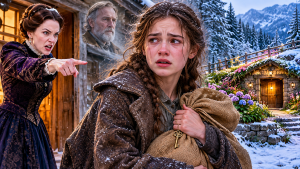
the cruel stepmother threw a 14-year-old girl into the freezing mountains after her father died—but the secret garden she built beneath an abandoned hillside would one day save the very woman who abandoned her
Part 1
On the night of January 4, 1880, fourteen-year-old Verity Halloran stood barefoot inside her father’s cabin in the mountains of West Virginia, watching her stepmother throw the last of her belongings into an old flour sack.
Outside, the temperature had fallen to eight degrees above zero.
Wind rattled the windowpanes. Snow had collected along the fence rails. Beyond the yard, the Appalachian forest rose into darkness, its pine-covered ridges disappearing beneath a pale winter moon.
Cordelia Braswell tied the sack with a piece of twine and shoved it into Verity’s arms.
“Your father is dead,” she said. “And this house belongs to me now.”
Verity looked toward the bedroom where Emmett Halloran had spent the final months of his life.
Six weeks had passed since they buried him beside her mother.
Six weeks since the last person who might have protected her had disappeared beneath the frozen ground.
“Where am I supposed to go?” Verity asked.
Cordelia tightened the black shawl around her shoulders.
“That is no longer my concern.”
“But it’s winter.”
“Then you should have thought of that before becoming such an ungrateful child.”
Verity felt her throat tighten.
She had not stolen the money Cordelia accused her of stealing. She had not refused to work. She had scrubbed floors, carried water, prepared meals, and sat beside her dying father while Cordelia slept.
But none of that mattered.
For weeks, Cordelia had been visiting neighbors throughout Wren Hollow, telling them Verity was dishonest, disobedient, and impossible to control.
The stories had traveled farther than Verity could have walked in a day.
Even people who had known her since birth now looked away when she passed.
Cordelia opened the front door.
Cold air rushed inside, making the oil lamp flicker.
“If you return,” she said, “I’ll have the sheriff take you to the county poorhouse.”
Verity stared at the woman.
“Did you ever love my father?”
For the first time that evening, Cordelia hesitated.
Then her face hardened.
“I gave that man a clean home and three meals a day. More than most women would have done.”
“That’s not what I asked.”
Cordelia seized her arm and pushed her over the threshold.
The door slammed.
Verity stumbled into the frozen mud.
For several seconds, she remained motionless, the flour sack pressed against her chest.
Through the frosted glass, she could see the warm glow of the kitchen lamp.
Then Cordelia’s shadow moved across the window.
The lamp went out.
Verity was alone.
She wore her father’s oversized wool coat, a faded dress, and boots whose soles had begun separating from the leather.
Inside the flour sack were two spare dresses, a pocketknife, a little bread, and a gardening book that had belonged to her mother.
Around her neck hung a small brass key.
Her father had given it to her three nights before he died.
She remembered kneeling beside his bed while he struggled to breathe.
“Verity,” he had whispered, pressing the key into her palm, “when you need it most, go to the smokehouse.”
She had leaned closer.
“Third board from the east wall. Lift it. Promise me you won’t tell Cordelia.”
“I promise, Papa.”
He had attempted to say something else.
But another fit of coughing seized him, and he never finished.
Now the smokehouse stood twenty yards behind the cabin.
Twenty yards that might as well have been twenty miles.
Cordelia had barred the doors, and Verity knew that returning would give her stepmother the excuse she wanted to summon the sheriff.
She touched the brass key through her dress.
Whatever her father had hidden, she would have to leave it behind.
The road south led to Foxglove Junction.
Beyond that lay Marlinton, the courthouse, and the county poorhouse where children without families were sent to work.
Verity knew what happened to girls there.
They scrubbed floors and washed laundry until someone offered them employment or marriage.
Some never left.
She turned north instead.
There was an abandoned place three miles into the mountains, beyond the old logging road.
Her father had shown it to her years earlier.
A ruined cabin.
A forgotten root cellar.
And a hillside everyone in Wren Hollow believed was cursed.
The place had once belonged to Zebulon Craddock, a farmer who died when a falling tree crushed him in 1856.
His widow had abandoned the property soon afterward.
The cabin collapsed.
The land returned to the forest.
But the cellar remained.
Verity remembered her father examining its sandstone walls.
“Good stonework,” he had said. “That fellow knew how to build something that would outlast him.”
She had never forgotten his words.
Now, standing in the dark, she made her decision.
She would rather risk the mountains than surrender her freedom.
She tightened the coat, lifted her sack, and started walking.
The logging trail was buried beneath frozen leaves.
Its ruts had hardened into sharp ridges.
The bare branches overhead creaked as the wind moved through them.
After nearly an hour, Verity reached Anvil Rock, a massive gray boulder marking the beginning of the steeper trail.
That was when she heard the first wolf.
The howl came from somewhere above her.
A second answered from the eastern ridge.
Then a third sounded behind her.
Verity stopped.
She had heard wolves before, but always from the safety of a house.
Never from the middle of the forest.
She searched the darkness for somewhere to climb.
A white oak stood beside the trail.
Its lowest branch hung several feet above her head.
She dropped the flour sack, jumped, and caught the limb with both hands.
Her boots scraped against the bark.
With a desperate kick, she hauled herself upward.
She climbed until she reached a fork fifteen feet above the ground.
Moments later, four gray shapes moved along the trail.
They passed beneath her tree without stopping.
Their breath drifted through the moonlight.
Verity clung to the trunk, scarcely daring to breathe.
Long after they disappeared, she remained among the branches.
Eventually, the cold became more dangerous than the wolves.
She began climbing down.
A rotten limb snapped beneath her weight.
She fell through the darkness and landed violently on her right ankle.
Pain shot up her leg.
She bit her sleeve to keep from screaming.
For several minutes, she lay among the frozen leaves, staring at the stars between the branches.
She wanted her mother.
Not in the distant, quiet way she had wanted her since the funeral five years earlier.
She wanted her with the desperate longing of a little girl who had finally reached the limit of what she could bear.
She remembered her mother kneeling in the garden behind their cabin.
Winifred Halloran had always kept seeds in folded paper packets, labeling each with her careful handwriting.
“The earth wants to give us things, Verity,” she used to say. “We only have to learn how to ask properly.”
Verity closed her eyes.
Then she forced herself upright.
Her ankle could barely hold her weight.
She leaned against the oak, retrieved her sack, and began limping north.
Near midnight, she reached the abandoned Craddock clearing.
The ruined cabin was barely recognizable beneath its covering of vines and fallen timber.
But the cellar entrance still stood.
Sandstone framed a black opening in the hillside.
Verity crawled inside.
The air smelled of damp leaves and old stone.
She gathered dry leaves into a pile and pressed herself against the back wall.
There was no bed.
No food beyond the last of her bread.
No door to keep the wind out.
She pulled her father’s coat tightly around her and waited for morning.
Sometime during the night, while shivering against the stone, she noticed something strange.
The wall behind her was warmer than the air.
Not warm like a stove.
But noticeably warmer than the frozen world outside.
She pressed both palms against it.
The stone held a steady, gentle warmth.
Her father had once told her that earth deep beneath the frost changed temperature slowly.
At the time, she had not understood.
Now, sitting alone in the darkness, she began to wonder.
Could the hillside do more than shelter her?
Could it actually help keep her alive?
Part 2
The first morning, Verity emerged from the cellar into gray sunlight.
Her ankle had swollen badly.
Her lips were cracked.
The few pieces of bread she had carried were gone.
She stood in the clearing and studied the land.
The hillside faced south.
Even in January, sunlight poured across its exposed slope.
Behind the cellar lay a thick mass of earth.
In front of it stretched a small clearing where the old farmer had once cultivated his vegetables.
Verity lowered herself onto a fallen log and opened her mother’s gardening book.
Its cloth cover was worn almost white along the spine.
Several pages had come loose.
She turned to a chapter she had read many times but never fully appreciated.
It described underground growing chambers built into hillsides by German farming families in Pennsylvania.
Three walls were surrounded by earth.
The fourth faced south and admitted sunlight through sloping windows.
The soil below the frost line helped moderate the temperature, while sunlight warmed the interior during the day.
The structures were not miracles.
They required proper drainage, ventilation, insulation, and careful cultivation.
But they allowed farmers to protect crops from conditions that would destroy ordinary gardens.
Verity looked toward the cellar.
Then back at the illustration.
The Craddock cellar already possessed three earth-covered walls.
Its location faced the winter sun.
Its sandstone construction remained strong.
What it lacked was a proper front, growing beds, and enough room.
She found a pointed stick and drew the structure in the frozen dirt.
Beside it, she sketched the changes she imagined.
A wider chamber.
Stepped planting beds.
A drainage channel.
A glass-covered southern entrance.
She stared at the drawing.
Then whispered, “If the hill can protect a seed, perhaps it can protect me.”
The thought was so simple that it frightened her.
Because if it was true, she had something to work toward.
And work meant she could not surrender.
She searched the collapsed cabin.
Beneath a fallen log, she discovered a rusted spade with its wooden handle broken off.
The blade remained usable.
Nearby lay a small pocketknife, an old iron trap, and several pieces of timber that had escaped serious decay.
She carried everything to the cellar.
That afternoon, she found a dented tin box wedged beneath a fallen roof beam.
Inside were three little glass vials, a whetstone, and a folded letter.
The paper was dated April 11, 1856.
It had been written by Zebulon Craddock.
In it, he explained that he had intended to construct an underground growing house like those his father had known in Pennsylvania.
He had begun the work but had not lived to finish it.
The vials contained seeds saved from his mother’s garden.
And near the end of the letter, he had written a few lines that Verity read over and over.
He hoped that if misfortune stopped him, another person would someday finish the work.
Verity looked around the abandoned cellar.
A man dead for almost twenty-four years had left behind a dream.
And she, a girl discarded by her own family, had stumbled into it.
For the first time since Cordelia shut the door, she smiled.
It was a small smile.
But it was real.
The following days were brutally difficult.
Verity learned to move on her injured ankle without putting too much weight on it.
She found running water in a spring east of the clearing, exactly where Craddock’s letter said it would be.
She gathered edible wintergreen berries and used the old trap to catch small animals.
When she managed to catch a squirrel, she prepared it with trembling hands and roasted the meat over a little fire outside the cellar.
The first mouthful nearly made her cry.
She had been so hungry that eating hurt.
But hunger returned the following morning, and the morning after that.
Her coat hung more loosely around her shoulders.
Her fingers split from cold and labor.
At night, she sometimes dreamed that she was back in her father’s cabin, listening to Cordelia calling her name.
She would wake with her heart racing.
Then she would see the rough sandstone wall and remember where she was.
She began digging anyway.
Using the broken spade blade, she loosened clay and soil from the old cellar’s edges.
The work advanced painfully slowly.
One afternoon, she managed to remove only four stones.
Another day, she could not lift her arms enough to work at all.
When her hands bled, she tore strips from her underdress and wrapped them around her palms.
When the weather turned colder, she slept against the earth-covered wall.
She made notes in the margins of her mother’s gardening book.
What she had eaten.
How many stones she had moved.
Where water collected after the snow melted.
Which parts of the clearing received the longest sunlight.
One evening, after a day of particularly difficult digging, she wrote a sentence inside the front cover.
The hill is not my enemy.
She read it back to herself.
Then added another.
It is the only thing here that has not turned against me.
By the third week, she had made a rough door from saplings and bark.
She had cleared the cellar floor.
She had widened one section of the interior.
And she had begun arranging flat stones for planting terraces.
She had also become dangerously thin.
One evening, she was kneeling inside the excavation when a voice came from above.
“Merciful heavens. What are you doing down there?”
Verity jerked upright.
An elderly woman stood at the edge of the clearing.
Her white hair escaped beneath a wool cap, and she carried a hickory walking stick.
Verity recognized her name before the woman introduced herself.
Prudence Kilgore.
The old herbalist from Millstone Run.
People said she had delivered half the children in three neighboring hollows.
They also said she knew every medicinal plant growing between the mountain ridges.
Verity gripped the broken spade.
“I’m building something.”
Prudence looked around.
“That much I can see.”
“A greenhouse.”
The old woman blinked.
“Inside a hill?”
“Yes, ma’am.”
“In January?”
“Yes, ma’am.”
Prudence stepped closer.
She examined the stacked sandstone, the rough door, the ledger, and the narrow drainage channel Verity had begun cutting.
Then she looked at the girl’s bleeding hands.
“How old are you?”
“Fourteen.”
“What’s your name?”
“Verity Halloran.”
The old woman’s expression changed.
“Emmett Halloran’s daughter?”
Verity nodded.
Prudence lowered herself slowly onto a flat stone.
“I helped your mother bring you into this world.”
Verity stared at her.
“You knew my mother?”
“I knew Winifred well enough to recognize her stubbornness in your face.”
For a moment, neither spoke.
Then Prudence looked toward the excavation.
“Your drainage is wrong.”
Verity blinked.
“Ma’am?”
“That channel. When March rain comes down the slope, water will gather against your back wall. You’ll drown every root you plant.”
She pointed with her walking stick.
“Cut the trench diagonally toward the mouth. Lay gravel beneath the beds. And don’t build your roof against that unsupported bank unless you want half the hillside in your lap.”
Verity listened.
The woman was not asking why she had run away.
She was not ordering her back to town.
She was discussing how to save the garden.
“Can it work?” Verity whispered.
Prudence studied the cellar again.
“With proper work? Yes.”
Verity felt tears burn behind her eyes.
“Then please tell me what I’m doing wrong.”
Prudence nodded.
“First, you’re going to eat.”
She stood.
“I’ll return tonight with cornbread, beans, a blanket, and a decent knife.”
Verity opened her mouth, but nothing came out.
The old woman began walking toward the trail.
Then she stopped.
“And girl?”
“Yes, ma’am?”
“Don’t mistake help for charity. I expect you to finish what you’ve started.”
That evening, Prudence returned with food, blankets, tools, and a lantern.
Verity ate slowly beside the fire while the old woman examined the plans.
They talked until the candles burned low.
Prudence explained that a garden could not survive on determination alone.
It needed sound engineering.
Correct soil.
Water management.
A structure that would remain standing through frost, rain, and heavy snow.
“Your mother understood growing things,” Prudence said. “Your father understood timber. You have some of both in you.”
Verity swallowed a mouthful of cornbread.
“Sometimes I think neither of them wanted me enough to stay.”
The old woman looked at her sharply.
“Death is not a choice people make to hurt their children.”
Verity lowered her eyes.
“And your father’s mistakes,” Prudence continued, “do not mean you must spend the rest of your life believing yourself unwanted.”
Verity began crying.
It happened quietly at first.
Then she covered her face with both hands.
Prudence moved beside her but did not force an embrace.
She simply remained there until the tears stopped.
Before leaving, she placed a hand on Verity’s shoulder.
“Tomorrow we start fixing that trench.”
And for the first time in weeks, Verity went to sleep knowing someone intended to return.
Part 3
Prudence Kilgore brought two men to the clearing three days later.
Ellis and Jonas DellaCourt were brothers who worked in logging camps along Millstone Run.
The sawmill had temporarily closed, leaving them without steady wages.
Prudence had arranged payment in food and supplies in exchange for their labor.
She had also required their silence.
No one in Wren Hollow was to learn where Verity lived.
Ellis, the older brother, removed his cap when the girl approached.
“Mrs. Kilgore says you need a trench.”
Verity nodded.
“Forty feet, if we can manage it.”
Jonas surveyed the frozen ground.
“That’s a fair amount of digging.”
“I know.”
“You’re planning to grow vegetables in there?”
“Yes.”
“During winter?”
“That’s the idea.”
Jonas glanced toward his brother.
Ellis shrugged.
“Well, we’d best get started.”
The brothers worked for three days, breaking through hard ground and lifting stones from the excavation.
Verity worked beside them whenever her strength allowed.
They cut a drainage channel, lined it with gravel, and widened the growing chamber.
Prudence supervised from a log outside.
When the men discovered a seam of blue clay, she ordered them to save it.
When they uncovered dry sand beneath the western wall, she insisted that it be stored for the planting beds.
Every material had a purpose.
Nothing was wasted.
Soon, the original cellar began taking the shape Verity had drawn in the dirt.
Still, the most important piece remained beyond her reach.
Glass.
Without it, sunlight could not enter the chamber efficiently while keeping out winter wind.
Verity had no money for windows.
She considered using oiled canvas, but knew it would admit far less light.
One afternoon, Prudence arrived with an older gentleman riding a chestnut mare.
He was tall, silver-bearded, and dressed in a brown coat.
He introduced himself as Colonel Thaddeus Ashcroft.
“I knew your father,” he said.
Verity stiffened.
“From where?”
“The war.”
Her father had rarely discussed his years in the Union Army.
She knew only that he had returned with a limp and nightmares he refused to explain.
Ashcroft looked toward the growing chamber.
“Mrs. Kilgore tells me this was your idea.”
“Some of it. Mr. Craddock began it long before I was born.”
“And you intend to finish it?”
“Yes, sir.”
He nodded thoughtfully.
“I have six panes of window glass stored in my carriage house. They came from an old church building. I also have tools you could use.”
Verity looked at him suspiciously.
“What do you want in return?”
“Nothing.”
“People don’t give things for nothing.”
“No,” the colonel replied. “Usually they don’t.”
He removed his gloves.
“Your father once carried me out of Confederate fire when I could not walk. He saved my life at Antietam.”
Verity stared at him.
“He never told me.”
“That sounds like Emmett.”
The colonel looked toward the mountains.
“He refused every favor I offered afterward. But I’ve carried the debt for eighteen years.”
Verity lowered her eyes.
“I don’t want anyone paying me because they feel sorry for me.”
Ashcroft shook his head.
“I’m offering you materials because I believe you know what to do with them.”
She looked toward the unfinished greenhouse.
Then back at him.
“Will you tell me about my father?”
“Everything I remember.”
“Then bring the glass. And tell me when you come.”
He kept his promise.
The following week, a wagon climbed the logging road carrying six glass panes, proper spades, a saw, nails, a gardening manual, and other supplies.
The colonel also arranged regular wages for the DellaCourt brothers while they worked on the project.
One afternoon in March, Ellis fitted the last pane into its oak frame.
The glass sloped toward the southern sky.
Sunlight entered the chamber and spread across the sandstone wall.
Verity stood in the doorway, staring.
For months, the cellar had been a dark shelter.
Now the entire room glowed.
She walked slowly between the newly constructed planting beds.
Her fingers brushed the warm stone.
“This is what he wanted,” she whispered.
Prudence understood that she was speaking of Zebulon Craddock.
“Perhaps,” the old woman replied. “But I doubt he imagined a girl like you would finish it.”
A thermometer the colonel provided showed the difference the construction made.
Even on cold evenings, the chamber remained considerably warmer than the air outside.
The earth moderated the temperature, while the glass admitted daylight.
Verity knew she would still need to protect crops during severe freezes.
But she finally possessed something more than a hiding place.
She possessed a working growing house.
On April 2, she opened Craddock’s seed vials.
She planted tomatoes, beans, and squash.
Prudence contributed lettuce, spinach, radishes, turnips, and collards.
The colonel sent peas, carrots, beets, and kale.
Verity prepared the beds carefully, mixing forest soil with decomposed leaves, sand, and other amendments.
She pressed each seed into the soil with one finger.
Then she watered the rows.
Every morning, she hurried to the greenhouse before sunrise.
For the first week, nothing happened.
She checked the soil.
Measured its temperature.
Adjusted the coverings.
Waited.
On April 9, she discovered two tiny pale-green leaves pushing through the earth.
Lettuce.
She dropped to her knees.
For several seconds, she could only stare.
Then she laughed.
It was the first unguarded laugh she had made since her father died.
“Mrs. Kilgore!” she shouted when the old woman arrived that afternoon. “Look!”
Prudence examined the seedlings.
She nodded.
“Good.”
Verity grinned.
“Just good?”
“Don’t get proud yet. You’ll still have to keep them alive.”
But Verity saw the smile the old woman tried to hide.
By late April, neat green rows covered the growing beds.
The first harvest was small.
A bowl of lettuce.
A few radishes.
Tender greens that tasted extraordinary after months of dried food and trapped game.
Verity carried the bowl outside and sat in the sunshine.
She remembered her mother kneeling beside her in the garden.
She remembered her father repairing the fence.
She remembered the sound of the cabin door slamming behind her.
Then she looked at the food she had grown.
And she wept.
Not because she wanted to return.
But because she no longer had to.
Summer brought new challenges.
Two strangers arrived in June, claiming to represent someone who had purchased the abandoned Craddock property for unpaid taxes.
They demanded that Verity leave within seven days.
One carried a document bearing a suspicious red seal.
Verity examined it carefully.
“Who signed this?”
“The county register,” the older man answered.
“Then why isn’t his official impression on the seal?”
The man’s expression changed.
“You ought not concern yourself with such matters, girl.”
“I’m concerned because you’re telling me to leave my home.”
“This isn’t your home.”
Verity stood between them and the entrance.
“It is the only home I have.”
The men threatened legal action.
After they left, Verity sent word to Colonel Ashcroft.
He came the following morning, studied the description of the document, and recognized a familiar fraud.
The men had been intimidating isolated settlers into abandoning valuable land.
With his help, the matter reached the county court.
The fraudulent claim collapsed.
Soon afterward, a formal arrangement placed forty acres of the old Craddock property under an agricultural teaching trust, with Verity responsible for its care.
For the first time, she had a secure right to remain on the hillside.
That summer, Barnaby Sculthorpe, the owner of a general store at Foxglove Junction, visited the garden.
He stood among the leafy beds in astonishment.
“Miss Halloran, I’ve never seen vegetables like these coming out of a mountain cellar.”
He offered to purchase her surplus harvest.
She accepted after negotiating a fair price.
The first payment arrived in July.
Verity divided the money into two portions.
One for supplies.
One for emergencies.
She placed both inside a little wooden box beneath her bed.
The girl who had entered the hillside with almost nothing was becoming a farmer.
But prosperity did not erase danger.
In November, while the brothers were enlarging a second growing chamber, a support failed.
Earth and stone collapsed into the excavation.
Verity was caught beneath it.
She heard Ellis shouting her name.
Then a crushing weight drove her against the wall.
Her left shoulder exploded with pain.
For one terrifying moment, she could not breathe.
Ellis and Jonas dug her free, working carefully around the broken timber.
By the time they lifted her out, Verity was nearly unconscious.
A doctor later confirmed that her collarbone was broken.
She would have to stop heavy work for weeks.
That night, lying beneath a blanket in the main chamber, she stared at the glass overhead.
She had survived hunger.
Wolves.
Winter.
Loneliness.
And now the very hillside that had protected her had nearly killed her.
“What if I can’t finish it?” she whispered.
Prudence sat beside the bed.
“You won’t finish it this month.”
Verity turned toward her.
“Or perhaps next month,” the old woman continued. “But you have people to help you now.”
“I don’t want to depend on everyone.”
Prudence took her hand.
“Child, there’s a difference between depending on people and letting them carry you when your bones are broken.”
Verity closed her eyes.
Outside, snow began falling across the clearing.
Inside, beneath the glass, the winter greens continued growing.
Part 4
The winter of 1880 brought cold that seemed determined to break the mountains.
Snow covered the trails.
Creeks froze along their edges.
Families who had stored too little food began stretching flour with cornmeal and feeding their children thinner and thinner soup.
In Wren Hollow, livestock suffered.
Some barns stood without adequate hay.
The general store carried debts that many households could not repay until spring.
But beneath the hillside, Verity’s growing beds remained green.
The greenhouse did not produce unlimited food.
Its space was small.
Every plant required care, and prolonged cloudy weather slowed growth.
Yet the insulated walls, protected soil, and carefully managed ventilation allowed her to harvest vegetables when ordinary gardens stood frozen.
Barnaby Sculthorpe began collecting produce each Saturday.
Some families paid for it.
Others received it on credit.
Verity kept careful records, refusing to allow anyone to take more than the garden could replace.
One afternoon, a woman named Ruth Everly arrived carrying a basket of eggs.
Her husband had injured his leg in a logging accident.
They had four children.
Their food stores were almost gone.
“I heard you could grow things in winter,” Ruth said.
Verity showed her the chamber.
Ruth stared at the spinach.
“How?”
Verity explained the southern exposure, the stone, the glass, and the insulated soil.
Ruth listened carefully.
Then she said, “We have a hillside behind our barn.”
Verity considered her.
“Does it face south?”
“Mostly.”
“Is there good drainage?”
“I don’t know.”
“Then we’ll find out.”
She gave Ruth seeds and a hand-drawn plan.
The following Saturday, Ruth returned with her sister-in-law.
Soon more neighbors began climbing the trail.
They came to see the strange greenhouse.
They came to ask about seeds.
They came because they were tired of watching winter decide whether their children would eat.
Verity began holding Saturday lessons.
She taught people how to select a site, support excavations, control water, prepare soil, and build protective glazing.
She insisted that anyone constructing an underground chamber use adequate timber support and never work beneath an unstable bank.
Her broken collarbone had taught her the cost of careless digging.
One afternoon, after a lesson, Prudence found her sitting outside with her mother’s gardening book open.
“What’s troubling you?” the old woman asked.
Verity hesitated.
“Some of these people lived in Wren Hollow when Cordelia threw me out.”
“I know.”
“They heard what she said about me.”
“I know that too.”
“Not one of them came.”
Prudence lowered herself onto the log.
“Are you thinking of sending them away?”
Verity watched two children carrying baskets of lettuce toward the trail.
“No.”
“Why not?”
“Because their children didn’t throw me out.”
Prudence said nothing.
Verity turned another page.
“And because Mama would have fed them.”
The old woman rested her hands on her walking stick.
“Then you have learned something worth more than gardening.”
As the winter progressed, Verity began thinking again about the brass key.
She still wore it around her neck.
Its edges had become smooth from the years she had spent rubbing it between her fingers.
Sometimes, after a difficult day, she remembered her father’s final instruction.
Third board from the east wall.
She imagined returning to the smokehouse.
She imagined lifting the plank.
But she feared what she might find.
Perhaps nothing valuable.
Perhaps an old family keepsake.
Perhaps another reminder that her father had known Cordelia would hurt her but had failed to stop it.
That last possibility frightened her more than poverty ever had.
One December evening, Colonel Ashcroft came to visit.
He had been helping arrange supplies for families attempting their own hillside gardens.
After supper, he noticed Verity turning the key in her hand.
“Your father gave you that?”
She nodded.
“Before he died.”
The colonel looked at it for a long moment.
“Have you used it?”
“No.”
“Why not?”
Verity looked toward the fire.
“I don’t know whether I want to know what he left.”
Ashcroft folded his hands.
“Your father was not an easy man to understand.”
“He let Cordelia treat me terribly.”
“Yes.”
The simple acknowledgment surprised her.
The colonel continued.
“Emmett was brave under gunfire. I’ve seen him walk through musket fire to save a stranger. But a man may possess one sort of courage and lack another.”
Verity swallowed.
“Do you think he loved me?”
“I know he did.”
“Then why didn’t he protect me?”
Ashcroft looked pained.
“I cannot answer that for him.”
For a long time, they sat without speaking.
Then he said, “Whatever you find in that smokehouse, it will not change what you’ve made here.”
Verity glanced toward the greenhouse.
Beyond the windows, snow drifted against the pine trees.
She had spent nearly a year rebuilding herself from a winter night that should have destroyed her.
But she had not yet confronted the house she had lost.
A few days before Christmas, she made a decision.
She would go back.
Not to ask Cordelia for anything.
Not to reclaim her old bedroom.
And not to settle a score.
She would go because her father had left her a final message, and she had a right to hear it.
Ellis offered to accompany her.
She accepted.
They walked south through the forest on a bitterly cold morning.
At Anvil Rock, Verity paused.
She remembered the wolves.
The fall from the oak tree.
The pain in her ankle.
She touched the scar along her shin through her stocking.
Then continued.
The Halloran cabin appeared at the head of Wren Hollow just before noon.
It looked smaller than she remembered.
The fence sagged.
One shutter hung crooked.
Smoke rose weakly from the chimney.
Cordelia’s garden lay neglected beneath the snow.
Verity stood behind a stand of bare trees.
For a moment, she was fourteen again.
Cold.
Afraid.
Holding a flour sack against her chest.
Ellis waited beside her.
“Are you certain?”
“No,” she admitted.
Then she took another step.
“I suppose that’s why I have to do it.”
The smokehouse stood behind the cabin.
Its door hung slightly crooked on its hinges.
Verity approached quietly.
She had no intention of entering the main house.
Inside the smokehouse, the air smelled of old wood, salt, and cold ashes.
She knelt beside the eastern wall.
Counted the floorboards.
One.
Two.
Three.
The third plank had a narrow keyhole concealed beneath accumulated dirt.
Her hands began shaking.
She drew the brass key from her neck.
For several seconds, she could not bring herself to insert it.
Then she remembered her father pressing it into her palm.
When you need it most.
She turned the key.
Something clicked beneath the floor.
The board loosened.
Verity looked up at Ellis.
Then she lifted it.
Beneath lay a narrow wooden box wrapped in oilcloth.
Her father’s initials had been carved into its lid.
She pulled it into the light.
And opened it.
Part 5
Inside the box lay a folded legal document, a letter bearing Verity’s name, a small canvas bag of silver coins, and a bank draft.
She unfolded the document first.
The paper was old but carefully preserved.
Across the top were the words Deed of Conveyance.
It was dated March 12, 1878.
Verity read the first paragraph.
Then she read it again.
Her father had transferred ownership of the Halloran cabin, its outbuildings, and the surrounding property to her years before his death.
The deed named her as the owner.
It had been witnessed and formally recorded through legal arrangements made while Emmett was still healthy enough to travel.
Cordelia had never legally owned the property.
The house she had used to threaten Verity had belonged to Verity all along.
Verity sank onto the floor.
For several moments, she could not move.
Then she noticed the signatures.
One belonged to a Charleston notary.
The other belonged to Colonel Thaddeus Ashcroft.
Her breath caught.
The colonel had known.
He had witnessed the deed.
He had known since the day he came to the hillside that Cordelia’s claim was false.
Yet he had never told her.
Verity stared at his signature until the letters blurred.
Then she lifted her father’s letter.
She carried it outside into the pale winter sunlight before opening it.
Ellis remained a few paces away.
The letter began:
My dearest Verity,
Her father explained that after his illness worsened, he had become frightened of what Cordelia might do.
He knew the marriage had changed their home.
He knew Verity had been treated unfairly.
And he admitted that his silence had been cowardice.
He had hoped things would improve.
Instead, he had watched his daughter grow quieter, thinner, and more afraid.
He wrote that he had transferred the family property into her name because he wanted to protect her inheritance from any future claim.
He had placed the documents beneath the smokehouse floor and left the key where Cordelia would not find it.
He had intended to explain everything while he still had strength.
But his illness had advanced faster than expected.
Near the end, he wrote something Verity could barely read through her tears.
I failed you in ways a father ought never fail his child. I cannot ask you to excuse those failures. But I need you to know that the house your mother loved belongs to you, and no one has the right to tell you otherwise.
The final paragraph was shorter.
Your mother believed there was a gift in your love of growing things. I believed it too, though I did not say so often enough. Wherever you make your home, remember that you were loved before you could speak, and you will remain loved after I am gone.
Your father, Emmett.
Verity pressed the letter against her chest.
She had imagined a hundred possible things hidden beneath that floor.
Money.
Jewelry.
A family Bible.
She had never imagined an apology.
Nor had she imagined proof that she had not been abandoned in her father’s heart, even though he had failed to protect her while alive.
Ellis watched silently as she cried.
Finally, he offered her a handkerchief.
She accepted it.
“The house is mine,” she whispered.
Ellis nodded.
“It appears so.”
“I could make her leave.”
“With that deed, I believe you could.”
Verity looked toward the cabin.
A thin line of smoke drifted from the chimney.
Somewhere inside, Cordelia was living in a home she had stolen through intimidation and lies.
For a brief moment, Verity imagined walking to the front door, placing the deed before her stepmother, and demanding that she leave in the same clothes she wore.
The thought carried a fierce satisfaction.
Then she remembered standing in the frozen yard at fourteen.
She remembered how terrifying it had been to have nowhere to go.
She did not want to become the woman who had done that to her.
“No,” she said.
Ellis looked at her.
“No what?”
“I’m not putting her out.”
“After what she did?”
“Yes.”
“Why?”
Verity folded the deed.
“Because I know what it feels like.”
She returned the documents to the box.
Then she turned toward the mountain trail.
“Come on. I want to go home.”
That evening, Verity read her father’s letter aloud to Prudence, Ellis, and Jonas beside the hearth.
When she finished, nobody spoke for a long time.
Prudence finally reached across the table and covered Verity’s hand with her own.
“Your mother would be proud of the woman you’re becoming.”
Verity glanced at the letter.
“And Papa?”
The old woman smiled gently.
“I think he’d be proudest of all.”
The wooden box was placed on a shelf beside Winifred’s gardening book and Zebulon Craddock’s seed vials.
Verity kept the deed secure.
But she did not use it against Cordelia.
Instead, she kept building.
Over the following years, the hillside garden expanded into three growing chambers.
Each had insulated earth walls, carefully constructed drainage, and glass fronts facing the winter sun.
People from neighboring counties traveled to see the unusual farm.
Some came with questions.
Others brought tools, seeds, or stories of crops lost to frost.
Verity taught them what she knew.
She showed them mistakes she had made, including the unstable excavation that had broken her collarbone.
She told them to respect the weight of earth, the movement of water, and the limits of their own strength.
She explained that a greenhouse was not simply a hole in a hill.
It was a structure that required judgment, maintenance, and an understanding of how sunlight, soil, and temperature worked together.
By the middle of the decade, several families had built similar gardens.
Then more followed.
A professor from the agricultural station at Morgantown visited the hillside in 1885.
He measured temperatures, examined the growing beds, and asked questions for three days.
On the final evening, he offered Verity a position helping teach her methods to mountain families.
She agreed on two conditions.
First, her work would be published in her own words.
Second, the money paid for her services would support families who could not afford glass, seeds, or basic tools.
The professor accepted.
Verity had become something no one in Wren Hollow could have imagined on the night Cordelia shut the door.
A teacher.
A respected grower.
A woman whose knowledge could change how other families survived winter.
But one afternoon in October 1885, a visitor arrived who threatened to reopen every wound she had struggled to heal.
Cordelia Braswell came walking up the old logging trail.
She was older, thinner, and dressed in a worn coat that had once been expensive.
Her hair had gone almost entirely white.
Her boots were muddy, and she leaned heavily against a walking stick.
Verity was working among the tomatoes when someone came to tell her.
She walked outside.
Cordelia stood at the edge of the clearing.
For a moment, they simply stared at each other.
Five years had passed since the night Verity was thrown out.
The girl Cordelia remembered had vanished.
In her place stood a confident young woman with strong hands, sun-browned cheeks, and the steady gaze of someone who had earned everything she possessed.
Cordelia looked past her at the glass-covered chambers.
“I heard stories,” she said.
Verity waited.
“I didn’t believe them.”
The older woman took another breath.
“I never thought anything like this could be built up here.”
“What do you want, Cordelia?”
Her stepmother looked down.
For the first time Verity could remember, the woman seemed unable to find a ready answer.
Finally, she spoke.
“The roof is leaking.”
Verity said nothing.
“Over the north bedroom. The boards have rotted, and I cannot afford repairs.”
Cordelia swallowed.
“The garden failed this summer. The man who promised to help me left. I’ve sold nearly everything worth selling.”
Her voice trembled.
“I haven’t eaten a proper meal in weeks.”
Verity felt something tighten inside her.
The old memories returned.
The slammed door.
The flour sack.
The wolves.
The terrible cold.
Cordelia looked toward the greenhouses.
“I know I have no right to ask you for anything.”
“No,” Verity replied. “You don’t.”
The older woman closed her eyes.
“I know what I did.”
“Do you?”
Cordelia nodded slowly.
“I was afraid.”
“Of what?”
“Being poor again. Being left with nothing. Your father was dying, and I thought everything I’d worked to secure would disappear.”
“So you took my home.”
“Yes.”
“And told everyone I was a thief.”
Cordelia began crying.
“I thought if people believed you were bad, they wouldn’t question why I sent you away.”
Verity stared at her.
For years, she had wondered whether Cordelia believed her own lies.
Now she knew.
“You could have killed me,” Verity said.
Cordelia lowered her head.
“I know.”
The wind moved across the clearing.
Far behind them, Jonas was repairing a fence.
The ordinary sound of hammering drifted through the trees.
Verity waited until her anger had settled enough for her to speak clearly.
“The house you live in belongs to me.”
Cordelia looked up sharply.
“What?”
“My father transferred it into my name in 1878. I have the deed.”
Her stepmother’s face drained of color.
“He never—”
“He left the document in the smokehouse. Beneath the third floorboard.”
Cordelia gripped her walking stick.
Verity continued.
“I could have removed you years ago. I chose not to.”
The older woman began trembling.
“Are you going to make me leave now?”
“No.”
Cordelia stared.
“But you cannot live here with me,” Verity said. “That part of my life is finished.”
She gestured toward the trail.
“You can remain at the old cabin. I’ll arrange for the roof to be repaired.”
Cordelia opened her mouth.
Verity raised a hand.
“I’m not finished.”
She explained that she would provide seeds, timber, and glass to build a small cold frame beside the smokehouse.
Jonas would help construct it.
A woman from Prudence’s family would teach Cordelia how to manage it.
After that, Cordelia would have to do the work herself.
“You will grow what you eat,” Verity said. “You can trade what you don’t need. But I will not be responsible for supporting you forever.”
Cordelia could barely speak.
“Why would you do this?”
Verity looked toward the mountain ridge.
“Because I know what hunger feels like.”
She turned back.
“And because my mother taught me that knowing how to grow food means having something worth sharing.”
Cordelia covered her mouth with one hand.
“I’m sorry, Verity.”
Verity watched her for a long moment.
Then she answered.
“I believe you are.”
She paused.
“But being sorry doesn’t give me back the childhood you took.”
Cordelia lowered her head.
“I understand.”
“And I am not ready to forgive you.”
The older woman nodded.
Verity stepped aside.
“Jonas will come tomorrow.”
Cordelia began walking down the trail.
Verity watched until the trees concealed her.
Then she returned to her greenhouse.
She did not feel triumphant.
She did not feel that justice had erased anything.
But she knew she had chosen her own future rather than allowing Cordelia’s cruelty to determine the kind of woman she would become.
The years continued.
In 1889, Verity married Lemuel Wainwright, a former coal miner who had lost his left hand in an accident.
He came to one of her Saturday lessons out of curiosity.
He returned because he admired her work.
And eventually he stayed because he loved her.
Their wedding took place inside the original greenhouse.
Sunlight entered through the same glass panes the colonel had donated years earlier.
Prudence stood near the front.
Ellis and Jonas attended with their families.
Colonel Ashcroft walked Verity down the narrow aisle between the planting beds.
As they reached Lemuel, he leaned toward her.
“Your father would have liked this man.”
Verity squeezed his arm.
“I think so too.”
She and Lemuel raised three children among the gardens.
Their children learned to plant seeds before they could write their names.
The teaching operation grew into a center where mountain families exchanged seeds, learned practical growing methods, and helped one another prepare for winter.
When the colonel died in 1892, he left money to support agricultural education in the mountain counties.
Verity helped administer the fund.
She named it in memory of her father.
Not because she had forgotten his failings.
But because she wanted the best part of his life to continue doing good.
In February 1899, a terrible blizzard swept across the region.
Temperatures plunged far below zero.
Roads disappeared beneath snowdrifts.
Several isolated families lost their lives to the cold.
Verity organized the growers she had trained.
Protected gardens supplied greens and other food that could be carried to neighbors.
Volunteers distributed meals and checked on isolated households whenever travel was possible.
Their work could not stop the storm.
But it helped families endure days when ordinary supplies ran dangerously low.
Among those who survived was Cordelia.
By then, she was an old woman living alone in the Halloran cabin.
The little cold frame beside the smokehouse had become her most dependable source of fresh vegetables.
She had maintained it for years.
When the blizzard finally ended, neighbors found her alive.
The same knowledge Verity had refused to withhold from her had helped keep her fed.
Cordelia died in 1902.
Verity paid for her burial.
She did not attend the service.
Instead, she walked to the small family burying ground behind the old cabin and stood beside her parents’ graves.
She remained there until the afternoon light began fading.
Nobody asked what she said.
In the decades that followed, Verity continued teaching.
Her pamphlet on hillside cultivation passed through several editions.
The seed collection expanded.
Her eldest daughter, Winifred, studied agriculture and returned to help preserve and improve the family’s work.
Lemuel died in 1938.
Verity spent her remaining years teaching from a chair inside the main greenhouse.
Her hands had grown stiff with age.
Some days, she could barely hold a trowel.
But she still insisted on examining the seedlings herself.
In April 1942, her family found her sitting peacefully beside a tray of young tomato plants.
Morning sunlight streamed through the glass.
Her face was turned toward the warmth.
She was seventy-six years old.
The woman who had once survived in a dark hole beneath a mountain had spent more than sixty years turning that same hillside into a place of life.
Her family preserved the gardens and the teaching center.
Later generations rebuilt the original chambers with stronger materials, while keeping their locations and purpose.
The collection of seeds grew into the hundreds of varieties.
Students, farmers, and visitors continued climbing the old trail to learn about the young girl who had transformed an abandoned root cellar into a working garden.
A bronze plaque was eventually placed beside the original chamber.
It carried Verity’s name and the years of her life.
Beneath them were a few simple words.
She dug into the dark and found the light.
But perhaps her greatest legacy was not the greenhouse.
It was not the land, the money, the books, or even the families who survived because of her teachings.
It was the choice she had made when the woman who once abandoned her came begging for help.
Verity had every reason to close the door.
She knew what a closed door could do.
Instead, she offered seeds.
And in doing so, she proved that the cruelest things done to a person do not have to determine what that person gives back to the world.
On that freezing January night in 1880, Cordelia had believed she was throwing away a helpless child.
She never imagined that the little girl walking into the mountains would become the woman who taught an entire community how to survive.
And she certainly never imagined that one day, her own life would depend on the garden that child had built.
The earth had given Verity a second chance when people would not.