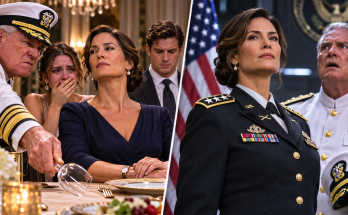
I had never wanted my rank to become part of Olivia's relationship.
That was one reason I had kept my professional life private for so long.
I didn't want her choosing friends because they admired my position.
I didn't want people approaching her because of my uniform.
And I certainly didn't want a man deciding whether she was suitable for marriage based on what her mother had achieved.
Yet that was exactly what had happened.
Richard Whitmore had judged me when he believed I was an ordinary single mother.
Then he discovered I was a three-star Army general.
His manner changed immediately.
I could still picture his face in the conference room.
The surprise.
The uncertainty.
The sudden caution.
He had looked at me as though I had become someone else overnight.
But I hadn't changed.
I had driven home with Olivia on Friday.
I had listened to her cry.
I had stood in the kitchen looking at the flowers she brought me.
I had read Ethan's message.
I had checked my Monday schedule.
Then I had gone to work.
Nothing about those actions had required a different identity.
I was the same woman in every moment.
Only Richard's opinion of me had changed.
That was what troubled me.
I looked at him sitting in my living room.
He seemed to be listening carefully.
He had admitted his mistake.
He had apologized for his comments about my family.
He had acknowledged that he disrespected me in his home.
Those admissions were important.
But I couldn't ignore the timing.
He hadn't come to my house on Saturday.
He hadn't apologized when Olivia cried.
He hadn't corrected Ethan's explanation about leaving before dessert.
The apology came after Monday's meeting.
After he saw my stars.
After he understood that I held a position senior to his.
I couldn't know what he would have done if that discovery had never occurred.
I wasn't going to pretend I could read his mind.
But I could recognize the question.
Would he have apologized to a woman who had no military rank?
Would he have reconsidered his behavior if I truly worked in an ordinary government office?
Would he have cared about my daughter's distress if there had been no professional embarrassment?
Those were questions Richard needed to answer for himself.
I had already asked him something similar at Fort Meade.
After the meeting, he approached me privately.
His confidence had vanished.
He asked whether I was the same Victoria Hayes who attended his dinner.
I confirmed it.
Then he apologized.
But his first explanation was that he hadn't known who I was.
That was the moment I understood how deeply his thinking needed to change.
He believed his mistake was failing to recognize my importance.
I believed his mistake was deciding that a person needed importance before receiving courtesy.
I had asked him about ordinary professions.
A teacher.
A waitress.
A retired employee.
Someone who had never served in uniform.
Would those people deserve humiliation?
He admitted they wouldn't.
Then I asked why he had treated me that way.
He couldn't give me an explanation.
I hadn't expected one.
There was no good explanation.
He had judged me without knowing me.
Then he acted as though that judgment gave him permission to be cruel.
I looked at Olivia.
She understood that better than anyone.
Friday's dinner had been humiliating for me.
But it had been devastating for her.
She had wanted Ethan's parents to welcome us.
She had wanted Patricia to appreciate her gift.
She had wanted Richard to see that we were a family worth knowing.
Most of all, she had expected Ethan to stand beside her.
Instead, he remained silent.
I remembered his message later that evening.
He apologized for the discomfort.
But he also defended Richard.
His father was difficult.
His father was protective.
His father cared about his family.
I had read those words twice.
The explanation had seemed so inadequate.
A man who humiliated a guest wasn't demonstrating protection.
He was demonstrating how much disrespect he expected other people to tolerate.
I had placed the phone down.
I hadn't answered.
There was nothing useful I could say to someone who believed the main problem was that I had taken Richard's remarks personally.
The remarks had been personal.
They were about my daughter.
My family.
The fact that I raised Olivia alone.
How could I not understand them personally?
I thought about my daughter's childhood.
I had always wanted her to feel secure.
I wanted her to know that our family was complete in the ways that mattered.
I wanted her to know she was loved.
I didn't want her growing up believing that a household needed to match someone else's expectations to deserve respect.
Richard's remarks challenged that.
They suggested that raising her alone was something shameful.
I rejected that idea.
I had worked hard.
I had served my country.
I had raised my daughter.
Those were facts I could acknowledge without apology.
Not every decision had been easy.
Keeping my career separate from home had been complicated.
There were times when my work demanded more than I wanted to give.
But I had never considered Olivia a reason for embarrassment.
She was the person I loved most.
I looked at her standing beside me.
She was twenty-six.
Old enough to make decisions about marriage.
Old enough to understand that love involved more than affection.
Old enough to recognize the difference between a difficult conversation and a relationship that required her to ignore her own feelings.
I couldn't take credit for every part of that understanding.
She had reached it through painful experience.
I wished she hadn't needed to.
But I respected what she had learned.
Richard had said Ethan loved her.
I didn't doubt that Ethan had feelings for Olivia.
I had no reason to dismiss three years together as meaningless.
But love couldn't be measured only by declarations.
There had to be action.
Not dramatic action.
Not grand gestures.
Simple things.
Speaking when someone was being treated badly.
Acknowledging a mistake.
Refusing to excuse cruelty merely because the person responsible was family.
Those were the things Olivia needed.
And Ethan had failed to offer them.
I thought about his Monday phone call.
His father had discovered my rank.
Richard felt embarrassed.
Ethan believed Olivia should understand how difficult that was for him.
But he hadn't asked the question that mattered.
Why had Richard treated me badly before he knew?
That question could have changed the conversation.
It could have shown Olivia that Ethan understood the original problem.
Instead, he focused on his father's position.
His years of service.
His professional reputation.
I understood the value of a military reputation.
I had spent thirty years building my own.
I knew how important trust could be between officers.
But trust wasn't protected by avoiding accountability.
It was strengthened when people accepted responsibility.
That was what I expected professionally.
It was what I expected personally.
And I wasn't willing to pretend otherwise.
I looked at Richard.
He had apologized.
I had listened.
I had explained that forgiveness wasn't something he could purchase.
The gift bag remained untouched.
It was a small object.
But it reminded me of the difference between making a gesture and making a change.
A gift could be bought.
An apology could be spoken.
Neither required someone to behave differently tomorrow.
That was the part that mattered.
Richard needed to decide whether he would treat people with respect when he had no reason to fear their influence.
He needed to consider whether his position in the Navy had become an excuse for expecting special treatment.
And he needed to recognize that the damage to Olivia's relationship wasn't something he could repair by speaking to me.
I thought about my own conduct.
I had been angry on Friday.
I had been disappointed by Ethan.
I had been troubled when I saw Richard's name on the Monday schedule.
But I hadn't used my position against him.
I had chaired the readiness review.
I had asked questions.
I had requested the missing personnel information.
I had set the same standards for everyone.
Then I had spoken to Richard privately.
I didn't regret any of it.
It mattered that I could look back without wondering whether I had abused my authority.
My daughter deserved to know that.
Richard deserved to know it too.
I wasn't interested in humiliating him.
I wanted him to understand why humiliation was wrong.
There was a difference.
I looked toward Olivia.
She had been so shocked when I showed her the photograph on Sunday.
I could still hear her asking whether I was really a general.
She had paced around my bedroom.
She had asked why I never told her.
Then she wondered whether Richard knew.
When I said he didn't, she had looked almost astonished.
I understood why.
She imagined his reaction.
She wanted him to realize he had underestimated me.
But I had told her something important.
I didn't want his respect to depend on discovering my rank.
I didn't want her marrying Ethan because his family suddenly saw us as important.
I wanted her to be valued for herself.
And I wanted her to recognize that same value in others.
Now she was doing exactly that.
She hadn't demanded an apology because of my uniform.
She had demanded responsibility because of what happened.
I felt proud again.
And sad.
Both feelings could exist together.
Proud that she had found her voice.
Sad that she needed to use it against people she hoped would become her family.
I watched Richard's expression.
He no longer seemed eager to explain himself.
Perhaps he had begun to understand that listening was necessary.
I hoped so.
But I couldn't know what would happen after he left.
I couldn't know whether he would speak differently to Ethan.
I couldn't know whether Ethan would reconsider his silence.
I couldn't know whether Olivia would continue believing the marriage should end.
Those answers belonged beyond this room.
For now, all I could see was a father, a mother, and a daughter facing what had happened.
Richard had admitted his cruelty.
Olivia had described its consequences.
And I had refused to let my rank become the reason either of those things mattered.
I looked at the gift bag one last time.
I still didn't want it.
The important thing wasn't what Richard had brought into my home.
It was what he might take away from the conversation.
An understanding that people deserved respect before their titles were known.