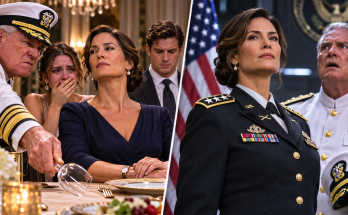
There was one thing I never wanted Richard Whitmore to misunderstand.
I hadn't forgiven his behavior simply because I refused to punish him.
Those were two different decisions.
I could recognize that he had treated me badly.
I could tell him why.
I could expect him to apologize.
And I could still perform my duties without allowing resentment to influence them.
That was what responsibility required.
I had spent thirty years learning it.
Some lessons came through experience.
Others came from watching people who confused authority with personal importance.
I had seen enough to understand that rank could become dangerous when someone forgot why it existed.
A uniform represented service.
It didn't turn its wearer into a better human being.
Three stars carried responsibility.
They didn't make my feelings more valuable than anyone else's.
And they certainly didn't give me permission to settle family disagreements through official decisions.
I thought about that as Richard sat across from me.
If I had wanted to frighten him, Monday morning would have provided the opportunity.
He had been in a conference room with officers from several branches.
Colonel Brooks had announced my arrival.
Everyone stood.
Richard recognized me.
I saw the shock on his face.
I could have used that moment against him.
I could have stared at him until the room noticed his discomfort.
I could have asked unnecessary questions.
I could have turned a routine personnel review into something humiliating.
But what would that have accomplished?
It might have embarrassed him.
It might have satisfied a part of me that was still angry about Friday.
It might have made Olivia feel that her mother had defended the family.
But none of those things would have been worth betraying my responsibilities.
The meeting concerned a joint readiness exercise.
The information mattered.
Officers had come prepared to discuss personnel coordination and logistical requirements.
They hadn't come to witness a private dispute.
I had to remember that.
Richard's behavior at dinner didn't make the other people in the room responsible for our conflict.
They deserved a professional meeting.
And Richard deserved to have his work evaluated fairly.
Even if he hadn't been fair to me.
That was difficult.
I could admit it now.
When I first saw his name on Friday night, I felt the weight of the coincidence.
The man who had spoken to me as though I were beneath him would be reporting to a meeting I chaired.
I knew he would be surprised.
Part of me wanted him to understand how wrong his assumptions had been.
I wasn't ashamed of that feeling.
But I wasn't going to let it control my conduct.
I had built my career on standards that mattered more than a personal insult.
I couldn't discard them when they became inconvenient.
So I went to Fort Meade.
I arrived at six fifteen.
My driver opened the door.
The morning air was cold.
The flag outside headquarters moved in the wind.
I walked into the building wearing my dress uniform.
Nothing unusual.
Nothing arranged for Richard.
It was simply another morning of work.
Colonel Brooks met me outside the conference room.
He handed me the briefing folder.
He confirmed that the Navy delegation had arrived.
Richard was among them.
I remembered pausing when Brooks said his name.
Only briefly.
Then I asked whether the meeting was ready.
It was.
We began.
That was the correct choice.
I remembered walking to the head of the table.
Richard's face had changed.
He looked at my shoulders.
Then at me.
For a moment, he seemed unable to understand what he was seeing.
I knew what had happened.
He had connected the woman from Friday's dinner with the general entering the conference room.
But I didn't acknowledge the connection.
I welcomed the officers.
I opened my folder.
And I began the readiness review.
We discussed the planned exercise.
Personnel figures.
Operational schedules.
Logistical requirements.
Unresolved coordination matters.
I asked the questions the material required.
Richard spoke when his office's responsibilities came up.
At one point, the personnel allocation report contained a discrepancy.
I asked him to explain it.
He told me his office was reviewing the matter.
I asked who was responsible.
His office.
I asked when the results would be available.
Wednesday.
I wrote the date down.
Then I moved on.
That was all.
No accusation.
No personal remark.
No attempt to make the discrepancy seem more serious simply because Richard had offended me.
I expected accurate figures.
I expected the report by Wednesday.
Those expectations would have been identical if the officer responsible had been someone I'd never met.
I thought about how important that was.
A professional standard couldn't change depending on whether I liked someone.
If it did, it wasn't a standard.
It was a preference.
And preferences weren't enough when other people depended on the work.
I looked at Richard in my living room.
He had seen how I conducted the meeting.
He knew I hadn't threatened him.
He knew I hadn't publicly confronted him about Friday.
Yet he had apparently described the experience to Ethan as humiliating.
That troubled me.
Not because I needed Richard to approve of my conduct.
But because it suggested he still measured the situation through embarrassment.
He felt exposed.
He felt uncomfortable.
He disliked discovering that the person he had insulted outranked him.
But discomfort wasn't the same as mistreatment.
Sometimes discomfort was the result of recognizing one's own behavior.
I couldn't remove that discomfort for him.
Nor did I believe I should.
He had choices to make about what he learned from it.
I had made my choices already.
I thought about the leadership guidance Colonel Brooks distributed near the end of the meeting.
The officers had received their copies.
I had spoken about conduct.
Not about Richard.
Not about my dinner.
About the obligations shared by everyone in that room.
I wanted them to remember that authority was tied to service.
I wanted them to consider how they treated people who couldn't offer them anything.
I wanted them to understand that respect couldn't be demanded while dignity was denied to others.
Those weren't new ideas.
They were standards I had believed in for years.
Friday had simply reminded me why they mattered.
I hadn't named Richard.
I hadn't needed to.
If he recognized himself in the guidance, that was something he could consider privately.
But the message wasn't written for him alone.
It applied to me too.
I looked at my hands.
That was the part I kept returning to.
I couldn't ask Richard to avoid abusing authority while using my own authority to retaliate.
I couldn't tell him respect was universal and then decide he deserved professional mistreatment because he had been cruel.
I couldn't claim that uniforms represented service while treating mine as a weapon in a family disagreement.
It would make everything I said meaningless.
I wasn't willing to do that.
After the meeting, Richard approached me.
He asked to speak privately.
I agreed.
His first apology was awkward.
He said he hadn't known my position.
I remembered looking at him.
That was the moment I realized he still didn't understand the problem.
I asked whether my behavior toward someone should depend on knowing their career.
He admitted it shouldn't.
Then I asked him to consider why he had treated me differently when he believed I was an ordinary single mother.
He didn't offer a convincing explanation.
I hadn't expected one.
The purpose wasn't to win an argument.
It was to make him examine the assumptions that had guided his behavior.
I told him his professional responsibilities would remain separate.
He would be evaluated fairly.
His office would still have to complete its work.
The incident at dinner would not become a reason for improper decisions.
He appeared relieved.
I remembered noticing that.
It told me he had been worried about what I might do.
I understood the worry.
But I also wondered what it said about his own view of authority.
Perhaps he expected someone with greater rank to behave the way he had behaved when he believed he held the advantage.
I couldn't know.
I didn't ask.
I simply made my position clear.
Fairness wasn't something I offered because I liked him.
It was something I owed the work.
And the people affected by it.
I looked at Richard again.
He had come to my house without his uniform.
He had carried a gift.
He had apologized more directly than he had at Fort Meade.
Those were things I could acknowledge.
But I didn't want him leaving with the belief that the greatest problem had been his failure to recognize a superior officer.
The problem was how he treated someone he considered unimportant.
That lesson went beyond military rank.
It belonged in his home.
At his dinner table.
In the ordinary moments when nobody wore insignia.
I thought about Olivia.
She had been raised without knowing the full extent of my professional position.
I had kept that information separate because I wanted her life to be hers.
I wanted her achievements to belong to her.
I wanted her relationships to form without the influence of my rank.
I had never imagined that the secrecy would become part of such a painful discovery.
But when she learned the truth Sunday morning, I had made something clear.
She shouldn't use my rank to demand respect from Richard.
If his family welcomed us only after learning I was a general, that welcome would be difficult to trust.
Olivia had listened.
And now she was demonstrating that she understood.
She hadn't asked Richard to admire my career.
She hadn't described my stars as proof that he should be ashamed.
She had spoken about Ethan's silence.
She had spoken about loyalty.
She had spoken about what it meant to stand beside someone.
That made me prouder than any reaction Richard had shown at Fort Meade.
I looked toward my daughter.
Her face remained serious.
She was still carrying the weight of the Monday phone call.
Ethan had defended his father.
He had asked her to understand Richard's professional embarrassment.
He had suggested that I should apologize to restore peace.
And he had been unable to explain why.
Olivia had finally said she didn't believe they should marry.
I knew that wasn't a decision she made lightly.
I knew she might continue questioning it.
But I respected the reasons she had given.
She didn't want to marry someone hoping courage would arrive afterward.
She wanted to see it before she made that commitment.
I understood.
I looked back at Richard.
He had apologized.
That was his decision.
I had treated him fairly.
That was mine.
Olivia had questioned the wedding.
That was hers.
And Ethan still had to answer for his own behavior.
I couldn't take responsibility for all of them.
I had enough responsibility already.
I thought about the untouched gift bag.
It was a reminder that some things couldn't be resolved by offering something in return.
Richard couldn't buy forgiveness.
I couldn't command trust.
Olivia couldn't make Ethan brave.
And Ethan couldn't erase Friday simply by saying he loved her.
Each of us had to decide how we would behave.
That was the lesson I had spent thirty years learning.
Not that authority made people right.
Not that rank guaranteed respect.
But that character appeared most clearly when doing the right thing was uncomfortable.
I looked at my daughter.
Then at Richard.
I didn't need him to fear my stars.
I needed him to understand why I had never used them against him.