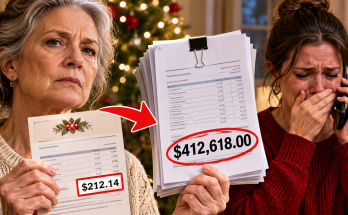
I had spent weeks thinking about a Christmas invoice.
But until that Sunday dinner, I had never imagined that Mark had told his parents I volunteered to pay.
I looked at his mother.
She seemed genuinely uncomfortable.
I could see that she had not expected her explanation to upset anyone.
Perhaps she thought she was clearing up an ordinary misunderstanding.
But there was nothing ordinary about what I had just heard.
I had never offered to pay a calculated share of Christmas dinner.
I had brought a ham.
I had made pies.
I had brought shortbread.
And I had helped clean afterward.
Those were my contributions.
I had offered them gladly.
But the $212.14 had arrived afterward.
Without discussion.
Without agreement.
Without even a warning that the evening would be divided into charges.
Now Mark's mother was telling us that her son had described something entirely different.
I looked at Lauren.
She was staring at him.
Her face had gone pale.
"Mark?"
He did not answer.
His mother looked toward me.
"I'm sorry. I thought you had asked to contribute."
I shook my head.
"I never asked to be billed."
She looked embarrassed.
I could see that she was trying to make sense of the situation.
She had attended Christmas.
She knew I had brought food.
Perhaps she had assumed the financial arrangements were something Lauren and I had discussed privately.
I could understand that.
What I could not understand was why Mark had told her something that was not true.
His mother continued carefully.
"He said you didn't want us carrying the cost of your portion."
I looked at her.
"That's what he said?"
She nodded.
"Yes."
I turned toward Mark.
He was looking down at his plate.
I waited for him to explain.
He did not.
Lauren leaned forward.
"Mark, did you tell your parents that Mom offered to pay?"
He rubbed his forehead.
I recognized the gesture.
He seemed irritated.
Not embarrassed.
Not apologetic.
I tried not to judge too quickly.
People could become defensive when they felt accused.
I wanted to hear his explanation.
Lauren asked again.
"Did you?"
Mark looked toward his mother.
Then at his father.
Finally, he nodded.
"Yes."
Lauren stared at him.
I felt something settle heavily in my stomach.
He had admitted it.
There was no misunderstanding.
He had told his parents I volunteered to contribute.
And he knew that was not what happened.
Lauren's voice was quiet.
"Why would you say that?"
Mark leaned back.
"I didn't want the whole thing to turn into a problem."
I almost laughed.
Not because it was funny.
Because the explanation made so little sense.
He had created a spreadsheet.
He had calculated my share.
He had persuaded Lauren to send an invoice.
Then he had told his parents I had volunteered.
And now he was saying he wanted to avoid a problem.
I looked at him carefully.
"Mark, nobody told me there was a shared charge until after Christmas."
He looked uncomfortable.
"I know."
"Then why tell your parents I offered?"
He shrugged slightly.
"I was trying to keep things simple."
Simple.
That word bothered me.
Nothing about the situation had been simple for me.
I had paid the money.
I had sat alone at my kitchen table wondering whether my daughter still wanted my company.
I had opened boxes of old receipts.
I had prepared eleven pages of expenses because I could not find another way to explain my hurt.
Lauren had cried at eleven o'clock at night.
She had come to my house the following morning.
And Mark was calling his explanation simple.
I looked at Lauren.
She was still staring at him.
"That's not what you told me."
He frowned.
"What?"
"You told me charging Mom was normal."
I stayed quiet.
She continued.
"You said everyone should share expenses."
Mark looked away.
"That's what I believed."
Lauren shook her head.
"Then why didn't you tell your parents what we were doing?"
He sighed.
"Lauren, it wasn't a big deal."
I felt my chest tighten.
Those words again.
A small amount.
A practical decision.
No reason to be upset.
I had heard versions of that explanation since the invoice arrived.
But the money had never been the important part.
It was the way I had been treated.
And now I was learning that Mark had not even been honest about the arrangement.
His father cleared his throat.
I looked toward him.
He seemed uncomfortable.
But he also looked as though he had something to say.
"Mark told us something else."
Mark's head lifted.
"Dad."
His father looked at him.
"I'm only explaining what we were told."
Mark did not answer.
His father turned toward Lauren.
"He said the invoice was meant to show your mother how much it costs to host a holiday."
I stared at him.
I could feel Lauren becoming still beside me.
His father continued.
"We understood it as a way of helping her see the expenses."
I looked down at my plate.
I had spent more than three decades paying household expenses.
I had raised a daughter.
I had supported her through difficult decisions.
I had helped with a wedding that never happened.
I had given her money for a condominium.
I had allowed her to live with me for eleven months after her divorce.
And Mark had apparently decided that I needed a lesson about the cost of hosting dinner.
I felt anger rising.
I did not want it to control me.
So I folded my hands beneath the table.
Lauren looked at her husband.
"Did you say that too?"
Mark sighed.
"Can we not turn this into an interrogation?"
She did not move.
"Did you?"
He looked at her.
"I was just explaining the idea."
"What idea?"
"The expense sharing."
Lauren shook her head.
"That isn't what you told Mom."
I looked at her.
She was right.
To me, Mark had been described as someone trying to make household costs fair.
To his parents, I had supposedly volunteered to pay.
And the invoice had been explained as a lesson in what hosting cost.
Those explanations did not fit together.
I could see Lauren recognizing that.
Her expression was changing.
She no longer looked merely embarrassed about sending the bill.
She looked confused by her husband's behavior.
"Mark, you told me Mom wouldn't mind."
He looked at her.
"I thought she wouldn't."
"Because you said she didn't have many expenses anymore."
His mother turned toward him.
I noticed her expression.
She seemed surprised.
Mark's father looked uncomfortable.
I stayed silent.
I had already told Lauren what I thought about anyone making assumptions about my finances.
I did not need to repeat it.
Lauren continued.
"You said it would be fair."
Mark shrugged.
"Yes."
"But you told your parents Mom offered."
He said nothing.
"And you never suggested sending them the same invoice."
His mother looked at him.
I could see that she was beginning to understand why Lauren was upset.
Mark rubbed his forehead again.
"You're making too much of this."
Lauren looked at him for a long moment.
Then she spoke quietly.
"No. I'm trying to understand what actually happened."
That was when I felt something shift.
I had been worried Lauren would let Mark explain everything away.
I had been worried she might decide that keeping peace at home mattered more than asking difficult questions.
But she was not backing down.
She was asking.
Listening.
Comparing what she had been told with what everyone else had heard.
I felt proud of her.
And worried for her.
Both feelings came at once.
I knew how painful it could be to discover that someone close to you had been telling different versions of the same event.
It could make you question more than one conversation.
It could make you question your own judgment.
Lauren had already admitted that she ignored her doubts about charging me.
Now she was learning that the explanation she trusted had not been the explanation Mark gave everyone else.
I wanted to protect her.
I wanted to tell her she did not need to keep asking.
I wanted to make the dinner comfortable again.
But that would have been another way of making her decisions for her.
She was the one who had to understand what was happening.
Mark's mother placed her napkin beside her plate.
"I didn't realize there had been no agreement beforehand."
I looked at her.
"There wasn't."
She nodded slowly.
"I see."
I could tell she felt awkward.
I did not blame her.
She had not sent me the invoice.
She had not prepared the spreadsheet.
She had come to dinner expecting an ordinary evening.
Just as I had.
His father looked at me.
"I'm sorry if we misunderstood."
I shook my head gently.
"You were told something different."
He nodded.
For a moment, nobody spoke.
I thought perhaps the conversation might end there.
Mark had admitted what he told his parents.
Lauren had made her apology.
His parents understood that I had not volunteered to pay.
It was uncomfortable, but the facts were clearer.
Then Lauren looked at Mark again.
"I want to know why you were so determined to charge my mother."
Mark frowned.
"I wasn't determined."
She stared at him.
"You made the spreadsheet."
He looked at me.
I recognized the expression.
He seemed to know Lauren had told me.
I did not look away.
Lauren continued.
"I told you it felt wrong."
Mark sighed.
"And I explained why I disagreed."
"You told me everybody contributed."
"That was the plan."
Lauren shook her head.
"But everybody wasn't billed."
He leaned back.
"Lauren."
"No. I need you to answer."
I could see how difficult this was for her.
She was speaking firmly.
But her hands were trembling.
I wanted to take one.
Instead, I let her speak.
"Why was Mom the one who received a bill?"
Mark looked annoyed.
"Because she hadn't paid her share."
I stared at him.
There it was.
The same reasoning that had hurt me from the beginning.
He had decided I owed something.
He had decided what counted as a contribution.
He had decided that the food I brought did not count.
And he had allowed Lauren to send the invoice.
I looked toward the dining table.
The roast chicken was cooling.
The potatoes had barely been touched since Lauren began speaking.
I thought about how easily family meals could become something painful when people stopped treating one another with care.
Lauren looked at Mark.
"Mom brought food."
He shrugged.
"That was her choice."
I closed my eyes briefly.
The words were exactly what Lauren had told me.
Hearing them from him made them no easier to accept.
Lauren stared at her husband.
"She helped clean."
Mark said nothing.
"And she brought gifts."
He looked irritated.
"Lauren, that's what people do at Christmas."
She took a breath.
"Exactly."
I looked at her.
Her voice had become steadier.
"That's what family does."
Mark leaned back.
I could see that he wanted the conversation to end.
But Lauren was not finished.
She looked at him directly.
"If this was really about fairness, why did the rules change depending on who you were talking to?"
For the first time that evening, Mark did not have an immediate answer.
I sat quietly beside my daughter.
And I understood that the conversation was no longer only about the $212.14.
It was about whether the people sitting at that table had been told the truth.