Lauren kept holding my hand.
The old wedding records were still spread across the table.
I could see the amount that had upset her.
I could also see that she was no longer looking at it as an accusation.
She was remembering.
I knew that expression.
I had seen it when she was trying to make sense of something she had misunderstood for years.
"Mom, I thought you were just being kind when I canceled the wedding."
I smiled faintly.
"I was trying to be."
"But you were dealing with all of that money."
"Yes."
"And you never told me."
"No."
She looked down.
"Why?"
I thought for a moment.
"Because I didn't want you believing that money was a good reason to marry someone you didn't love."
Her fingers tightened around mine.
I could feel how much that answer affected her.
The wedding had been years ago.
But some feelings stayed close to the surface.
I remembered her fear.
Her embarrassment.
The way she had worried about what people would think.
I had tried to make one thing clear to her.
She was allowed to change her mind.
Even when changing her mind was expensive.
Lauren looked at me.
"I was so ashamed."
"I know."
"I thought I'd ruined everything."
"You hadn't."
She laughed sadly.
"It felt like I had."
I nodded.
"Sometimes doing the right thing still hurts."
She looked at the page again.
Then she slowly released my hand.
"I want to keep going."
"All right."
She moved the papers.
I watched her find the section about the months after her divorce.
Her face changed.
The embarrassment I had seen a moment earlier became something quieter.
She stared at the page.
Then she looked toward the kitchen doorway.
I knew what she was remembering.
She had lived in this house for eleven months.
Not as a visitor.
Not for a weekend.
She had come home because her life had fallen apart and she needed somewhere safe to begin again.
I had made room for her.
I had not asked her to explain every mistake.
I had not asked her to promise she would never need help again.
I had simply opened the door.
Lauren looked at the figures.
"Eleven months."
I nodded.
"Yes."
"I knew it was almost a year."
"It was."
"But I never thought about the household expenses."
I looked at her.
"Why would you?"
She gave me a sad smile.
"Because I was an adult, Mom."
"You were an adult having a difficult time."
"That didn't mean everything was free."
"No."
She looked down at the document.
"Yet you never charged me."
I shook my head.
"No."
"Not once."
"No."
She sat back.
I could see that the words were becoming difficult for her.
She had known she was welcome here.
She had known I would help her.
But she had never been asked to consider what it took to maintain that welcome.
I did not blame her for that.
I had wanted her to feel safe.
There was a difference between being grateful for help and having to calculate what every kindness cost.
I hoped she was starting to see it.
"Do you remember when you first came back?" I asked.
She looked up.
"A little."
"You were exhausted."
She nodded.
"I felt like everyone was judging me."
I remembered.
She had been carrying a sadness that seemed to follow her into every room.
Some days she spoke about the divorce.
Other days she could barely stand to mention it.
I had learned to leave questions alone when she needed quiet.
I had not always managed perfectly.
I was her mother.
I worried.
And sometimes I worried too openly.
But I had tried to give her somewhere she did not have to defend herself.
"I didn't want you coming home to another argument about money," I said.
She pressed her lips together.
"But you still had bills."
"Of course."
"Food."
"Yes."
"Electricity."
"Yes."
"Everything."
I nodded.
"Everything."
She looked miserable.
I reached across the table again.
"Lauren, those bills were my responsibility. I had a home to run before you came back, and I had one afterward."
"But they increased because of me."
"Some expenses did."
She swallowed.
"And you never said anything."
I took a breath.
"I didn't want you waking up every morning feeling like you were costing me something."
She began crying.
I handed her another napkin.
She took it without looking at me.
"I wish I'd known."
I considered that.
I did not want her to misunderstand.
"Would knowing have helped you get through the divorce?"
She thought about it.
Then she shook her head.
"No."
"It probably would have made you worry more."
"Yes."
"That's why I didn't tell you."
She looked at me.
There was something almost childlike in her expression.
"Mom, you always did that."
"Did what?"
"Made the hard things feel smaller."
I looked at my coffee.
It had gone cold.
I did not know whether that was something to be proud of.
Sometimes I had made things easier for Lauren because I could.
Sometimes I had hidden too much.
Perhaps that was part of how we had arrived at the Christmas invoice.
She had grown used to help appearing without understanding what it required.
I had grown used to giving without explaining when something hurt.
Neither habit was entirely fair to the other.
I wanted to say that.
But I did not want to turn the conversation into another lecture.
So I waited.
Lauren looked down at the pages again.
She traced one of the lines with her finger.
"I never thanked you properly."
"You thanked me."
"Not enough."
I smiled faintly.
"I didn't keep a record of your thank-yous."
She let out a small laugh.
Then she became serious.
"But you kept all these receipts."
"Yes."
"Why?"
I looked at the documents.
Some were old.
Some had faded.
Others were still clear enough that I could read every detail.
"I kept things because they reminded me of important moments."
She looked surprised.
"Even bills?"
"Sometimes especially bills."
I thought of the hospital receipt.
The doctor.
The sticker.
The relief of bringing Lauren home.
I thought of the wedding deposits.
The disappointment that had eventually become relief.
I thought of the condominium contribution in 2015.
A gift I had wanted her to have.
The receipts had never meant that I was secretly waiting to collect money.
They had simply stayed with the memories.
I tried to explain that.
"A receipt can remind you of something much bigger than the amount printed on it."
She nodded slowly.
"Like the hospital."
"Exactly."
She turned another page.
Then she stopped.
I knew what she had found.
Page ten.
The note from November 2017.
It was not an expense.
There was no amount beside it.
Just a record of one night when Lauren had come home crying and I had made her favorite soup.
She read it quietly.
I watched her expression.
Her mouth moved slightly as she reached the time.
2:30 a.m.
Then she looked up.
"You remember that night?"
I nodded.
"Very clearly."
She stared at me.
"I didn't know you did."
"Of course I do."
She looked back at the paper.
"I came home from work."
"Yes."
"And I was crying."
"You were."
She took a breath.
"I remember the soup."
I smiled.
"I thought you might."
Her eyes filled.
"I remember sitting here."
"So do I."
She looked around the kitchen.
Nothing remarkable had changed about the table.
It was still the place where we drank coffee.
Where I opened the Christmas invoice.
Where I had counted years of expenses.
And where Lauren had once sat crying because life had become more than she could manage.
I remembered the sound of her voice that night.
I remembered how late it became.
I remembered that neither of us seemed interested in looking at the clock.
I had simply stayed awake.
That was what she needed.
Not advice every minute.
Not a solution to everything.
Someone willing to sit beside her until she felt steady enough to go to bed.
"Mom, why did you put this in there?"
I looked at the note.
"Because it was important to me."
"But there's no charge."
"No."
She stared at me.
"I don't understand."
I folded my hands.
"That was the point."
She looked confused.
I continued.
"I could count the cost of the chicken."
She nodded.
"I could count what I spent making dinner that night."
"Yes."
"But how would I put a price on sitting with my daughter when she was heartbroken?"
Lauren covered her mouth.
I waited.
"How would I charge for those hours?"
She began crying.
I reached for her hand.
"I couldn't."
She squeezed my fingers.
"And I wouldn't."
Her shoulders shook.
I moved my chair closer.
She leaned toward me.
For a moment, she rested her forehead against my shoulder.
I put my arm around her.
I remembered doing the same thing when she was much younger.
I remembered how often I had wished I could take away whatever hurt her.
That morning, I could not.
She was facing something uncomfortable.
Something she had done.
And I knew she needed to face it.
But she did not need to face it alone.
"Mom, I'm so ashamed."
I rubbed her shoulder.
"I don't want you to be ashamed of needing me."
She shook her head.
"That's not what I mean."
I waited.
"I'm ashamed that I could accept all of this and then send you a bill for one dinner."
I closed my eyes.
There it was.
The understanding I had hoped for.
Not that the money was too much.
Not that the invoice was too long.
Not that she suddenly owed me something.
She understood why her decision had hurt.
I held her a little tighter.
"That's what I wanted you to see."
She cried quietly.
I let her.
There was no point rushing the moment.
Eventually, she straightened.
She wiped her face.
Then she looked at the papers again.
"I can't believe you never asked me to repay any of it."
I shook my head.
"I didn't lend you those things."
She looked at me.
"I gave them because I wanted to help."
"But that much money."
"I know."
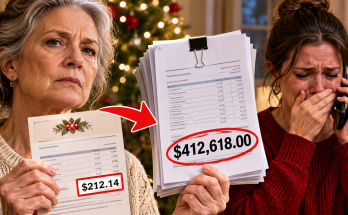
She glanced at the total.
"$412,618."
"Yes."
She looked overwhelmed.
I took her hand again.
"Lauren, listen carefully."
She met my eyes.
"I am not asking you for that amount."
Her face tightened.
"I know."
"I don't want monthly payments."
She nodded.
"I don't want interest."
Her eyes filled again.
"And I don't want you spending the rest of your life trying to settle an account that never existed."
She began to cry.
I continued.
"I wanted you to see the difference between giving something because you love someone and charging them afterward for something they thought was a gift."
She nodded.
"I understand."
I hoped she did.
But there was something else I needed to tell her.
Something the eleven pages could not explain.
I thought of the little girl who used to make birthday cards with uneven hearts.
I thought of the young woman who called to tell me about ordinary things.
A pretty bird outside her office.
Something funny that happened during the day.
A small piece of news she wanted to share simply because she thought I would enjoy hearing it.
Those calls had become less frequent.
I had noticed.
I had told myself she was busy.
She had work.
A marriage.
A new house.
Responsibilities.
I understood all of that.
But I had missed her.
Not the expensive gifts.
Not the occasional formal thank-you.
Her.
I looked at Lauren.
She was still holding my hand.
I decided it was time to say what I had been holding back.
"There's something I want more than any money."
She looked up.
"What?"
I took a breath.
"I want us to feel like mother and daughter again."
She stared at me.
I continued.
"I don't want every visit to have a reason attached to it."
Her eyes widened.
"I don't want you calling only when you need something."
She began shaking her head.
"Mom."
"And I don't want to come to your house wondering whether I'm welcome unless I contribute."
She covered her mouth.
I felt tears in my own eyes.
"I miss you, Lauren."
For several seconds, she did not move.
Then she stood so quickly that her chair scraped against the floor.
She came around the table.
And she put her arms around me.
I held her.
This time, neither of us spoke.