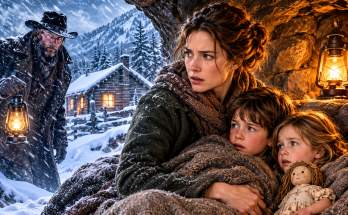
I thought finding work would be easier than finding kindness.
Looking back, that was a foolish assumption.
But I was eighteen.
I had never tried to survive entirely on my own.
And my grandfather had taught me that work was something a person could always offer, even when they had little else.
So I walked toward Pinewood believing there would be someone who needed a pair of hands.
The town wasn't far enough away to make me forget the house I had left.
Every time I looked behind me, I half expected to see Elias coming after me.
Not to apologize.
Just to say he had reconsidered.
I knew better.
Still, I looked.
The road was hard beneath my shoes.
A few patches of snow lay along its edges.
The air hurt my cheeks.
I kept my blanket wrapped around my shoulders and held my small bundle against my side.
Twelve dollars.
I had counted the money before leaving the house.
Then I counted it again as I walked.
There was something comforting about knowing exactly what I had.
Twelve dollars wasn't enough to solve my problem.
But it was more than nothing.
I told myself I would spend it carefully.
Only on food.
Only when necessary.
I would find work first, then arrange somewhere to sleep.
That seemed sensible in the morning.
By afternoon, it seemed childish.
Pinewood had a general store, stables, a boarding house, and a small saloon.
There were people going about their business.
Men carrying supplies.
Customers entering shops.
Horses shifting in the cold outside.
To everyone else, it seemed to be an ordinary working day.
To me, every building represented a possibility.
I stopped at the general store first.
I waited until the shopkeeper had finished attending to another customer.
Then I approached the counter.
"Excuse me. Do you need someone to help here?"
He looked at me.
His eyes moved from my worn clothes to the bundle beneath my arm.
"What sort of help?"
"Cleaning. Carrying things. Anything you need done."
He shook his head.
"Nobody needed just now."
I tried again.
"I don't mind hard work."
"That's good to hear. But I can't hire you."
I thanked him.
Then I stepped outside.
My face burned.
I told myself not to be upset.
One refusal meant nothing.
People had reasons.
Businesses had expenses.
Not everyone could give work to a girl simply because she asked.
So I went to the stables.
I could clean.
I could carry water.
I knew how to mend simple wooden things.
Grandpa had made certain of that.
The man there barely waited for me to finish.
"We've got enough help."
"Even for a few hours?"
"No."
I stood awkwardly for a moment.
Then I left.
The cold felt sharper outside.
I pulled my blanket higher around my neck.
I had imagined that offering to work would be enough.
I hadn't considered what happened when nobody wanted what I could offer.
At the boarding house, I asked whether there was work in the kitchen.
The woman listened.
Then she explained that she had no place for another worker.
I asked whether she knew anyone else who might need help.
She shook her head.
It wasn't a cruel answer.
In some ways, that made it harder.
I couldn't be angry with people simply for having no work.
I couldn't demand that strangers solve my problems.
All I could do was keep asking.
I walked to the saloon.
I hesitated outside.
I had never liked places where people drank and raised their voices.
But I needed work.
And pride wouldn't buy supper.
I went in and asked.
There was nothing available.
I came out feeling smaller than when I entered.
A few people looked at me as I passed.
Perhaps they noticed the blanket.
Perhaps they wondered why a young woman was walking around town alone.
I tried not to care.
One shopkeeper asked whether I had family with me.
"No," I answered.
He frowned.
He told me a young woman shouldn't be going from place to place without relatives to look after her.
I stood there listening.
It was the sort of advice that might have sounded reasonable to someone who had somewhere to go.
To me, it was unbearable.
I wanted to tell him that I knew exactly how dangerous the world could be.
I wanted to explain that I hadn't chosen to be alone.
My mother had died.
My grandfather was gone.
My stepfather had decided his duty to me ended when I became eighteen.
But I didn't tell him any of that.
I said I understood.
Then I left.
Outside, I stopped near the edge of the street.
I was angry.
Not at that particular man.
At the way people spoke about having family as though it were something everyone could arrange.
As though I had simply forgotten to bring mine along.
I had a name.
Mary Holt.
I had skills my grandfather had spent years teaching me.
I was willing to do whatever honest work someone gave me.
But none of those things seemed to matter as much as the fact that I had no one standing beside me.
I tried another place.
Then another.
The answers barely changed.
There was no work.
There might be work when the weather improved.
Perhaps I should return in spring.
Spring.
I remember that word.
It sounded impossibly far away.
I didn't need work in spring.
I needed somewhere to sleep that night.
By late afternoon, I had stopped expecting anyone to say yes.
I was still asking.
But the hope had gone out of my voice.
I walked past the boarding house again.
For a moment, I considered renting a room.
One dollar for a night.
That was the price.
One dollar.
It seemed reasonable for a warm bed.
Then I began thinking about what would happen afterward.
If I paid for twelve nights, every cent Elias had given me would be gone.
And that was before buying food.
I stood outside looking at the building.
Through the window, I could see enough to know there was warmth inside.
A place to sit.
A place where the wind didn't reach.
I wanted that more than I had ever wanted anything.
But wanting something wasn't the same as being able to afford it.
I reached into my pocket.
I touched the envelope.
The money was still there.
All twelve dollars.
I imagined handing over one of them.
Then another the next evening.
Then another.
I imagined waking up one morning with no work and an empty pocket.
What would happen then?
Would I be put outside again?
Would someone tell me it wasn't their concern?
I couldn't face that thought.
Not yet.
I stepped away from the boarding house.
The sky was growing darker.
Small flakes of snow had begun to fall.
At first, I barely noticed.
Winter meant snow.
That was ordinary.
What mattered was deciding what to do next.
I remembered hearing about Greenwater.
It lay beyond the western mountain pass.
I knew very little about the settlement.
Only that people lived there.
And where people lived, there were kitchens to clean, rooms to sweep, clothes to mend, and meals to prepare.
Perhaps someone there would employ me.
Perhaps a widow would need help around her home.
Perhaps the people in Greenwater would be more willing to give a stranger a chance.
I had no evidence for any of those hopes.
I can admit that now.
At the time, they felt like possibilities worth following.
I had been turned away all afternoon.
There was no reason to believe that staying in Pinewood would produce a different answer before nightfall.
So I made my decision.
I would go west.
I didn't intend to travel through the night.
I thought I could make progress before the weather became too bad.
I thought I could keep following the road.
I thought that if I walked steadily enough, I would reach somewhere useful.
Those thoughts sound foolish when I repeat them now.
But I had spent the day being told there was no place for me.
I was frightened of standing still.
I went back to the general store.
This time, I wasn't looking for work.
I bought bread and a piece of hard cheese.
I counted out the money carefully.
The shopkeeper handed me the food.
I tucked it into my bundle.
I didn't buy anything else.
I wanted to save as much as possible.
Money had become a strange thing to me.
I resented the twelve dollars because of what they represented.
But I also held on to them because I knew I needed them.
That contradiction stayed with me.
I hated depending on Elias's final payment.
I hated it.
Yet I was grateful that I could buy food.
I stepped back into the street.
The snow was falling more steadily.
I pulled my mother's blanket tightly around my shoulders.
It wasn't thick enough for the weather.
I knew that.
But it was what I had.
I looked west.
Beyond the town, the road rose toward the mountains.
The sky above them was gray.
I could still make out the direction of the route.
That seemed important.
As long as I could see where the road went, I told myself I could follow it.
I had walked difficult distances before.
I had endured cold days before.
I knew how to be careful with what I carried.
And I knew how to work.
I mistook those things for being prepared.
Before leaving Pinewood, I stopped for a moment and checked my bundle.
Bread.
Cheese.
Clothes.
The old sharpening stone wrapped in flannel.
My grandfather's steel striker was there too.
It was one of the small things I had kept from his tools.
He had shown me how to use it.
I could still picture his hands.
Steady.
Patient.
He never liked watching me rush.
Whenever something proved difficult, he made me begin again more carefully.
He said careless work usually became twice as much work later.
I thought about that as I looked toward the mountains.
I should have been more careful.
I should have understood what the clouds meant.
I should have realized that a thin blanket and ordinary shoes weren't enough protection if the weather changed.
But fear was making decisions for me.
I was afraid of spending my money.
Afraid of another refusal.
Afraid of returning to the boarding house the next evening without employment.
And more than anything, I was afraid of admitting I had nowhere to go.
So I started walking.
The last buildings of Pinewood fell behind me.
The road became quieter.
I could hear my shoes against the hard ground.
I adjusted the bundle beneath my arm.
Snow collected on my blanket.
I brushed it off.
Then more fell.
At first, it was easy to keep going.
I could still see the road.
I could still see the trees on either side.
I knew which direction I wanted to travel.
I began thinking about what I might say when I reached Greenwater.
I would tell people I could cook and clean.
I could repair broken furniture.
I could sharpen tools.
I could do the kind of practical work Grandpa had taught me.
I wouldn't complain about long hours.
I wouldn't ask for much.
Just enough to eat.
Somewhere safe to sleep.
And a chance to earn my way.
I wanted so little that I thought it must be possible.
That belief kept me walking after I should have turned back.
The wind strengthened.
The snow began falling at an angle.
I lowered my head and kept moving.
The road was still there.
I could feel the packed surface beneath my shoes.
But its edges were becoming harder to distinguish.
I told myself the storm would pass.
Weather changed all the time.
Perhaps it would ease in a few minutes.
Perhaps the clouds would move on.
Perhaps Greenwater was closer than I thought.
I kept making excuses for continuing.
Every excuse saved me from having to admit I had made a mistake.
Soon, the trees looked different.
Their branches bent beneath fresh snow.
The distance between them seemed to shrink whenever the wind blew.
I stopped and looked behind me.
The way back was already becoming difficult to recognize.
That frightened me.
I turned west again.
I thought about my mother's blanket.
I thought about the bread in my bundle.
I thought about the warm rooms I had refused to rent.
The snow came harder.
I walked faster.
Then faster still.
And when I finally understood that the weather was much worse than I had expected, Pinewood was already behind me.
I had chosen the mountain road because I believed it might lead me to a better life.
I hadn't understood that before I could find a new home, I might have to fight simply to stay alive.