CHAPTER 1 — THE WOMAN NOBODY RESPECTED
The airport was crowded that Thursday afternoon.
Passengers hurried through the terminal, dragging suitcases behind them. Families gathered near the departure gates. Business travelers checked their watches while airport announcements echoed overhead.
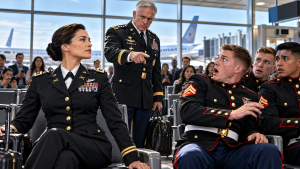
At Gate 17, a woman in an Army dress uniform sat quietly beside the window.
She appeared to be in her early forties.
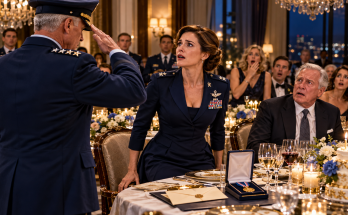
Her dark hair was pulled into a neat bun, her black shoes were polished, and several military decorations rested above the left pocket of her jacket.
Her name was Colonel Evelyn Hale.
But nobody in the waiting area knew who she was.
And Evelyn preferred it that way.
For twenty years, she had served her country. She had commanded soldiers, managed dangerous operations, and spent countless nights making decisions that could determine whether someone returned home alive.
Yet on this particular afternoon, she wanted nothing more than to drink her coffee, finish her book, and board her flight to Denver.
That simple wish was about to disappear.
Three young Marines entered the waiting area.
They were returning from a training assignment and appeared delighted to finally be heading home.
The loudest among them was Corporal Jason Carter, a twenty-three-year-old Marine who had recently transferred to a new unit.
Carter was confident, athletic, and desperate to impress his fellow Marines.
Unfortunately, his confidence often traveled further than his judgment.
As the three men approached the seating area, Carter noticed Evelyn.
He stopped.
Then he smiled.
“Well, look at that,” he whispered to his friends.
Marine Tyler Mason followed his gaze.
“What?”
“Over there. The lady in the fancy uniform.”
Mason glanced toward Evelyn.
“She’s an officer. Leave her alone.”
But Carter had already begun laughing.
“Come on. You don’t think that’s a little unusual?”
His third companion, Private Aaron Blake, said nothing.
Carter raised his voice.
“Excuse me, ma’am!”
Evelyn looked up from her book.
“Yes?”
Carter gestured toward the decorations on her uniform.
“That’s quite a collection you’ve got there. Are those all real?”
Several nearby passengers turned their heads.
Evelyn studied him for a moment.
“Yes, Marine. They are.”
Carter grinned.
“Wow. Must have been a pretty impressive career.”
His tone was mocking.
Evelyn recognized it immediately.
She had heard that tone before.
From men who assumed she had received special treatment.
From strangers who questioned whether she had earned her rank.
And sometimes from officers who smiled politely while doubting every decision she made.
She simply returned to her book.
But Carter was not finished.
“Hey, ma’am, seriously. What do you actually do in the military?”
Evelyn closed her book.
“I serve.”
Carter laughed.
“Yeah, obviously. But doing what?”
“At the moment?”
“Sure.”
“Waiting for an airplane.”
A few passengers chuckled.
Carter’s smile tightened.
He had expected her to become embarrassed.
Instead, she had made him look foolish.
So he tried again.
“Look, no offense, but you don’t exactly look like someone who gives orders to soldiers.”
Mason shifted uncomfortably.
“Jason, enough.”
Carter ignored him.
He stepped closer and reached toward one of the ribbons on Evelyn’s jacket.
“Can I see this one?”
Before she could answer, his fingers brushed her sleeve.
Evelyn’s expression changed.
Not dramatically.
But enough.
“Marine,” she said firmly, “remove your hand.”
Carter immediately stepped back.
“Relax. I was only joking.”
Evelyn looked directly into his eyes.
“A joke stops being harmless when someone else is forced to endure it.”
For a moment, Carter seemed uncertain.
Then he shook his head.
“Whatever. It’s just a uniform.”
A voice behind him answered.
“No, Corporal.”
The voice was deep.
Quiet.
And unmistakably authoritative.
“That is not just a uniform.”
Carter turned.
Standing behind him was an older man carrying a black leather travel bag.
His silver hair was neatly trimmed.
His face was serious.
And on his military uniform were four silver stars.
A four-star general.
Carter’s smile vanished.
The man looked past him toward Evelyn.
“Colonel Hale.”
Evelyn stood immediately.
“General Whitmore.”
The general nodded respectfully.
Then he turned back toward Carter.
“Corporal, do you have any idea who you have been speaking to?”
Carter’s throat tightened.
“No, sir.”
The general regarded him silently.
“That much is obvious.”
Nobody laughed now.
Then General Whitmore said something that made the entire waiting area fall silent.
“Colonel Hale is wearing that uniform today because I personally ordered her to. And the reason I chose her is something you may spend the rest of your career trying to understand.”
Carter stared at him.
The general continued.
“She is not here to prove that she deserves respect.”
He glanced toward Evelyn.
“She is here because thousands of people may soon depend upon her judgment.”
Then he spoke the words Carter would never forget.
“You saw a woman you thought was powerless. I saw the officer I trust with a mission that could change the future of this command.”
But neither Carter nor the watching passengers understood the full meaning of those words.
Because Colonel Evelyn Hale was carrying a secret.
And before the next morning, that secret would threaten the careers of some of the most powerful officers in the military.
CHAPTER 2 — THE MISSION NOBODY WAS SUPPOSED TO KNOW ABOUT
General Whitmore motioned for Evelyn to join him near the windows.
Behind them, the three Marines remained standing.
Carter looked as though he wanted the floor to open beneath his feet.
But the general did not shout.
He did not threaten punishment.
He simply walked away with Colonel Hale.
That silence was somehow worse.
Once they were seated, Evelyn looked at him.
“Sir, you could have handled that differently.”
Whitmore raised an eyebrow.
“How?”
“You could have ignored him.”
The general sighed.
“Evelyn, there are moments when silence teaches patience. And there are moments when silence allows ignorance to become acceptable.”
She considered his answer.
Then she noticed the folder resting on his lap.
It was marked with a red classification label.
“Is that the Hartwell file?”
Whitmore nodded.
“The situation has changed.”
“How seriously?”
He opened the folder.
Inside was a photograph of a young Marine standing beside an older woman.
The Marine had dark eyes and a tired smile.
“His name is Captain Daniel Ortiz,” the general said. “For years, he was considered one of the most promising young officers in his command.”
Evelyn studied the photograph.
“Was?”
Whitmore hesitated.
“Six months ago, he stopped reporting for duty.”
Evelyn frowned.
“Desertion?”
“Unauthorized absence. His case is still under review.”
“What happened?”
The general looked toward the runway.
“His mother became seriously ill. Daniel requested a compassionate reassignment so he could help care for her.”
“And?”
“The request was denied.”
“On what grounds?”
“According to the official record, insufficient medical documentation and operational requirements.”
Evelyn waited.
Whitmore lowered his voice.
“The problem is that we now have reason to believe the official record may not tell the whole story.”
He placed another paper on the table.
It contained a recommendation that Daniel’s case be reconsidered.
At the bottom was a handwritten signature.
Evelyn Hale.
She stared at it.
Her face went pale.
“Sir…”
Whitmore watched her carefully.
“Is that your signature?”
“No.”
“Are you certain?”
“Absolutely.”
She picked up the page.
“The handwriting is close. Someone even copied how I form the first letter of my last name.”
“Then the document is forged.”
Evelyn looked up sharply.
“Who submitted it?”
“An unidentified sender using a temporary account connected to a personnel office.”
“Why would someone use my name?”
“Because your professional assessment of Captain Ortiz was included in the submission.”
Evelyn searched her memory.
She had trained hundreds of service members.
Some became remarkable leaders.
Others disappeared into assignments scattered across the world.
“Daniel Ortiz,” she whispered.
The name stirred something.
Then it came back.
A summer afternoon.
A military training exercise.
A young officer refusing to abandon an exhausted soldier.
And a report Evelyn had filed afterward.
She sat straighter.
“General, Daniel Ortiz attended one of my command courses.”
“I know.”
“There was an incident during the final exercise.”
Whitmore did not respond.
“One of the trainees nearly died.”
The general slowly closed the folder.
“That is why I need you in Denver.”
Evelyn stared at him.
“Sir, what exactly are we investigating?”
Whitmore’s expression hardened.
“Whether a young officer broke his oath…”
He paused.
“Or whether people above him broke theirs first.”
CHAPTER 3 — WHAT HAPPENED TWO YEARS EARLIER
The memory returned to Evelyn with painful clarity.
Two years earlier, she had been supervising a joint military leadership exercise at Fort Blackwood.
The exercise was designed to test decision-making under pressure.
Participants were required to lead small teams across difficult terrain while dealing with simulated equipment failures, communication disruptions, and emergency situations.
It was the kind of training that revealed character.
And Evelyn believed character mattered more than appearances.
On the third afternoon, temperatures climbed dangerously high.
The training schedule should have been adjusted.
But Major Roland Pierce, the officer overseeing the exercise’s operational timetable, insisted everything continue.
“We are preparing leaders for combat conditions,” he told the instructors.
Evelyn disagreed.
“Training people to ignore warning signs does not make them stronger.”
Pierce dismissed her concerns.
“The medical team has approved the conditions.”
That statement would later prove crucial.
During the final movement, a young soldier named Lucas Bennett collapsed.
At first, several trainees thought he was simply exhausted.
But Daniel Ortiz immediately recognized that something was wrong.
Lucas was confused.
His skin was burning hot.
And he could barely speak.
Daniel called for medical assistance.
The radio operator tried three times.
No response.
The communication equipment had malfunctioned.
Their scheduled transport was still several miles away.
Daniel faced a decision.
Continue the exercise as instructed.
Or abandon the objective and carry Lucas toward the nearest emergency access road.
He chose Lucas.
With the help of two other trainees, Daniel carried the injured soldier for almost two miles.
When the rescue vehicle finally arrived, Lucas was barely conscious.
The doctors later confirmed that a longer delay could have killed him.
Daniel had saved his life.
But the official evaluation was not complimentary.
He had failed to complete the mission.
He had ignored the planned route.
And he had missed the mandatory debriefing.
Major Pierce recommended a formal reprimand.
Evelyn was furious.
“You want to punish him for saving a man’s life?”
Pierce folded his arms.
“He disobeyed the exercise instructions.”
“Because the medical response failed.”
“That is under review.”
“And who is reviewing it?”
Pierce did not answer.
Evelyn filed her own assessment.
She praised Daniel’s judgment, challenged the handling of the emergency, and requested a full review of the communications failure.
Then something unusual happened.
Late that evening, Daniel knocked on her office door.
He was still wearing his training uniform.
There were dark circles beneath his eyes.
“Colonel, may I speak with you?”
Evelyn invited him inside.
“How is Bennett?”
“Stable, ma’am.”
“Then you did the right thing.”
Daniel did not smile.
“Ma’am, the radio didn’t fail by accident.”
Evelyn leaned forward.
“What do you mean?”
“Two hours before the exercise, one of the technicians reported a problem with the backup communications system.”
“Was the exercise supervisor informed?”
“Yes.”
“Who?”
Daniel hesitated.
“Major Pierce.”
The room became very quiet.
Daniel continued.
“He was told the medical evacuation route wasn’t reliable. He told the technician to record the system as operational.”
Evelyn felt a chill.
“Do you have proof?”
Daniel reached into his pocket and placed a folded paper on her desk.
It was a maintenance warning.
At the bottom were two signatures.
One belonged to the technician.
The other acknowledged receipt of the warning.
Major Roland Pierce.
Evelyn read the document twice.
Then she looked at Daniel.
“Where did you get this?”
“The technician gave it to me. He said he was afraid the original would disappear.”
Evelyn understood.
If the warning had been ignored knowingly, the incident was not merely a training accident.
It was a failure of command responsibility.
She submitted the evidence through the appropriate channels the following morning.
A formal inquiry was promised.
Weeks passed.
No inquiry results arrived.
When Evelyn requested an update, she was told the matter had been resolved.
When she asked for the findings, she received a brief memorandum.
The equipment malfunction had been classified as an unexpected technical failure.
No misconduct had been established.
No further action was required.
Evelyn objected.
But soon afterward, she received orders transferring her to another assignment.
She believed the case had been buried.
What she did not know was that Daniel Ortiz had never stopped searching for the truth.
And someone inside the military had spent two years making sure he failed.
CHAPTER 4 — THE APOLOGY THAT CHANGED EVERYTHING
Back at the airport, the boarding announcement had been delayed by bad weather.
Passengers settled into their seats again.
Evelyn stood and walked toward a nearby trash can to discard her cold coffee.
As she turned, Carter approached.
His confident expression had disappeared.
“Colonel Hale?”
She stopped.
“Yes, Corporal?”
He swallowed.
“I’d like to apologize.”
Evelyn waited.
“I was disrespectful. I made assumptions about you, and I touched your uniform without permission. I shouldn’t have done any of that.”
She studied him.
“Why did you?”
Carter looked embarrassed.
“I thought my friends would laugh.”
“Did they?”
He glanced behind him.
“Yes, ma’am.”
“And did that make you feel important?”
He said nothing.
Evelyn softened her voice.
“Corporal, a uniform does not make someone honorable. Neither do ribbons, medals, or rank.”
Carter looked up.
“Honor comes from what you do when nobody expects you to do the right thing.”
He nodded slowly.
“Yes, Colonel.”
She continued.
“Someday you’ll be responsible for someone younger than you. Someone inexperienced. Someone who makes mistakes.”
Carter listened.
“When that day comes, you will have a choice. You can make that person feel small so you can feel powerful, or you can help them become better.”
His face reddened.
“I understand.”
“Good. Then show me through your actions.”
Carter returned to his friends.
General Whitmore had watched the exchange from a distance.
When Evelyn returned, he smiled faintly.
“You could have reported him.”
“I still can.”
“Will you?”
“I’ll document the incident if necessary. But I would rather see him learn before his next mistake hurts someone.”
Whitmore nodded.
“That’s why you’re here.”
Evelyn sat beside him.
But the general’s expression suddenly became serious.
“There’s another complication.”
He withdrew a small envelope.
Inside was a photocopy of an anonymous handwritten message.
It contained only a short instruction:
Ask Colonel Hale what happened after the exercise.
Evelyn stared at the words.
“What is this?”
“It was delivered to Dr. Lena Ortiz last week.”
“Daniel’s sister?”
“Yes.”
“Who sent it?”
“We don’t know.”
Evelyn read the message again.
Then her memory returned to the night Daniel had visited her office.
The maintenance warning.
The signatures.
The inquiry that vanished.
And one final detail she had forgotten.
Before Daniel left her office, he had said something unusual.
“If they tell you the report is missing, Colonel, look for the duplicate.”
At the time, she thought he meant the technician’s copy.
Now she was no longer certain.
“General,” she said quietly.
Whitmore looked at her.
“I think Daniel left evidence somewhere.”
“Where?”
Evelyn slowly closed the folder.
“I may know.”
CHAPTER 5 — THE WOMAN WHO NO LONGER TRUSTED THE MILITARY
The plane landed in Denver late that evening.
By the time Evelyn and General Whitmore reached their hotel, the streets were wet from rain.
The Hartwell Foundation meeting was scheduled for nine the next morning.
Evelyn barely slept.
She spent hours reviewing the documents Whitmore had provided.
The deeper she looked, the more disturbing the inconsistencies became.
Daniel’s compassionate reassignment request had been submitted on March 4.
A personnel officer had acknowledged receipt on March 6.
The medical documentation was uploaded on March 9.
Yet the denial memorandum claimed the supporting medical evidence was missing.
There was also a note stating Daniel’s command had offered him counseling and alternative arrangements.
But there were no corresponding appointment records.
No signed acknowledgment.
No proof that anyone had explained the alternatives.
And the denial had been approved unusually quickly by the same office that had handled the Fort Blackwood inquiry.
Major Roland Pierce’s office.
By dawn, Evelyn knew the cases were connected.
What she did not yet know was how deeply.
At nine o’clock, she entered the Hartwell Foundation conference room.
Dr. Lena Ortiz was already waiting.
Lena was thirty-four, with dark hair, serious eyes, and the exhausted expression of someone who had spent too many months fighting an institution larger than herself.
She did not offer her hand.
“Colonel Hale.”
“Dr. Ortiz.”
Lena looked at the uniform.
“So they sent someone decorated.”
Evelyn accepted the criticism without reacting.
“They sent someone who knew your brother.”
Lena froze.
“What?”
“I supervised one of Daniel’s leadership exercises.”
Lena’s expression changed.
“Fort Blackwood?”
“Yes.”
Lena stood abruptly.
“Then you know what they did to him.”
Evelyn did not respond immediately.
“I know some of it.”
“Some of it?”
Lena opened a folder and removed a photograph.
It showed Daniel standing outside a hospital.
His face was thin.
His eyes looked exhausted.
“This is my brother six months ago.”
She placed another photograph beside it.
Daniel was smiling in uniform, his arm around his mother.
“This is who he used to be.”
Evelyn stared at the pictures.
Lena’s voice trembled.
“He loved the military, Colonel. He believed in it. He believed that if he worked hard, followed orders, and took care of people, the institution would take care of him.”
She wiped her eyes angrily.
“Then our mother became sick.”
Evelyn remained silent.
“Daniel asked for a compassionate reassignment. He didn’t demand special treatment. He asked to serve somewhere close enough to help us.”
“What happened?”
“His paperwork kept disappearing. They demanded documents we had already supplied. They told him to wait.”
Lena’s voice broke.
“And while he waited, our mother nearly died.”
Evelyn lowered her eyes.
Lena continued.
“He stopped sleeping. He missed counseling appointments. He became convinced that nobody was listening.”
“And then he stopped reporting for duty.”
“Yes.”
Lena took a breath.
“I’m not defending that decision. He knows it was wrong. But he was drowning, and everyone kept handing him another form.”
Those words struck Evelyn harder than anger would have.
General Whitmore entered the room.
Lena turned toward him.
“I suppose you’re here to explain why the Army did nothing wrong.”
Whitmore shook his head.
“No, Doctor.”
He placed his folder on the table.
“I’m here to find out what went wrong and who is responsible.”
Lena looked skeptical.
“Why should I believe you?”
Evelyn stepped forward.
“Because two years ago, your brother saved a young soldier’s life, and I believe someone altered the record of what happened afterward.”
Lena’s expression shifted from anger to shock.
Then she whispered:
“Daniel told me you would remember.”
CHAPTER 6 — THE ENVELOPE HIDDEN FOR TWO YEARS
Lena immediately reached into her handbag.
She removed an old brown envelope.
The corners were worn.
The seal had been opened and carefully retaped.
“My brother gave me this before he disappeared,” she said.
Evelyn leaned forward.
“What is it?”
“He told me not to open it unless someone from Fort Blackwood contacted me.”
“And you opened it?”
“After I received the anonymous message.”
Lena emptied the contents onto the table.
There was a small key.
A handwritten note.
And a photograph of Daniel standing beside a row of military storage lockers.
The note contained an address and a locker number.
Evelyn recognized the building immediately.
“The old training annex.”
Whitmore looked at her.
“At Fort Blackwood?”
“Yes. That building was used to store archived exercise materials.”
Lena nodded.
“Daniel said the locker belonged to a technician who helped him after the accident.”
Evelyn picked up the key.
On its metal tag were three engraved numbers.
317.
For the first time, she remembered the exact words Daniel had spoken in her office.
Look for the duplicate.
Whitmore immediately contacted the investigating office responsible for the case.
The evidence could not simply be collected privately.
A proper investigative team would have to secure the location and document the chain of custody.
By early afternoon, an authorized team arrived at the old annex.
Evelyn and Lena were permitted to observe the process.
The building smelled of dust and old paper.
Rows of gray lockers lined the basement.
Many had not been opened in years.
The investigator stopped in front of Locker 317.
“Is everyone ready?”
He inserted the key.
It turned.
Inside was a small metal box.
The investigator placed it on a table and opened it under the recording camera.
There were several documents.
A backup storage device.
And a handwritten statement signed by the communications technician.
His name was Samuel Reed.
The statement described the warnings issued before the training exercise.
It confirmed that the emergency communications system had been flagged as unreliable.
It also stated that Major Pierce had instructed personnel to proceed.
But the most important discovery was a second document.
An internal memorandum directing staff to change the equipment status in the official report.
The original wording described a known communications defect.
The revised version called it an unexpected malfunction.
At the bottom was a handwritten authorization.
R. Pierce.
Lena covered her mouth.
“Oh my God.”
Evelyn stared at the paper.
She had suspected a cover-up.
Now there was evidence of one.
But the investigator was not finished.
The storage device contained a copy of a recorded briefing.
The team verified it before allowing anyone to hear the relevant portion.
Major Pierce’s voice filled the room.
“If we report this as a preventable failure, the entire training command will face scrutiny. We need to keep this contained.”
Another officer objected.
“A soldier nearly died.”
Pierce answered sharply.
“The soldier survived. We’re not destroying careers over a problem that has already been corrected.”
Evelyn felt sick.
Somebody had nearly lost his life.
And the people responsible had apparently cared more about the report than the soldier.
Lena began to cry.
But Evelyn noticed something else.
The recording included a third voice.
A voice she knew.
A voice belonging to an officer she had once trusted completely.
Brigadier General Thomas Vale.
He had been the senior officer responsible for overseeing the training program.
And he was now the director of the very personnel command responsible for Daniel Ortiz’s denied reassignment.
The room fell silent.
The investigator stopped the recording.
General Whitmore’s face hardened.
“Secure everything.”
Then he turned toward Evelyn.
“This is no longer a review of one officer’s personnel case.”
Evelyn nodded.
“No, sir.”
Whitmore looked at the evidence.
“This is potentially a command-wide investigation.”
CHAPTER 7 — THE GENERAL WHO HAD EVERYTHING TO LOSE
Brigadier General Thomas Vale was considered one of the military’s rising stars.
He had an impressive record.
He was respected by senior leaders.
He was expected to receive another major promotion.
And he had built his reputation on discipline, efficiency, and operational readiness.
But his carefully constructed career was about to face scrutiny.
Within twenty-four hours, investigators began reviewing the records connected to the Fort Blackwood exercise and Daniel Ortiz’s reassignment.
The findings were disturbing.
Several relevant emails were missing from the normal files.
A medical attachment had been incorrectly categorized.
The denial memorandum relied on a summary that omitted important information.
And the altered training report had been accessed from accounts associated with Vale’s former staff.
Then investigators discovered another connection.
Major Roland Pierce, the officer whose signature appeared on the revised training report, had later been assigned to Vale’s personnel office.
He had personally reviewed Daniel’s compassionate reassignment request.
Evelyn sat across from General Whitmore as the information was presented.
“That’s not a coincidence,” she said.
Whitmore nodded.
“Not one we can safely dismiss.”
The military investigators requested interviews with Pierce and Vale.
Both denied any intentional wrongdoing.
Pierce claimed the training report had been revised to correct technical inaccuracies.
Vale insisted he had relied on recommendations from his staff.
Neither could explain why the communications warning was absent from the final report.
Nor could they explain why evidence supporting Daniel’s family emergency had been marked incomplete.
But one mystery remained.
Who had forged Colonel Hale’s signature?
The answer came from a digital examination of the personnel office records.
The document had been assembled using an archived copy of Evelyn’s original training assessment.
The forged signature had been inserted from a scanned administrative form.
And the editing activity traced back to a workstation assigned to Pierce’s staff.
Investigators eventually identified a former administrative specialist who had processed the file.
Her name was Rachel Dunn.
When interviewed, Rachel admitted she had been instructed to prepare a new recommendation under Evelyn’s name.
She said Pierce had told her it was a legitimate correction to an earlier record.
“I thought Colonel Hale had authorized it,” Rachel explained.
“Did you verify that?”
“No.”
“Why not?”
Rachel lowered her eyes.
“Because the instruction came from my commanding officer.”
That answer revealed another problem.
People had become so accustomed to trusting authority that they had stopped questioning suspicious instructions.
Rachel admitted her mistake and provided the original messages she had received.
They showed that Pierce had ordered the recommendation to be prepared using Evelyn’s name.
The messages did not establish every motive behind the forgery.
But they were enough to justify further investigation.
And suddenly, the officers who had appeared untouchable were facing serious questions.
Still, the biggest question had nothing to do with Pierce or Vale.
It concerned Daniel Ortiz.
Where was he?
And why had he disappeared?
CHAPTER 8 — THE PHONE CALL THAT BROKE HIS SISTER’S HEART
Lena had not seen Daniel in person for nearly four months.
He occasionally called.
Always from unfamiliar numbers.
Always for only a few minutes.
He asked about their mother.
He asked whether she was taking her medication.
He asked whether Lena was sleeping.
But whenever Lena asked him to come home, he changed the subject.
The night after the evidence was discovered, Lena’s phone rang.
Unknown number.
She answered immediately.
“Daniel?”
There was silence.
Then a familiar voice.
“Hey, Lena.”
Her knees weakened.
“Where are you?”
“I’m okay.”
“Don’t say that. Please don’t say that again.”
Daniel breathed heavily.
“I heard about the investigation.”
Lena began crying.
“They found the documents, Daniel. They found everything.”
He said nothing.
“Colonel Hale is here. General Whitmore too. They’re reopening the case.”
Daniel gave a short, bitter laugh.
“That’s what they said two years ago.”
Evelyn, seated nearby, heard the pain in his voice through the speaker.
She leaned closer.
“Daniel?”
The line went quiet.
“This is Colonel Hale.”
Another long silence.
Then Daniel whispered:
“Ma’am?”
“Yes.”
“I didn’t think you’d remember me.”
Evelyn closed her eyes.
“I remember you carrying Lucas Bennett.”
Daniel’s breathing changed.
For several seconds, he could not speak.
Finally, he said:
“I thought I was doing what you taught us.”
“You were.”
“I thought taking care of people mattered.”
“It does.”
“Then why did everything fall apart?”
Evelyn had no easy answer.
She would not insult him by pretending otherwise.
“Daniel, I can’t undo what happened. And I can’t promise that you won’t have to answer for your absence.”
“I know.”
“But you deserve a fair process. And the people who mishandled your case must answer for their decisions too.”
His voice shook.
“I’m tired, Colonel.”
“I can hear that.”
“I don’t want to spend my life hiding.”
“Then let us help you find a lawful way forward.”
Daniel began crying.
It was the sound of someone who had held himself together for too long.
Lena covered her mouth.
“Please come home,” she whispered.
Daniel struggled to speak.
“I’m scared.”
“I know.”
“I’m scared they’ll make an example of me.”
Evelyn leaned toward the phone.
“Daniel, I won’t tell you that consequences disappear because someone else acted wrongly. But I will insist that the full truth is heard.”
There was another silence.
Then Daniel asked one question.
“Will you be there?”
Evelyn answered without hesitation.
“Yes.”
The following morning, Captain Daniel Ortiz voluntarily reported to the appropriate military authorities with legal representation.
His six-month absence had not vanished.
His choices still mattered.
But now, for the first time in months, he was no longer facing the situation alone.
And his sister was waiting when he walked through the door.
Lena ran toward him.
Daniel dropped his bag.
They embraced.
Neither spoke for a long time.
When he finally pulled away, his first question was about their mother.
“Is she okay?”
Lena nodded through tears.
“She’s getting stronger.”
Daniel covered his face.
“Thank God.”
Then he looked toward Evelyn.
He straightened instinctively.
“Colonel.”
Evelyn stepped forward.
“Captain Ortiz.”
His eyes filled again.
“Thank you for remembering.”
She shook her head.
“I should have asked more questions when the investigation disappeared.”
Daniel looked surprised.
“Ma’am, you tried.”
“Not enough.”
For a moment, neither spoke.
Then Daniel said softly:
“Maybe we both get another chance to do better.”
CHAPTER 9 — THE HEARING THAT EXPOSED THE TRUTH
The investigation continued for several weeks.
Independent reviewers examined the training exercise records.
Personnel officials reviewed the compassionate reassignment process.
Legal representatives examined Daniel’s unauthorized absence in the context of his circumstances.
And additional witnesses came forward.
The communications technician confirmed that he had warned supervisors before the exercise.
Lucas Bennett, the soldier Daniel had rescued, provided testimony about what happened that afternoon.
Rachel Dunn described the instructions she had received regarding the forged document.
Each testimony strengthened the picture of what had gone wrong.
Then came the most important hearing.
General Whitmore sat among senior officials observing the proceedings.
Colonel Hale appeared as a witness.
Across the room sat Major Pierce and Brigadier General Vale with their representatives.
Daniel was present with counsel.
Lena sat quietly behind him.
The investigating officer asked Evelyn to describe the original Fort Blackwood incident.
She explained the dangerous conditions.
The communications failure.
Daniel’s decision to abandon the exercise objective and rescue Lucas.
Then she described the assessment she had submitted afterward.
“Did you recommend that Captain Ortiz receive a reprimand for his actions?” the officer asked.
“No.”
“Why not?”
“Because I believed his actions demonstrated sound judgment in an emergency.”
“Did you believe the failure of the communications equipment required investigation?”
“Yes.”
“Did you report that concern?”
“Yes.”
“And what happened to your report?”
Evelyn paused.
“I received a memorandum stating that the incident had been resolved.”
The officer displayed the original maintenance warning.
“Had you been informed that this document was omitted from the final report?”
“No.”
The next question was directed at the forged recommendation.
“Colonel Hale, did you sign this?”
“No.”
“Did you authorize another person to sign it on your behalf?”
“No.”
“Would you have supported a fair reconsideration of Captain Ortiz’s circumstances?”
Evelyn looked toward Daniel.
“Yes. But I would have done so in my own name, based on verified facts.”
Then the officer asked a final question.
“Colonel, what do you believe is the central failure revealed by these records?”
The room became very quiet.
Evelyn looked at the rows of uniforms before her.
For most of her career, she had believed leadership was measured by courage, knowledge, and the ability to make difficult decisions.
Now she understood something else.
Sometimes courage meant admitting that the people entrusted with authority had failed.
She answered carefully.
“A military organization cannot function without standards. People must be accountable for their choices. But accountability must apply upward as well as downward.”
She paused.
“Captain Ortiz made a serious decision when he stopped reporting for duty. That requires an appropriate review. But the evidence also suggests that leaders responsible for protecting their personnel ignored warnings, concealed information, and failed to provide a fair process.”
She looked toward the senior officers.
“If we demand responsibility from those who serve under us, we must accept an even greater responsibility for the decisions we make about their lives.”
No one interrupted.
Evelyn continued.
“An institution becomes stronger when it corrects its failures, not when it hides them.”
The hearing room remained silent.
Daniel lowered his head.
Lena wiped her tears.
General Whitmore looked at Evelyn with quiet pride.
And for the first time, the question was no longer whether a decorated officer deserved respect.
It was whether those entrusted with command had earned the trust placed in them.
CHAPTER 10 — THE PRICE OF THE TRUTH
The investigation did not end with a dramatic confession.
Real accountability was slower than that.
There were additional interviews.
Documents had to be authenticated.
Witness statements had to be reconciled.
Legal rights had to be respected.
But the findings eventually led to serious consequences.
Major Pierce was removed from his supervisory duties while his conduct was examined.
The investigators concluded that he had directed the creation of the unauthorized recommendation bearing Evelyn’s signature.
They also found that he had knowingly approved inaccurate information in the training incident report.
His case was referred for further disciplinary consideration.
Brigadier General Vale was relieved of his current responsibilities pending the outcome of the investigations into his oversight and the personnel decisions made within his command.
The full extent of his involvement remained subject to the evidence.
But his reputation for flawless management had been shattered.
And the Army was forced to confront how procedural failures could compound into devastating consequences.
Daniel’s case was considered separately.
His unauthorized absence was not simply erased.
He accepted responsibility for failing to report.
But the review also established that his request for compassionate reassignment had not received the consideration it deserved.
His treatment needs were assessed, his legal representation was heard, and the circumstances were considered in deciding the appropriate administrative outcome.
Ultimately, Daniel was permitted to pursue a structured path toward resolving his status without being treated as though the failures surrounding his case were irrelevant.
For him, that was the first sign of hope in months.
He returned to counseling.
He reconnected with his family.
He began rebuilding the routine he had lost.
And for the first time in a very long while, he slept through the night.
Lena continued her work advocating improvements to military family support.
But something about her approach changed.
She no longer believed every officer was indifferent.
And Evelyn no longer believed that submitting a report was enough if nobody followed through.
Together, they worked with a review group examining how serious concerns could be escalated when normal procedures failed.
Their recommendations included clearer records of compassionate reassignment requests, independent review of disputed decisions, and stronger protections for personnel reporting safety concerns.
The changes would not repair everything.
They would not restore the months Daniel had lost.
They would not erase his mother’s fear.
But they might keep another family from experiencing the same nightmare.
One afternoon, Evelyn received a handwritten letter from Lucas Bennett.
He had recovered from the medical emergency at Fort Blackwood.
He was now married.
His wife was expecting their first child.
The letter was short.
Colonel Hale, I heard the case was reopened. I wanted you to know that Captain Ortiz didn’t just save my life that day. He gave me the chance to have a future I nearly lost. Please tell him thank you.
Evelyn read it twice.
Then she folded it carefully and placed it in her desk.
There were decorations on her uniform that represented major achievements.
But that small letter mattered just as much.
CHAPTER 11 — SIX MONTHS LATER, THE YOUNG MARINE RETURNED
Six months after the airport incident, Colonel Hale was invited to speak at a military leadership symposium.
The event brought together young service members from different branches.
Her presentation was titled:
Leadership Is What You Do When Someone Needs You.
Evelyn stood before a crowded auditorium.
She spoke about difficult decisions.
About accountability.
About the importance of listening to people whose concerns were inconvenient.
She did not reveal private details of Daniel’s case.
Instead, she discussed the principles that had emerged from the review.
Near the end of her speech, she noticed a familiar face in the audience.
A young Marine.
Short hair.
Straight posture.
Serious expression.
Corporal Jason Carter.
The same Marine who had mocked her at the airport.
This time, he was listening carefully.
After the presentation, he approached.
“Colonel Hale.”
Evelyn recognized him immediately.
“Corporal Carter.”
He smiled nervously.
“I’m surprised you remember me.”
Evelyn raised an eyebrow.
“You made quite an impression.”
He laughed awkwardly.
“Not the one I wanted.”
“No.”
His expression grew serious.
“Ma’am, I’ve wanted to tell you something.”
“Go ahead.”
“After that day at the airport, I thought about what you said.”
Evelyn waited.
“You told me that I could either make people feel small or help them become better.”
“Yes.”
Carter took a breath.
“A few months ago, a new Marine joined our unit. He was nervous, and he kept making mistakes. Some of the guys started laughing at him.”
Evelyn watched him.
“What did you do?”
Carter looked down.
“At first, I almost laughed too.”
“And then?”
“I remembered the airport.”
He paused.
“So I pulled him aside and helped him practice until he got it right.”
Evelyn smiled.
“And?”
“He passed his evaluation.”
“Good.”
Carter’s eyes shone.
“Last week he told me I was the first person in the unit who made him feel like he belonged.”
For a moment, Evelyn said nothing.
Then she extended her hand.
Carter shook it.
“That’s leadership, Corporal.”
He stood a little straighter.
“Thank you, Colonel.”
As he turned to leave, Evelyn called after him.
“Carter.”
He stopped.
“Yes, ma’am?”
“Don’t make that the last time.”
He smiled.
“I won’t.”
From across the hall, General Whitmore had witnessed the conversation.
He approached Evelyn.
“That young man seems different.”
“He is.”
“What changed him?”
Evelyn looked toward Carter as he joined his fellow Marines.
“Someone gave him a chance to become better.”
Whitmore nodded.
“Sounds familiar.”
CHAPTER 12 — THE LETTER THAT BROUGHT EVERYONE TO TEARS
A year after the airport confrontation, Evelyn received an invitation.
It came from Lena Ortiz.
Her mother was celebrating her seventieth birthday.
The family wanted Evelyn to attend.
At first, she hesitated.
Her work schedule was demanding.
Travel was exhausting.
And she had never been particularly comfortable being celebrated.
But the invitation contained a handwritten message.
Colonel, our family is finally together again. It would mean a great deal to have you here.
Evelyn accepted.
The celebration took place in a modest backyard.
There were strings of warm lights above the patio.
Children played near the garden.
Food covered a long wooden table.
And at the center sat Mrs. Rosa Ortiz, surrounded by her children and grandchildren.
When Evelyn arrived, Daniel met her at the gate.
He looked healthier.
There was color in his face.
His shoulders were relaxed.
“Colonel.”
“Daniel.”
He smiled.
“Thank you for coming.”
“I’m glad I could.”
He led her toward the patio.
Rosa Ortiz stood slowly when she saw Evelyn.
She was smaller than Evelyn expected.
Her silver hair was neatly arranged.
Her eyes filled with tears.
“Are you Colonel Hale?”
“Yes, ma’am.”
Rosa took Evelyn’s hands.
“I’ve wanted to meet you for so long.”
Evelyn smiled gently.
“It’s a pleasure.”
Rosa held her hands tightly.
“My son told me what happened.”
Evelyn glanced toward Daniel.
Rosa continued.
“He told me you listened when people were trying to tell him he had nothing worth saying.”
Evelyn’s throat tightened.
“Daniel showed a great deal of courage.”
Rosa shook her head.
“He was always brave. Even as a little boy, he wanted to protect everyone.”
She paused.
“But sometimes the people who protect others need someone to protect them too.”
Evelyn looked down.
Rosa embraced her.
“Thank you for helping him find his way home.”
For several seconds, Evelyn could not speak.
She had faced hostile hearings.
She had commanded difficult missions.
She had stood before senior officers without hesitation.
But a mother’s gratitude nearly brought her to her knees.
Later that evening, Daniel asked everyone to gather near the patio.
He held a small envelope.
“I want to say something.”
The guests became quiet.
“A year ago, I didn’t think I would be standing here.”
His voice trembled.
“I thought I’d ruined everything. My career. My family’s trust. My future.”
Lena reached for his hand.
Daniel continued.
“I made mistakes. Serious ones. And I’ve had to accept that.”
He looked toward Evelyn.
“But I also learned that being accountable doesn’t mean being abandoned.”
Then he turned toward his mother.
“Mom, you spent your whole life teaching us that doing the right thing matters, even when it’s difficult.”
Rosa wiped her eyes.
Daniel smiled through tears.
“I forgot that for a while.”
He looked around the backyard.
“But I’m learning again.”
He opened the envelope.
Inside was the letter from Lucas Bennett—the man whose life he had saved.
Evelyn had forwarded it with Lucas’s permission.
Daniel read it aloud.
By the time he reached the final sentence, his voice had broken.
He lowered the paper.
For a long moment, nobody spoke.
Then Rosa stood and embraced her son.
Lena joined them.
And the backyard filled with quiet applause.
Not because a soldier had been declared perfect.
Not because every injustice had disappeared.
But because a family had survived a terrible season and found a way to begin again.
CHAPTER 13 — WHY THE GENERAL ORDERED HER TO WEAR THAT UNIFORM
Several weeks later, Evelyn was preparing to leave General Whitmore’s office when she finally asked the question that had remained unanswered.
“Sir, why did you really order me to wear my dress uniform that day?”
Whitmore looked up from his desk.
“Didn’t I explain?”
“You said you wanted me to represent the Army.”
“That was true.”
“But it wasn’t the entire reason.”
The general leaned back.
For a moment, he seemed to consider how much to say.
Then he opened a drawer and removed an old photograph.
It showed a young military officer standing beside a small group of soldiers.
The officer looked barely twenty-five.
Evelyn recognized him.
“That’s you.”
Whitmore smiled.
“A long time ago.”
He handed her the photograph.
“During my first major command assignment, I made a mistake. A young soldier brought me a concern about unsafe equipment.”
Evelyn listened.
“I dismissed him. I thought he was exaggerating. I believed the people above him knew better.”
“What happened?”
“The equipment failed during a training operation.”
Evelyn’s face grew serious.
“Was anyone hurt?”
“Yes.”
Whitmore looked toward the window.
“Two soldiers were injured. One never fully recovered.”
He was silent for a moment.
“That experience changed the way I understood command.”
Evelyn lowered the photograph.
“I didn’t know.”
“Very few people do.”
Whitmore folded his hands.
“When I learned about Daniel Ortiz, I recognized the pattern. A young officer was raising concerns, and people with more authority were deciding he wasn’t worth listening to.”
He looked directly at her.
“I needed someone who understood that a person can be wrong about one thing and right about another.”
Evelyn remained silent.
“I chose you because you had demonstrated that judgment at Fort Blackwood. Even when it was inconvenient.”
“But why the uniform?”
Whitmore smiled sadly.
“Because I wanted everyone at that meeting to see that accountability was not coming from outside the institution.”
He paused.
“It was coming from within it.”
Evelyn looked down at the gold insignia on her jacket.
The general continued.
“That uniform represents authority, Evelyn. But authority is not a shield that protects us from difficult questions.”
He leaned forward.
“It is a promise that we will answer them.”
For the first time, Evelyn fully understood.
The uniform had never been about displaying her medals.
It had never been about humiliating a young Marine.
It had never been about proving she was more important than anyone else.
It was about something far more demanding.
Responsibility.
And the courage to accept it.
EPILOGUE — THE UNIFORM WAS NEVER THE MOST IMPORTANT THING
Two years after that unforgettable afternoon at the airport, Colonel Evelyn Hale was preparing for retirement.
Her career had taken her across continents.
She had worked alongside brave soldiers, extraordinary civilians, and leaders whose decisions shaped countless lives.
She had received decorations.
She had earned promotions.
She had endured losses that would never appear in any official record.
But on the morning of her retirement ceremony, she stood before a mirror and looked at her uniform for a long time.
The medals gleamed beneath the light.
The insignia rested perfectly on her collar.
Everything was exactly where it belonged.
Then she noticed a small photograph on her dresser.
It showed Rosa Ortiz surrounded by her family.
Daniel was smiling.
Lena had her arm around her mother.
And Evelyn stood beside them, looking slightly uncomfortable with all the attention.
She picked up the photograph.
For years, she had believed her greatest accomplishments were the missions she had completed.
Now she understood that some of the most important victories could not be recorded on a service history.
A frightened young officer returning home.
A family reunited.
A young Marine learning to treat others with dignity.
A system beginning to correct its mistakes.
Those things had no medals.
But they mattered.
At the ceremony, General Whitmore delivered the final remarks.
He spoke about Evelyn’s leadership.
Her professionalism.
Her courage.
Then he paused and looked directly at her.
“Over the years, I have met many officers who knew how to command attention.”
The audience listened.
“Colonel Hale understood something rarer.”
He smiled.
“She knew how to give attention to those who needed it most.”
Evelyn lowered her eyes.
Whitmore continued.
“Rank can give us authority. Experience can give us confidence. But character determines what we do with both.”
He turned toward her.
“Colonel, you have spent your career demonstrating that lesson.”
The room rose in applause.
Evelyn stood.
For a moment, she thought about the airport.
The young Marine who had laughed at her.
The cold coffee beside her chair.
The delayed flight.
And the general who had appeared at exactly the right moment.
She remembered how easily that afternoon could have ended as nothing more than an embarrassing encounter.
Instead, it became the beginning of one of the most important chapters of her career.
After the ceremony, Evelyn walked outside.
The afternoon sunlight spread across the parade ground.
She removed her cap.
Breathed in the fresh air.
And smiled.
Her military service had come to an end.
But the lessons she had learned would remain.
Because true leadership had never been about making other people recognize your importance.
It was about recognizing theirs.
And somewhere far away, Corporal Jason Carter was teaching a nervous young Marine how to succeed.
Daniel Ortiz was rebuilding his life.
Lena Ortiz was helping other military families find the support they needed.
And Rosa Ortiz was enjoying another birthday with her children.
None of those moments would ever appear among the citations for Evelyn’s medals.
Yet each one represented something worth protecting.
THE END.