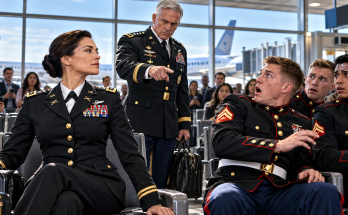
The moment my father raised his glass and called my military career a waste of government money, I knew I shouldn’t have come to his seventieth birthday dinner.
What I didn’t know was that, twenty minutes later, a four-star general would walk through the restaurant doors, stop directly in front of me, and deliver a salute that would leave every person at that table speechless.
And what happened afterward would change my family forever.
My name is Natalie Brooks. I’m thirty-nine years old, a lieutenant colonel in the United States Air Force, and for most of my adult life, I’ve been the family disappointment.
Not because I failed.
Not because I was irresponsible.
And certainly not because I lacked ambition.
I disappointed my father because I refused to live the life he had planned for me.
My father, Edward Brooks, had spent nearly forty years building a successful construction company in Colorado. He believed that respectable people worked in offices, wore expensive suits, bought impressive houses, and made decisions based on financial security.
My older brother, Christopher, followed that blueprint perfectly.
He graduated with a business degree, married the daughter of one of Dad’s closest friends, and eventually became the vice president of the family company.
My younger sister, Vanessa, married a wealthy orthopedic surgeon and moved into a beautiful house overlooking the mountains.
And then there was me.
The daughter who wanted to fly airplanes.
When I was nine years old, I built a cardboard cockpit in our garage. I used bottle caps for buttons, an old kitchen timer for the instrument panel, and a broken bicycle handle for the control stick.
My mother thought it was wonderful.
My father took one look and asked why I couldn’t find a normal hobby.
At sixteen, I told my parents I wanted to become a military pilot.
Dad laughed so hard he spilled his coffee.
“Natalie, sweetheart, flying fighter jets isn’t something girls from respectable families do.”
My mother told him to stop.
He didn’t.
“You’ll grow out of it. You’re intelligent enough to have a real career.”
I remember standing in the kitchen with my acceptance letter to a summer aviation program hidden behind my back.
I didn’t argue.
I simply decided that, someday, I would prove him wrong.
Four years later, I earned a scholarship through an Air Force commissioning program.
My mother cried at my graduation.
My father shook my hand and said, “Well, I suppose everyone has to make mistakes before they grow up.”
That was the closest thing to congratulations I received.
For the next seventeen years, I built my career thousands of miles away from him.
I completed flight training, survived deployments, led missions, and eventually became responsible for pilots whose lives depended on my judgment.
But every time I came home, Dad treated me as though I were still the stubborn teenager in the garage.
He never asked about my missions.
He never asked whether I was happy.
And he certainly never asked whether I was afraid.
Instead, he asked when I planned to leave the military and find a proper job.
Eventually, I stopped talking about work.
It was easier that way.
Then came his seventieth birthday.
My brother organized an elaborate celebration at an exclusive restaurant outside Denver.
There were thirty guests, including business associates, extended family, and several people I hadn’t seen in years.
I almost declined the invitation.
But my mother had died three years earlier, and some stubborn part of me still wanted to believe our family could learn to treat one another differently.
So I bought a navy-blue dress, arranged leave, and drove six hours to be there.
I arrived fifteen minutes early.
My father barely acknowledged me.
“Natalie,” he said, looking me up and down. “I see you managed to escape whatever desert they’ve stationed you in.”
“I’m stationed in Nevada, Dad.”
“Same difference.”
Christopher laughed.
Vanessa gave me an apologetic look but said nothing.
I took my seat near the far end of the table.
The evening continued with expensive wine, speeches about the family business, and stories about my father’s professional accomplishments.
I listened politely.
When Christopher described closing a multimillion-dollar contract, everyone applauded.
When Vanessa mentioned her husband’s newest medical partnership, Dad proudly raised his glass.
Then someone asked about me.
“So, Natalie, are you still flying?”
Before I could answer, Dad chuckled.
“Unfortunately. She’s nearly forty and still playing Top Gun.”
A few guests laughed.
I kept my expression neutral.
“Actually, I supervise operational training now,” I said.
Dad waved his hand.
“Same thing. Airplanes, uniforms, taxpayer money. It’s not exactly running a business.”
I looked down at my untouched dinner.
There it was again.
The same joke.
The same contempt.
The same familiar expectation that I would smile and let him enjoy the applause.
My father’s friend, a retired businessman named Harold, leaned toward me.
“Surely you’ve accomplished something worthwhile after all these years?”
I opened my mouth.
But Dad answered first.
“She has a very impressive collection of certificates, apparently.”
More laughter.
Something inside me grew very still.
I placed my napkin beside my plate.
“Excuse me,” I said.
My father frowned.
“Where are you going? We’re about to serve the cake.”
“I need some air.”
I had barely pushed back my chair when the restaurant manager entered the private dining room.
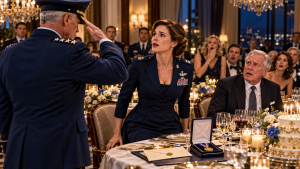
Behind him walked a tall, silver-haired man in a dark blue military dress uniform.
Four stars gleamed on his shoulders.
Conversation stopped.
I recognized him immediately.
General Marcus Whitfield.
Eight years earlier, he had commanded the overseas air operations division under which I served.
I hadn’t seen him since my final deployment.
He surveyed the room and then looked directly at me.
“Lieutenant Colonel Brooks?”
I stood instinctively.
“General Whitfield, sir.”
He approached.
Then, before anyone could speak, he came to attention and saluted.
I returned the salute.
“Ma’am,” he said, “it is an honor to see you again.”
My father slowly lowered his wineglass.
The general turned toward the table.
“I apologize for interrupting the celebration. But I was informed that one of the finest officers I’ve ever served with would be here tonight.”
Nobody moved.
General Whitfield looked back at me.
“Eight years is a long time to wait for recognition, Natalie.”
My throat tightened.
“Sir?”
He reached into his jacket and removed a dark presentation case.
“I was hoping to do this properly.”
He opened it.
Inside lay a military decoration.
And suddenly, I understood.
I gripped the back of my chair.
“No, sir,” I whispered. “You don’t have to do this here.”
His expression softened.
“I know. But there’s someone in this room who needs to understand what you did.”
He glanced toward my father.
“Mr. Brooks, do you know about Operation Northern Lantern?”
Dad shook his head.
“No, General.”
“Eight years ago, your daughter volunteered for a rescue mission that had already been declared too dangerous for further aircraft deployment.”
My father’s smile disappeared.
The general continued.
“A transport helicopter carrying wounded personnel had gone down during a severe storm in mountainous terrain. Communications were unreliable. Enemy patrols were moving through the area. The weather was deteriorating faster than expected.”
My chest tightened.
I knew every detail of that night.
I could still remember the smell of overheated electronics inside my cockpit.
The violent turbulence.
The warning lights.
And the desperate voices coming through the radio.
General Whitfield continued.
“Two rescue attempts failed. A third aircraft was forced to return because of mechanical problems. Command was preparing to suspend operations until morning.”
He paused.
“Your daughter refused to accept that eight Americans would be left on that mountain overnight.”
My brother stared at me.
Vanessa covered her mouth.
“She wasn’t reckless,” the general said. “She calculated the available options, coordinated with the ground commander, and designed an extraction approach that none of us had considered.”
I remembered studying the terrain map.
A narrow valley.
A steep ridge.
A dangerous crosswind.
We had one chance.
“She took her aircraft into conditions that would have overwhelmed many experienced crews,” he said. “When the extraction equipment malfunctioned, she remained above the site long enough for the ground team to improvise a second procedure.”
My hands were trembling.
I folded them behind my back.
“She brought those men home.”
The general closed his eyes for a brief moment.
“All eight survived.”
The private room was silent.
Then he said something I hadn’t expected.
“One of those men was my son.”
I stared at him.
I had never known.
“His name is Andrew,” the general said quietly. “He was twenty-six. He had a wife and a three-month-old daughter.”
The man’s voice changed.
Not much.
Just enough to reveal the father beneath the uniform.
“Because of your decision, my granddaughter got to grow up knowing her dad.”
I felt tears burning behind my eyes.
“Sir, my crew deserves recognition too.”
“They received it,” he replied. “And every one of them asked me when you would finally accept yours.”
He lifted the medal from its case.
“Lieutenant Colonel Natalie Brooks, for extraordinary heroism and courage under life-threatening conditions, it is my privilege to formally recognize your actions during Operation Northern Lantern.”
I couldn’t speak.
He fastened the decoration to my dress.
For several seconds, I saw nothing clearly.
Then he stepped back.
Saluted again.
And said, “Thank you for bringing my boy home.”
That was when my father stood.
His chair scraped loudly against the floor.
“General,” he said, his voice unsteady, “I had no idea.”
General Whitfield studied him.
“With respect, Mr. Brooks, your daughter shouldn’t have needed a general to convince you her service mattered.”
The words struck harder than anything else said that evening.
My father looked at me.
For the first time in my life, he seemed unable to find something critical to say.
But the evening wasn’t finished.
Not even close.
The general reached into his briefcase.
“There’s another reason I came tonight.”
He placed a sealed envelope on the table.
My name was written across the front.
I recognized the handwriting immediately.
Colonel Rebecca Sullivan.
My former commanding officer.
She had died two years earlier following a long illness.
“Rebecca left this with me,” General Whitfield explained. “She asked that it be delivered when your award was finally approved.”
My hands went cold.
Rebecca had been more than my commander.
She was my mentor, my friend, and the person who taught me that leadership had little to do with rank and everything to do with responsibility.
I opened the envelope carefully.
Inside was a handwritten letter.
I started reading.
Then I stopped.
Because the first paragraph mentioned my father.
Rebecca wrote that she had known about a complaint filed against me following Operation Northern Lantern.
A complaint alleging that I had disregarded operational safety and placed personnel at unnecessary risk.
At first, I assumed it was another routine administrative objection.
Then I saw the signature attached to the complaint.
Edward Brooks.
My father.
I looked up slowly.
“Dad?”
He wouldn’t meet my eyes.
The general’s expression hardened.
“I believe you and your father need to discuss something.”
I turned the document around.
“Did you write this?”
My father glanced at it.
His face turned gray.
“Natalie, I can explain.”
“Did you write it?”
“Yes.”
I felt as if the floor had disappeared.
For eight years, I had believed the investigation into my mission was simply part of the military’s extensive review process.
I’d been interviewed repeatedly.
My promotion had been delayed.
My actions scrutinized.
There had been months when I wondered whether everything I’d worked for might disappear.
I never knew that my father had been involved.
“Why?” I whispered.
He rubbed his forehead.
“Your mother called me that night. Someone had told her your aircraft might have gone down. We couldn’t reach you. Nobody would tell us anything.”
“So you accused me of misconduct?”
“I wanted someone to investigate.”
“You wrote that I had a history of making irresponsible decisions.”
He looked at me.
“I was scared.”
I almost laughed.
Not because it was funny.
Because the answer was so painfully inadequate.
“You were scared,” I repeated. “So you tried to destroy my career?”
“That’s not what I intended.”
“But it is what you did.”
My brother pushed his chair back.
“Dad, tell me this isn’t real.”
Dad said nothing.
Vanessa began crying.
Christopher looked at the document and shook his head.
“You knew how much the Air Force meant to her.”
“I thought she was going to get herself killed,” Dad said.
“And if she survived,” I replied, “you wanted to make sure she never flew again.”
He looked away.
That was answer enough.
I removed the medal case from the table and placed it inside my handbag.
Then I thanked General Whitfield.
He touched my shoulder.
“You don’t owe anyone an explanation tonight, Natalie.”
I nodded.
And walked out.
Outside, snow was falling.
The parking lot was almost empty.
I reached my car before my knees began shaking.
I sat behind the steering wheel and stared through the windshield.
For seventeen years, I had believed that my father’s criticism was merely something I needed to tolerate.
Now I understood how far he had gone.
It was one thing to dismiss my achievements.
It was another to put them in jeopardy.
I thought about calling someone.
But the person I wanted most was my mother.
She had always known how to sit beside me without demanding an explanation.
After she died, I’d discovered how much of my relationship with Dad she had quietly held together.
Now there was no one left to translate his cruelty into concern.
My phone buzzed.
A message from Christopher.
I’m sorry. I didn’t know.
Then another from Vanessa.
Please don’t drive while you’re upset. I’ll come outside.
I turned the phone over.
I needed to be alone.
But before I could start the engine, someone tapped gently on my window.
It was General Whitfield.
I lowered it.
“May I speak with you?”
“Of course, sir.”
He handed me a folded photograph.
It showed eight exhausted men standing beside a damaged aircraft.
Their clothes were dirty.
Several wore bandages.
One leaned heavily against another.
But they were smiling.
“That was taken two days after the rescue,” he said.
I studied their faces.
“I’ve never seen this.”
“We weren’t allowed to distribute it at the time.”
He pointed to the man standing near the center.
“Andrew.”
I looked closely.
A memory returned.
During the rescue, one injured serviceman had kept asking whether his daughter would remember him if he never came home.
I remembered speaking to him afterward while he was being loaded onto a medical transport.
He had pressed a small pink hair ribbon into my hand.
He said it belonged to his baby girl.
He asked me to give it to her if anything happened.
I had carried that ribbon in my flight suit until the medical team confirmed his survival.
“How is he?” I asked.
The general smiled.
“Still stubborn. Still terrible at returning phone calls. His daughter is eight now.”
He hesitated.
“And he wants to meet you.”
I shook my head.
“He doesn’t owe me anything.”
“No,” the general said. “But perhaps you could allow him to thank you.”
I looked down at the photograph.
For so many years, I had focused on the damage left by my father’s words that I had forgotten the lives my own decisions had touched.
General Whitfield seemed to understand.
“Your father made a terrible mistake,” he said. “But don’t let his opinion become the measure of who you are.”
I nodded.
He wished me a safe drive.
Then he returned to the restaurant.
I stayed in the parking lot until the snow began covering the hood of my car.
Three days later, a package arrived at my apartment.
There was no return address.
Inside was a small wooden box that had belonged to my mother.
I recognized it immediately.
She used to keep old photographs, birthday cards, and letters in it.
At the bottom was a sealed envelope addressed to me.
Her handwriting.
My hands began shaking again.
I sat on the living room floor and opened it.
The letter had been written six months before she died.
She told me how proud she had been when I earned my wings.
She wrote about watching me as a little girl, racing through the backyard with my arms spread wide, pretending to be an airplane.
She confessed that she had been afraid every time I deployed.
But then came the part that made me stop breathing.
My mother had discovered my father’s complaint years earlier.
She had confronted him.
He told her he was trying to protect me.
She told him he was trying to control me.
Their argument lasted for hours.
She wrote that he had promised to withdraw the complaint, but she never learned whether he actually did.
Then she wrote something that stayed with me.
She said love could explain fear, but it could never excuse cruelty.
And she begged me not to confuse forgiving my father with allowing him to hurt me again.
I read that sentence six times.
Then I began to cry.
Not the quiet tears I’d trained myself to hide.
I cried the way I had after Mom’s funeral, when everyone had finally gone home and there was no one left to be strong for.
I cried for the little girl in the cardboard cockpit.
For the young officer who had searched the graduation crowd for her father’s proud face.
For the pilot who survived a terrifying night only to discover that her own father had questioned her competence.
And for my mother, who had spent years trying to protect us from the damage we caused one another.
A week later, my father called.
I almost ignored it.
Then I answered.
“Natalie?”
“Yes.”
He cleared his throat.
“I’d like to see you.”
I stared at the wall.
“Why?”
“Because I owe you an apology.”
“You’ve owed me one for twenty years.”
“I know.”
I closed my eyes.
He sounded different.
Not suddenly transformed.
Not magically kind.
Just tired.
“I don’t expect you to forgive me,” he said. “But I want to tell you what happened.”
I agreed to meet him at a small coffee shop halfway between my apartment and his house.
He arrived early.
He was sitting by the window when I walked in.
For the first time, I noticed how old he had become.
His hair was almost entirely white.
His hands trembled slightly as he lifted his cup.
The man who had once seemed larger than life now looked uncertain about where to put his arms.
I sat across from him.
He didn’t try to hug me.
For that, I was grateful.
He pulled a folder from his briefcase.
“I contacted the Air Force inspector general’s office after the dinner,” he said.
I looked at the folder.
“What for?”
“To provide a statement correcting my allegations.”
I said nothing.
“I explained that I had no firsthand knowledge of your mission. I admitted that my complaint was based on fear and assumptions.”
“Eight years late.”
“Yes.”
He slid the folder toward me.
“I should have done it eight years ago.”
I opened it.
There was a copy of his statement.
And a handwritten apology.
He had written about how my independence frightened him.
How he associated control with safety.
How he thought that if he discouraged me enough, I might choose a quieter life.
Then he admitted something that surprised me.
“When you became a pilot, I was jealous.”
I looked up.
“Jealous?”
He gave a bitter little smile.
“I wanted to fly when I was young.”
I stared at him.
He had never told me that.
“My father wouldn’t allow it. He said aviation was unstable. Said I needed a serious occupation. So I went into construction.”
He looked out the window.
“When you refused to surrender your dream, I saw you doing something I had never been brave enough to do.”
For a moment, I couldn’t speak.
“I spent years telling myself I was protecting you,” he said. “But the truth is, I wanted you to make the same choices I had made. Then I wouldn’t have to wonder whether I’d wasted my own chances.”
I studied his face.
There was no arrogance left in his expression.
Only regret.
“You could have told me,” I whispered.
“I know.”
“You could have said you were frightened.”
“I know.”
“You could have said you were proud.”
His eyes filled with tears.
“I know.”
I pushed the folder back toward him.
“I’m not ready to forgive you.”
He nodded.
“I understand.”
“And I don’t want you telling people we’re fine because you apologized.”
“I won’t.”
I stood.
He didn’t try to stop me.
But before I walked away, he said something.
“Natalie?”
I turned.
“I’m proud of you.”
For most of my life, I had wanted those words more than anything.
Now that I finally heard them, I discovered they couldn’t repair the past.
But perhaps they could become the beginning of something different.
Three months later, I attended a military family event at a base in Texas.
General Whitfield had arranged for me to meet his son.
Andrew was taller than I remembered.
He walked with a slight limp, but his smile was enormous.
Beside him stood his wife and a little girl wearing a yellow dress.
“Lieutenant Colonel Brooks?” he asked.
I nodded.
He stepped forward.
Then he hugged me.
Not politely.
Not briefly.
He hugged me like someone who had spent years searching for the person who had changed his life.
“Thank you,” he whispered.
I felt my throat tighten.
His daughter looked up at me.
“Are you the lady who brought Daddy home?”
I knelt in front of her.
“I helped,” I said.
She considered that.
Then she threw her arms around my neck.
“My daddy says you’re a hero.”
I closed my eyes.
For one impossible moment, I was back in the aircraft.
I heard the warning alarms.
I saw the storm outside the windshield.
I felt the weight of the decision to stay.
And then the memory faded.
I was kneeling on a sunny afternoon with a little girl’s arms around me.
She pulled away and reached into her pocket.
“I made you something.”
She handed me a bracelet made from blue and white beads.
In the center was a small silver airplane charm.
I put it on immediately.
“It’s beautiful.”
She beamed.
“Now you’ll remember us.”
I looked at Andrew.
“I already do.”
Later that afternoon, General Whitfield asked whether I wanted to speak during the ceremony.
I declined at first.
Public recognition had never been comfortable for me.
But then I noticed the younger officers sitting in the audience.
Some looked nervous.
Some looked proud.
All of them were beginning careers full of decisions they couldn’t yet imagine.
So I walked to the microphone.
I talked about courage.
Not the kind people applaud.
The quieter kind.
The courage to admit fear.
To trust your training.
To take responsibility.
To ask for help.
And to keep doing what you believe is right even when someone you love tells you that you are wrong.
Then I looked toward Andrew and his family.
“Sometimes,” I said, “the most important thing you accomplish is something you’ll never fully understand until years later.”
The room grew still.
“You may never know whose life you changed. You may never receive recognition. Someone may even misunderstand your choices.”
I paused.
“But that doesn’t make your service meaningless.”
When I finished, the audience stood.
I hadn’t expected it.
I looked down at the little bracelet on my wrist.
And smiled.
That evening, as I prepared to leave, my phone buzzed.
It was a photograph from my brother.
My father was standing in his study.
Behind him, on the wall where he had always displayed Christopher’s business awards and Vanessa’s graduation portraits, hung a framed photograph of me in my flight suit.
Beneath it was a copy of my military citation.
Christopher’s message was simple.
He put it up himself.
I stared at the photograph for a long time.
Then another message arrived.
This one was from Dad.
I know a picture doesn’t change what I did. But I should have hung it there seventeen years ago.
I sat in my car, thinking about the years we’d lost.
I didn’t reply immediately.
A week later, I sent him a photograph of the little bracelet Andrew’s daughter had made.
And underneath it, I wrote:
This is why I stayed.
He answered the following morning.
I’m beginning to understand.
We didn’t become a perfect family.
There was no magical reconciliation.
Some conversations were uncomfortable.
Some apologies came late.
There were still days when I remembered things he had said and felt the old anger return.
But he stopped making jokes about my career.
He started asking questions.
Real questions.
Not about my salary or when I planned to retire.
He asked what I loved about flying.
He asked about the people I had served with.
And one afternoon, when I visited him, he handed me a small cardboard box.
Inside was my childhood cockpit.
Or what remained of it.
The cardboard had yellowed.
The bottle-cap buttons were loose.
The old kitchen timer no longer worked.
But the crooked words I had written across the front were still visible.
CAPTAIN NATALIE.
I looked at him.
“Where did you find this?”
He smiled sadly.
“In the attic. Your mother saved it.”
I ran my fingers over the cardboard.
“I thought you threw it away.”
“I wanted to,” he admitted. “But she wouldn’t let me.”
We stood quietly in the garage.
Then Dad picked up the broken bicycle handle that had once served as my control stick.
“You really did know what you wanted, didn’t you?”
I nodded.
“Even back then.”
He looked at the little cockpit.
“I wish I’d believed you.”
I didn’t tell him it was all right.
Because it hadn’t been.
Instead, I said, “I wish you had too.”
He nodded.
And for once, he didn’t try to explain away the past.
He simply stood beside me.
That was enough for that afternoon.
Today, the medal General Whitfield presented to me sits in a simple wooden case on my bookshelf.
Not because I’m ashamed of it.
And not because I want to hide what happened.
I keep it there beside the little blue-and-white bracelet and a photograph of eight rescued men standing in front of a damaged aircraft.
Together, they remind me of something I spent most of my life struggling to understand.
My worth was never determined by my father’s approval.
My achievements didn’t become meaningful the moment a general walked into a restaurant.
They had always mattered.
The men who came home to their families already knew that.
The little girl whose father survived already knew that.
My mother had known it from the beginning.
The only person who needed convincing was the man who had once laughed at a little girl building an airplane out of cardboard.
And perhaps, after seventy years, he was finally learning.
Because the last time I visited him, we sat outside watching aircraft cross the evening sky.
He pointed at one and asked, “Do you ever miss being up there?”
I smiled.
“Every day.”
He nodded thoughtfully.
Then he said, “You know, when you were little, I used to think you were chasing something impossible.”
I looked at him.
“What do you think now?”
He watched the airplane disappear beyond the mountains.
Then he turned toward me.
“I think I was the one who couldn’t see how far you could go.”
For the first time in my life, I didn’t need him to say anything more.
THE END.