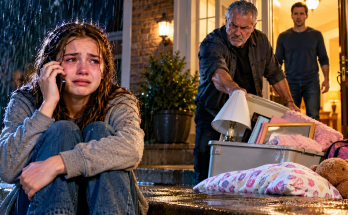
One year after the night Emma called me from the curb, I worked another emergency-department shift.
I considered requesting the date off.
Then decided not to give the calendar that kind of power.
The hospital was busy but manageable.
No catastrophic pileup.
No impossible trauma.
Mostly ordinary emergencies.
A fractured wrist.
Dehydration.
An elderly man frightened by chest pain that turned out not to be a heart attack.
At 12:41 a.m., I noticed the clock.
I stopped for half a second.
Two minutes.
My body remembered before my mind did.
The medication room.
The vibrating phone.
Emma crying in the rain.
At 12:43, my phone buzzed.
I stared at it.
Then laughed.
Emma.
I answered immediately.
“Mom?”
Her voice was bright.
“What happened?”
“Nothing.”
I leaned against the counter.
“You called me at exactly 12:43 to say nothing happened?”
“Yes.”
“Why?”
“Because I figured you’d notice the time.”
I closed my eyes.
Of course she had.
“Where are you?”
“In my bedroom.”
Warmth moved through my chest.
“Doing what?”
“Studying.”
“At 12:43?”
“I have chemistry.”
“You had chemistry last year too.”
“And yet chemistry continues to exist.”
I smiled.
“Where’s Dad?”
“Downstairs asleep on the sofa because he said he was waiting up for you.”
“That sounds like him.”
“Olivia’s here.”
I straightened.
“She is?”
“Sarah had a late recovery meeting and Olivia didn’t want to be alone.”
“Everything okay?”
“Yeah.”
Emma lowered her voice.
“Sarah called before the meeting and asked if Olivia could stay.”
The detail mattered.
Asked.
Not assumed.
Not decided.
“Good.”
Emma continued.
“Grandma dropped off cookies.”
“Marlene?”
“No, the other secret grandma.”
I laughed.
“Mrs. Ellis?”
“Obviously.”
A year earlier Mrs. Ellis had opened her kitchen to a soaking child while my own house failed her.
Now Emma crossed that driveway constantly.
Sometimes for tea.
Sometimes for advice.
Sometimes because Mrs. Ellis’s old terrier liked her better than anyone else.
“What do you need?” I asked.
Emma became quieter.
“Nothing.”
“Then why really call?”
She hesitated.
“I wanted this year to have a different 12:43.”
My throat tightened.
I said nothing for a moment.
Then, “It does.”
“I know.”
She sounded pleased.
“I’m going back to studying.”
“Go to sleep.”
“Eventually.”
“Emma.”
“Love you.”
“Love you too.”
She hung up.
I stood in the medication room holding the silent phone.
A year earlier I had left the hospital believing the emergency was that my daughter had lost her bedroom.
I had been wrong.
The bedroom was only the visible injury.
Underneath it was a family system built on one man’s belief that help created ownership.
Gerald helped Daniel, so Daniel owed obedience.
He supported Sarah, so Sarah’s daughter became a problem he could solve without permission.
He gave Emma birthday money, so her education savings somehow remained available to him.
He lived in my house, so residency became authority.
He called himself responsible, so everyone else was expected to accept his decisions after the fact.
The deed stopped him legally.
But the deed was not what healed us.
The hospital shift ended shortly after seven.
Dawn was pale and cold.
I drove home along wet streets.
Not freezing rain this time.
Just the ordinary Portland drizzle that makes every traffic light glow softly against the pavement.
When I turned onto our street, the house looked exactly like itself.
Same porch.
Same maple tree.
Same upstairs windows.
The difference was invisible from outside.
I parked.
Before I reached the front door, it opened.
Daniel stood there barefoot holding coffee.
I stared at him.
“What?”
“You’re awake.”
“I said I’d wait up.”
“You fell asleep.”
“I woke up.”
He held out the mug.
“You made this before I arrived?”
“Yes.”
“That seems dangerously competent.”
“Therapy.”
I laughed.
He stepped aside.
Not because I needed permission to enter.
Because he was making room.
That distinction, too, had become important.
Inside, Olivia was asleep on the living-room sofa beneath a blanket.
The good sofa.
Not the broken basement couch.
Emma had apparently abandoned chemistry around two because she was asleep upstairs when I checked.
Her door was open slightly.
Blue wall.
Desk lamp still glowing.
Books spread across the bed.
I turned off the light without waking her.
Across the hall, Olivia’s room remained ready even though she no longer lived with us full-time.
A toothbrush in the bathroom.
Two hoodies hanging in the closet.
Photographs on the wall.
Her life had moved back toward Sarah without requiring her to erase us.
That had been the outcome I once feared we might never reach.
Sarah was still sober.
Not cured.
Nobody used that word.
She worked.
Attended meetings.
Went to therapy.
Had bad days.
Called people before bad days became dangerous.
Olivia lived with her most of the time now.
Their relationship was imperfect and real.
Sometimes Olivia spent weekends with us because she wanted to.
Sometimes because Sarah needed support.
Neither situation was treated as failure.
Marlene remained in her apartment.
Her probation requirements were nearly complete.
She and Sarah had begun counseling together too.
Their relationship was harder than Marlene’s relationship with Daniel.
Sarah remembered more.
Resented more.
Asked questions Daniel had once avoided.
Marlene answered.
Sometimes badly.
Then came back and answered better.
She had not reconciled fully with Gerald.
They were legally separated.
Not divorced.
Not reunited.
For once, Marlene allowed an important decision to remain unfinished until she actually knew what she wanted.
Gerald remained on supervised probation.
He lived in a small rental apartment.
Financial monitoring restricted what he could open, transfer, or manage.
He worked part-time doing inventory for a hardware distributor.
A job with rules, records, and supervisors.
Daniel saw him approximately once a month.
Coffee.
Lunch.
Occasionally a walk.
He came home from those meetings sometimes sad, sometimes irritated, sometimes hopeful.
I no longer interrogated him afterward.
If he wanted to talk, he did.
If not, I trusted him to carry the relationship without letting it enter our house uninvited.
Emma had seen Gerald twice after their diner meeting.
Both times in public.
Both times because she asked.
The second meeting, she brought the wooden coin box.
They spent an hour looking through the old coins.
Gerald did not offer her money.
Did not ask about her bank account.
Did not say she owed him forgiveness.
When they finished, he asked whether he could hug her.
Asked.
Emma said yes.
Later she told me, “It was weird.”
Then added, “Good weird.”
That was enough.
Gerald had not entered our house again.
Once, during a conversation with Daniel, he asked whether that might ever change.
Daniel answered correctly.
“It isn’t my invitation to give.”
Gerald accepted it.
Months later, he wrote to me.
Not requesting entry.
Not asking forgiveness.
Simply saying he understood.
I believed he understood the rule.
Whether he had changed deeply enough to live by it forever was not something I needed to decide in advance.
Today’s behavior.
That was all any of us could evaluate.
Emma finished her junior year with better grades than she expected.
Her college account remained intact.
More than intact.
Restitution, recovered funds, and the contributions Daniel and I resumed after the investigations closed had put her back on track.
She refused to let the account become sacred.
“It’s money for school,” she told me. “Not Grandpa’s ghost.”
She was right.
She planned to study environmental science.
Then changed her mind to nursing.
Then changed it back.
I tried not to react to either.
Sixteen had become seventeen, and seventeen was allowed to change its mind.
Daniel became the father who now read forms twice.
Sometimes three times.
Emma mocked him mercilessly.
Permission slips.
Car insurance.
School travel forms.
He read every word.
“Dad.”
“Hold on.”
“It’s literally permission for a field trip.”
“Words matter.”
She rolled her eyes.
But I noticed she smiled when he said it.
Words mattered.
Signatures mattered.
Silence mattered.
So did showing up.
Our marriage remained a work in progress.
That phrase used to sound like something people said when they did not want to admit they were unhappy.
Now I understood it differently.
Progress was work.
We had stopped expecting trust to behave like a switch.
Some days I trusted Daniel completely.
Other days an argument with his mother or a message from Gerald tightened something inside me.
When that happened, I said it.
Daniel no longer called that punishment.
He listened.
Sometimes he defended himself.
Healthy people are allowed to defend themselves.
The difference was he no longer made my discomfort proof that I was unfair.
And when he slipped into old avoidance, I did not compensate by taking over.
I let him feel the consequence of not speaking.
That was harder for me than I expected.
Competence can become control too, even when it begins as survival.
We were both learning.
Downstairs that anniversary morning, Daniel made eggs while I changed out of scrubs.
Olivia woke first.
Her hair stuck straight up on one side.
“You look medical,” she told me.
“I am medical.”
“No, like medically tired.”
“Thank you.”
She opened the refrigerator.
“Do we have orange juice?”
“You were standing in front of it.”
“Oh.”
I watched her pour a glass.
A year earlier, she had stood on our staircase wearing Emma’s comforter, frightened to speak because Gerald had made truth feel dangerous.
Now she moved through the kitchen without asking whether she was allowed to touch anything.
Belonging without ownership.
Again.
The distinction.
Emma came downstairs twenty minutes later.
She looked at me.
“You got my call?”
“I answered it.”
“I was tired.”
“You were studying chemistry at one in the morning.”
“I’m committed to education.”
Daniel put a plate in front of her.
“You’re committed to procrastination.”
Emma pointed at him.
“Do not ruin the anniversary.”
“What anniversary?”
“The anniversary of me realizing everyone in this family needed therapy.”
Olivia choked on orange juice laughing.
Even Daniel laughed.
Then Emma became quieter.
“Can we do something tonight?”
“What?”
“Nothing big.”
She looked around the table.
“Just dinner.”
“With who?”
“Us.”
Then she corrected herself.
“And Olivia if Sarah’s okay with it.”
Olivia picked up her phone.
“I’ll ask.”
Ask.
A tiny word.
The opposite of everything that began this story.
Sarah said yes.
Marlene was invited too, but she already had plans with her probation-support group and declined without guilt.
Gerald was not invited.
Nobody debated it.
That evening, the five of us ate at the dining table.
Me.
Daniel.
Emma.
Olivia.
Sarah, who joined after work because Olivia asked her.
That would have been unimaginable a year earlier.
Sarah sat beneath the same light where Gerald once spread financial decisions as if the room belonged to him.
She looked nervous at first.
Then Emma asked whether Olivia had always stolen other people’s fries.
Sarah laughed.
“Since birth.”
The girls argued.
Daniel poured water.
I watched.
No speeches.
No ceremony.
Eventually Sarah said, “I should thank you.”
I shook my head.
“You don’t owe me.”
She stopped.
Then smiled.
“Right.”
The correction mattered.
She tried again.
“I’m grateful.”
“That I can accept.”
After dinner, Sarah and Olivia left together.
At the door, Olivia hugged us.
Then ran back upstairs because she forgot her charger.
Some things never changed.
When they were gone, Emma helped clear plates.
Daniel loaded the dishwasher.
I wiped down the table.
Outside, rain had started.
Again.
Emma noticed.
She walked to the window.
“Pretty hard.”
I stood beside her.
“Yes.”
She looked toward the curb.
For a moment, neither of us spoke.
Then Emma said, “I don’t think about sitting there every time it rains anymore.”
My throat tightened.
“That’s good.”
“I still remember.”
“You probably always will.”
She nodded.
“Does that bother you?”
“No.”
She looked at me.
“I don’t want to forget.”
I understood.
Forgetting was never the goal.
Memory could become a boundary instead of a wound.
She leaned her shoulder against mine.
“Mom?”
“Yes?”
“If something like that ever happens again…”
I turned toward her.
She smiled.
“I know who to call.”
I laughed softly.
“So do I.”
Daniel came into the room carrying a dish towel.
“What are you two talking about?”
Emma looked at him.
“You.”
He froze.
“Should I leave?”
“No.”
She held out one hand.
He came closer.
Emma took his hand.
Then mine.
For a moment, the three of us stood beside the window looking at the rain.
There was no perfect family waiting at the end of what happened.
No miraculous transformation.
Gerald remained a man capable of love and harm who had finally been forced to confront both.
Marlene remained someone rebuilding a conscience she had once traded for peace.
Sarah remained in recovery, earning trust one day at a time.
Olivia remained a girl learning that needing safety did not make her property.
Daniel remained my husband, accountable for the night he stood still and for every day afterward when he chose not to.
Emma remained herself.
That mattered most.
She had not become hardened.
She had become clearer.
She knew a gift was hers once given.
She knew adults could be wrong.
She knew love did not require surrender.
She knew she could leave a room where someone disrespected her.
And she knew that if she called me at 12:43 in the morning, I would answer.
My father’s deed was still locked in my office.
One owner.
Rachel Elizabeth Moore.
The paper had mattered.
Without it, Gerald might have succeeded in turning entitlement into something harder to stop.
But the deed was never what made this house Emma’s home.
A home was the place where nobody had to earn the right to sleep safely.
Where help did not become debt.
Where a bedroom was not leverage.
Where a child’s savings remained hers.
Where someone knocking at the door waited to be invited inside.
Where apologies did not erase consequences.
Where love could survive truth without controlling it.
The next morning, I found Emma’s new house key on the kitchen table.
She had attached a bright blue keychain to it.
On the plastic tag she had written two words in permanent marker.
MY HOME.
Not my property.
Not my asset.
Not my inheritance.
My home.
I picked it up and smiled.
Then I carried it upstairs and placed it beside her sleeping hand.
Outside, the last of the rain moved east.
Inside, every bedroom door belonged to the person sleeping behind it.
And nobody else got to decide differently.
The End
Read more original stories on Feel Every Story.