Gerald’s release date appeared on the calendar long before any of us decided what it meant.
Daniel wrote it down because he believed pretending not to know would only make the day larger. Emma refused to put it on her phone. Olivia knew it because Marlene mentioned it during a visit, then apologized for assuming she wanted the information.
I knew because Thomas Vance contacted Denise three weeks in advance.
Gerald would complete the custodial portion of his sentence on a Friday morning. Supervised probation would begin immediately. Restitution was substantially paid. Financial monitoring remained in place. His restrictions concerning Olivia would be governed by her case plan, and he still had no automatic right to contact Emma.
Then Vance asked the question.
“Mr. Hart would like to know whether the family is willing to receive a letter requesting contact.”
Not contact.
A request for contact.
The distinction mattered.
I looked at Daniel.
He had heard through speaker.
“What do you want?” I asked.
His first answer surprised me.
“I don’t know.”
A year earlier, Daniel would have interpreted uncertainty as a problem to solve immediately.
Now he sat with it.
“I don’t want him showing up here.”
“He won’t.”
“I don’t want Mom pressured to mediate.”
“We can tell her that.”
“I don’t want Emma feeling like she has to forgive him because he served his sentence.”
“She doesn’t.”
Daniel rubbed his thumb along the edge of the table.
“But I think I want to read the letter.”
So we allowed Vance to send it.
Gerald’s letter arrived two days later.
Separate copies.
One to Daniel.
One to me.
One sealed envelope addressed to Emma, to be given only if we believed she wanted it.
Nothing for Olivia.
That absence was deliberate. Her reunification plan with Sarah was still active, and Gerald’s contact with her remained subject to professional approval.
I read mine alone.
It was shorter than I expected.
Rachel,
I spent a long time believing this house became part of my responsibility because my son lived there and because I had helped your family in other ways. I understand now that I confused being involved with having authority.
I had no right to use your property, your accounts, your schedule, or your absence from home as opportunities to make decisions you had not approved.
I had no right to remove Emma from her room.
I had no right to expect Daniel to carry responsibility for choices I made.
If I ever enter your home again, it should only be because you invited me, not because I believe being family gives me access.
I do not expect that invitation.
Gerald
I read it twice.
Then once more.
No self-defense.
No reference to decades of sacrifice.
No explanation of how frightened or desperate he had been.
That did not erase anything.
But it meant he had finally identified the central violation accurately.
Access without permission.
Authority without consent.
I handed the letter to Denise.
She read it.
“What do you think?”
“I think it is better than anything he said before.”
“That is not what I asked.”
I sighed.
“I don’t know whether I trust it.”
“You don’t have to.”
“Daniel may want to see him.”
“That does not require you to.”
“Emma may too.”
“That still does not require you to.”
I smiled faintly.
“You really do enjoy boundaries.”
“I built a career out of people wishing they had used them earlier.”
At home, Daniel read his letter.
He did not show it to me immediately.
He went for a walk.
When he came back, he looked exhausted but calm.
“What did he say?”
“That he used me because he believed I would keep choosing peace over truth.”
My chest tightened.
“He wrote that?”
“Basically.”
Daniel sat down.
“He said he mistook my loyalty for permission.”
“That sounds accurate.”
“He said he’s in counseling.”
“Also useful if true.”
Daniel gave me a look.
“You’ve become cynical.”
“I’ve become evidence-based.”
That made him laugh.
Then he folded the letter.
“He asked if I’d meet him somewhere public.”
“What do you want?”
“I think yes.”
I waited for the old fear to rise.
The fear that Gerald would pull him back.
That Daniel would return from one lunch speaking Gerald’s language again.
It came.
But it did not control my answer.
“Then you should.”
Daniel looked surprised.
“You’re okay with it?”
“I’m okay with you deciding.”
His face softened.
“That’s different.”
“Yes.”
He nodded.
“Thank you.”
Emma learned about the sealed letter that night.
She stared at the envelope for a long time.
“Do I have to decide now?”
“No.”
“Can I leave it in your office?”
“Yes.”
“What if I never read it?”
“Then I will never open it.”
She nodded.
“Okay.”
It stayed in my locked drawer for eleven days.
On the twelfth, Emma took it upstairs.
She read it by herself.
Then came downstairs carrying the page.
Daniel and I were making dinner.
“He said sorry again.”
Daniel put down the knife he was using.
Emma leaned against the counter.
“He said he understands that I might never want him in my life.”
“What do you think?” I asked.
“I don’t know.”
She looked toward Daniel.
“Do you want him in yours?”
“I think I want to try.”
Emma nodded.
“Does that mean he comes here?”
“No.”
The answer came immediately.
I watched her shoulders lower.
Daniel continued.
“If I see Grandpa, that doesn’t automatically include you or Mom.”
“Good.”
Emma looked at me.
“Would you ever let him inside?”
I took my time.
“Not now.”
She nodded.
“Me neither.”
Then she looked at the letter again.
“But I might want to see him somewhere someday.”
“That’s okay.”
She folded it carefully.
“I don’t want him thinking one meeting means everything’s fixed.”
“Then tell him.”
Emma raised an eyebrow.
“You think he’ll listen?”
“I think if he doesn’t, you leave.”
That answer seemed to please her.
Daniel met Gerald the following Saturday at a diner halfway across town.
Public.
Daytime.
No Marlene.
No mediator.
Daniel told me afterward that his father looked older than he expected.
Not just from confinement.
From uncertainty.
Gerald had always occupied rooms as if the furniture had been arranged for him.
At the diner, he waited for Daniel to choose the booth.
That tiny act almost made Daniel cry.
“What did you talk about?”
“Nothing important for the first ten minutes.”
“Meaning?”
“Coffee. Traffic. The Seahawks.”
I smiled.
“And then?”
“Dad asked about Emma.”
“What did you say?”
“That she’s doing well.”
“Anything else?”
“No.”
Daniel looked proud of that.
“He asked whether she read his letter.”
“And?”
“I said that was her business.”
I could picture Gerald absorbing the answer.
“What did he do?”
“Accepted it.”
“That surprised you?”
“Yes.”
Daniel became serious.
“Then he apologized to me.”
“For what?”
“Using my signature. Keeping the old credit accounts hidden. Making me think obedience was the same thing as love.”
That last sentence hurt.
“What did you say?”
“That I loved him.”
I looked at Daniel.
“And that I didn’t trust him.”
He swallowed.
“I expected him to argue.”
“He didn’t?”
“No.”
Daniel stared at the table.
“He said, ‘That makes sense.’”
Sometimes the simplest reasonable response feels extraordinary when someone has spent a lifetime refusing reason.
“Do you believe he’s changed?” I asked.
Daniel considered it.
“I believe he’s behaving differently.”
That was the right answer.
A month later, Emma asked for her own meeting.
Not alone.
She wanted Daniel there.
Not me.
“I think I’ll be more honest if you’re not watching.”
The statement stung for half a second.
Then I understood.
I was the person who had driven home.
The person who had protected her.
Sometimes children protect the protector from hearing their uncertainty.
“Okay.”
They met Gerald at the same diner.
Emma told me afterward only what she wanted me to know.
“I asked him why he put me outside.”
My chest tightened.
“What did he say?”
“That he thought if he made the decision fast enough, everyone would accept it.”
I closed my eyes.
That sounded like Gerald.
“He said he thought Dad would keep you from making a scene.”
Daniel looked ashamed.
Emma noticed.
“Don’t.”
He looked at her.
“You didn’t know he thought that.”
Daniel nodded.
Emma continued.
“I asked Grandpa whether he would’ve let me back into my room after the inspection.”
“And?”
“He said yes.”
She looked at me.
“I believe that part.”
“So do I.”
“That doesn’t make it okay.”
“No.”
“He said he knows.”
She twisted her sleeve around one finger.
“Then I asked if he really loved me.”
I stopped moving.
“What did he say?”
“He cried.”
Emma stared at the floor.
“He said yes.”
She began crying too.
“I believe that part too.”
I pulled her into my arms.
She held on tightly.
“Why does that make me sadder?”
“Because love doesn’t explain away harm.”
“I know.”
She laughed shakily.
“I really hate two truths.”
From the hallway Olivia called, “Everybody does!”
Emma laughed through tears.
Her meeting with Gerald did not restore a grandparent relationship.
It created a first boundary.
She agreed he could send occasional letters.
No surprise visits.
No financial gifts.
No contact without her parents knowing.
No discussion about the criminal case unless she asked.
Gerald accepted.
Months earlier, he would have called those conditions disrespectful.
Now, at least for the moment, he treated them as the price of access.
Olivia’s life was moving in another direction.
Weekend visits with Sarah became regular.
Then five-day stretches.
Sarah found steady work at a medical billing office.
She attended recovery meetings three nights a week.
Her apartment stayed small, clean, and imperfect.
Olivia tested it relentlessly.
She left a wet towel on the bathroom floor just to see whether Sarah would explode.
She came home forty minutes late from a study group and braced for accusations.
She asked the same question twice about whether Sarah had attended a meeting.
Sarah answered.
Sometimes irritably.
But she answered.
One Sunday Olivia came back to our house carrying half her wardrobe.
Emma stared at the bags.
“Are you moving back?”
“No.”
“Then why do you own seventeen hoodies?”
“I contain multitudes.”
The girls laughed.
Later Olivia told me Sarah had had a bad day.
Not a relapse.
A craving.
She called her sponsor and told Olivia honestly that she was struggling.
“I freaked out.”
“That makes sense.”
“I almost called Karen and said I wanted to stay here forever.”
“What stopped you?”
“Mom didn’t hide it.”
That mattered.
“What did you do?”
“I stayed at Grandma’s that night.”
Marlene had become part of the safety plan.
Not as controller.
As backup.
The difference was enormous.
Sarah had not failed because she needed help.
She had succeeded by asking for it before the danger became secrecy.
At the next case review, Karen asked Olivia whether she still wanted reunification to continue.
Olivia said yes.
No adult answered first.
No one needed to.
By summer, she moved back with Sarah primarily.
Her room in our house remained hers when she visited.
Not because a caseworker required it.
Because we wanted her to know she could return without displacing anyone.
One Friday, months after Gerald’s release, Daniel found me in the backyard.
He sat beside me.
“Dad asked if he could come to Emma’s graduation next year.”
I looked at him.
“What did you say?”
“That he needs to ask Emma closer to the date.”
“Good.”
“He said okay.”
We sat quietly.
Then Daniel said, “I think he’s finally learning that family isn’t a permanent invitation.”
I looked toward the house.
Emma’s blue bedroom wall visible through the upstairs window.
Olivia’s old guest room across the hall, now used whenever she stayed over.
New locks.
Repaired roof.
No packed bags.
No unauthorized papers.
“I think we all are.”
Daniel slipped his hand into mine.
This time I let it stay.
Our marriage had survived.
Not unchanged.
Not because one crisis made us stronger by magic.
It survived because Daniel stopped asking me to trust promises and began behaving in ways that made trust possible.
And because I stopped confusing carrying everything with being safe.
Some nights, when I worked late at the hospital, Emma still texted me.
Home safe.
Door locked.
Dad made pasta.
Olivia here studying.
Normal messages.
Precious because they were normal.
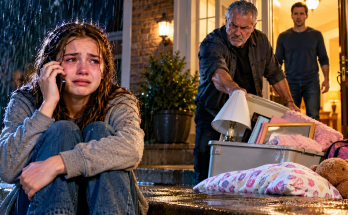
But every time my phone buzzed after midnight, some part of me still remembered 12:43 a.m.
The rain.
Emma’s voice.
Grandpa threw my stuff out.
Dad just stood there.
That memory would always exist.
It no longer controlled the house.
On the anniversary of that night, Emma came into the kitchen carrying the new house key I had given her after the locks were changed.
She spun it around one finger.
“Do you know I still carry this even if Dad is home?”
“I assumed most people carry house keys.”
She rolled her eyes.
“You know what I mean.”
I did.
The key was not proof that she owned the house.
It was proof that she belonged in it.
Those were two different things.
Gerald had spent years confusing them.
Emma no longer did.
Neither did the rest of us.