The prosecutor called me first.
Assistant District Attorney Priya Raman spoke carefully.
“We are discussing a negotiated resolution.”
“I understand.”
“Nothing is final until the court accepts it.”
“Okay.”
She explained the broad structure.
Gerald would admit responsibility for unauthorized financial conduct involving Emma’s account, fraudulent representations connected to the property application, and participation in the false insurance claim.
Several overlapping counts would be dismissed or consolidated.
Restitution would be mandatory.
Probation conditions and potential confinement remained part of the negotiation.
I listened without interrupting.
Then she said, “Emma has the right to submit a victim-impact statement.”
My chest tightened.
“She is not required?”
“No.”
“Does Gerald receive it?”
“Typically, yes, as part of sentencing materials.”
“Does she have to appear?”
“No. She may write something, speak, submit through counsel, or decline entirely.”
I looked through the kitchen window.
Emma was outside with Olivia trying to teach her how to reverse Daniel’s car into the driveway.
Daniel was supervising from the sidewalk.
Olivia nearly mounted the curb.
Emma doubled over laughing.
For once, the sight had nothing to do with fraud.
“I’ll tell her.”
“Please emphasize that there is no correct emotional response.”
I appreciated that.
When I explained the option that evening, Emma stared at her dinner.
“What am I supposed to say?”
“Whatever is true.”
“What if what’s true sounds mean?”
“You are allowed to be angry.”
“What if it sounds too nice?”
“You’re allowed that too.”
She looked toward Daniel.
“Did Dad write one?”
“No.”
“Can he?”
“He may have his own opportunity to provide information, but this is about the harm to you.”
Emma frowned.
“I don’t want Grandpa thinking I decide whether he goes to jail.”
“You don’t.”
“Will he?”
“We don’t know exactly what the sentence will be.”
“I hate that.”
“I know.”
Olivia pushed food around her plate.
“Do I have to write one?”
“Not for Emma’s account.”
“But for the other stuff?”
“Karen or the prosecutor would tell you if they want your input.”
Olivia nodded.
“Okay.”
Emma looked at her.
“Would you?”
“Write one?”
“Yeah.”
Olivia thought.
“I don’t know.”
Then she looked at Emma.
“Probably not yet.”
Emma nodded.
“Same.”
I expected that to end it.
Two days later, Emma knocked on my office door holding three handwritten pages.
“I wrote something.”
I put my laptop aside.
“Do you want me to read it?”
“Yes.”
“Do you want feedback?”
“No.”
That made me smile.
“Understood.”
She sat in the chair opposite me while I read.
The first sentence was simple.
My grandfather did not just take money from me.
The next line made my throat tighten.
He made me wonder whether every gift he ever gave me had secretly belonged to him.
I looked up.
Emma stared at the floor.
I continued.
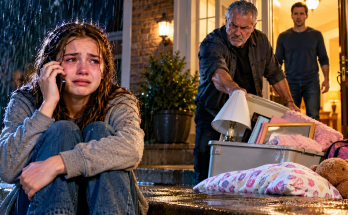
She wrote about the curb.
Not dramatically.
She described the cold concrete through her jeans.
The grocery bag tearing near the bottom.
Watching Daniel through the front window and realizing he might not come outside.
Then she wrote about the account.
My grandpa said the money was temporary, but it did not feel temporary when I saw forty-two thousand dollars missing. It felt like years of birthdays, my great-grandfather’s work, and my parents’ savings had become available because Grandpa wanted them.
She did not ask for prison.
She did not ask for forgiveness.
Her final paragraph was the strongest.
I want the money returned because it was not his. I want him to stop saying what he did was for our family. It was for what he wanted. If he is sorry someday, I hope he tells the truth without explaining why everybody else made him do it.
I put the pages down.
Emma watched me.
“Too mean?”
“No.”
“Too nice?”
“No.”
“Then what?”
“Clear.”
She exhaled.
“That’s what I wanted.”
“Do you want to submit it?”
“I think so.”
“You can change your mind.”
“I know.”
She took the pages back.
Then stopped.
“Can I add something?”
“Of course.”
She returned twenty minutes later with one more sentence.
I still love him, and that does not make what he did smaller.
I stared at the line.
Emma folded the pages.
“That part feels important.”
“It is.”
She submitted the statement through Priya.
Then she went upstairs and studied for a chemistry test.
The world remained stubbornly ordinary around enormous things.
Daniel struggled more with the pending plea.
He wanted it over.
Then felt guilty for wanting it over.
Counseling had given him language for the cycle, but language did not stop the feelings.
One night he sat at the kitchen counter after everyone went to bed.
“Do you think Dad will ever admit what he did without the word but?”
I poured tea.
“I don’t know.”
“He always says, ‘I did this, but…’”
“Yes.”
“I was trying to help, but.”
“Yes.”
“I borrowed money, but.”
“Yes.”
“I changed documents, but.”
I sat beside him.
“You may never get the sentence you want.”
He stared into the mug.
“I want him to say, ‘I did it because I wanted control and money and I thought I could get away with it.’”
“That is a very specific sentence.”
“I’ve practiced.”
I smiled faintly.
Then he became serious.
“Would it change anything?”
“For you?”
“Yes.”
“I don’t know.”
He nodded.
“Probably not.”
But I understood why he wanted it.
A clean admission would mean Daniel did not have to hold reality alone.
Gerald had trained his family to doubt their perception whenever it conflicted with his story.
An admission would end the argument.
But healing could not depend on Gerald giving them one.
Marlene continued cooperating.
She moved into a small apartment ten minutes from the condo.
The condo itself was listed for sale.
According to Anita, the proceeds would largely disappear into debt.
Marlene had taken a part-time bookkeeping job with a church-affiliated thrift organization.
Daniel reacted to that with disbelief.
“Bookkeeping?”
I understood.
“Maybe she wants to prove something.”
“To who?”
“Probably herself.”
He shook his head.
“She better read every document.”
That made both of us laugh.
Marlene’s visits with Olivia remained supervised only by Olivia’s preference now, not by an agency requirement.
Sometimes they met in public.
Sometimes Marlene came to our house when Emma agreed.
She no longer entered without knocking.
That mattered to me more than I expected.
One afternoon, she stood on the porch holding a container of soup.
I opened the door.
“Can I come in?”
The old Marlene would have already stepped past me.
This one waited.
“Yes.”
She entered.
Small behavior.
Real change.
Emma remained polite but distant.
Marlene accepted it.
She did not force affection.
That was another change.
Sarah’s progress continued too.
Her treatment team began discussing a future step-down program.
No immediate return of Olivia.
The plan was gradual.
Supervised day visits.
Family therapy.
Then longer contact if stability held.
Olivia wanted it.
She was terrified of it.
Both were allowed.
During one family session, Sarah told her something she later repeated to me.
“I am not going to ask you to trust me faster than I act trustworthy.”
Olivia loved that sentence.
She wrote it on a sticky note beside her desk.
Daniel saw it.
The next day he wrote his own version and left it beside my coffee.
I won’t ask either.
I kept the note.
Not because it proved anything.
Because it matched his behavior.
When the bank finalized its investigation, Emma’s education account was restored almost completely.
Only $1,860 remained unrecovered through banking channels.
The prosecutor’s restitution calculation included that amount plus certain fees.
Daniel offered to replace it immediately.
Emma shook her head.
“No.”
He looked surprised.
“Why?”
“Because Grandpa owes it.”
“He does.”
“I want the court paper to say he owes it.”
Daniel looked at me.
I nodded.
Her reasoning was not about money.
It was about naming responsibility.
The amount stayed missing for now.
Not forgotten.
Documented.
The day before the plea hearing, Thomas Vance contacted Melissa.
Gerald had read Emma’s statement.
Daniel’s entire body tensed when Melissa told him.
“What did he say?”
“Vance says Gerald became upset.”
“Angry?”
“Emotional.”
“That can mean anything with Dad.”
Melissa agreed.
“He asked whether he could respond to Emma directly.”
My stomach tightened.
“What did Vance say?”
“No.”
Good lawyer.
“He may express remorse through the court if appropriate. He may not use sentencing to pressure her.”
Daniel exhaled.
“Did he say anything else?”
Melissa hesitated.
“Vance said Gerald objected to one sentence.”
Of course.
“Which one?”
The line about gifts.
He made me wonder whether every gift he ever gave me had secretly belonged to him.
Daniel’s face tightened.
“Why that one?”
“Apparently Gerald said his gifts were always genuine.”
I sat back.
Of everything in Emma’s statement, that was what he needed defended.
Not the curb.
Not the theft.
Not the fake bedroom.
His identity as a generous grandfather.
Daniel laughed sadly.
“He still wants the good acts admitted into evidence.”
Melissa said nothing.
There was nothing to say.
The plea hearing happened on a gray Thursday morning.
Emma did not attend.
Olivia did not attend.
Marlene attended with Anita.
Daniel and I sat several rows behind the attorneys.
Gerald entered in a dark suit.
No handcuffs.
No spectacle.
He looked older.
When he saw us, he stopped for half a second.
Then continued.
The judge asked a series of questions.
Gerald answered yes.
Did he understand the agreement?
Yes.
Had he discussed it with counsel?
Yes.
Was he entering the plea voluntarily?
Yes.
Then came the factual admissions.
Unauthorized transfers from an education account.
False representations concerning financial authority over my property.
Conduct intended to induce an insurance payment based on deliberately exaggerated or created damage.
Gerald’s voice weakened slightly.
But he said yes.
No but.
For once, procedure did not permit one.
The judge accepted the plea.
Sentencing would follow after final reports.
Restitution remained mandatory.
Several charges were dismissed as part of the agreement.
Others were incorporated into the admitted conduct.
It was neither the maximum possible punishment nor an escape.
It was consequence.
Afterward, we stood outside the courtroom.
Marlene approached Daniel.
“Are you okay?”
He nodded.
“Not really.”
“Me neither.”
They stood awkwardly.
Then Daniel hugged her.
Briefly.
Not because everything was repaired.
Because she was his mother and the morning hurt.
Gerald came out with Vance.
Everyone froze.
He stopped ten feet away.
His eyes went to Daniel.
Then me.
Then Marlene.
He did not approach.
Vance said something quietly.
Gerald nodded.
Then he looked at me.
“I read what Emma wrote.”
I said nothing.
“She thinks I didn’t love her.”
“That is not what she wrote.”
His face tightened.
“I loved all of them.”
“I believe you.”
That surprised him.
I continued.
“That didn’t stop you from hurting them.”
Gerald stared.
For once, he had no immediate counterargument.
Then he asked, “Is she all right?”
A simple question.
Maybe the first one he had asked without placing himself inside the answer.
“She’s getting there.”
He nodded.
Vance guided him away.
Daniel watched his father disappear down the courthouse steps.
“He didn’t defend himself.”
“No.”
“For almost twenty seconds.”
I almost laughed.
He did too.
Then the laughter broke into tears.
I put my arm around him.
This time it did not feel like rescue.
It felt like standing beside someone while he faced what was already true.

One Comment on “PART 26 – Emma Was Offered the Chance to Speak Before Gerald’s Plea, and Her Decision Was Nothing Like the Revenge Everyone Expected From a Betrayed Child”