PART 1 — THE WOMAN NOBODY REMEMBERED
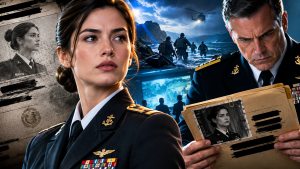
The first time Admiral Richard Crowe saw my personnel file, he asked why a woman with my record had been allowed into a room full of elite military operators.
The second time he saw it, he ordered an investigation that threatened to end my career.
By the third time, he was standing in front of a room full of witnesses, staring at evidence that could destroy everything he had spent thirty years protecting.
But I am getting ahead of myself.
My name is Lieutenant Commander Evelyn Whitaker.
For most of my military career, I had become exceptionally good at being overlooked.
I arrived early. I spoke when necessary. I completed assignments without asking who would receive the credit. When colleagues congratulated me, I thanked them and moved on. When senior officers asked about my past, I gave them the information required by their forms and nothing more.
I had learned that silence could be a form of protection.
It could also become a prison.
Thirty days before Admiral Crowe summoned me to the auditorium, I had reported to a specialized training program at a naval facility on the Atlantic coast. The course brought together experienced operators, intelligence officers, communications specialists, and mission planners. Everyone had been selected for a reason, and everyone knew that someone else was measuring their performance.
Some wanted promotions.
Others wanted assignments that would take them closer to the action.
A few wanted to prove that their reputations were deserved.
I wanted to finish the course, return to my desk, and forget that the past still had a way of finding me.
The first person to make me feel welcome was Chief Petty Officer Elias Vance.
Elias was not the loudest man in the room. He did not tell stories about his deployments or display photographs of places he had visited. He had a quiet, steady manner that made people trust him before they realized they were doing it.
When a young communications specialist struggled with a complicated exercise, Elias stayed behind to help him.
When an operator lost his temper after making a mistake, Elias gave him time to cool down instead of embarrassing him in front of the group.
And when I sat alone during our first lunch break, he placed a cup of coffee on the table opposite me.
“You’re Whitaker,” he said.
“That’s what the identification badge says.”
He glanced at my badge, then back at me.
“Always this friendly?”
“Only before noon.”
For the first time that morning, he smiled.
“Good. I was worried I’d have to do all the work around here.”
We developed an easy professional friendship. We spoke about training schedules, equipment failures, difficult assignments, and the peculiar exhaustion that came from spending years preparing for situations you hoped would never happen.
We never discussed Raven Strait.
Not once.
Yet sometimes, when a storm rattled the windows of the equipment building, I noticed Elias becoming unusually quiet.
He would stare toward the dark glass as if listening for something beyond the rain.
I understood that expression because I had worn it myself.
Six years earlier, during a classified recovery exercise at Raven Strait, our team had lost communications in the middle of a violent storm.
The exercise was supposed to test our ability to coordinate an evacuation under pressure.
Instead, it became the night I learned how quickly a plan could collapse, how easily a team could become lost, and how difficult it was to live with a decision that had saved one person while putting everyone else at risk.
The official report described the operation as a successful recovery.
It praised the team leader’s discipline, the medical unit’s response, and the extraction crew’s efficiency.
My contribution occupied a single line.
Intelligence liaison.
No mention of the route I had reconstructed from fragments of information.
No mention of the injured operator who would have been left behind if we had followed the original evacuation plan.
No mention of the person who had turned back after being ordered to continue toward the extraction point.
I had accepted the report without complaint.
I had even signed the acknowledgment.
Some things, I believed, were better left uncelebrated.
Then Admiral Crowe arrived.
He was a decorated officer with a reputation for discipline and an extraordinary talent for making people feel that every word they spoke was being weighed against an invisible standard.
He began our training review by examining each participant’s record.
Most officers received a few questions and a brief assessment.
When he reached mine, he stopped.
“Lieutenant Commander Whitaker,” he said, studying the paper. “Your assignments are unusual.”
“How so, sir?”
“You have served in intelligence coordination, emergency planning, and operational assessment. Yet your file contains remarkably little about your field contributions.”
“I have performed the duties assigned to me, sir.”
“That wasn’t what I asked.”
“No, sir.”
He looked up.
“Are you deliberately modest, Commander, or is there something in your record you would prefer not to discuss?”
A few people shifted in their seats.
I kept my hands still.
“My record contains the information authorized for release, sir.”
For a moment, Crowe appeared almost amused.
Then he closed the folder.
“We’ll see whether your performance matches your paperwork.”
That afternoon, I noticed something strange.
When the training staff distributed our identification cards, every participant had a designation printed beneath their name.
Mine was blank.
I assumed it was an administrative mistake.
I reported it to the clerk, who checked the system twice and told me the field was empty in the original personnel record.
“That’s unusual,” she said.
“Can you correct it?”
“I’ll submit a request.”
Three days later, the request came back without explanation.
The designation remained blank.
I did not pursue it.
I should have.
Because on the thirtieth evening, during the closing ceremony, Admiral Crowe stood at the podium, raised a glass, and asked a question that made the entire auditorium go silent.
“One final matter,” he announced. “Several members of this training group appear to have developed an unofficial tradition.”
He looked directly at me.
“They have been using a name that does not appear anywhere in Commander Whitaker’s official record.”
A few people exchanged glances.
Crowe smiled without warmth.
“Perhaps someone would care to explain why.”
For several seconds, nobody moved.
Then a chair scraped against the polished floor.
Chief Petty Officer Elias Vance stood.
And for the first time in six years, I heard someone say the name I had tried so hard to leave behind.
“Northstar.”
The admiral’s smile disappeared.
And I knew my past had finally caught up with me.
PART 2 — THE NIGHT THE SEA WENT DARK
“We called her Northstar,” Elias repeated.
Admiral Crowe placed his glass on the podium.
“Explain.”
Elias stepped into the aisle.
“Six years ago, during the Raven Strait recovery exercise, our communications network failed twelve minutes after insertion. Our navigator was injured, the weather deteriorated, and the team lost its position.”
Crowe’s expression remained neutral.
“I am familiar with the report.”
“With respect, sir, you’re familiar with the report that was filed.”
The words landed like a stone dropped into still water.
Every person in the auditorium understood that Elias had crossed a line. Challenging a senior officer was one thing. Suggesting that an official report had concealed the truth was another.
Crowe folded his hands.
“Are you suggesting the report was false?”
“I’m suggesting it was incomplete.”
“That is a serious accusation.”
“Yes, sir.”
Elias did not look away.
He explained how the storm had destroyed their reliable communications, how their navigator had been injured, and how the team had begun moving in the wrong direction.
Their instruments disagreed. Their backup beacon had failed. The route they had memorized was no longer useful because the conditions had changed.
They had been trained to rely on equipment, procedures, and established chains of command.
But the equipment had failed.
The procedures no longer matched reality.
And the chain of command had gone silent.
“Commander Whitaker noticed that the wind was changing direction around the western cliffs,” Elias said. “She compared it with the terrain map and the wave intervals. She realized the storm was bending around the inlet.”
Crowe gave a dismissive laugh.
“So she navigated by listening to the weather?”
“She used the evidence available to her, sir.”
“And you expect this room to believe that was enough?”
“No. I expect this room to understand that she didn’t pretend to have answers she didn’t possess. She asked questions, listened, and waited until the information made sense.”
I felt the eyes of hundreds of people settling on me.
I hated every second.
I had spent six years making peace with my anonymity. I had convinced myself that the absence of recognition was a small price for being allowed to move forward.
Now Elias was dragging that carefully constructed peace into the open.
Crowe turned toward me.
“Commander, did you lead that operation?”
“No, sir.”
“Were you in command of the team?”
“No, sir.”
“Then what exactly did you do?”
I looked at the six operators who had participated in the exercise.
They were older now. Some had gray at their temples. One walked with a slight limp. Another still wore the same expression of intense concentration I remembered from that terrible night.
“I helped them find the way out,” I answered.
Crowe’s mouth tightened.
“A remarkably modest description.”
“It is an accurate one, sir.”
“Yet your colleagues have given you a name usually reserved for someone whose actions distinguish them from everyone else.”
I drew a slow breath.
“Northstar wasn’t meant to distinguish me from the team. It was meant to remind us where we were going.”
For a moment, the admiral had nothing to say.
Then Lieutenant Marcus Hale, the team leader during Raven Strait, stood.
“Commander Whitaker didn’t take command away from me,” he said. “She gave me the information I needed to make the right decision.”
“Did she save the exercise?” Crowe asked.
Hale looked at me.
“She saved the team.”
The first clap came from the back of the room.
Then another.
Within seconds, the auditorium filled with applause.
I wanted to disappear.
Crowe waited for the noise to subside.
“Interesting,” he said. “But I have a question for Chief Vance.”
Elias straightened.
“Sir?”
“You were the last operator to leave the training area, weren’t you?”
“Yes, sir.”
“You were ordered to evacuate with the rest of the team.”
“Yes, sir.”
“And yet you remained behind.”
Elias’s jaw tightened.
Crowe turned toward me.
“Why?”
My stomach went cold.
I knew the question was coming. I had simply hoped it would never be asked in front of these people.
“Commander Whitaker?” Crowe pressed.
“Chief Vance was injured, sir.”
“That does not answer my question.”
I met his eyes.
“I returned for him.”
“You had already reached the recovery point.”
“Yes, sir.”
“You abandoned the extraction plan.”
“I returned for one of my team.”
“You were not the team leader. You were not the medic. You had no authorization to alter the plan.”
“No, sir.”
“Then you disobeyed an order.”
The auditorium became so quiet I could hear the ventilation system humming above us.
“Yes, sir,” I replied.
Crowe leaned forward.
“And you believe that was the correct decision?”
“Yes.”
“Because he survived?”
“Because he was there.”
The admiral studied me for a long moment.
Then he reached behind the podium and lifted a thin gray folder.
I recognized it immediately.
It was the same folder I had seen on his desk during our first week of training.
My personnel summary.
The file with the blank designation field.
Crowe opened it.
“The official record contains no mention of your return to the training area,” he said. “Perhaps the problem is not that your call sign was never submitted. Perhaps someone has been protecting you from the consequences of what really happened.”
He closed the folder.
“I am ordering a formal review of Lieutenant Commander Whitaker’s record, effective immediately.”
Before I could respond, an aide approached carrying a sealed envelope.
The envelope bore a classification marking I had not seen in six years.
Beneath it, someone had written three words.
RAVEN STRAIT — NORTHSTAR FILE.
And the authorization seal belonged to Admiral Crowe.
PART 3 — THE FILE THAT SHOULD NOT EXIST
I waited until the auditorium was nearly empty before opening the envelope.
Elias stood beside me.
Neither of us had spoken since the ceremony ended.
The envelope was thick, its edges worn, and the security seal bore the date of the original Raven Strait exercise. Across the back, a faded handwritten notation identified the file’s last authorized custodian.
Admiral Richard Crowe.
Elias read the name twice.
“Why would he have this?”
“I don’t know.”
“That folder was in his possession before he questioned you.”
“I noticed.”
“Ev, this isn’t an administrative mistake.”
I looked at him sharply.
He rarely called me Ev, and never in a professional setting.
“Don’t,” I said.
“Don’t what?”
“Turn this into a personal investigation.”
His expression hardened.
“Someone sealed a file about the night I nearly died. Someone removed your name from the report. And now the officer who possesses the file is ordering an investigation into you.”
“That doesn’t prove anything.”
“No. But it proves we need answers.”
I looked down at the envelope.
For six years, I had told myself that the report was simply a report. Imperfect, perhaps, but not malicious. The exercise had ended, everyone had survived, and no one had been formally punished.
I had wanted that to be enough.
I broke the seal.
Inside were three documents.
The first was a copy of the original mission plan.
The second was a transcript of a communications exchange recorded during the exercise.
The third was a memorandum stamped with the word RESTRICTED.
My hands became cold when I read the first line.
Emergency withdrawal authorization issued at 21:14.
Below it appeared a signature.
Rear Admiral Richard Crowe.
Elias leaned closer.
“He was in command?”
“Not directly. He was overseeing the exercise from the regional command center.”
“Then why did he issue the withdrawal order?”
I turned to the second document.
The transcript was incomplete, but the surviving entries were enough to make my heart pound.
At 21:14, command had ordered the team to withdraw immediately.
At 21:19, the field team had reported that one operator was missing.
At 21:22, the command center had acknowledged the report.
At 21:24, a final message had been recorded.
Recovery of remaining personnel is not authorized. Proceed to designated extraction point.
The sender’s identification was partially obscured.
But the routing code matched the regional command center.
Elias read the message and went pale.
“They knew I was still out there.”
“They knew someone was missing.”
“They ordered the team to leave anyway.”
I did not answer.
There was something worse.
The transcript showed that a second communications channel had remained active for eleven minutes after the primary network failed.
Someone at command had continued receiving information from the field.
Someone had known that the team was not where the original report claimed it was.
I opened the memorandum.
Most of the page had been blacked out. Only a few sentences remained readable.
The incident shall be recorded as a successful exercise termination.
No individual deviation shall be highlighted.
The final report shall reflect approved command findings.
At the bottom was another signature.
Not Crowe’s.
Vice Admiral Nathaniel Sloane.
I remembered the name.
Sloane had been the senior officer responsible for reviewing the exercise six years earlier. He had since retired, leaving behind a reputation for impeccable discipline and a series of promotions that had surprised almost no one.
I stared at the signature.
“Someone decided what the report would say before it was written,” I whispered.
Elias shook his head.
“Why would they conceal the fact that you saved me?”
“I don’t know.”
“Did you see the order before you turned back?”
“No.”
“Then how did you know I was still alive?”
I looked at him.
Because I had heard him.
Not through the radio.
Not through a functioning communications system.
I had heard three faint knocks against the metal structure where he was trapped.
I had followed the sound.
I had never told anyone because I had no way to prove it.
“I heard something,” I said.
“What?”
“Three knocks.”
Elias stared at me.
“I remember knocking,” he whispered. “I thought no one could hear me.”
For several seconds, neither of us moved.
Then my phone vibrated.
A message had arrived from an unknown number.
Do not open the original Northstar file without independent counsel.
A second message appeared before I could respond.
The official report was not the only thing that disappeared at Raven Strait.
And then a third.
Ask who disabled the backup beacon.
I looked up at Elias.
He had read the messages over my shoulder.
“Someone knows we’re looking,” he said.
I folded the documents carefully and returned them to the envelope.
For the first time in six years, I was no longer afraid of remembering Raven Strait.
I was afraid of discovering that the people I had trusted had known the truth all along.
PART 4 — THE MAN WHO SIGNED THE LIE
The following morning, I reported to the review office at 0800.
The room contained a long table, three chairs, and a camera mounted in the upper corner.
An officer from personnel sat behind a computer. Beside him was a civilian attorney whose name I recognized from the military’s internal oversight directory.
A second officer entered carrying a thick binder.
“Lieutenant Commander Whitaker, this is a preliminary administrative review,” he explained. “The purpose is to establish whether your actions during the Raven Strait exercise were consistent with applicable orders and procedures.”
“I understand.”
“Do you acknowledge returning to the training area after the withdrawal order?”
“Yes.”
“Did you receive authorization to do so?”
“No.”
“Why did you return?”
“An operator remained injured in a dangerous location.”
“Was the operator’s position confirmed?”
“No.”
“Was his survival confirmed?”
“No.”
“Then you made a decision based on incomplete information.”
“Yes.”
The officer looked up.
“Do you consider that decision appropriate?”
“I consider it necessary under the circumstances.”
He made a note.
The civilian attorney studied me for several seconds.
“Commander, did you know that a separate communications channel remained active during the incident?”
“No.”
“Did you know that command had received information indicating the team was not at the expected extraction location?”
“No.”
“Did you know that the original mission report had been amended?”
I hesitated.
“Not until yesterday.”
She exchanged a glance with the personnel officer.
“Who informed you?”
“Admiral Crowe provided a sealed file.”
“Did he explain why the file had been retained?”
“No.”
The questioning continued for nearly two hours.
They asked about my training, my qualifications, my decision-making process, and my relationship with the other operators.
Every answer was recorded.
Every pause seemed to invite another question.
Finally, the personnel officer closed his binder.
“Until the review is complete, you are not to access classified materials relating to Raven Strait or contact personnel assigned to the original exercise concerning the matter.”
I nodded.
As I stood to leave, the civilian attorney spoke.
“Commander, one more question.”
I turned.
“Why did you never request an amendment to the original report?”
I could have given her the easy answer.
I could have said that the team mattered more than individual recognition, that the exercise had ended successfully, or that I had not wanted to reopen a painful memory.
Instead, I told her the truth.
“Because I believed the report had been written by people who understood what happened.”
She held my gaze.
“And do you still believe that?”
“No.”
Outside the review office, I found Elias waiting beside a window.
“They restricted your access,” he said.
“Yes.”
“That means we’re getting close.”
“Or it means the review is working exactly as it should.”
He studied me.
“You really believe that?”
“I want to.”
We walked toward the parking area without speaking.
At the gate, an unfamiliar sedan pulled alongside us. The passenger window lowered, revealing an older man in civilian clothes.
He looked directly at me.
“Commander Whitaker?”
“Yes.”
“My name is Thomas Bell. I was the communications supervisor at Raven Strait.”
Elias stepped forward.
“Your name isn’t on the roster.”
“Because I was assigned to the command center, not the field team.”
Bell glanced toward the security booth.
“I don’t have much time.”
He reached through the window and handed me a small business card.
On the back, he had written an address and a time.
“Meet me tomorrow. Come alone.”
“Why?”
His expression tightened.
“Because the person who altered your report is still alive, and the person who ordered it sealed is not the only one who had something to lose.”
Before I could ask another question, he raised the window and drove away.
I turned the card over.
At the bottom, beneath the address, he had written one final sentence.
The beacon wasn’t broken, Commander.
Someone turned it off.
PART 5 — THE WITNESS WHO DISAPPEARED
Thomas Bell had chosen a small diner twenty miles from the naval facility.
It was the kind of place where nobody looked twice at a person wearing a uniform, where truck drivers drank coffee beside retired mechanics, and where conversations disappeared beneath the noise of the kitchen.
I arrived ten minutes early.
Bell was already there.
He sat in a booth near the back, his hands wrapped around a cup of coffee he had not touched.
“You came alone,” he said.
“You asked me to.”
He nodded toward the opposite seat.
I sat down.
“Tell me about the beacon.”
Bell looked toward the window.
“Six years ago, the primary communications system failed during the storm. That part of the report is true. But the backup beacon should have remained active.”
“Why didn’t it?”
“Someone disabled it remotely.”
“Who?”
“I never received a name. I received an authorization code.”
He took a folded sheet of paper from his jacket.
The code had been partially redacted, but the surviving characters matched the regional command network.
“Did you report this?”
“Immediately.”
“To whom?”
“Vice Admiral Sloane’s review office.”
“And what happened?”
Bell gave a humorless laugh.
“I was told the system had malfunctioned. Then I was ordered to sign a statement confirming that the beacon had failed because of environmental conditions.”
“Did you sign it?”
“Yes.”
“Why?”
“Because I had a family, a mortgage, and two children in school. I thought I could survive one bad decision.”
He looked at me.
“I didn’t understand that the decision would follow me for the rest of my life.”
I studied the document.
“Do you still have the original record?”
“No. But I kept a copy of the maintenance log.”
He slid a second page across the table.
The log showed that the backup beacon had passed its operational check shortly before insertion. Its power supply remained stable. No mechanical fault had been recorded.
Then, at 21:17, the system had received an authenticated shutdown command.
The command originated from a remote terminal inside the regional command center.
Someone had deliberately disabled the beacon after the team had already entered the training area.
“Why?” I whispered.
Bell shook his head.
“I never found out.”
“Who had access to that terminal?”
“Three people. The communications director, the duty commander, and the senior officer overseeing the exercise.”
I looked at the code again.
“Did you ever see the original authorization?”
“Once.”
“Whose name was on it?”
Bell hesitated.
Then he said, “Nathaniel Sloane.”
The diner suddenly felt too small.
Sloane had overseen the exercise. He had approved the final report. And now there was evidence that a system crucial to the team’s recovery had been deliberately disabled under his authority.
“Why are you telling me this now?” I asked.
Bell’s hands trembled slightly.
“Because yesterday, someone contacted me and told me the Northstar file had been opened.”
“Who?”
“I don’t know. The person said the truth would come out whether I cooperated or not.”
He leaned forward.
“Commander, I need you to understand something. I don’t know whether Sloane intended to hurt anyone. I don’t know whether he was following an order or trying to protect a larger operation. But I know that the beacon didn’t fail on its own.”
I placed the maintenance log inside my folder.
“Will you testify?”
Bell looked down at his coffee.
For a moment, I thought he would refuse.
Then he nodded.
“Yes.”
As I stood, he caught my sleeve.
“There’s something else.”
“What?”
“Your name wasn’t supposed to appear in the report at all.”
I froze.
“What do you mean?”
“After the exercise, I saw an internal message instructing the records team to remove the intelligence liaison’s identification from the narrative summary. The message didn’t say your name. It referred to a designation.”
“Northstar?”
Bell’s eyes widened.
“That’s what they called you?”
“Yes.”
He swallowed.
“Then the name was known before your team ever used it.”
I stared at him.
That was impossible.
The operators had given me the name after Raven Strait.
At least, that was what I had believed.
Bell pushed a final slip of paper across the table.
It contained a reference number and the name of an archived personnel record.
“Find the original authorization,” he said. “It may tell you why.”
I left the diner with the maintenance log and a question that followed me all the way back to the base.
If someone had known the name Northstar before the rescue, what exactly had they expected me to do?
PART 6 — THE NAME BURIED UNDER ANOTHER NAME
My access to the Raven Strait archive had been suspended, but I still had one option.
I could request an independent review of the records associated with the exercise.
It was a formal process. Slow, inconvenient, and difficult to influence.
It was also the only legitimate way to obtain information without violating the restrictions placed on me.
I submitted the request before noon.
By the following morning, it had been acknowledged.
By the afternoon, it had been placed on hold.
The explanation cited a discrepancy in the archive’s classification history.
I read the notice three times.
Then I called the civilian attorney who had interviewed me.
“I believe someone is obstructing the review,” I said.
“What evidence do you have?”
I explained the maintenance log and Thomas Bell’s testimony.
She listened without interrupting.
When I finished, she asked me to send the documents through the authorized reporting channel.
“Do not attempt to access the restricted archive yourself,” she said. “If there has been interference, we need a clean record of how the evidence was obtained.”
I followed her instructions.
Two days later, she called me back.
“We found something,” she said.
“What?”
“Your designation was originally entered into a preliminary training database eleven days before the Raven Strait exercise.”
I sat down.
“That’s impossible.”
“The database entry is authentic. It was created by the program’s assessment office.”
“Who submitted it?”
She paused.
“Vice Admiral Sloane.”
For several seconds, I could not speak.
The designation field in my personnel record had not been left blank by accident.
Someone had entered a name before the exercise, then ensured that the name disappeared from the official record afterward.
But why?
The attorney continued.
“The designation was linked to an assessment category, not a formal call sign. It appears to have been used internally to identify participants who demonstrated exceptional performance under uncertain conditions.”
“So Northstar wasn’t originally a nickname.”
“Not according to the record.”
I closed my eyes.
The name had begun as a label.
Then, after Raven Strait, the operators had given it a meaning of their own.
They had used it to remind themselves that they had survived because someone had kept searching for a way forward when everything else had failed.
Someone had taken that meaning and turned it into an administrative secret.
“Was the designation used for anyone else?” I asked.
“Yes.”
“Who?”
“Two other officers. Both records were later amended.”
“Why?”
“We don’t know yet.”
The attorney promised to continue investigating.
That evening, Elias came to my apartment.
He brought a folder of his own.
“I spoke with Marcus,” he said.
“You’re not supposed to contact the team about Raven Strait.”
“I didn’t ask him about the investigation. I asked him about something he remembered from before the exercise.”
He opened the folder.
Inside was a photograph of a whiteboard taken during an old training session.
Several names were written in columns.
Mine appeared near the bottom.
Beside it was the word NORTHSTAR.
Below that, someone had written a short note.
Independent judgment. High reliability under degraded communications.
I stared at the photograph.
“Where did you get this?”
“Marcus kept it in his training archive. He didn’t know what it meant until I told him what Bell had said.”
I looked up.
“Did he remember who wrote it?”
“Not at first.”
“And now?”
Elias took a breath.
“He remembers Sloane standing beside the board. He remembers asking why a liaison officer was being evaluated alongside the operational team.”
“What did Sloane say?”
Elias looked directly at me.
“He said, ‘Because one day, the people who survive will depend on someone nobody thought to watch.'”
A chill moved through me.
That sentence could have been a compliment.
It could also have been a warning.
And for the first time, I began to wonder whether Raven Strait had been an ordinary exercise at all.
PART 7 — THE ADMIRAL’S PRIVATE OFFER
Admiral Crowe summoned me to his office on Friday morning.
He did not offer coffee.
He did not ask me to sit.
Instead, he stood beside the window overlooking the parade ground and held a sheet of paper in his hand.
“I have reviewed the preliminary findings,” he said.
“Yes, sir.”
“Your actions at Raven Strait raise serious questions about your judgment.”
“I understand.”
“You knowingly departed from an evacuation order.”
“Yes, sir.”
“You returned to a hazardous area without confirmation that the missing operator could be recovered.”
“Yes, sir.”
“And you have recently obtained documents that may have been retained outside the authorized chain of custody.”
“I submitted them through the independent review process.”
His expression tightened.
“You have become very careful with your wording, Commander.”
“I am trying to be accurate, sir.”
Crowe placed the paper on his desk.
“Your record could be damaged by this investigation. A formal finding of misconduct could affect your future assignments, your eligibility for promotion, and your standing within the service.”
I remained silent.
He studied me.
“However, there is a way to prevent this from becoming more complicated.”
I knew what was coming before he said it.
“You could acknowledge that the decision to return was unauthorized, accept responsibility for the procedural breach, and agree that the original report was an appropriate summary of the exercise.”
“The original report states that all recovery procedures were completed according to plan.”
“That is the approved conclusion.”
“But the backup beacon was deliberately disabled.”
Crowe’s face changed.
Only slightly.
Enough.
“Who told you that?”
“Evidence submitted to the review office.”
“Evidence can be misinterpreted.”
“Then the review should determine whether it is accurate.”
He moved around the desk.
“Commander, you have a promising career. Do not destroy it over a misunderstanding that occurred six years ago.”
I looked at the document on his desk.
It was a draft statement.
The wording was carefully constructed. It acknowledged my unauthorized return, described the incident as a training complication, and affirmed that I had no reason to question the accuracy of the final report.
All I had to do was sign.
In return, the review could be concluded without a formal disciplinary recommendation.
I understood the offer.
He was not asking me to admit that I had made a mistake.
He was asking me to help preserve a version of events that we both now had reason to doubt.
“No, sir,” I said.
Crowe stared at me.
“What did you say?”
“I cannot sign a statement that I believe is inaccurate.”
His voice became colder.
“Be very careful, Commander.”
“I am being careful.”
“You may not understand the consequences.”
“Then I would prefer to understand them before I make a statement.”
For a long moment, he said nothing.
Then he picked up the draft and placed it inside a folder.
“Your review will continue.”
“Yes, sir.”
“Until it concludes, your duties will be restricted.”
“I understand.”
I turned toward the door.
“Whitaker.”
I stopped.
Crowe’s expression had become difficult to read.
“Do you know what happens when a person mistakes personal loyalty for professional duty?”
I faced him.
“Yes, sir.”
“Then perhaps you should remember that.”
I left without answering.
Outside his office, I found the civilian attorney waiting.
She had heard about the meeting through the review process.
“Did he ask you to sign a statement?”
“Yes.”
“Did you sign it?”
“No.”
She nodded.
“Good. Because we’ve found the original transmission log.”
I stared at her.
“From Raven Strait?”
“Yes.”
“Does it identify who disabled the beacon?”
“Not yet.”
She handed me a sealed document.
“But it establishes something else. The command center received a distress signal from the missing operator before the withdrawal order was finalized.”
I felt the floor shift beneath me.
“Elias?”
“Yes.”
The attorney lowered her voice.
“Someone knew he was alive before your team left the area.”
I thought of the three knocks against the metal structure.
The faint sound I had followed through the rain.
The order to continue toward extraction.
And the name someone had entered into a database before the exercise began.
“What happens now?” I asked.
“Now we find out why that signal was ignored.”
PART 8 — THE VOICE ON THE RECORDING
The original transmission log led to an archived audio file.
It was incomplete, but the surviving recording contained three exchanges between the field team and the command center.
The first was routine.
The second reported the navigator’s injury.
The third was the distress signal.
Elias’s voice was barely recognizable beneath the static.
“—position uncertain—structural collapse—requesting recovery—”
A second voice answered.
“Confirm personnel status.”
Elias tried again.
“One operator injured. Unable to move. Requesting immediate assistance.”
Then came a pause.
A long one.
Finally, the command center responded.
“Withdrawal remains in effect. Proceed to the designated extraction point.”
Elias’s voice returned, weaker this time.
“Negative. Operator cannot be moved without assistance.”
The recording ended.
I listened to it twice.
Then a third time.
The attorney sat beside me, studying the transcript.
“The audio doesn’t identify the person issuing the order,” she said. “But the transmission was routed through a terminal assigned to the duty command officer.”
“Who was on duty?”
She turned a page.
“Vice Admiral Sloane was overseeing the exercise. Admiral Crowe was the regional operations supervisor. There were also two communications officers in the control room.”
“Can we identify the voice?”
“We’re arranging an authenticated forensic review.”
I leaned back.
The truth was beginning to emerge, but it was not yet complete.
Someone had heard Elias’s distress call.
Someone had ordered the team to withdraw.
Someone had later removed the evidence that could explain what happened.
But I still could not understand why anyone would risk an operator’s life to preserve a training exercise.
Unless the exercise had been designed to test something other than our ability to complete a recovery.
The attorney noticed my expression.
“What are you thinking?”
“The original assessment.”
She opened the file containing the preliminary designation records.
We examined the entries again.
Three officers had been assigned special evaluation categories before Raven Strait.
One was me.
The second was a communications specialist who had since transferred to another branch.
The third was a mission planner who had retired after a distinguished career.
All three records had been amended within a month of the exercise.
The same phrase appeared in each amendment.
Designation removed pending final operational assessment.
“Why would they evaluate us separately?” I asked.
The attorney read the sentence beneath the classification header.
“Perhaps the exercise was testing individual decision-making under conditions where normal command structures were unavailable.”
“That would explain the designation.”
“Possibly.”
“But it wouldn’t explain why the beacon was disabled.”
She closed the file.
“No. It wouldn’t.”
That afternoon, the forensic team confirmed that the audio had not been altered after its original recording.
They could not identify the speaker with certainty, but they verified the timing and routing information.
The distress call had reached the command center four minutes before the final withdrawal order.
Four minutes.
Four minutes in which someone could have authorized a recovery team.
Four minutes in which someone could have asked for clarification.
Four minutes in which the decision to leave Elias behind had not yet become irreversible.
Instead, the order had remained unchanged.
I thought about the man trapped beneath the collapsed structure, listening to the rain and wondering whether anyone had heard him.
I thought about the three knocks.
And I thought about the fact that I had never been told the command center knew he was alive.
When I returned to my quarters, an envelope lay beneath the door.
It contained a single handwritten page.
You are looking at the wrong officer.
Beneath the sentence was a name.
Thomas Bell.
I immediately called the attorney.
Bell had been scheduled to provide a formal statement the following morning.
He never arrived.
His phone had been disconnected.
His apartment was empty.
And when investigators contacted his former employer, they were told that Bell had moved overseas two years earlier.
I knew that was impossible.
I had seen him two days ago.
Someone had known he was about to testify.
And someone wanted us to believe that the man who could explain the missing beacon had simply disappeared.
PART 9 — THE MAN WHO CAME BACK
The investigation changed direction after Thomas Bell disappeared.
The civilian attorney requested assistance from an independent oversight office. His disappearance was treated as a matter requiring verification, not proof of wrongdoing by any particular officer.
For two days, we heard nothing.
Then, shortly before midnight, I received a call from an unfamiliar number.
“Commander Whitaker?”
It was Bell.
“Where are you?”
“I can’t tell you.”
“Are you safe?”
A long silence followed.
“I’m safe enough to talk.”
“Why did you disappear?”
“Because I realized the person who contacted me wasn’t trying to frighten me into silence.”
“Then what were they trying to do?”
“Make sure I didn’t testify.”
I closed my eyes.
“Do you have evidence?”
“Yes.”
“Of what?”
“Of who authorized the beacon shutdown.”
I sat up straight.
“Tell me.”
“Not over the phone.”
“Bell, the investigators need to know you’re alive.”
“I’ll contact them through the attorney. But there’s something you need to understand first.”
His voice became quieter.
“The person who signed the shutdown authorization wasn’t Sloane.”
I gripped the phone.
“The record carries his authorization code.”
“Because he approved the command after the fact. The original instruction came from another office.”
“Whose office?”
“I have a copy of the routing record. It points to a senior command review unit that no longer exists.”
“Who was responsible for that unit?”
Bell hesitated.
Then he gave me a name.
“Admiral Crowe.”
The room seemed to go silent around me.
“Are you certain?”
“I’m certain the instruction came from his office. I’m not certain he understood what the instruction would do.”
That distinction mattered.
An officer could authorize a technical procedure without knowing every operational consequence. A command could be misrepresented. A record could be altered to make a decision appear more deliberate than it had been.
I refused to turn suspicion into certainty.
“What does the routing record actually say?” I asked.
“That the beacon was to be disabled during the final assessment window.”
“Why?”
“I don’t know. But the instruction was issued before the exercise began.”
The preliminary assessment.
The blank designation field.
The call sign that had appeared in a database before anyone on the team had used it.
Suddenly, the pieces were beginning to form a picture.
Raven Strait had not simply been a training exercise that went wrong.
It had been an evaluation designed to measure how personnel responded when communications and normal procedures failed.
Someone had expected the beacon to be disabled.
Someone had expected the team to encounter uncertainty.
But the exercise had crossed into dangerous territory when a real injury occurred and the command center failed to adapt.
“Can you prove the original instruction came from Crowe’s office?” I asked.
“I have a routing record and an archived copy of the authorization.”
“Then give it to the attorney.”
“I will.”
He paused.
“Commander, there’s one more thing.”
“What?”
“The Northstar designation was never intended to be a call sign.”
“I know.”
“No. You don’t understand. It wasn’t just an evaluation category. It was the name of a proposed program designed to identify people who could make sound decisions when command information became unreliable.”
I thought of the note on the whiteboard.
Independent judgment. High reliability under degraded communications.
“Why was the program abandoned?”
“Because Raven Strait became a liability.”
He took a breath.
“After the exercise, the program’s leadership had to decide whether to acknowledge that the assessment had been conducted under unsafe conditions or bury the circumstances and preserve the official conclusion.”
“And they chose to bury it.”
“Yes.”
I stared at the dark window.
“Why are you telling me this now?”
“Because the person who contacted me said the program is being reviewed again. Someone wants to know whether the original assessment can be revived.”
I felt a chill.
“Who?”
“I don’t know.”
The call ended a few seconds later.
I sat in the darkness for a long time.
Someone had designed an evaluation to test independent judgment.
I had turned back for an injured teammate.
The team had survived.
And the people responsible for the evaluation had spent six years hiding the conditions under which that decision had been made.
The next morning, the attorney confirmed that Bell had contacted her through a secure channel.
He had agreed to provide the evidence.
The investigation was no longer just about my personnel file.
It was about a program that had never officially existed.
And the name they had never filed was at the center of it.
PART 10 — THE OFFICER WHO REFUSED TO LIE
Admiral Crowe requested a meeting with the independent review panel.
He arrived carrying his own documents and asked to give a statement before the other witnesses were interviewed.
The panel agreed.
I was not present in the room, but I later learned what he had said.
Crowe acknowledged that his office had approved a temporary communications restriction during the Raven Strait exercise.
He said the restriction was intended to evaluate whether the team could continue operating when its primary systems became unavailable.
He denied ordering anyone to abandon an injured operator.
He also denied knowing that the backup beacon had been disabled until after the exercise had ended.
His explanation was plausible.
It was also incomplete.
The routing record showed that his office had received a technical warning about the beacon’s status before the final withdrawal order.
The warning did not explicitly state that the beacon had been deliberately disabled.
But it did state that the system was no longer transmitting.
Crowe had signed the acknowledgment.
The panel asked why he had not ordered the exercise suspended.
He answered that the command center had believed the field team could continue toward the designated recovery point.
The panel asked why the report omitted the warning.
He said he had not been responsible for drafting the final narrative.
Then the attorney placed the original authorization on the table.
It contained a handwritten instruction:
Maintain assessment conditions until termination threshold is reached.
The signature belonged to Crowe.
For the first time, his composure faltered.
He read the sentence twice.
“I do not recall writing this,” he said.
The panel asked whether he recognized the signature.
“Yes.”
“Do you dispute its authenticity?”
Crowe took a long breath.
“No.”
“Then explain it.”
He looked down at the document.
“I approved the assessment conditions. I did not approve risking an operator’s life.”
“Did you understand that disabling the beacon could interfere with emergency recovery?”
“I was told the backup system would remain available through a separate channel.”
“Was it available?”
“No.”
“Why not?”
“I don’t know.”
The panel continued questioning him for another hour.
By the time the session ended, Crowe had admitted that his office had approved the temporary restriction, that he had received a warning about the communications system, and that he had signed a report confirming the exercise had been completed within approved parameters.
But he had not explained who had disabled the beacon.
Nor had he explained why the final report had been amended to remove the warning.
That afternoon, I received an official notice.
The panel had determined that the available evidence did not support disciplinary action against me for returning to Raven Strait.
The review of my conduct was suspended pending completion of the broader investigation.
I read the notice twice.
Then I placed it on the table and sat very still.
For six years, I had believed that the absence of punishment meant the institution had accepted what I had done.
Now I understood that the absence of punishment had meant something else.
The people responsible had been unable to decide whether acknowledging my actions would expose their own.
Elias came to see me that evening.
He found me sitting beside the window, staring at the notice.
“Does this mean you’re cleared?”
“It means the panel hasn’t found grounds to punish me.”
“That’s a start.”
“Yes.”
He sat opposite me.
For a while, neither of us spoke.
Then he said, “You know what I remember most about that night?”
I looked at him.
“Not the storm. Not the pain. Not even the moment you found me.”
“What, then?”
“The fact that you looked furious.”
I almost smiled.
“I was furious.”
“At me?”
“At the entire situation.”
He shook his head.
“You looked at me like I had personally inconvenienced you.”
“You had.”
He laughed softly.
Then his expression grew serious.
“I spent six years believing you had saved me because you were brave.”
I waited.
“Now I think you did it because you refused to accept that the order was the same thing as the right decision.”
I looked away.
“I was afraid.”
“I know.”
“No. You don’t.”
He fell silent.
I had never told him the full truth.
I had been afraid of dying, of being wrong, of leading the team into a second disaster. I had been afraid that turning back would cost more lives than it saved.
But there had been another fear.
A smaller, more personal one.
I had been afraid of walking away from a man who trusted me enough to believe that someone would come.
“I couldn’t leave you there,” I whispered.
Elias reached across the table and covered my hand with his.
“You didn’t.”
For the first time since the investigation began, I allowed myself to cry.
Not because the truth had been revealed.
Because I had finally stopped carrying it alone.
PART 11 — THE ORIGINAL NORTHSTAR PROGRAM
The independent review eventually recovered the founding memorandum for the Northstar assessment program.
It was stored in a separate archive, under a classification that had survived several administrative reorganizations.
The memorandum described a simple objective.
The military needed personnel capable of making reliable decisions when communications failed, intelligence was incomplete, and conventional procedures no longer fit the situation.
The program’s designers believed that the best decision-makers were not necessarily the loudest or most confident people in a room.
They were the people who recognized uncertainty, sought relevant information, considered the risks, and acted when delay became more dangerous than a calculated decision.
The program was intended to identify those people.
It was not intended to create heroes.
Raven Strait had been one of its assessments.
Three officers had been selected for evaluation. Each had been given a different responsibility within the exercise.
My role was to assess incomplete information and provide guidance to the operational team.
The team leader was expected to make the final decisions.
The communications supervisor was responsible for maintaining the integrity of the technical systems.
The exercise had been designed to test how these roles interacted when the situation became unpredictable.
But the founding memorandum included an additional requirement.
No assessment condition may compromise emergency recovery capability. Any actual injury or threat to personnel requires immediate suspension of the exercise.
That instruction had been signed by the program’s original director.
Someone had violated it.
The question was who.
The review panel compared the founding memorandum with the technical authorization and the final mission report.
The documents revealed three separate decisions.
First, the assessment conditions had been approved.
Second, the backup beacon had been disabled under an instruction routed through Crowe’s office.
Third, after the team reported an injury, the withdrawal order remained in effect despite the communications warning.
The final report then described the exercise as a successful termination and omitted the technical failure.
The documents did not establish that any one person had intended to endanger Elias.
They did establish that the people responsible for the exercise had failed to respond appropriately when the situation changed.
That distinction became the center of the investigation.
Crowe’s office had approved the assessment.
Sloane had overseen the final review.
The communications supervisor had been ordered to certify the system failure as environmental.
And the personnel records had been amended to remove the Northstar designation from the official summary.
The panel also discovered that Sloane had submitted a recommendation shortly after the exercise.
The recommendation proposed that the Northstar program be suspended until its emergency safeguards could be reviewed.
That recommendation had never been acted upon.
Instead, the program was quietly closed, and its assessment records were placed in restricted storage.
Why?
The answer came from an unexpected source.
The retired officer who had served as the program’s administrative coordinator agreed to provide a statement.
He explained that the program had become politically inconvenient after Raven Strait.
Senior leadership had already committed to expanding the training system. Acknowledging that one of its assessments had failed to protect an injured operator could have delayed the expansion and triggered a wider review.
The officers responsible had been under pressure to produce successful results.
They had confused the successful completion of an exercise with proof that the exercise had been conducted properly.
Rather than confront the distinction, they had allowed the report to stand.
No one had needed to invent a dramatic conspiracy.
A chain of ordinary decisions, each defended as temporary or necessary, had been enough to bury the truth.
When I read the report, I felt no satisfaction.
I thought of the young communications specialist who had signed a statement he knew was inaccurate because he feared losing his livelihood.
I thought of the officers who had convinced themselves that protecting an institution meant protecting its reputation.
And I thought of the team that had survived Raven Strait without ever learning how close it had come to being abandoned.
The review panel asked me to provide a final statement.
I agreed.
I did not ask for an award.
I did not ask for compensation.
I asked for three things.
The original report had to be corrected.
The safety safeguards had to be restored.
And every person whose record had been altered by the Northstar assessment had to be informed of the truth.
The panel accepted the requests for formal consideration.
For the first time, the name Northstar appeared in an official document without being concealed, amended, or removed.
But the investigation was not over.
Because the original authorization contained one more signature.
A signature belonging to someone who had never been mentioned in any of the previous reports.
A civilian consultant named Daniel Mercer.
And according to the archived contract, Mercer had been responsible for designing the assessment conditions that had put our team in danger.
PART 12 — THE MAN BEHIND THE DESIGN
Daniel Mercer had retired from government consulting several years earlier.
He lived in a quiet coastal town, taught occasional leadership seminars, and had published a book about decision-making under pressure.
His work was respected.
His name appeared in professional journals and training manuals.
When the investigators contacted him, he agreed to an interview.
He arrived with a leather briefcase and a calm expression that reminded me of people who had spent their lives explaining difficult decisions to committees.
“I understand why you’re here,” he said.
The lead investigator placed the Northstar memorandum on the table.
“Did you design the Raven Strait assessment?”
“I designed the evaluation framework.”
“Did you recommend disabling the backup beacon?”
“No. Absolutely not.”
“Your signature appears on the technical authorization.”
Mercer studied the page.
“My signature approved the assessment framework. It did not authorize the removal of emergency safeguards.”
“Did you know the beacon had been disabled?”
“Not until after the exercise.”
“Why didn’t you report the failure?”
“I did.”
He opened his briefcase and produced a folder of correspondence.
The documents showed that Mercer had submitted a written objection after learning about the beacon shutdown. He had recommended an immediate suspension of the program and an independent safety review.
The recommendation had been acknowledged but not implemented.
“Who received your objection?” the investigator asked.
“Vice Admiral Sloane’s office.”
“Did you contact Admiral Crowe?”
“I sent a copy to his staff.”
“Did he respond?”
“No.”
I studied the documents.
Mercer had been involved in designing the assessment, but the evidence did not support the idea that he had intended to put anyone in danger.
He had helped create the system that had made the failure possible.
Then he had tried to stop it.
The investigator asked him why he had remained silent publicly.
Mercer looked down at his hands.
“Because I believed the official review would correct the problem.”
“And when it didn’t?”
“I told myself that the program had been closed. I convinced myself that nothing like it would happen again.”
“Did you ever contact the operators involved?”
“No.”
“Why not?”
He took a long breath.
“Because I was ashamed.”
The admission surprised me.
He continued.
“I had designed an assessment intended to identify people who could make sound decisions under pressure. I had trusted the safeguards. When those safeguards failed, I allowed myself to believe that the failure belonged to someone else.”
He looked at me.
“You were the person who acted correctly when the system stopped functioning.”
I said nothing.
“I should have made certain that the report reflected that,” he continued. “Instead, I assumed someone else would do it.”
The investigator closed the folder.
“Mr. Mercer, do you believe the Northstar program should be restored?”
“No.”
“Why not?”
“Because the program’s purpose was worthwhile, but its oversight was not strong enough. If the institution cannot guarantee that an assessment will stop when real people are in danger, it should not conduct that assessment.”
For the first time, I found myself respecting him.
Not because he was innocent of every mistake.
Because he was willing to identify the mistake that belonged to him.
After the interview, Mercer approached me in the corridor.
“I owe you an apology,” he said.
“You didn’t issue the withdrawal order.”
“No. But I helped design the conditions that made it possible for someone to issue one and leave it unchanged.”
I considered his words.
“Then help make sure the next report tells the truth.”
He nodded.
“I will.”
The investigation was nearing its conclusion.
But one question remained.
Why had Admiral Crowe taken such a personal interest in my record?
Why had he brought the gray folder to the ceremony?
And why had he ordered a review only after Elias spoke the name Northstar aloud?
The answer came three days later, when Crowe requested to meet with the oversight panel again.
This time, he brought no documents.
He asked to make a statement.
And before the panel could begin its questions, he said something that changed the direction of the investigation.
“I knew Commander Whitaker before Raven Strait.”
I stared at him.
I had never met him.
At least, I had never believed I had.
Crowe looked at me across the table.
“You were involved in an earlier assessment,” he said. “One that was never recorded under your name.”
PART 13 — THE MEMORY I HAD BURIED
I searched my memory for anything that might explain Crowe’s statement.
There had been other exercises, other evaluations, and countless assignments during my early career.
But nothing that connected me personally to the admiral.
“I have no recollection of meeting you before Raven Strait, sir,” I said.
Crowe nodded.
“I would not expect you to.”
The panel asked him to explain.
Six years before Raven Strait, I had been assigned to a joint training assessment involving emergency communications and intelligence coordination.
The exercise had been routine.
At least, that was how it had appeared.
A simulated crisis had caused the primary information system to fail. Participants had been required to reconstruct the situation using partial reports and make recommendations to the command staff.
I had identified a discrepancy in the available information and advised the team leader to delay the planned response until the conflicting reports could be reconciled.
The decision had prevented the exercise from producing a false result.
My contribution had been noted in an internal evaluation.
Crowe had reviewed that evaluation.
“You were one of the first officers identified as a potential candidate for Northstar,” he said.
“Why wasn’t I told?”
“The program was still being developed. Your participation was recorded as part of a broader assessment process.”
“And why was my name removed?”
Crowe hesitated.
“Your designation was never intended to become part of your permanent personnel record.”
“Then why was it entered into the preliminary database?”
“To track the assessment.”
“Why was it removed after Raven Strait?”
He looked down.
“Because the program had failed.”
The answer was too simple.
I waited.
Crowe finally continued.
“After Raven Strait, there was disagreement about what the exercise had demonstrated. Some officers believed the team had shown the value of independent judgment. Others believed the exercise had exposed the danger of allowing personnel to depart from established procedures.”
“And what did you believe?”
“I believed both conclusions could be true.”
The panel remained silent.
Crowe explained that he had initially supported an independent review. But Sloane argued that a public investigation would undermine the entire assessment program and expose the command to scrutiny.
Crowe had accepted the recommendation to close the program temporarily.
He had also signed the report confirming the exercise had ended successfully.
“I told myself that the technical failure would be addressed separately,” he said. “I told myself that the report was adequate because everyone had survived.”
I felt anger rising inside me.
“You knew the beacon had failed.”
“I knew it was unavailable. I did not know why.”
“You knew an operator had been injured.”
“Yes.”
“You knew the team had been ordered to withdraw.”
“Yes.”
“And you signed a report that omitted the fact that the command center had received a distress call.”
Crowe closed his eyes briefly.
“Yes.”
No defense.
No carefully worded explanation.
Just an admission.
The panel asked why he had reopened the matter now.
Crowe looked at me.
“Because I recognized the name Northstar when I saw it on the training roster. I wanted to know whether the program’s original assessment had been improperly restored.”
“So you investigated me.”
“I investigated the designation.”
“You publicly questioned my judgment before asking whether the records were accurate.”
His expression tightened.
“Yes.”
“Why?”
“Because I believed the name had been used to conceal an unauthorized action.”
“And when Elias explained what happened?”
“I realized that I had accepted the official account for too long.”
I studied him.
“Did you order the beacon disabled?”
“No.”
“Did you authorize the assessment conditions that allowed it to be disabled?”
“Yes.”
“Did you have the authority to stop the exercise when the warning arrived?”
“Yes.”
“Did you stop it?”
“No.”
The final answer remained between us.
Crowe had not necessarily intended the outcome.
But he had possessed the authority to intervene, and he had failed to use it.
That failure had consequences.
The panel thanked him for his statement and informed him that the investigation would continue.
As we left the room, Crowe approached me.
“Commander, I owe you an apology.”
I looked at him.
“For what?”
“For treating your record as a problem before asking why it was incomplete.”
I waited.
“And for allowing a report to stand that should have been corrected years ago.”
His apology sounded sincere.
It did not erase what had happened.
“I appreciate the acknowledgment, sir,” I said. “But the record needs to be corrected whether or not you apologize.”
He nodded.
“Agreed.”
For the first time since Raven Strait, I felt that the past was no longer a locked room.
It was a place we could enter, examine, and finally leave.
But the panel still needed to determine responsibility.
And the evidence now pointed toward the officer who had approved the original shutdown instruction.
Vice Admiral Nathaniel Sloane.
PART 14 — THE FINAL HEARING
The final hearing took place six weeks after the ceremony.
The room was smaller than the auditorium where Elias had first spoken the name Northstar, but the atmosphere was heavier.
The review panel had assembled the original mission plan, the transmission logs, the beacon maintenance records, the amended report, and the correspondence from the program’s designers.
Thomas Bell appeared by secure video link.
Daniel Mercer provided a written statement and answered questions about the assessment framework.
Admiral Crowe acknowledged his role in approving the conditions and signing the final report.
Then Vice Admiral Nathaniel Sloane entered the room.
He was older than I remembered from the archived photographs. His hair had turned almost completely white, and he walked with a cane.
He looked at the documents without visible emotion.
The panel began with the technical authorization.
Sloane acknowledged that his office had reviewed the assessment conditions.
He denied ordering the beacon shutdown.
The investigators presented the routing record.
He said the code identified the office that processed the instruction, not the individual who originated it.
They presented the amended report.
He said the report had been prepared by a subordinate.
They presented Mercer’s objection.
Sloane said he had believed the issue was being handled administratively.
Finally, they played the recording of Elias’s distress call.
When the command center ordered the team to withdraw, Sloane lowered his eyes.
The recording ended.
The panel waited.
“Admiral,” the chairperson said, “did you know that an operator was injured and unable to evacuate when the withdrawal order was maintained?”
Sloane took a long breath.
“I knew the team had reported an injury.”
“Did you know the operator could not move?”
“Not at that moment.”
“Did you know the backup beacon was unavailable?”
“I knew the system was not transmitting.”
“Then why was the exercise not suspended?”
Sloane looked at the table.
“Because I believed the team could reach the extraction point without the beacon.”
“On what basis?”
“That was the assessment.”
“Who made that assessment?”
“I did.”
The answer was quiet.
The chairperson leaned forward.
“Was it an appropriate decision?”
Sloane did not respond immediately.
Then he said, “No.”
For the first time, his composure broke.
He explained that the Northstar program had been facing criticism before Raven Strait. Its critics argued that an assessment built around independent judgment would encourage personnel to disregard the chain of command.
Sloane had wanted the exercise to demonstrate that the system could operate under difficult conditions.
He believed that if the team completed the exercise successfully, the program would receive continued support.
When the beacon failed, he had treated the problem as a technical complication rather than a reason to suspend the assessment.
When the team reported an injury, he had assumed the recovery plan would remain sufficient.
When the distress call arrived, he had failed to reconsider his decision quickly enough.
And when the exercise ended, he had approved a report that concealed the full sequence of events.
“I told myself the result justified the decision,” he said. “I told myself that the team had survived, so the system had worked.”
The chairperson asked him whether he still believed that.
“No.”
The room remained silent.
Sloane looked toward me.
“I did not know Commander Whitaker had returned to the training area until after the exercise. When I learned what she had done, I realized that her decision had exposed the weakness in our assessment.”
“Why was her contribution removed from the report?” the chairperson asked.
“Because I believed the report would become a dispute about the exercise rather than a record of what happened.”
“Did you order her designation removed?”
“Yes.”
“Why?”
“Because I wanted the program’s evaluation records separated from the incident.”
“Did you understand that this would also conceal her role?”
Sloane looked down.
“Yes.”
There it was.
Not an elaborate scheme.
Not an enemy who had spent years plotting my destruction.
A senior officer who had made a series of decisions to protect a program, then allowed those decisions to become a false account of what had happened.
The panel concluded the hearing and began preparing its findings.
No one applauded.
No one celebrated.
There was only the quiet sound of papers being gathered and chairs moving across the floor.
As I stood to leave, Sloane spoke.
“Commander Whitaker.”
I turned.
“I cannot undo what happened.”
“No, sir.”
“But I can correct the record.”
“Yes, sir.”
He nodded.
“I will do that.”
I believed he meant it.
That did not mean I forgave him.
It meant I was finally ready to stop waiting for him to become the person I had once assumed he was.
PART 15 — THE NAME THEY FINALLY FILED
The final report was published internally two months later.
It confirmed that the Raven Strait exercise had been conducted under conditions that did not adequately protect personnel once a real injury occurred.
It found that the backup beacon had been disabled under an authorized technical instruction, that the command center had received warnings about its status, and that the withdrawal decision had not been appropriately reconsidered when the team’s circumstances changed.
The report also found that the original mission summary had omitted material information.
The omission had affected the accuracy of the official account and prevented the institution from fully examining its own failures.
Admiral Crowe was formally censured for his role in approving the assessment conditions and signing the incomplete report.
Sloane’s decisions were referred for separate administrative review, including his role in authorizing the beacon shutdown, maintaining the exercise after the warning, and directing the amendment of the records.
The Northstar assessment program was not immediately restored.
Instead, its framework was placed under independent review, with new safeguards required before any similar assessment could be considered.
Most importantly, the Raven Strait report was corrected.
The new version acknowledged the communications failure, the delayed recovery decision, the injury to Chief Petty Officer Elias Vance, and my unauthorized return to the training area.
It also acknowledged the role played by the entire team.
The correction did not describe me as a lone hero.
It described a team that had survived because its members had trusted one another, adapted to changing conditions, and continued working when the original plan failed.
That was the truth I had wanted all along.
On the day the corrected report was released, I received a message from the personnel office.
My designation field had been updated.
For the first time in six years, the official record contained the name Northstar.
Beneath it was a short explanation.
Informal team designation adopted during the Raven Strait recovery exercise. Retained in recognition of the team’s collective experience and the importance of independent judgment within established safety requirements.
I read the entry several times.
Then I closed the file.
I did not need a medal.
I did not need a promotion.
I did not even need an apology from every person who had failed to tell the truth.
I needed the record to reflect what had happened.
And now it did.
Elias found me outside the administration building that afternoon.
“Have you seen it?” he asked.
“Yes.”
“What do you think?”
I considered the question.
“I think it took six years to write a sentence that should have been written six years ago.”
He laughed.
“That’s probably the most Northstar thing you’ve ever said.”
I shook my head.
“Don’t start.”
“Too late.”
For the first time, the nickname did not make me uncomfortable.
It no longer felt like a spotlight I had been forced to stand beneath.
It felt like a memory shared by people who had earned the right to tell it.
We walked toward the parking area.
The sky was clear, and the wind had begun to soften.
At the gate, Elias stopped.
“Can I ask you something?”
“Of course.”
“Back at Raven Strait, when you found me, did you ever think about turning around again?”
I knew what he meant.
Not the physical act of returning.
The decision itself.
The possibility that I might have been wrong.
“Yes,” I said. “Every step.”
“Then why didn’t you?”
I looked at him.
“Because being afraid didn’t change what I knew.”
He nodded slowly.
“I’ve spent six years trying to figure out how to repay you.”
“You don’t owe me anything.”
“I know that’s what you’ll say.”
“Then why ask?”
“Because I wanted you to hear me say it.”
He took a breath.
“You didn’t just bring me home. You reminded me what kind of person I wanted to be when things got difficult.”
I felt my throat tighten.
“Then do the same for someone else,” I said.
He smiled.
“I can do that.”
We shook hands before parting.
It was a simple gesture, the kind we had exchanged hundreds of times.
But this time, neither of us pretended it meant nothing.
That evening, I returned to my apartment and placed the corrected report in a drawer beside the old copy.
I kept both.
The first reminded me how easily a record could become a convenient version of the truth.
The second reminded me that even a buried truth could eventually be recovered.
I turned off the light and went to bed.
For the first time in six years, I did not dream about the storm.
I dreamed about the sea at sunrise.
And when I woke, I remembered the sound of three knocks against metal.
Not as a warning.
As an answer.
Someone had called for help.
Someone had heard.
And someone had come back.
PART 16 — NORTHSTAR
A year later, I returned to the naval facility where the Raven Strait training program had taken place.
The purpose of the visit was not a ceremony.
It was a review of the new emergency safeguards developed after the investigation.
The training program had been redesigned. No assessment could continue after a real injury or an unverified personnel emergency. Independent monitoring had been added, and any technical restriction affecting recovery systems required explicit authorization and documented safeguards.
The new procedures were less dramatic than the old program’s promises.
They were also better.
I walked through the training building and stopped outside the equipment bay where Elias and I had first spoken about the Raven Strait exercise.
The room had been renovated.
The old benches were gone. New equipment lined the walls, and a large display showed the status of the communications systems.
A young officer approached me.
“Commander Whitaker?”
“Yes.”
“Lieutenant Harris, ma’am. I’m assigned to the current assessment group.”
“How is the course going?”
“Well, ma’am. We’re learning to work with incomplete information without assuming that incomplete information means we have to guess.”
I smiled.
“That’s a good start.”
He hesitated.
“May I ask you something?”
“Go ahead.”
“Is it true that you were called Northstar?”
I looked at him.
“Yes.”
“People talk about Raven Strait. They say you ignored an order and went back for an injured operator.”
“That’s what happened.”
“Do you think you did the right thing?”
The question brought me back to the auditorium, to Admiral Crowe’s cold stare, and to the gray folder that had threatened to erase the truth all over again.
I could have told him that courage meant disobeying a bad order.
I could have told him that the right decision mattered more than the chain of command.
Both answers would have been incomplete.
So I gave him the answer I had learned through six years of silence, investigation, and regret.
“I think I made the best decision I could with the information I had. But I also think a good decision must be examined honestly afterward. If you refuse to examine it, you can turn courage into an excuse for recklessness.”
He listened carefully.
“And the name Northstar?”
I glanced toward the window.
“The name was never meant to make me special. It reminded my team that we had to find our way when the systems we trusted stopped working.”
The young officer nodded.
“Thank you, ma’am.”
He returned to his group.
I continued down the corridor.
At the end of the building, a small display had been installed in honor of the Raven Strait recovery team. It contained a photograph of the six operators who had participated in the exercise, along with the corrected mission summary.
There were no dramatic descriptions.
No exaggerated claims.
No single person placed above the others.
The final line read:
The successful recovery was made possible by teamwork, adaptability, and the determination to account for every member of the team.
I stood there for a long time.
Then I noticed a small handwritten note beneath the display.
It had been placed there by Elias.
We called her Northstar because, when we could no longer trust the instruments, she reminded us to keep looking for a way home.
I smiled.
For years, I had believed the hardest part of Raven Strait was the decision to turn back.
I was wrong.
The hardest part had been living with the silence afterward, wondering whether the truth would ever matter to anyone beyond the people who had been there.
Now I understood that the truth mattered precisely because people had tried to bury it.
Not because I needed recognition.
Not because the team needed a legend.
But because future operators deserved to know what had gone wrong, how the failure had happened, and why the rules had to protect people even when a plan became inconvenient.
I left the building and stepped into the sunlight.
Elias was waiting near the parking lot.
“Ready?” he asked.
“Ready for what?”
“Lunch. I’ve been waiting twenty minutes.”
“You could have gone without me.”
“I could have.”
“Then why didn’t you?”
He gave me the same quiet smile he had worn the first day we met.
“Because I know you’ll come back.”
For a moment, I could not answer.
Then I laughed.
We walked toward the gate together.
Behind us, the display remained in the corridor, recording a story that had once been hidden inside a sealed folder.
The official record had finally been corrected.
The people responsible had been held accountable through the appropriate process.
And the name Northstar had become something it had never been intended to become by the people who first entered it into a database.
Not a secret designation.
Not a symbol of disobedience.
Not a legend about one extraordinary officer.
A reminder.
That leadership is not always about having the loudest voice.
That following a procedure does not remove the responsibility to think.
That loyalty does not require silence when the truth matters.
And that the most important decision a person makes may be the one nobody else ever sees.
Six years earlier, the sea had gone dark.
The instruments had failed.
The official order had told us to move on.
But somewhere beneath the storm, a man had knocked three times against a piece of broken metal.
I had heard him.
And I had turned back.
For a long time, I thought that was the moment that made me Northstar.
Now I knew better.
The moment that mattered was not when I turned around.
It was when I refused to let the truth disappear afterward.
Because a name can be removed from a file. A report can be rewritten. A mistake can be buried beneath years of silence.
But the truth does not become a lie simply because someone powerful orders it hidden.
And sometimes, the person they tried hardest to erase is the one who finally brings everyone home.
THE END.