PART 1 — THE NIGHT EVERYTHING WENT WRONG
At 11:47 p.m., a black SUV was speeding toward the mountains when a voice crackled through the police radio.
“Unit Seven, do not approach the silver vehicle. Repeat, do not approach. The driver is not your target.”
Deputy Thomas Reed heard the warning.
He looked at the radio mounted beside his steering wheel.
Then he looked at the silver sedan traveling along the empty highway.
And he switched off the volume.
“Too late,” he muttered.
He accelerated.
Three miles ahead, a woman named Evelyn Carter was driving home through the rain. She was fifty-two years old, wore a plain navy coat, and had spent the previous twelve hours working in a federal office in Washington.
Her silver sedan was old enough to attract no attention and ordinary enough to disappear into almost any parking lot.
That was precisely why she drove it.
Evelyn had spent twenty-six years investigating corruption, financial crimes, and public officials who believed their positions placed them above the law.
For the last eight months, she had been investigating the disappearance of evidence connected to a deadly construction scandal in Ashford County.
Three years earlier, a bridge had collapsed during rush hour, killing eleven people.
The official investigation blamed defective materials and an incompetent contractor.
But confidential financial records suggested something far more sinister.
Millions of dollars intended for structural repairs had been diverted into shell companies. Inspection reports had been altered. Engineers who raised concerns had been dismissed, threatened, or forced to sign statements they knew were false.
And one name appeared repeatedly in the records.
Sheriff Richard Vale.
Evelyn had been preparing to interview a former county accountant who claimed to possess the original financial ledger.
The meeting had been scheduled for the following morning.
But someone had discovered her plans.
At 11:51 p.m., blue lights flooded her rearview mirror.
Evelyn sighed and pulled onto the shoulder.
She placed both hands on the steering wheel and waited.
A heavyset deputy approached her window, his flashlight shining directly into her eyes.
“License and registration.”
“Of course.”
She reached slowly for her purse.
“Keep your hands where I can see them!”
Evelyn stopped moving.
“My purse is on the passenger seat. I’m reaching for my identification.”
“Did I tell you to move?”
“No, officer.”
He leaned closer.
“Step out of the vehicle.”
“May I ask why I was stopped?”
The deputy’s nameplate read REED.
He ignored her question.
“Step out. Now.”
Evelyn opened the door and stepped into the rain.
“Am I suspected of a crime?”
Thomas smiled.
It was not a friendly smile.
“You people always want to know the rules.”
“What people?”
“The ones who think they can drive through this county and demand explanations.”
Evelyn studied him carefully.
His patrol car had no illuminated incident number on its dashboard display. His body camera was switched off. Most troubling of all, he had positioned his vehicle at an angle that prevented passing traffic from seeing the confrontation clearly.
“Deputy Reed,” she said, reading his nameplate, “please tell me the reason for this stop.”
He grabbed her wrist.
“Turn around.”
Evelyn stiffened.
“I have not resisted you.”
“Then you won’t mind being searched.”
He twisted her arm behind her back.
Pain shot through her shoulder.
Across the road, an elderly mechanic named Walter Hayes had been closing his repair shop when he noticed the patrol lights.
He initially assumed it was an ordinary traffic stop.
Then he heard the woman cry out.
He pulled out his phone and began recording.
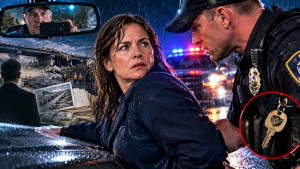
Thomas shoved Evelyn against the hood of her car.
“You’re going to tell me why you’re in Ashford County tonight.”
“I am traveling on a public highway.”
“Wrong answer.”
He pressed her cheek against the wet metal.
For several seconds, Evelyn said nothing.
Then she noticed something hanging from the deputy’s belt.
A small brass key.
She recognized the symbol engraved on it immediately.
It belonged to a private security company connected to one of the shell corporations in her investigation.
The same company that had supplied security at the collapsed bridge construction site.
Her expression changed.
Thomas noticed.
“What is it?”
“Nothing.”
“You recognized something.”
“I recognized your key.”
He pulled her upright.
“You should be careful about what you notice.”
The words were quiet, but they confirmed something Evelyn had suspected for months.
This was not a random traffic stop.
Someone knew who she was.
Someone had arranged for her to be intercepted before she could meet the accountant.
And Deputy Reed was not acting alone.
Thomas reached for his handcuffs.
Evelyn glanced toward Walter, who was still filming from across the road.
Then she looked at the patrol car.
Its radio was active.
A faint voice emerged from the speaker.
“Seven, status check. Seven, respond.”
Thomas froze.
Evelyn recognized the voice.
It belonged to the county dispatcher, a woman named Linda Brooks.
But Linda had been instructed to contact Evelyn through a secure channel only if the investigation had been compromised.
The dispatcher spoke again.
“Unit Seven, your microphone is open.”
Thomas looked at the radio.
He had forgotten that the transmission switch on his shoulder microphone was stuck.
Every word he had spoken was being broadcast to the county dispatch center.
And possibly recorded.
Evelyn slowly raised her head.
For the first time that night, she smiled.
“Deputy Reed,” she said softly, “I think you should answer your radio.”
PART 2 — THE TRANSMISSION HE COULDN’T ERASE
Thomas released Evelyn’s wrist and hurried toward his patrol car.
He grabbed the microphone.
“Dispatch, disregard the previous transmission. Everything is under control.”
Linda’s reply came immediately.
“Unit Seven, we received a request for assistance. Please confirm the civilian’s condition.”
Thomas glanced back at Evelyn.
“She is being detained for interfering with an investigation.”
“What investigation?” Linda asked.
His jaw tightened.
“That’s not your concern.”
“Dispatch requires an incident code before logging a detention.”
“I’ll provide it later.”
“Negative. Provide the code now.”
Thomas slammed the microphone against its holder.
He had worked in Ashford County for fourteen years. He knew every shortcut in the department, every supervisor who owed him a favor, and every complaint that had disappeared before reaching an internal investigator.
But Linda Brooks had never been afraid of him.
That made her dangerous.
He returned to Evelyn and pulled her hands behind her back.
“You’re coming with me.”
“On what charge?”
“Obstruction.”
“What did I obstruct?”
“Keep talking. You’ll find out.”
He snapped the handcuffs shut.
Across the road, Walter continued recording.
Thomas pointed at him.
“You. Put that phone away.”
Walter swallowed.
“I’m on my own property.”
“You’re interfering with police business.”
“I’m standing outside my garage.”
“Last warning.”
Walter did not lower the phone.
He was sixty-eight years old. His wife had died two years earlier, and his youngest son had been one of the eleven people killed when the bridge collapsed.
For three years, Walter had listened to officials explain why the tragedy could not have been prevented.
He had attended hearings.
He had written letters.
He had watched the sheriff promise grieving families that justice would be served.
And now he was watching an officer threaten a woman who had asked a simple question.
“I’ve spent three years watching people look away,” Walter said. “I’m not doing it tonight.”
Thomas started toward him.
Evelyn spoke sharply.
“Deputy Reed, leave him alone.”
Thomas turned.
“You don’t give orders here.”
“No,” Evelyn replied. “But you are making a serious mistake.”
He laughed.
“You think you scare me?”
“I think you have no idea what is being recorded.”
For a moment, Thomas looked uncertain.
Then a second patrol car appeared on the highway.
Sheriff Richard Vale stepped out.
He was tall, silver-haired, and impeccably dressed. His uniform was always spotless, even in bad weather.
He had built his public image around three promises: safety, honesty, and accountability.
At election time, he visited grieving families and spoke about protecting ordinary people.
Behind closed doors, he had allegedly approved payments to contractors who falsified inspection reports.
Vale surveyed the scene.
“What happened?”
Thomas answered quickly.
“Suspicious vehicle. Uncooperative driver. Possible interference.”
The sheriff studied Evelyn.
Something flickered across his face.
Recognition.
He had seen her photograph in a confidential briefing three days earlier.
He approached her slowly.
“Ma’am, I’m Sheriff Vale. If there has been a misunderstanding, we can clear it up at the station.”
Evelyn looked directly into his eyes.
“Then perhaps you can explain why your deputy recognized a security key belonging to a company under federal investigation.”
The sheriff’s smile vanished.
Walter’s phone continued recording.
Thomas stared at Evelyn.
Vale leaned closer.
“You need to be very careful with accusations.”
“And you need to be very careful with evidence.”
The sheriff straightened.
“Deputy, put her in the vehicle.”
Before Thomas could move, the radio erupted.
“ALL UNITS, STAND BY. SUPERVISOR REQUESTS CONFIRMATION OF UNIT SEVEN’S LOCATION.”
Vale reached for the microphone.
“This is Sheriff Vale. We have a routine detention.”
Linda’s voice returned.
“Sheriff, federal headquarters has requested preservation of all communications related to this incident.”
Silence.
Rain pattered against the patrol car.
Vale looked at Thomas.
Thomas looked at Evelyn.
Neither man spoke.
Then the dispatcher added one final sentence.
“Sheriff, the request specifically names Evelyn Carter.”
The color drained from Vale’s face.
Evelyn said nothing.
She did not need to.
The men standing around her had finally understood that the woman they had handcuffed was not an ordinary traveler.
But they still did not know the most important thing.
Evelyn had not come to Ashford County to arrest a corrupt deputy.
She had come to identify the person who had ordered eleven people to die.
And she was beginning to suspect that the person was standing right in front of her.
PART 3 — THE SHERIFF’S PRIVATE CALL
Sheriff Vale ordered Thomas to step away from the vehicle.
Then he walked toward his own cruiser and made a phone call.
He did not realize that the microphone on his uniform was still transmitting.
“It’s me,” he whispered. “We have a problem.”
A man’s voice answered.
“Who?”
“Carter.”
There was a long silence.
Then the voice said, “You told me she wasn’t coming until tomorrow.”
“She wasn’t supposed to.”
“Get rid of the evidence.”
Vale glanced toward Evelyn.
“She’s already looking at me.”
“Then you know what to do.”
The transmission ended.
Inside the dispatch center, Linda Brooks sat motionless.
She had heard every word.
For months, she had suspected that the sheriff was involved in the bridge investigation. She had seen unusual dispatch orders, unexplained changes to patrol logs, and reports that appeared to have been rewritten after officers submitted them.
But suspicion was not proof.
Now she had a recorded conversation.
She immediately saved the transmission to a protected server and called the county’s independent communications supervisor.
Then she made a second call.
This time, she contacted the state attorney general’s emergency line.
On the highway, Vale returned to Evelyn.
“Your identification, please.”
“My purse is in your deputy’s vehicle.”
He retrieved it himself.
Inside was an ordinary driver’s license, a bank card, and a folded grocery receipt.
There was no federal badge.
No government identification.
No official document that would explain why federal headquarters had contacted the county.
Vale looked irritated.
“Who exactly are you?”
Evelyn held his gaze.
“You already know.”
“I’m asking you to identify yourself.”
“Then ask me somewhere with a working camera and an independent witness.”
Walter raised his phone.
“I’m happy to help with that.”
The sheriff turned toward him.
“You’ve already been warned.”
“And you’ve already been recorded.”
Vale’s expression hardened.
He reached for Walter’s phone.
Walter stepped backward.
“Don’t touch me.”
Thomas moved between them.
For one brief moment, it appeared that the deputy might finally stand up to his superior.
Instead, he seized Walter’s arm.
Evelyn’s voice cut through the rain.
“Release him.”
Thomas hesitated.
Vale barked, “Do it!”
Thomas tightened his grip.
Walter winced.
And then the radio spoke again.
“Sheriff Vale, this is state dispatch. A supervisor is en route. All officers are instructed to preserve body-camera footage, vehicle recordings, and radio communications.”
Vale stared at the dashboard.
“Who authorized that order?”
“State command.”
“That is my county.”
“Not when the state opens an investigation into misconduct.”
The sheriff’s face turned red.
He grabbed the microphone.
“I demand to speak with the commander.”
“Your request has been logged.”
“Now!”
“Your request has been logged, Sheriff.”
The transmission ended.
For the first time, Thomas looked frightened.
Not because he had suddenly discovered that what he was doing was wrong.
Because he realized that the people who had protected him might no longer be able to protect him.
Evelyn watched him carefully.
“Deputy Reed, how long have you worked for Sheriff Vale?”
“Fourteen years.”
“Did you investigate the bridge collapse?”
“No.”
“Did you attend any meetings with the company that supplied its inspection reports?”
His eyes flickered toward the sheriff.
Evelyn noticed.
“So you did.”
Vale stepped forward.
“This interrogation is over.”
“I’m not interrogating him,” Evelyn said. “I’m asking questions.”
“You have no authority here.”
Evelyn took a slow breath.
“That’s what you keep telling yourself.”
Then she looked at Thomas.
“Did you know my name before you stopped me?”
Thomas did not answer.
“Did someone tell you to intercept a silver sedan tonight?”
His silence became more revealing than any confession.
Evelyn’s expression changed.
She had expected the sheriff to be involved.
She had not expected the deputy to have been given such specific instructions.
Someone had leaked her vehicle information, her route, and the time of her meeting.
That meant the corruption reached beyond the sheriff’s office.
It might extend into the department that had assigned her the case.
The thought chilled her more deeply than the rain.
Her investigation had been compromised from the beginning.
And the person responsible might know every step she intended to take.
PART 4 — THE WOMAN WHO REFUSED TO BE AFRAID
A pair of headlights appeared in the distance.
Then another.
Within minutes, three state police vehicles arrived, followed by a black government sedan.
A woman in a charcoal suit stepped out of the sedan and approached the scene.
Her name was Special Agent Naomi Brooks.
She carried no visible weapon and showed no interest in the sheriff’s anger.
“Who placed Evelyn Carter in handcuffs?”
Thomas raised his chin.
“I did.”
“On what grounds?”
“Suspicious behavior.”
“What behavior?”
Thomas opened his mouth.
Nothing came out.
Naomi turned to Sheriff Vale.
“Were you aware that Deputy Reed detained a federal investigator without confirming the legal basis for the detention?”
Vale folded his arms.
“I was responding to an officer’s request for assistance.”
“Then you will have no objection to preserving all communications from your vehicle.”
“Of course not.”
“Good. The state technicians will secure your radio system.”
Vale’s jaw tightened.
Naomi then turned toward Walter.
“Sir, do you have a recording?”
Walter held up his phone.
“Yes.”
“Please keep the original file. Do not edit it or upload it publicly until investigators have copied it.”
Walter nodded.
Naomi examined Evelyn’s wrists.
“Are you injured?”
“My left shoulder hurts. My hands are numb.”
“We’ll arrange a medical assessment.”
Only then did Naomi look at the damaged sedan.
“Was anything removed from your vehicle?”
“I don’t know yet.”
“Did you bring case materials?”
Evelyn shook her head.
“Nothing that would identify the witnesses.”
That answer mattered.
The former county accountant had agreed to meet her because he feared for his life. If his identity became public, he could disappear before giving his testimony.
Naomi lowered her voice.
“Headquarters received an anonymous warning twenty minutes ago. Someone claimed your investigation was compromised.”
“Who sent it?”
“We’re tracing the source.”
Evelyn glanced at the sheriff.
“Don’t use the county network.”
Naomi’s expression grew serious.
“You think someone inside the system is involved?”
“I think we should assume it until we know otherwise.”
Naomi nodded.
She then ordered the handcuffs removed and instructed a medical team to examine Evelyn.
Thomas stood beside his cruiser, watching his career collapse in slow motion.
But Sheriff Vale was not finished.
He stepped toward Naomi.
“This is an embarrassing overreaction. Deputy Reed made a judgment call. No one was seriously hurt.”
Naomi turned toward him.
“Eleven people died because someone made a judgment call about a bridge inspection.”
Vale went silent.
She continued.
“Families were told the structure had been safe. Engineers were blamed. Public money disappeared. And now a federal investigator is assaulted on a highway while your department tries to invent a reason for her detention.”
“We have no proof of any of that.”
“Not yet.”
Naomi glanced toward the state police vehicles.
“But we have a recording of your private conversation.”
Vale’s face went pale.
He looked at the patrol car microphone.
Then at Thomas.
Then at Evelyn.
He finally understood what the night had become.
Every threat had been recorded.
Every order had been transmitted.
Every attempt to control the story had created another piece of evidence.
For three years, Sheriff Vale had believed that power meant deciding which version of events the public would hear.
Tonight, the radio had chosen differently.
PART 5 — THE ACCOUNTANT’S LAST MESSAGE
At 2:18 a.m., Evelyn sat in a secure state police office with a blanket around her shoulders.
A nurse had examined her wrists and recommended further evaluation for the shoulder injury. Naomi had arranged transportation to a protected location.
The roadside incident was no longer the only emergency.
The former accountant, Peter Lawson, had stopped responding to calls.
Peter had worked in Ashford County’s finance department for nineteen years. He was the person who discovered that millions of dollars intended for bridge repairs had been transferred through a chain of consulting firms.
Three days before the collapse, he had sent an internal warning to his supervisor.
The warning disappeared.
Two weeks later, the supervisor resigned.
A month after that, Peter found his home broken into and his files scattered across the floor.
He finally contacted Evelyn after discovering a second set of records in an old storage facility.
At 11:30 p.m., he had sent her a message.
I found the original payment authorization. It has Vale’s signature, but there’s something worse. The signature isn’t the most important part.
Then he stopped answering.
Evelyn had assumed he was frightened.
Now she feared something had happened to him.
Naomi placed a tablet on the desk.
“His phone last connected to a tower near the old water-treatment plant.”
“Is that where he lives?”
“No. It’s six miles from his apartment.”
“Did anyone check the location?”
“State officers are on the way.”
Evelyn stared at the message.
There’s something worse.
What could be worse than a sheriff authorizing the theft of money intended to repair a bridge?
She thought about the victims.
A young father who had been driving to work.
A nurse returning from a night shift.
Two college students sharing a ride.
An elderly couple on their way to visit their granddaughter.
Eleven people whose families had been forced to accept an official explanation that never made sense.
If the bridge had failed because money was stolen, the tragedy was not an accident.
It was the consequence of decisions made by people who had calculated that the savings were worth the risk.
And someone had helped them hide it.
At 2:41 a.m., Naomi’s phone rang.
She listened without speaking.
Then she stood.
“They found Peter’s car.”
Evelyn rose too quickly, wincing as pain shot through her shoulder.
“Where is he?”
“They don’t know.”
“Was the car abandoned?”
“Yes. The driver’s door was open.”
Evelyn closed her eyes.
Naomi continued.
“But they found a package under the passenger seat.”
“What was inside?”
“A small digital recorder and a handwritten note.”
Naomi turned the tablet toward her.
The note contained one sentence.
If anything happens to me, listen to the recording marked BRIDGE—ORIGINAL.
Evelyn felt a chill.
“Where is it?”
“Being transferred to our secure evidence unit.”
“Play it as soon as it’s verified.”
Naomi hesitated.
“Evelyn, the note also mentions a name.”
“Whose?”
“Daniel Mercer.”
Evelyn stared at her.
Daniel Mercer was not a contractor.
He was the director of the federal office that had approved the original investigation.
He was also the man who had personally assigned Evelyn to the case.
For the first time that night, she wondered whether the person who had sent her to uncover the truth had instead sent her into a trap.
PART 6 — THE RECORDING THAT CHANGED EVERYTHING
At 4:06 a.m., the digital recorder arrived.
A technician copied its contents onto an isolated computer and verified that the files had not been altered.
There were six recordings.
The first five contained routine discussions about construction payments, inspection schedules, and missing paperwork.
The sixth was different.
A man spoke first.
“We cannot reopen the bridge report.”
Another voice replied.
“Then replace the inspection document.”
“That won’t be enough. The engineers have copies.”
“Get the copies.”
“And if they refuse?”
A pause followed.
Then the second man answered.
“Make sure nobody can prove they ever existed.”
Evelyn felt her stomach tighten.
She recognized Sheriff Vale’s voice.
The first speaker was Daniel Mercer.
The recording continued.
They discussed a series of transfers, an upcoming audit, and the need to prevent the original financial ledger from reaching federal investigators.
Then Daniel said something that made Naomi stop the playback.
“Carter is asking questions now.”
Vale replied, “She doesn’t have the full ledger.”
“She will if Lawson talks.”
“Then Lawson won’t talk.”
The recording ended.
For several seconds, no one moved.
Evelyn had worked with Daniel for six years.
He had recommended her for promotion. He had defended her after a difficult investigation. He had attended her father’s funeral and sent flowers when she returned to work.
She had trusted him.
Now his voice was preserved on a recording discussing how to silence a witness.
Naomi broke the silence.
“We need to verify the identities.”
“It’s him,” Evelyn whispered.
“We still need independent confirmation.”
“I know his voice.”
Naomi sat opposite her.
“I’m sorry.”
Evelyn looked down at her hands.
She felt anger first.
Then disbelief.
Then a deeper, more painful emotion: the realization that someone could appear to care about you while quietly arranging circumstances that might destroy your life.
She had spent months looking for corruption in a county government.
She had never imagined it would lead directly to her own office.
Naomi asked, “Did you tell Mercer where you were meeting Lawson?”
“No.”
“Who knew your route?”
“Only a small group.”
“Names?”
Evelyn listed four people.
Naomi wrote them down.
One name stood out.
Assistant Director Paul Bennett.
He had access to the case schedule, the vehicle assignment, and the secure briefing system.
He had also insisted that Evelyn use an unmarked car for the meeting.
At the time, she had assumed he wanted to protect her identity.
Now that instruction looked different.
Naomi closed the notebook.
“We’ll secure the records and notify the appropriate oversight officials.”
“And Mercer?”
“He won’t know what we have until we control the evidence.”
Evelyn looked at the recorder.
“Then we have to find Peter before he disappears.”
PART 7 — THE MAN IN THE ABANDONED FACTORY
Peter Lawson was found shortly after sunrise.
He was alive, frightened, and badly dehydrated.
State officers discovered him inside a locked maintenance room at an abandoned factory near the river. He had been held there overnight after two men intercepted him outside his apartment.
Peter told investigators that he had hidden the recorder in his car before leaving home.
He had suspected that his communications were being monitored.
When he realized he was being followed, he abandoned the vehicle and left the note for whoever found it.
He did not know whether the recorder had survived.
He had no idea that the recording had already exposed the sheriff and a senior federal official.
At the hospital, Evelyn sat beside his bed.
“You shouldn’t have come looking for me,” Peter said.
“I needed the ledger.”
“You needed to stay alive.”
“So did you.”
He gave a tired laugh.
“Fair enough.”
Peter explained that the missing money had been diverted through three companies. The companies shared the same registered agent and used nearly identical financial documents.
But the most important discovery came after the bridge collapse.
An internal engineer had found that the structure was failing long before the disaster.
The engineer recommended closing the bridge until emergency repairs could be completed.
The recommendation was rejected.
A second report was prepared.
This one declared the bridge safe.
The engineer refused to approve it.
Three days later, the report carried his electronic authorization anyway.
“Who changed it?” Evelyn asked.
Peter swallowed.
“Daniel Mercer.”
Evelyn’s face tightened.
“And Vale approved the funding transfers?”
“Yes.”
“Who else knew?”
Peter looked toward the hospital door.
“I don’t know all their names. But I know the money didn’t stop with the sheriff.”
He reached beneath his pillow and produced a folded sheet of paper.
“I kept one copy.”
Evelyn unfolded it.
It was a list of payments to officials, consultants, and private security contractors.
Near the bottom was a payment authorized two days before the bridge collapse.
The recipient was a company called Northstar Risk Solutions.
Evelyn recognized the name.
It was the company whose symbol had been engraved on the brass key hanging from Thomas Reed’s belt.
Her roadside stop had not been a coincidence.
The security company had been monitoring the investigation.
And Deputy Reed had been connected to it.
Peter watched her face.
“You understand now?”
“Yes.”
“They weren’t just trying to hide stolen money,” he said. “They were trying to control who could find it.”
Evelyn folded the document.
“Then we’ll make sure they can’t control the truth anymore.”
PART 8 — THE DEPUTY WHO FINALLY SPOKE
Thomas Reed spent the morning in an interview room at state headquarters.
He had requested an attorney.
He had also asked twice whether Sheriff Vale had been arrested.
The answer was the same both times.
“No information is available.”
At 10:30 a.m., Naomi entered the room.
She placed a printed transcript on the table.
Thomas stared at it.
“What’s that?”
“Your radio transmission.”
“I already explained what happened.”
“Then you won’t mind listening to it.”
She pressed play.
His own voice filled the room.
Tell me why you’re in Ashford County tonight.
Then the sheriff’s voice.
Get rid of the evidence.
Then the private call.
You know what to do.
Thomas lowered his eyes.
Naomi paused the recording.
“Who told you to stop Evelyn Carter?”
“No one.”
“Your vehicle location was sent to you before the stop.”
“I don’t remember.”
“You received a message from a private security number.”
Thomas said nothing.
Naomi slid a second document across the table.
“We recovered the message from your department-issued phone.”
He stared at the screen.
The message was brief.
Silver sedan. Mile marker forty-seven. Delay the driver. Do not allow contact with Lawson.
Thomas rubbed his face.
“I’m not a bad person.”
Naomi did not answer.
“I’ve worked here for fourteen years. I have a mortgage. Two kids. I did what I was told.”
“You handcuffed an unarmed woman and threatened a witness.”
“I thought she was dangerous.”
“Why?”
Thomas looked away.
“Because they told me she was.”
“Who?”
He closed his eyes.
“Vale.”
Naomi waited.
“And Mercer,” he finally whispered.
The room seemed to grow smaller.
Thomas explained that he had received occasional payments from Northstar Risk Solutions. He claimed they were presented as consulting fees for security work performed during county events.
In exchange, he had provided patrol schedules and information about certain investigations.
He insisted he had never known the bridge collapse was connected to the payments.
Naomi listened without interrupting.
“Why did you stop the sedan?” she asked.
“Vale said the investigator had the original ledger. He told me to delay her until the package could be recovered.”
“Recovered by whom?”
“Northstar.”
“Where were they supposed to meet you?”
Thomas shook his head.
“I don’t know. I was told to make the stop look routine.”
Naomi closed the file.
“Then help us establish who gave the orders, who received the money, and who knew the bridge was unsafe.”
Thomas looked at her.
“What happens to me?”
“That depends on the evidence, your cooperation, and the decisions you made.”
He stared at the transcript again.
For the first time, he seemed to understand that following an order did not erase responsibility for carrying it out.
And the radio had preserved every word.
PART 9 — THE SHERIFF’S LAST PRESS CONFERENCE
At noon, Sheriff Richard Vale appeared before the cameras.
He stood behind a podium bearing the county seal and announced that an outside investigation had begun into an alleged misunderstanding involving one of his deputies.
He described the incident as unfortunate.
He called the federal investigator’s claims premature.
He praised his department’s professionalism.
Then a reporter asked about the bridge collapse.
Vale smiled tightly.
“That tragedy was investigated thoroughly three years ago.”
Another reporter asked whether he had received money from Northstar Risk Solutions.
“No.”
“Did you speak with Daniel Mercer about the investigation?”
“I speak with many officials.”
“Did you instruct Deputy Reed to stop Evelyn Carter?”
Vale leaned toward the microphone.
“I will not comment on an ongoing matter.”
The press conference ended.
Within minutes, the state attorney general released a statement confirming that investigators had obtained radio transmissions and financial records relevant to the case.
No charges were announced yet.
But the sheriff’s carefully prepared explanation had already begun to unravel.
At 1:17 p.m., an independent news outlet published Walter Hayes’s video.
The footage showed Thomas grabbing Evelyn, refusing to explain the stop, and threatening a witness.
The recording also captured the sheriff arriving and ordering the deputy to place Evelyn in the patrol car.
The clip spread rapidly.
By late afternoon, people who had never heard of Ashford County were asking the same question.
Why had a woman been detained simply for asking why she was stopped?
Walter received hundreds of messages.
Some praised his courage.
Others accused him of interfering with the police.
He ignored both groups and gave the original video to investigators.
That evening, he visited a memorial near the collapsed bridge.
Eleven names were engraved on a stone wall.
His son, Michael Hayes, was number seven.
Walter placed a small bouquet at the base of the memorial.
“I don’t know if this changes anything,” he whispered.
A woman standing nearby heard him.
“It changes something,” she said.
He turned.
Evelyn stood a few feet away, her left arm in a sling.
She had come to pay her respects to the victims.
Walter looked at her for a long moment.
“Did they get the truth?”
“We’re getting closer.”
He nodded toward his son’s name.
“That’s all I wanted.”
Evelyn stood beside him as the sun disappeared behind the trees.
For the first time since the roadside stop, she allowed herself to cry.
Not for her career.
Not for the betrayal.
But for the eleven people whose families had spent three years wondering whether anyone would ever tell them what really happened.
PART 10 — THE FILE THAT WAS NEVER SUPPOSED TO EXIST
The investigation continued for six weeks.
Financial analysts traced payments through shell companies. Digital specialists recovered deleted messages. Engineers reviewed the original bridge reports.
The evidence established that safety concerns had been deliberately concealed and that money intended for emergency repairs had been diverted.
Investigators also uncovered a confidential memo written before the collapse.
Its conclusion was unmistakable.
Continued public use of the bridge presents a substantial risk of structural failure. Immediate closure is recommended.
The memo had been removed from the official file.
Someone had replaced it with a document declaring the bridge safe.
Daniel Mercer had approved the replacement.
Sheriff Vale had pressured county officials to keep the bridge open because closing it would delay a major development project linked to his financial supporters.
The payments from Northstar Risk Solutions had helped conceal the arrangement.
But there was one more discovery.
An internal email showed that Paul Bennett, the assistant director who knew Evelyn’s travel schedule, had forwarded details of her meeting with Peter Lawson to a private security address.
Bennett initially denied sending the message.
Then investigators recovered the original email from an archived server.
He resigned before he could be questioned.
Two days later, he was arrested at an airport while attempting to board an international flight.
His suitcase contained cash, several passports, and a storage device holding copies of confidential case files.
The investigation had begun with a traffic stop.
It now involved corruption across two government agencies, falsified safety reports, unlawful surveillance, and an attempt to obstruct a federal investigation.
Yet Evelyn knew the most difficult part was still ahead.
The accused men would have attorneys.
They would challenge the recordings.
They would question the witnesses.
They would argue that the financial transfers had innocent explanations and that the bridge collapse had resulted from negligence rather than deliberate misconduct.
The public might lose interest.
The case could drag on for years.
Evelyn had seen it happen before.
But this time, there was a difference.
The evidence existed in several independent places.
The radio system had recorded the stop.
Walter’s phone had captured the confrontation.
Peter had preserved the financial ledger.
The state had secured the digital recordings.
No single official could make all of it disappear.
The truth had become larger than the people trying to suppress it.
PART 11 — THE DAY THE HANDCUFFS RETURNED
On a cold Tuesday morning, Sheriff Vale walked into the county courthouse expecting another procedural hearing.
Instead, federal agents were waiting near the entrance.
He was informed that he was being arrested in connection with the alleged conspiracy to conceal public corruption and obstruct an investigation.
He demanded to speak with his attorney.
He demanded to know who had authorized the arrest.
He demanded that the cameras be removed.
None of his demands changed what happened next.
As agents escorted him across the courthouse steps, reporters called out questions.
“Sheriff, did you know the bridge was unsafe?”
“Did you order Deputy Reed to stop Evelyn Carter?”
“Were public funds diverted to private companies?”
Vale kept walking.
His expression remained controlled, but his hands trembled when an agent opened the vehicle door.
Across the street, Thomas Reed watched from the steps of another building.
He had agreed to cooperate with investigators and had been placed on administrative leave. His cooperation did not guarantee immunity from prosecution.
He knew that.
He also knew that the recording of his roadside actions would follow him for the rest of his life.
Evelyn approached him.
Thomas looked at the ground.
“I suppose you’re satisfied.”
“No.”
He glanced up.
“No?”
“Eleven people died. Families spent three years waiting for answers. A recording and an arrest don’t give them their loved ones back.”
He swallowed.
“I made a mistake.”
“You made several decisions.”
His face tightened.
Evelyn continued.
“You could have asked questions. You could have checked the information. You could have refused to threaten a witness. You could have told the truth the moment you realized what was happening.”
Thomas had no answer.
“I can’t tell you what a judge will decide,” Evelyn said. “But you can still tell the truth about everything you know.”
She walked away.
Thomas remained on the steps, staring at the place where the sheriff had been arrested.
For years, he had believed that loyalty meant protecting the people above him.
Now he was beginning to understand that loyalty without conscience was merely another word for obedience.
PART 12 — THE VERDICT
The trial began nine months later.
The courtroom was filled with reporters, grieving families, former county employees, and residents who had followed the case from the first roadside video.
Peter Lawson testified about the financial transfers.
Engineers explained how the bridge’s safety warnings had been altered.
Digital specialists authenticated the recordings.
Walter Hayes described what he had witnessed on the highway and submitted the original video from his phone.
Then Evelyn took the stand.
The defense attorney questioned her about her investigation, her relationship with Daniel Mercer, and the circumstances of the traffic stop.
He suggested that her conclusions were influenced by anger over the detention.
Evelyn answered each question calmly.
“My conclusions are based on records, recordings, financial transactions, and testimony. The roadside incident did not create the evidence. It exposed an effort to prevent that evidence from being examined.”
The attorney asked whether she could prove that every person involved had known the bridge was unsafe.
“No,” Evelyn said. “That is why the investigation distinguishes between those who approved the false reports, those who concealed the warnings, and those who merely handled administrative work.”
Her answer was reported widely.
She refused to exaggerate.
She refused to claim that every allegation had been proved.
And she refused to let the public spectacle distract from the evidence.
After weeks of testimony, the jury reached its verdict.
Sheriff Richard Vale was found guilty of the principal corruption and obstruction charges presented at trial.
Daniel Mercer was convicted on charges related to falsifying records and obstructing the investigation.
Paul Bennett pleaded guilty to leaking confidential information and participating in the conspiracy.
Thomas Reed was convicted of civil-rights violations and obstruction-related offenses. His cooperation was considered during sentencing, but it did not erase his responsibility.
Northstar Risk Solutions lost its government contracts and became the subject of additional criminal and financial proceedings.
The verdict could not repair the bridge or return the eleven victims to their families.
But it established something the official investigation had denied for three years.
The tragedy had not simply been an unavoidable accident.
Warnings had been ignored.
Records had been falsified.
Money had been diverted.
And people had worked to conceal the truth.
Outside the courthouse, Walter stood beneath the gray sky with his son’s photograph in his hand.
A reporter asked him whether he felt justice had been served.
Walter looked at the picture.
“Justice isn’t the same as getting my son back,” he said. “But now, nobody can tell me his death was meaningless.”
He folded the photograph carefully and walked away.
PART 13 — THE VOICE THAT REMAINED
One year after the roadside incident, a memorial was built beside the river.
The names of the eleven victims were engraved on a polished stone wall. Beneath them, a smaller inscription honored the engineers, whistleblowers, and ordinary citizens who had refused to let the truth disappear.
Walter attended the dedication ceremony.
So did Peter Lawson, several former investigators, and the families of the victims.
Evelyn stood at the back of the gathering.
She had returned to federal service, but she no longer accepted assignments without asking difficult questions about who controlled the information and who benefited from silence.
The experience had changed her.
Not by making her suspicious of everyone, but by teaching her that trust should never replace verification.
After the ceremony, Walter approached her.
“I still have the original recording,” he said.
“The roadside video?”
“Yes. I listen to it sometimes.”
Evelyn looked surprised.
“Why?”
“Because I remember how frightened I was when I started filming. I thought I might lose my shop. I thought the sheriff would find a way to punish me.”
He paused.
“But I also remember the moment I decided not to put the phone away.”
Evelyn smiled faintly.
“You did the right thing.”
“I wasn’t brave,” Walter replied. “I was tired of being afraid.”
For a moment, neither spoke.
Then Walter asked, “Do you think people will remember what happened?”
“Some will,” Evelyn said. “Others will move on. That’s why the records matter.”
He nodded.
As they walked toward the parking lot, a police radio crackled from a vehicle nearby.
A dispatcher announced a routine traffic update.
The sound was ordinary.
Almost forgettable.
But Evelyn stopped for a moment and listened.
She remembered the night when a deputy believed he could control a situation by controlling the story.
She remembered the sheriff’s private call.
She remembered the warning about the bridge.
And she remembered the simple transmission that had changed everything.
The truth had not emerged because the powerful people involved suddenly became honest.
It had emerged because one dispatcher kept asking for an incident code, one witness kept recording, one accountant preserved a file, and one deputy finally chose to tell investigators what he knew.
None of them had possessed enough power to expose the entire conspiracy alone.
Together, they had made it impossible to bury.
Evelyn looked toward the memorial one final time.
Then she continued walking.
The voice on the radio had started as a warning.
It had become evidence.
And in the end, it had become something more important than either.
It had become a reminder that no badge, office, uniform, or title could make a lie true simply because someone powerful repeated it.
THE END