Elena did not cry immediately after telling me the extent of the fraud. She watched my face instead, looking for some indication that I might change my mind about believing her. The paper trembled slightly between my fingers. I set it on the bedside table, where the daylight fell across the forged signature, and moved my chair closer. "Tell me which documents," I said. She shook her head once. "I can't remember the names of all of them. There were too many."
She described a succession of appointments, most held in my mother's study. Ricardo would arrive carrying leather folders and speak about protecting investments while I was away. Victoria would sit beside Elena and explain that these decisions were merely administrative. Some documents involved the business. Others concerned our home, joint accounts, and property holdings. Elena had initially resisted because the arrangement differed from the instructions I left. My mother replied that I had changed my plans after deployment and had asked them to handle the details.
"I requested copies," Elena said. "Every time they put something in front of me, I asked to take it upstairs first. Your mother said the information was confidential, and Ricardo told me delaying could cause problems with the banks." She looked down at her hands. "Sometimes he would keep me in that study for hours. He'd repeat the same explanation until I was too tired to argue. Your mother would come in and tell me to stop making the situation difficult."
I asked whether anyone else had witnessed those meetings. She mentioned the occasional assistant delivering documents and several people from the company, but the most frightening conversations had happened behind closed doors. As she spoke, I began to understand how thoroughly my family had exploited my absence. They did not need to steal everything in a single dramatic act. They had months in which to create confusion, change procedures, undermine Elena's authority, and make their own decisions appear normal.
"When did they tell you that the house wasn't ours anymore?" I asked. Elena stared at the carpet. "After I'd signed the last set they gave me." She paused. "Ricardo said you had transferred your interest in several properties to him. Then your mother told me that my signature had made the arrangements final." I reminded her that an assertion was not proof of a valid transfer. She gave me a tired look. "I tried saying that. They told me to find a lawyer if I thought I could afford one."
I thought about the money Elena and I had saved before our marriage, the years when we had postponed holidays so we could invest in the business. She had worked beside me through failed negotiations and difficult seasons. Her contribution was not symbolic. The company existed in its present form because she had helped build it. The thought of Ricardo sitting in our office, treating that work as an inheritance waiting for him, made my hands tighten around the chair arms.
Then Elena told me about the locked study. She had refused to sign a final document concerning the remaining ownership rights. Ricardo became furious and shut her inside while he went to speak with our mother. She did not know exactly how long she remained there. The curtains were drawn, and her phone had been taken from her. She remembered the ticking of the mantel clock and the smell of old paper. When she was finally allowed out, Victoria told her that continuing to resist would only make matters worse.
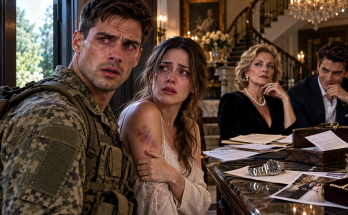
"Did Ricardo strike you?" I asked. Elena took several seconds before answering. "He grabbed me. Once he pushed me against the desk when I tried to leave. Your mother slapped me when I demanded my phone." She pulled her sleeve back without being asked. The bruises were more extensive than I had first seen. Some were fading yellow; others remained purple. I had seen injuries during service. These were different because the person wearing them was my wife, and the people responsible had been welcomed into our marriage.
My first instinct was to call the authorities immediately. I reached for my phone, but Elena held out her hand. "Please listen before you do anything," she said. She was not asking me to abandon the idea. She was asking me to understand the danger as she had experienced it. I set the phone down. She seemed relieved that I had heard the difference.
"They controlled my calls," she said. "Ricardo took my phone whenever he wanted. Your mother knew the passwords because she'd insisted on helping me fix it after it stopped working. Sometimes they read messages before I saw them." I remembered sending Elena photographs and long notes that received strangely brief replies. When I called, her voice was often strained, and someone always seemed to be nearby. I had blamed poor connections and exhaustion. Now those small moments rearranged themselves into a pattern.
"Why didn't you say something during our calls?" I asked. Elena looked up, and I heard the accusation embedded in my question. "Because he was listening," she replied. "Sometimes your mother was sitting across from me. When I tried to talk privately, they'd appear at the door. They knew exactly when you called." I closed my eyes briefly. I had trusted our family to keep Elena company while I was gone. Instead, she had spent months learning to measure every sentence.
The paper on the table caught my attention again. The imitation of my signature was careful, but whoever had prepared it had overlooked the habits I developed over years of signing business documents. There was a slight imbalance in the letters, and the date had been written in a form I never used. It was enough to tell me I had not signed it. Establishing that fact legally would take more than my judgment, but for the first time since entering the house, I had something concrete.
I asked who possessed the original paperwork. Elena believed Ricardo had some files and Victoria kept others in her study. There might also be copies with the attorney who had helped prepare my deployment arrangements. She knew little about his involvement. What troubled her most was how confidently my mother spoke about the documents. Victoria acted as though every official system had already accepted her version of events. That certainty had frightened Elena into doubting what she knew.
I began asking about the insurance policy I had arranged shortly before leaving. Elena's expression changed so sharply that I stopped. I had created the policy to give her financial security if I never returned. An attorney had explained the provisions to us in private. Ricardo had never attended those conversations, and I had not shared the full details with Victoria. Yet when I mentioned the policy, Elena pressed both hands together and looked toward the floor.
"What did they tell you about it?" I asked. She shook her head. I waited. At last she said, "Your mother knew about it. She knew things I'd never told her." I pictured the attorney's office, the polished desk, and the envelope of documents we had carried home. The people familiar with the policy had been few. Someone had either shared information they should have protected or gained access to records without permission.
Elena tried to explain what happened several months into my deployment. One afternoon, Victoria had come upstairs carrying a letter. Ricardo followed her and stood beside the door. My mother sat with Elena and said she had received terrible news. According to her account, an incident had occurred during my military service. She claimed the authorities had contacted the family because I had been killed. Elena stopped speaking at that point and pressed her fist against her lips.
I moved my chair close enough that she could reach me, but I did not touch her. "I'm here," I said. "You can see me." She gave a faint nod. "I know that now." The distinction made my throat tighten. For a period of her life, my wife had been forced to consider the possibility that I was dead while the people she depended on used her grief against her.
Elena said she had refused to believe the news at first. She demanded an official call and tried repeatedly to reach me. My number went to voicemail. Ricardo claimed my unit had secured my personal effects and that formal notification paperwork was being processed. Victoria showed her an image of a document that resembled an official notice. The photograph was imperfect, but Elena had been too frightened to examine every detail. They told her she needed to act quickly before insurance procedures complicated the ownership of our assets.
"I kept asking to speak to someone from your unit," she said. "Your mother told me they wouldn't discuss details until the paperwork was complete." She wiped her cheeks with the back of her hand. "I knew something didn't sound right. But I couldn't reach you, and they kept saying I was refusing to accept what had happened." I remembered the restrictions of deployment, the hours when communication was impossible, and the frustration of trying to call home through unreliable connections. My family had used those ordinary obstacles as proof of a lie.
I reminded Elena that we had spoken by video several months earlier. She nodded. "That was before they brought the letter." Afterward, she had searched desperately for information, but the access available to her was limited. When I eventually managed another call, the people controlling her phone were present. She had been afraid to challenge their story openly while still trapped in the house. I could not imagine what it felt like to hear my living voice after being told I was dead, knowing that the people responsible for the deception stood nearby.
Victoria had not simply frightened Elena with the possibility of losing me. She had turned that fear into pressure to sign documents. Elena remembered my mother placing a pen beside a stack of papers and insisting that the family's assets needed immediate protection. When Elena protested that she could not make financial decisions while overwhelmed, Victoria told her she was being selfish. Ricardo said delaying might prevent her from receiving what I had supposedly intended to leave her.
"Did they admit the story was false?" I asked. Elena shook her head. "Not really. When it became impossible to keep saying you were dead, your mother changed the explanation. She said the information had been confused and that you were alive but no longer interested in our marriage." I felt a quiet sickness spread through me. The deception had evolved according to whatever my mother needed Elena to believe. Truth had become something she could rearrange at will.
I rose and walked to the window. Below us, guests moved between the garden tables. Ricardo stood beside a man from our company, gesturing toward the house as though presenting his accomplishments. My mother spoke with two women near the flowerbeds. Everyone looked relaxed. No one watching would have guessed that upstairs, Elena was recounting months of intimidation and fraud. I understood suddenly why she had been afraid no one would believe her. The picture below was far easier to accept.
I returned to the bed and told her that I believed her completely. She looked at me for a long time. "I kept thinking that when you came home, everything would make sense," she said. "Then I became afraid they would have prepared you to see me as the problem." I admitted that my mother had already begun doing exactly that. She had described Elena as emotional and difficult before I even reached the bedroom. Elena gave a small, bitter smile. "She's been practicing."
The comment drew a brief laugh from me, more painful than amused. I remembered how Elena used to tease Victoria gently at family dinners, confident that our disagreements would remain ordinary disagreements. She had once defended my mother to a friend who found her controlling. Now Elena sat with bruised arms in a room that had become a refuge of sorts, frightened by footsteps outside. I felt the distance between the marriage we once had and the one she had been forced to endure alone.
I asked what else she remembered from the study. She said Ricardo had been on the phone during one of the later meetings. She could not see whom he was speaking to, but she heard him mention documents that needed to be destroyed before my return. The conversation had been unusually tense. Ricardo kept interrupting whoever was on the other end, insisting that they were running out of time. Elena had pretended not to listen because she did not want another confrontation.
"What was he afraid I'd find?" I asked. She hesitated. "That's what I haven't been able to understand." I watched her struggle to decide whether to continue. At last she told me that the call had not ended with a discussion of our accounts. Ricardo had mentioned my father. He said that if I learned the circumstances surrounding his death, the consequences would be far worse than losing the business.
My father had died when I was seventeen, on a rain-soaked country road. I grew up believing he had lost control of his vehicle in terrible weather. The investigation had been closed, and my mother rarely tolerated questions about it. I knew he had been dealing with business trouble shortly before his death, but every attempt to discuss those problems ended with Victoria asking why I wanted to disturb his memory.
One detail had remained with me for years. On the evening before the accident, my father had telephoned me and asked me to keep something secure. I had been distracted and had not fully understood his request. When I asked what he meant, he said we would talk the following day. That conversation never happened. I had spent years wondering whether the request concerned money, paperwork, or something personal. Eventually I learned to leave the question unanswered.
Now Elena had placed my father's death beside the fraud unfolding in our marriage. I asked her to repeat Ricardo's words as accurately as she could remember them. She did, slowly, stopping when she was uncertain rather than inventing details. He had been afraid I would discover something about the night my father died. She could not tell whether Ricardo knew the truth himself or was repeating a warning from someone else.
My phone vibrated on the bedside table. The number was unfamiliar. I glanced at the screen, expecting an airline notification or a message from someone who knew I was traveling. Instead, a short message directed me to a concealed safe behind my father's portrait in Victoria's study. The sender claimed it contained information about the circumstances of his death and warned me not to trust the people inside the house.
I showed Elena the message. She stared at it, then lifted her eyes toward the bedroom door. "How could someone know you're home?" she asked. I had not told many people about my return. Ricardo and Victoria had seemed surprised, although I was no longer certain I trusted their reactions. Whoever sent the message knew not only that I was here but also that I had reason to question my father's death.
I put the phone away and looked at the copy of the forged authorization. Until that moment, I had understood our crisis as a deliberate theft carried out during my absence. Now I was facing a possibility that reached into the most painful years of my childhood. My mother and brother had concealed one set of crimes from me. The message suggested that their secrets had begun long before I entered military service.
Elena reached for my hand. "Promise you won't rush into that study," she said. I looked at the bruises on her arm and the fear in her eyes. I wanted to promise that I would not put either of us in danger. I could not promise to ignore the message. "I won't confront them without evidence," I said. "But I have to know what's in that safe."