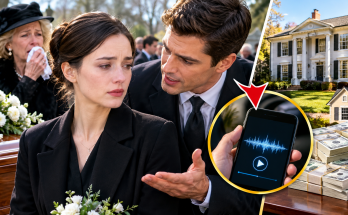
Julian Rojas spoke slowly at first, frequently pausing to consult the documents placed before him. He admitted that he and Vanessa had begun their relationship while she was married to Arthur Vance. Their early conversations concerned leaving Chicago, purchasing property in California, and living without the restrictions Vanessa associated with her marriage. She repeatedly described Arthur's fortune as something she expected to control eventually. When the prosecutor asked why Vanessa did not simply seek a divorce, Julian said she believed the financial settlement would be less favorable than the inheritance she expected as a widow.
Elaine Mercer allowed the statement to settle before asking when their discussions became criminal. Julian described Vanessa's growing interest in Arthur's medications and health records. She wanted to understand which symptoms could be attributed to an existing cardiac condition and which changes might appear natural as that condition worsened. Julian acknowledged helping her obtain information and knowing that she intended to administer a toxic substance under the appearance of legitimate supplements. He did not provide technical instructions. Instead, he described their decisions, the secrecy surrounding them, and the financial outcome they expected.
Caleb listened without moving. He remembered Arthur's account of the evenings when Vanessa appeared with tablets and water. Arthur had described those moments with bewilderment, unable to reconcile the apparent tenderness with the confession he later heard. Julian's testimony confirmed that the gestures of care had been central to the deception. Vanessa needed Arthur to trust her enough to accept what she provided. She also needed others to believe she was doing everything possible to help him recover.
Mercer asked Julian whether he had ever seen Arthur refuse the supplements. Julian said he had not personally witnessed every administration, but Vanessa frequently reported that Arthur followed the routine without objection. She sometimes joked about how grateful he was for her attention. When Arthur began questioning the appearance of one container, Vanessa became concerned. Julian acknowledged that they discussed whether Arthur might contact Richard Hayes or examine the household accounts.
“And what did you decide?” Mercer asked.
Julian glanced toward Vanessa, then quickly looked away. “We decided we couldn't let him figure it out.”
The prosecutor asked what that meant. Julian said Vanessa intended to continue the poisoning despite Arthur's suspicion and prevent him from reviewing the financial arrangements before his condition became critical. He admitted supporting that decision. He had known that Arthur might die and had treated that possibility as necessary to their plans.
Vanessa sat rigidly beside Caroline Price. Her face had become pale, but she did not interrupt. Daniel watched her from the gallery, struggling to understand the absence of visible grief. He had not expected tears to prove innocence or remorse, yet he wondered whether she remembered Arthur as a person at all. Julian's testimony described his father as an obstacle: someone whose continued breathing delayed a property purchase and a new life.
Mercer then turned to the Malibu house. Julian confirmed that Vanessa made financial preparations before Arthur died, using funds she could access and relying on the expected inheritance to complete the purchase. They had selected furnishings, discussed vehicles, and considered how quickly the manufacturing company could be sold. Julian acknowledged that they expected Arthur's death to occur soon enough that their financial commitments would not become difficult to maintain.
The prosecutor displayed messages recovered from his phone. Julian identified them as genuine. In one, Vanessa complained that Arthur's condition had not declined as quickly as she anticipated. In another, Julian reminded her that visible impatience would attract suspicion. Mercer asked whether either of them considered stopping after Arthur became seriously ill.
Julian hesitated. “We talked about whether it was getting too risky.”
“That wasn't my question,” Mercer said. “Did you consider stopping because Arthur might die?”
Julian looked at the table. “No.”
The answer was quiet, but Caleb felt it like a physical blow. He had already known the essential facts. Hearing Julian admit that Arthur's suffering had not persuaded them to stop made the crime seem newly deliberate.
During cross-examination, Price attacked Julian's credibility. She reviewed his involvement in the intimidation of Caleb, the payments to Eric Dalton, and his attempts to minimize responsibility for the threats against Mia. Julian acknowledged that he had lied during earlier interviews. Price asked whether he was cooperating because he hoped prosecutors would recommend a reduced sentence. He admitted that he hoped his cooperation would be considered.
“So your future depends on giving the prosecution the account it wants,” Price said.
Julian answered that his future depended on telling the truth. Price pressed him about discrepancies between his first statements and later testimony. She pointed out occasions when he initially described himself as a reluctant participant but later admitted substantial involvement. Julian became visibly uncomfortable. He could not explain away the contradictions without acknowledging that he had tried to protect himself.
Price then suggested Vanessa had not understood the substance's potential consequences and that Julian might have exaggerated her role to reduce his own exposure. He rejected that claim. He said Vanessa understood the intended outcome and repeatedly discussed Arthur's death as the event that would release the inheritance. The recovered messages supported his account, he added, though Price objected to his characterization. The judge reminded the jury that the documents would speak for themselves and that they must evaluate Julian's credibility carefully.
Daniel followed the exchange with grim attention. He did not need Julian to appear sympathetic. The man's willingness to betray Arthur for money was already established. What mattered was whether his testimony matched the independent evidence. Caleb had reached a similar conclusion. Julian was a participant seeking leniency, not a redeemed hero. The prosecution's responsibility was to prove the case without asking the jury to trust his word alone.
When questioning turned to Caleb's assault, Julian's voice grew weaker. He admitted contacting Eric Dalton after the estate meeting because Vanessa wanted Caleb pressured into abandoning the trust. Julian had believed intimidation might succeed where litigation would take too long. He acknowledged authorizing payments and knowing that Mia's medical condition made her a powerful source of leverage. He denied personally ordering an attack on the surgical procedure, but admitted that the possibility had been discussed within the group he financed.
Caleb stared at him. For weeks, he had wondered whether Julian understood what it meant to threaten a child whose heart was already failing. Now he had his answer. Julian knew exactly why Mia mattered to Caleb. He had used that knowledge deliberately.
Price challenged him again, emphasizing that other participants had independently escalated the intimidation. Julian admitted that Eric and Victor made decisions without consulting him about every detail. But he also acknowledged that he never withdrew the assignment after learning Caleb had been assaulted. Instead, he continued discussing ways to pressure him.
The admission left little room for the harmless explanations Julian once offered. Even if he had not directed every act, he knew the intimidation involved violence and continued funding the people responsible.
At the end of the day, Mercer asked Julian one final question. Had Arthur ever done anything to him personally that justified the hostility behind the plan? Julian looked confused. He considered the question, then shook his head. Arthur had been polite to him, invited him to dinner, and treated him as Vanessa's friend. He had never threatened Julian or attempted to interfere with his business.
Mercer returned to her seat. No further explanation was needed. Arthur had offered hospitality to the man helping arrange his death.
Outside the courtroom, Daniel walked away from the reporters before they could approach. Caleb found him beside a concrete pillar near the parking garage. Daniel was breathing rapidly, his hands shaking. He told Caleb he had spent years imagining Arthur as a man whose work mattered more than his family. That belief had allowed him to remain angry without feeling guilty. Now the trial forced him to confront his father's vulnerability. Arthur had made mistakes, but he had also been lonely enough to trust the affection Vanessa offered.
“I keep thinking he must have been terrified,” Daniel said.
Caleb nodded. “He was.”
Daniel turned sharply. “Did he cry?”
The question surprised Caleb. He thought back to Arthur's final days. The older man had struggled to speak, had shown anger and grief, and had occasionally stared at the ceiling for long periods. Caleb had seen tears in his eyes when they discussed Daniel, but Arthur rarely allowed himself to lose control.
“Not much,” Caleb answered. “But he talked about you.”
Daniel lowered his head. Caleb told him how Arthur had described the letters, the pocket watch, and the regret he carried about their estrangement. He did not pretend Arthur had become perfect in his final days. He simply explained that the man who signed the trust understood he had neglected important relationships.
Daniel wiped his face with one hand. “I wish I'd been there.”
Caleb did not tell him that he should have been. Arthur's life had included many choices that made reconciliation difficult. Daniel had needed distance for reasons Caleb respected. Regret did not mean those reasons disappeared.
At the hospital, Mia had reached another milestone. Dr. Foster approved a gradual transition toward rehabilitation outside the acute cardiac unit. The family would need to learn how to monitor symptoms, manage medications, and support her recovery without allowing fear to control every activity. Mia listened attentively, then asked whether she could return to school. Dr. Foster explained that the timing would depend on her progress and that accommodations might be necessary at first.
Mia seemed disappointed, but she accepted the answer more easily than Caleb expected. She had begun understanding that recovery was not a single event. Surviving surgery had opened a door; walking through it would take time.
Evelyn asked whether they could eventually take Mia to see the stars outside the city. Dr. Foster smiled. A carefully planned trip might become possible once Mia was strong enough and medically cleared. Mia immediately began naming places she wanted to visit. Caleb promised they would discuss the details when her doctors approved.
That evening, Daniel brought Mia a small telescope he had borrowed from a friend. They set it near the window, though the city lights made observing difficult. Mia examined the controls with fascination. She wanted Daniel to explain the lenses, the mount, and how the instrument gathered light. Caleb watched them and thought about Arthur's childhood photograph of Daniel beside a wooden solar-system model. A relationship lost between father and son was producing an unexpected friendship between Daniel and Mia.
The following morning, Richard told Caleb that the estate court had issued a significant ruling. After reviewing the medical capacity evidence, the execution records, and the competing arguments, the court had rejected a central part of Vanessa's challenge. The judge found that the evidence presented did not support invalidating Arthur's documents on the claimed ground of incapacity. Other procedural issues remained, but the decision strengthened the trust considerably.
Caleb felt relief, though Richard cautioned against treating the matter as completely finished. Appeals and additional filings remained possible. Nevertheless, the trust could continue operating under its established safeguards, and the court had recognized the seriousness of the contemporaneous evidence documenting Arthur's decision.
Laura called later to congratulate Caleb. She said employees at the manufacturing plant had been following the litigation with concern. Many had worked for Arthur for decades and feared that Vanessa might force a sale. The ruling reassured them. Caleb asked Laura to explain that the business would continue under professional management and that he intended to learn from the people who knew it best.
Marcus also called. He reminded Caleb that Arthur had survived years of financial uncertainty by refusing to abandon the company when conditions became difficult. Caleb replied that he hoped to honor that persistence without repeating Arthur's habit of working until everyone around him felt neglected. Marcus laughed and admitted that Arthur probably would have argued with him about the distinction.
As the criminal trial continued, prosecutors introduced the final medical causation findings and additional testimony about Arthur's symptoms. The expert evidence supported the conclusion that repeated digoxin toxicity significantly contributed to his death. The defense questioned whether every medical complication could be attributed to poisoning, but the prosecution presented a coherent chronology connecting the exposure, decline, and fatal cardiac failure.
Vanessa's attorney also emphasized that Arthur's final recording did not show the substances being administered. Mercer responded by bringing together the evidence already admitted: the recorded confession, the video from Arthur's study, the messages discussing his deterioration, the household schedules, the financial preparations, and Julian's testimony. The prosecution argued that the pieces formed a consistent account of deliberate murder.
Near the end of the prosecution's case, Price informed the judge that Vanessa was considering whether to testify. The decision carried substantial risk. If she remained silent, the jury would evaluate the evidence without hearing her account directly. If she testified, prosecutors could question her about the recordings, communications, and contradictions in her earlier statements.
Vanessa spent that evening discussing the choice with her attorneys. She insisted she could explain the supplements as an attempt to help Arthur and portray the hospital confession as a cruel exaggeration made during an emotional crisis. Price listened, then reminded her that the recovered video showed planning before the hospitalization. The messages also made the claim of spontaneous exaggeration difficult to sustain.
Vanessa became angry. She accused Julian of manipulating the evidence and threatened to reveal things about him that prosecutors had not yet discovered. Price asked whether those allegations were true and supported by records. Vanessa refused to answer directly.
For the first time, she seemed to understand that speaking might expose more than silence concealed.
The next morning, Vanessa informed the court through her attorney that she would not testify. Her defense rested on challenges to the prosecution's evidence and the argument that the government had not proved guilt beyond a reasonable doubt.
Daniel listened to the announcement without surprise. He had wanted to hear Vanessa explain why she helped destroy Arthur, but he now doubted any explanation would satisfy him. The motive described throughout the trial had been painfully simple: she wanted the money and the freedom she believed his death would purchase.
During closing arguments, Mercer stood before the jury and described the progression from calculated poisoning to confession, inheritance plans, and later intimidation. She reminded the jurors that they must decide the charges from the admitted evidence, not sympathy for Arthur's wealth or anger over the allegations.
Price responded that the prosecution relied heavily on Julian, a self-interested witness who had repeatedly lied. She argued that medical uncertainty and disputed interpretations left reasonable doubt. The jurors listened closely. Their task was not to determine whether Vanessa was likable or whether Arthur had been a good husband. It was to decide whether the legal elements of the charged crimes had been proved.
When the judge finally instructed the jury and sent them to deliberate, Caleb felt a strange emptiness. Months of investigation had led to this moment, yet he could do nothing to influence what happened next.
Daniel stood beside him outside the courthouse.
“What if they don't convict her?” he asked.
Caleb looked toward the street, where traffic moved steadily beneath the afternoon light.
“Then we'll still know what Arthur tried to protect,” he said. “And we'll keep doing what he asked us to do.”
Daniel nodded, though his expression remained troubled.
Inside the courthouse, the jurors began examining the evidence that Arthur had helped preserve with his final strength.
The verdict would determine whether Vanessa's carefully constructed future ended in freedom or imprisonment.
But neither outcome could return the man whose death had brought them all together.