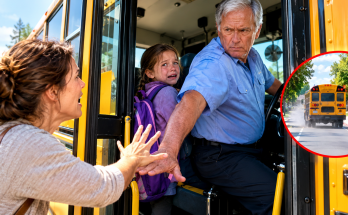
On Wednesday afternoon, Deputy Reed called with information that made the events on Oak Street feel more deliberate than ever. Investigators had reviewed the handwritten notes recovered from Robert Hale and compared them with his statements about the supposed family emergency. The notes contained references to Ellie's school, bus route, and the approximate time she would be traveling home. They also included a reminder about a hospital story, though Reed would not describe the exact wording while the legal review continued. I stood beside the kitchen counter listening, aware that Ellie was upstairs working on a classroom assignment. The information confirmed that the false emergency had not simply emerged during an argument with Frank. It appeared to have been considered beforehand.
I asked whether Hale had admitted intending to remove Ellie from the bus. Reed said Hale acknowledged approaching Frank but continued disputing the significance of his actions. He described the incident as an attempt to help with a situation he claimed to have misunderstood. Investigators had found no legitimate request from our family, the school, or a medical facility authorizing him to collect Ellie. The notes and camera footage also conflicted with important parts of his explanation. Reed said those contradictions would be considered by prosecutors along with the statements and recordings. I appreciated his care, though the idea of a prepared story about my injury made my hands feel cold.
The folded paper now seemed more important than it had when Ellie first remembered it. I imagined Hale standing beside the bus holding a document that appeared to support his claim. Frank had no way to know what the paper contained, but he knew a sheet of writing could not replace official authorization. That distinction had saved Ellie from being released to someone she did not recognize. I wondered how many people, confronted with an urgent story about an injured parent, might have accepted the paper rather than insisting on verification. Frank had done the less convenient thing. He had asked questions that the stranger could not answer properly.
Reed told me the school district had confirmed once more that there was no authorized change to Ellie's transportation arrangements. The parent portal had no emergency request, and the approved pickup list had remained unchanged. The hospital claim was false. Investigators had not found evidence that any family member had asked Hale to collect Ellie. Those facts were clear. What remained less certain was why he had chosen her specifically and what he would have attempted after gaining access. Reed said the legal process would focus on conduct that could be established, not on every possibility that frightened us.
I asked whether Hale had known where we lived. Reed said investigators were examining how he obtained information about our neighborhood and Ellie's route. The pickup's appearance near Briar Street suggested he knew where the bus would stop, but they had not established whether he intended to approach our house. I felt a familiar surge of fear. I wanted to ask whether the police could guarantee that Hale would never come near us again. Instead, I asked what protections and reporting procedures applied while the case proceeded. Reed explained the practical steps available through authorities and the school, and I wrote them down.
After the call, I sat at the kitchen table and reviewed the notes. I had become accustomed to separating what investigators knew from what they suspected. It was not always easy. The false hospital story, the handwritten route information, and the repeated approaches pointed toward planning. Yet the full purpose remained unknown. I was learning that a person could be held responsible for verifiable actions without every private motive becoming visible. The uncertainty was painful, but I no longer believed a convincing explanation mattered more than a supported one.
Ellie came downstairs carrying her school project. She had constructed a small rainforest from cardboard, colored paper, and a plastic container that once held strawberries. A bright blue strip represented a river, and several carefully drawn birds rested among the paper leaves. She placed it on the table and asked whether I thought Mrs. Benton would like it. I told her the details were wonderful. Then she looked at my notebook and asked whether Deputy Reed had called again. I nodded. She studied my face for a moment before asking whether the man had finally explained why he wanted her.
The question caught me off guard. I had prepared myself for inquiries about whether Hale had been arrested or whether he could return to the school. I had not considered how deeply Ellie might want to understand why she had been chosen. She sat across from me, her hands folded beside the rainforest model, and waited. I told her investigators had found more evidence about what the man did, but they still did not have a complete explanation for why he had approached her. She looked down at the table. "Was it because I did something?" she asked.
I moved beside her immediately. I told her no. She had not caused the stranger to approach the bus, and nothing about her behavior had given him permission to make false claims. She frowned, trying to understand. She wondered whether waving through the window or sitting near the front had somehow attracted his attention. I reminded her that he had asked for her by name before she spoke to him. He had arrived with information she had not provided. Ellie listened, then asked whether he had chosen her because she was small. I said investigators had not established his reason, and she should not search for something wrong with herself to explain an adult's behavior.
She rested her head against my shoulder. I held her and let the silence continue. There were questions a parent could answer with instructions or facts, and others that required accepting the limits of knowledge. I wanted to tell Ellie the stranger had selected her randomly, because that might spare her from believing she was personally targeted. But I did not know that. I also wanted to promise she would never encounter someone dishonest again. That would be another comforting falsehood. Instead, I told her that adults who behaved deceptively were responsible for their own choices. Her responsibility was to seek help and stay with people entrusted with her care.
Ellie asked whether Frank had known what the man wanted. I told her he had recognized that the man had no authorization to collect her and that his story could not be verified. Frank did not need to know everything about Hale's intentions to understand that releasing her would be unsafe. She considered the distinction. Then she said she was glad he had asked whether she recognized the stranger. I agreed. Her truthful answer had been one important piece of information, and Frank's responsibility was to act on it.
The next morning, I received an email from the school district about a parent information evening addressing transportation safety and unexpected pickup requests. The notice did not identify Ellie or discuss the investigation. It invited families to learn how authorization procedures worked, how drivers contacted dispatch, and how parents could keep emergency information accurate. I appreciated the practical approach. The district was not turning my daughter's frightening experience into a public spectacle. It was using the lessons available from the incident to strengthen communication and understanding.
I attended the meeting that evening while my brother stayed with Ellie. The school auditorium was only partly filled, but the parents who came listened closely. Mrs. Shaw described how drivers handled unauthorized adults at stops. Ms. Patel explained why knowing a child's name or claiming to be family did not establish permission to collect that child. The assistant principal reviewed official contact procedures. No one promised that every unexpected situation could be prevented. Instead, they emphasized verification, communication, and consistent responses. I found the honesty reassuring.
During the question period, a parent asked what a driver should do if a child appeared frightened and a waiting adult became angry. I felt heat rise in my cheeks. Mrs. Shaw answered without referring to me. She said a driver's first responsibility was the child's immediate safety. If circumstances made a normal release unsafe, the driver could keep the child aboard, contact dispatch, and follow established instructions. Communication with parents was important, but it could not override an urgent protective decision. I listened, remembering myself striking the glass and shouting while Frank tried to keep the entrance secure.
After the meeting, I approached Mrs. Shaw. I thanked her for explaining the procedures clearly and told her I appreciated that the district had improved parent notifications. She said the review had identified useful changes and that staff were continuing to practice emergency communication. I asked whether Frank had been involved in the training. She said his account had helped officials understand how quickly a situation could develop at a stop. She did not describe him as a hero or turn his experience into a dramatic example. She simply acknowledged his professionalism. Somehow, that meant more to me.
On the drive home, I thought about how my understanding of Frank had changed. Before Tuesday, he had been the man who drove the bus and occasionally exchanged a greeting. During the incident, I had seen him as someone threatening my daughter. After the recording, I understood that he had protected her. Now I saw something more complicated: a worker carrying responsibility for children in circumstances parents rarely witnessed, making decisions without complete information and accepting that those decisions might anger the people he was trying to help.
My brother was helping Ellie finish a puzzle when I returned. He had brought a box containing a picture of a lighthouse, and they were arguing cheerfully about whether a blue piece belonged to the sea or the sky. Ellie looked up and asked whether the school meeting had been interesting. I told her it had been useful. She wanted to know whether the teachers had talked about the man in the brown jacket. I said they had discussed general safety procedures rather than her personal experience. She seemed pleased by that. She had become more protective of her privacy as the investigation progressed.
After my brother left, Ellie asked whether she could tell her best friend a little more about what happened. I said she could share what she felt comfortable sharing, but she did not owe anyone details. We talked about the difference between telling someone she had been frightened and repeating information that investigators were still examining. Ellie understood. She said she wanted her friend to know why she had been nervous about riding the bus, not to make everyone discuss the stranger. I told her that was a reasonable choice.
Friday afternoon brought another update from Deputy Reed. The prosecutor's office had reviewed the evidence submitted so far, and the matter was moving through the legal process. Reed could not yet provide a final outcome or promise which allegations would be sustained. He did say the combination of recordings, witness accounts, false representations, and written route information formed a substantial evidentiary record. I thanked him. For the first time, I felt the investigation had moved beyond identifying a suspect toward formally evaluating what had been done.
I asked Reed whether Ellie would have to testify. He said that depended on future proceedings and decisions that had not yet been made. Her recorded interview and the independent evidence were being preserved carefully. He emphasized that investigators would avoid unnecessary repeated questioning. I was relieved by the consideration, though the possibility of further involvement frightened me. Ellie had already done everything asked of her. She deserved to return to school and home without constantly reliving the incident.
That weekend, my mother visited. She brought a tin of homemade cookies and sat with Ellie at the kitchen table while my daughter showed her the rainforest project. Later, when Ellie went upstairs, I explained the latest developments. My mother listened carefully. She said she was grateful Frank had refused the man's request and that the school had supported his decision after reviewing the evidence. Then she asked whether I had forgiven myself for accusing him. The question made me uncomfortable. I told her I had apologized and corrected the official complaint. She said she knew, but she was asking whether I could now see that learning from a mistake was different from carrying it forever.
I considered her words long after she left. I did not want to excuse my accusations simply because I had been frightened. Frank had faced a review because I described my interpretation with too much certainty. Yet remaining trapped in shame would not help him, Ellie, or anyone else. I had taken responsibility. I could continue acting more carefully. Perhaps that was what accountability required after the practical corrections were complete. I wrote a short note in my notebook: Do not confuse regret with repair. The sentence remained there beside the timeline.
On Monday, Ellie came home from school laughing about a classmate who had accidentally glued two pages of a project together. She climbed down the bus steps without hesitation and waved to Frank. I watched the familiar exchange and felt a quiet steadiness. Our routine had returned, though it would never feel quite as thoughtless as before. I noticed Frank's mirrors, his brief pause before opening the doors, and the way he waited until Ellie was clear of the bus before pulling away. Those small actions had once escaped my attention. Now I understood their importance.
That evening, Deputy Reed sent a message confirming that investigators would contact me when the legal process reached a stage where additional information could be shared. He did not offer a timetable. I placed the phone beside the notebook and looked toward the living room, where Ellie was reading on the sofa. I had wanted the investigation to end with a single explanation that made everything understandable. Instead, it was moving through careful steps, each resolving some questions while leaving others unsettled. The essential facts were clearer: Hale had approached the bus with a false emergency claim and information about Ellie's route. Frank had refused to release her. The remaining legal and personal consequences would take longer to settle.
Before bed, Ellie asked whether she would have to stop riding Route 24 if the case went to court. I told her no decision about her ordinary transportation had been made and that the school would inform us if anything changed. She nodded, then said she hoped Frank would still be driving when she reached fourth grade. I smiled and told her I hoped so too. She climbed beneath her lavender blanket and turned out the light. As I closed the door, I realized that her question about the future mattered as much as her questions about the stranger. She was beginning to imagine next year again, rather than looking backward at one frightening afternoon.